GENE EXPRESSION
CLUSTERING
GRAPH BASED APPROACHES
                             A   P R E S E N T A T I O N   B Y   GOVIND M (M120432CS)
                         MTECH COMPUTER SCIENCE AND ENGINEERING
                         N AT I O N A L I N S T I T U T E O F T E C H N O L O G Y C A L I C U T
                                                           govindmaheswaran@gmail.com
Clustering and Graph Theory


      Using Graphs in
      Clustering

        Simple Graph Partitioning   Outline

      Spectral Graph Partitioning


Conclusion
Clustering
• Process of Grouping a set of data objects, in terms of similarity
• Same Cluster => Similar Objects and vice versa.
• Widely used in data mining, market analysis etc.
• Used to make sense of Bioinformatics data.
• Two major purposes, in Bioinformatics
    • Find properties of genes ( Relationship among genes, deduce the functions of genes etc)
    • Predict more relevant factors (eg. Clustering cancerous and non cancerous
      genes, finding the effect of a medication)
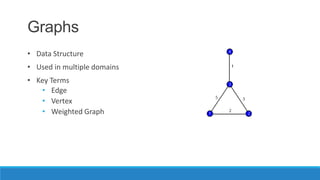
Graphs
• Data Structure
• Used in multiple domains
• Key Terms
   • Edge
   • Vertex
   • Weighted Graph
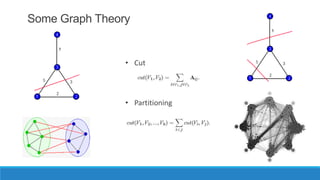
Some Graph Theory


                • Cut


                • Partitioning
Clustering using Graphs
 Involves 3 steps
1.   Preprocessing
     ◦   Convert data set into a graph
     ◦   Using Adjacency matrix and Degree Matrix representation
     ◦   Similarity between nodes can be taken as the weight of an edge.

2.   Partitioning
     ◦   Partition the graph


3.   Clustering
     ◦   Repeat until required number of clusters are obtained
     ◦   Alternatively, extra iterations followed by joinings may also be implemented.
Simple Graph Partitioning
• Weight of an edge = Similarity between the nodes
• Find Minimum Cut
• Edge Value decreases, cluster differs
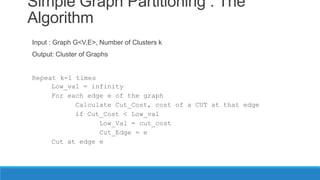
Simple Graph Partitioning : The
Algorithm
Input : Graph G<V,E>, Number of Clusters k
Output: Cluster of Graphs


Repeat k-1 times
     Low_val = infinity
     For each edge e of the graph
           Calculate Cut_Cost, cost of a CUT at that edge
           if Cut_Cost < Low_val
                 Low_Val = cut_cost
                 Cut_Edge = e
     Cut at edge e
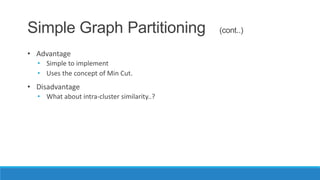
Simple Graph Partitioning                    (cont..)

• Advantage
  • Simple to implement
  • Uses the concept of Min Cut.
• Disadvantage
  • What about intra-cluster similarity..?
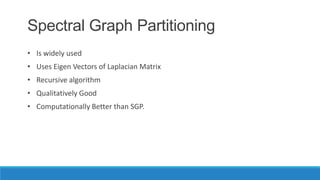
Spectral Graph Partitioning
• Is widely used
• Uses Eigen Vectors of Laplacian Matrix
• Recursive algorithm
• Qualitatively Good
• Computationally Better than SGP.
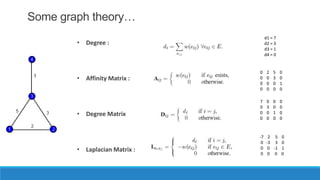
Some graph theory…
                                    d1 = 7
        • Degree :                  d2 = 3
                                    d3 = 1
                                    d4 = 0


                               0     2   5   0
        • Affinity Matrix :    0     0   3   0
                               0     0   0   1
                               0     0   0   0

                               7     0   0   0
                               0     3   0   0
        • Degree Matrix        0     0   1   0
                               0     0   0   0


                               -7    2 5 0
                                0   -3 3 0
        • Laplacian Matrix :    0    0 -1 1
                                0    0 0 0
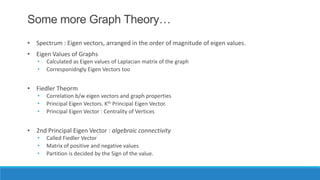
Some more Graph Theory…
• Spectrum : Eigen vectors, arranged in the order of magnitude of eigen values.
• Eigen Values of Graphs
   •   Calculated as Eigen values of Laplacian matrix of the graph
   •   Corresponidngly Eigen Vectors too


• Fiedler Theorm
   •   Correlation b/w eigen vectors and graph properties
   •   Principal Eigen Vectors. Kth Principal Eigen Vector.
   •   Principal Eigen Vector : Centrality of Vertices


• 2nd Principal Eigen Vector : algebraic connectivity
   •   Called Fiedler Vector
   •   Matrix of positive and negative values
   •   Partition is decided by the Sign of the value.
Spectral Graph Partitioning
Input : Graph G<V,E>
Output: Graphs G1< V1,E1>, G2< V2,E2>

 Create the Laplacian Vector L, of the Graph G.
 Calculate the Fiedler Vector F
 for each vertex vi in G
    if F[i]>0
          V1.append(v)
    else
          V2.append(v)
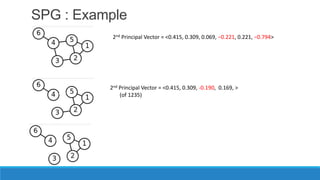
SPG : Example
           2nd Principal Vector = <0.415, 0.309, 0.069, −0.221, 0.221, −0.794>


          2nd Principal Vector = <0.415, 0.309, -0.190, 0.169, >
              (of 1235)
SGP : Bipartitioning Method
       (contd.)

• Recursive Algorithm
• Although better than Simple Graph Partitioning, not optimum
• Multiple times bipartitioning.


• Can be improved by Multipartitioning
• Use more eigen vectors.
Conclusion
• Clustering is Based on simple concepts of graph theory
• Optimal results (Spectral methods)
• Can give better performance than traditional clustering.
• Preprocessing overhead.
References
1.   Yanhua Chen; Ming Dong; Rege, M., "Gene Expression Clustering: a Novel Graph Partitioning
     Approach," Neural Networks, 2007. IJCNN 2007. International Joint Conference on
     , vol., no., pp.1542,1547, 12-17 Aug. 2007, doi: 10.1109/IJCNN.2007.4371187
     URL: http://ieeexplore.ieee.org/stamp/stamp.jsp?tp=&arnumber=4371187&isnumber=4370
     891
2.   Hagen, L.; Kahng, A.B., "New spectral methods for ratio cut partitioning and clustering,"
     Computer-Aided Design of Integrated Circuits and Systems, IEEE Transactions on
     , vol.11, no.9, pp.1074,1085, Sep 1992, doi: 10.1109/43.159993
     URL: http://ieeexplore.ieee.org/stamp/stamp.jsp?tp=&arnumber=159993&isnumber=4190
3.   Donath, W.E.; Hoffman, A.J., "Lower Bounds for the Partitioning of Graphs," IBM Journal of
     Research and Development, vol. 17, pp. 420-425, 1973.
4.   Pavla Kabel´ıková , “Graph Partitioning Using Spectral Methods”, Thesis, VˇSB - Technical
     University of Ostrava, 2006.
5.   Chung, F.R.K., "Spectral Graph Theory," American Mathematical Society, 1997.

Graph based approaches to Gene Expression Clustering

  • 1.
    GENE EXPRESSION CLUSTERING GRAPH BASEDAPPROACHES A P R E S E N T A T I O N B Y GOVIND M (M120432CS) MTECH COMPUTER SCIENCE AND ENGINEERING N AT I O N A L I N S T I T U T E O F T E C H N O L O G Y C A L I C U T govindmaheswaran@gmail.com
  • 2.
    Clustering and GraphTheory Using Graphs in Clustering Simple Graph Partitioning Outline Spectral Graph Partitioning Conclusion
  • 3.
    Clustering • Process ofGrouping a set of data objects, in terms of similarity • Same Cluster => Similar Objects and vice versa. • Widely used in data mining, market analysis etc. • Used to make sense of Bioinformatics data. • Two major purposes, in Bioinformatics • Find properties of genes ( Relationship among genes, deduce the functions of genes etc) • Predict more relevant factors (eg. Clustering cancerous and non cancerous genes, finding the effect of a medication)
  • 4.
    Graphs • Data Structure •Used in multiple domains • Key Terms • Edge • Vertex • Weighted Graph
  • 5.
    Some Graph Theory • Cut • Partitioning
  • 6.
    Clustering using Graphs Involves 3 steps 1. Preprocessing ◦ Convert data set into a graph ◦ Using Adjacency matrix and Degree Matrix representation ◦ Similarity between nodes can be taken as the weight of an edge. 2. Partitioning ◦ Partition the graph 3. Clustering ◦ Repeat until required number of clusters are obtained ◦ Alternatively, extra iterations followed by joinings may also be implemented.
  • 7.
    Simple Graph Partitioning •Weight of an edge = Similarity between the nodes • Find Minimum Cut • Edge Value decreases, cluster differs
  • 8.
    Simple Graph Partitioning: The Algorithm Input : Graph G<V,E>, Number of Clusters k Output: Cluster of Graphs Repeat k-1 times Low_val = infinity For each edge e of the graph Calculate Cut_Cost, cost of a CUT at that edge if Cut_Cost < Low_val Low_Val = cut_cost Cut_Edge = e Cut at edge e
  • 9.
    Simple Graph Partitioning (cont..) • Advantage • Simple to implement • Uses the concept of Min Cut. • Disadvantage • What about intra-cluster similarity..?
  • 10.
    Spectral Graph Partitioning •Is widely used • Uses Eigen Vectors of Laplacian Matrix • Recursive algorithm • Qualitatively Good • Computationally Better than SGP.
  • 11.
    Some graph theory… d1 = 7 • Degree : d2 = 3 d3 = 1 d4 = 0 0 2 5 0 • Affinity Matrix : 0 0 3 0 0 0 0 1 0 0 0 0 7 0 0 0 0 3 0 0 • Degree Matrix 0 0 1 0 0 0 0 0 -7 2 5 0 0 -3 3 0 • Laplacian Matrix : 0 0 -1 1 0 0 0 0
  • 12.
    Some more GraphTheory… • Spectrum : Eigen vectors, arranged in the order of magnitude of eigen values. • Eigen Values of Graphs • Calculated as Eigen values of Laplacian matrix of the graph • Corresponidngly Eigen Vectors too • Fiedler Theorm • Correlation b/w eigen vectors and graph properties • Principal Eigen Vectors. Kth Principal Eigen Vector. • Principal Eigen Vector : Centrality of Vertices • 2nd Principal Eigen Vector : algebraic connectivity • Called Fiedler Vector • Matrix of positive and negative values • Partition is decided by the Sign of the value.
  • 13.
    Spectral Graph Partitioning Input: Graph G<V,E> Output: Graphs G1< V1,E1>, G2< V2,E2> Create the Laplacian Vector L, of the Graph G. Calculate the Fiedler Vector F for each vertex vi in G if F[i]>0 V1.append(v) else V2.append(v)
  • 14.
    SPG : Example 2nd Principal Vector = <0.415, 0.309, 0.069, −0.221, 0.221, −0.794> 2nd Principal Vector = <0.415, 0.309, -0.190, 0.169, > (of 1235)
  • 15.
    SGP : BipartitioningMethod (contd.) • Recursive Algorithm • Although better than Simple Graph Partitioning, not optimum • Multiple times bipartitioning. • Can be improved by Multipartitioning • Use more eigen vectors.
  • 16.
    Conclusion • Clustering isBased on simple concepts of graph theory • Optimal results (Spectral methods) • Can give better performance than traditional clustering. • Preprocessing overhead.
  • 17.
    References 1. Yanhua Chen; Ming Dong; Rege, M., "Gene Expression Clustering: a Novel Graph Partitioning Approach," Neural Networks, 2007. IJCNN 2007. International Joint Conference on , vol., no., pp.1542,1547, 12-17 Aug. 2007, doi: 10.1109/IJCNN.2007.4371187 URL: http://ieeexplore.ieee.org/stamp/stamp.jsp?tp=&arnumber=4371187&isnumber=4370 891 2. Hagen, L.; Kahng, A.B., "New spectral methods for ratio cut partitioning and clustering," Computer-Aided Design of Integrated Circuits and Systems, IEEE Transactions on , vol.11, no.9, pp.1074,1085, Sep 1992, doi: 10.1109/43.159993 URL: http://ieeexplore.ieee.org/stamp/stamp.jsp?tp=&arnumber=159993&isnumber=4190 3. Donath, W.E.; Hoffman, A.J., "Lower Bounds for the Partitioning of Graphs," IBM Journal of Research and Development, vol. 17, pp. 420-425, 1973. 4. Pavla Kabel´ıková , “Graph Partitioning Using Spectral Methods”, Thesis, VˇSB - Technical University of Ostrava, 2006. 5. Chung, F.R.K., "Spectral Graph Theory," American Mathematical Society, 1997.

Editor's Notes

  • #13 Centrality : Influence