Grammar RevisionGrammar Revision
Summit 1Summit 1
Level: AdvancedLevel: Advanced
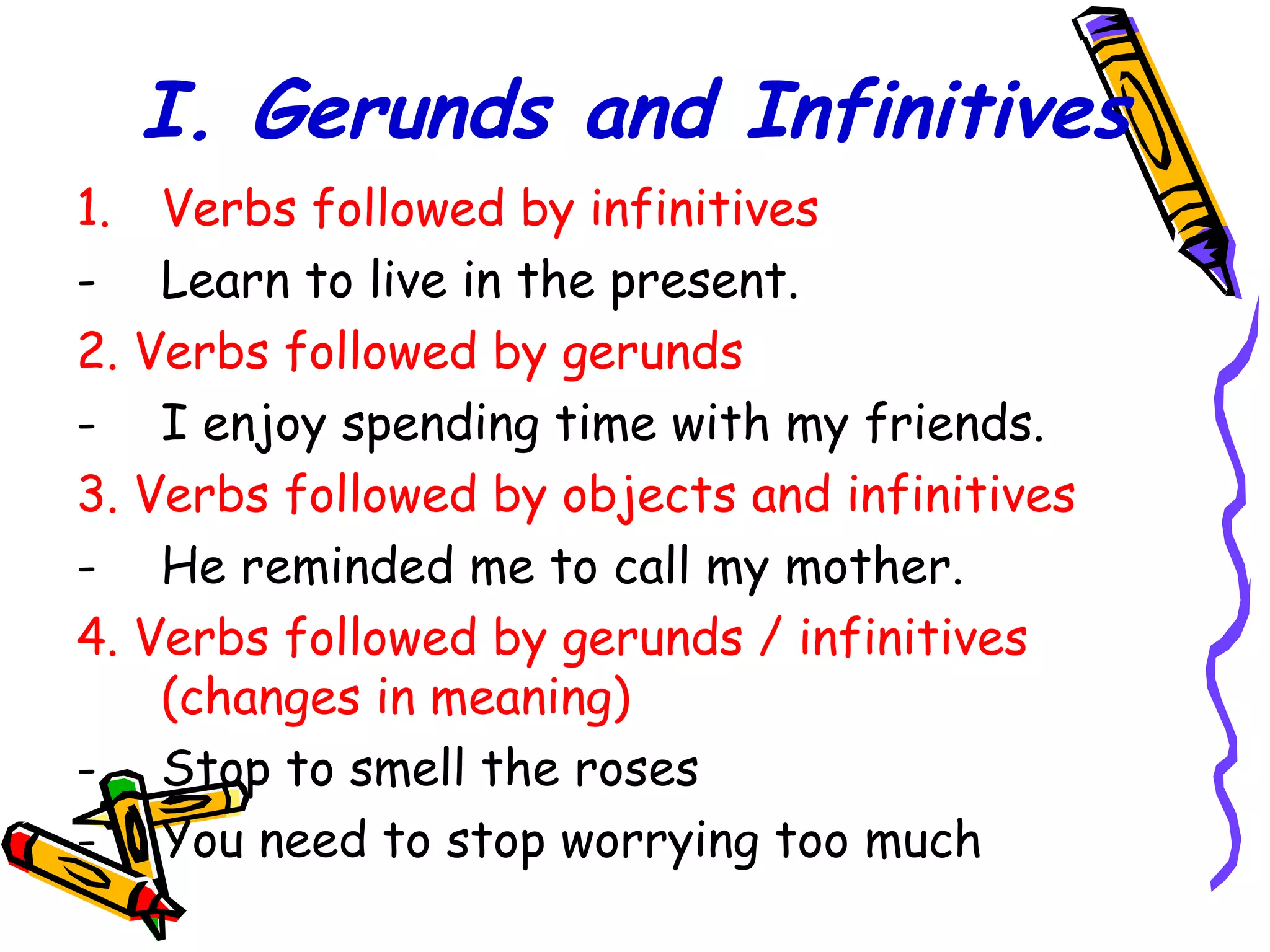
I. Gerunds and Infinitives
1. Verbs followed by infinitives
- Learn to live in the present.
2. Verbs followed by gerunds
- I enjoy spending time with my friends.
3. Verbs followed by objects and infinitives
- He reminded me to call my mother.
4. Verbs followed by gerunds / infinitives
(changes in meaning)
- Stop to smell the roses
- You need to stop worrying too much
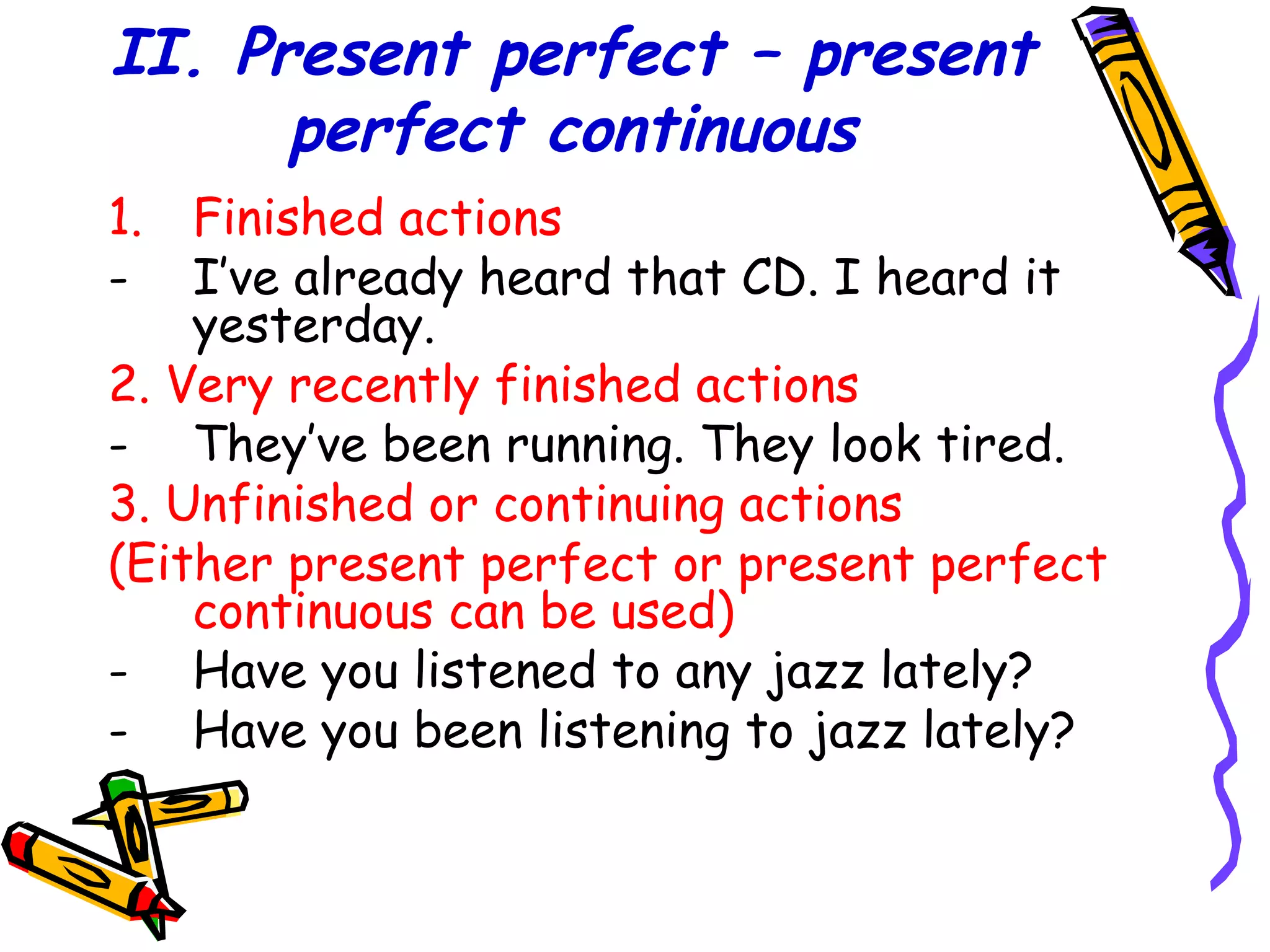
II. Present perfect – present
perfect continuous
1. Finished actions
- I’ve already heard that CD. I heard it
yesterday.
2. Very recently finished actions
- They’ve been running. They look tired.
3. Unfinished or continuing actions
(Either present perfect or present perfect
continuous can be used)
- Have you listened to any jazz lately?
- Have you been listening to jazz lately?
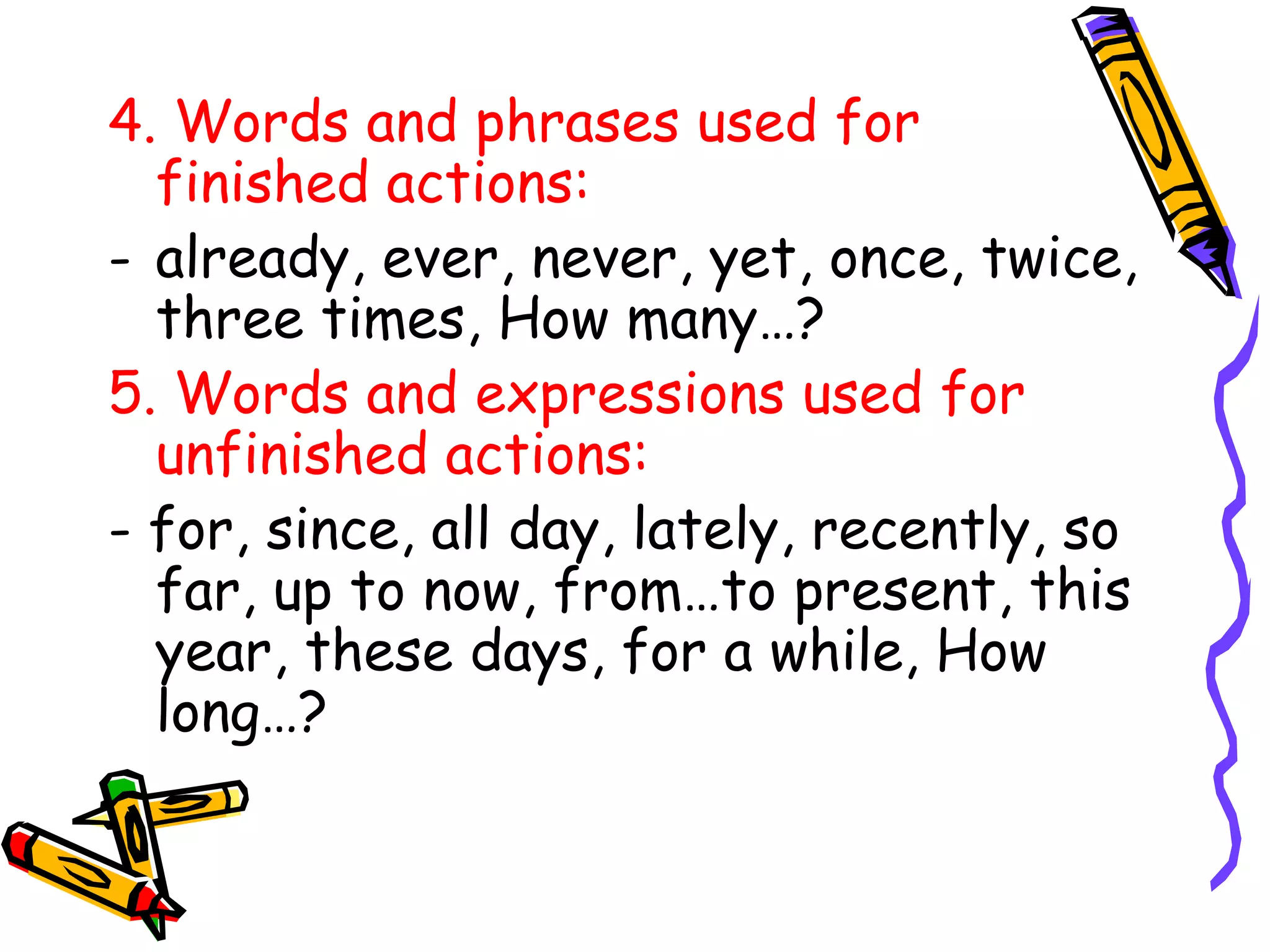
4. Words and phrases used for
finished actions:
- already, ever, never, yet, once, twice,
three times, How many…?
5. Words and expressions used for
unfinished actions:
- for, since, all day, lately, recently, so
far, up to now, from…to present, this
year, these days, for a while, How
long…?
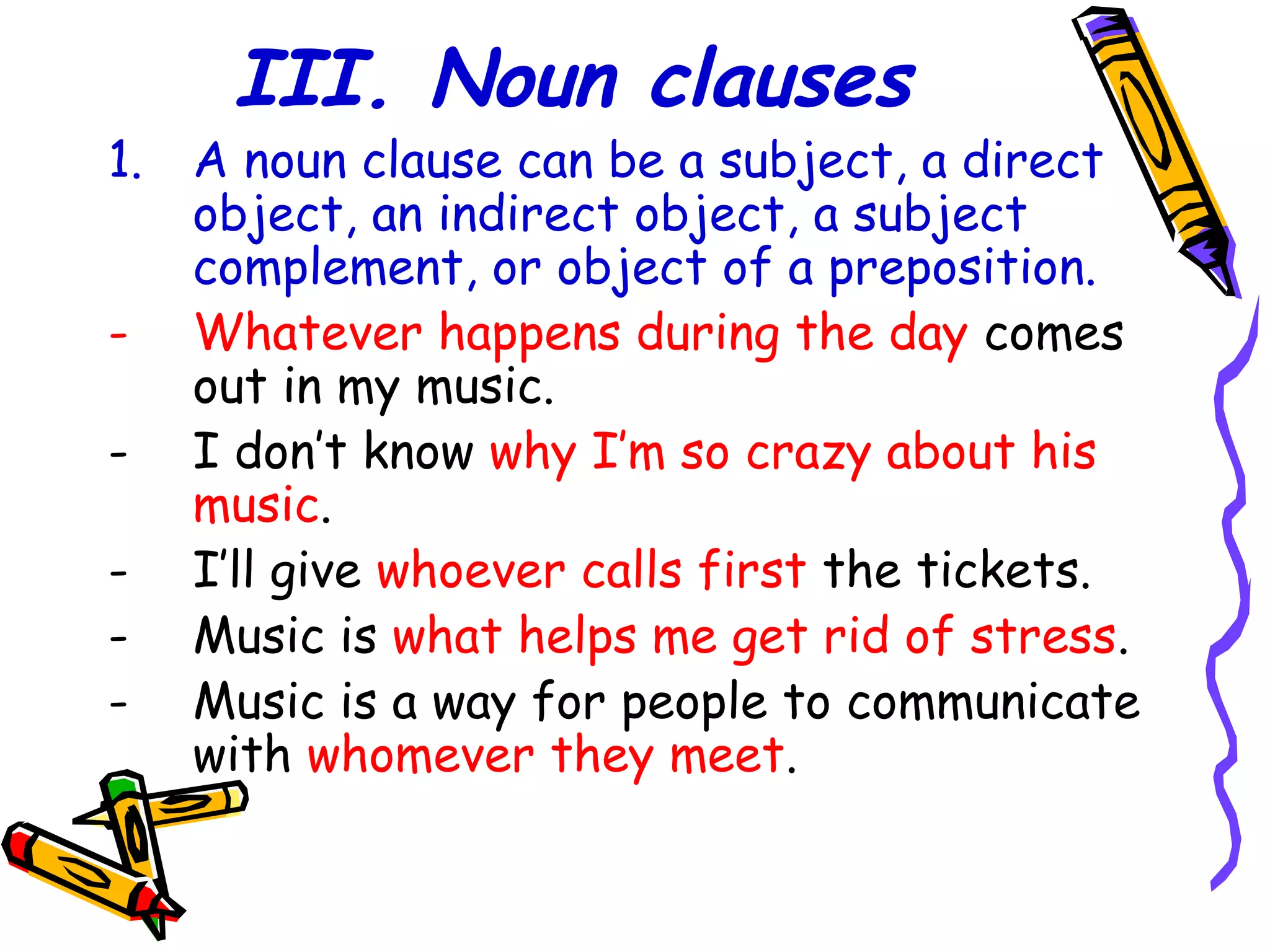
III. Noun clauses
1. A noun clause can be a subject, a direct
object, an indirect object, a subject
complement, or object of a preposition.
- Whatever happens during the day comes
out in my music.
- I don’t know why I’m so crazy about his
music.
- I’ll give whoever calls first the tickets.
- Music is what helps me get rid of stress.
- Music is a way for people to communicate
with whomever they meet.
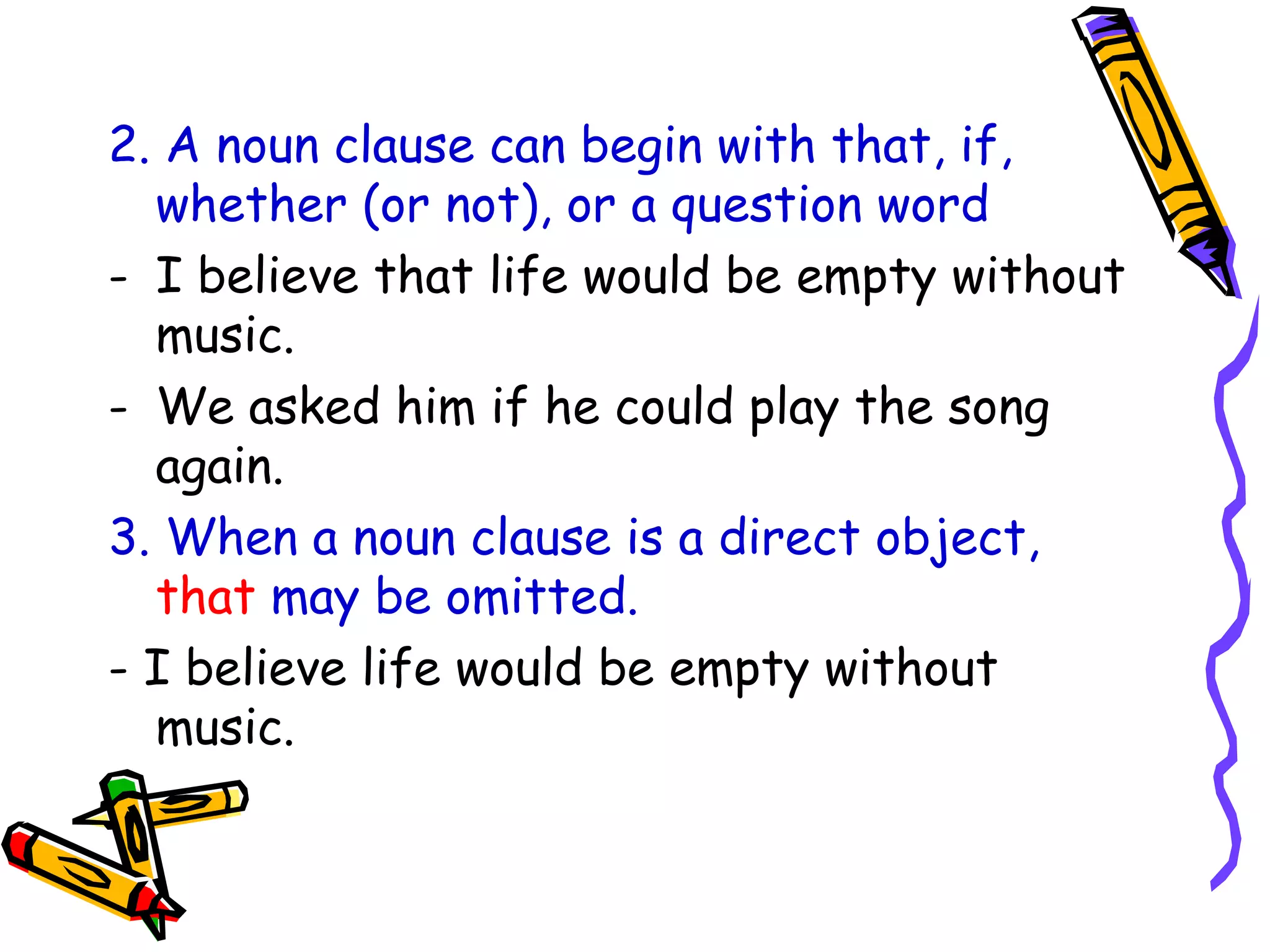
2. A noun clause can begin with that, if,
whether (or not), or a question word
- I believe that life would be empty without
music.
- We asked him if he could play the song
again.
3. When a noun clause is a direct object,
that may be omitted.
- I believe life would be empty without
music.
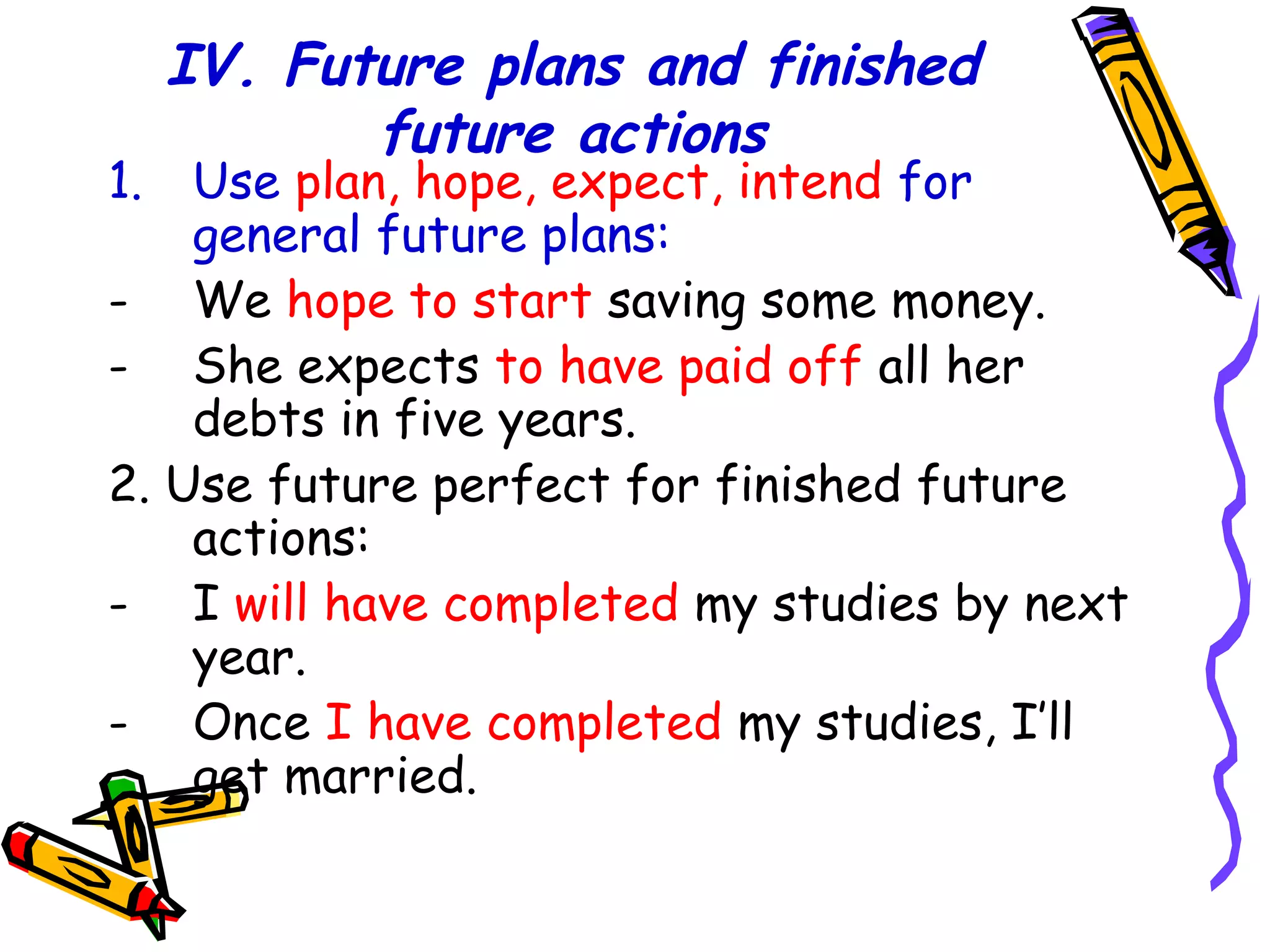
IV. Future plans and finished
future actions
1. Use plan, hope, expect, intend for
general future plans:
- We hope to start saving some money.
- She expects to have paid off all her
debts in five years.
2. Use future perfect for finished future
actions:
- I will have completed my studies by next
year.
- Once I have completed my studies, I’ll
get married.
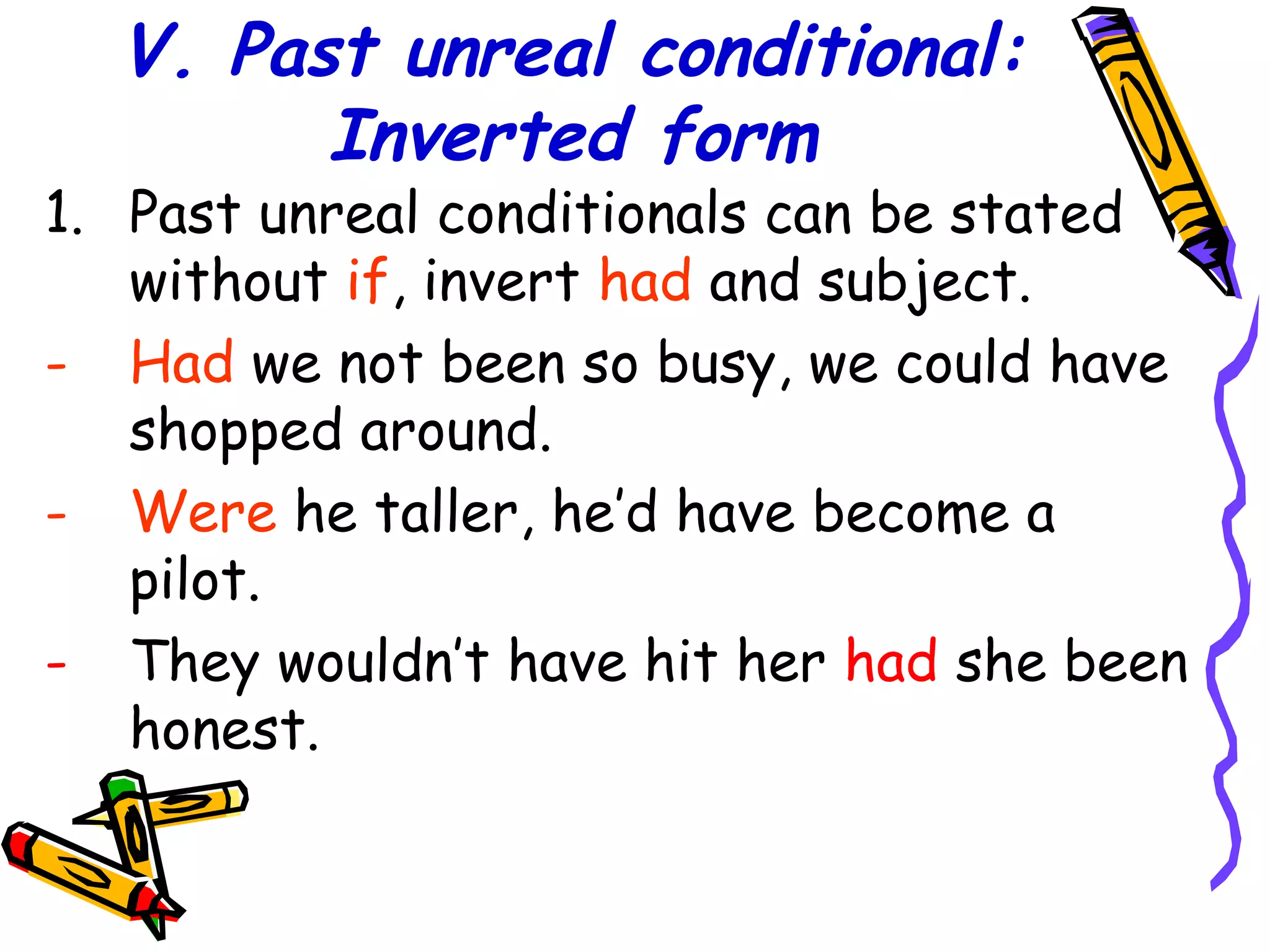
V. Past unreal conditional:
Inverted form
1. Past unreal conditionals can be stated
without if, invert had and subject.
- Had we not been so busy, we could have
shopped around.
- Were he taller, he’d have become a
pilot.
- They wouldn’t have hit her had she been
honest.
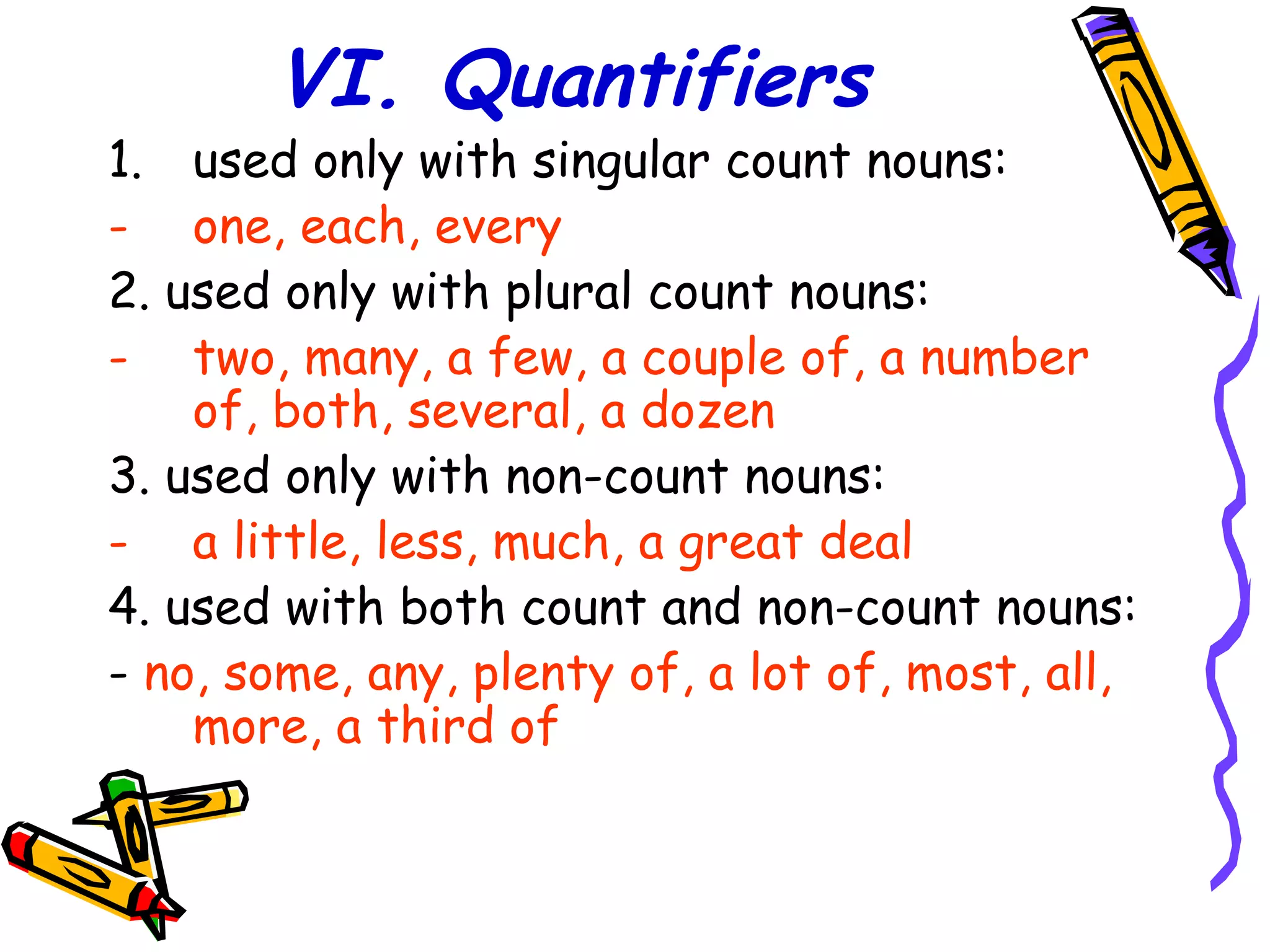
VI. Quantifiers
1. used only with singular count nouns:
- one, each, every
2. used only with plural count nouns:
- two, many, a few, a couple of, a number
of, both, several, a dozen
3. used only with non-count nouns:
- a little, less, much, a great deal
4. used with both count and non-count nouns:
- no, some, any, plenty of, a lot of, most, all,
more, a third of
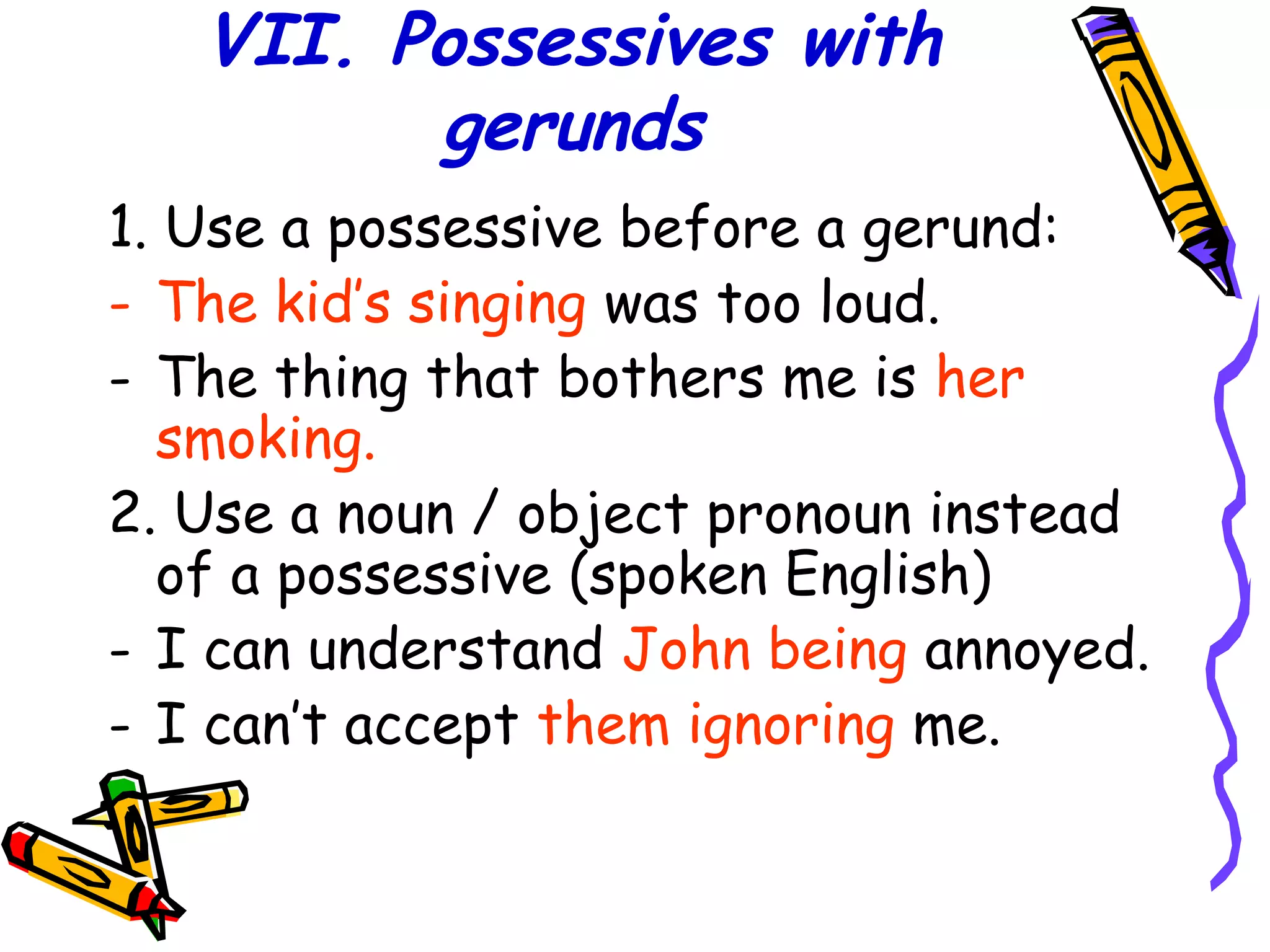
VII. Possessives with
gerunds
1. Use a possessive before a gerund:
- The kid’s singing was too loud.
- The thing that bothers me is her
smoking.
2. Use a noun / object pronoun instead
of a possessive (spoken English)
- I can understand John being annoyed.
- I can’t accept them ignoring me.
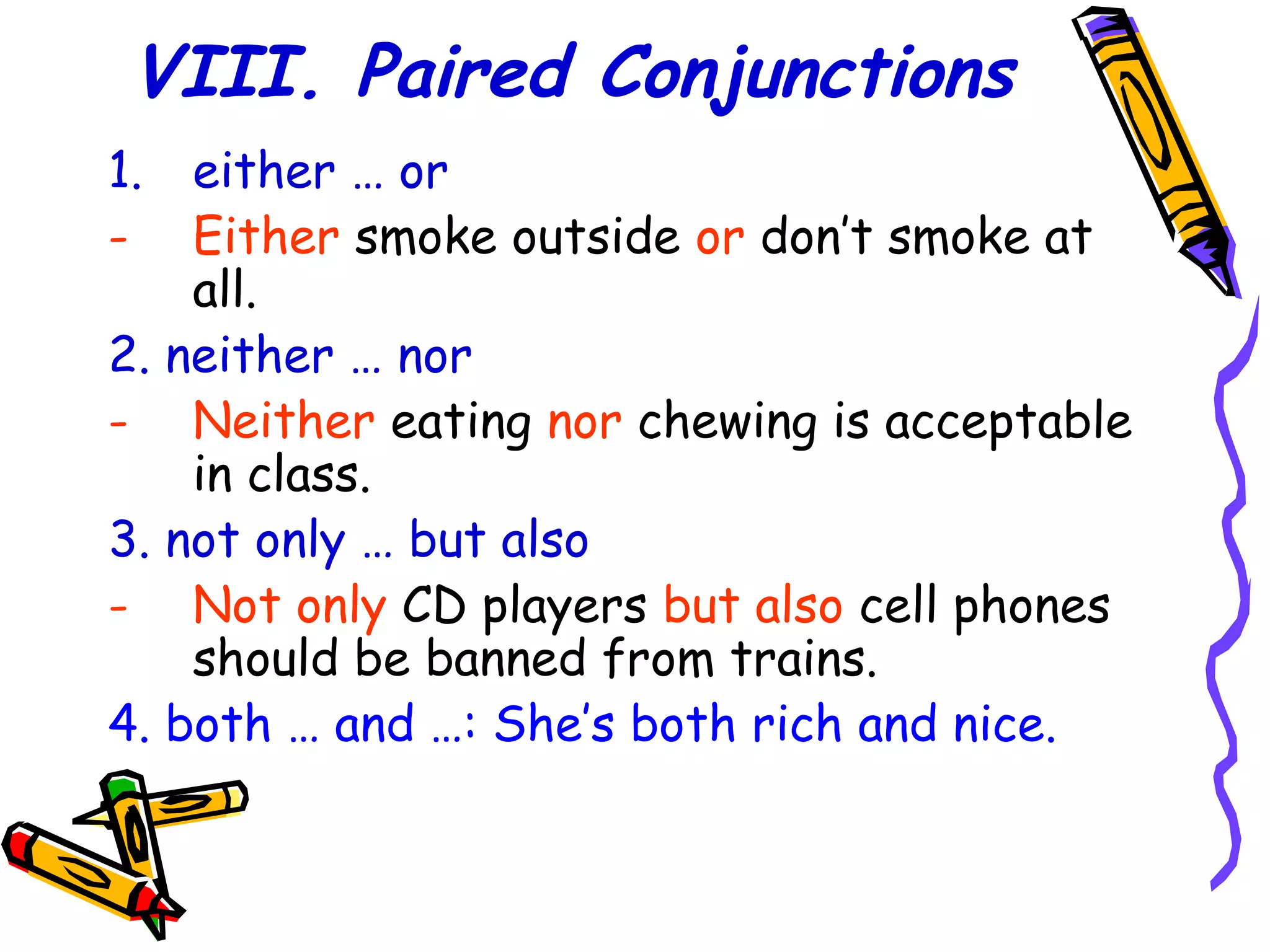
VIII. Paired Conjunctions
1. either … or
- Either smoke outside or don’t smoke at
all.
2. neither … nor
- Neither eating nor chewing is acceptable
in class.
3. not only … but also
- Not only CD players but also cell phones
should be banned from trains.
4. both … and …: She’s both rich and nice.
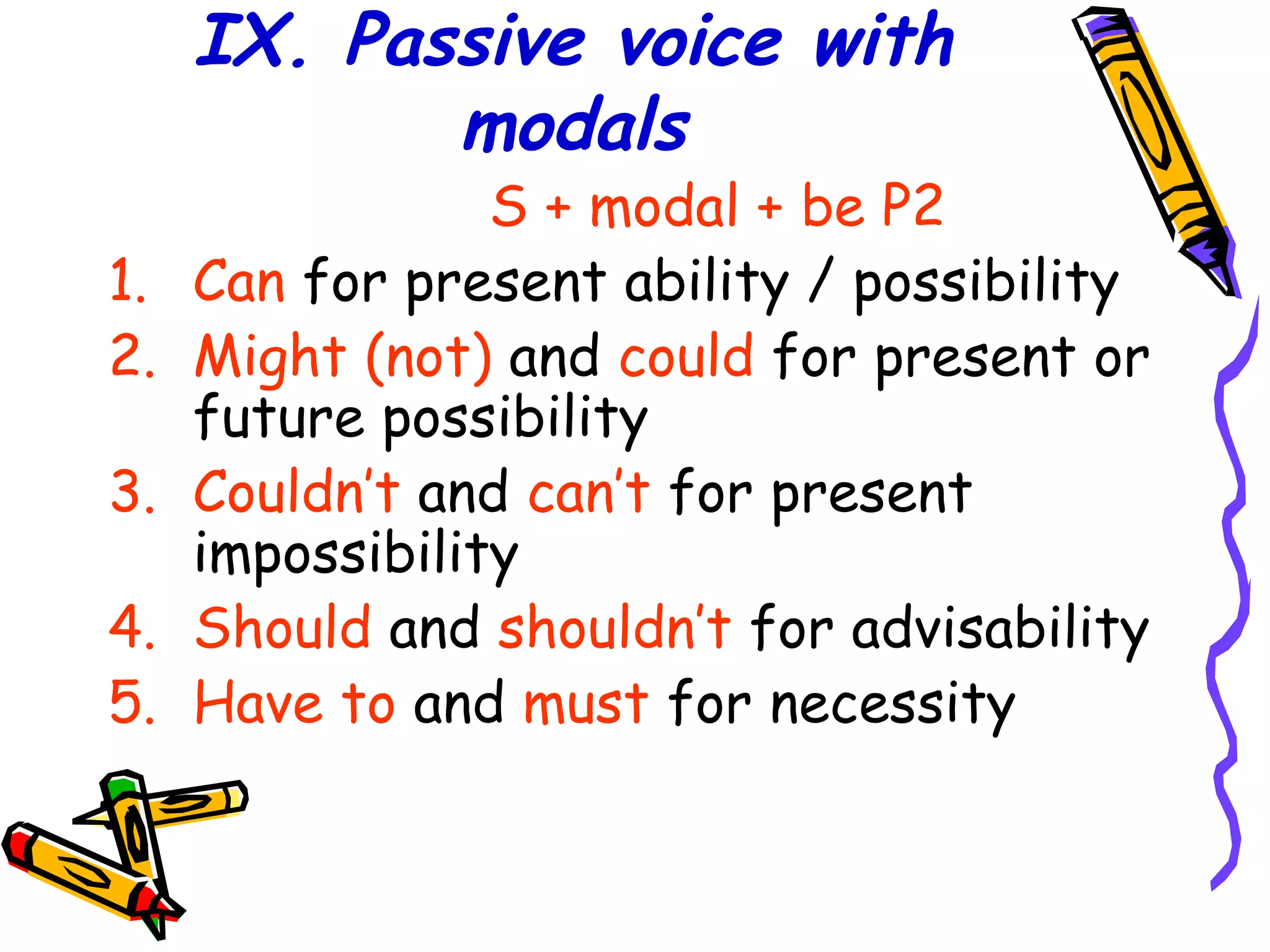
IX. Passive voice with
modals
S + modal + be P2
1. Can for present ability / possibility
2. Might (not) and could for present or
future possibility
3. Couldn’t and can’t for present
impossibility
4. Should and shouldn’t for advisability
5. Have to and must for necessity
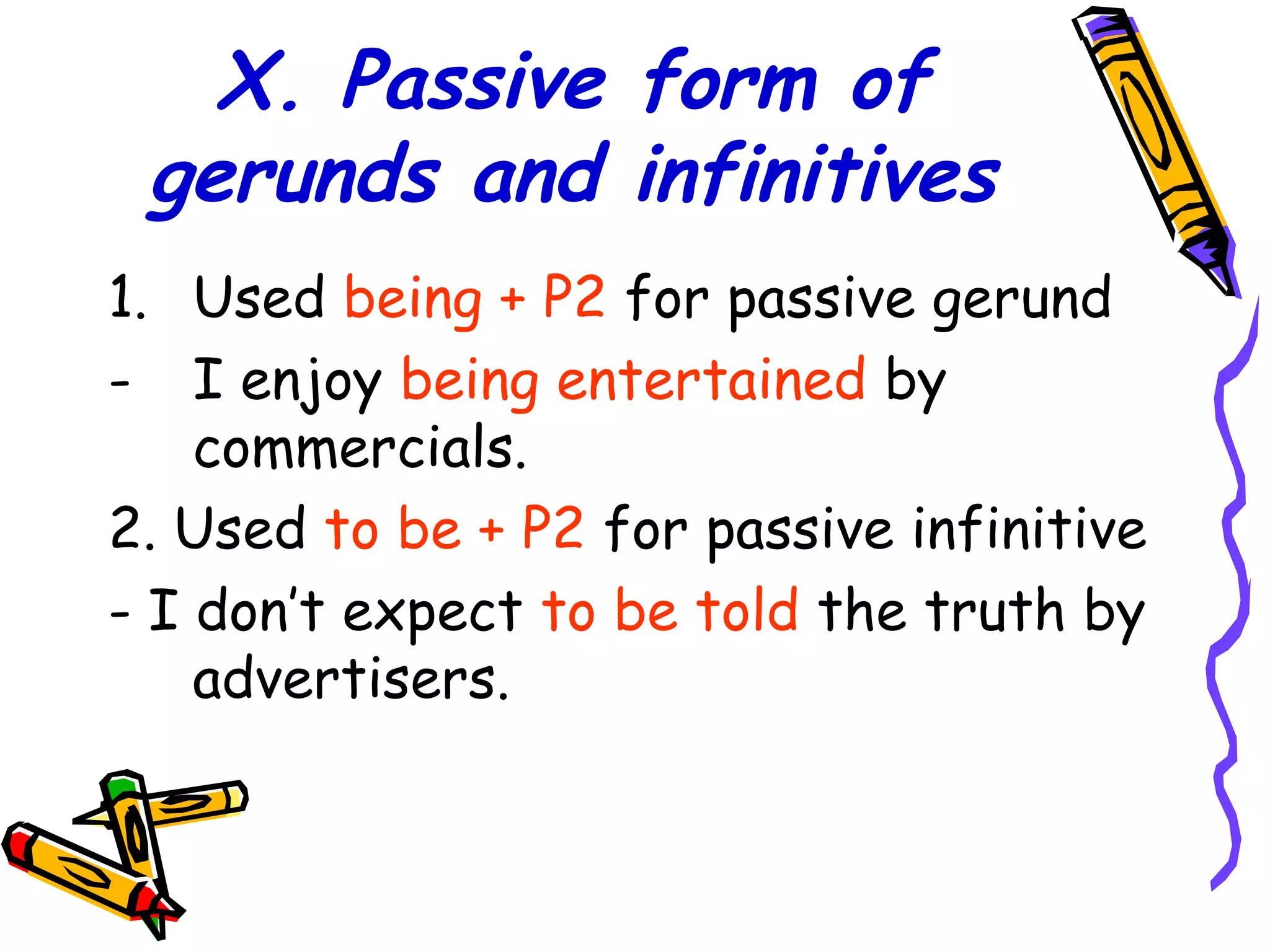
X. Passive form of
gerunds and infinitives
1. Used being + P2 for passive gerund
- I enjoy being entertained by
commercials.
2. Used to be + P2 for passive infinitive
- I don’t expect to be told the truth by
advertisers.
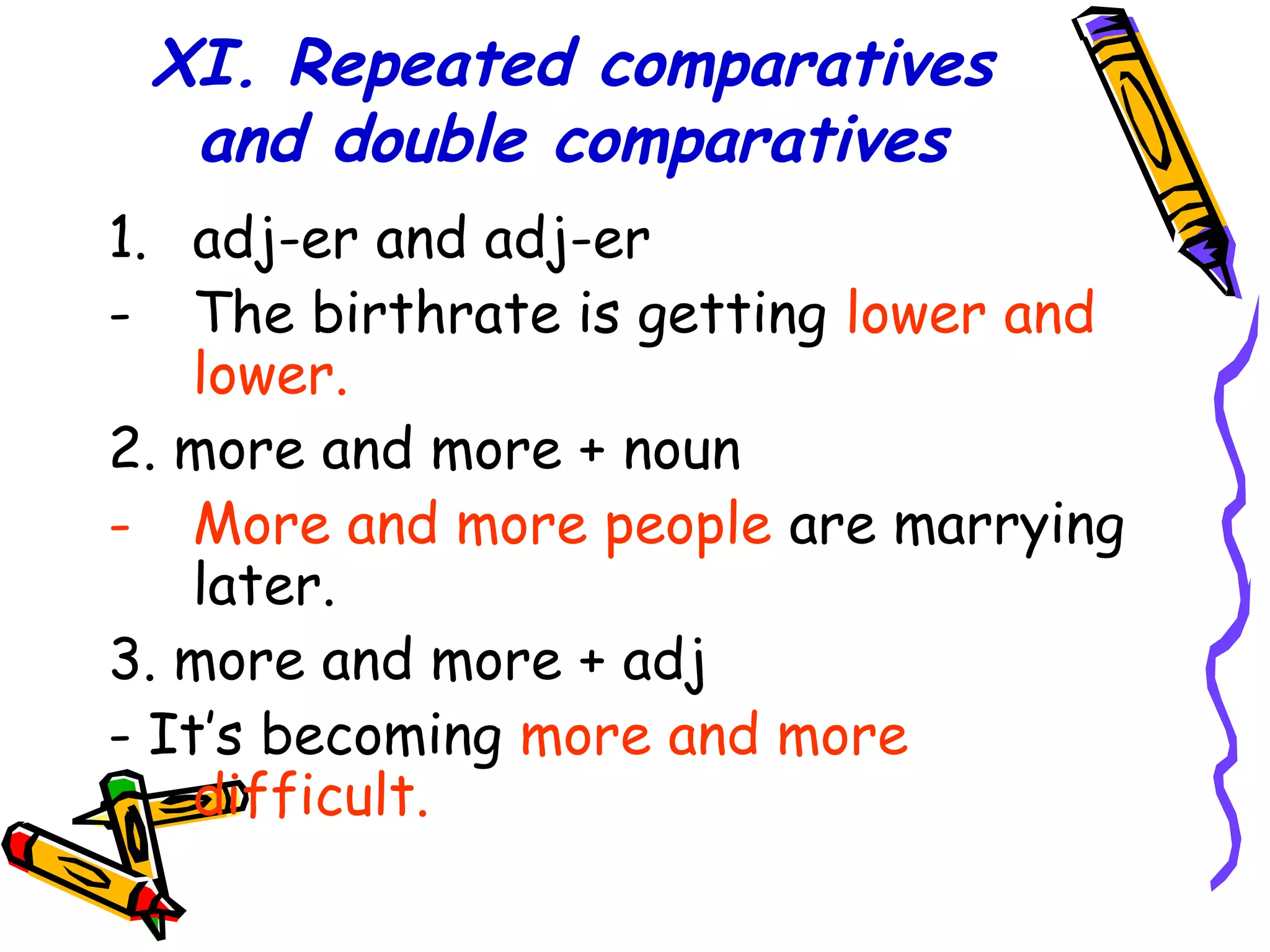
XI. Repeated comparatives
and double comparatives
1. adj-er and adj-er
- The birthrate is getting lower and
lower.
2. more and more + noun
- More and more people are marrying
later.
3. more and more + adj
- It’s becoming more and more
difficult.
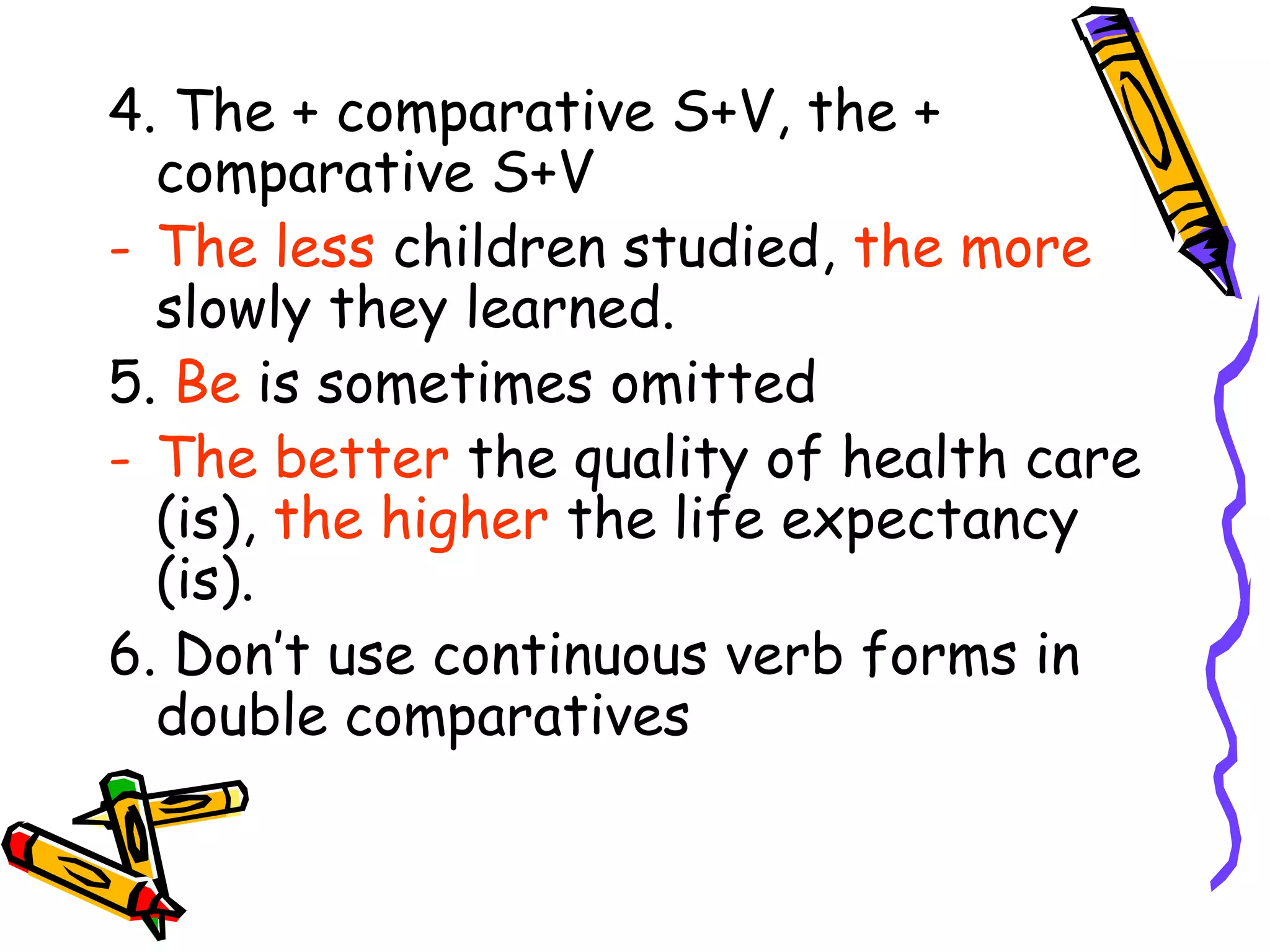
4. The + comparative S+V, the +
comparative S+V
- The less children studied, the more
slowly they learned.
5. Be is sometimes omitted
- The better the quality of health care
(is), the higher the life expectancy
(is).
6. Don’t use continuous verb forms in
double comparatives
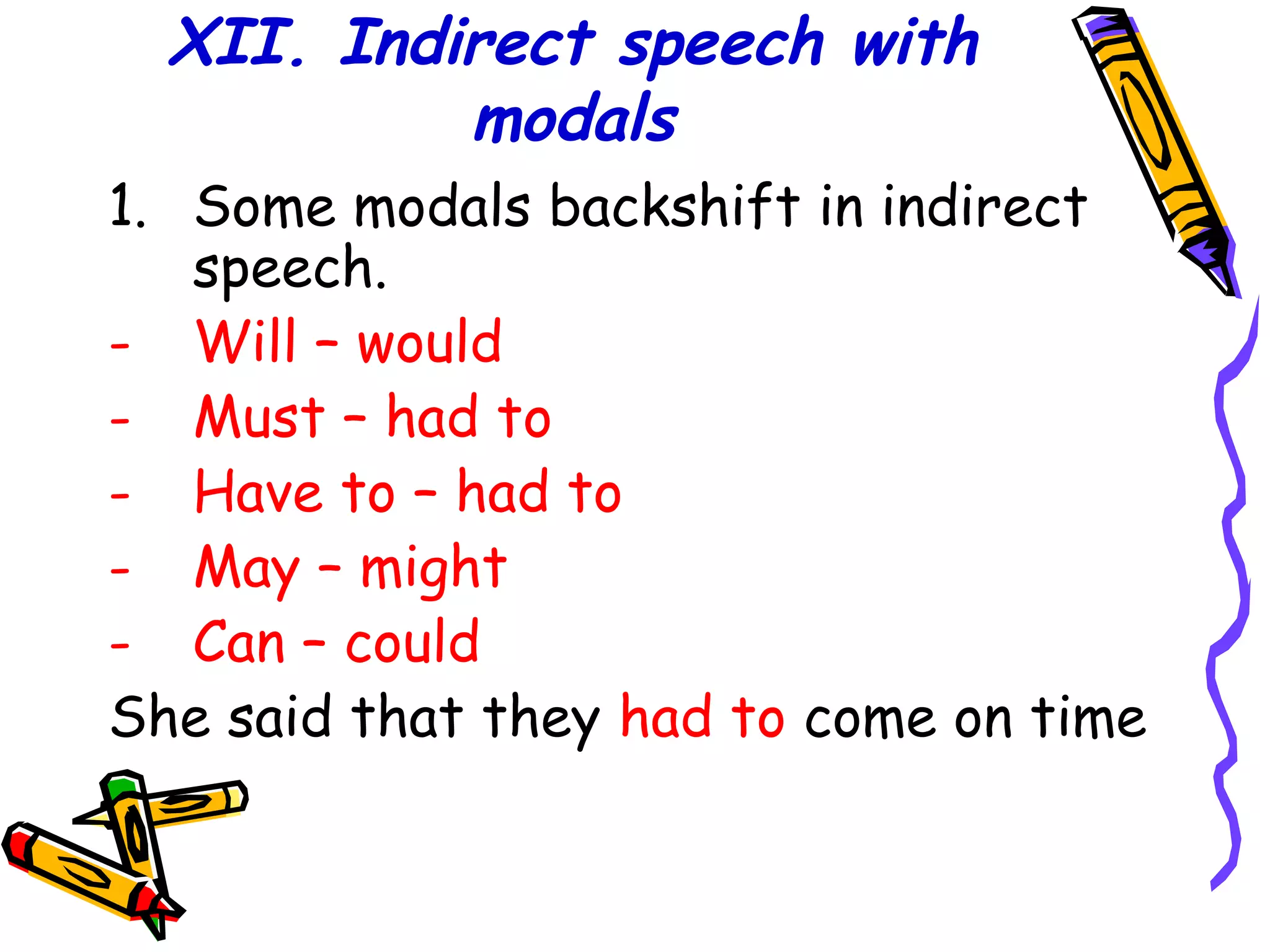
XII. Indirect speech with
modals
1. Some modals backshift in indirect
speech.
- Will – would
- Must – had to
- Have to – had to
- May – might
- Can – could
She said that they had to come on time
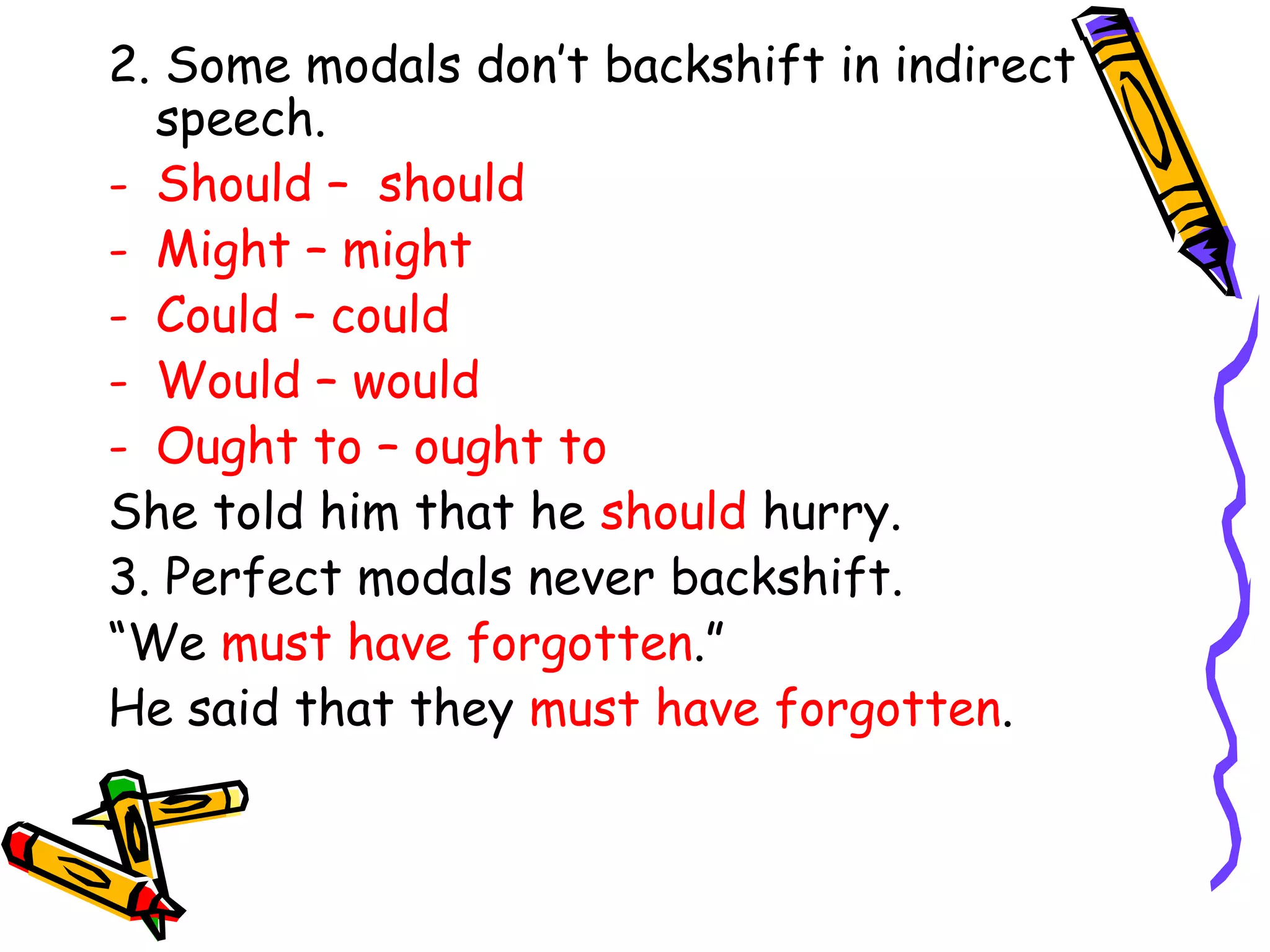
2. Some modals don’t backshift in indirect
speech.
- Should – should
- Might – might
- Could – could
- Would – would
- Ought to – ought to
She told him that he should hurry.
3. Perfect modals never backshift.
“We must have forgotten.”
He said that they must have forgotten.
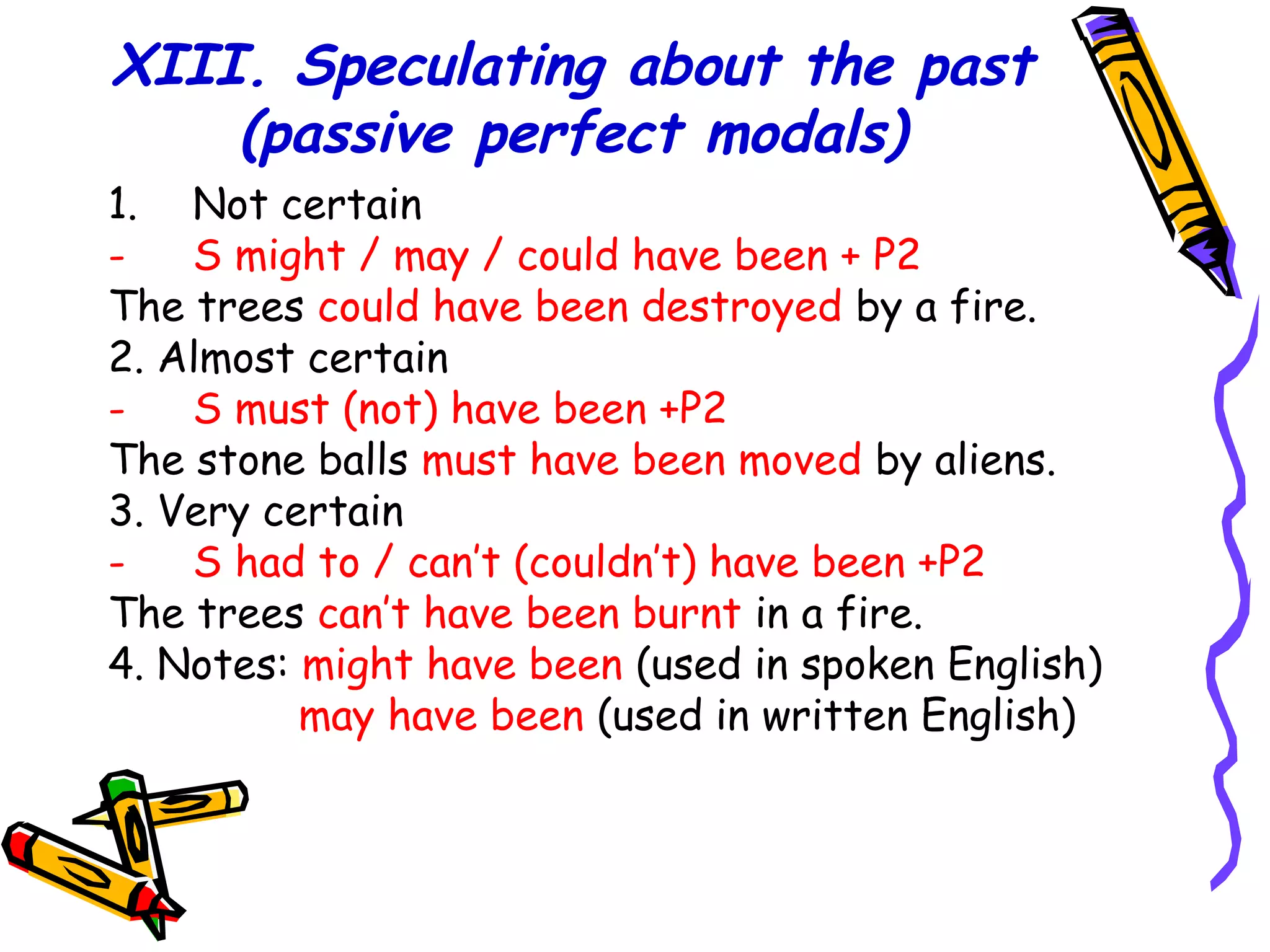
XIII. Speculating about the past
(passive perfect modals)
1. Not certain
- S might / may / could have been + P2
The trees could have been destroyed by a fire.
2. Almost certain
- S must (not) have been +P2
The stone balls must have been moved by aliens.
3. Very certain
- S had to / can’t (couldn’t) have been +P2
The trees can’t have been burnt in a fire.
4. Notes: might have been (used in spoken English)
may have been (used in written English)
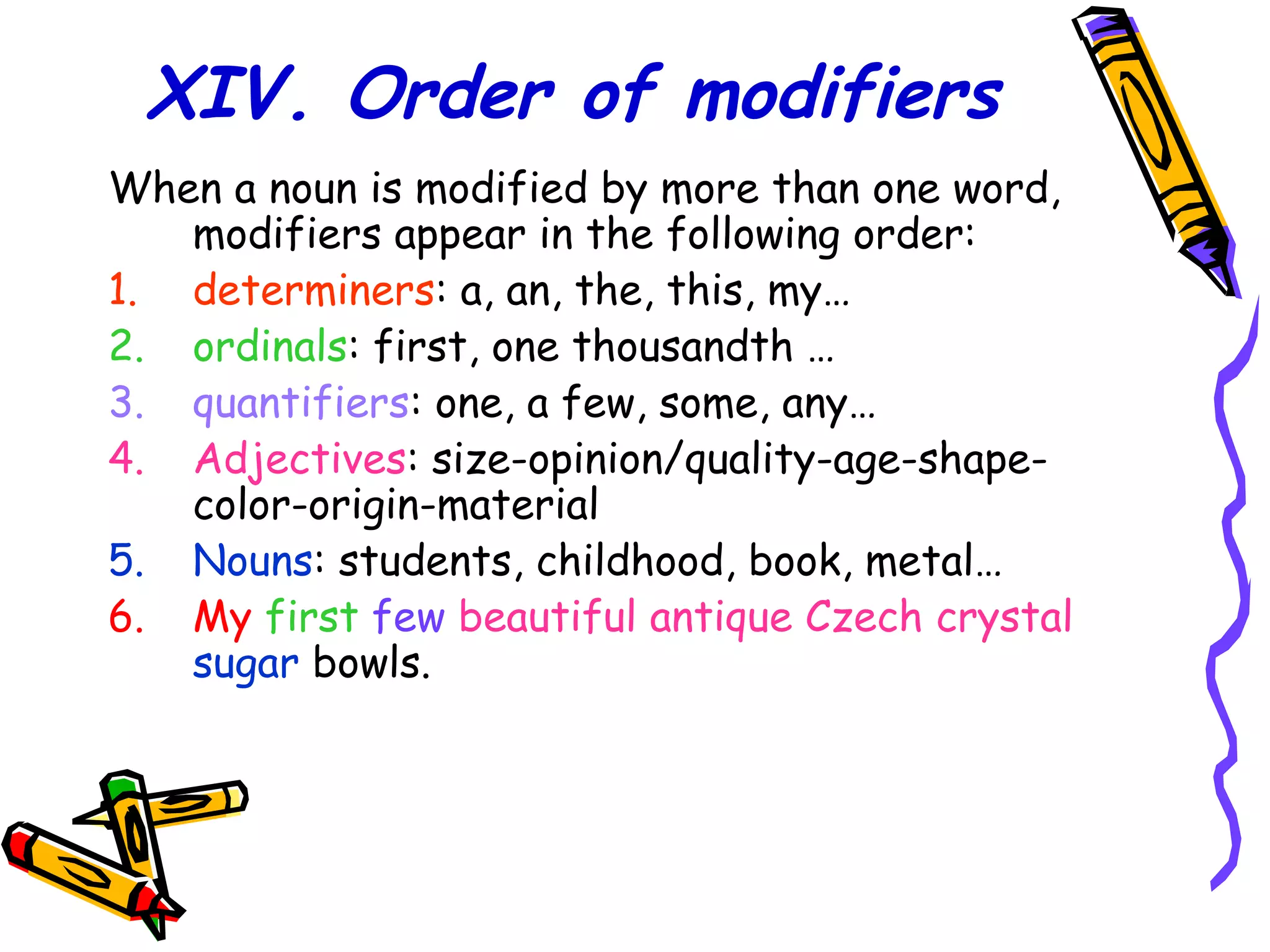
XIV. Order of modifiers
When a noun is modified by more than one word,
modifiers appear in the following order:
1. determiners: a, an, the, this, my…
2. ordinals: first, one thousandth …
3. quantifiers: one, a few, some, any…
4. Adjectives: size-opinion/quality-age-shape-
color-origin-material
5. Nouns: students, childhood, book, metal…
6. My first few beautiful antique Czech crystal
sugar bowls.
The end of grammar
revision for summit
1
Good luck in your
exam!

Grammar revision summit 1

  • 1.
    Grammar RevisionGrammar Revision Summit1Summit 1 Level: AdvancedLevel: Advanced
  • 2.
    I. Gerunds andInfinitives 1. Verbs followed by infinitives - Learn to live in the present. 2. Verbs followed by gerunds - I enjoy spending time with my friends. 3. Verbs followed by objects and infinitives - He reminded me to call my mother. 4. Verbs followed by gerunds / infinitives (changes in meaning) - Stop to smell the roses - You need to stop worrying too much
  • 3.
    II. Present perfect– present perfect continuous 1. Finished actions - I’ve already heard that CD. I heard it yesterday. 2. Very recently finished actions - They’ve been running. They look tired. 3. Unfinished or continuing actions (Either present perfect or present perfect continuous can be used) - Have you listened to any jazz lately? - Have you been listening to jazz lately?
  • 4.
    4. Words andphrases used for finished actions: - already, ever, never, yet, once, twice, three times, How many…? 5. Words and expressions used for unfinished actions: - for, since, all day, lately, recently, so far, up to now, from…to present, this year, these days, for a while, How long…?
  • 5.
    III. Noun clauses 1.A noun clause can be a subject, a direct object, an indirect object, a subject complement, or object of a preposition. - Whatever happens during the day comes out in my music. - I don’t know why I’m so crazy about his music. - I’ll give whoever calls first the tickets. - Music is what helps me get rid of stress. - Music is a way for people to communicate with whomever they meet.
  • 6.
    2. A nounclause can begin with that, if, whether (or not), or a question word - I believe that life would be empty without music. - We asked him if he could play the song again. 3. When a noun clause is a direct object, that may be omitted. - I believe life would be empty without music.
  • 7.
    IV. Future plansand finished future actions 1. Use plan, hope, expect, intend for general future plans: - We hope to start saving some money. - She expects to have paid off all her debts in five years. 2. Use future perfect for finished future actions: - I will have completed my studies by next year. - Once I have completed my studies, I’ll get married.
  • 8.
    V. Past unrealconditional: Inverted form 1. Past unreal conditionals can be stated without if, invert had and subject. - Had we not been so busy, we could have shopped around. - Were he taller, he’d have become a pilot. - They wouldn’t have hit her had she been honest.
  • 9.
    VI. Quantifiers 1. usedonly with singular count nouns: - one, each, every 2. used only with plural count nouns: - two, many, a few, a couple of, a number of, both, several, a dozen 3. used only with non-count nouns: - a little, less, much, a great deal 4. used with both count and non-count nouns: - no, some, any, plenty of, a lot of, most, all, more, a third of
  • 10.
    VII. Possessives with gerunds 1.Use a possessive before a gerund: - The kid’s singing was too loud. - The thing that bothers me is her smoking. 2. Use a noun / object pronoun instead of a possessive (spoken English) - I can understand John being annoyed. - I can’t accept them ignoring me.
  • 11.
    VIII. Paired Conjunctions 1.either … or - Either smoke outside or don’t smoke at all. 2. neither … nor - Neither eating nor chewing is acceptable in class. 3. not only … but also - Not only CD players but also cell phones should be banned from trains. 4. both … and …: She’s both rich and nice.
  • 12.
    IX. Passive voicewith modals S + modal + be P2 1. Can for present ability / possibility 2. Might (not) and could for present or future possibility 3. Couldn’t and can’t for present impossibility 4. Should and shouldn’t for advisability 5. Have to and must for necessity
  • 13.
    X. Passive formof gerunds and infinitives 1. Used being + P2 for passive gerund - I enjoy being entertained by commercials. 2. Used to be + P2 for passive infinitive - I don’t expect to be told the truth by advertisers.
  • 14.
    XI. Repeated comparatives anddouble comparatives 1. adj-er and adj-er - The birthrate is getting lower and lower. 2. more and more + noun - More and more people are marrying later. 3. more and more + adj - It’s becoming more and more difficult.
  • 15.
    4. The +comparative S+V, the + comparative S+V - The less children studied, the more slowly they learned. 5. Be is sometimes omitted - The better the quality of health care (is), the higher the life expectancy (is). 6. Don’t use continuous verb forms in double comparatives
  • 16.
    XII. Indirect speechwith modals 1. Some modals backshift in indirect speech. - Will – would - Must – had to - Have to – had to - May – might - Can – could She said that they had to come on time
  • 17.
    2. Some modalsdon’t backshift in indirect speech. - Should – should - Might – might - Could – could - Would – would - Ought to – ought to She told him that he should hurry. 3. Perfect modals never backshift. “We must have forgotten.” He said that they must have forgotten.
  • 18.
    XIII. Speculating aboutthe past (passive perfect modals) 1. Not certain - S might / may / could have been + P2 The trees could have been destroyed by a fire. 2. Almost certain - S must (not) have been +P2 The stone balls must have been moved by aliens. 3. Very certain - S had to / can’t (couldn’t) have been +P2 The trees can’t have been burnt in a fire. 4. Notes: might have been (used in spoken English) may have been (used in written English)
  • 19.
    XIV. Order ofmodifiers When a noun is modified by more than one word, modifiers appear in the following order: 1. determiners: a, an, the, this, my… 2. ordinals: first, one thousandth … 3. quantifiers: one, a few, some, any… 4. Adjectives: size-opinion/quality-age-shape- color-origin-material 5. Nouns: students, childhood, book, metal… 6. My first few beautiful antique Czech crystal sugar bowls.
  • 20.
    The end ofgrammar revision for summit 1 Good luck in your exam!