Present simple tense
• We use simple present tense to
 talk about things in general.
 Ex:
    Nurses look after the patients in
 hospitals.
       Children like ice-cream
• We use it to say that something
 happens repeatedly or for
 habitual actions or daily activities
Example:

I usually go to the market at weekends.

Paul wakes up at 5 in the morning.
• We use it to say that something
 is true in general.
Ex.
The earth goes around the sun.
Peter works on his basket every
day (He) .
• Children like ice-cream very much
 (They).
THE PRESENT SIMPLE TENSE
        (Interrogative)
DOES HE WORK AS A DOCTOR?


YES, HE DOES
• Do they
  watch T.V
  together?
SHE DOESN’T WORK AS A DOCTOR,
SHE WORKS AS A TEACHER.
Negative sentences

• We use do/does to make negative
  sentences.
• Ex: I don’t go to the market in the
  evening.
• Sally doesn’t take sugar in her
  coffee. (She).
Affirmative form
subject       verb

I             Drive.
you           Drive.
We            Drive.
They          Drive.
*He/she/it    Drives.
Interrogative form

Do/does       Subject           Verb
Do            You       Work?
Do            We        Work?
Do            they      Work?
Does          *He/she   Work ? Not works
Does          *It       Work? Not works
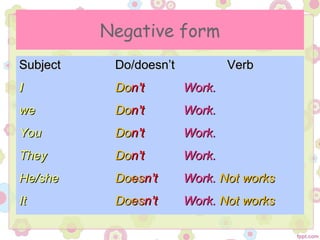
Negative form
Subject    Do/doesn’t           Verb
I          Don’t        Work.
we         Don’t        Work.
You        Don’t        Work.
They       Don’t        Work.
He/she     Doesn’t      Work. Not works
It         Doesn’t      Work. Not works
More examples:
  More examples
I go to school every day.
  I go to school every day.
She speaks English fluently.
  She speaks English fluently.
The sun rises in theeast. (It)
  The sun rises in the east. (It)
  Paper burns easily. (It)
Paper burns easily. (It)
  Water boils at 100 degrees celcius. (It)
Water boils work in a hospital (They) (It)
  My parents
              at 100 degrees celcius.
My parents work in a hospital (They)
Points to remember
• Remember that we say
   I work, but he works.
   They teach but my sister (She) teaches.
   We sing but Rihanna (She) sings.
• Don’t forget the –s in 3rd person singular
(e.g., he, she, it, Peter, Jane, My father, etc)
Present simple 1
Present simple 1
Present simple 1
Present simple 1
Present simple 1
Present simple 1

Present simple 1

  • 1.
  • 2.
    • We usesimple present tense to talk about things in general. Ex: Nurses look after the patients in hospitals. Children like ice-cream
  • 3.
    • We useit to say that something happens repeatedly or for habitual actions or daily activities Example: I usually go to the market at weekends. Paul wakes up at 5 in the morning.
  • 4.
    • We useit to say that something is true in general. Ex. The earth goes around the sun.
  • 5.
    Peter works onhis basket every day (He) .
  • 6.
    • Children likeice-cream very much (They).
  • 7.
    THE PRESENT SIMPLETENSE (Interrogative) DOES HE WORK AS A DOCTOR? YES, HE DOES
  • 8.
    • Do they watch T.V together?
  • 9.
    SHE DOESN’T WORKAS A DOCTOR, SHE WORKS AS A TEACHER.
  • 10.
    Negative sentences • Weuse do/does to make negative sentences. • Ex: I don’t go to the market in the evening. • Sally doesn’t take sugar in her coffee. (She).
  • 11.
    Affirmative form subject verb I Drive. you Drive. We Drive. They Drive. *He/she/it Drives.
  • 12.
    Interrogative form Do/does Subject Verb Do You Work? Do We Work? Do they Work? Does *He/she Work ? Not works Does *It Work? Not works
  • 13.
    Negative form Subject Do/doesn’t Verb I Don’t Work. we Don’t Work. You Don’t Work. They Don’t Work. He/she Doesn’t Work. Not works It Doesn’t Work. Not works
  • 14.
    More examples: More examples I go to school every day. I go to school every day. She speaks English fluently. She speaks English fluently. The sun rises in theeast. (It) The sun rises in the east. (It) Paper burns easily. (It) Paper burns easily. (It) Water boils at 100 degrees celcius. (It) Water boils work in a hospital (They) (It) My parents at 100 degrees celcius. My parents work in a hospital (They)
  • 15.
    Points to remember •Remember that we say I work, but he works. They teach but my sister (She) teaches. We sing but Rihanna (She) sings. • Don’t forget the –s in 3rd person singular (e.g., he, she, it, Peter, Jane, My father, etc)