A S S E S S I N G L I S T E N I N G
D E S I G N I N G A S S E S S M E N T TA S K S
DESIGNING ASSESSMENT TASKS: RESPONSIVE LISTENING
• Responsive Listening involves listening to a small amount of a language such
as a command, question, or greeting. After listening, the student is expected
develop an appropriate short response.
• A question-and-answer format can provide some interactivity in these lower-
end listening tasks. The test-taker's response is the appropriate answer to a
question.
E.g.:
 Appropriate response to a question:
Test-takers hear:
How much time did you take to do your homework?
Test-takers read:
(a) In about an hour.
(b) About an hour.
(c) About $10.
(d) Yes, I did.
APPROPRIATE RESPONSE TO A QUESTION
• The objective of this item is recognition of the wh-question how much and its
appropriate response. Distractors are chosen to represent common learner errors:
• (a) responding to how much vs. how much longer.
• (c) confusing how much in reference to time vs. the more frequent reference to
money.
• (d) confusing a wh-question with a yes/no question.
• Ps :None of the tasks so far discussed have to be framed in a multiple-choice
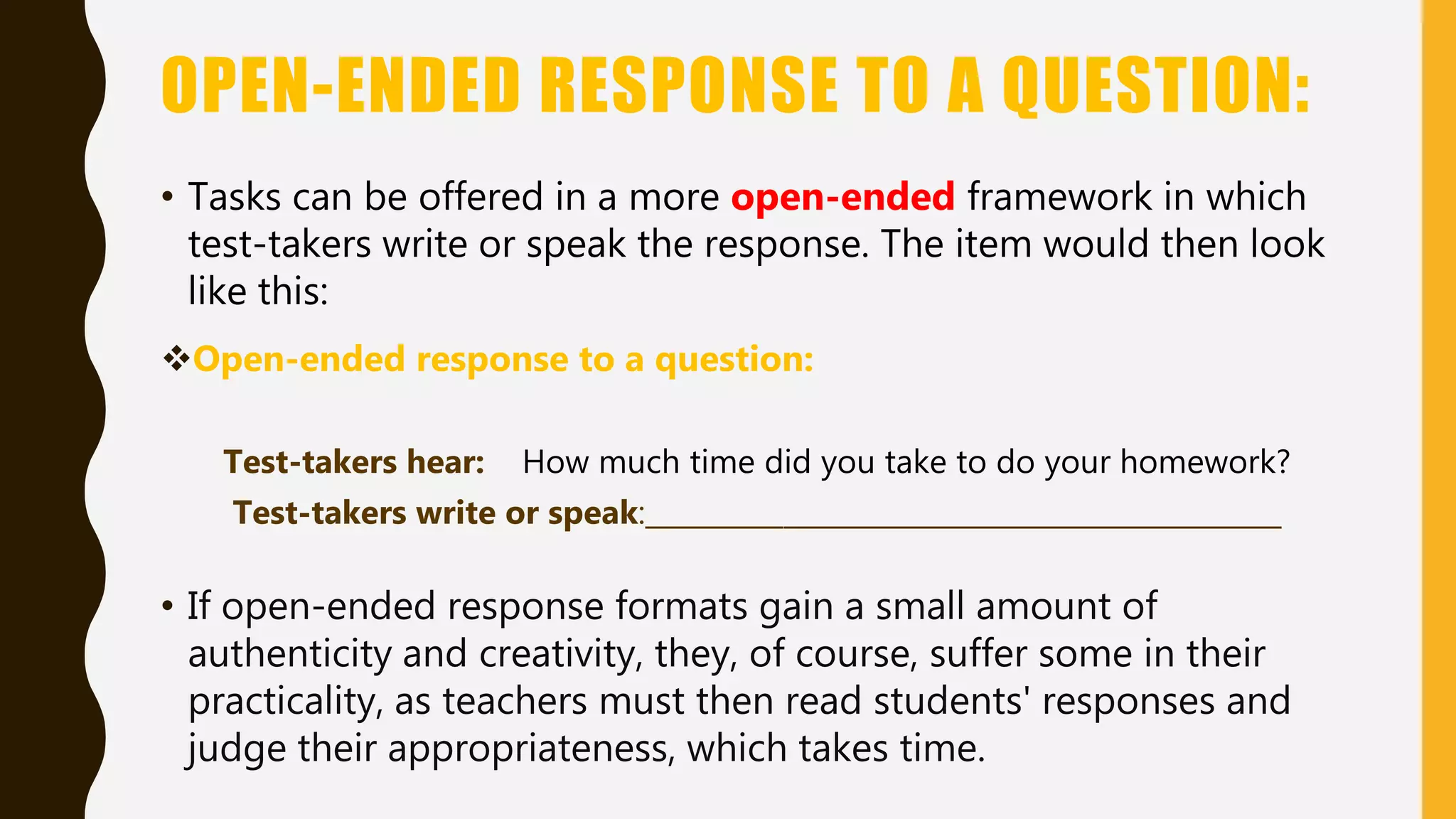
OPEN-ENDED RESPONSE TO A QUESTION:
• Tasks can be offered in a more open-ended framework in which
test-takers write or speak the response. The item would then look
like this:
Open-ended response to a question:
Test-takers hear: How much time did you take to do your homework?
Test-takers write or speak:______________________________________________
• If open-ended response formats gain a small amount of
authenticity and creativity, they, of course, suffer some in their
practicality, as teachers must then read students' responses and
judge their appropriateness, which takes time.
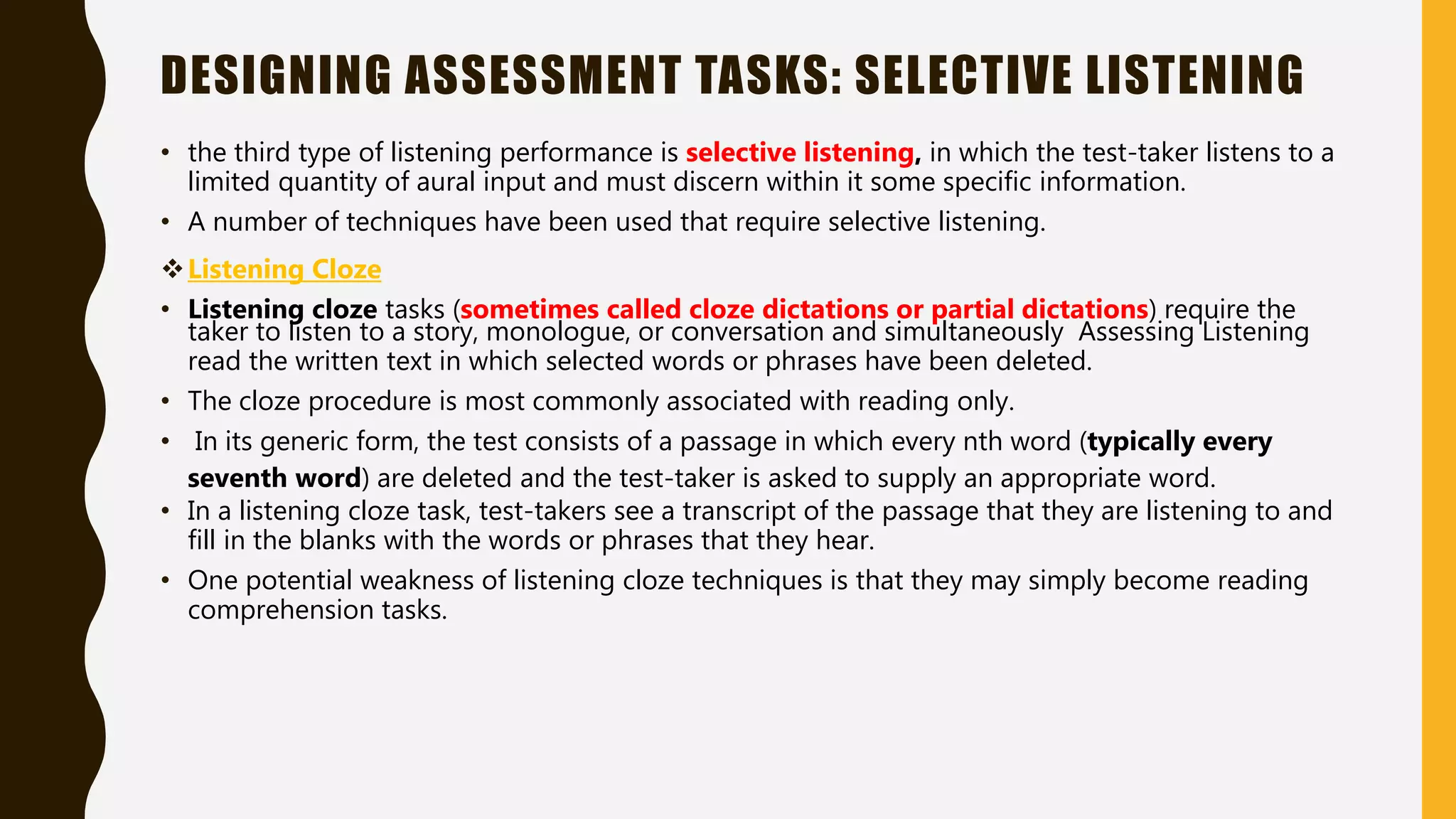
DESIGNING ASSESSMENT TASKS: SELECTIVE LISTENING
• the third type of listening performance is selective listening, in which the test-taker listens to a
limited quantity of aural input and must discern within it some specific information.
• A number of techniques have been used that require selective listening.
Listening Cloze
• Listening cloze tasks (sometimes called cloze dictations or partial dictations) require the
taker to listen to a story, monologue, or conversation and simultaneously Assessing Listening
read the written text in which selected words or phrases have been deleted.
• The cloze procedure is most commonly associated with reading only.
• In its generic form, the test consists of a passage in which every nth word (typically every
seventh word) are deleted and the test-taker is asked to supply an appropriate word.
• In a listening cloze task, test-takers see a transcript of the passage that they are listening to and
fill in the blanks with the words or phrases that they hear.
• One potential weakness of listening cloze techniques is that they may simply become reading
comprehension tasks.
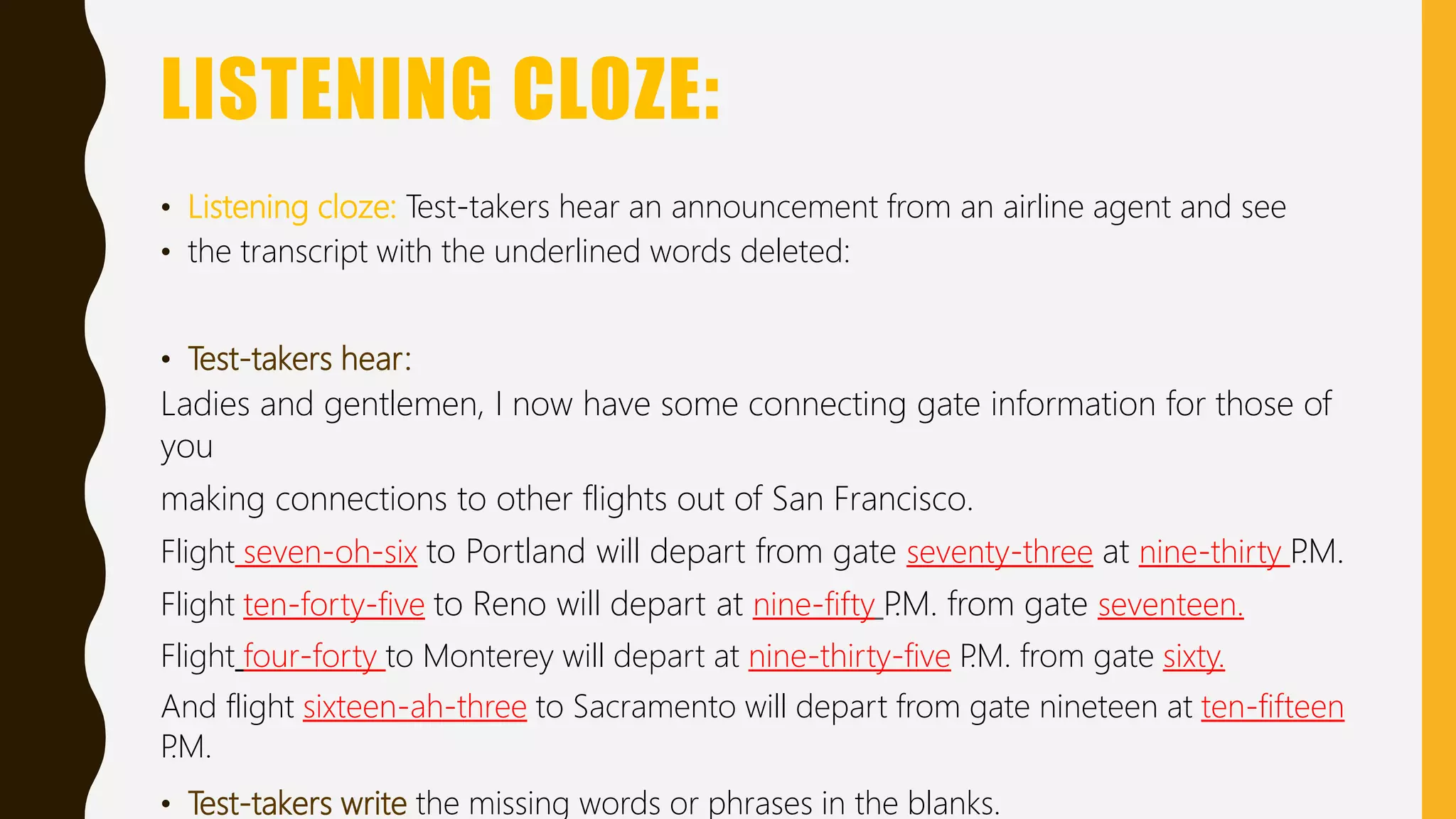
LISTENING CLOZE:
• Listening cloze: Test-takers hear an announcement from an airline agent and see
• the transcript with the underlined words deleted:
• Test-takers hear:
Ladies and gentlemen, I now have some connecting gate information for those of
you
making connections to other flights out of San Francisco.
Flight seven-oh-six to Portland will depart from gate seventy-three at nine-thirty P.M.
Flight ten-forty-five to Reno will depart at nine-fifty P.M. from gate seventeen.
Flight four-forty to Monterey will depart at nine-thirty-five P.M. from gate sixty.
And flight sixteen-ah-three to Sacramento will depart from gate nineteen at ten-fifteen
P.M.
• Test-takers write the missing words or phrases in the blanks.
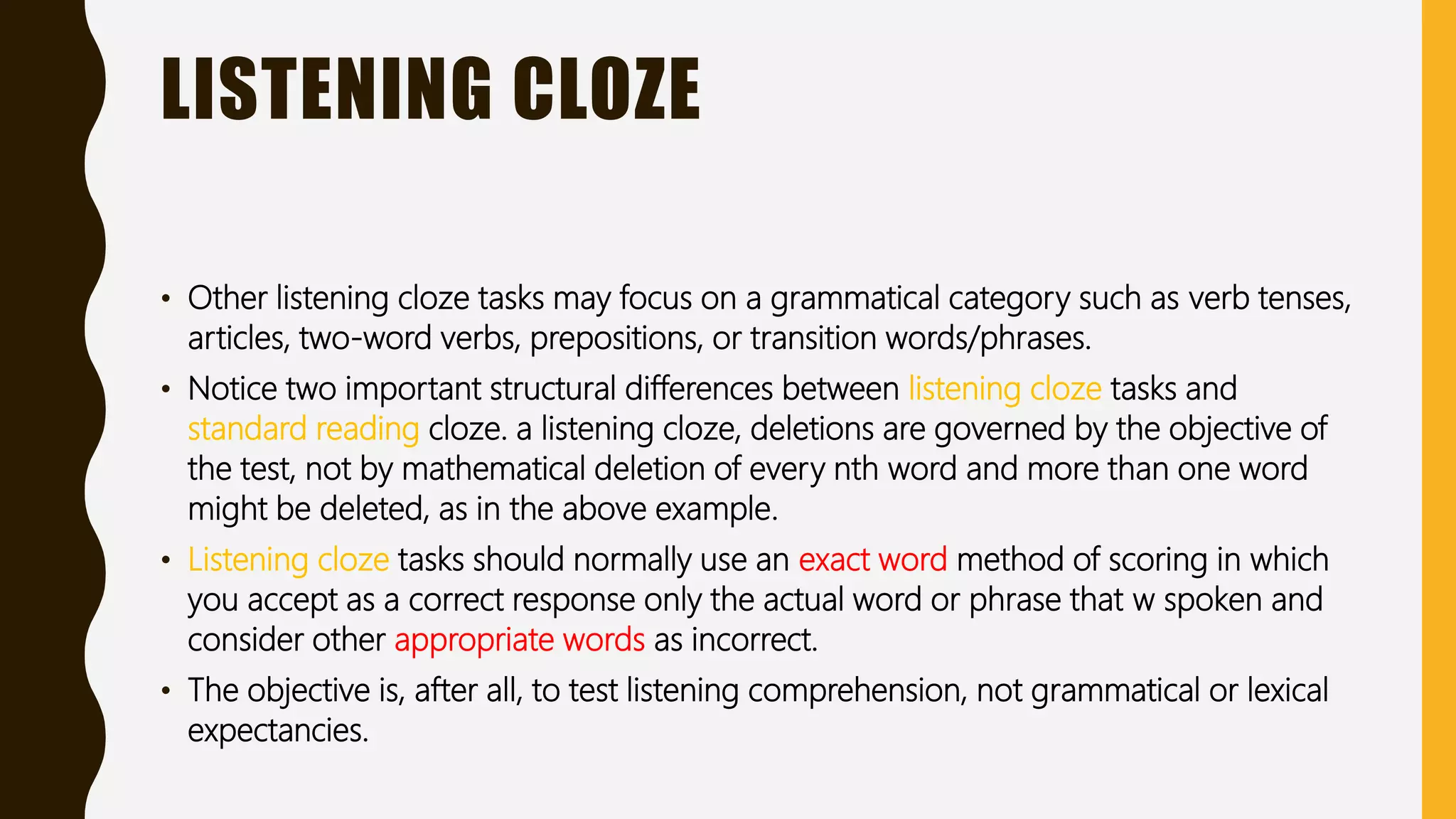
LISTENING CLOZE
• Other listening cloze tasks may focus on a grammatical category such as verb tenses,
articles, two-word verbs, prepositions, or transition words/phrases.
• Notice two important structural differences between listening cloze tasks and
standard reading cloze. a listening cloze, deletions are governed by the objective of
the test, not by mathematical deletion of every nth word and more than one word
might be deleted, as in the above example.
• Listening cloze tasks should normally use an exact word method of scoring in which
you accept as a correct response only the actual word or phrase that w spoken and
consider other appropriate words as incorrect.
• The objective is, after all, to test listening comprehension, not grammatical or lexical
expectancies.
INFORMATION TRANSFERING:
• INFORMATION TRANSFERING:
• Selective listening can also be assessed through an
information transfer technique in which aurally processed
information must be transferred to a visual representation,
such as labeling a diagram, identifying an element in a
picture, completing a form, or showing routes on a map.
• The preceding example illustrates the need for
test-takers to focus on just the relevant
information.
• The objective of this task is to test prepositions
and prepositional phrases of location (at the
bottom, on top of, around, along with larger,
smaller).
• The task also presupposes, of course, that test-
takers are able to identify the difference between
a bird and a squirrel!
INFORMATION TRANSFERING:
• Another genre of picture-cued tasks, a number of people
and/or actions are presented in one picture, such as a group
of people at a party. Assuming that all the items, people, and
actions are clearly depicted and understood by the test-takes
assessment may take the form of:
• questions: "Is the tall man near the door talking to a short
woman?“.
• true/false: "The woman wearing a red skirt is watching TV.
• identification: "Point to the person who is standing behind
the lamp." "Draw a circle around the person to the left of the
INFORMATION TRANSFERING:
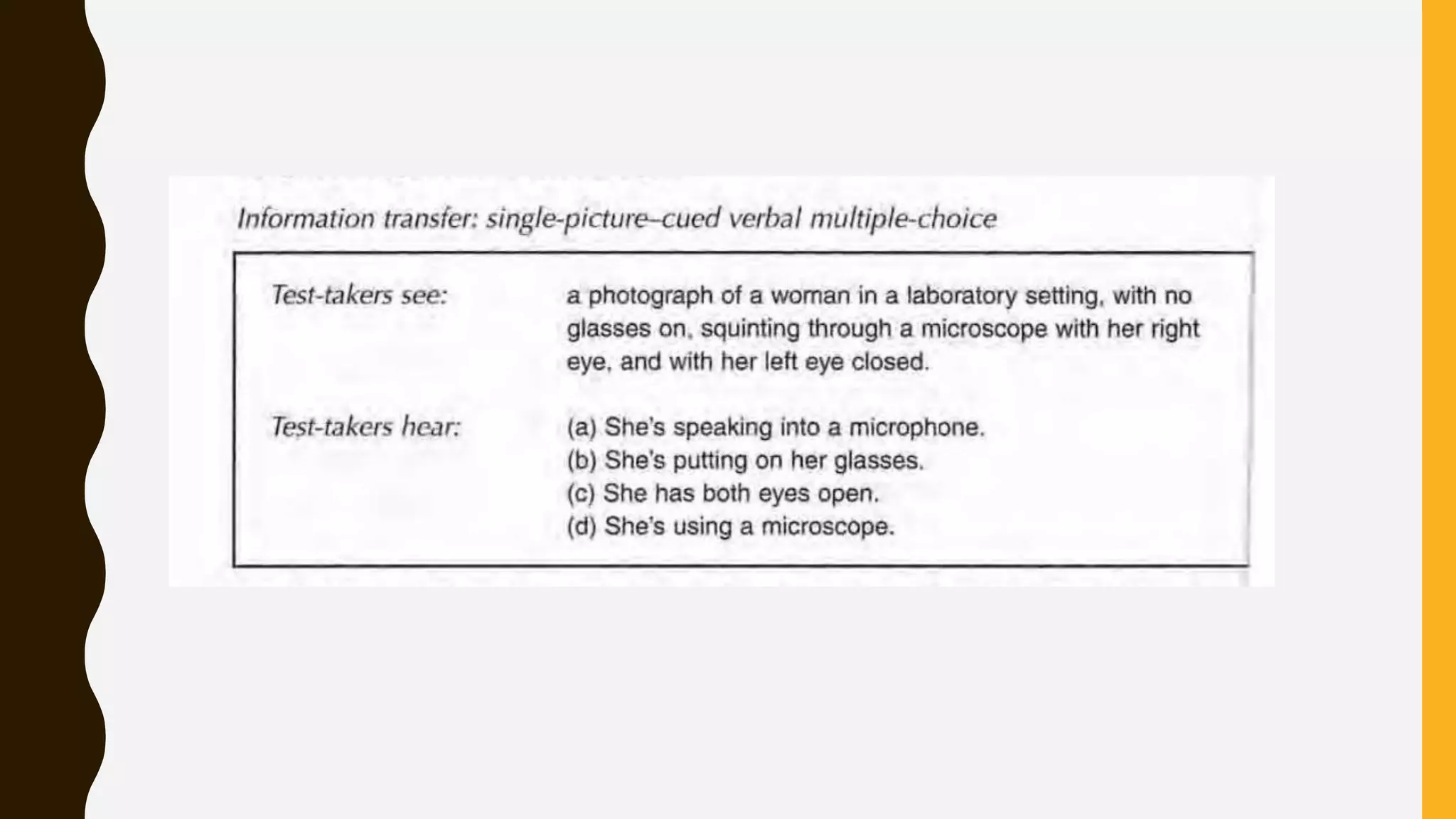
• In a picture-cued option used by the Test of English for
International Communication (TOEIC"), one single
is presented to the test-taker, wh. then hears four different
statements and must choose one of the four to describe the
photograph. Here is an example:
INFORMATION TRANSFER: CHART-FILLING
• Information transfer tasks may reflect greater
authenticity by using char maps, grids, timetables, and
other artifacts of daily life. In the example below, test
takers hear a student's daily schedule, and the task is
to fill in the partially complete weekly calendar.
INFORMATION TRANSFERING:
• Such chart-filling tasks are good examples of aural scanning strategies. A listener must
discern from a number of pieces of information in which pieces are relevant. In the
above example, virtually all of the stimuli are relevant, and very few words can be
ignored. In other tasks, however, much more information might be, presented than is
needed (as in the birdfeeder item on page 127). forcing the test taker to select the
correct bits and pieces necessary to complete a task.
• Such chart-filling tasks are good examples of aural scanning strategies. A listener must
discern from a number of pieces of information in which pieces are relevant. In the
above example, virtually all of the stimuli are relevant, and very few words can be
ignored. In other tasks, however, much more information might be, presented than is
needed (as in the birdfeeder item on page 127). forcing the test taker to select the
correct bits and pieces necessary to complete a task.
• Chart-filling tasks increase in difficulty as the linguistic stimulus material
becomes more complex.
• In one task described by Ur (1984, pp. 108-112). test-takers listen to a
very long description of animals in various cages in a zoo. While they
listen, they can look at a map of the layout of the zoo with unlabeled
cages their task is to fill in the correct animal in each cage, but the
complexity of the language used to describe the positions of cages and
their inhabitants is very challenging Similarly Hughes (1989. p. 138)
described a map-marking ask in which test-takers must process around
250 words of colloquial language in order to complete the tasks of
identifying names. positions, and directions in a car accident scenario on
a city street
THANK YOU
C R E AT E D BY : M O N A B O U TA G H A N E

Assessing listening_ chapter6

  • 1.
    A S SE S S I N G L I S T E N I N G D E S I G N I N G A S S E S S M E N T TA S K S
  • 2.
    DESIGNING ASSESSMENT TASKS:RESPONSIVE LISTENING • Responsive Listening involves listening to a small amount of a language such as a command, question, or greeting. After listening, the student is expected develop an appropriate short response. • A question-and-answer format can provide some interactivity in these lower- end listening tasks. The test-taker's response is the appropriate answer to a question. E.g.:  Appropriate response to a question: Test-takers hear: How much time did you take to do your homework? Test-takers read: (a) In about an hour. (b) About an hour. (c) About $10. (d) Yes, I did.
  • 3.
    APPROPRIATE RESPONSE TOA QUESTION • The objective of this item is recognition of the wh-question how much and its appropriate response. Distractors are chosen to represent common learner errors: • (a) responding to how much vs. how much longer. • (c) confusing how much in reference to time vs. the more frequent reference to money. • (d) confusing a wh-question with a yes/no question. • Ps :None of the tasks so far discussed have to be framed in a multiple-choice
  • 4.
    OPEN-ENDED RESPONSE TOA QUESTION: • Tasks can be offered in a more open-ended framework in which test-takers write or speak the response. The item would then look like this: Open-ended response to a question: Test-takers hear: How much time did you take to do your homework? Test-takers write or speak:______________________________________________ • If open-ended response formats gain a small amount of authenticity and creativity, they, of course, suffer some in their practicality, as teachers must then read students' responses and judge their appropriateness, which takes time.
  • 5.
    DESIGNING ASSESSMENT TASKS:SELECTIVE LISTENING • the third type of listening performance is selective listening, in which the test-taker listens to a limited quantity of aural input and must discern within it some specific information. • A number of techniques have been used that require selective listening. Listening Cloze • Listening cloze tasks (sometimes called cloze dictations or partial dictations) require the taker to listen to a story, monologue, or conversation and simultaneously Assessing Listening read the written text in which selected words or phrases have been deleted. • The cloze procedure is most commonly associated with reading only. • In its generic form, the test consists of a passage in which every nth word (typically every seventh word) are deleted and the test-taker is asked to supply an appropriate word. • In a listening cloze task, test-takers see a transcript of the passage that they are listening to and fill in the blanks with the words or phrases that they hear. • One potential weakness of listening cloze techniques is that they may simply become reading comprehension tasks.
  • 6.
    LISTENING CLOZE: • Listeningcloze: Test-takers hear an announcement from an airline agent and see • the transcript with the underlined words deleted: • Test-takers hear: Ladies and gentlemen, I now have some connecting gate information for those of you making connections to other flights out of San Francisco. Flight seven-oh-six to Portland will depart from gate seventy-three at nine-thirty P.M. Flight ten-forty-five to Reno will depart at nine-fifty P.M. from gate seventeen. Flight four-forty to Monterey will depart at nine-thirty-five P.M. from gate sixty. And flight sixteen-ah-three to Sacramento will depart from gate nineteen at ten-fifteen P.M. • Test-takers write the missing words or phrases in the blanks.
  • 7.
    LISTENING CLOZE • Otherlistening cloze tasks may focus on a grammatical category such as verb tenses, articles, two-word verbs, prepositions, or transition words/phrases. • Notice two important structural differences between listening cloze tasks and standard reading cloze. a listening cloze, deletions are governed by the objective of the test, not by mathematical deletion of every nth word and more than one word might be deleted, as in the above example. • Listening cloze tasks should normally use an exact word method of scoring in which you accept as a correct response only the actual word or phrase that w spoken and consider other appropriate words as incorrect. • The objective is, after all, to test listening comprehension, not grammatical or lexical expectancies.
  • 8.
    INFORMATION TRANSFERING: • INFORMATIONTRANSFERING: • Selective listening can also be assessed through an information transfer technique in which aurally processed information must be transferred to a visual representation, such as labeling a diagram, identifying an element in a picture, completing a form, or showing routes on a map.
  • 10.
    • The precedingexample illustrates the need for test-takers to focus on just the relevant information. • The objective of this task is to test prepositions and prepositional phrases of location (at the bottom, on top of, around, along with larger, smaller). • The task also presupposes, of course, that test- takers are able to identify the difference between a bird and a squirrel!
  • 11.
    INFORMATION TRANSFERING: • Anothergenre of picture-cued tasks, a number of people and/or actions are presented in one picture, such as a group of people at a party. Assuming that all the items, people, and actions are clearly depicted and understood by the test-takes assessment may take the form of: • questions: "Is the tall man near the door talking to a short woman?“. • true/false: "The woman wearing a red skirt is watching TV. • identification: "Point to the person who is standing behind the lamp." "Draw a circle around the person to the left of the
  • 12.
    INFORMATION TRANSFERING: • Ina picture-cued option used by the Test of English for International Communication (TOEIC"), one single is presented to the test-taker, wh. then hears four different statements and must choose one of the four to describe the photograph. Here is an example:
  • 14.
    INFORMATION TRANSFER: CHART-FILLING •Information transfer tasks may reflect greater authenticity by using char maps, grids, timetables, and other artifacts of daily life. In the example below, test takers hear a student's daily schedule, and the task is to fill in the partially complete weekly calendar.
  • 16.
    INFORMATION TRANSFERING: • Suchchart-filling tasks are good examples of aural scanning strategies. A listener must discern from a number of pieces of information in which pieces are relevant. In the above example, virtually all of the stimuli are relevant, and very few words can be ignored. In other tasks, however, much more information might be, presented than is needed (as in the birdfeeder item on page 127). forcing the test taker to select the correct bits and pieces necessary to complete a task. • Such chart-filling tasks are good examples of aural scanning strategies. A listener must discern from a number of pieces of information in which pieces are relevant. In the above example, virtually all of the stimuli are relevant, and very few words can be ignored. In other tasks, however, much more information might be, presented than is needed (as in the birdfeeder item on page 127). forcing the test taker to select the correct bits and pieces necessary to complete a task.
  • 17.
    • Chart-filling tasksincrease in difficulty as the linguistic stimulus material becomes more complex. • In one task described by Ur (1984, pp. 108-112). test-takers listen to a very long description of animals in various cages in a zoo. While they listen, they can look at a map of the layout of the zoo with unlabeled cages their task is to fill in the correct animal in each cage, but the complexity of the language used to describe the positions of cages and their inhabitants is very challenging Similarly Hughes (1989. p. 138) described a map-marking ask in which test-takers must process around 250 words of colloquial language in order to complete the tasks of identifying names. positions, and directions in a car accident scenario on a city street
  • 18.
    THANK YOU C RE AT E D BY : M O N A B O U TA G H A N E

Editor's Notes

  • #3 Student listen to techer then answer immediately
  • #6 Listening cloze /(students fill in the blanks)
  • #10 (students choose a picture
  • #14 (students give MC verbal response
  • #16 students feel in a grid