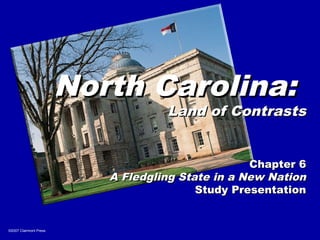
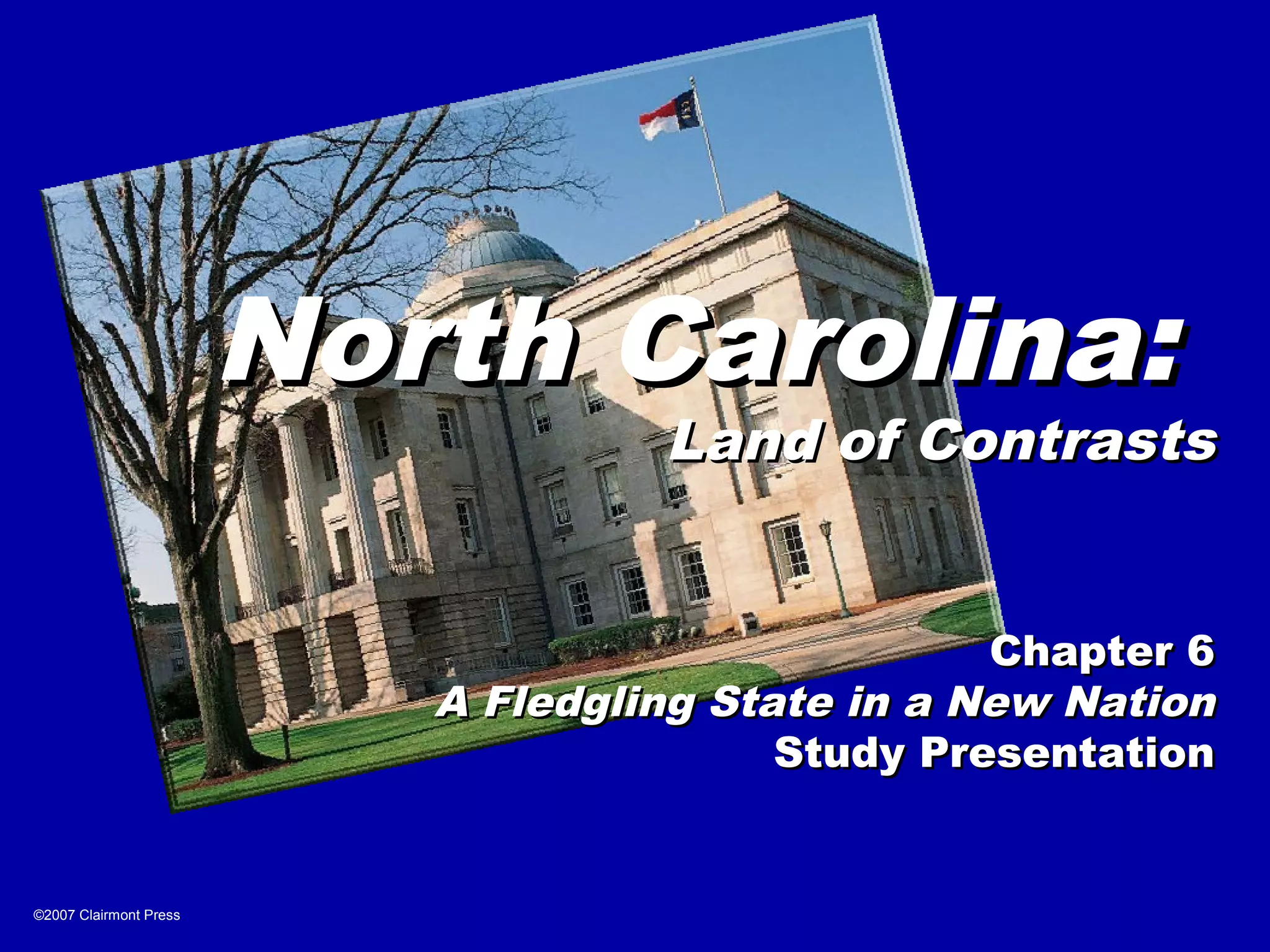
North Carolina:

Land of Contrasts

Chapter 6
A Fledgling State in a New Nation
Study Presentation

©2007 Clairmont Press
Chapter 6:
A Fledgling State in a
New Nation
•
•
•
•

Section 1: The State in the Confederation
Section 2: North Carolina Joins the New Union
Section 3: North Carolina’s Role in the New Nation
Section 4: Efforts to Improve North Carolina
Section 1: The State in the
Confederation
ESSENTIAL QUESTION
– What obstacles were encountered
when establishing the state of North
Carolina?
Section 1: The State in the
Confederation
What words do I need to know?
1. Articles of Confederation
2. precedent
3. judicial review
Section 1: The State in the
Confederation
Introduction
• The Articles of Confederation were
adopted by Congress during the War. The
Articles were the country’s first
Constitution.
• The Articles called for a Congress in which
each state had one vote.
• The Confederation was ineffective
because it lacked money and resources.
North Carolina After the War
• The NC General Assembly had few places
to meet and little money to work with.
• The state tried to raise money by selling
confiscated Tory land, even though that
act was illegal.
• The state ceded the lands west of the
Appalachians to the Confederation, then
took the land back to sell.
A Landmark Case
• Tories sued to protect their properties so the
General Assembly voted to not allow lawsuits of
that type.
• 1787: the law was declared unconstitutional
when Mrs. Elizabeth Bayard sued to gain land
her father had willed to her.
• Samuel Ashe was honored for his role in the
case.
• Bayard vs. Singleton established an important
precedent, putting judicial review into place.
The State of Franklin
• There was conflict between settlers of the
Watauga area and those on the coast.
• 1784: Watauga created their own state of
Franklin, after Benjamin Franklin.
• The state was not recognized.
• 1787: the State of Franklin was dissolved.
• 1789: NC joined the new United States.
• 1794: Watauga land became part of
Tennessee.
Click here to return to Main Menu.
Section 2: North Carolina Joins
the New Union
ESSENTIAL QUESTION
– How was the United States
Constitution put into place?
Section 2: North Carolina Joins
the New Union
What words do I need to know?
1.
2.
3.
4.
5.
6.
7.

compromise
United States Constitution
veto
ratify
Federalists
Antifederalists
Bill of Rights
Section 2: North Carolina Joins the
New Union
Introduction
• Americans suffered after the war because
Britain did not follow the 1783 treaty.
• 1784: British closed trade to the
Caribbean islands, cutting off income to
NC.
• British refused to leave military bases.
• British encouraged Indians to attack white
settlers moving West.
North Carolina and the
Constitutional Convention
• 1787: Constitutional Convention in
Philadelphia
• The Constitution was written to organize
the new federal government.
• Great Compromise: set up the
government we have today, with each
state having members in the House of
Representatives based on the state’s
population and each state having two
Senators.
North Carolina Hesitates to Ratify
• 1788: Enough states had ratified the
Constitution – elections held and George
Washington was elected President.
• NC was split between Federalists who liked the
new government and Antifederalists who did not
trust the new government.
• Federalists would benefit from the government
power over business and money.
• Antifederalists did not want the government to
have too much power.
• Antifederalists were able to stop the first vote in
North Carolina to ratify the Constitution.
The Hillsborough Convention
• July, 1788: Delegates met and voted to
delay ratifying the Constitution.
• Antifederalists wanted a Bill of Rights.
• Delegates proposed more than 20
amendments to safeguard rights.
• There were economic disadvantages of
not joining the Union.
• James Madison proposed adding a Bill
of Rights to the Constitution.
The Fayetteville Convention
• November, 1789: Delegates met and
voted to ratify the Constitution.
• 1790: North Carolina sent its first
representatives and senators to the new
government.
• Representatives and senators were
mostly Federalists.

Click here to return to Main Menu.
Section 3: North Carolina’s Role
in the New Nation
ESSENTIAL QUESTION
– How did North Carolina participate
as a state in the newly formed
Union?
Section 3: North Carolina’s Role
in the New Nation
What words do I need to know?
1. state’s rights
2. republican simplicity
3. War of 1812
Section 3: North Carolina’s Role in
the New Nation
Introduction
• North Carolina continued to have little
power.
• The population and land area of North
Carolina were large.
• The approach to governing was
dominated by distrust of political power.
North Carolina and Federalism
• 1790: state legislature refused to take an
oath to the federal government because of
the power given when states disagree.
• 1794: James Iredell argued for state’s
rights, leading to the passage of the 10 th
and 11th Amendments.
• Iredell, John Steele, and William Davie
were some of the only North Carolinians in
the federal government.
North Carolina and Federalism
(cont.)
• State leaders often disagreed with the federal
government.
• 1794: President Washington declared the United
States neutral in war between France and
England.
• 1795: Jay’s Treaty approved, hurting the
economy.
• 1796 election: state supported Antifederalist
Thomas Jefferson for President.
North Carolina in the War of 1812
• Americans fought the British for control of
the West and safety on the seas.
• The War of 1812 had little impact on the
state.
• Benjamin Forsyth, Johnston Blakely,
Otway Burns, Dolley Payne Madison, and
Andrew Jackson gained recognition during
the War of 1812.
• After the war, people continued to leave
North Carolina, moving West.
Click here to return to Main Menu.
North Carolinians Become
Jeffersonians
• Antifederalists rallied around Jefferson.
• Nathaniel Macon served as Speaker of the
House under Jefferson.
• Macon pushed republican simplicity –
people should take care of things
themselves and government should not
interfere.
• Macon helped sponsor bills in Congress
that led to the War of 1812.
Section 4: Efforts to Improve North
Carolina
Introduction
• Conrad Reed, age 14, found the first gold
in the state, leading to the founding of the
state’s first mine.
• Schools were lacking, links to the outside
world were few, towns were small, and
little effort was made to build roads.
The State Establishes a New
Capital
• 1788 Hillsborough Convention had chosen
a location for the state capital that was
equidistant for people in many areas.
• 1794: State government moved to
Raleigh.
• Raleigh, the new state capital, grew very
slowly.
The First State University
• 1789: Legislature met in Fayetteville and
William Davie led the way to establish a
university.
• 1795: University opened, followed by the
village of Chapel Hill.
• It took 20 years to found the university.
The Poor Shape of the State
• Every state in the Union had a bank
before North Carolina.
• Low levels of trade resulted in less money.
• Western boundary of the state was set
along the Smokey Mountains.
• Southern boundary with Georgia was
disputed until 1819.
• Topsoil had eroded over generations,
resulting in depleted harvests.
The Poor Shape of the State (cont.)
• Eroding soil led to flooding.
• 1816: major flood in western part of state.
• 1819: national recession caused farmers to go
into debt.
• The state did little to help, taxes (when collected)
were kept low, and schools closed.
• Buncombe Turnpike made Asheville prosperous.
• More than 200,000 people left NC over twentyyear period.
Murphey’s Proposals
• Archibald Murphey and his followers
presented ideas to the legislature for
funding:
– Internal improvements (transportation)
– Common schools (affordable schooling)

• 1825: state set up a Literacy Fund, using
government revenue to pay for schools.
• 1832: Murphey died as North Carolina
began to improve.
Click here to return to Main Menu.

North Carolina History

  • 1.
    North Carolina: Land ofContrasts Chapter 6 A Fledgling State in a New Nation Study Presentation ©2007 Clairmont Press
  • 2.
    Chapter 6: A FledglingState in a New Nation • • • • Section 1: The State in the Confederation Section 2: North Carolina Joins the New Union Section 3: North Carolina’s Role in the New Nation Section 4: Efforts to Improve North Carolina
  • 3.
    Section 1: TheState in the Confederation ESSENTIAL QUESTION – What obstacles were encountered when establishing the state of North Carolina?
  • 4.
    Section 1: TheState in the Confederation What words do I need to know? 1. Articles of Confederation 2. precedent 3. judicial review
  • 5.
    Section 1: TheState in the Confederation Introduction • The Articles of Confederation were adopted by Congress during the War. The Articles were the country’s first Constitution. • The Articles called for a Congress in which each state had one vote. • The Confederation was ineffective because it lacked money and resources.
  • 6.
    North Carolina Afterthe War • The NC General Assembly had few places to meet and little money to work with. • The state tried to raise money by selling confiscated Tory land, even though that act was illegal. • The state ceded the lands west of the Appalachians to the Confederation, then took the land back to sell.
  • 7.
    A Landmark Case •Tories sued to protect their properties so the General Assembly voted to not allow lawsuits of that type. • 1787: the law was declared unconstitutional when Mrs. Elizabeth Bayard sued to gain land her father had willed to her. • Samuel Ashe was honored for his role in the case. • Bayard vs. Singleton established an important precedent, putting judicial review into place.
  • 8.
    The State ofFranklin • There was conflict between settlers of the Watauga area and those on the coast. • 1784: Watauga created their own state of Franklin, after Benjamin Franklin. • The state was not recognized. • 1787: the State of Franklin was dissolved. • 1789: NC joined the new United States. • 1794: Watauga land became part of Tennessee. Click here to return to Main Menu.
  • 9.
    Section 2: NorthCarolina Joins the New Union ESSENTIAL QUESTION – How was the United States Constitution put into place?
  • 10.
    Section 2: NorthCarolina Joins the New Union What words do I need to know? 1. 2. 3. 4. 5. 6. 7. compromise United States Constitution veto ratify Federalists Antifederalists Bill of Rights
  • 11.
    Section 2: NorthCarolina Joins the New Union Introduction • Americans suffered after the war because Britain did not follow the 1783 treaty. • 1784: British closed trade to the Caribbean islands, cutting off income to NC. • British refused to leave military bases. • British encouraged Indians to attack white settlers moving West.
  • 12.
    North Carolina andthe Constitutional Convention • 1787: Constitutional Convention in Philadelphia • The Constitution was written to organize the new federal government. • Great Compromise: set up the government we have today, with each state having members in the House of Representatives based on the state’s population and each state having two Senators.
  • 13.
    North Carolina Hesitatesto Ratify • 1788: Enough states had ratified the Constitution – elections held and George Washington was elected President. • NC was split between Federalists who liked the new government and Antifederalists who did not trust the new government. • Federalists would benefit from the government power over business and money. • Antifederalists did not want the government to have too much power. • Antifederalists were able to stop the first vote in North Carolina to ratify the Constitution.
  • 14.
    The Hillsborough Convention •July, 1788: Delegates met and voted to delay ratifying the Constitution. • Antifederalists wanted a Bill of Rights. • Delegates proposed more than 20 amendments to safeguard rights. • There were economic disadvantages of not joining the Union. • James Madison proposed adding a Bill of Rights to the Constitution.
  • 15.
    The Fayetteville Convention •November, 1789: Delegates met and voted to ratify the Constitution. • 1790: North Carolina sent its first representatives and senators to the new government. • Representatives and senators were mostly Federalists. Click here to return to Main Menu.
  • 16.
    Section 3: NorthCarolina’s Role in the New Nation ESSENTIAL QUESTION – How did North Carolina participate as a state in the newly formed Union?
  • 17.
    Section 3: NorthCarolina’s Role in the New Nation What words do I need to know? 1. state’s rights 2. republican simplicity 3. War of 1812
  • 18.
    Section 3: NorthCarolina’s Role in the New Nation Introduction • North Carolina continued to have little power. • The population and land area of North Carolina were large. • The approach to governing was dominated by distrust of political power.
  • 19.
    North Carolina andFederalism • 1790: state legislature refused to take an oath to the federal government because of the power given when states disagree. • 1794: James Iredell argued for state’s rights, leading to the passage of the 10 th and 11th Amendments. • Iredell, John Steele, and William Davie were some of the only North Carolinians in the federal government.
  • 20.
    North Carolina andFederalism (cont.) • State leaders often disagreed with the federal government. • 1794: President Washington declared the United States neutral in war between France and England. • 1795: Jay’s Treaty approved, hurting the economy. • 1796 election: state supported Antifederalist Thomas Jefferson for President.
  • 21.
    North Carolina inthe War of 1812 • Americans fought the British for control of the West and safety on the seas. • The War of 1812 had little impact on the state. • Benjamin Forsyth, Johnston Blakely, Otway Burns, Dolley Payne Madison, and Andrew Jackson gained recognition during the War of 1812. • After the war, people continued to leave North Carolina, moving West. Click here to return to Main Menu.
  • 22.
    North Carolinians Become Jeffersonians •Antifederalists rallied around Jefferson. • Nathaniel Macon served as Speaker of the House under Jefferson. • Macon pushed republican simplicity – people should take care of things themselves and government should not interfere. • Macon helped sponsor bills in Congress that led to the War of 1812.
  • 23.
    Section 4: Effortsto Improve North Carolina Introduction • Conrad Reed, age 14, found the first gold in the state, leading to the founding of the state’s first mine. • Schools were lacking, links to the outside world were few, towns were small, and little effort was made to build roads.
  • 24.
    The State Establishesa New Capital • 1788 Hillsborough Convention had chosen a location for the state capital that was equidistant for people in many areas. • 1794: State government moved to Raleigh. • Raleigh, the new state capital, grew very slowly.
  • 25.
    The First StateUniversity • 1789: Legislature met in Fayetteville and William Davie led the way to establish a university. • 1795: University opened, followed by the village of Chapel Hill. • It took 20 years to found the university.
  • 26.
    The Poor Shapeof the State • Every state in the Union had a bank before North Carolina. • Low levels of trade resulted in less money. • Western boundary of the state was set along the Smokey Mountains. • Southern boundary with Georgia was disputed until 1819. • Topsoil had eroded over generations, resulting in depleted harvests.
  • 27.
    The Poor Shapeof the State (cont.) • Eroding soil led to flooding. • 1816: major flood in western part of state. • 1819: national recession caused farmers to go into debt. • The state did little to help, taxes (when collected) were kept low, and schools closed. • Buncombe Turnpike made Asheville prosperous. • More than 200,000 people left NC over twentyyear period.
  • 28.
    Murphey’s Proposals • ArchibaldMurphey and his followers presented ideas to the legislature for funding: – Internal improvements (transportation) – Common schools (affordable schooling) • 1825: state set up a Literacy Fund, using government revenue to pay for schools. • 1832: Murphey died as North Carolina began to improve. Click here to return to Main Menu.
  • 29.
    Click here toreturn to Main Menu.