Made by: Ilseyar Shakirova
*There are several structures in English that
 are called conditionals.
*Conditional sentences usually consist of two
 clauses: a conditional clause (or if clause)
 and a main clause (or result clause).
*The result in the main clause is dependent on
 the condition in the conditional clause. This
 unit looks at the basic types of conditional
 sentence, and some variations on these, and
 introduces a number of words and phrases
 used to express conditions.
*   Zero Conditional
               *   Pattern
                * Use
*   First Conditional
                * Pattern
                * Use
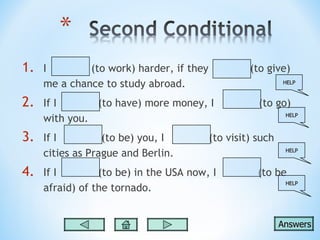
*   Second Conditional
               *   Pattern
               * Use
*   Third Conditional
               * Pattern
               * Use
*   Test
*   Answers
               * Zero Conditional
               * First Conditional
               * Second Conditional
               * Third Conditional
               * Test
*   Additional materials
*      Zero Conditional is formed in this way:

     If + Present Simple, Present Simple
     If you want to study in USA, you have to pass an exam in English.

    We use the Zero Conditional to describe rules, situations where one event
       always follows the other and eternal truths.

    We use the zero conditional to talk about events or situations that can occur at
       any time, and often occur more than once, and their results.
    We also use the zero conditional to talk about actions which always have the
        same result.
    In Zero Conditional sentences If can be replaced by When without violating the
        meaning.

If/When I eat dairy products, I get red spots on my skin.
If/When can be replaced by when in this type of conditional sentence:

If/When you press this key, the game starts, and when you click here, it stops.
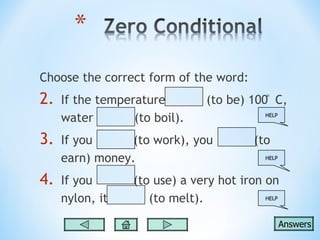
Choose the correct form of the word:
2.   If the temperature         (to be) 100 ̊ C,
     water        (to boil).                HELP


3.   If you      (to work), you          (to
     earn) money.                           HELP


4.   If you       (to use) a very hot iron on
     nylon, it       (to melt).            HELP


                                                   Answers
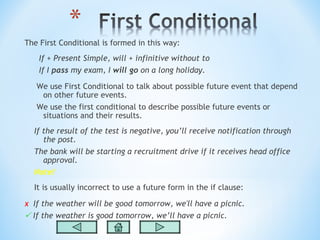
The First Conditional is formed in this way:
    If + Present Simple, will + infinitive without to
    If I pass my exam, I will go on a long holiday.

   We use First Conditional to talk about possible future event that depend
    on other future events.
   We use the first conditional to describe possible future events or
    situations and their results.
  If the result of the test is negative, you’ll receive notification through
     the post.
  The bank will be starting a recruitment drive if it receives head office
     approval.
  Note!
  It is usually incorrect to use a future form in the if clause:

x  If the weather will be good tomorrow, we'll have a picnic.
 If the weather is good tomorrow, we’ll have a picnic.
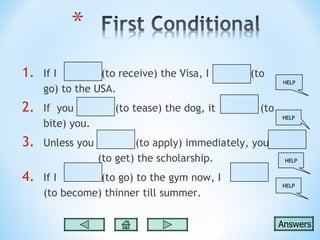
1.   If I        (to receive) the Visa, I        (to
                                                         HELP
     go) to the USA.
2.   If you          (to tease) the dog, it        (to
                                                         HELP
     bite) you.
3.   Unless you           (to apply) immediately, you
                  (to get) the scholarship.               HELP


4.   If I       (to go) to the gym now, I
                                                         HELP
     (to become) thinner till summer.

                                                         Answers
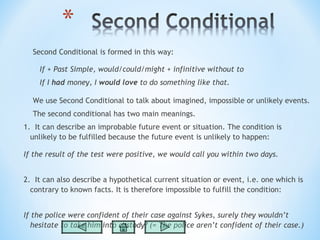
Second Conditional is formed in this way:

    If + Past Simple, would/could/might + infinitive without to
    If I had money, I would love to do something like that.

  We use Second Conditional to talk about imagined, impossible or unlikely events.
  The second conditional has two main meanings.
1.  It can describe an improbable future event or situation. The condition is
  unlikely to be fulfilled because the future event is unlikely to happen:

If the result of the test were positive, we would call you within two days.


2.  It can also describe a hypothetical current situation or event, i.e. one which is
  contrary to known facts. It is therefore impossible to fulfill the condition:


If the police were confident of their case against Sykes, surely they wouldn’t
   hesitate to take him into custody? (= The police aren’t confident of their case.)
1.   I        (to work) harder, if they            (to give)
     me a chance to study abroad.                           HELP


2.   If I      (to have) more money, I               (to go)
                                                             HELP
     with you.
3.   If I         (to be) you, I          (to visit) such
     cities as Prague and Berlin.                            HELP


4.   If I        (to be) in the USA now, I           (to be
                                                             HELP
     afraid) of the tornado.


                                                            Answers
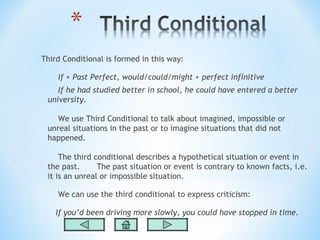
Third Conditional is formed in this way:

    If + Past Perfect, would/could/might + perfect infinitive
    If he had studied better in school, he could have entered a better
 university.

    We use Third Conditional to talk about imagined, impossible or
 unreal situations in the past or to imagine situations that did not
 happened.

     The third conditional describes a hypothetical situation or event in
 the past.      The past situation or event is contrary to known facts, i.e.
 it is an unreal or impossible situation.

    We can use the third conditional to express criticism:

    If you’d been driving more slowly, you could have stopped in time.
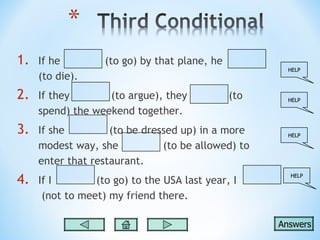
1.   If he         (to go) by that plane, he
                                                       HELP
     (to die).
2.   If they       (to argue), they            (to     HELP

     spend) the weekend together.
3.   If she         (to be dressed up) in a more       HELP

     modest way, she           (to be allowed) to
     enter that restaurant.
4.   If I        (to go) to the USA last year, I
                                                       HELP


      (not to meet) my friend there.

                                                     Answers
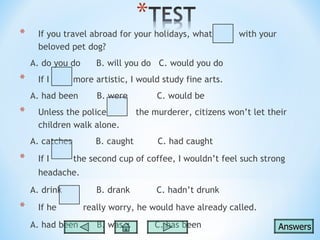
*     If you travel abroad for your holidays, what         with your
      beloved pet dog?
    A. do you do       B. will you do C. would you do
*     If I       more artistic, I would study fine arts.
    A. had been        B. were         C. would be
*     Unless the police           the murderer, citizens won’t let their
      children walk alone.
    A. catches        B. caught        C. had caught

*     If I       the second cup of coffee, I wouldn’t feel such strong
      headache.
    A. drink           B. drank        C. hadn’t drunk

*     If he        really worry, he would have already called.
    A. had been        B. was         C. has been                      Answers
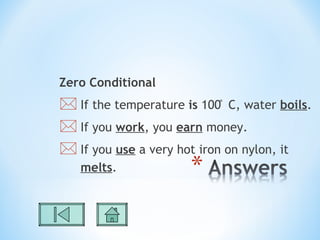
Zero Conditional
 If the temperature is 100 ̊ C, water boils.
 If you work, you earn money.
 If you use a very hot iron on nylon, it
   melts.
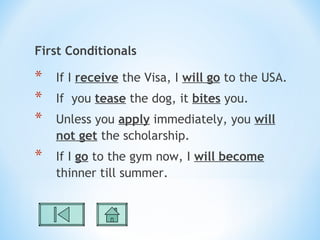
First Conditionals

*   If I receive the Visa, I will go to the USA.
*   If you tease the dog, it bites you.
*   Unless you apply immediately, you will
    not get the scholarship.
*   If I go to the gym now, I will become
    thinner till summer.
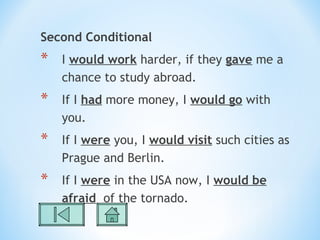
Second Conditional
*   I would work harder, if they gave me a
    chance to study abroad.
*   If I had more money, I would go with
    you.
*   If I were you, I would visit such cities as
    Prague and Berlin.
*   If I were in the USA now, I would be
    afraid of the tornado.
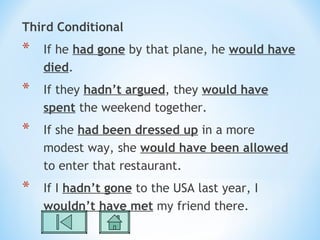
Third Conditional
*   If he had gone by that plane, he would have
    died.
*   If they hadn’t argued, they would have
    spent the weekend together.
*   If she had been dressed up in a more
    modest way, she would have been allowed
    to enter that restaurant.
*   If I hadn’t gone to the USA last year, I
    wouldn’t have met my friend there.
Test


1. A
2. B
3. A
4. C
5. A
* http://www.ego4u.com
* http://www.englishlanguageguide.com

Grammar book 1

  • 1.
  • 2.
    *There are severalstructures in English that are called conditionals. *Conditional sentences usually consist of two clauses: a conditional clause (or if clause) and a main clause (or result clause). *The result in the main clause is dependent on the condition in the conditional clause. This unit looks at the basic types of conditional sentence, and some variations on these, and introduces a number of words and phrases used to express conditions.
  • 3.
    * Zero Conditional * Pattern * Use * First Conditional * Pattern * Use * Second Conditional * Pattern * Use * Third Conditional * Pattern * Use * Test * Answers * Zero Conditional * First Conditional * Second Conditional * Third Conditional * Test * Additional materials
  • 4.
    * Zero Conditional is formed in this way: If + Present Simple, Present Simple If you want to study in USA, you have to pass an exam in English. We use the Zero Conditional to describe rules, situations where one event always follows the other and eternal truths. We use the zero conditional to talk about events or situations that can occur at any time, and often occur more than once, and their results. We also use the zero conditional to talk about actions which always have the same result. In Zero Conditional sentences If can be replaced by When without violating the meaning. If/When I eat dairy products, I get red spots on my skin. If/When can be replaced by when in this type of conditional sentence: If/When you press this key, the game starts, and when you click here, it stops.
  • 5.
    Choose the correctform of the word: 2. If the temperature (to be) 100 ̊ C, water (to boil). HELP 3. If you (to work), you (to earn) money. HELP 4. If you (to use) a very hot iron on nylon, it (to melt). HELP Answers
  • 6.
    The First Conditionalis formed in this way: If + Present Simple, will + infinitive without to If I pass my exam, I will go on a long holiday. We use First Conditional to talk about possible future event that depend on other future events. We use the first conditional to describe possible future events or situations and their results. If the result of the test is negative, you’ll receive notification through the post. The bank will be starting a recruitment drive if it receives head office approval. Note! It is usually incorrect to use a future form in the if clause: x  If the weather will be good tomorrow, we'll have a picnic.  If the weather is good tomorrow, we’ll have a picnic.
  • 7.
    1. If I (to receive) the Visa, I (to HELP go) to the USA. 2. If you (to tease) the dog, it (to HELP bite) you. 3. Unless you (to apply) immediately, you (to get) the scholarship. HELP 4. If I (to go) to the gym now, I HELP (to become) thinner till summer. Answers
  • 8.
    Second Conditional isformed in this way: If + Past Simple, would/could/might + infinitive without to If I had money, I would love to do something like that. We use Second Conditional to talk about imagined, impossible or unlikely events. The second conditional has two main meanings. 1.  It can describe an improbable future event or situation. The condition is unlikely to be fulfilled because the future event is unlikely to happen: If the result of the test were positive, we would call you within two days. 2.  It can also describe a hypothetical current situation or event, i.e. one which is contrary to known facts. It is therefore impossible to fulfill the condition: If the police were confident of their case against Sykes, surely they wouldn’t hesitate to take him into custody? (= The police aren’t confident of their case.)
  • 9.
    1. I (to work) harder, if they (to give) me a chance to study abroad. HELP 2. If I (to have) more money, I (to go) HELP with you. 3. If I (to be) you, I (to visit) such cities as Prague and Berlin. HELP 4. If I (to be) in the USA now, I (to be HELP afraid) of the tornado. Answers
  • 10.
    Third Conditional isformed in this way: If + Past Perfect, would/could/might + perfect infinitive If he had studied better in school, he could have entered a better university. We use Third Conditional to talk about imagined, impossible or unreal situations in the past or to imagine situations that did not happened. The third conditional describes a hypothetical situation or event in the past. The past situation or event is contrary to known facts, i.e. it is an unreal or impossible situation. We can use the third conditional to express criticism: If you’d been driving more slowly, you could have stopped in time.
  • 11.
    1. If he (to go) by that plane, he HELP (to die). 2. If they (to argue), they (to HELP spend) the weekend together. 3. If she (to be dressed up) in a more HELP modest way, she (to be allowed) to enter that restaurant. 4. If I (to go) to the USA last year, I HELP (not to meet) my friend there. Answers
  • 12.
    * If you travel abroad for your holidays, what with your beloved pet dog? A. do you do B. will you do C. would you do * If I more artistic, I would study fine arts. A. had been B. were C. would be * Unless the police the murderer, citizens won’t let their children walk alone. A. catches B. caught C. had caught * If I the second cup of coffee, I wouldn’t feel such strong headache. A. drink B. drank C. hadn’t drunk * If he really worry, he would have already called. A. had been B. was C. has been Answers
  • 13.
    Zero Conditional  Ifthe temperature is 100 ̊ C, water boils.  If you work, you earn money.  If you use a very hot iron on nylon, it melts.
  • 14.
    First Conditionals * If I receive the Visa, I will go to the USA. * If you tease the dog, it bites you. * Unless you apply immediately, you will not get the scholarship. * If I go to the gym now, I will become thinner till summer.
  • 15.
    Second Conditional * I would work harder, if they gave me a chance to study abroad. * If I had more money, I would go with you. * If I were you, I would visit such cities as Prague and Berlin. * If I were in the USA now, I would be afraid of the tornado.
  • 16.
    Third Conditional * If he had gone by that plane, he would have died. * If they hadn’t argued, they would have spent the weekend together. * If she had been dressed up in a more modest way, she would have been allowed to enter that restaurant. * If I hadn’t gone to the USA last year, I wouldn’t have met my friend there.
  • 17.
    Test 1. A 2. B 3.A 4. C 5. A
  • 18.