ENGLISH CONDITIONALS


 "Condition" means "situation or circumstance". If a particular condition is true, then a
particular result happens. There are three basic conditionals that we use very often in
English.

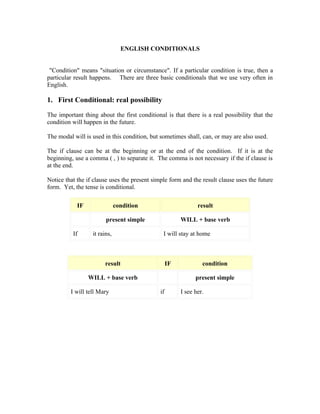
1. First Conditional: real possibility

The important thing about the first conditional is that there is a real possibility that the
condition will happen in the future.

The modal will is used in this condition, but sometimes shall, can, or may are also used.

The if clause can be at the beginning or at the end of the condition. If it is at the
beginning, use a comma ( , ) to separate it. The comma is not necessary if the if clause is
at the end.

Notice that the if clause uses the present simple form and the result clause uses the future
form. Yet, the tense is conditional.

            IF                condition                        result

                        present simple                  WILL + base verb

          If      it rains,                    I will stay at home


                       result                      IF            condition

                 WILL + base verb                             present simple

         I will tell Mary                     if        I see her.
A. Think of particular situations or conditions in the future to use the first conditional.

1._____________________________________________________________________

2. ____________________________________________________________________

3. ____________________________________________________________________

4. ___________________________________________________________________


B. Circle the answer that best completes each sentence.

1. If you ________ an apple every day, you'll be very healthy.
a) will eat                  b) eat

2. If we don't protect the elephant, it ________ extinct.
a) becomes              b) will become

3. She ________ completely different if she cuts her hair.
a) will look       b) looks

4. You'll pay higher insurance if you ________ a sports car.
a) buy                       b) will buy

5. You ________ better if you turn on the lamp.
a) are able to see          b) will be able to see

6. If I ________ some eggs, how many ________?
a) cook … will you eat       b) will cook … do you eat
C.   Write sentences using the first conditional. Use the words given in the correct order.
     Example:
the weather / be good we / go /to the beach tomorrow
     If the weather is good, we will go to the beach tomorrow.

        1. you / go / to school on foot / you / be / late

___________________________________________________________________

       2. I / have / money / I / buy / you a present

___________________________________________________________________

       3. I / do / my homework / I / find / my notebook

___________________________________________________________________

        4. My mom / give / me five pounds / I / do / the washing-up

___________________________________________________________________

       5. We / spend / our holidays in Spain / we / visit / Valencia

___________________________________________________________________
2.      Second Conditional: unreal possibility or dream

We are thinking about a particular condition in the future and the result of this condition.
But, there is not a real possibility that this condition will happen.

The if clause can be at the beginning or at the end of the condition. If it is at the
beginning, use a comma ( , ) to separate it. The comma is not necessary if the if clause is
at the end.

Notice that the if clause uses the past simple form and the result clause uses would. Yet,
the tense is conditional.

Sometimes we use should ,could, and might instead of would in the result clause.

       IF            condition                                  result

                    past simple                      WOULD + base verb

      If    I won the lottery,             I would buy a car.


                     result                  IF                  condition

             WOULD + base verb                                  past simple

      I would be happy                      if    I married Mary.

D. Fill the gap using the verb in brackets. Use the second conditional. 5 gaps need a
NEGATIVE verb!
1.   I ___________________ that if I were you. It's bad luck. (to do)
2.   They'd be a better team if they ___________________ fitter. (to be)
3.   If I had some spare money, I ___________________ a DVD player. (to buy)
4.   Those children ___________________ so horrible if their parents were stricter. (to be)
5.   I wouldn't go out with him even if you ___________________ me. (to pay)
6.   If we ___________________ so hard, we wouldn't be so tired all the time. (to work)
7.   If she didn't take so long in the shower, she ___________________ more time for breakfast.
     (to have)
8.   If you ___________________ so much beer, you wouldn't be so fat. (to drink)
9.      The world ___________________ a better place if politicians were less vain. (to be)
10.     I ___________________ to visit Thailand if I had the chance. (to love)

E. Complete by using the second conditional. Use the verbs in parentheses.

1. If we (have) ______________a yacht, we (sail) ______________the seven seas.
2. If he (have) ______________more time, he (learn) ______________karate.
3. If they (tell) ______________their father, he (be) ______________very angry.
4. She (spend) ______________a year in the USA if it (be) ______________easier to get a green
card.
5. If I (live) ______________on a lonely island, I (run) ______________around naked all day.
6. We (help) ______________you if we (know) ______________how.
7. My brother (buy) ______________a sports car if he (have) ______________the money.
8. If I (feel) ______________better, I (go) ______________to the cinema with you.
9. If you (go) ______________by bike more often, you (be / not) ______________so flabby.
10. She (not / talk) ______________to you if she (be) ______________mad at you.


F. Complete the sentences by using second conditional. Answers vary.

1. If I were taller ___________________________________________________
2. If I didn’t feel so ill _______________________________________________
3. I would marry her tomorrow _______________________________________
4. I would buy a new computer _______________________________________
5. If I had enough money _____________________________________________
6. If you apologized _________________________________________________
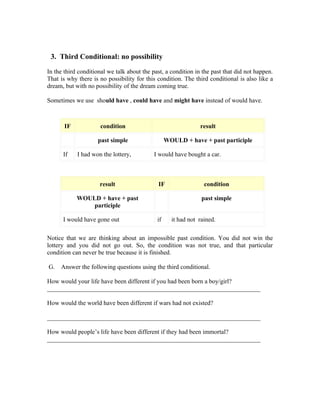
3. Third Conditional: no possibility

In the third conditional we talk about the past, a condition in the past that did not happen.
That is why there is no possibility for this condition. The third conditional is also like a
dream, but with no possibility of the dream coming true.

Sometimes we use should have , could have and might have instead of would have.


       IF            condition                                 result

                    past simple                   WOULD + have + past participle

      If    I had won the lottery,          I would have bought a car.


                     result                  IF                  condition

            WOULD + have + past                                 past simple
                participle

      I would have gone out                  if     it had not rained.

Notice that we are thinking about an impossible past condition. You did not win the
lottery and you did not go out. So, the condition was not true, and that particular
condition can never be true because it is finished.

G.   Answer the following questions using the third conditional.

How would your life have been different if you had been born a boy/girl?
____________________________________________________________________

How would the world have been different if wars had not existed?

____________________________________________________________________

How would people’s life have been different if they had been immortal?
____________________________________________________________________

English iii, conditionals 1

  • 1.
    ENGLISH CONDITIONALS "Condition"means "situation or circumstance". If a particular condition is true, then a particular result happens. There are three basic conditionals that we use very often in English. 1. First Conditional: real possibility The important thing about the first conditional is that there is a real possibility that the condition will happen in the future. The modal will is used in this condition, but sometimes shall, can, or may are also used. The if clause can be at the beginning or at the end of the condition. If it is at the beginning, use a comma ( , ) to separate it. The comma is not necessary if the if clause is at the end. Notice that the if clause uses the present simple form and the result clause uses the future form. Yet, the tense is conditional. IF condition result present simple WILL + base verb If it rains, I will stay at home result IF condition WILL + base verb present simple I will tell Mary if I see her.
  • 2.
    A. Think ofparticular situations or conditions in the future to use the first conditional. 1._____________________________________________________________________ 2. ____________________________________________________________________ 3. ____________________________________________________________________ 4. ___________________________________________________________________ B. Circle the answer that best completes each sentence. 1. If you ________ an apple every day, you'll be very healthy. a) will eat b) eat 2. If we don't protect the elephant, it ________ extinct. a) becomes b) will become 3. She ________ completely different if she cuts her hair. a) will look b) looks 4. You'll pay higher insurance if you ________ a sports car. a) buy b) will buy 5. You ________ better if you turn on the lamp. a) are able to see b) will be able to see 6. If I ________ some eggs, how many ________? a) cook … will you eat b) will cook … do you eat
  • 3.
    C. Write sentences using the first conditional. Use the words given in the correct order. Example: the weather / be good we / go /to the beach tomorrow If the weather is good, we will go to the beach tomorrow. 1. you / go / to school on foot / you / be / late ___________________________________________________________________ 2. I / have / money / I / buy / you a present ___________________________________________________________________ 3. I / do / my homework / I / find / my notebook ___________________________________________________________________ 4. My mom / give / me five pounds / I / do / the washing-up ___________________________________________________________________ 5. We / spend / our holidays in Spain / we / visit / Valencia ___________________________________________________________________
  • 4.
    2. Second Conditional: unreal possibility or dream We are thinking about a particular condition in the future and the result of this condition. But, there is not a real possibility that this condition will happen. The if clause can be at the beginning or at the end of the condition. If it is at the beginning, use a comma ( , ) to separate it. The comma is not necessary if the if clause is at the end. Notice that the if clause uses the past simple form and the result clause uses would. Yet, the tense is conditional. Sometimes we use should ,could, and might instead of would in the result clause. IF condition result past simple WOULD + base verb If I won the lottery, I would buy a car. result IF condition WOULD + base verb past simple I would be happy if I married Mary. D. Fill the gap using the verb in brackets. Use the second conditional. 5 gaps need a NEGATIVE verb! 1. I ___________________ that if I were you. It's bad luck. (to do) 2. They'd be a better team if they ___________________ fitter. (to be) 3. If I had some spare money, I ___________________ a DVD player. (to buy) 4. Those children ___________________ so horrible if their parents were stricter. (to be) 5. I wouldn't go out with him even if you ___________________ me. (to pay) 6. If we ___________________ so hard, we wouldn't be so tired all the time. (to work) 7. If she didn't take so long in the shower, she ___________________ more time for breakfast. (to have) 8. If you ___________________ so much beer, you wouldn't be so fat. (to drink)
  • 5.
    9. The world ___________________ a better place if politicians were less vain. (to be) 10. I ___________________ to visit Thailand if I had the chance. (to love) E. Complete by using the second conditional. Use the verbs in parentheses. 1. If we (have) ______________a yacht, we (sail) ______________the seven seas. 2. If he (have) ______________more time, he (learn) ______________karate. 3. If they (tell) ______________their father, he (be) ______________very angry. 4. She (spend) ______________a year in the USA if it (be) ______________easier to get a green card. 5. If I (live) ______________on a lonely island, I (run) ______________around naked all day. 6. We (help) ______________you if we (know) ______________how. 7. My brother (buy) ______________a sports car if he (have) ______________the money. 8. If I (feel) ______________better, I (go) ______________to the cinema with you. 9. If you (go) ______________by bike more often, you (be / not) ______________so flabby. 10. She (not / talk) ______________to you if she (be) ______________mad at you. F. Complete the sentences by using second conditional. Answers vary. 1. If I were taller ___________________________________________________ 2. If I didn’t feel so ill _______________________________________________ 3. I would marry her tomorrow _______________________________________ 4. I would buy a new computer _______________________________________ 5. If I had enough money _____________________________________________ 6. If you apologized _________________________________________________
  • 6.
    3. Third Conditional:no possibility In the third conditional we talk about the past, a condition in the past that did not happen. That is why there is no possibility for this condition. The third conditional is also like a dream, but with no possibility of the dream coming true. Sometimes we use should have , could have and might have instead of would have. IF condition result past simple WOULD + have + past participle If I had won the lottery, I would have bought a car. result IF condition WOULD + have + past past simple participle I would have gone out if it had not rained. Notice that we are thinking about an impossible past condition. You did not win the lottery and you did not go out. So, the condition was not true, and that particular condition can never be true because it is finished. G. Answer the following questions using the third conditional. How would your life have been different if you had been born a boy/girl? ____________________________________________________________________ How would the world have been different if wars had not existed? ____________________________________________________________________ How would people’s life have been different if they had been immortal? ____________________________________________________________________