Conditional Sentences
in English
Conditionals
• The conditionals are used to talk about real or
unreal situations, sometimes called… if-clauses.
• Used to show an action is reliant on
something else.
• Real Conditional describes real-life situations.
• Unreal Conditional describes unreal, imaginary
situations.
Conditional Sentences
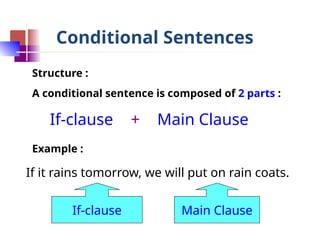
Structure :
A conditional sentence is composed of 2 parts :
If-clause + Main Clause
Example :
If it rains tomorrow, we will put on rain coats.
If-clause Main Clause
Conditional Sentences
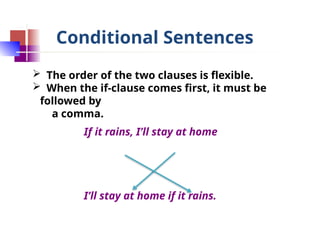
 The order of the two clauses is flexible.
 When the if-clause comes first, it must be
followed by
a comma.
If it rains, I’ll stay at home
I’ll stay at home if it rains.
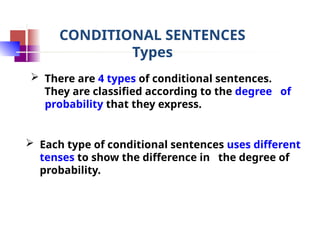
CONDITIONAL SENTENCES
Types
 There are 4 types of conditional sentences.
They are classified according to the degree of
probability that they express.
 Each type of conditional sentences uses different
tenses to show the difference in the degree of
probability.
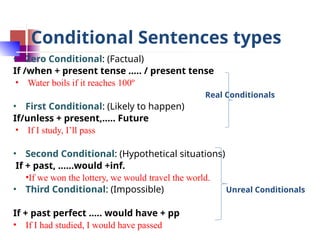
• Zero Conditional: (Factual)
If /when + present tense ….. / present tense
• Water boils if it reaches 100º
Real Conditionals
• First Conditional: (Likely to happen)
If/unless + present,….. Future
• If I study, I’ll pass
• Second Conditional: (Hypothetical situations)
If + past, ……would +inf.
•If we won the lottery, we would travel the world.
• Third Conditional: (Impossible) Unreal Conditionals
If + past perfect ….. would have + pp
• If I had studied, I would have passed
Conditional Sentences types
ZERO Conditional
• It is used to talk about things that
are always true or factual (Scientific
Facts, General or Universal Truths).
(present simple + present simple)
If you expose phosphorous to air, it
burns.
More Examples
1. If people eat too much, they get fat.
2. If you touch a fire, you get burned.
3. People die if they don't eat.
4. You get water if you mix hydrogen and
oxygen.
5. Snakes bite if they are scared
6. If babies are hungry, they cry
Practice
1. (I / wake up late / I / be late for work)
2. (my husband / cook / he / burn the food)
3. (Julie / not wear a hat / she / get
sunstroke)
4. (children / not eat well / they / not be
healthy)
5. (you / mix water and electricity / you /
get a shock)
Answers
1. If I wake up late, I’m late for work.
2. If my husband cooks, he burns the food.
3. If Julie doesn’t wear a hat, she gets
sunstroke.
4. If children don’t eat well, they aren’t
healthy.
5. If you mix water and electricity, you get a
shock.
First Conditional
(VERY LIKELY SITUATIONS)
It is used to:
1. Talk about situations which are very likely to
happen
2. Giving advice and instructions
3. Suggest something which is unlikely to happen
4. Talk about the result of a situation which is just a
possibility
5. Talk about present decisions based on future
abilities
a) If + Simple present + will
Both condition and result are very likely to happen
If Javaid gets a good result, he will study medicine.
If he fails his exams, he will not go abroad.
b) If + Simple present + Imperative
This is a way of giving advice or instructions
If you feel tired, drink a cup of coffee.
If you can't wake up, buy an alarm clock.
If you see my wife, tell her I'll be late for dinner.
Possible sentence structures
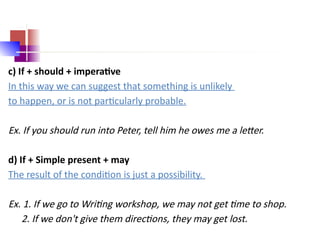
c) If + should + imperative
In this way we can suggest that something is unlikely
to happen, or is not particularly probable.
Ex. If you should run into Peter, tell him he owes me a letter.
d) If + Simple present + may
The result of the condition is just a possibility.
Ex. 1. If we go to Writing workshop, we may not get time to shop.
2. If we don't give them directions, they may get lost.
e. If + Simple present + can/ would
We use this form when we make present
decisions
about future ability. Otherwise we use will
be able to.
Ex.
1. If I haven't enough time today, I can wash
your car tomorrow.
Sentence structures in First
conditional
Functions
1 If+ Simple present + will Both conditions or results are
very likely to happen
2 If + Simple present + Imperative Giving Advice or Instructions
3 If + should+ imperative To suggest that something is
unlikely to happen
4 If + simple present + may The result of the condition is just
a possibility
5 If + Simple present + can To talk about present decisions
based on future ability
Practice
Write two sentences for each
function
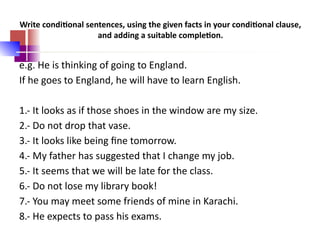
Write conditional sentences, using the given facts in your conditional clause,
and adding a suitable completion.
e.g. He is thinking of going to England.
If he goes to England, he will have to learn English.
1.- It looks as if those shoes in the window are my size.
2.- Do not drop that vase.
3.- It looks like being fine tomorrow.
4.- My father has suggested that I change my job.
5.- It seems that we will be late for the class.
6.- Do not lose my library book!
7.- You may meet some friends of mine in Karachi.
8.- He expects to pass his exams.
1) If those shoes in the window are of my size, I will buy them.
2) If you drop that vase, it will break.
3) If it is fine tomorrow, we will go for a walk.
4) If I change my job, I might find a better opportunity.
5) If we do not leave now, we will be late for the class.
6) If you lose my library book, you will have to replace it.
7) If you go to Karachi, you may meet some friends of mine.
8) If he studies hard, he will pass his exams.
Second Conditional
(Hypothetical Situations)
• It is used to talk about unreal or impossible
situation in present or Future. These
structures are used to imagine what would
it be like if things were different.
Ex.
If I were rich, I would travel around the world.
If I have a car, I could drive you home.
a) If + Simple past + would
If I were the president, I would end unemployment.
If I won the lottery, I would buy a Ferrari
If I were you, I'd start packing now.
b) If + Simple past + might
The result of the condition would be just a possibility
Ex.
If you drove with drowsy head, you might have an
accident
If you were not so selfish, you might be happier
c) If + Simple past + could (the meaning of could
here is would be able to).
Ex.
1) If I had another 1000 Rs, I could buy the latest
edition of this book.
d) If + were to + would
This makes a future possibility sound less
probable
Ex. If world war were to break out, I would
emigrate to Mars.
Possible sentence
structure for 2nd
conditionals
Function
1 If+ simple past+ would To imagine what would it be like if things
were different
2 If + simple past +might The result of a condition (in past) would be
just a possibility
3 If + simple past + could To talk about a past ability with a
hypothetical condition
4 If were to + would To talk about a less probable future
possibility
Practice
Complete these 2nd
conditional
sentences
1. If you _______________ (leave) your job,
you ________________ (travel) around the
world.
2. If you _____________ (be) nicer to him, he
____________________(lend) you the money
3. It _________________(be) nice if the rain
____________________(stop)!
Exercise
Answer the following sentences with 2nd
conditional sentences.
1. What cities or other places of interest would you
visit if you went to America?
2. What would you do (or not do) if you could live
your life over again?
3. What famous person would you like to meet if
you had the chance?
THIRD Conditional
• It is used to talk about conditions which didn’t
happen in the past, and so the result did not
happen either. It is used for speculating about
past events.
1. If you hadn’t been lazy, you would have been
on time for the audition.
2. If he had come earlier, he could have had a
free lunch.
a) If + Past perfect + Perfect conditional
Ex. If he had studied, he would have passed.
b) If + Past perfect + might have
Ex. If someone had heard the S.O.S., their lives might
have been saved.
c) If + Past perfect + could have (Could have been
means here able to)
Ex. If my parents had not been poor, I could have gone
to university
Possible sentence
structures
Functions
1 If + Past perfect + perfect
conditional (would have)
1. These structures are used to
talk about the conditions which
did not happen in past
2. These structures are used to
talk about past regrets and to
criticize past actions
2 If + Past perfect + might have
3 If + Past perfect + could have
Practice
Complete these sentences
1. He crashed his car, because he fell asleep while driving.
If he _______ asleep while driving, he __________ his car.
2. We couldn't go to the concert, because we didn't have enough
money.
If we __________ enough money, we ____________ to the
concert.
3. I lost my job because I was late for work.
I _____________ my job if I ___________ late for work.
4. The wind was so strong that the bridge collapsed.
If the wind _______________so strong, the bridge
_____________________ .
5. I couldn't call Sally because I had lost her number.
I __________________ Sally if I ________________ her
number.
1) If he had not fallen asleep while
driving, he would not have crashed his
car.
2) If we had had enough money, we
could have gone to the concert.
3) I would not have lost my job if I had
not been late for work.
4) If the wind had not been so strong, the
bridge would not have collapsed.
5) I would have called Sally if I had not
lost her number.
Make 3rd
Conditional sentences
1. Nobody told me about your birthday, and
so I asked you to have an official tour out
of city.
2. There was no chance of rescuing
survivors, and so they called off the
search.
3. Ali was suddenly taken ill, and so he and
his family did not go on holiday to Muree
Hills.
If somebody had told me about your
birthday, I wouldn’t have asked you to have
an official tour out of the city.
If there had been a chance of rescuing
survivors, they wouldn’t have called off the
search.
If Ali hadn’t been suddenly taken ill, he and
his family would have gone on holiday to
Murree Hills.
Conditional Probability Example Time
zero Certain
If you heat water to 100 degrees
Celsius, it boils
any time
first Likely If it rains, I will stay in. future
second Unlikely If I won the lottery, I would retire. future
second Impossible
If I had the money, I would lend it to
you
present
third Impossible
If I had seen him, I would have
given him the message.
past
Thanks!!!

conditional sentences.pptx clarity structure

  • 1.
  • 2.
    Conditionals • The conditionalsare used to talk about real or unreal situations, sometimes called… if-clauses. • Used to show an action is reliant on something else. • Real Conditional describes real-life situations. • Unreal Conditional describes unreal, imaginary situations.
  • 3.
    Conditional Sentences Structure : Aconditional sentence is composed of 2 parts : If-clause + Main Clause Example : If it rains tomorrow, we will put on rain coats. If-clause Main Clause
  • 4.
    Conditional Sentences  Theorder of the two clauses is flexible.  When the if-clause comes first, it must be followed by a comma. If it rains, I’ll stay at home I’ll stay at home if it rains.
  • 5.
    CONDITIONAL SENTENCES Types  Thereare 4 types of conditional sentences. They are classified according to the degree of probability that they express.  Each type of conditional sentences uses different tenses to show the difference in the degree of probability.
  • 6.
    • Zero Conditional:(Factual) If /when + present tense ….. / present tense • Water boils if it reaches 100º Real Conditionals • First Conditional: (Likely to happen) If/unless + present,….. Future • If I study, I’ll pass • Second Conditional: (Hypothetical situations) If + past, ……would +inf. •If we won the lottery, we would travel the world. • Third Conditional: (Impossible) Unreal Conditionals If + past perfect ….. would have + pp • If I had studied, I would have passed Conditional Sentences types
  • 7.
    ZERO Conditional • Itis used to talk about things that are always true or factual (Scientific Facts, General or Universal Truths). (present simple + present simple) If you expose phosphorous to air, it burns.
  • 8.
    More Examples 1. Ifpeople eat too much, they get fat. 2. If you touch a fire, you get burned. 3. People die if they don't eat. 4. You get water if you mix hydrogen and oxygen. 5. Snakes bite if they are scared 6. If babies are hungry, they cry
  • 9.
    Practice 1. (I /wake up late / I / be late for work) 2. (my husband / cook / he / burn the food) 3. (Julie / not wear a hat / she / get sunstroke) 4. (children / not eat well / they / not be healthy) 5. (you / mix water and electricity / you / get a shock)
  • 10.
    Answers 1. If Iwake up late, I’m late for work. 2. If my husband cooks, he burns the food. 3. If Julie doesn’t wear a hat, she gets sunstroke. 4. If children don’t eat well, they aren’t healthy. 5. If you mix water and electricity, you get a shock.
  • 11.
    First Conditional (VERY LIKELYSITUATIONS) It is used to: 1. Talk about situations which are very likely to happen 2. Giving advice and instructions 3. Suggest something which is unlikely to happen 4. Talk about the result of a situation which is just a possibility 5. Talk about present decisions based on future abilities
  • 12.
    a) If +Simple present + will Both condition and result are very likely to happen If Javaid gets a good result, he will study medicine. If he fails his exams, he will not go abroad. b) If + Simple present + Imperative This is a way of giving advice or instructions If you feel tired, drink a cup of coffee. If you can't wake up, buy an alarm clock. If you see my wife, tell her I'll be late for dinner. Possible sentence structures
  • 13.
    c) If +should + imperative In this way we can suggest that something is unlikely to happen, or is not particularly probable. Ex. If you should run into Peter, tell him he owes me a letter. d) If + Simple present + may The result of the condition is just a possibility. Ex. 1. If we go to Writing workshop, we may not get time to shop. 2. If we don't give them directions, they may get lost.
  • 14.
    e. If +Simple present + can/ would We use this form when we make present decisions about future ability. Otherwise we use will be able to. Ex. 1. If I haven't enough time today, I can wash your car tomorrow.
  • 15.
    Sentence structures inFirst conditional Functions 1 If+ Simple present + will Both conditions or results are very likely to happen 2 If + Simple present + Imperative Giving Advice or Instructions 3 If + should+ imperative To suggest that something is unlikely to happen 4 If + simple present + may The result of the condition is just a possibility 5 If + Simple present + can To talk about present decisions based on future ability
  • 16.
  • 17.
    Write conditional sentences,using the given facts in your conditional clause, and adding a suitable completion. e.g. He is thinking of going to England. If he goes to England, he will have to learn English. 1.- It looks as if those shoes in the window are my size. 2.- Do not drop that vase. 3.- It looks like being fine tomorrow. 4.- My father has suggested that I change my job. 5.- It seems that we will be late for the class. 6.- Do not lose my library book! 7.- You may meet some friends of mine in Karachi. 8.- He expects to pass his exams.
  • 18.
    1) If thoseshoes in the window are of my size, I will buy them. 2) If you drop that vase, it will break. 3) If it is fine tomorrow, we will go for a walk. 4) If I change my job, I might find a better opportunity. 5) If we do not leave now, we will be late for the class. 6) If you lose my library book, you will have to replace it. 7) If you go to Karachi, you may meet some friends of mine. 8) If he studies hard, he will pass his exams.
  • 19.
    Second Conditional (Hypothetical Situations) •It is used to talk about unreal or impossible situation in present or Future. These structures are used to imagine what would it be like if things were different. Ex. If I were rich, I would travel around the world. If I have a car, I could drive you home.
  • 20.
    a) If +Simple past + would If I were the president, I would end unemployment. If I won the lottery, I would buy a Ferrari If I were you, I'd start packing now. b) If + Simple past + might The result of the condition would be just a possibility Ex. If you drove with drowsy head, you might have an accident If you were not so selfish, you might be happier
  • 21.
    c) If +Simple past + could (the meaning of could here is would be able to). Ex. 1) If I had another 1000 Rs, I could buy the latest edition of this book. d) If + were to + would This makes a future possibility sound less probable Ex. If world war were to break out, I would emigrate to Mars.
  • 22.
    Possible sentence structure for2nd conditionals Function 1 If+ simple past+ would To imagine what would it be like if things were different 2 If + simple past +might The result of a condition (in past) would be just a possibility 3 If + simple past + could To talk about a past ability with a hypothetical condition 4 If were to + would To talk about a less probable future possibility
  • 23.
  • 24.
    Complete these 2nd conditional sentences 1.If you _______________ (leave) your job, you ________________ (travel) around the world. 2. If you _____________ (be) nicer to him, he ____________________(lend) you the money 3. It _________________(be) nice if the rain ____________________(stop)!
  • 25.
    Exercise Answer the followingsentences with 2nd conditional sentences. 1. What cities or other places of interest would you visit if you went to America? 2. What would you do (or not do) if you could live your life over again? 3. What famous person would you like to meet if you had the chance?
  • 26.
    THIRD Conditional • Itis used to talk about conditions which didn’t happen in the past, and so the result did not happen either. It is used for speculating about past events. 1. If you hadn’t been lazy, you would have been on time for the audition. 2. If he had come earlier, he could have had a free lunch.
  • 27.
    a) If +Past perfect + Perfect conditional Ex. If he had studied, he would have passed. b) If + Past perfect + might have Ex. If someone had heard the S.O.S., their lives might have been saved. c) If + Past perfect + could have (Could have been means here able to) Ex. If my parents had not been poor, I could have gone to university
  • 28.
    Possible sentence structures Functions 1 If+ Past perfect + perfect conditional (would have) 1. These structures are used to talk about the conditions which did not happen in past 2. These structures are used to talk about past regrets and to criticize past actions 2 If + Past perfect + might have 3 If + Past perfect + could have
  • 29.
  • 30.
    Complete these sentences 1.He crashed his car, because he fell asleep while driving. If he _______ asleep while driving, he __________ his car. 2. We couldn't go to the concert, because we didn't have enough money. If we __________ enough money, we ____________ to the concert. 3. I lost my job because I was late for work. I _____________ my job if I ___________ late for work. 4. The wind was so strong that the bridge collapsed. If the wind _______________so strong, the bridge _____________________ . 5. I couldn't call Sally because I had lost her number. I __________________ Sally if I ________________ her number.
  • 31.
    1) If hehad not fallen asleep while driving, he would not have crashed his car. 2) If we had had enough money, we could have gone to the concert. 3) I would not have lost my job if I had not been late for work. 4) If the wind had not been so strong, the bridge would not have collapsed. 5) I would have called Sally if I had not lost her number.
  • 32.
    Make 3rd Conditional sentences 1.Nobody told me about your birthday, and so I asked you to have an official tour out of city. 2. There was no chance of rescuing survivors, and so they called off the search. 3. Ali was suddenly taken ill, and so he and his family did not go on holiday to Muree Hills.
  • 33.
    If somebody hadtold me about your birthday, I wouldn’t have asked you to have an official tour out of the city. If there had been a chance of rescuing survivors, they wouldn’t have called off the search. If Ali hadn’t been suddenly taken ill, he and his family would have gone on holiday to Murree Hills.
  • 34.
    Conditional Probability ExampleTime zero Certain If you heat water to 100 degrees Celsius, it boils any time first Likely If it rains, I will stay in. future second Unlikely If I won the lottery, I would retire. future second Impossible If I had the money, I would lend it to you present third Impossible If I had seen him, I would have given him the message. past
  • 35.