Going to
There is no one 'future tense' in English. There are 4 future forms. The one which is
used most often in spoken English is 'going to', not 'will'.
We use 'going to' when we want to talk about a plan for the future.






I'm going to see him later today.
They're going to launch it next month.
We're going to have lunch first.
She's going to see what she can do.
I'm not going to talk for very long.

Notice that this plan does not have to be for the near future.



When I retire I'm going to go back to Barbados to live.
In ten years time, I'm going to be boss of my own successful company.

We use 'going to' when we want to make a prediction based on evidence we can see
now.





Look out! That cup is going to fall off.
Look at those black clouds. It's going to rain soon.
These figures are really bad. We're going to make a loss.
You look very tired. You're going to need to stop soon.

We can replace 'going to go' by 'going'.



I'm going out later.
She's going to the exhibition tomorrow.
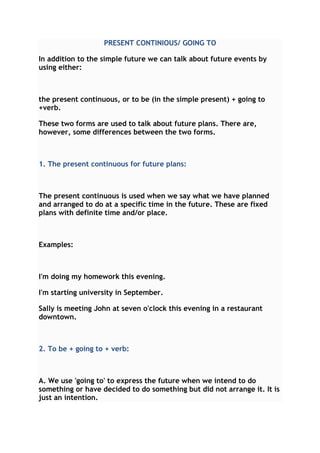
PRESENT CONTINIOUS/ GOING TO
In addition to the simple future we can talk about future events by
using either:

the present continuous, or to be (in the simple present) + going to
+verb.
These two forms are used to talk about future plans. There are,
however, some differences between the two forms.

1. The present continuous for future plans:

The present continuous is used when we say what we have planned
and arranged to do at a specific time in the future. These are fixed
plans with definite time and/or place.

Examples:

I'm doing my homework this evening.
I'm starting university in September.
Sally is meeting John at seven o'clock this evening in a restaurant
downtown.

2. To be + going to + verb:

A. We use 'going to' to express the future when we intend to do
something or have decided to do something but did not arrange it. It is
just an intention.
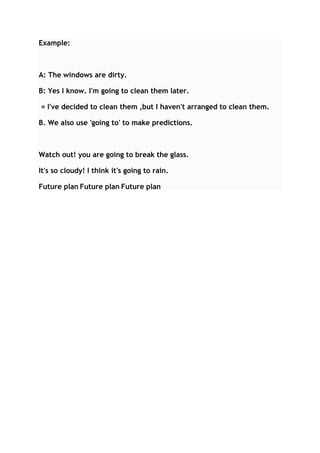
Example:

A: The windows are dirty.
B: Yes I know. I'm going to clean them later.
= I've decided to clean them ,but I haven't arranged to clean them.
B. We also use 'going to' to make predictions.

Watch out! you are going to break the glass.
It's so cloudy! I think it's going to rain.
Future plan Future plan Future plan

Grammar

  • 1.
    Going to There isno one 'future tense' in English. There are 4 future forms. The one which is used most often in spoken English is 'going to', not 'will'. We use 'going to' when we want to talk about a plan for the future.      I'm going to see him later today. They're going to launch it next month. We're going to have lunch first. She's going to see what she can do. I'm not going to talk for very long. Notice that this plan does not have to be for the near future.   When I retire I'm going to go back to Barbados to live. In ten years time, I'm going to be boss of my own successful company. We use 'going to' when we want to make a prediction based on evidence we can see now.     Look out! That cup is going to fall off. Look at those black clouds. It's going to rain soon. These figures are really bad. We're going to make a loss. You look very tired. You're going to need to stop soon. We can replace 'going to go' by 'going'.   I'm going out later. She's going to the exhibition tomorrow.
  • 2.
    PRESENT CONTINIOUS/ GOINGTO In addition to the simple future we can talk about future events by using either: the present continuous, or to be (in the simple present) + going to +verb. These two forms are used to talk about future plans. There are, however, some differences between the two forms. 1. The present continuous for future plans: The present continuous is used when we say what we have planned and arranged to do at a specific time in the future. These are fixed plans with definite time and/or place. Examples: I'm doing my homework this evening. I'm starting university in September. Sally is meeting John at seven o'clock this evening in a restaurant downtown. 2. To be + going to + verb: A. We use 'going to' to express the future when we intend to do something or have decided to do something but did not arrange it. It is just an intention.
  • 3.
    Example: A: The windowsare dirty. B: Yes I know. I'm going to clean them later. = I've decided to clean them ,but I haven't arranged to clean them. B. We also use 'going to' to make predictions. Watch out! you are going to break the glass. It's so cloudy! I think it's going to rain. Future plan Future plan Future plan