#talentbites
Marketing to Generation Z 
#talentbites 
Graeme Wright 
Director of Strategy, Havas People 
@Grey101
@Grey101 #talentbites
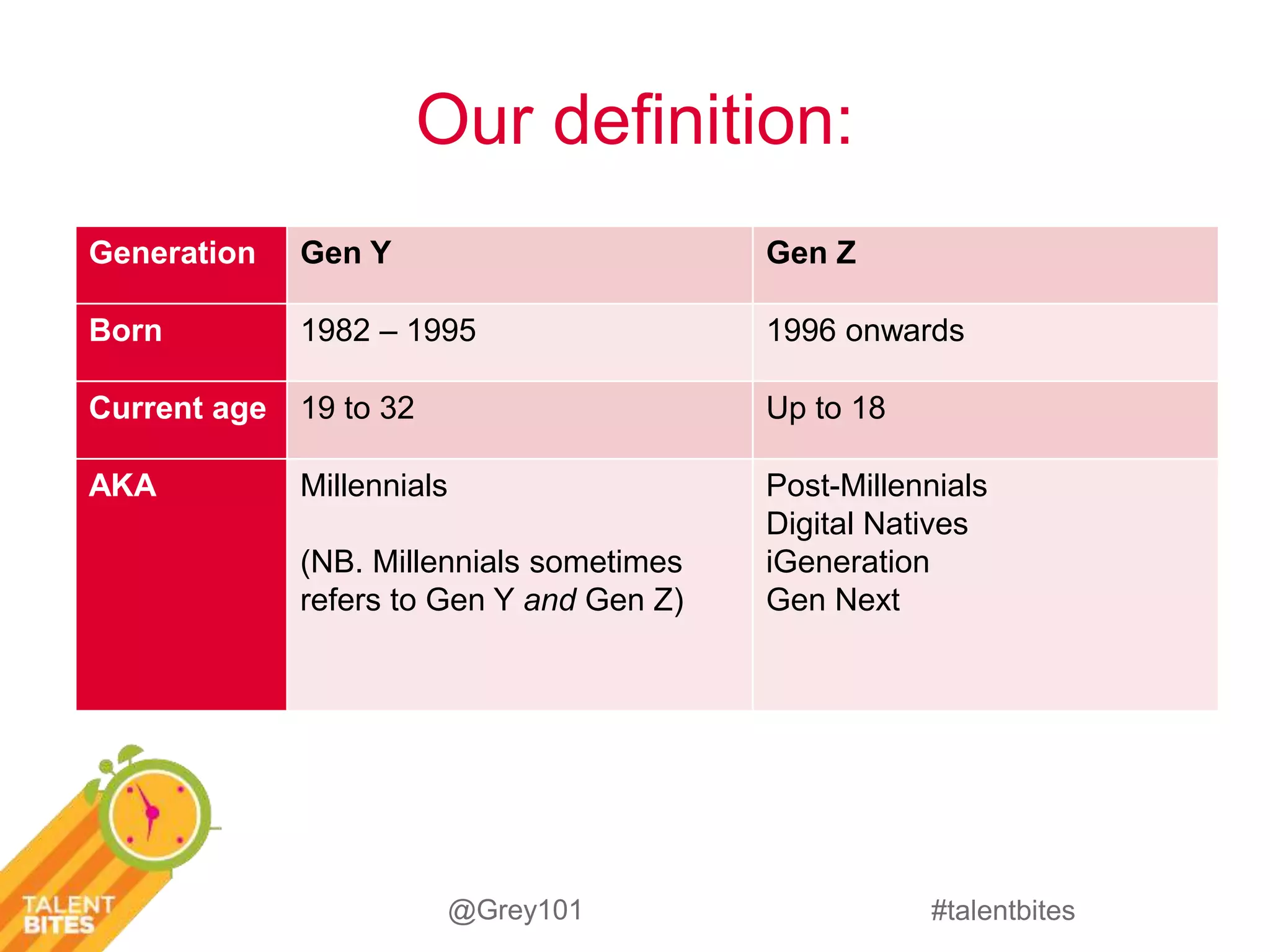
Born 1982 – 1995 1996 onwards 
#talentbites 
Our definition: 
Generation Gen Y Gen Z 
Current age 19 to 32 Up to 18 
@Grey101 
AKA Millennials 
(NB. Millennials sometimes 
refers to Gen Y and Gen Z) 
Post-Millennials 
Digital Natives 
iGeneration 
Gen Next
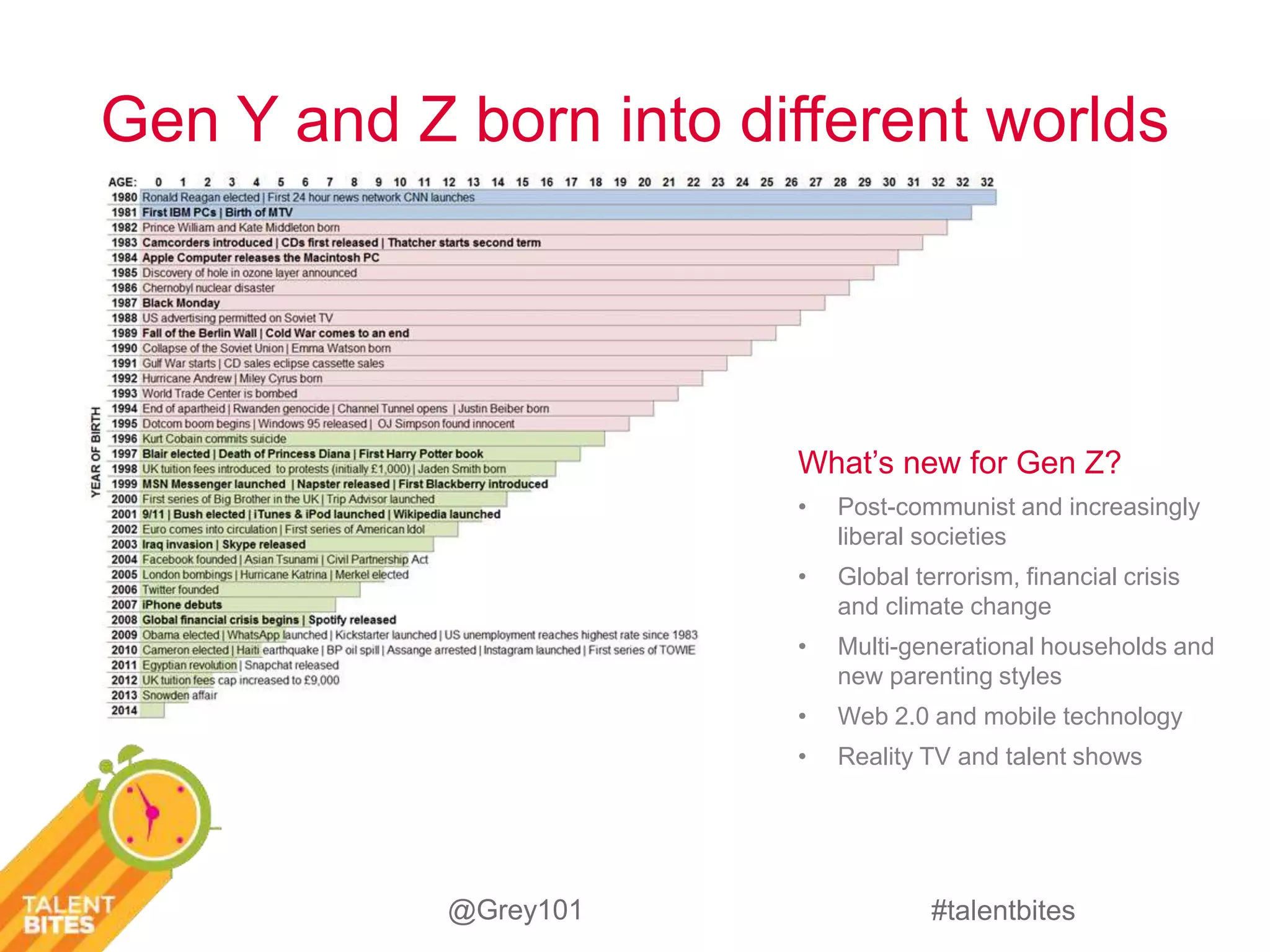
Gen Y and Z born into different worlds 
#talentbites 
@Grey101 
What’s new for Gen Z? 
• Post-communist and increasingly 
liberal societies 
• Global terrorism, financial crisis 
and climate change 
• Multi-generational households and 
new parenting styles 
• Web 2.0 and mobile technology 
• Reality TV and talent shows
Generation Z – some firsts 
#talentbites 
@Grey101
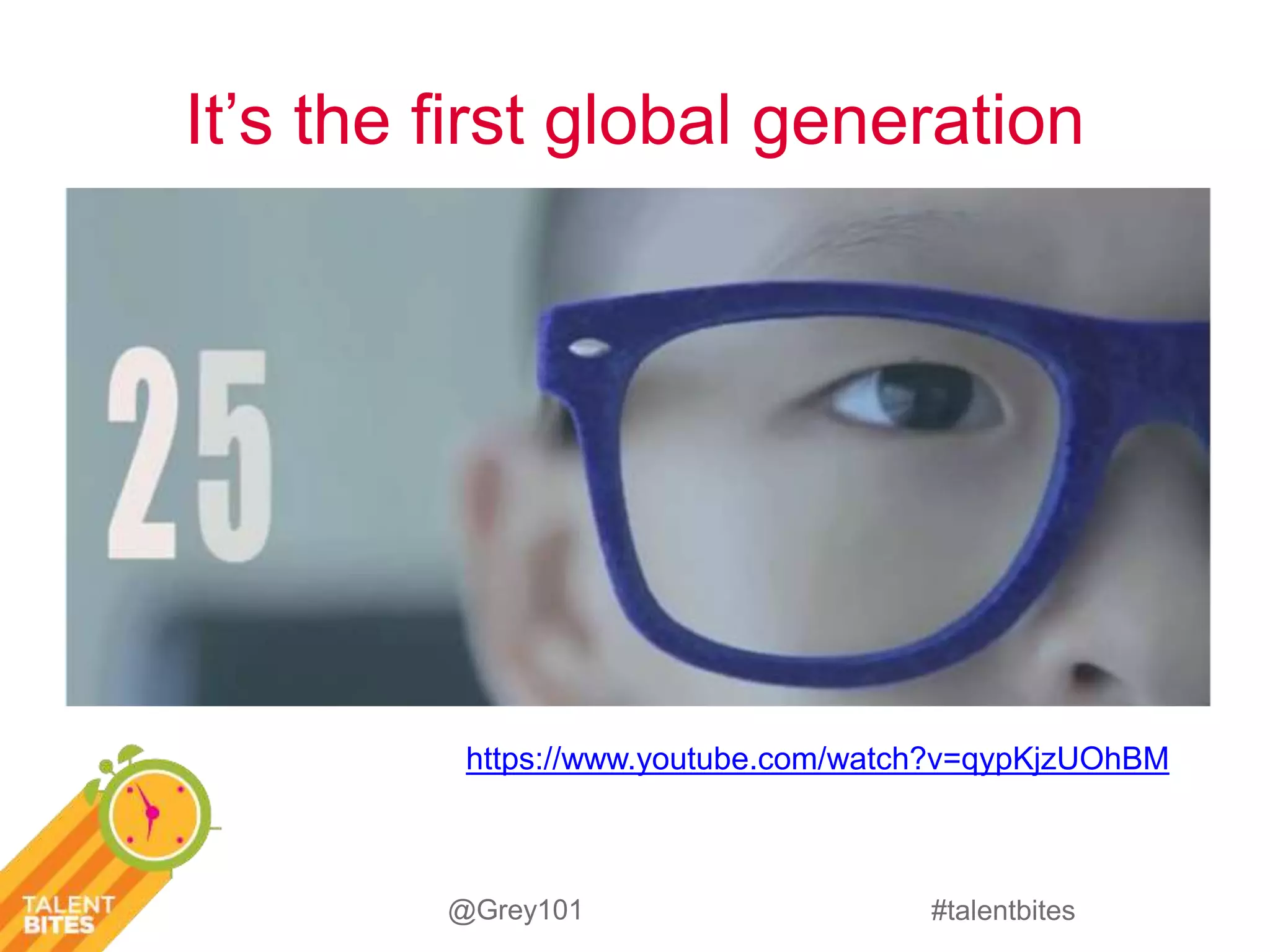
It’s the first global generation 
https://www.youtube.com/watch?v=qypKjzUOhBM 
#talentbites 
@Grey101
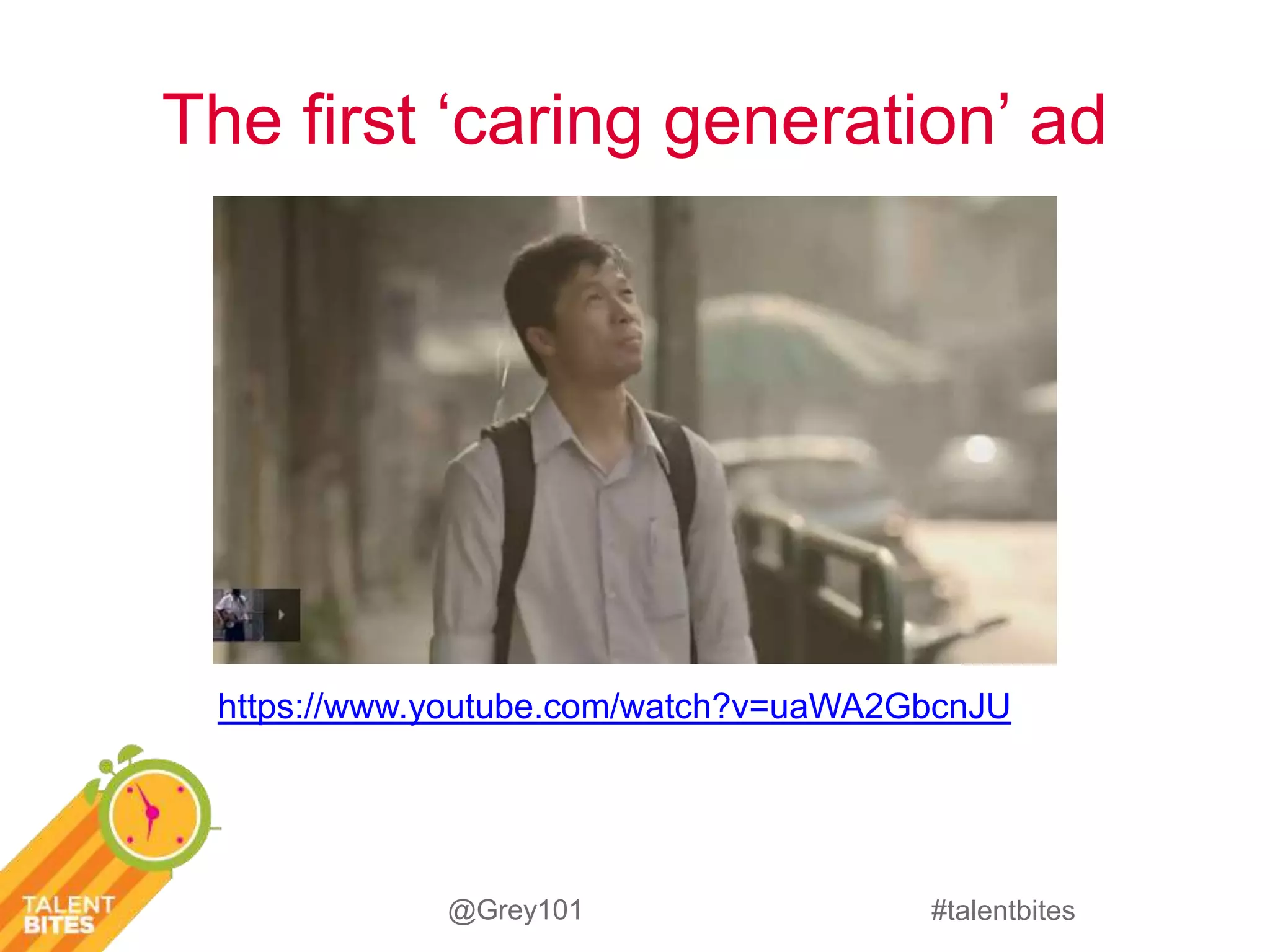
The first ‘caring generation’ ad 
https://www.youtube.com/watch?v=uaWA2GbcnJU 
#talentbites 
@Grey101
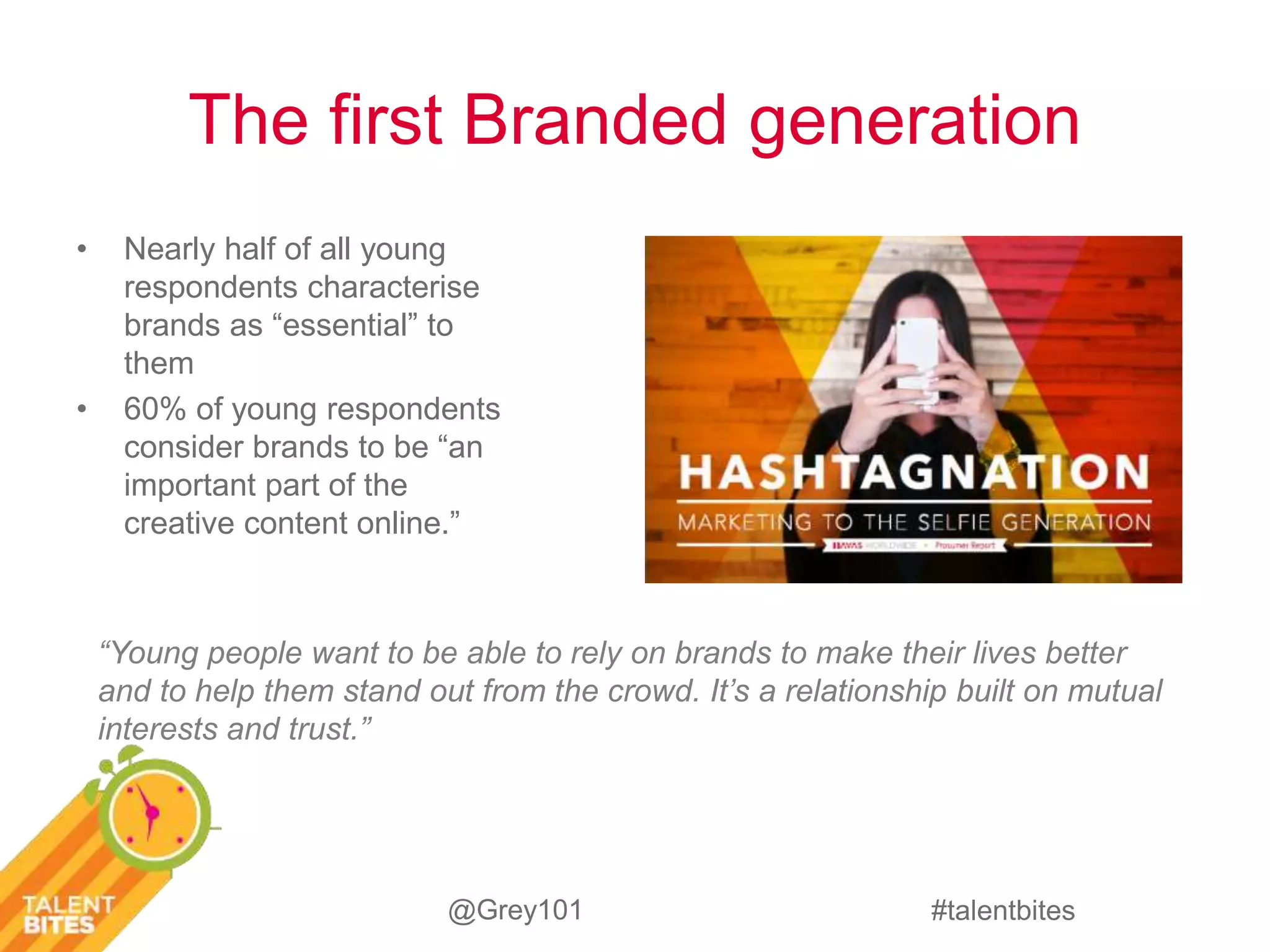
The first Branded generation 
“Young people want to be able to rely on brands to make their lives better 
and to help them stand out from the crowd. It’s a relationship built on mutual 
interests and trust.” 
#talentbites 
• Nearly half of all young 
respondents characterise 
brands as “essential” to 
them 
• 60% of young respondents 
consider brands to be “an 
important part of the 
creative content online.” 
@Grey101
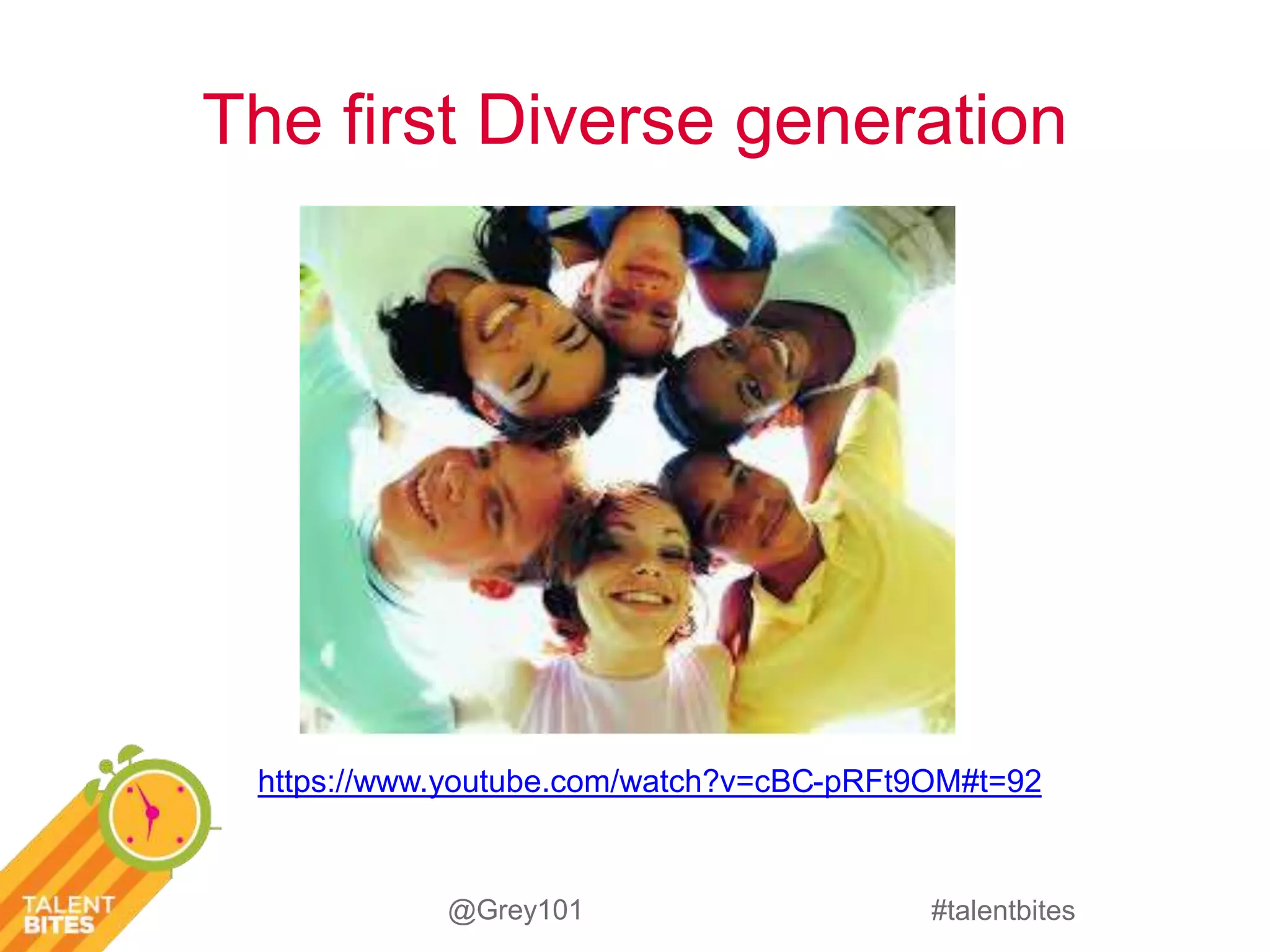
The first Diverse generation 
https://www.youtube.com/watch?v=cBC-pRFt9OM#t=92 
#talentbites 
@Grey101
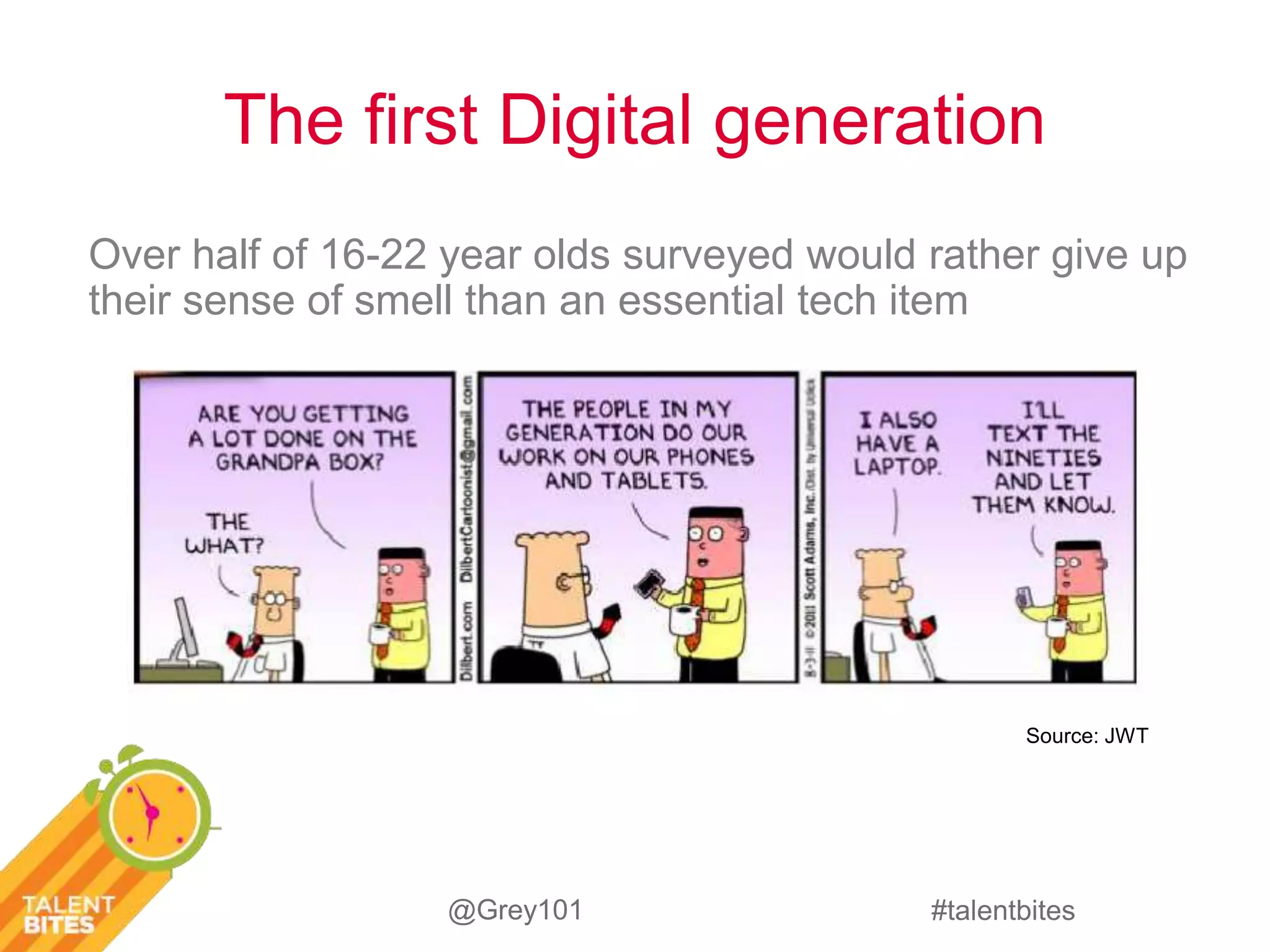
The first Digital generation 
Over half of 16-22 year olds surveyed would rather give up 
their sense of smell than an essential tech item 
Source: JWT 
#talentbites 
@Grey101
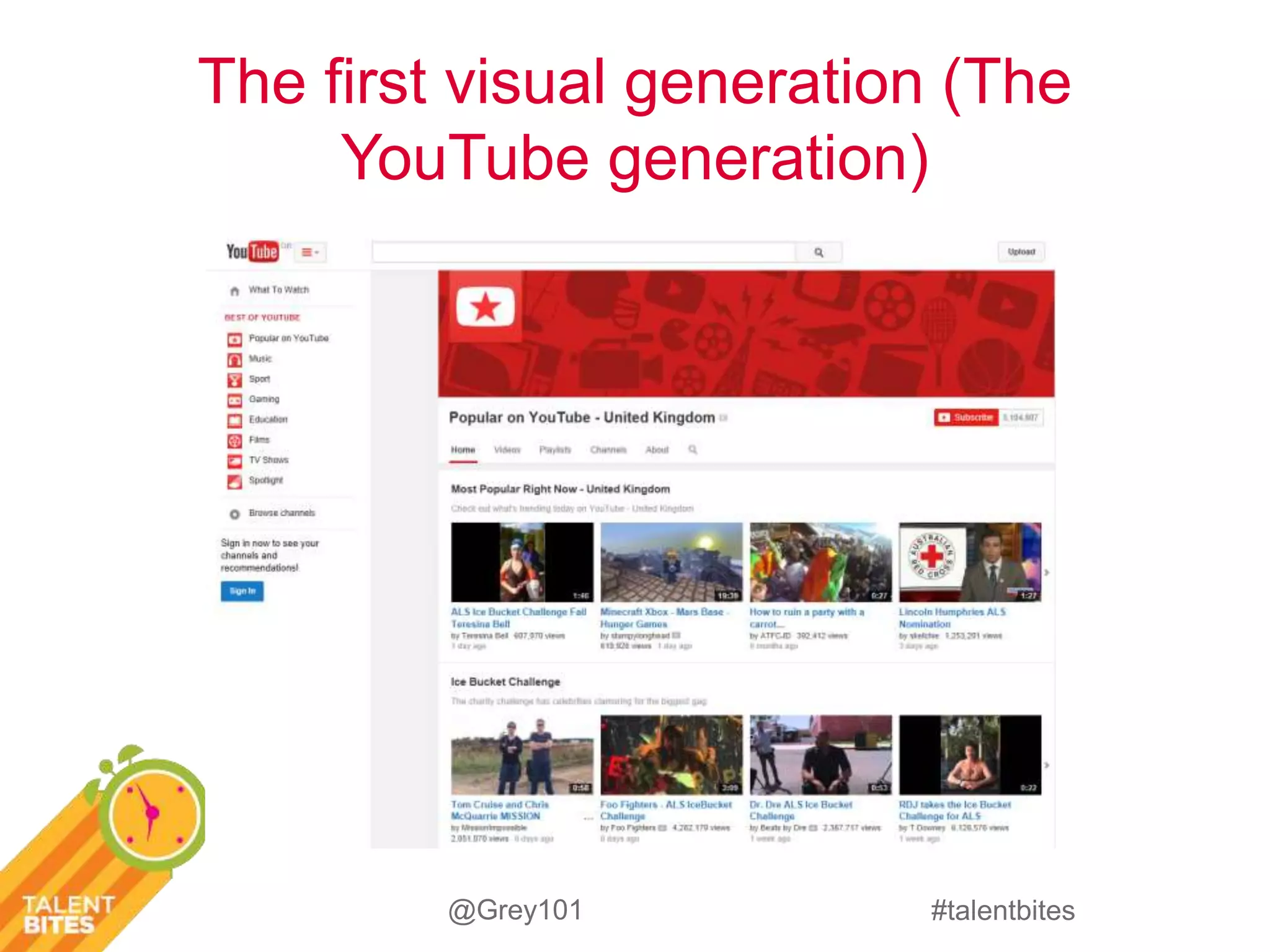
The first visual generation (The 
#talentbites 
YouTube generation) 
@Grey101
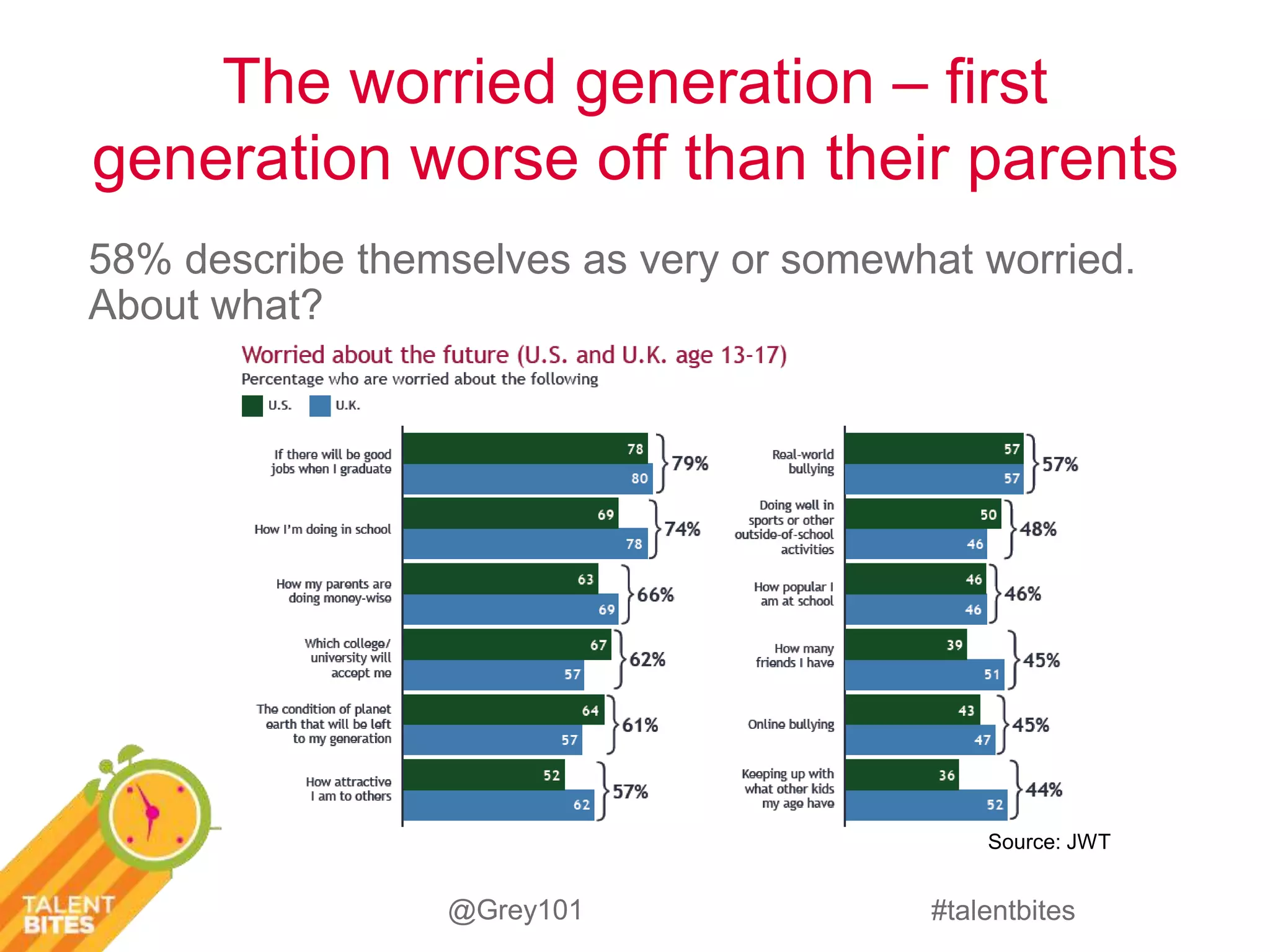
The worried generation – first 
generation worse off than their parents 
58% describe themselves as very or somewhat worried. 
About what? 
Source: JWT 
#talentbites 
@Grey101
Marketing to Generation Z 
#talentbites
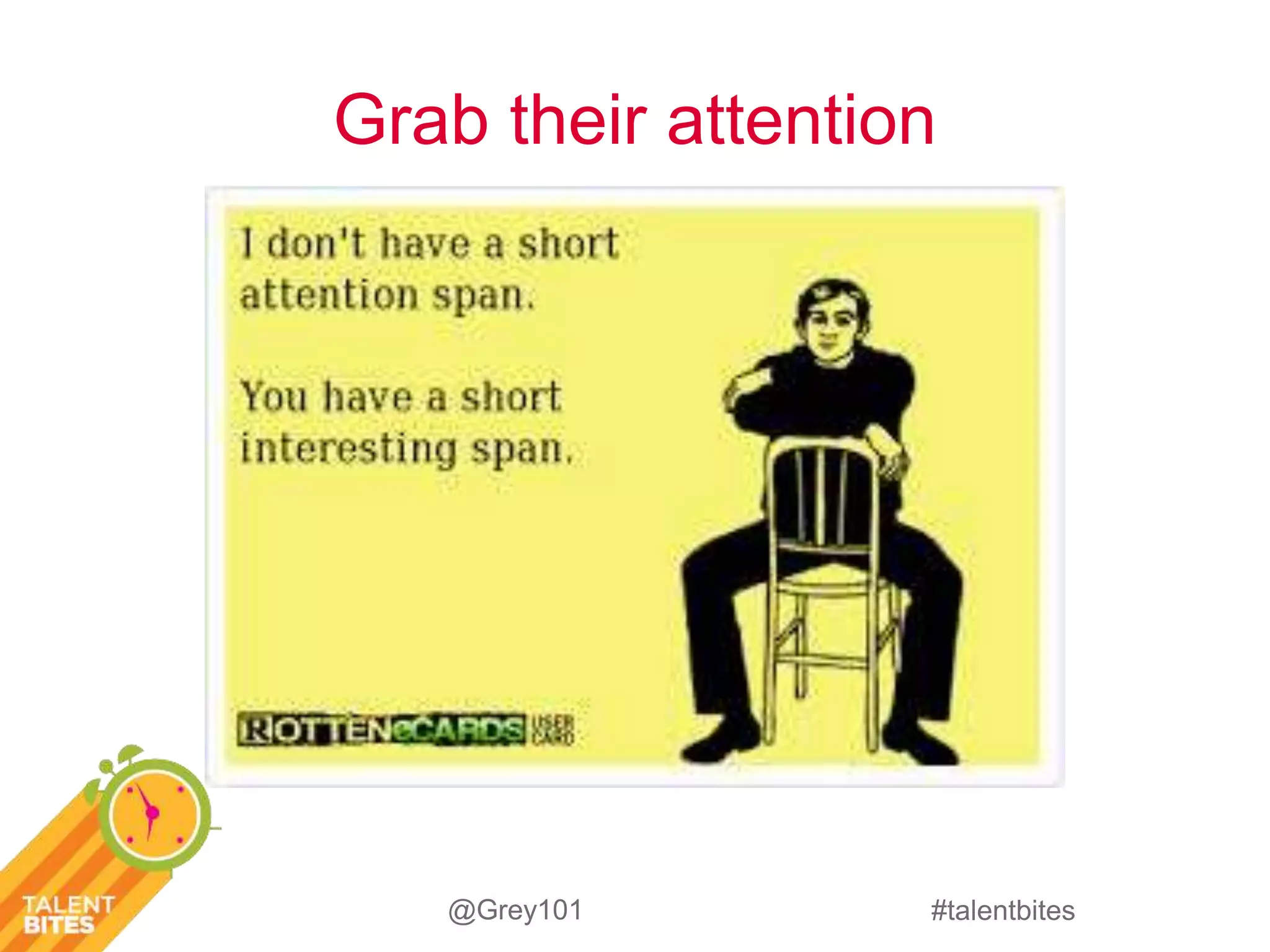
Grab their attention 
#talentbites 
@Grey101
#talentbites 
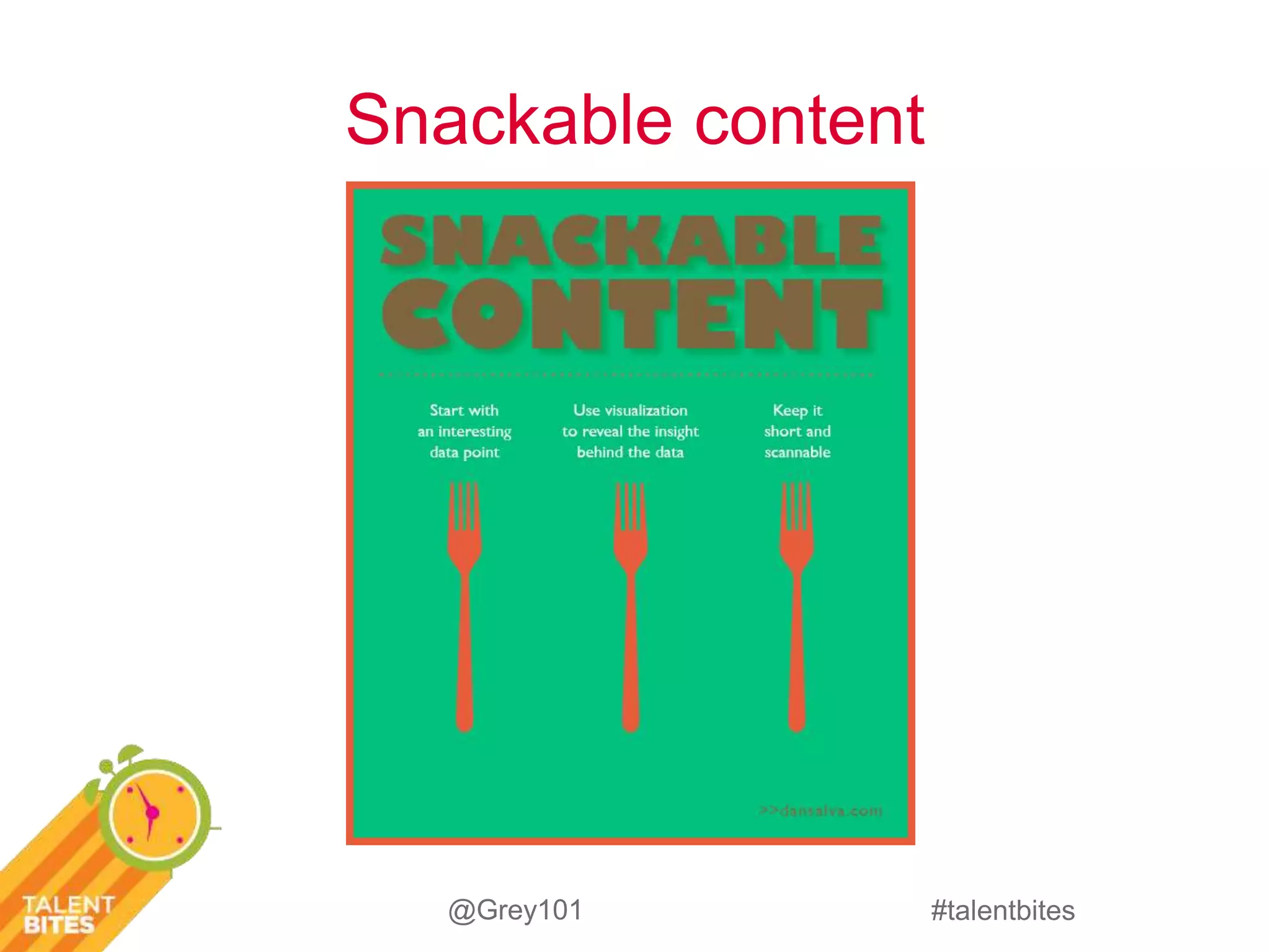
Snackable content 
@Grey101
Making your snackable content visual 
#talentbites 
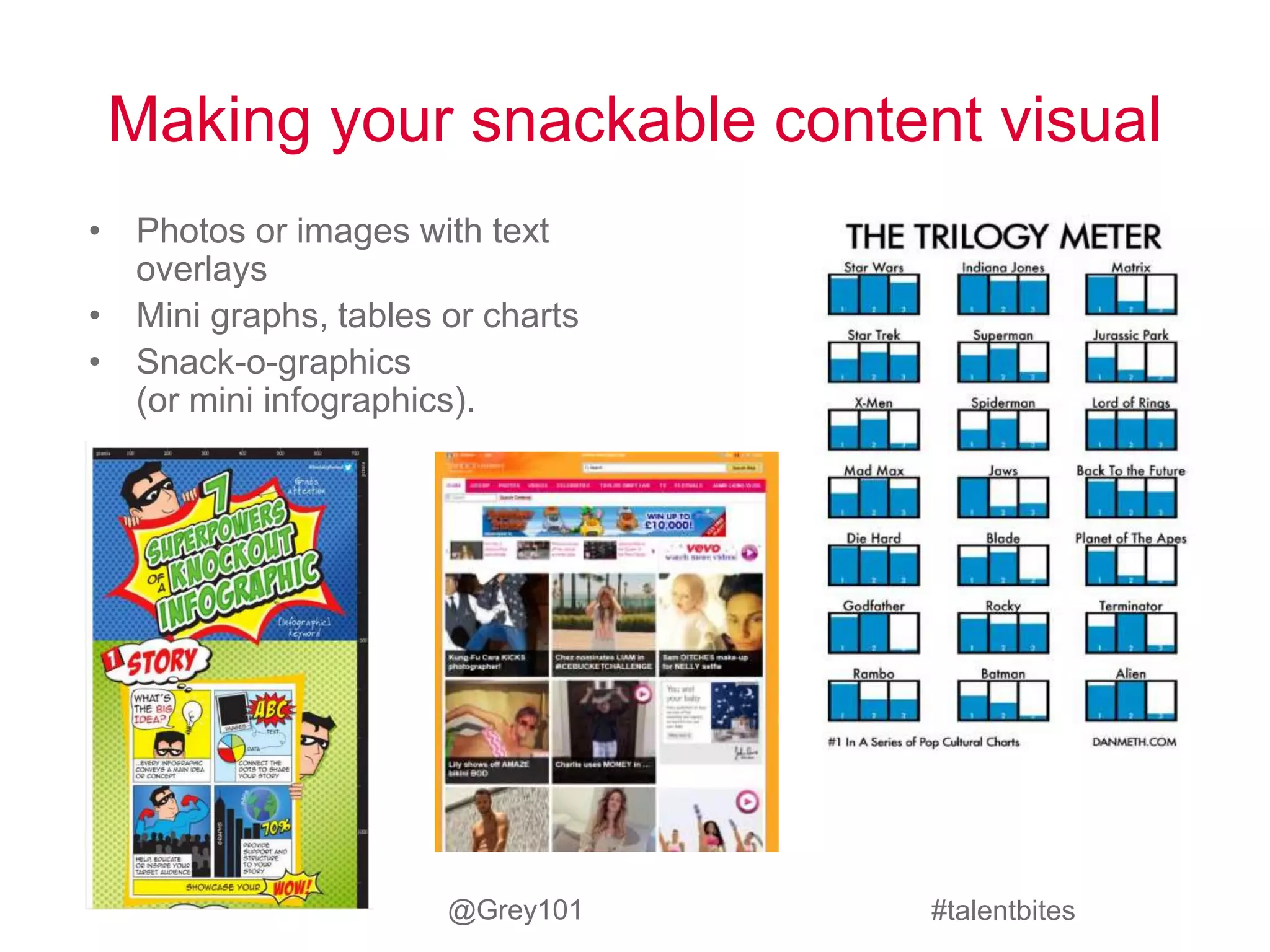
• Photos or images with text 
overlays 
• Mini graphs, tables or charts 
• Snack-o-graphics 
(or mini infographics). 
@Grey101
Make visual platforms key channels 
#talentbites 
@Grey101
Social media is not all the same 
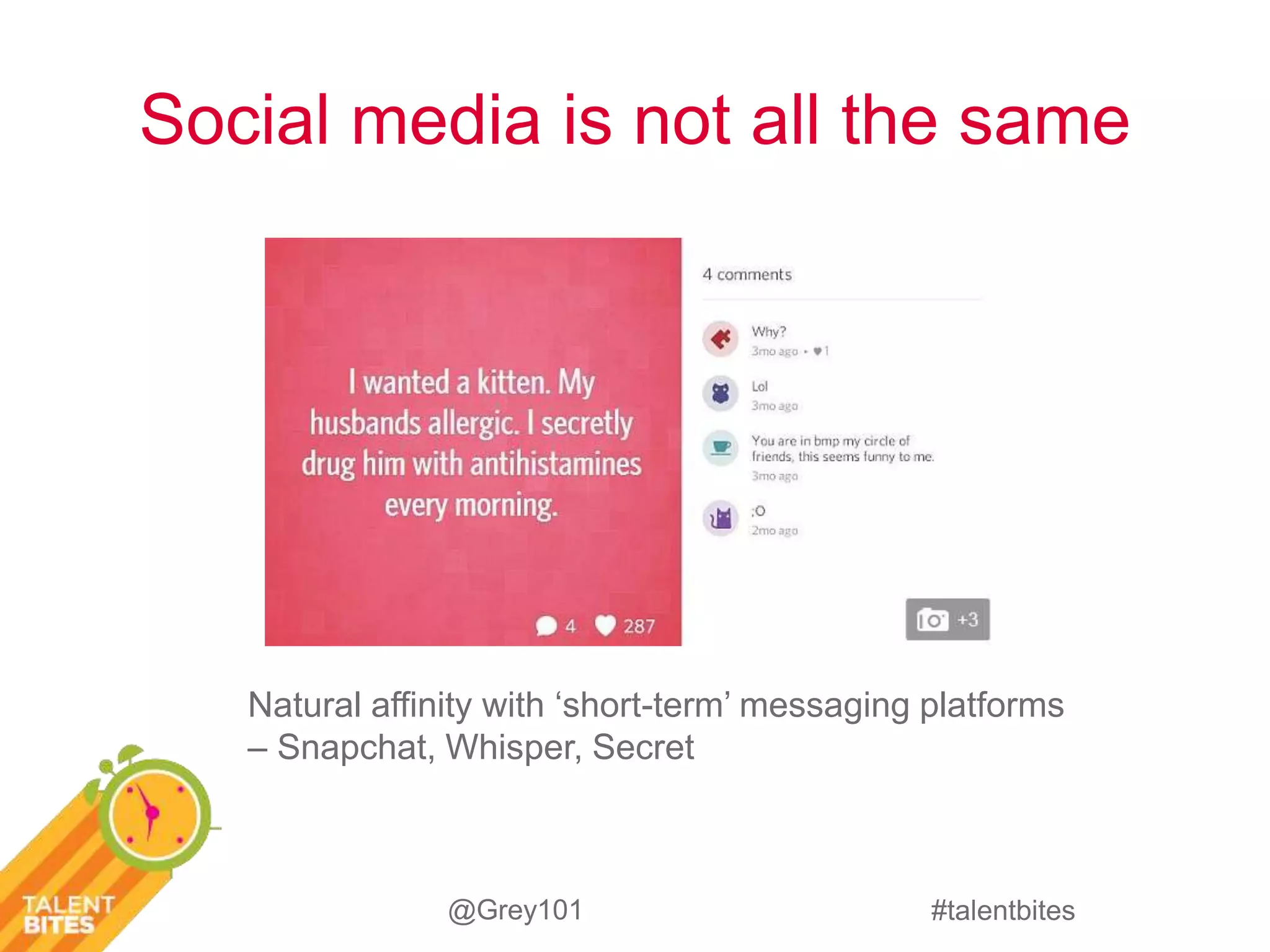
Natural affinity with ‘short-term’ messaging platforms 
– Snapchat, Whisper, Secret 
#talentbites 
@Grey101
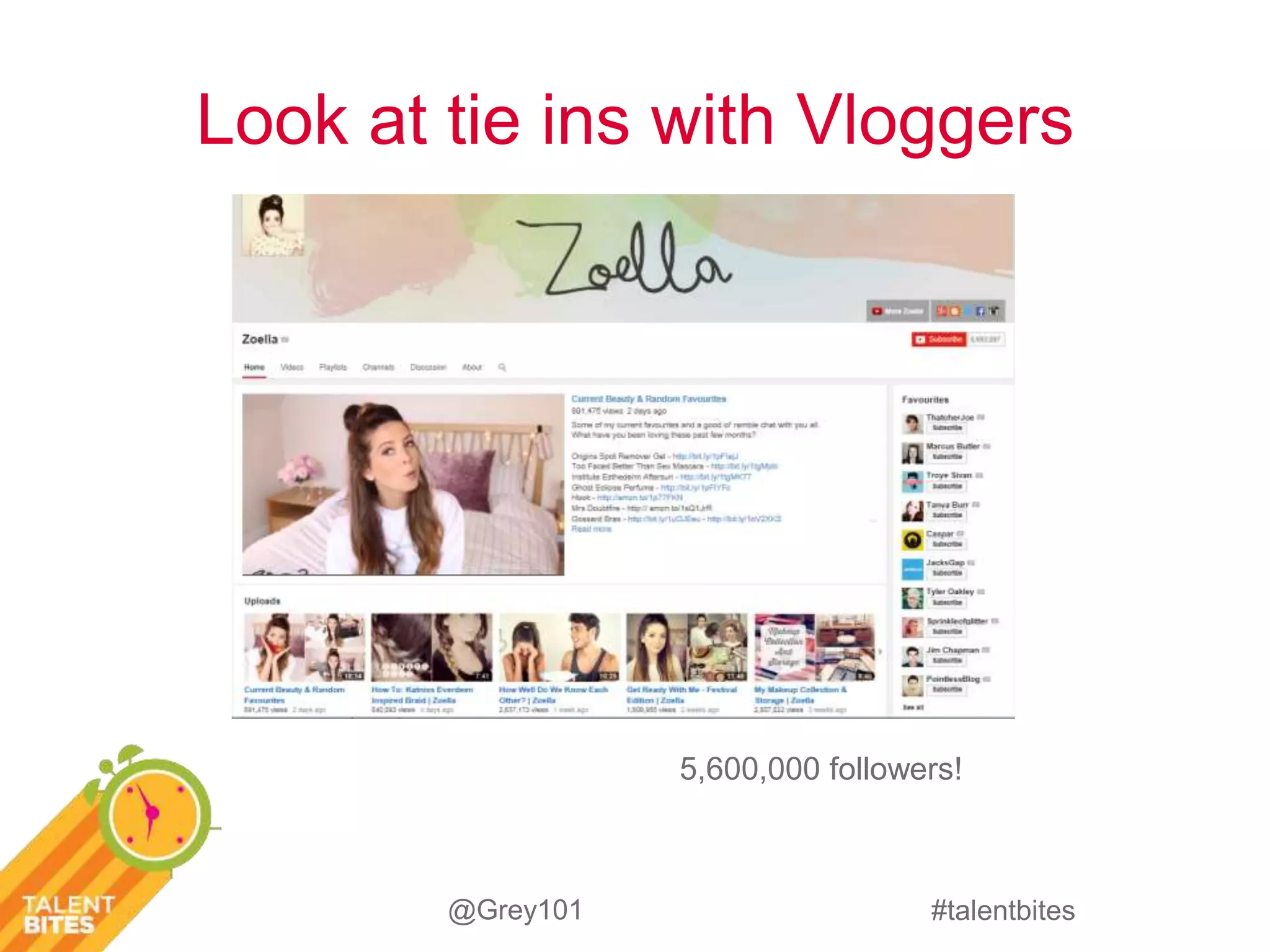
Look at tie ins with Vloggers 
5,600,000 followers! 
#talentbites 
@Grey101
Remember your audience has an 
#talentbites 
audience 
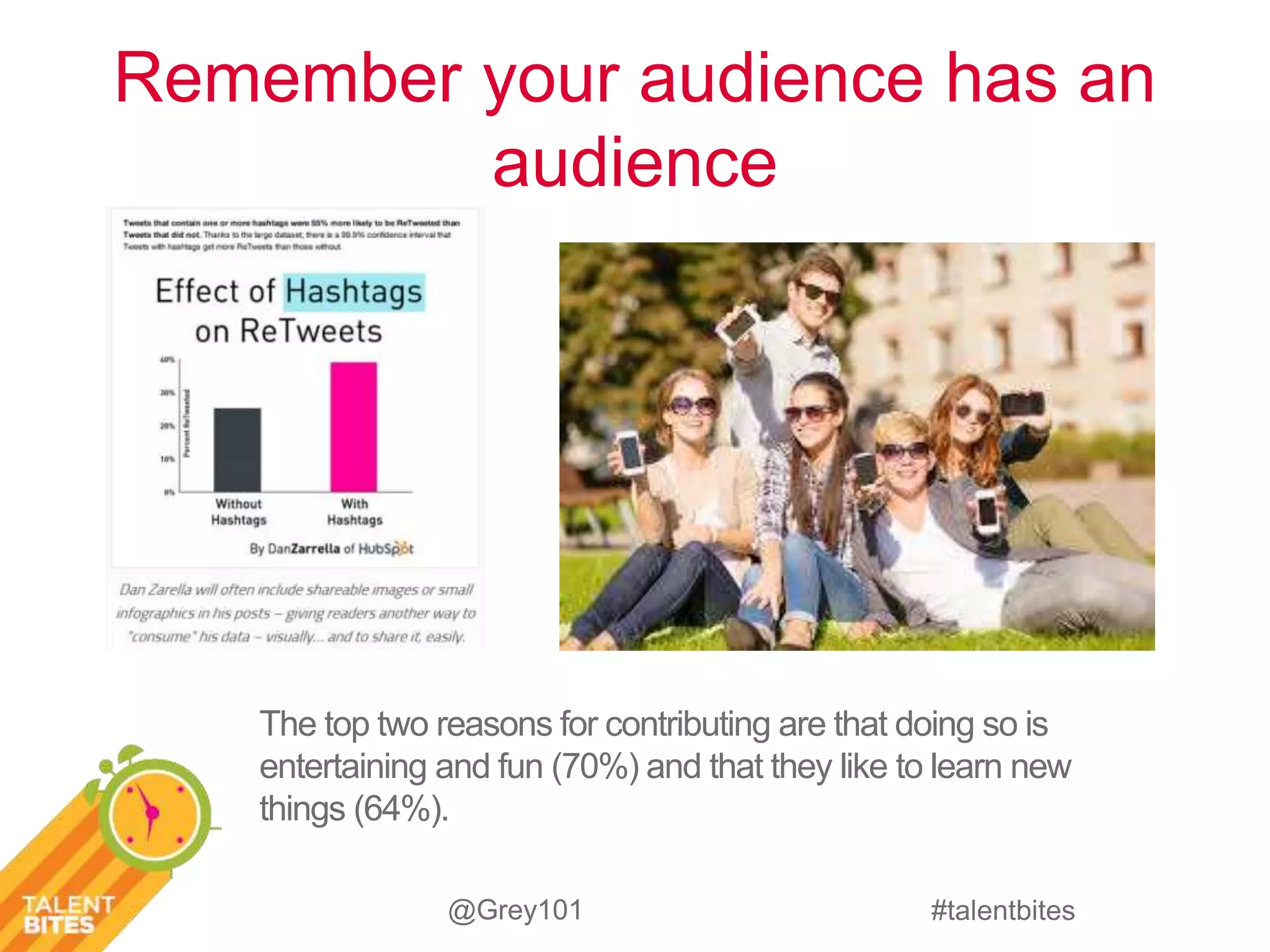
The top two reasons for contributing are that doing so is 
entertaining and fun (70%) and that they like to learn new 
things (64%). 
@Grey101
Think viral (easier said than done) 
https://www.youtube.com/watch?v=pyV57QlGUGI 
#talentbites 
@Grey101
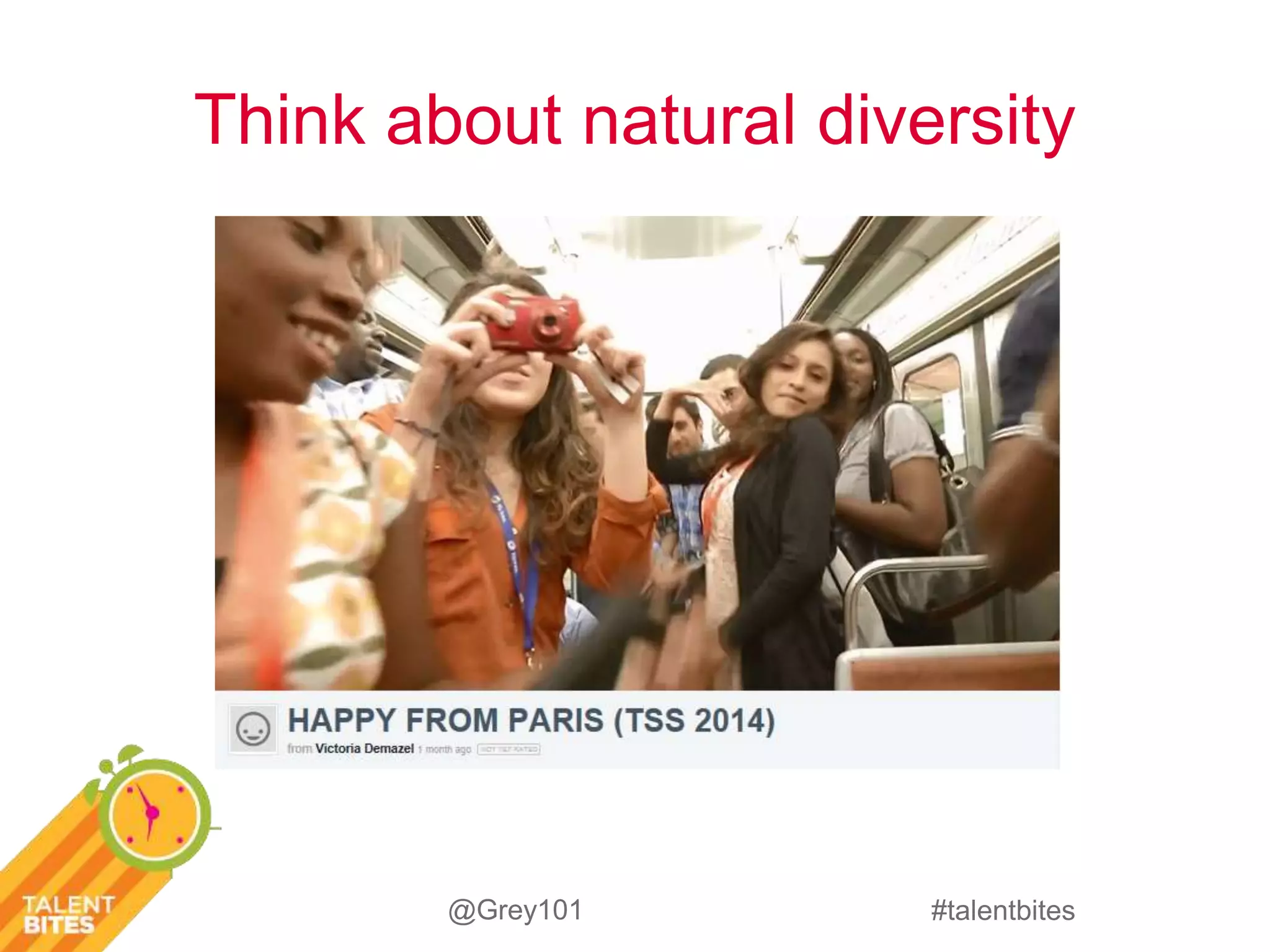
Think about natural diversity 
#talentbites 
@Grey101
Speed up communications 
(physically and culturally) 
#talentbites 
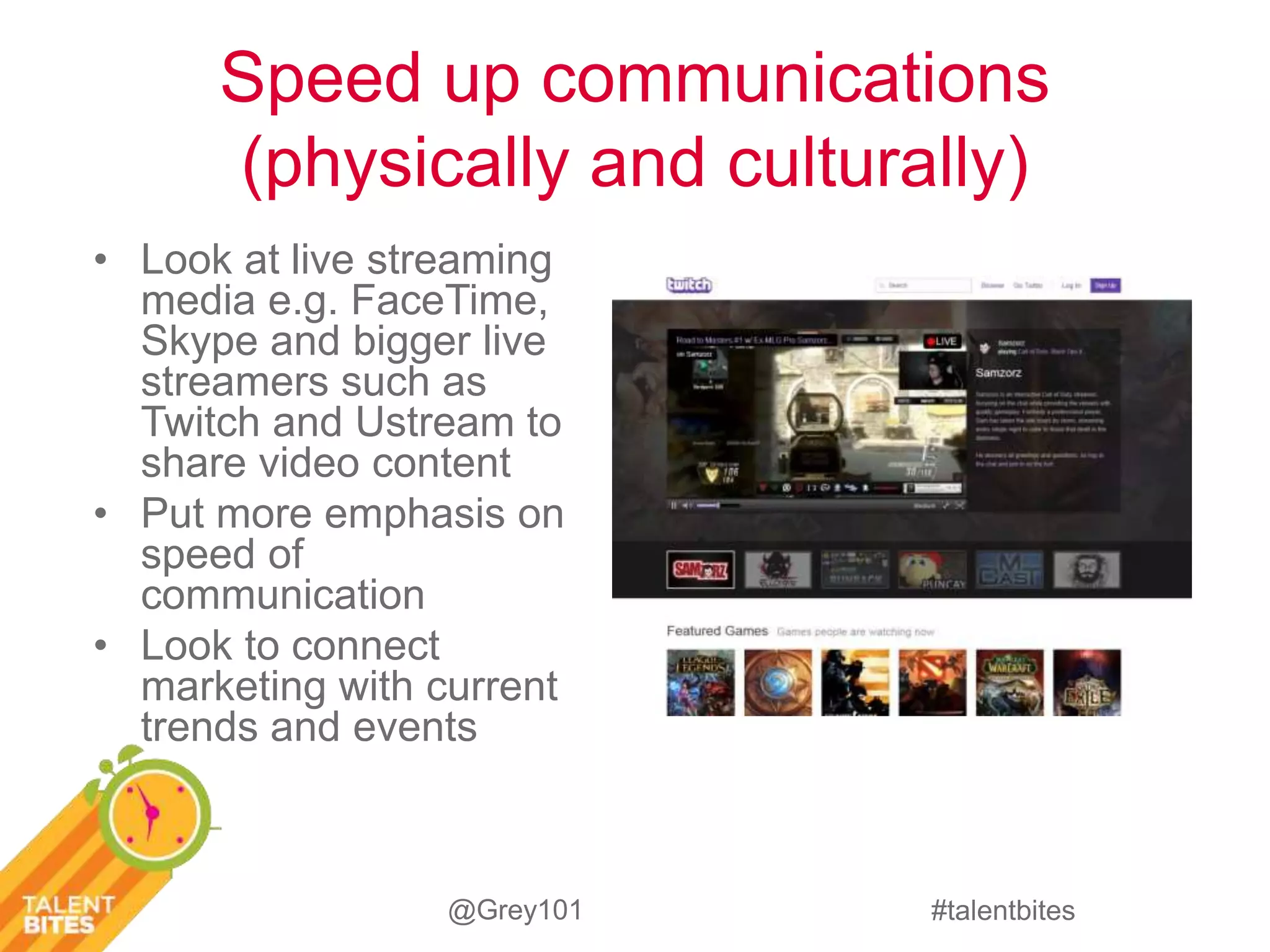
• Look at live streaming 
media e.g. FaceTime, 
Skype and bigger live 
streamers such as 
Twitch and Ustream to 
share video content 
• Put more emphasis on 
speed of 
communication 
• Look to connect 
marketing with current 
trends and events 
@Grey101
Remember, they will research you 
#talentbites 
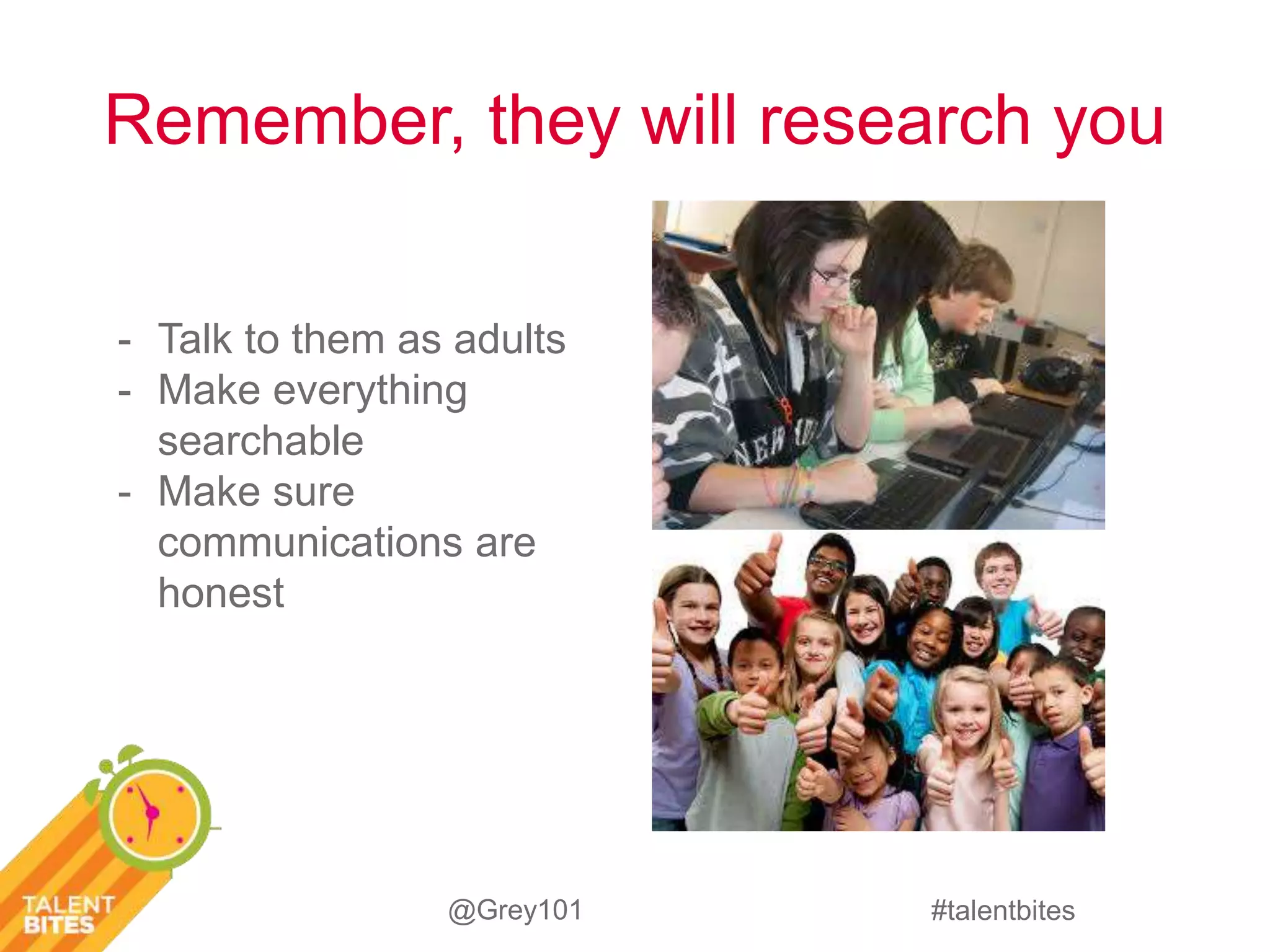
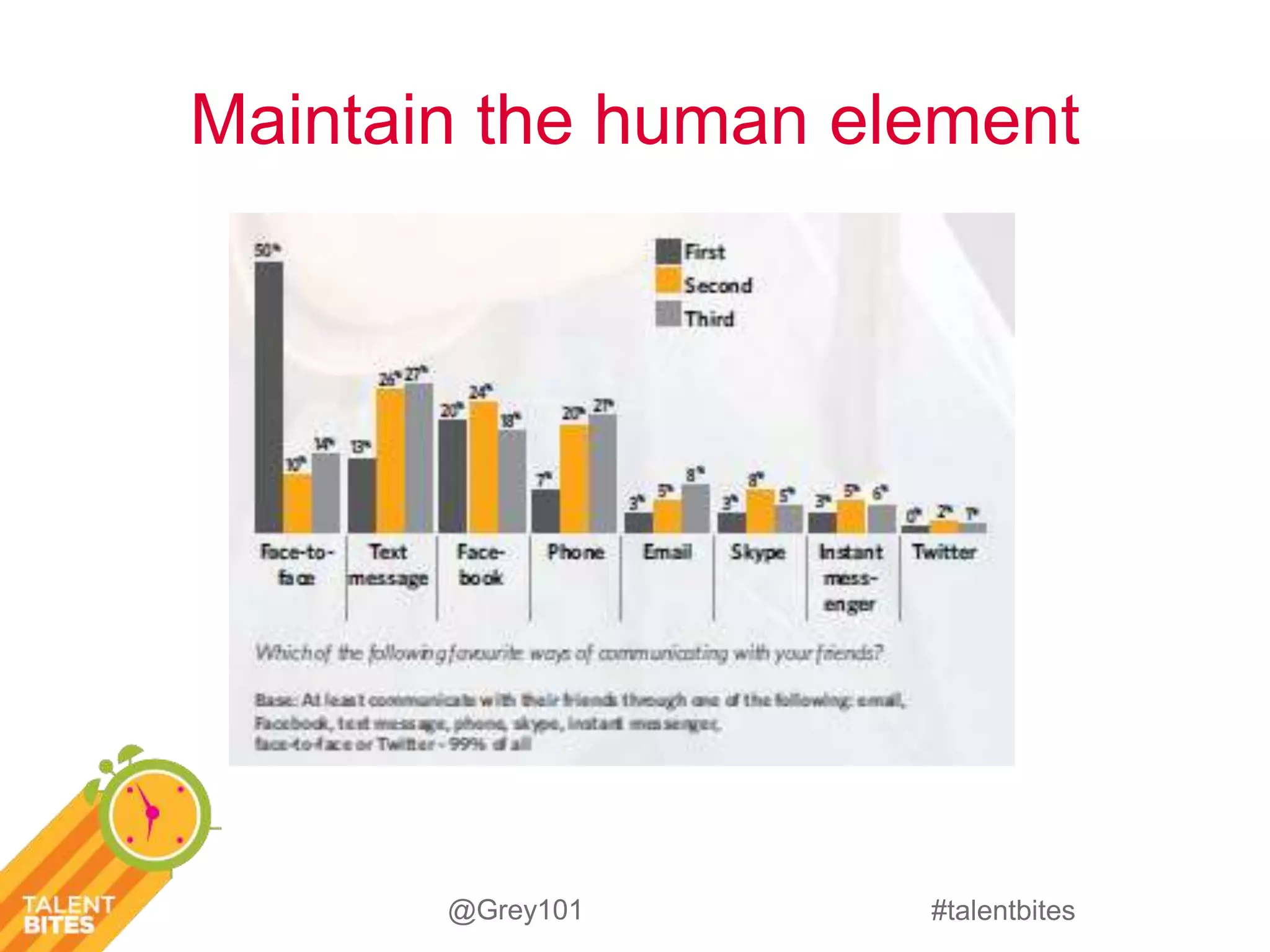
- Talk to them as adults 
- Make everything 
@Grey101 
searchable 
- Make sure 
communications are 
honest
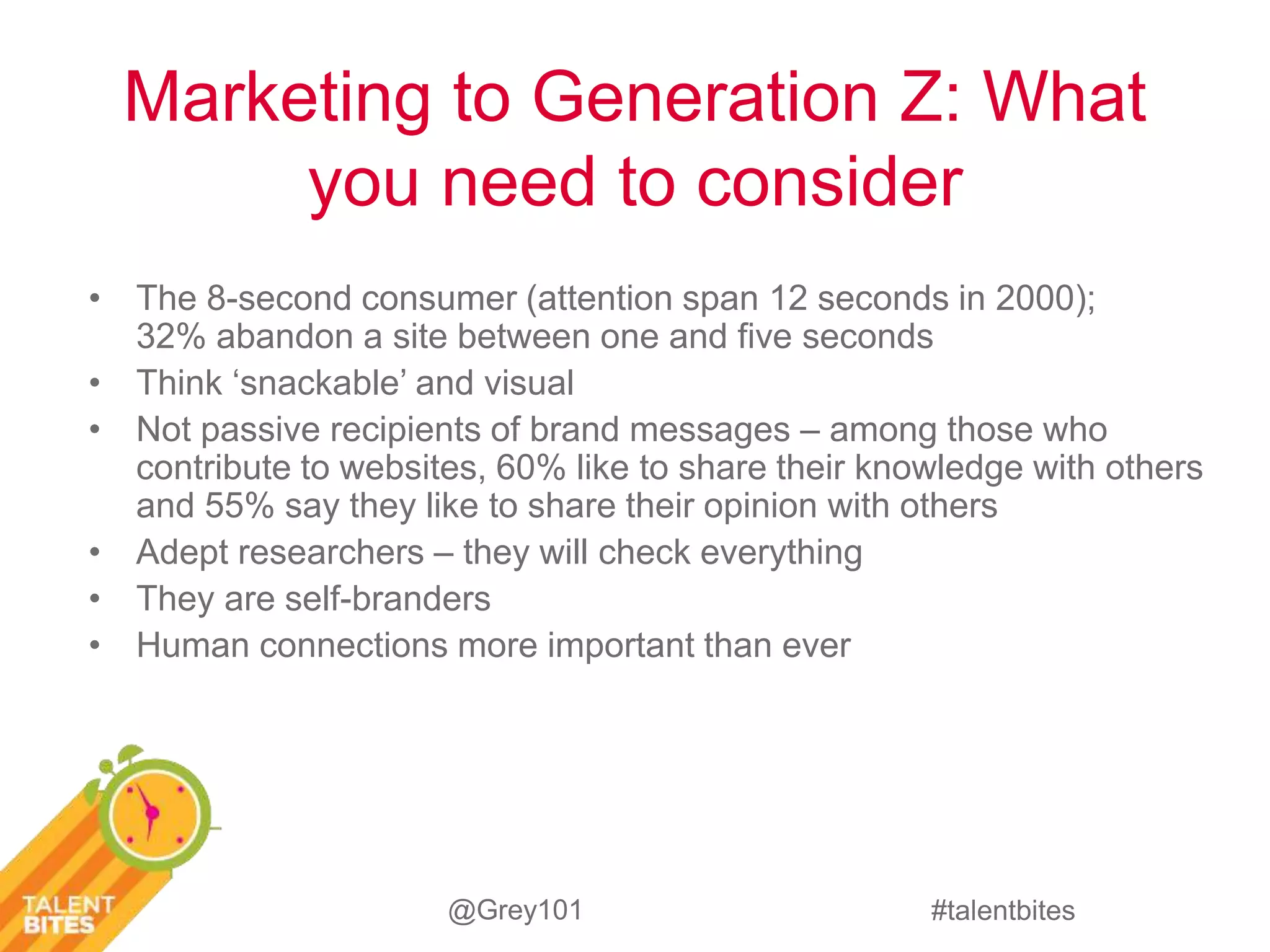
Maintain the human element 
#talentbites 
@Grey101
Marketing to Generation Z: What 
you need to consider 
• The 8-second consumer (attention span 12 seconds in 2000); 
32% abandon a site between one and five seconds 
• Think ‘snackable’ and visual 
• Not passive recipients of brand messages – among those who 
contribute to websites, 60% like to share their knowledge with others 
and 55% say they like to share their opinion with others 
#talentbites 
• Adept researchers – they will check everything 
• They are self-branders 
• Human connections more important than ever 
@Grey101
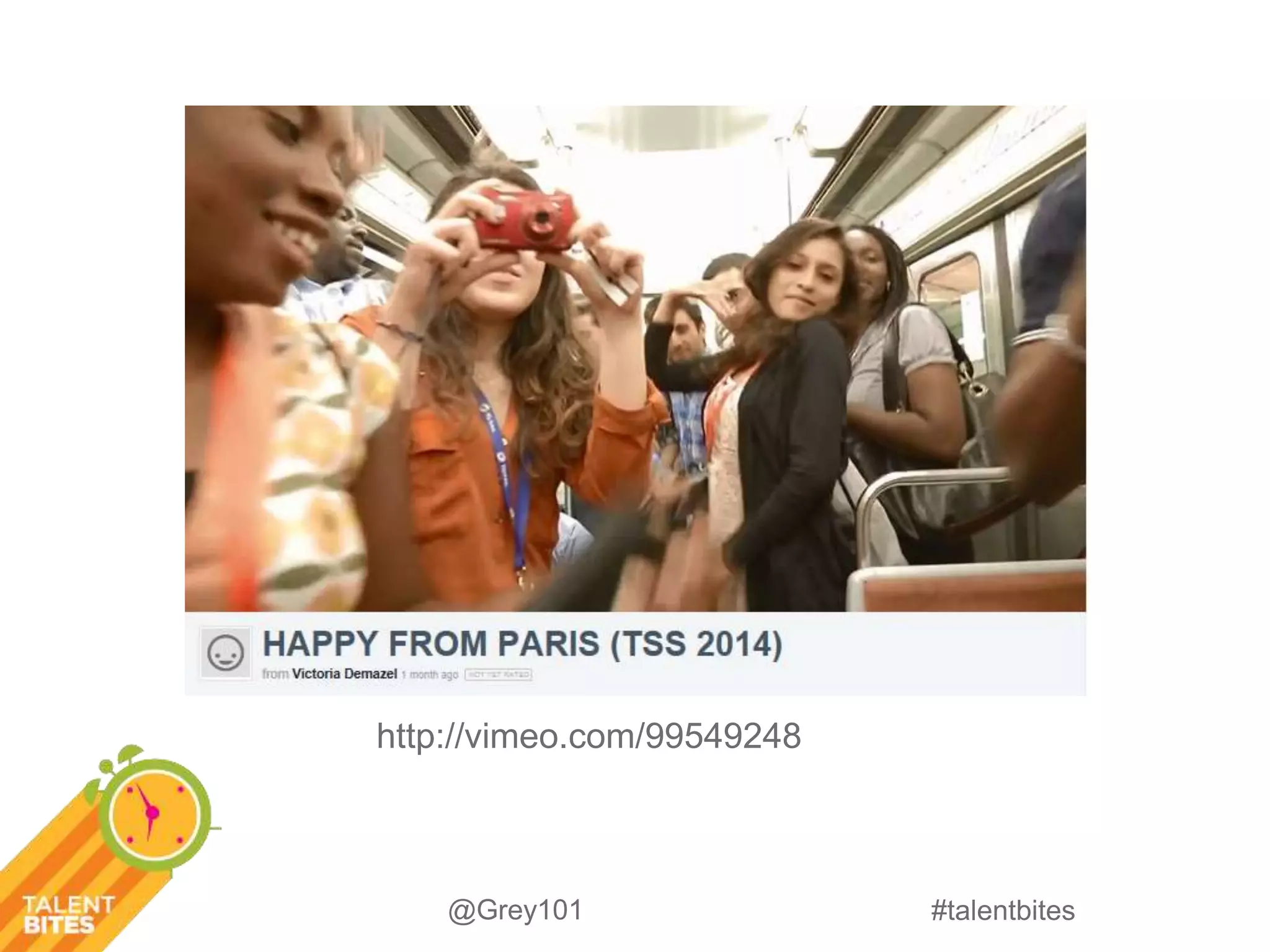
Anyone doing it well? 
#talentbites
#talentbites 
http://vimeo.com/99549248 
@Grey101
#talentbites 
View more at 
talentbites.com

Marketing to Generation Z

  • 1.
  • 2.
    Marketing to GenerationZ #talentbites Graeme Wright Director of Strategy, Havas People @Grey101
  • 3.
  • 4.
    Born 1982 –1995 1996 onwards #talentbites Our definition: Generation Gen Y Gen Z Current age 19 to 32 Up to 18 @Grey101 AKA Millennials (NB. Millennials sometimes refers to Gen Y and Gen Z) Post-Millennials Digital Natives iGeneration Gen Next
  • 5.
    Gen Y andZ born into different worlds #talentbites @Grey101 What’s new for Gen Z? • Post-communist and increasingly liberal societies • Global terrorism, financial crisis and climate change • Multi-generational households and new parenting styles • Web 2.0 and mobile technology • Reality TV and talent shows
  • 6.
    Generation Z –some firsts #talentbites @Grey101
  • 7.
    It’s the firstglobal generation https://www.youtube.com/watch?v=qypKjzUOhBM #talentbites @Grey101
  • 8.
    The first ‘caringgeneration’ ad https://www.youtube.com/watch?v=uaWA2GbcnJU #talentbites @Grey101
  • 9.
    The first Brandedgeneration “Young people want to be able to rely on brands to make their lives better and to help them stand out from the crowd. It’s a relationship built on mutual interests and trust.” #talentbites • Nearly half of all young respondents characterise brands as “essential” to them • 60% of young respondents consider brands to be “an important part of the creative content online.” @Grey101
  • 10.
    The first Diversegeneration https://www.youtube.com/watch?v=cBC-pRFt9OM#t=92 #talentbites @Grey101
  • 11.
    The first Digitalgeneration Over half of 16-22 year olds surveyed would rather give up their sense of smell than an essential tech item Source: JWT #talentbites @Grey101
  • 12.
    The first visualgeneration (The #talentbites YouTube generation) @Grey101
  • 13.
    The worried generation– first generation worse off than their parents 58% describe themselves as very or somewhat worried. About what? Source: JWT #talentbites @Grey101
  • 14.
  • 15.
    Grab their attention #talentbites @Grey101
  • 16.
  • 17.
    Making your snackablecontent visual #talentbites • Photos or images with text overlays • Mini graphs, tables or charts • Snack-o-graphics (or mini infographics). @Grey101
  • 18.
    Make visual platformskey channels #talentbites @Grey101
  • 19.
    Social media isnot all the same Natural affinity with ‘short-term’ messaging platforms – Snapchat, Whisper, Secret #talentbites @Grey101
  • 20.
    Look at tieins with Vloggers 5,600,000 followers! #talentbites @Grey101
  • 21.
    Remember your audiencehas an #talentbites audience The top two reasons for contributing are that doing so is entertaining and fun (70%) and that they like to learn new things (64%). @Grey101
  • 22.
    Think viral (easiersaid than done) https://www.youtube.com/watch?v=pyV57QlGUGI #talentbites @Grey101
  • 23.
    Think about naturaldiversity #talentbites @Grey101
  • 24.
    Speed up communications (physically and culturally) #talentbites • Look at live streaming media e.g. FaceTime, Skype and bigger live streamers such as Twitch and Ustream to share video content • Put more emphasis on speed of communication • Look to connect marketing with current trends and events @Grey101
  • 25.
    Remember, they willresearch you #talentbites - Talk to them as adults - Make everything @Grey101 searchable - Make sure communications are honest
  • 26.
    Maintain the humanelement #talentbites @Grey101
  • 27.
    Marketing to GenerationZ: What you need to consider • The 8-second consumer (attention span 12 seconds in 2000); 32% abandon a site between one and five seconds • Think ‘snackable’ and visual • Not passive recipients of brand messages – among those who contribute to websites, 60% like to share their knowledge with others and 55% say they like to share their opinion with others #talentbites • Adept researchers – they will check everything • They are self-branders • Human connections more important than ever @Grey101
  • 28.
    Anyone doing itwell? #talentbites
  • 29.
  • 30.
    #talentbites View moreat talentbites.com

Editor's Notes

  • #4 A group of individuals of similar ages whose members have experienced a noteworthy historical event within a set period of time has to involve the individuals in their young age a distinctive consciousness is dependent on the pace of social change members of a generation are internally stratified (by their location, culture, class, etc.) – they are not totally homogenous.
  • #7 Large More ethnically diverse than previous generations Multiracial children the fastest growing youth group – 50% increase in the multiracial youth population since 2000 (to 4.2 million) 400% increase in multiracial marriages (Black and White) in the last 30 years (with a 1,000% increase in Asian-White marriages) (Sparks & Honey) More educated In the UK, the proportion of all 16–64-year-olds holding a degree or higher-level qualification has doubled in the last 20 years – to over 20% – whereas in this time the proportion holding no educational qualification has more than halved (CIPD Megatrends)
  • #9 Hyper-aware and concerned about man’s impact on the planet Intend to change the world – determined to ‘make a difference’, 26% currently volunteering Have a conscience – 48% care about helping poor and sick, 80% support same sex marriage Want to play a hands on role on change Believe change can and should come from anyone anywhere, expect constant innovation and little patience for sacred cows Being ‘Truthful’ (by a landslide) is seen as the most desired trait in a Gen Z best friend, followed by being Genuine, Sociable, Mature and Humble
  • #10 10,574 people aged 16+ in 29 markets:
  • #11 According to U.S. Census projections released in 2008 (the most recent data), only 54 percent of them are Caucasian—and that will drop to less than 50 percent by 2042
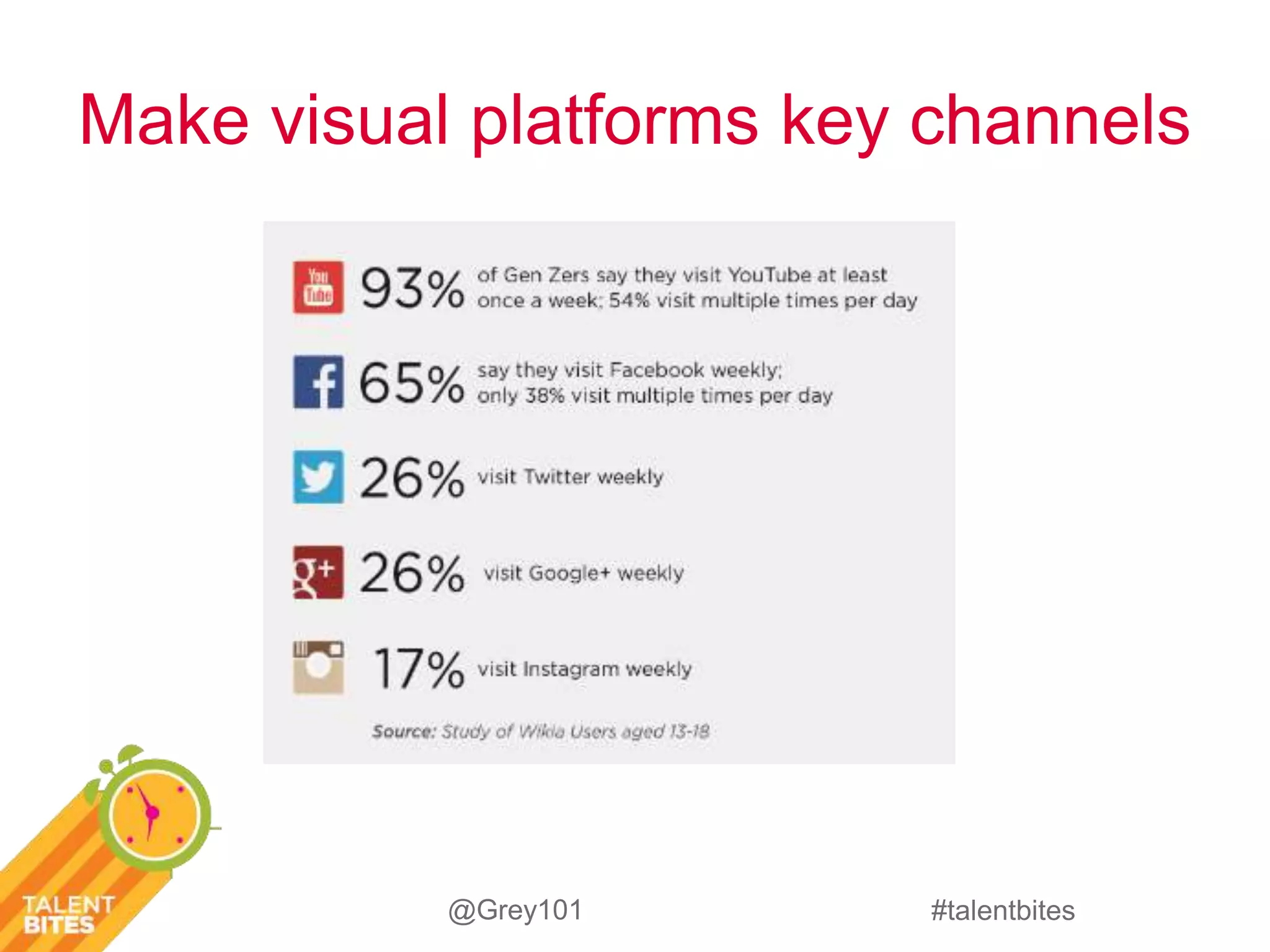
  • #13 93% visit YouTube regularly
  • #16 Work hard to grab attention Be succinct and clear – use 5 word sentences, bullet points, engaging headlines Snackable content
  • #17 Content that is easily consumed at a glance. It is also highly shareable and can easily cross social platforms and drive traffic.
  • #18 Featuring a simple image that illustrates a key point, or provides a how-to example or a tip or quote straight from your post, makes your blog post so much more shareable and ready to pinned to Pinterest Rather than larger infographics,  smaller graphs, tables or charts can be embedded into a post to illustrate the same point. These types of images are also easily shared to Pinterest, or Facebook or even LinkedIn.  They encourage readers to share a key concept or “part” of your whole post, leading readers back to your blog from other social media platforms. Sometimes bloggers want to illustrate a single point and back it up with data – if you have created an image that helps to explain that data well, then others are likely to share and reference to it in a whole range of related blog posts. Dan Zarella does this very well over on his blog.  Dan is known as “The Social Media Scientist” for good reason. He breaks down data and research into relevant, shareable graphs and tables – all to help marketers better understand social behaviour (from a data-backed position). It makes sense then that Dan’s posts have a lot of “data” in them. But he doesn’t take us to Boredom Town with it. Oh no. Instead, he cleverly breaks that data up into smaller “snackable” images that help to illustrate his point.  They are also highly shareable as shown in this excerpt from his blogpost: These can be a stand alone image or a series of images that are taken from a larger infographic.
  • #19 Develop a wide range of video content Consider encouraging followers to submit pictures and video (i.e. crowdsourcing images)
  • #22  Make everything sharable Facilitate sharing (eg use of # on Twitter) Listen and respond to their opinions and ideas (social listening is important) Create communities Enhance and Enable Curation What does Generation Z care about? Finding and sharing the best stuff in the world. They aren’t just consumers, they are curators. They not only discover brands and products but they evaluate them with brilliant objectivity, sift through them, and share the results. Please a Generation Z-er with your particular product or service and you’ll earn your biggest supporter. As a result, marketers need to make it easy to share what their Gen Z customers love. From Facebook “Likes” to branded tweets to Polyvore’s brand expression collages, it’s never been easier to share your opinion online. Don’t stifle conversation, nor attempt to control conversation about your products — encourage it. There will be bad along with the good, but it will be authentic. This transparency will ultimately contribute to the long term success of your brand. Regardless, promoting an “open brand” ethos will lead to better informed and more passionate curators. Ready or not, Generation Z is here, and they are the future. I, for one, am thrilled to have a front-row seat as we watch them change the world before our very eyes. Reality #1: Generation Z was born to share. Sharing has a different meaning to Zs, who are used to operating in a web of connected friends, media and entertainment. When they hate the plot of a TV show, or love a new video game, they don’t call up their friends. They put it online through Facebook posts, tweets, personal blogs, Instagram pics … the list goes on. And, because Zs know they have a powerful voice, they’re more demanding of brands. Don’t like the design of the new Air Jordans? Generation Z will be the ones who tell Nike exactly how they feel. How to Respond: It’s essential that listening and fast response are key tenets of your community management strategy. Simply by listening to user comments, answering questions or sharing feedback, Gen Z will feel you’re a brand who cares. To encourage them to share, make sure you’re creating content that Zs enjoy. A fun brand voice, engaging content and incentive to share is a winning combo
  • #23  Viral can be all sorts of things – videos, competitions, images or great info Here’s one we did earlier: Go viral. (Easy to say, hard to do.) Video is a fantastic way to reach Generation Z. Teens, however, don’t care about a new low price on a particular good or service. If they want that information, they will visit your website. Instead, social video sharing should be clever and/or funny. Case in point: I asked 10 older teens to name as many insurance companies as possible. They responded with Progressive, Geico, and a few with 21st Century Insurance. Very few named any of the other top providers like Nationwide, probably because their campaigns haven’t been attention-grabbing enough for this demographic. Remember: If you think something is corny, so will the consumer. Be mindful of what you consider funny.
  • #24 In terms of demographics, Generation Z is more ethnically diverse than any other generational cohort. According to U.S. Census projections released in 2008 (the most recent data), only 54 percent of them are Caucasian—and that will drop to less than 50 percent by 2042. (If that sounds like a long time from now, it’s actually fewer years than those that have passed since Journey’s “Don’t Stop Believin’” was a No. 1 hit!) Not only do the faces of those in Generation Z look different, but their social circles are also more diverse. This ethnic diversity and openness means that what constitutes “American” food is changing, and that ethnic tastes and foods will become even more mainstream. Also, the lines between ethnic menus are blurring, and Generation Z will want—and expect—more mash-ups combining multiple ethnic influences.
  • #25  Accstomed to rapid-fire banter and commentry (also not precise communicators and leave a lot of room for interpretation Drawn to social media which disintegrates and self-destructs, They suffer from FOMO (fear of missing out) – so being culturally connected is critical
  • #26 Talk to them as adults Make everything searchable Make sure communications are honest Respond to negativity
  • #28 Short Attention spans - the 8-second consumer (attention span 12 seconds in 2000). 32% abandon a site between one and five seconds Audience has an audience Not passive recipients of brand messages ie there behaviours result in instantaneous influence ie as soon as a brand communication is made live it will immediately come with a publicised reaction. Some contribute to share their knowledge, others just like to share their opinions with others. Among those who contribute to websites, 60% like to share their knowledge with others and 55% say they like to share their opinion with others. Only 31% of those who contribute to websites do so in order to feel good about themselves, and even fewer do so to show that they are smarter than others (14%). Adapt researchers – they will check everything (52% use YouTube or Social Media for typical research assignments) Valuing human connections more than ever. The highly engaged parenting, teaching and counselling approach to the young accelerated dramatically from Y to Z. Zers are less likely to resist authority relationships than Gen Yers did and as we have seen look to influencers for advice They are self branders They live diversity Social media has demolished all barriers to communicating about brands and products. If you can write, you can share, and Generation Z is all about sharing. Some contribute to share their knowledge, others just like to share their opinions with others. Among those who contribute to websites, 60% like to share their knowledge with others and 55% say they like to share their opinion with others. Only 31% of those who contribute to websites do so in order to feel good about themselves, and even fewer do so to show that they are smarter than others (14%). The top two reasons for contributing are that doing so is entertaining and fun (70%) and that they like to learn new things (64%).