What is Plate Tectonics?
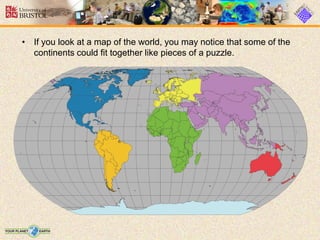
• If you look at a map of the world, you may notice that some of the
continents could fit together like pieces of a puzzle.
Plate Tectonics
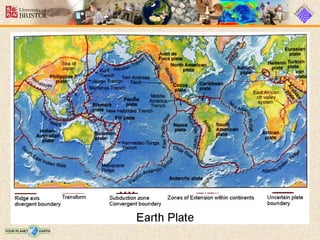
• The Earth’s crust is divided into 12 major
plates which are moved in various directions.
• This plate motion causes them to collide, pull
apart, or scrape against each other.
• Each type of interaction causes a
characteristic set of Earth structures or
“tectonic” features.
• The word, tectonic, refers to the deformation of
the crust as a consequence of plate
interaction.
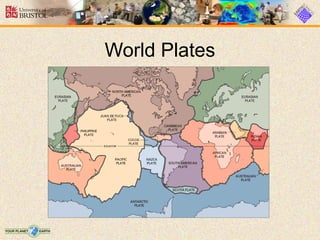
World Plates
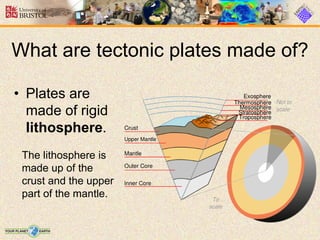
What are tectonic plates made of?
• Plates are
made of rigid
lithosphere.
The lithosphere is
made up of the
crust and the upper
part of the mantle.
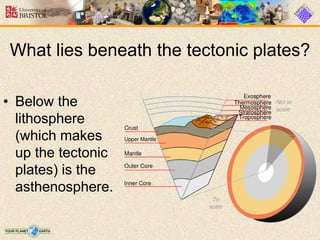
What lies beneath the tectonic plates?
• Below the
lithosphere
(which makes
up the tectonic
plates) is the
asthenosphere.
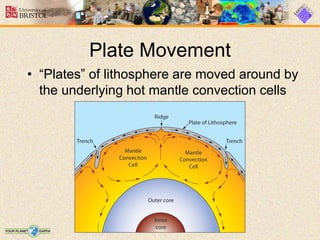
Plate Movement
• “Plates” of lithosphere are moved around by
the underlying hot mantle convection cells
What happens at tectonic
plate boundaries?
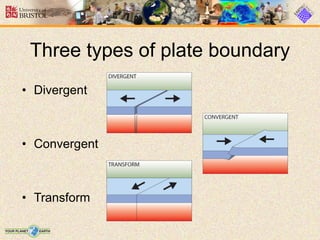
• Divergent
• Convergent
• Transform
Three types of plate boundary
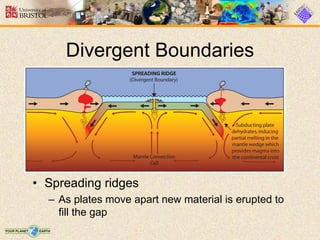
• Spreading ridges
– As plates move apart new material is erupted to
fill the gap
Divergent Boundaries
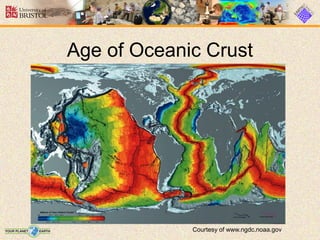
Age of Oceanic Crust
Courtesy of www.ngdc.noaa.gov
• There are three styles of convergent
plate boundaries
– Continent-continent collision
– Continent-oceanic crust collision
– Ocean-ocean collision
Convergent Boundaries
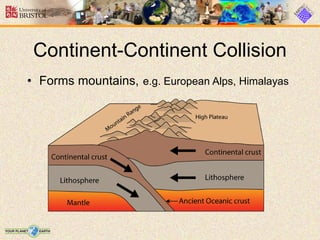
• Forms mountains, e.g. European Alps, Himalayas
Continent-Continent Collision
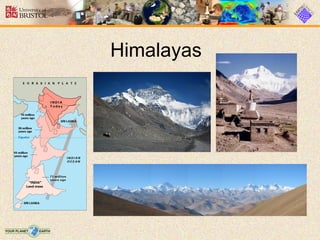
Himalayas
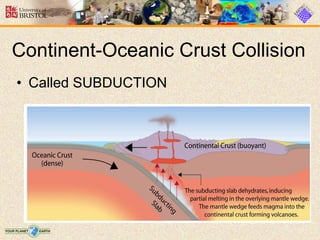
• Called SUBDUCTION
Continent-Oceanic Crust Collision
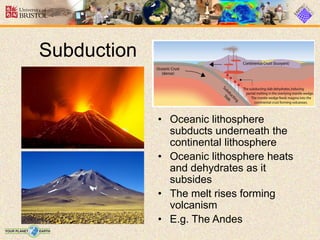
• Oceanic lithosphere
subducts underneath the
continental lithosphere
• Oceanic lithosphere heats
and dehydrates as it
subsides
• The melt rises forming
volcanism
• E.g. The Andes
Subduction
• When two oceanic plates collide, one runs over the
other which causes it to sink into the mantle forming
a subduction zone.
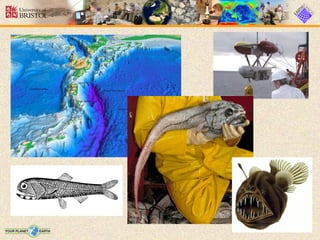
• The subducting plate is bent downward to form a very
deep depression in the ocean floor called a trench.
• The worlds deepest parts of the ocean are found
along trenches.
– E.g. The Mariana Trench is 11 km deep!
Ocean-Ocean Plate Collision
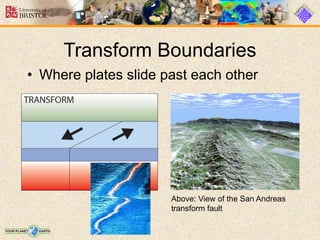
• Where plates slide past each other
Transform Boundaries
Above: View of the San Andreas
transform fault
…what’s the connection?
Volcanoes and Plate
Tectonics…
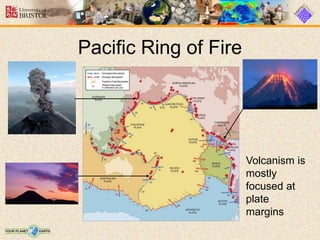
Volcanism is
mostly
focused at
plate
margins
Pacific Ring of Fire
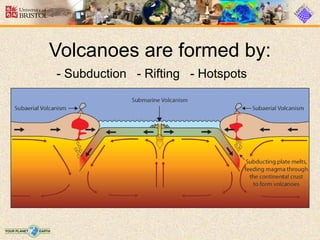
- Subduction - Rifting - Hotspots
Volcanoes are formed by:
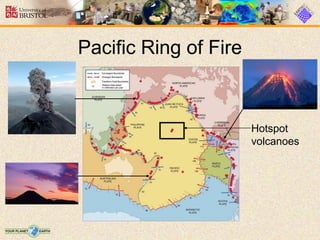
Pacific Ring of Fire
Hotspot
volcanoes
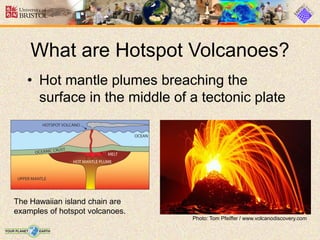
• Hot mantle plumes breaching the
surface in the middle of a tectonic plate
What are Hotspot Volcanoes?
Photo: Tom Pfeiffer / www.volcanodiscovery.com
The Hawaiian island chain are
examples of hotspot volcanoes.
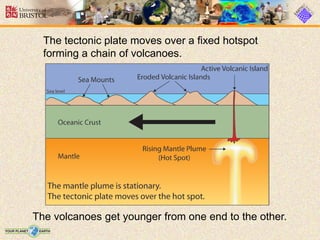
The tectonic plate moves over a fixed hotspot
forming a chain of volcanoes.
The volcanoes get younger from one end to the other.
…what’s the connection?
Earthquakes and Plate
Tectonics…
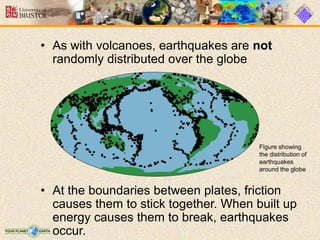
• As with volcanoes, earthquakes are not
randomly distributed over the globe
• At the boundaries between plates, friction
causes them to stick together. When built up
energy causes them to break, earthquakes
occur.
Figure showing
the distribution of
earthquakes
around the globe
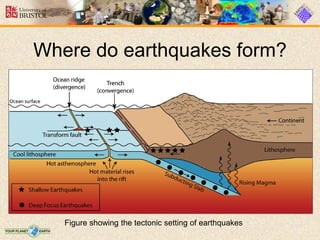
Where do earthquakes form?
Figure showing the tectonic setting of earthquakes
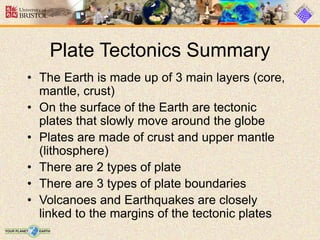
Plate Tectonics Summary
• The Earth is made up of 3 main layers (core,
mantle, crust)
• On the surface of the Earth are tectonic
plates that slowly move around the globe
• Plates are made of crust and upper mantle
(lithosphere)
• There are 2 types of plate
• There are 3 types of plate boundaries
• Volcanoes and Earthquakes are closely
linked to the margins of the tectonic plates

grade-10-plate-tectonics_compress.pdf

  • 1.
    What is PlateTectonics?
  • 2.
    • If youlook at a map of the world, you may notice that some of the continents could fit together like pieces of a puzzle.
  • 3.
    Plate Tectonics • TheEarth’s crust is divided into 12 major plates which are moved in various directions. • This plate motion causes them to collide, pull apart, or scrape against each other. • Each type of interaction causes a characteristic set of Earth structures or “tectonic” features. • The word, tectonic, refers to the deformation of the crust as a consequence of plate interaction.
  • 4.
  • 5.
    What are tectonicplates made of? • Plates are made of rigid lithosphere. The lithosphere is made up of the crust and the upper part of the mantle.
  • 6.
    What lies beneaththe tectonic plates? • Below the lithosphere (which makes up the tectonic plates) is the asthenosphere.
  • 7.
    Plate Movement • “Plates”of lithosphere are moved around by the underlying hot mantle convection cells
  • 8.
    What happens attectonic plate boundaries?
  • 9.
    • Divergent • Convergent •Transform Three types of plate boundary
  • 10.
    • Spreading ridges –As plates move apart new material is erupted to fill the gap Divergent Boundaries
  • 11.
    Age of OceanicCrust Courtesy of www.ngdc.noaa.gov
  • 12.
    • There arethree styles of convergent plate boundaries – Continent-continent collision – Continent-oceanic crust collision – Ocean-ocean collision Convergent Boundaries
  • 13.
    • Forms mountains,e.g. European Alps, Himalayas Continent-Continent Collision
  • 14.
  • 15.
  • 16.
    • Oceanic lithosphere subductsunderneath the continental lithosphere • Oceanic lithosphere heats and dehydrates as it subsides • The melt rises forming volcanism • E.g. The Andes Subduction
  • 17.
    • When twooceanic plates collide, one runs over the other which causes it to sink into the mantle forming a subduction zone. • The subducting plate is bent downward to form a very deep depression in the ocean floor called a trench. • The worlds deepest parts of the ocean are found along trenches. – E.g. The Mariana Trench is 11 km deep! Ocean-Ocean Plate Collision
  • 19.
    • Where platesslide past each other Transform Boundaries Above: View of the San Andreas transform fault
  • 21.
  • 22.
  • 23.
    - Subduction -Rifting - Hotspots Volcanoes are formed by:
  • 24.
    Pacific Ring ofFire Hotspot volcanoes
  • 25.
    • Hot mantleplumes breaching the surface in the middle of a tectonic plate What are Hotspot Volcanoes? Photo: Tom Pfeiffer / www.volcanodiscovery.com The Hawaiian island chain are examples of hotspot volcanoes.
  • 26.
    The tectonic platemoves over a fixed hotspot forming a chain of volcanoes. The volcanoes get younger from one end to the other.
  • 27.
  • 28.
    • As withvolcanoes, earthquakes are not randomly distributed over the globe • At the boundaries between plates, friction causes them to stick together. When built up energy causes them to break, earthquakes occur. Figure showing the distribution of earthquakes around the globe
  • 29.
    Where do earthquakesform? Figure showing the tectonic setting of earthquakes
  • 30.
    Plate Tectonics Summary •The Earth is made up of 3 main layers (core, mantle, crust) • On the surface of the Earth are tectonic plates that slowly move around the globe • Plates are made of crust and upper mantle (lithosphere) • There are 2 types of plate • There are 3 types of plate boundaries • Volcanoes and Earthquakes are closely linked to the margins of the tectonic plates