Computer
Number Systems
Grade 7 – ICT – Quarter 1- Lesson 5
Content
Computer Number Systems
● binary
● octal
● decimal
● hexadecimal
Conversion of Computer
Number Systems
● binary
● octal
● decimal
● hexadecimal
Content Standards
The learners will
demonstrate an understanding of the computer
number systems.
demonstrate an understanding of conversion of
computer number systems.
Performance
Standards
The learners convert number systems in practical
scenarios.
Learning Competencies:
differentiate the various computer
number systems
apply conversion of computer number
systems
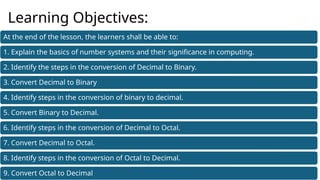
Learning Objectives:
At the end of the lesson, the learners shall be able to:
1. Explain the basics of number systems and their significance in computing.
2. Identify the steps in the conversion of Decimal to Binary.
3. Convert Decimal to Binary
4. Identify steps in the conversion of binary to decimal.
5. Convert Binary to Decimal.
6. Identify steps in the conversion of Decimal to Octal.
7. Convert Decimal to Octal.
8. Identify steps in the conversion of Octal to Decimal.
9. Convert Octal to Decimal
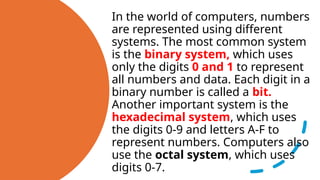
In the world of computers, numbers
are represented using different
systems. The most common system
is the binary system, which uses
only the digits 0 and 1 to represent
all numbers and data. Each digit in a
binary number is called a bit.
Another important system is the
hexadecimal system, which uses
the digits 0-9 and letters A-F to
represent numbers. Computers also
use the octal system, which uses
digits 0-7.
What is a number system?
•A number system is a
method of representing
numbers using specific
rules. It provides a
consistent way to express
numerical values. In
mathematics, we use
various number systems to
represent and manipulate
numbers.
Here are
the four
most
common
types:
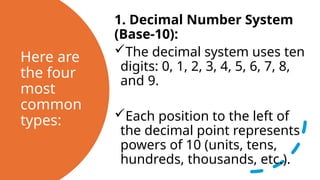
1. Decimal Number System
(Base-10):
The decimal system uses ten
digits: 0, 1, 2, 3, 4, 5, 6, 7, 8,
and 9.
Each position to the left of
the decimal point represents
powers of 10 (units, tens,
hundreds, thousands, etc.).
Here are
the four
most
common
types:
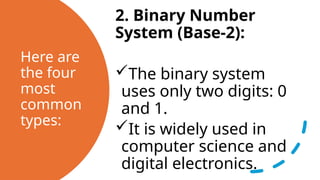
2. Binary Number
System (Base-2):
The binary system
uses only two digits: 0
and 1.
It is widely used in
computer science and
digital electronics.
Here are
the four
most
common
types:
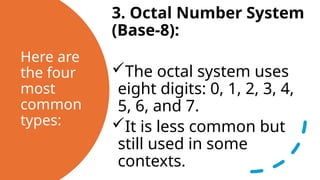
3. Octal Number System
(Base-8):
The octal system uses
eight digits: 0, 1, 2, 3, 4,
5, 6, and 7.
It is less common but
still used in some
contexts.
Here are
the four
most
common
types:
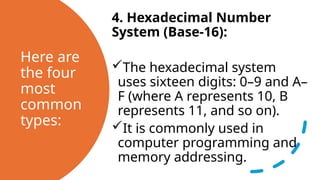
4. Hexadecimal Number
System (Base-16):
The hexadecimal system
uses sixteen digits: 0–9 and A–
F (where A represents 10, B
represents 11, and so on).
It is commonly used in
computer programming and
memory addressing.
The number
system plays a
crucial role in
mathematics
and our daily
lives.
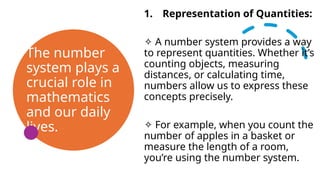
1. Representation of Quantities:
✧ A number system provides a way
to represent quantities. Whether it’s
counting objects, measuring
distances, or calculating time,
numbers allow us to express these
concepts precisely.
✧ For example, when you count the
number of apples in a basket or
measure the length of a room,
you’re using the number system.
The number
system plays
a crucial role
in
mathematics
and our daily
lives.
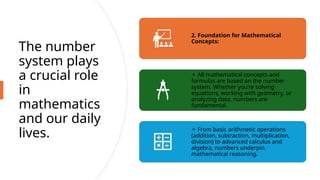
2. Foundation for Mathematical
Concepts:
✧ All mathematical concepts and
formulas are based on the number
system. Whether you’re solving
equations, working with geometry, or
analyzing data, numbers are
fundamental.
✧ From basic arithmetic operations
(addition, subtraction, multiplication,
division) to advanced calculus and
algebra, numbers underpin
mathematical reasoning.
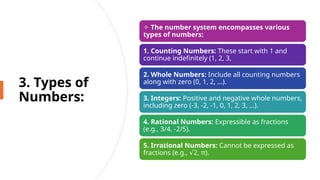
3. Types of
Numbers:
✧ The number system encompasses various
types of numbers:
1. Counting Numbers: These start with 1 and
continue indefinitely (1, 2, 3,
2. Whole Numbers: Include all counting numbers
along with zero (0, 1, 2, …).
3. Integers: Positive and negative whole numbers,
including zero (-3, -2, -1, 0, 1, 2, 3, …).
4. Rational Numbers: Expressible as fractions
(e.g., 3/4, -2/5).
5. Irrational Numbers: Cannot be expressed as
fractions (e.g., 2, π).
√
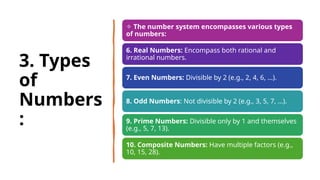
3. Types
of
Numbers
:
✧ The number system encompasses various types
of numbers:
6. Real Numbers: Encompass both rational and
irrational numbers.
7. Even Numbers: Divisible by 2 (e.g., 2, 4, 6, …).
8. Odd Numbers: Not divisible by 2 (e.g., 3, 5, 7, …).
9. Prime Numbers: Divisible only by 1 and themselves
(e.g., 5, 7, 13).
10. Composite Numbers: Have multiple factors (e.g.,
10, 15, 28).
4. Digital Systems and Data Representation:
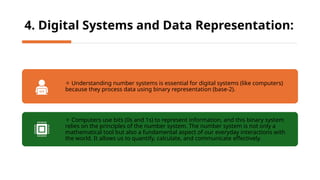
✧ Understanding number systems is essential for digital systems (like computers)
because they process data using binary representation (base-2).
✧ Computers use bits (0s and 1s) to represent information, and this binary system
relies on the principles of the number system. The number system is not only a
mathematical tool but also a fundamental aspect of our everyday interactions with
the world. It allows us to quantify, calculate, and communicate effectively.
Definitio
n of
Terms
• Number system - is a mathematical way of
representing a set of values using digits or
symbols.
• Decimal - is a number that consists of a
whole part and a fractional part separated by a
decimal point.
• Binary - is a number expressed in the base-2
numeral system, in this system, we use only
two symbols: typically, "0" (zero) and "1" (one).
• Octal - is a type of numeral system that uses
a base of eight, in this system, the digits range
from 0 to 7.
• Hexadecimal - is a base-16 numeral system. Unlike
our everyday decimal system (base 10), which uses ten
symbols (0-9), hexadecimal employs sixteen symbols.
These symbols represent values from 0 to 15.
Binary
number
system
The binary number
system is a fundamental
concept in computer
science and digital
electronics. It uses a base-
2 numeral system, which
means it only employs
two distinct symbols: 0
(zero) and 1 (one).
Key
points
about
binary
numbers
:
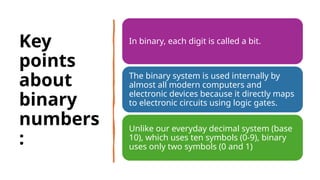
In binary, each digit is called a bit.
The binary system is used internally by
almost all modern computers and
electronic devices because it directly maps
to electronic circuits using logic gates.
Unlike our everyday decimal system (base
10), which uses ten symbols (0-9), binary
uses only two symbols (0 and 1)
Conversions
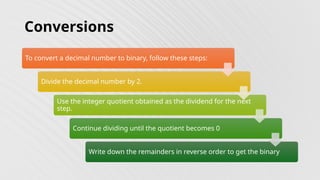
To convert a decimal number to binary, follow these steps:
Divide the decimal number by 2.
Use the integer quotient obtained as the dividend for the next
step.
Continue dividing until the quotient becomes 0
Write down the remainders in reverse order to get the binary
Download the Full version copy click
the link below
• Link 1:
https://www.facebook.com/mrjfoodproducts?mibextid=ZbW
KwL
Link 2:
https://www.raket.ph/sirj./products/grade-7-ict-computer-nu
mber-systems-ppt-matatag-curriculum

Grade 7 ICT : Computer Number Systems PPT-MATATAG Curriculum

  • 1.
    Computer Number Systems Grade 7– ICT – Quarter 1- Lesson 5
  • 2.
    Content Computer Number Systems ●binary ● octal ● decimal ● hexadecimal Conversion of Computer Number Systems ● binary ● octal ● decimal ● hexadecimal
  • 3.
    Content Standards The learnerswill demonstrate an understanding of the computer number systems. demonstrate an understanding of conversion of computer number systems.
  • 4.
    Performance Standards The learners convertnumber systems in practical scenarios.
  • 5.
    Learning Competencies: differentiate thevarious computer number systems apply conversion of computer number systems
  • 6.
    Learning Objectives: At theend of the lesson, the learners shall be able to: 1. Explain the basics of number systems and their significance in computing. 2. Identify the steps in the conversion of Decimal to Binary. 3. Convert Decimal to Binary 4. Identify steps in the conversion of binary to decimal. 5. Convert Binary to Decimal. 6. Identify steps in the conversion of Decimal to Octal. 7. Convert Decimal to Octal. 8. Identify steps in the conversion of Octal to Decimal. 9. Convert Octal to Decimal
  • 7.
    In the worldof computers, numbers are represented using different systems. The most common system is the binary system, which uses only the digits 0 and 1 to represent all numbers and data. Each digit in a binary number is called a bit. Another important system is the hexadecimal system, which uses the digits 0-9 and letters A-F to represent numbers. Computers also use the octal system, which uses digits 0-7.
  • 8.
    What is anumber system? •A number system is a method of representing numbers using specific rules. It provides a consistent way to express numerical values. In mathematics, we use various number systems to represent and manipulate numbers.
  • 9.
    Here are the four most common types: 1.Decimal Number System (Base-10): The decimal system uses ten digits: 0, 1, 2, 3, 4, 5, 6, 7, 8, and 9. Each position to the left of the decimal point represents powers of 10 (units, tens, hundreds, thousands, etc.).
  • 10.
    Here are the four most common types: 2.Binary Number System (Base-2): The binary system uses only two digits: 0 and 1. It is widely used in computer science and digital electronics.
  • 11.
    Here are the four most common types: 3.Octal Number System (Base-8): The octal system uses eight digits: 0, 1, 2, 3, 4, 5, 6, and 7. It is less common but still used in some contexts.
  • 12.
    Here are the four most common types: 4.Hexadecimal Number System (Base-16): The hexadecimal system uses sixteen digits: 0–9 and A– F (where A represents 10, B represents 11, and so on). It is commonly used in computer programming and memory addressing.
  • 13.
    The number system playsa crucial role in mathematics and our daily lives. 1. Representation of Quantities: ✧ A number system provides a way to represent quantities. Whether it’s counting objects, measuring distances, or calculating time, numbers allow us to express these concepts precisely. ✧ For example, when you count the number of apples in a basket or measure the length of a room, you’re using the number system.
  • 14.
    The number system plays acrucial role in mathematics and our daily lives. 2. Foundation for Mathematical Concepts: ✧ All mathematical concepts and formulas are based on the number system. Whether you’re solving equations, working with geometry, or analyzing data, numbers are fundamental. ✧ From basic arithmetic operations (addition, subtraction, multiplication, division) to advanced calculus and algebra, numbers underpin mathematical reasoning.
  • 15.
    3. Types of Numbers: ✧The number system encompasses various types of numbers: 1. Counting Numbers: These start with 1 and continue indefinitely (1, 2, 3, 2. Whole Numbers: Include all counting numbers along with zero (0, 1, 2, …). 3. Integers: Positive and negative whole numbers, including zero (-3, -2, -1, 0, 1, 2, 3, …). 4. Rational Numbers: Expressible as fractions (e.g., 3/4, -2/5). 5. Irrational Numbers: Cannot be expressed as fractions (e.g., 2, π). √
  • 16.
    3. Types of Numbers : ✧ Thenumber system encompasses various types of numbers: 6. Real Numbers: Encompass both rational and irrational numbers. 7. Even Numbers: Divisible by 2 (e.g., 2, 4, 6, …). 8. Odd Numbers: Not divisible by 2 (e.g., 3, 5, 7, …). 9. Prime Numbers: Divisible only by 1 and themselves (e.g., 5, 7, 13). 10. Composite Numbers: Have multiple factors (e.g., 10, 15, 28).
  • 17.
    4. Digital Systemsand Data Representation: ✧ Understanding number systems is essential for digital systems (like computers) because they process data using binary representation (base-2). ✧ Computers use bits (0s and 1s) to represent information, and this binary system relies on the principles of the number system. The number system is not only a mathematical tool but also a fundamental aspect of our everyday interactions with the world. It allows us to quantify, calculate, and communicate effectively.
  • 18.
    Definitio n of Terms • Numbersystem - is a mathematical way of representing a set of values using digits or symbols. • Decimal - is a number that consists of a whole part and a fractional part separated by a decimal point. • Binary - is a number expressed in the base-2 numeral system, in this system, we use only two symbols: typically, "0" (zero) and "1" (one). • Octal - is a type of numeral system that uses a base of eight, in this system, the digits range from 0 to 7. • Hexadecimal - is a base-16 numeral system. Unlike our everyday decimal system (base 10), which uses ten symbols (0-9), hexadecimal employs sixteen symbols. These symbols represent values from 0 to 15.
  • 19.
    Binary number system The binary number systemis a fundamental concept in computer science and digital electronics. It uses a base- 2 numeral system, which means it only employs two distinct symbols: 0 (zero) and 1 (one).
  • 20.
    Key points about binary numbers : In binary, eachdigit is called a bit. The binary system is used internally by almost all modern computers and electronic devices because it directly maps to electronic circuits using logic gates. Unlike our everyday decimal system (base 10), which uses ten symbols (0-9), binary uses only two symbols (0 and 1)
  • 21.
    Conversions To convert adecimal number to binary, follow these steps: Divide the decimal number by 2. Use the integer quotient obtained as the dividend for the next step. Continue dividing until the quotient becomes 0 Write down the remainders in reverse order to get the binary
  • 22.
    Download the Fullversion copy click the link below • Link 1: https://www.facebook.com/mrjfoodproducts?mibextid=ZbW KwL Link 2: https://www.raket.ph/sirj./products/grade-7-ict-computer-nu mber-systems-ppt-matatag-curriculum