 A binary number system is one of the four
types of number system. In computer
applications, where binary numbers are
represented by only two symbols or digits,
i.e. 0 (zero) and 1(one). The binary numbers
here are expressed in the base-2 numeral
system. For example, (101)2 is a binary
number.
 The octal numeral system is the base-8
number system, and uses the digits 0 to 7.
That means there are only 8 symbols or
digits (0, 1, 2, 3, 4, 5, 6, 7) used to form
other numbers. The main advantage of using
the octal number system is that it uses fewer
digits than the decimal and hexadecimal
number system.
 decimal system, in mathematics, positional
numeral system employing 10 as the base
and requiring 10 different numerals, the
digits 0, 1, 2, 3, 4, 5, 6, 7, 8, 9. It also
requires a dot (decimal point) to represent
decimal fractions.
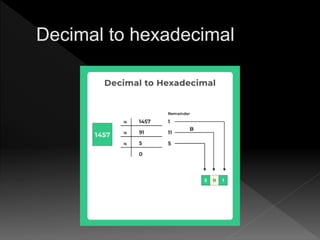
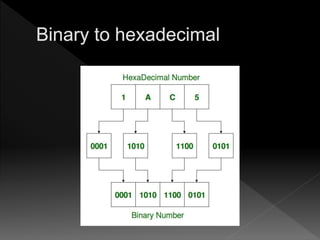
 The hexadecimal number system is a type of
number system, that has a base value equal
to 16. It is also pronounced sometimes as
'hex'. Hexadecimal numbers are represented
by only 16 symbols. These symbols or
values are 0, 1, 2, 3, 4, 5, 6, 7, 8, 9, A, B, C,
D, E and F. Each digit represents a decimal
value.
Datarepresentation grade 11 computer science

Datarepresentation grade 11 computer science

  • 2.
     A binarynumber system is one of the four types of number system. In computer applications, where binary numbers are represented by only two symbols or digits, i.e. 0 (zero) and 1(one). The binary numbers here are expressed in the base-2 numeral system. For example, (101)2 is a binary number.
  • 3.
     The octalnumeral system is the base-8 number system, and uses the digits 0 to 7. That means there are only 8 symbols or digits (0, 1, 2, 3, 4, 5, 6, 7) used to form other numbers. The main advantage of using the octal number system is that it uses fewer digits than the decimal and hexadecimal number system.
  • 4.
     decimal system,in mathematics, positional numeral system employing 10 as the base and requiring 10 different numerals, the digits 0, 1, 2, 3, 4, 5, 6, 7, 8, 9. It also requires a dot (decimal point) to represent decimal fractions.
  • 5.
     The hexadecimalnumber system is a type of number system, that has a base value equal to 16. It is also pronounced sometimes as 'hex'. Hexadecimal numbers are represented by only 16 symbols. These symbols or values are 0, 1, 2, 3, 4, 5, 6, 7, 8, 9, A, B, C, D, E and F. Each digit represents a decimal value.