Use of PPE in
Agricultural
Crop
Quarter 1 – Lesson 3-4:
At the end
of the
lesson you
should be
able to:
1. Identify the different
personal protective
equipment (PPE).
2. Check the suitable
personal protective
equipment as required by
the job.
3. Wear appropriate
personal protective
equipment.
Dust Mask
Personal
Hard Hat
goggles
Earmuffs
PERSONAL
PROTECTIVE
EQUIPMENT
• Personal Protective
Equipment (PPE) can reduce
the number and severity of
farm work related injuries and
illnesses. Personal protective
equipment not only helps
protect people but also
improves productivity and
profits. Farmers and ranchers
can share in these benefits by
using the appropriate
protective equipment for
themselves, family members
and employees when the job
and its potential hazards call
for it.
What’s In
1. What is manual handling?
2. Why does learning the
proper manual handling
important in the field of
agriculture?
3. Give 2 examples of
musculoskeletal disorders.
What’s New
•1. Have you seen workers working on
construction site or any related work?
•2. What have you observed what they’re
wearing?
•3. Have you asked yourself the purpose
of those clothing/paraphernalia?
Personal
Protective
Equipme
nt
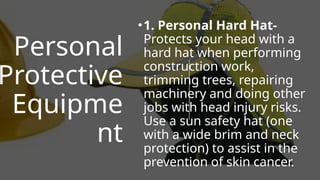
•1. Personal Hard Hat-
Protects your head with a
hard hat when performing
construction work,
trimming trees, repairing
machinery and doing other
jobs with head injury risks.
Use a sun safety hat (one
with a wide brim and neck
protection) to assist in the
prevention of skin cancer.
Personal
Protective
Equipment
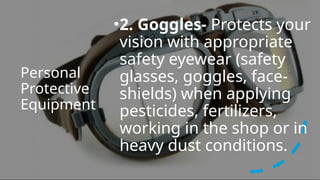
•2. Goggles- Protects your
vision with appropriate
safety eyewear (safety
glasses, goggles, face-
shields) when applying
pesticides, fertilizers,
working in the shop or in
heavy dust conditions.
Personal
Protective
Equipment
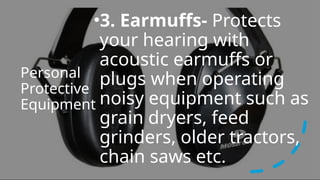
•3. Earmuffs- Protects
your hearing with
acoustic earmuffs or
plugs when operating
noisy equipment such as
grain dryers, feed
grinders, older tractors,
chain saws etc.
Personal Protective
Equipment
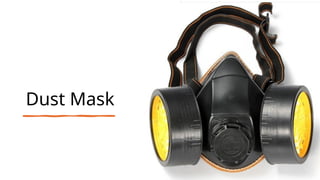
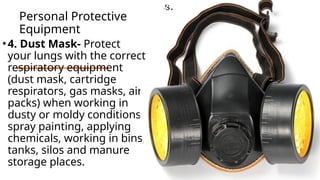
•4. Dust Mask- Protect
your lungs with the correct
respiratory equipment
(dust mask, cartridge
respirators, gas masks, air
packs) when working in
dusty or moldy conditions,
spray painting, applying
chemicals, working in bins,
tanks, silos and manure
storage places.
FARM WORKS THAT INVOLVE USING OF CHEMICALS
AND HAZARDOUS TOOLS AND EQUIPMENT
•1. Spraying Chemicals- Many
different chemicals are used on the
farm including pesticides. These
chemicals are used to fertilize and
control pests such as insects,
weeds, mollusk, etc. Most of these
chemicals are applied by spraying.
FARM WORKS THAT INVOLVE USING OF CHEMICALS
AND HAZARDOUS TOOLS AND EQUIPMENT
•Examples of chemical hazards:
•Spraying in a strong wind and the spray
drifting over a dam or the farm house.
Washing spray equipment and the water
running into open drains, collecting in
puddles, or running into stockyards or
dams. Containers or chemicals left lying
around. Empty containers lying in a heap.
Some ways you can reduce the risk of
hazards from chemicals are:
•Use personal protective equipment such as
respirators, waterproof clothes, rubber gloves and
waterproof footwear.
• Make sure chemicals are safely stored and
cupboards locked.
• Never spray chemicals on days when there is a high
wind.
• Know first aid procedures.
• Keep a list of all hazardous substances on the farm.
Safe use of chemicals
•Consider if a chemical substance is really
needed.
• Eliminate a hazardous substance, or if that
is not possible, substitute it with less
hazardous one.
• Safe work practices or personal protective
equipment should be used.
• Keep records of farm chemicals.
FARM WORKS THAT INVOLVE USING OF
CHEMICALS AND HAZARDOUS TOOLS
AND EQUIPMENT
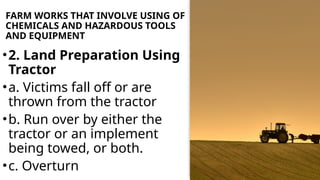
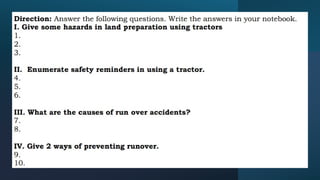
•2. Land Preparation Using
Tractor
•a. Victims fall off or are
thrown from the tractor
•b. Run over by either the
tractor or an implement
being towed, or both.
•c. Overturn
FARM WORKS THAT
INVOLVE USING OF
CHEMICALS AND
HAZARDOUS
TOOLS AND
EQUIPMENT
2. Land Preparation Using Tractor
Safety Reminders •
Tractors are not passenger vehicles.
Use seat belts when driving tractors.
ROPS will protect the operator from
serious injuries.
FARM WORKS THAT
INVOLVE USING OF
CHEMICALS AND
HAZARDOUS
TOOLS AND
EQUIPMENT
2. Land Preparation Using
Tractor
Causes of run over accidents
Sudden stops
Driving over holes, stumps and
debris, or a sharp turn
FARM WORKS THAT INVOLVE USING OF CHEMICALS
AND HAZARDOUS TOOLS AND EQUIPMENT
•2. Land Preparation Using Tractor
•How to prevent run over
Never allow riders on tractors.
Discuss with family members and farm workers the
potential risks of riding tractor.
It is also helpful to post 'no riders' decals on all
tractors to remind others about the policy.
Use or provide other vehicles that allow passengers,
such as trucks or cars, when transportation is needed
to fields or remote work
Assessment - Fill in the blanks.
1._________ can reduce the number and severity of farm work related
injuries and illnesses.
(2-4). Protect your head with a hard hat when performing 2.
_____________, 3. ______________, 4. __________, with head injury risks.
Use a sun safety hat one with a wide brim and neck protection to
assist in the prevention of 5. ________________. Protect your vision with
appropriate safety eyewear 6. _________________, 7. _________________, 8.
___________ when applying pesticides, fertilizers, working in the shop,
or in heavy dust conditions. Protect your hearing with acoustic
earmuffs or plugs when operating noisy equipment such as 9.
___________________, 10. _____________, older tractors, chain saws, etc.
II. Give at least five (5) examples of PPE.
1.
2.
3.
4.
5.
Download the Full version copy click
the link below
• Link 1:
https://www.facebook.com/mrjfoodproducts?mibextid=ZbW
KwL