Storage Practices
and Principles for
Waste Materials
Mang Tomas Story
•Mang Tomas own a small garden in their
barangay. HE was able to produce fresh
vegetables for the neighborhood. He lives alone
in his small house inside the garden. Due to his
age, he can’t manage the waste he accumulated
during gardening.
Mang Tomas Story
•One day, Aling Berta confront him that
his bulk waste in his garden was producing
a foul smell. Some of his neighborhood
are also complaining with some pest and
flies coming from it.
Mang Tomas Story
1. If you are in the situation of Mang
Tomas what will you do?
2. How could this problem with waste
disposal in the neighborhood be
resolve?
Farm Waste Storage
A good storage for farm wastes should
comply with requirements prescribed by the
Good Agricultural Practices and in
accordance with the local Law (RA 9003)
Ecological Solid Waste Management
Program.
Good Agricultural Practices (GAP)
Refers to the practices that address
environmental, economic and social
sustainability for/on farm processes, and
which result in safe and quality food and
nonfood agricultural products (RA 10611).
The said act should be observed always by
farmers as they are the cultivator of the farm.
Farm Waste
All garbage and waste materials
generated throughout the
operation, including cuttings and
trims, twigs, plastic, plant residues
and others.
Storage
1. Choose a place where your storage should be
built. See to it that the area is flood-free or
elevated, distance from the residence house and
does not easily attract insect and pest.
2. Ensure farm waste storage areas and containers
are enough for the amount of waste generated
from the time it will be disposed or collected.
Storage
3. Maintain cleanliness of the waste storage
areas often enough to avoid contamination and
diseases. Sanitize and disinfect the area as required.
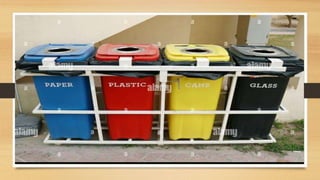
4. Always use containers with lid/cup. Label the
containers according to the nature of waste.
Color coding can be use also to determine the nature
of waste to be thrown.
Disposal
1. Remove farm waste often enough and in a manner to
prevent cross- contamination and avoid attracting
pests.
2. Dispose of all materials according to Local
Government Unit existing law.
3. Unless properly sanitized, vehicles used for transporting
farm waste should not be used to transport food
products and farm inputs.
Pesticide and Insecticide Wastes
Unwanted containers of
pesticides and insecticides used
during operation
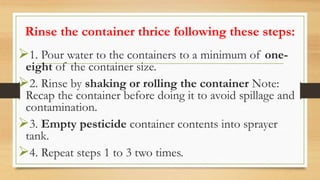
Rinse the container thrice following these steps:
1. Pour water to the containers to a minimum of one-
eight of the container size.
2. Rinse by shaking or rolling the container Note:
Recap the container before doing it to avoid spillage and
contamination.
3. Empty pesticide container contents into sprayer
tank.
4. Repeat steps 1 to 3 two times.
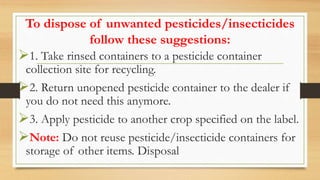
To dispose of unwanted pesticides/insecticides
follow these suggestions:
1. Take rinsed containers to a pesticide container
collection site for recycling.
2. Return unopened pesticide container to the dealer if
you do not need this anymore.
3. Apply pesticide to another crop specified on the label.
Note: Do not reuse pesticide/insecticide containers for
storage of other items. Disposal
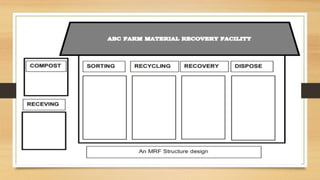
In some organized farm a Material Recovery
Facility (MRF) was established to facilitate
the proper storage and disposal of wastes.
The Material Recovery Facility (MRF)
A structure wherein wastes are being
segregate, sort, dispose, process
(compost/recycle) and recover some useful
products for money
The Material Recovery Facility (MRF)
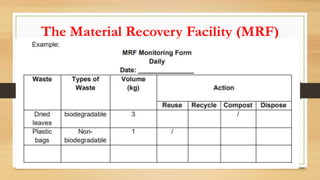
To facilitate the monitoring of the waste turn
into MRF a farmer should have a record. This
record should be kept for reporting
purposes to the Local Government Unit,
barangay, municipal/city, and provincial task
force in charge in the waste management.
The Material Recovery Facility (MRF)
To facilitate the monitoring of the waste turn
into MRF a farmer should have a record. This
record should be kept for reporting
purposes to the Local Government Unit,
barangay, municipal/city, and provincial task
force in charge in the waste management.
LET US REMEMBER
If farm wastes are not managed properly,
they can cause contamination and
diseases to both plants and man. The
production of waste can provide habitats
and food for insects and pests which are
harmful.
What Have You Learned?
Directions: Read each statement carefully. Draw a
 if the statement is correct and a  if not.
1. All garbage and waste materials generated throughout
the operation, including cuttings and trims, twigs, plastic,
plant residues and others are called farm waste
2. A pesticide container can be reuse as water container.
3. All farm needs to comply with the Good Agricultural
Practices.
Directions: Read each statement carefully. Draw a
 if the statement is correct and a  if not.
4. MRF monitoring form help the farmer to manage the
waste accumulated in the farm orderly.
5. Insects and pests thrive best in a clean and sanitize
environment
6. We can recover energy and penny from some wastes.
7. Biodegradable waste can be use in compost which are
established near the garden. and MRF.
Directions: Read each statement carefully. Draw a
 if the statement is correct and a  if not.
8. Storage area for waste should be flood free and far
from neighborhood.
9. Maintaining the storage area is not a task to do in
the MRF.
10. A clean and order storage area prevents
contamination and spread of diseases.
Directions: Read each statement carefully. Draw a
 if the statement is correct and a  if not.
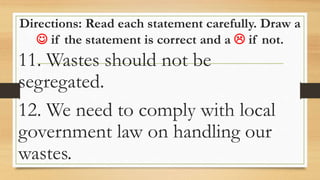
11. Wastes should not be
segregated.
12. We need to comply with local
government law on handling our
wastes.
Directions: Read each statement carefully. Draw a
 if the statement is correct and a  if not.
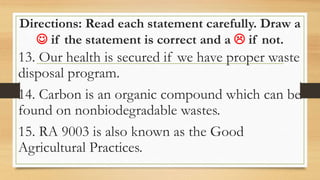
13. Our health is secured if we have proper waste
disposal program.
14. Carbon is an organic compound which can be
found on nonbiodegradable wastes.
15. RA 9003 is also known as the Good
Agricultural Practices.
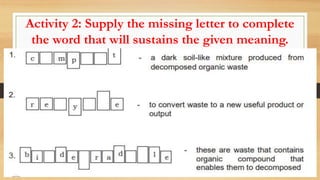
Activity 2: Supply the missing letter to complete
the word that will sustains the given meaning.
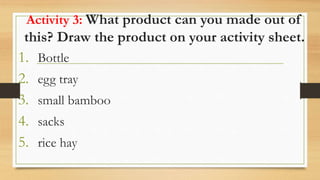
Activity 3: What product can you made out of
this? Draw the product on your activity sheet.
1. Bottle
2. egg tray
3. small bamboo
4. sacks
5. rice hay
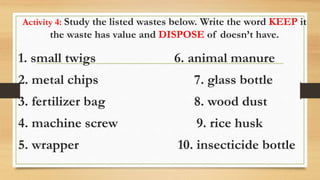
Activity 4: Study the listed wastes below. Write the word KEEP it
the waste has value and DISPOSE of doesn’t have.
1. small twigs 6. animal manure
2. metal chips 7. glass bottle
3. fertilizer bag 8. wood dust
4. machine screw 9. rice husk
5. wrapper 10. insecticide bottle
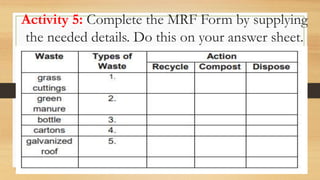
Activity 5: Complete the MRF Form by supplying
the needed details. Do this on your answer sheet.
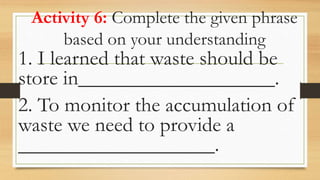
Activity 6: Complete the given phrase
based on your understanding
1. I learned that waste should be
store in___________________.
2. To monitor the accumulation of
waste we need to provide a
___________________.
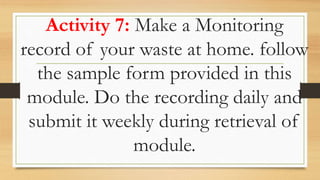
Activity 7: Make a Monitoring
record of your waste at home. follow
the sample form provided in this
module. Do the recording daily and
submit it weekly during retrieval of
module.
ACTIVITY 8: Read each statement carefully. Write the
word WAYS if the statement is correct and WASTE if
not. Write your answer on your answer sheet.
1. Wastes should not be segregated.
2. We need to comply with local government
law on handling our wastes.
3. Our health is secured if we have proper
waste disposal program
ACTIVITY 8: Read each statement carefully. Write the
word WAYS if the statement is correct and WASTE if
not. Write your answer on your answer sheet.
4. Carbon is an organic compound which can be found
on non- biodegradable wastes.
5. RA 9003 is also known as the Good Agricultural
Practices.
6. All farm needs to comply with the Good Agricultural
Practices.
ACTIVITY 8: Read each statement carefully. Write the
word WAYS if the statement is correct and WASTE if
not. Write your answer on your answer sheet.
7. MRF monitoring form help the farmer to
manage the waste accumulated in the farm orderly.
8. All garbage and waste materials generated
throughout the operation, including cuttings and
trims, twigs, plastic, plant residues and others are
called farm waste
ACTIVITY 8: Read each statement carefully. Write the
word WAYS if the statement is correct and WASTE if
not. Write your answer on your answer sheet.
9. A pesticide container can be reuse as water
container.
10. Insects and pests thrive best in a clean and
sanitize environment
11. We can recover energy and penny from some
wastes
ACTIVITY 8: Read each statement carefully. Write the
word WAYS if the statement is correct and WASTE if
not. Write your answer on your answer sheet.
12. Biodegradable waste can be use in
compost which are established near the
garden. and MRF.
13. A clean and order storage area prevents
contamination and spread of diseases.
ACTIVITY 8: Read each statement carefully. Write the
word WAYS if the statement is correct and WASTE if
not. Write your answer on your answer sheet.
14. Maintaining the storage area is not
a task to do in the MRF.
15. Storage area for waste should be
flood free and far from neighborhood
ACTIVITY 9: Answer the following questions:
1. Why is it necessary to dispose our waste
properly?
2. if you are a law maker, what law will you
pass to ease the problem with waste?