GPU acceleration of a non-
hydrostatic ocean model with a
multigrid Poisson/Helmholtz
solver
Takateru Yamagishi1, Yoshimasa Matsumura2
1 Research Organization for Information Science and
Technology
2 Institute of Low Temperature Science, Hokkaido University
6th International Workshop on Advances in High-
Performance Computational Earth Sciences: Applications
& Frameworks
Table of Contents
Motivation
Numerical ocean model ‘kinaco’
GPU implementation and Optimization
Evaluation and validation
Summary
Motivation
Significance of numerical ocean modelling
Global climate, weather, marine resource, etc.
GPU’s high computational performance
Explicit and detail expression, long time
simulation, many experiment cases
Previous studies
Bleichrodt et al. (2012), Milakov et al. (2013),
Werkhoven et al. (2013) Xu, et al. (2015)
They showed high performance, but limited to
experimental studies
We aim at realistic and practical studies
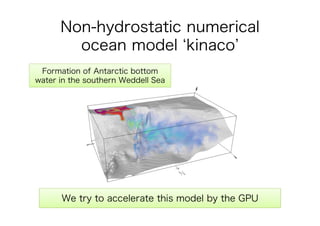
Non-hydrostatic numerical
ocean model ‘kinaco’
Formation of Antarctic bottom
water in the southern Weddell Sea
We try to accelerate this model by the GPU
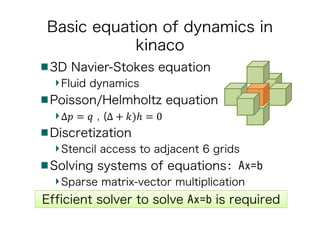
Basic equation of dynamics in
kinaco
3D Navier-Stokes equation
Fluid dynamics
Poisson/Helmholtz equation
∆ = , (∆ + )ℎ = 0
Discretization
Stencil access to adjacent 6 grids
Solving systems of equations: Ax=b
Sparse matrix-vector multiplication
Efficient solver to solve Ax=b is required
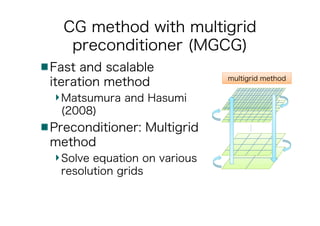
CG method with multigrid
preconditioner (MGCG)
Fast and scalable
iteration method
Matsumura and Hasumi
(2008)
Preconditioner: Multigrid
method
Solve equation on various
resolution grids
multigrid method
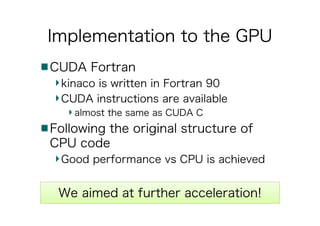
Implementation to the GPU
CUDA Fortran
kinaco is written in Fortran 90
CUDA instructions are available
almost the same as CUDA C
Following the original structure of
CPU code
Good performance vs CPU is achieved
We aimed at further acceleration!
Optimization of the MGCG
solver
The cost of MGCG solver: 21% of total
simulation
Mainly consists of sparse matrix-vector
multiplication
Optimization
1. Memory access
2. Hide latency by thread/Instruction-level
parallelism
3. Mixed precision preconditioner of MGCG
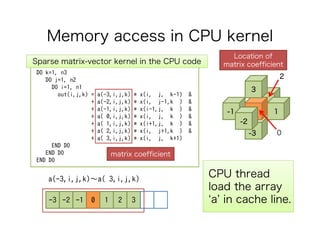
Memory access in CPU kernel
DO k=1, n3
DO j=1, n2
DO i=1, n1
out(i,j,k) = a(-3,i,j,k) * x(i, j, k-1) &
+ a(-2,i,j,k) * x(i, j-1,k ) &
+ a(-1,i,j,k) * x(i-1,j, k ) &
+ a( 0,i,j,k) * x(i, j, k ) &
+ a( 1,i,j,k) * x(i+1,j, k ) &
+ a( 2,i,j,k) * x(i, j+1,k ) &
+ a( 3,i,j,k) * x(i, j, k+1)
END DO
END DO
END DO
-3 -2 -1 0 1 2 3
a(-3,i,j,k)~a( 3,i,j,k)
Sparse matrix-vector kernel in the CPU code
matrix coefficient
Location of
matrix coefficient
-3
3
1-1
-2
2
0
CPU thread
load the array
‘a’ in cache line.
Memory access in GPU kernel
a(i,j,k,-3)
a(i+1,j,k,-3)
a(i+2,j,k,-3)
thread(id)
thread(id+1)
thread(id+2)
a(-3:3,i,j,k) a(i,j,k,-3:3)
Each GPU thread accesses array “a” with 7 intervals.
a(-3,i,j,k) a(-3,i+1,j,k) a(-3,i+2,j,k)
thread(id) thread(id+1) thread(id+2)
Coalesced access to array “a”
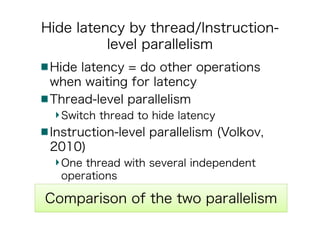
Hide latency by thread/Instruction-
level parallelism
Hide latency = do other operations
when waiting for latency
Thread-level parallelism
Switch thread to hide latency
Instruction-level parallelism (Volkov,
2010)
One thread with several independent
operations
Comparison of the two parallelism
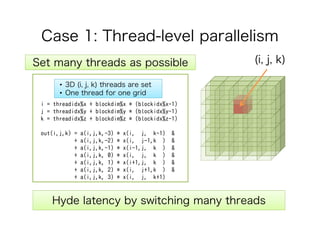
Case 1: Thread-level parallelism
i = threadidx%x + blockdim%x * (blockidx%x-1)
j = threadidx%y + blockdim%y * (blockidx%y-1)
k = threadidx%z + blockdim%z * (blockidx%z-1)
out(i,j,k) = a(i,j,k,-3) * x(i, j, k-1) &
+ a(i,j,k,-2) * x(i, j-1,k ) &
+ a(i,j,k,-1) * x(i-1,j, k ) &
+ a(i,j,k, 0) * x(i, j, k ) &
+ a(i,j,k, 1) * x(i+1,j, k ) &
+ a(i,j,k, 2) * x(i, j+1,k ) &
+ a(i,j,k, 3) * x(i, j, k+1)
Set many threads as possible (i, j, k)
• 3D (i, j, k) threads are set
• One thread for one grid
Hyde latency by switching many threads
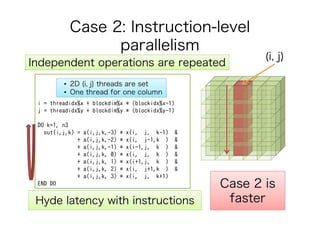
Case 2: Instruction-level
parallelism
Independent operations are repeated
i = threadidx%x + blockdim%x * (blockidx%x-1)
j = threadidx%y + blockdim%y * (blockidx%y-1)
DO k=1, n3
out(i,j,k) = a(i,j,k,-3) * x(i, j, k-1) &
+ a(i,j,k,-2) * x(i, j-1,k ) &
+ a(i,j,k,-1) * x(i-1,j, k ) &
+ a(i,j,k, 0) * x(i, j, k ) &
+ a(i,j,k, 1) * x(i+1,j, k ) &
+ a(i,j,k, 2) * x(i, j+1,k ) &
+ a(i,j,k, 3) * x(i, j, k+1)
END DO
Hyde latency with instructions
• 2D (i, j) threads are set
• One thread for one column
(i, j)
Case 2 is
faster
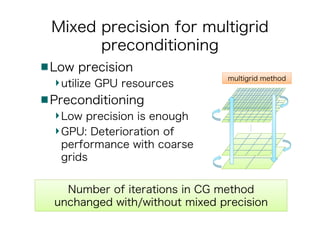
Mixed precision for multigrid
preconditioning
Low precision
utilize GPU resources
Preconditioning
Low precision is enough
GPU: Deterioration of
performance with coarse
grids
multigrid method
Number of iterations in CG method
unchanged with/without mixed precision
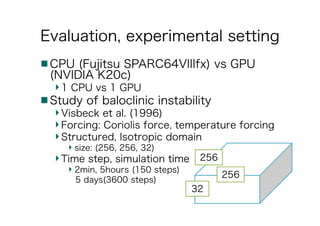
Evaluation, experimental setting
CPU (Fujitsu SPARC64VIIIfx) vs GPU
(NVIDIA K20c)
1 CPU vs 1 GPU
Study of baloclinic instability
Visbeck et al. (1996)
Forcing: Coriolis force, temperature forcing
Structured, Isotropic domain
size: (256, 256, 32)
Time step, simulation time
2min, 5hours (150 steps)
5 days(3600 steps)
256
256
32
Performance
CPU GPU_1 GPU_2 GPU_3
Speedup
(GPU_3)
all components 174.2 42.6 39.2 37.3 4.7
Poisson/Helmholtz
solver
36.8 15.8 12.4 10.5 3.5
others 137.4 26.9 26.8 26.8 5.1
Elapsed time[s]: CPU vs GPU
CPU : original CPU code
GPU_1: basic and typical implementation to the GPU
GPU_2: GPU_1 + memory optimization, hyde latency
GPU_3: GPU_2 + mixed precision preconditioning
GPU achieved 4.7 times speedup vs CPU
5hours (150 steps)
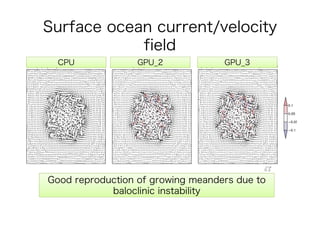
Surface ocean current/velocity
field
GPU_3GPU_2CPU
Good reproduction of growing meanders due to
baloclinic instability
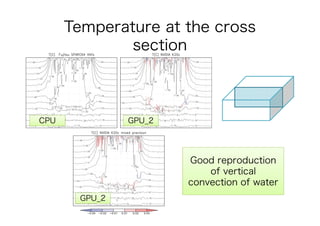
Temperature at the cross
section
Good reproduction
of vertical
convection of water
CPU GPU_2
GPU_2
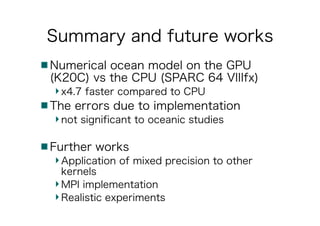
Summary and future works
Numerical ocean model on the GPU
(K20C) vs the CPU (SPARC 64 VIIIfx)
x4.7 faster compared to CPU
The errors due to implementation
not significant to oceanic studies
Further works
Application of mixed precision to other
kernels
MPI implementation
Realistic experiments

GPU acceleration of a non-hydrostatic ocean model with a multigrid Poisson/Helmholtz solver

  • 1.
    GPU acceleration ofa non- hydrostatic ocean model with a multigrid Poisson/Helmholtz solver Takateru Yamagishi1, Yoshimasa Matsumura2 1 Research Organization for Information Science and Technology 2 Institute of Low Temperature Science, Hokkaido University 6th International Workshop on Advances in High- Performance Computational Earth Sciences: Applications & Frameworks
  • 2.
    Table of Contents Motivation Numericalocean model ‘kinaco’ GPU implementation and Optimization Evaluation and validation Summary
  • 3.
    Motivation Significance of numericalocean modelling Global climate, weather, marine resource, etc. GPU’s high computational performance Explicit and detail expression, long time simulation, many experiment cases Previous studies Bleichrodt et al. (2012), Milakov et al. (2013), Werkhoven et al. (2013) Xu, et al. (2015) They showed high performance, but limited to experimental studies We aim at realistic and practical studies
  • 4.
    Non-hydrostatic numerical ocean model‘kinaco’ Formation of Antarctic bottom water in the southern Weddell Sea We try to accelerate this model by the GPU
  • 5.
    Basic equation ofdynamics in kinaco 3D Navier-Stokes equation Fluid dynamics Poisson/Helmholtz equation ∆ = , (∆ + )ℎ = 0 Discretization Stencil access to adjacent 6 grids Solving systems of equations: Ax=b Sparse matrix-vector multiplication Efficient solver to solve Ax=b is required
  • 6.
    CG method withmultigrid preconditioner (MGCG) Fast and scalable iteration method Matsumura and Hasumi (2008) Preconditioner: Multigrid method Solve equation on various resolution grids multigrid method
  • 7.
    Implementation to theGPU CUDA Fortran kinaco is written in Fortran 90 CUDA instructions are available almost the same as CUDA C Following the original structure of CPU code Good performance vs CPU is achieved We aimed at further acceleration!
  • 8.
    Optimization of theMGCG solver The cost of MGCG solver: 21% of total simulation Mainly consists of sparse matrix-vector multiplication Optimization 1. Memory access 2. Hide latency by thread/Instruction-level parallelism 3. Mixed precision preconditioner of MGCG
  • 9.
    Memory access inCPU kernel DO k=1, n3 DO j=1, n2 DO i=1, n1 out(i,j,k) = a(-3,i,j,k) * x(i, j, k-1) & + a(-2,i,j,k) * x(i, j-1,k ) & + a(-1,i,j,k) * x(i-1,j, k ) & + a( 0,i,j,k) * x(i, j, k ) & + a( 1,i,j,k) * x(i+1,j, k ) & + a( 2,i,j,k) * x(i, j+1,k ) & + a( 3,i,j,k) * x(i, j, k+1) END DO END DO END DO -3 -2 -1 0 1 2 3 a(-3,i,j,k)~a( 3,i,j,k) Sparse matrix-vector kernel in the CPU code matrix coefficient Location of matrix coefficient -3 3 1-1 -2 2 0 CPU thread load the array ‘a’ in cache line.
  • 10.
    Memory access inGPU kernel a(i,j,k,-3) a(i+1,j,k,-3) a(i+2,j,k,-3) thread(id) thread(id+1) thread(id+2) a(-3:3,i,j,k) a(i,j,k,-3:3) Each GPU thread accesses array “a” with 7 intervals. a(-3,i,j,k) a(-3,i+1,j,k) a(-3,i+2,j,k) thread(id) thread(id+1) thread(id+2) Coalesced access to array “a”
  • 11.
    Hide latency bythread/Instruction- level parallelism Hide latency = do other operations when waiting for latency Thread-level parallelism Switch thread to hide latency Instruction-level parallelism (Volkov, 2010) One thread with several independent operations Comparison of the two parallelism
  • 12.
    Case 1: Thread-levelparallelism i = threadidx%x + blockdim%x * (blockidx%x-1) j = threadidx%y + blockdim%y * (blockidx%y-1) k = threadidx%z + blockdim%z * (blockidx%z-1) out(i,j,k) = a(i,j,k,-3) * x(i, j, k-1) & + a(i,j,k,-2) * x(i, j-1,k ) & + a(i,j,k,-1) * x(i-1,j, k ) & + a(i,j,k, 0) * x(i, j, k ) & + a(i,j,k, 1) * x(i+1,j, k ) & + a(i,j,k, 2) * x(i, j+1,k ) & + a(i,j,k, 3) * x(i, j, k+1) Set many threads as possible (i, j, k) • 3D (i, j, k) threads are set • One thread for one grid Hyde latency by switching many threads
  • 13.
    Case 2: Instruction-level parallelism Independentoperations are repeated i = threadidx%x + blockdim%x * (blockidx%x-1) j = threadidx%y + blockdim%y * (blockidx%y-1) DO k=1, n3 out(i,j,k) = a(i,j,k,-3) * x(i, j, k-1) & + a(i,j,k,-2) * x(i, j-1,k ) & + a(i,j,k,-1) * x(i-1,j, k ) & + a(i,j,k, 0) * x(i, j, k ) & + a(i,j,k, 1) * x(i+1,j, k ) & + a(i,j,k, 2) * x(i, j+1,k ) & + a(i,j,k, 3) * x(i, j, k+1) END DO Hyde latency with instructions • 2D (i, j) threads are set • One thread for one column (i, j) Case 2 is faster
  • 14.
    Mixed precision formultigrid preconditioning Low precision utilize GPU resources Preconditioning Low precision is enough GPU: Deterioration of performance with coarse grids multigrid method Number of iterations in CG method unchanged with/without mixed precision
  • 15.
    Evaluation, experimental setting CPU(Fujitsu SPARC64VIIIfx) vs GPU (NVIDIA K20c) 1 CPU vs 1 GPU Study of baloclinic instability Visbeck et al. (1996) Forcing: Coriolis force, temperature forcing Structured, Isotropic domain size: (256, 256, 32) Time step, simulation time 2min, 5hours (150 steps) 5 days(3600 steps) 256 256 32
  • 16.
    Performance CPU GPU_1 GPU_2GPU_3 Speedup (GPU_3) all components 174.2 42.6 39.2 37.3 4.7 Poisson/Helmholtz solver 36.8 15.8 12.4 10.5 3.5 others 137.4 26.9 26.8 26.8 5.1 Elapsed time[s]: CPU vs GPU CPU : original CPU code GPU_1: basic and typical implementation to the GPU GPU_2: GPU_1 + memory optimization, hyde latency GPU_3: GPU_2 + mixed precision preconditioning GPU achieved 4.7 times speedup vs CPU 5hours (150 steps)
  • 17.
    Surface ocean current/velocity field GPU_3GPU_2CPU Goodreproduction of growing meanders due to baloclinic instability
  • 18.
    Temperature at thecross section Good reproduction of vertical convection of water CPU GPU_2 GPU_2
  • 19.
    Summary and futureworks Numerical ocean model on the GPU (K20C) vs the CPU (SPARC 64 VIIIfx) x4.7 faster compared to CPU The errors due to implementation not significant to oceanic studies Further works Application of mixed precision to other kernels MPI implementation Realistic experiments