Binary Vector Reconstruction
via Discreteness-Aware
Approximate Message Passing
APSIPA ASC 2017 (December 12-15, 2017)
@Kuala Lumpur, Malaysia
Ryo Hayakawa
(Graduate School of Informatics, Kyoto University)
Kazunori Hayashi
(Graduate School of Engineering, Osaka City University)
FP-07 (Special Session)
Large-Scale Stochastic Signal Processing For Wireless Communications
Outline
1. Introduction
2. Proposed Algorithm: DAMP

3. Performance Analysis with State Evolution

4. Bayes Optimal DAMP

5. Simulation Result

6. Conclusion
Purpose 

reconstruction of a discrete-valued vector 

from its underdetermined linear measurements
Discrete-Valued Vector Reconstruction
Introduction 1/13
y = Ab 2 RM
Application
✦ overloaded MIMO signal detection [1]

(multiple-input multiple-output)

✦ faster-than-Nyquist signaling [2]
A by NM
reconstruct
ˆb
(M < N)
✦ multiuser detection [1]

✦ overloaded MIMO signal detection [2]

(multiple-input multiple-output)

✦ faster-than-Nyquist signaling [3]
[1] H. Sasahara, K. Hayashi, and M. Nagahara, "Multiuser detection based on MAP estimation with
sum-of-absolute-values relaxation," IEEE Trans. Signal Process., vol.65, no. 21, pp. 5621-5634, Nov. 2017.
[2] R. Hayakawa and K. Hayashi, "Convex optimization based signal detection for massive overloaded MIMO
systems,” IEEE Trans. Wireless Commun., vol. 16, no. 11, pp. 7080-7091, Nov. 2017.
[3] H. Sasahara, K. Hayashi, and M. Nagahara, "Symbol detection for faster-than-Nyquist signaling by
sum-of-absolute-values optimization," IEEE Signal Process. Lett., vol. 23, no. 12, pp. 1853-1857, Dec. 2016.
b 2 {r1, . . . , rL}N
Conventional Approach
2/13Introduction
✦ regularization-based method [4]

✦ transform-based method [4]

✦ SOAV optimization [5]

(Sum-of-Absolute-Values)


✦ DAMP algorithm [7]

(Discreteness-Aware Approximate Message Passing)
[4] A. Aïssa-El-Bey, D. Pastor, S. M. A. Sbaï, and Y. Fadlallah, “Sparsity-based recovery of finite alphabet
solutions to underdetermined linear systems,” IEEE Trans. Inf. Theory, vol. 61, no. 4, pp. 2008– 2018, Apr. 2015.
[5] M. Nagahara, “Discrete signal reconstruction by sum of absolute values,” IEEE Signal Process. Lett., vol. 22,
no. 10, pp.1575–1579, Oct. 2015.
[6] D. L. Donoho, A. Maleki, and A. Montanari, “Message-passing algorithms for compressed sensing,”
Proc. Nat. Acad. Sci., vol. 106, no. 45, pp. 18914–18919, Nov. 2009.
[7] R. Hayakawa and K. Hayashi, “Discreteness-aware AMP for reconstruction of symmetrically distributed
discrete variables,” in Proc. IEEE SPAWC 2017, Jul. 2017.
based on convex optimization
❖ low computational complexity

❖ analytical tractability
apply the idea of 

AMP (Approximate Message Passing) algorithm [6]
Purpose of This Work
Introduction
1 extend the DAMP algorithm for asymmetric distributions
2
3
provide a condition for the perfect reconstruction
derive Bayes optimal DAMP
For binary vector (the simplest case),
Purpose of This Work
[7] R. Hayakawa and K. Hayashi, “Discreteness-aware AMP for reconstruction of symmetrically distributed
discrete variables,” in Proc. IEEE SPAWC 2017, Jul. 2017.
In [7], symmetric distribution of the elements of is assumed.
ex.)
3/13
b 2 {r1, r2}N
not applicable for b 2 {0, 1}N
b
(bj 2 {±1, ±3})(bj 2 {0, ±1})
bj bj bj
ex.)
Outline
1. Introduction

2. Proposed Algorithm: DAMP
3. Performance Analysis with State Evolution

4. Bayes Optimal DAMP

5. Simulation Result

6. Conclusion
Overview of Derivation
Proposed Algorithm: DAMP
✦ unknown vector: 

✦ probability: 

✦ measurements:
SOAV optimization [5]
Proposed algorithm:DAMP(Discreteness-aware AMP)
apply the idea of 

AMP (Approximate Message Passing) algorithm [6]
parameter
b 2 {r1, r2}N
(r1 < r2)
Pr(bj = r1) = p1, Pr(bj = r2) = p2
ˆb = arg min
s2RN
(q1ks r11k1 + q2ks r21k1) subject to y = As
based on the fact that
(, ) hasb r11 b r21
approximately (, ) zero elementsp1N p2N
4/13
[5] M. Nagahara, “Discrete signal reconstruction by sum of absolute values,” IEEE Signal Process. Lett., vol. 22,
no. 10, pp.1575–1579, Oct. 2015.
[6] D. L. Donoho, A. Maleki, and A. Montanari, “Message-passing algorithms for compressed sensing,”
Proc. Nat. Acad. Sci., vol. 106, no. 45, pp. 18914–18919, Nov. 2009.
bjr1 r2
p2
p1
(estimate of mean-square-error )
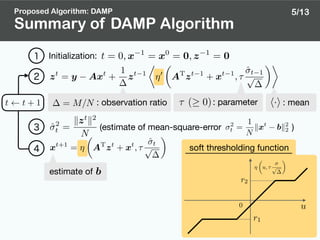
Summary of DAMP Algorithm
5/13Proposed Algorithm: DAMP
: mean
estimate of
: observation ratio
2
Initialization:1
: parameter⌧ ( 0)= M/N
b
soft thresholding function
⌘
✓
u, ⌧ p
◆
xt+1
= ⌘
✓
AT
zt
+ xt
, ⌧
ˆt
p
◆
zt
= y Axt
+
1
zt 1
⌧
⌘0
✓
AT
zt 1
+ xt 1
, ⌧
ˆt 1
p
◆
ˆ2
t =
kzt
k2
N
3
4
t t + 1
t = 0, x 1
= x0
= 0, z 1
= 0
r1
r2
Outline
1. Introduction

2. Proposed Algorithm: DAMP

3. Performance Analysis with State Evolution
4. Bayes Optimal DAMP

5. Simulation Result

6. Conclusion
[6] D. L. Donoho, A. Maleki, and A. Montanari, “Message-passing algorithms for compressed sensing,”
Proc. Nat. Acad. Sci., vol. 106, no. 45, pp. 18914–18919, Nov. 2009.
State Evolution
: estimate of at the th iteration
Performance Analysis with State Evolution
: mean-square-error (MSE) of
State Evolution [6]
( 2
) = E
"⇢
⌘
✓
X + p Z, ⌧ p
◆
X
2
#
predict the behavior of MSE
X ⇠ probability distribution of bj
Z ⇠ standard Gaussian distribution
In the large system limit ,
6/13
x
z
ex.)
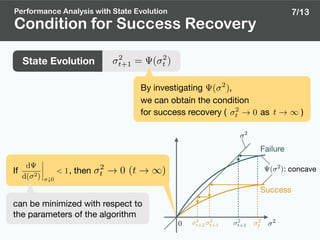
Condition for Success Recovery
Performance Analysis with State Evolution
Success
If , then
Failure
: concave
State Evolution
2
t ! 0 (t ! 1)
2
t+1
can be minimized with respect to 

the parameters of the algorithm
By investigating ,( 2
)
we can obtain the condition
for success recovery ( as )t ! 12
t ! 0
7/13
0 0.1 0.2 0.3 0.4 0.5 0.6 0.7 0.8 0.9 1
∆
0
0.1
0.2
0.3
0.4
0.5
0.6
0.7
0.8
0.9
1
p1
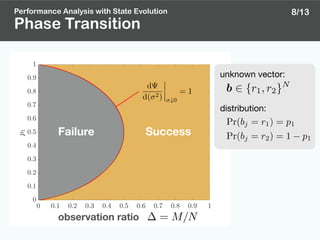
Phase Transition
Failure Success
Performance Analysis with State Evolution
observation ratio = M/N
unknown vector:
b 2 {r1, r2}N
Pr(bj = r1) = p1
Pr(bj = r2) = 1 p1
distribution:
8/13
d
d( 2) #0
= 1
Outline
1. Introduction

2. Proposed Algorithm: DAMP

3. Performance Analysis with State Evolution

4. Bayes Optimal DAMP
5. Simulation Result

6. Conclusion
Bayes optimal AMP [8]: AMP with minimizing
Bayes Optimal AMP [8]
[8] D. L. Donoho, A. Maleki, and A. Montanari, “The noise-sensitivity phase transition in compressed sensing,”
IEEE Trans. Inf. Theory, vol. 57, no. 10, pp. 6920–6941, Oct. 2011.
( 2
)
Bayes Optimal DAMP
State evolution
AMP algorithm
(in general form)
( 2
) = E
"⇢
⌘
✓
X + p Z
◆
X
2
#
9/13
Any Lipschitz function 

can be used
zt
= y Axt
+
1
zt 1
⌦
⌘0
AT
zt 1
+ xt 1
↵
,
xt+1
= ⌘ AT
zt
+ xt
⌘(·)
⌘(·)
smaller is better( 2
)
⌘B
(u) = E

X X + p Z = u
=
p1r1
⇣p
(u r1)
⌘
+ p2r2
⇣p
(u r2)
⌘
p1
⇣p
(u r1)
⌘
+ p2
⇣p
(u r2)
⌘
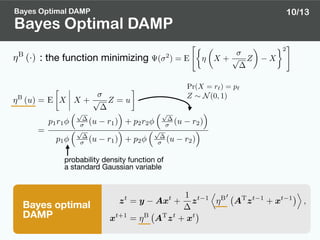
Bayes Optimal DAMP
Bayes Optimal DAMP
Bayes optimal
DAMP
: the function minimizing
probability density function of 

a standard Gaussian variable
Pr(X = r`) = p`
Z ⇠ N(0, 1)
⌘B
(·) ( 2
) = E
"⇢
⌘
✓
X + p Z
◆
X
2
#
zt
= y Axt
+
1
zt 1
D
⌘B0
AT
zt 1
+ xt 1
E
,
xt+1
= ⌘B
AT
zt
+ xt
10/13
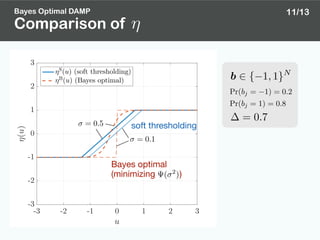
Comparison of
-3 -2 -1 0 1 2 3
u
-3
-2
-1
0
1
2
3
η(u)
ηS
(u) (soft thresholding)
ηB
(u) (Bayes optimal)
σ = 0.5
σ = 0.1
Bayes optimal

(minimizing )( 2
)
soft thresholding
Bayes Optimal DAMP
⌘
Pr(bj = 1) = 0.2
Pr(bj = 1) = 0.8
b 2 { 1, 1}N
= 0.7
11/13
Outline
1. Introduction

2. Proposed Algorithm: DAMP

3. Performance Analysis with State Evolution

4. Bayes Optimal DAMP

5. Simulation Result
6. Conclusion
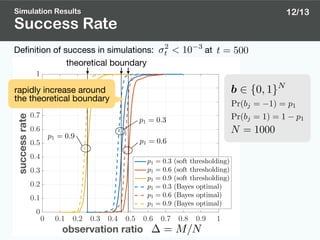
0 0.1 0.2 0.3 0.4 0.5 0.6 0.7 0.8 0.9 1
∆
0
0.1
0.2
0.3
0.4
0.5
0.6
0.7
0.8
0.9
1
recoveryrate
p1 = 0.3 (soft thresholding)
p1 = 0.6 (soft thresholding)
p1 = 0.9 (soft thresholding)
p1 = 0.3 (Bayes optimal)
p1 = 0.6 (Bayes optimal)
p1 = 0.9 (Bayes optimal)
p1 = 0.6
p1 = 0.9
p1 = 0.3
Definition of success in simulations: at
Success Rate
Simulation Results
Pr(bj = 1) = p1
Pr(bj = 1) = 1 p1
b 2 {0, 1}N
N = 1000
theoretical boundary
successrate
observation ratio = M/N
12/13
rapidly increase around

the theoretical boundary
Outline
1. Introduction

2. Proposed Algorithm: DAMP

3. Performance Analysis with State Evolution

4. Bayes Optimal DAMP

5. Simulation Result

6. Conclusion
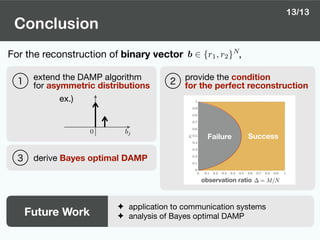
Future Work
Conclusion
✦ application to communication systems

✦ analysis of Bayes optimal DAMP
1
extend the DAMP algorithm 

for asymmetric distributions 2
3
provide the condition
for the perfect reconstruction
derive Bayes optimal DAMP
For the reconstruction of binary vector ,b 2 {r1, r2}N
bj
ex.)
0 0.1 0.2 0.3 0.4 0.5 0.6 0.7 0.8 0.9 1
∆
0
0.1
0.2
0.3
0.4
0.5
0.6
0.7
0.8
0.9
1
p1
Failure Success
observation ratio = M/N
13/13

Binary Vector Reconstruction via Discreteness-Aware Approximate Message Passing

  • 1.
    Binary Vector Reconstruction viaDiscreteness-Aware Approximate Message Passing APSIPA ASC 2017 (December 12-15, 2017) @Kuala Lumpur, Malaysia Ryo Hayakawa (Graduate School of Informatics, Kyoto University) Kazunori Hayashi (Graduate School of Engineering, Osaka City University) FP-07 (Special Session) Large-Scale Stochastic Signal Processing For Wireless Communications
  • 2.
    Outline 1. Introduction 2. ProposedAlgorithm: DAMP 3. Performance Analysis with State Evolution 4. Bayes Optimal DAMP 5. Simulation Result 6. Conclusion
  • 3.
    Purpose reconstruction ofa discrete-valued vector from its underdetermined linear measurements Discrete-Valued Vector Reconstruction Introduction 1/13 y = Ab 2 RM Application ✦ overloaded MIMO signal detection [1]
 (multiple-input multiple-output) ✦ faster-than-Nyquist signaling [2] A by NM reconstruct ˆb (M < N) ✦ multiuser detection [1] ✦ overloaded MIMO signal detection [2]
 (multiple-input multiple-output) ✦ faster-than-Nyquist signaling [3] [1] H. Sasahara, K. Hayashi, and M. Nagahara, "Multiuser detection based on MAP estimation with sum-of-absolute-values relaxation," IEEE Trans. Signal Process., vol.65, no. 21, pp. 5621-5634, Nov. 2017. [2] R. Hayakawa and K. Hayashi, "Convex optimization based signal detection for massive overloaded MIMO systems,” IEEE Trans. Wireless Commun., vol. 16, no. 11, pp. 7080-7091, Nov. 2017. [3] H. Sasahara, K. Hayashi, and M. Nagahara, "Symbol detection for faster-than-Nyquist signaling by sum-of-absolute-values optimization," IEEE Signal Process. Lett., vol. 23, no. 12, pp. 1853-1857, Dec. 2016. b 2 {r1, . . . , rL}N
  • 4.
    Conventional Approach 2/13Introduction ✦ regularization-basedmethod [4] ✦ transform-based method [4] ✦ SOAV optimization [5]
 (Sum-of-Absolute-Values)
 
 
 ✦ DAMP algorithm [7]
 (Discreteness-Aware Approximate Message Passing) [4] A. Aïssa-El-Bey, D. Pastor, S. M. A. Sbaï, and Y. Fadlallah, “Sparsity-based recovery of finite alphabet solutions to underdetermined linear systems,” IEEE Trans. Inf. Theory, vol. 61, no. 4, pp. 2008– 2018, Apr. 2015. [5] M. Nagahara, “Discrete signal reconstruction by sum of absolute values,” IEEE Signal Process. Lett., vol. 22, no. 10, pp.1575–1579, Oct. 2015. [6] D. L. Donoho, A. Maleki, and A. Montanari, “Message-passing algorithms for compressed sensing,” Proc. Nat. Acad. Sci., vol. 106, no. 45, pp. 18914–18919, Nov. 2009. [7] R. Hayakawa and K. Hayashi, “Discreteness-aware AMP for reconstruction of symmetrically distributed discrete variables,” in Proc. IEEE SPAWC 2017, Jul. 2017. based on convex optimization ❖ low computational complexity ❖ analytical tractability apply the idea of AMP (Approximate Message Passing) algorithm [6]
  • 5.
    Purpose of ThisWork Introduction 1 extend the DAMP algorithm for asymmetric distributions 2 3 provide a condition for the perfect reconstruction derive Bayes optimal DAMP For binary vector (the simplest case), Purpose of This Work [7] R. Hayakawa and K. Hayashi, “Discreteness-aware AMP for reconstruction of symmetrically distributed discrete variables,” in Proc. IEEE SPAWC 2017, Jul. 2017. In [7], symmetric distribution of the elements of is assumed. ex.) 3/13 b 2 {r1, r2}N not applicable for b 2 {0, 1}N b (bj 2 {±1, ±3})(bj 2 {0, ±1}) bj bj bj ex.)
  • 6.
    Outline 1. Introduction 2. ProposedAlgorithm: DAMP 3. Performance Analysis with State Evolution 4. Bayes Optimal DAMP 5. Simulation Result 6. Conclusion
  • 7.
    Overview of Derivation ProposedAlgorithm: DAMP ✦ unknown vector: ✦ probability: ✦ measurements: SOAV optimization [5] Proposed algorithm:DAMP(Discreteness-aware AMP) apply the idea of AMP (Approximate Message Passing) algorithm [6] parameter b 2 {r1, r2}N (r1 < r2) Pr(bj = r1) = p1, Pr(bj = r2) = p2 ˆb = arg min s2RN (q1ks r11k1 + q2ks r21k1) subject to y = As based on the fact that (, ) hasb r11 b r21 approximately (, ) zero elementsp1N p2N 4/13 [5] M. Nagahara, “Discrete signal reconstruction by sum of absolute values,” IEEE Signal Process. Lett., vol. 22, no. 10, pp.1575–1579, Oct. 2015. [6] D. L. Donoho, A. Maleki, and A. Montanari, “Message-passing algorithms for compressed sensing,” Proc. Nat. Acad. Sci., vol. 106, no. 45, pp. 18914–18919, Nov. 2009. bjr1 r2 p2 p1
  • 8.
    (estimate of mean-square-error) Summary of DAMP Algorithm 5/13Proposed Algorithm: DAMP : mean estimate of : observation ratio 2 Initialization:1 : parameter⌧ ( 0)= M/N b soft thresholding function ⌘ ✓ u, ⌧ p ◆ xt+1 = ⌘ ✓ AT zt + xt , ⌧ ˆt p ◆ zt = y Axt + 1 zt 1 ⌧ ⌘0 ✓ AT zt 1 + xt 1 , ⌧ ˆt 1 p ◆ ˆ2 t = kzt k2 N 3 4 t t + 1 t = 0, x 1 = x0 = 0, z 1 = 0 r1 r2
  • 9.
    Outline 1. Introduction 2. ProposedAlgorithm: DAMP 3. Performance Analysis with State Evolution 4. Bayes Optimal DAMP 5. Simulation Result 6. Conclusion
  • 10.
    [6] D. L.Donoho, A. Maleki, and A. Montanari, “Message-passing algorithms for compressed sensing,” Proc. Nat. Acad. Sci., vol. 106, no. 45, pp. 18914–18919, Nov. 2009. State Evolution : estimate of at the th iteration Performance Analysis with State Evolution : mean-square-error (MSE) of State Evolution [6] ( 2 ) = E "⇢ ⌘ ✓ X + p Z, ⌧ p ◆ X 2 # predict the behavior of MSE X ⇠ probability distribution of bj Z ⇠ standard Gaussian distribution In the large system limit , 6/13 x z ex.)
  • 11.
    Condition for SuccessRecovery Performance Analysis with State Evolution Success If , then Failure : concave State Evolution 2 t ! 0 (t ! 1) 2 t+1 can be minimized with respect to the parameters of the algorithm By investigating ,( 2 ) we can obtain the condition for success recovery ( as )t ! 12 t ! 0 7/13
  • 12.
    0 0.1 0.20.3 0.4 0.5 0.6 0.7 0.8 0.9 1 ∆ 0 0.1 0.2 0.3 0.4 0.5 0.6 0.7 0.8 0.9 1 p1 Phase Transition Failure Success Performance Analysis with State Evolution observation ratio = M/N unknown vector: b 2 {r1, r2}N Pr(bj = r1) = p1 Pr(bj = r2) = 1 p1 distribution: 8/13 d d( 2) #0 = 1
  • 13.
    Outline 1. Introduction 2. ProposedAlgorithm: DAMP 3. Performance Analysis with State Evolution 4. Bayes Optimal DAMP 5. Simulation Result 6. Conclusion
  • 14.
    Bayes optimal AMP[8]: AMP with minimizing Bayes Optimal AMP [8] [8] D. L. Donoho, A. Maleki, and A. Montanari, “The noise-sensitivity phase transition in compressed sensing,” IEEE Trans. Inf. Theory, vol. 57, no. 10, pp. 6920–6941, Oct. 2011. ( 2 ) Bayes Optimal DAMP State evolution AMP algorithm (in general form) ( 2 ) = E "⇢ ⌘ ✓ X + p Z ◆ X 2 # 9/13 Any Lipschitz function can be used zt = y Axt + 1 zt 1 ⌦ ⌘0 AT zt 1 + xt 1 ↵ , xt+1 = ⌘ AT zt + xt ⌘(·) ⌘(·) smaller is better( 2 )
  • 15.
    ⌘B (u) = E  XX + p Z = u = p1r1 ⇣p (u r1) ⌘ + p2r2 ⇣p (u r2) ⌘ p1 ⇣p (u r1) ⌘ + p2 ⇣p (u r2) ⌘ Bayes Optimal DAMP Bayes Optimal DAMP Bayes optimal DAMP : the function minimizing probability density function of a standard Gaussian variable Pr(X = r`) = p` Z ⇠ N(0, 1) ⌘B (·) ( 2 ) = E "⇢ ⌘ ✓ X + p Z ◆ X 2 # zt = y Axt + 1 zt 1 D ⌘B0 AT zt 1 + xt 1 E , xt+1 = ⌘B AT zt + xt 10/13
  • 16.
    Comparison of -3 -2-1 0 1 2 3 u -3 -2 -1 0 1 2 3 η(u) ηS (u) (soft thresholding) ηB (u) (Bayes optimal) σ = 0.5 σ = 0.1 Bayes optimal (minimizing )( 2 ) soft thresholding Bayes Optimal DAMP ⌘ Pr(bj = 1) = 0.2 Pr(bj = 1) = 0.8 b 2 { 1, 1}N = 0.7 11/13
  • 17.
    Outline 1. Introduction 2. ProposedAlgorithm: DAMP 3. Performance Analysis with State Evolution 4. Bayes Optimal DAMP 5. Simulation Result 6. Conclusion
  • 18.
    0 0.1 0.20.3 0.4 0.5 0.6 0.7 0.8 0.9 1 ∆ 0 0.1 0.2 0.3 0.4 0.5 0.6 0.7 0.8 0.9 1 recoveryrate p1 = 0.3 (soft thresholding) p1 = 0.6 (soft thresholding) p1 = 0.9 (soft thresholding) p1 = 0.3 (Bayes optimal) p1 = 0.6 (Bayes optimal) p1 = 0.9 (Bayes optimal) p1 = 0.6 p1 = 0.9 p1 = 0.3 Definition of success in simulations: at Success Rate Simulation Results Pr(bj = 1) = p1 Pr(bj = 1) = 1 p1 b 2 {0, 1}N N = 1000 theoretical boundary successrate observation ratio = M/N 12/13 rapidly increase around
 the theoretical boundary
  • 19.
    Outline 1. Introduction 2. ProposedAlgorithm: DAMP 3. Performance Analysis with State Evolution 4. Bayes Optimal DAMP 5. Simulation Result 6. Conclusion
  • 20.
    Future Work Conclusion ✦ applicationto communication systems ✦ analysis of Bayes optimal DAMP 1 extend the DAMP algorithm for asymmetric distributions 2 3 provide the condition for the perfect reconstruction derive Bayes optimal DAMP For the reconstruction of binary vector ,b 2 {r1, r2}N bj ex.) 0 0.1 0.2 0.3 0.4 0.5 0.6 0.7 0.8 0.9 1 ∆ 0 0.1 0.2 0.3 0.4 0.5 0.6 0.7 0.8 0.9 1 p1 Failure Success observation ratio = M/N 13/13