Download as PDF, PPTX


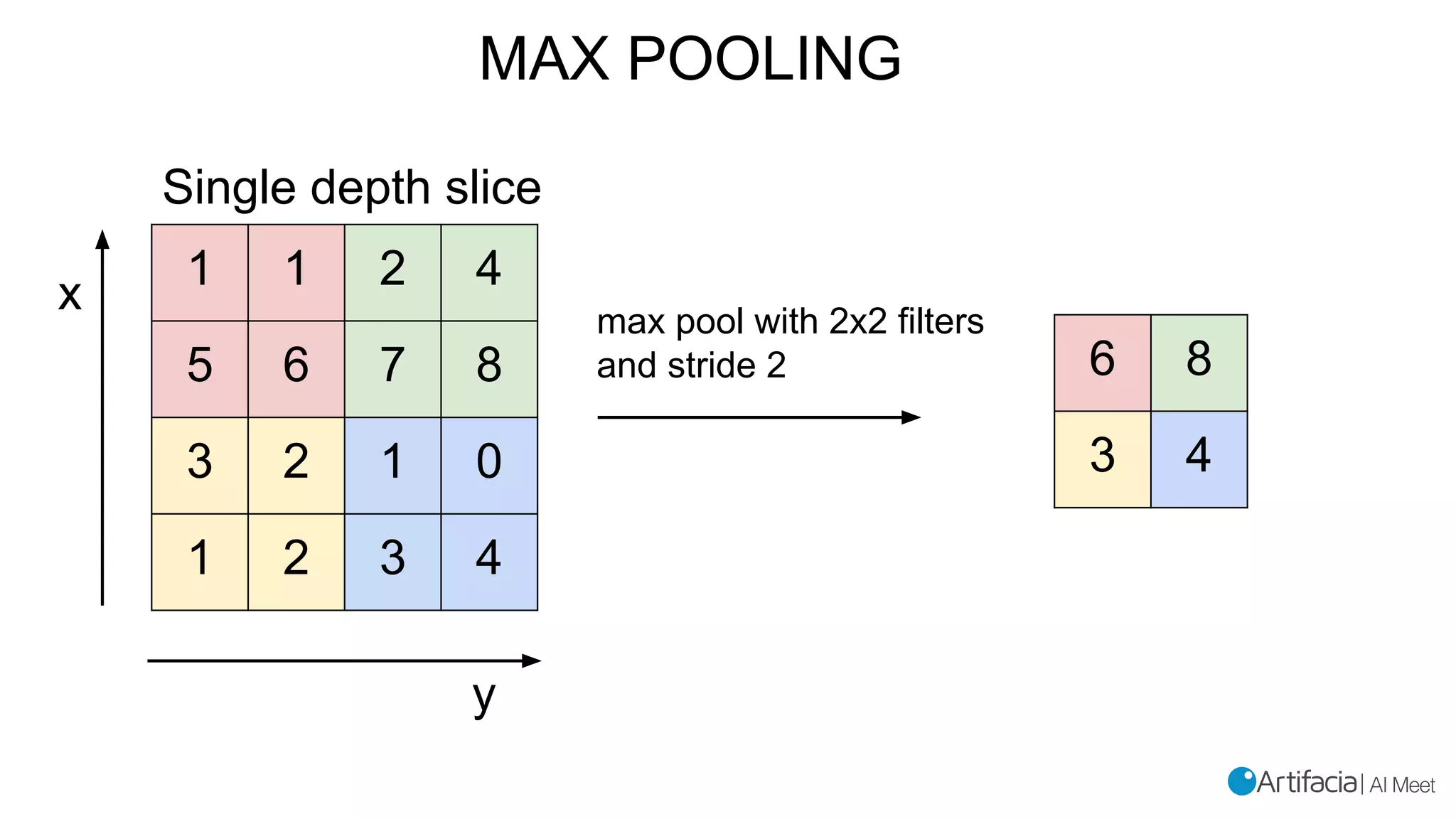


![Case Study: AlexNet
[Krizhevsky et al. 2012]
Input: 227x227x3 images
First layer (CONV1): 96 11x11 filters applied at stride 4
=>
Q: what is the output volume size? Hint: (227-11)/4+1 = 55](https://image.slidesharecdn.com/artifaciaaimeet-10dec-161220080555/75/Introduction-to-CNN-with-Application-to-Object-Recognition-25-2048.jpg)
![Case Study: AlexNet
[Krizhevsky et al. 2012]
Input: 227x227x3 images
First layer (CONV1): 96 11x11 filters applied at stride 4
=>
Output volume [55x55x96]
Q: What is the total number of parameters in this layer?](https://image.slidesharecdn.com/artifaciaaimeet-10dec-161220080555/75/Introduction-to-CNN-with-Application-to-Object-Recognition-26-2048.jpg)
![Case Study: AlexNet
[Krizhevsky et al. 2012]
Input: 227x227x3 images
First layer (CONV1): 96 11x11 filters applied at stride 4
=>
Output volume [55x55x96]
Parameters: (11*11*3)*96 = 35K](https://image.slidesharecdn.com/artifaciaaimeet-10dec-161220080555/75/Introduction-to-CNN-with-Application-to-Object-Recognition-27-2048.jpg)
![Case Study: AlexNet
[Krizhevsky et al. 2012]
Input: 227x227x3 images
After CONV1: 55x55x96
Second layer (POOL1): 3x3 filters applied at stride 2
Q: what is the output volume size? Hint: (55-3)/2+1 = 27](https://image.slidesharecdn.com/artifaciaaimeet-10dec-161220080555/75/Introduction-to-CNN-with-Application-to-Object-Recognition-28-2048.jpg)
![Case Study: AlexNet
[Krizhevsky et al. 2012]
Input: 227x227x3 images
After CONV1: 55x55x96
Second layer (POOL1): 3x3 filters applied at stride 2
Output volume: 27x27x96
Q: what is the number of parameters in this layer?](https://image.slidesharecdn.com/artifaciaaimeet-10dec-161220080555/75/Introduction-to-CNN-with-Application-to-Object-Recognition-29-2048.jpg)
![Case Study: AlexNet
[Krizhevsky et al. 2012]
Input: 227x227x3 images
After CONV1: 55x55x96
Second layer (POOL1): 3x3 filters applied at stride 2
Output volume: 27x27x96
Parameters: 0!](https://image.slidesharecdn.com/artifaciaaimeet-10dec-161220080555/75/Introduction-to-CNN-with-Application-to-Object-Recognition-30-2048.jpg)
![Case Study: AlexNet
[Krizhevsky et al. 2012]
Input: 227x227x3 images
After CONV1: 55x55x96
After POOL1: 27x27x96
...](https://image.slidesharecdn.com/artifaciaaimeet-10dec-161220080555/75/Introduction-to-CNN-with-Application-to-Object-Recognition-31-2048.jpg)
![Case Study: AlexNet
[Krizhevsky et al. 2012]
Full (simplified) AlexNet architecture:
[227x227x3] INPUT
[55x55x96] CONV1: 96 11x11 filters at stride 4, pad 0
[27x27x96] MAX POOL1: 3x3 filters at stride 2
[27x27x96] NORM1: Normalization layer
[27x27x256] CONV2: 256 5x5 filters at stride 1, pad 2
[13x13x256] MAX POOL2: 3x3 filters at stride 2
[13x13x256] NORM2: Normalization layer
[13x13x384] CONV3: 384 3x3 filters at stride 1, pad 1
[13x13x384] CONV4: 384 3x3 filters at stride 1, pad 1
[13x13x256] CONV5: 256 3x3 filters at stride 1, pad 1
[6x6x256] MAX POOL3: 3x3 filters at stride 2
[4096] FC6: 4096 neurons
[4096] FC7: 4096 neurons
[1000] FC8: 1000 neurons (class scores)](https://image.slidesharecdn.com/artifaciaaimeet-10dec-161220080555/75/Introduction-to-CNN-with-Application-to-Object-Recognition-32-2048.jpg)
![Case Study: AlexNet
[Krizhevsky et al. 2012]
Full (simplified) AlexNet architecture:
[227x227x3] INPUT
[55x55x96] CONV1: 96 11x11 filters at stride 4, pad 0
[27x27x96] MAX POOL1: 3x3 filters at stride 2
[27x27x96] NORM1: Normalization layer
[27x27x256] CONV2: 256 5x5 filters at stride 1, pad 2
[13x13x256] MAX POOL2: 3x3 filters at stride 2
[13x13x256] NORM2: Normalization layer
[13x13x384] CONV3: 384 3x3 filters at stride 1, pad 1
[13x13x384] CONV4: 384 3x3 filters at stride 1, pad 1
[13x13x256] CONV5: 256 3x3 filters at stride 1, pad 1
[6x6x256] MAX POOL3: 3x3 filters at stride 2
[4096] FC6: 4096 neurons
[4096] FC7: 4096 neurons
[1000] FC8: 1000 neurons (class scores)
Compared to LeCun 1998:
1 DATA:
- More data: 10^6 vs. 10^3
2 COMPUTE:
- GPU (~20x speedup)
3 ALGORITHM:
- Deeper: More layers (8 weight layers)
- Fancy regularization (dropout)
- Fancy non-linearity (ReLU)
4 INFRASTRUCTURE:
- CUDA](https://image.slidesharecdn.com/artifaciaaimeet-10dec-161220080555/75/Introduction-to-CNN-with-Application-to-Object-Recognition-33-2048.jpg)
![Case Study: AlexNet
[Krizhevsky et al. 2012]
Full (simplified) AlexNet architecture:
[227x227x3] INPUT
[55x55x96] CONV1: 96 11x11 filters at stride 4, pad 0
[27x27x96] MAX POOL1: 3x3 filters at stride 2
[27x27x96] NORM1: Normalization layer
[27x27x256] CONV2: 256 5x5 filters at stride 1, pad 2
[13x13x256] MAX POOL2: 3x3 filters at stride 2
[13x13x256] NORM2: Normalization layer
[13x13x384] CONV3: 384 3x3 filters at stride 1, pad 1
[13x13x384] CONV4: 384 3x3 filters at stride 1, pad 1
[13x13x256] CONV5: 256 3x3 filters at stride 1, pad 1
[6x6x256] MAX POOL3: 3x3 filters at stride 2
[4096] FC6: 4096 neurons
[4096] FC7: 4096 neurons
[1000] FC8: 1000 neurons (class scores)
Details/Retrospectives:
- first use of ReLU
- used Norm layers (not common anymore)
- heavy data augmentation
- dropout 0.5
- batch size 128
- SGD Momentum 0.9
- Learning rate 1e-2, reduced by 10
manually when val accuracy plateaus
- L2 weight decay 5e-4
- 7 CNN ensemble: 18.2% -> 15.4%](https://image.slidesharecdn.com/artifaciaaimeet-10dec-161220080555/75/Introduction-to-CNN-with-Application-to-Object-Recognition-34-2048.jpg)
![Case Study: ZFNet [Zeiler and Fergus, 2013]
AlexNet but:
CONV1: change from (11x11 stride 4) to (7x7 stride 2)
CONV3,4,5: instead of 384, 384, 256 filters use 512, 1024, 512
ImageNet top 5 error: 15.4% -> 14.8%](https://image.slidesharecdn.com/artifaciaaimeet-10dec-161220080555/75/Introduction-to-CNN-with-Application-to-Object-Recognition-35-2048.jpg)
![Case Study: VGGNet
[Simonyan and Zisserman, 2014]
best model
Only 3x3 CONV stride 1, pad 1
and 2x2 MAX POOL stride 2
11.2% top 5 error in ILSVRC 2013
->
7.3% top 5 error](https://image.slidesharecdn.com/artifaciaaimeet-10dec-161220080555/75/Introduction-to-CNN-with-Application-to-Object-Recognition-36-2048.jpg)
![INPUT: [224x224x3] memory: 224*224*3=150K params: 0
CONV3-64: [224x224x64] memory: 224*224*64=3.2M params: (3*3*3)*64 = 1,728
CONV3-64: [224x224x64] memory: 224*224*64=3.2M params: (3*3*64)*64 = 36,864
POOL2: [112x112x64] memory: 112*112*64=800K params: 0
CONV3-128: [112x112x128] memory: 112*112*128=1.6M params: (3*3*64)*128 = 73,728
CONV3-128: [112x112x128] memory: 112*112*128=1.6M params: (3*3*128)*128 = 147,456
POOL2: [56x56x128] memory: 56*56*128=400K params: 0
CONV3-256: [56x56x256] memory: 56*56*256=800K params: (3*3*128)*256 = 294,912
CONV3-256: [56x56x256] memory: 56*56*256=800K params: (3*3*256)*256 = 589,824
CONV3-256: [56x56x256] memory: 56*56*256=800K params: (3*3*256)*256 = 589,824
POOL2: [28x28x256] memory: 28*28*256=200K params: 0
CONV3-512: [28x28x512] memory: 28*28*512=400K params: (3*3*256)*512 = 1,179,648
CONV3-512: [28x28x512] memory: 28*28*512=400K params: (3*3*512)*512 = 2,359,296
CONV3-512: [28x28x512] memory: 28*28*512=400K params: (3*3*512)*512 = 2,359,296
POOL2: [14x14x512] memory: 14*14*512=100K params: 0
CONV3-512: [14x14x512] memory: 14*14*512=100K params: (3*3*512)*512 = 2,359,296
CONV3-512: [14x14x512] memory: 14*14*512=100K params: (3*3*512)*512 = 2,359,296
CONV3-512: [14x14x512] memory: 14*14*512=100K params: (3*3*512)*512 = 2,359,296
POOL2: [7x7x512] memory: 7*7*512=25K params: 0
FC: [1x1x4096] memory: 4096 params: 7*7*512*4096 = 102,760,448
FC: [1x1x4096] memory: 4096 params: 4096*4096 = 16,777,216
FC: [1x1x1000] memory: 1000 params: 4096*1000 = 4,096,000
(not counting biases)](https://image.slidesharecdn.com/artifaciaaimeet-10dec-161220080555/75/Introduction-to-CNN-with-Application-to-Object-Recognition-37-2048.jpg)
![INPUT: [224x224x3] memory: 224*224*3=150K params: 0
CONV3-64: [224x224x64] memory: 224*224*64=3.2M params: (3*3*3)*64 = 1,728
CONV3-64: [224x224x64] memory: 224*224*64=3.2M params: (3*3*64)*64 = 36,864
POOL2: [112x112x64] memory: 112*112*64=800K params: 0
CONV3-128: [112x112x128] memory: 112*112*128=1.6M params: (3*3*64)*128 = 73,728
CONV3-128: [112x112x128] memory: 112*112*128=1.6M params: (3*3*128)*128 = 147,456
POOL2: [56x56x128] memory: 56*56*128=400K params: 0
CONV3-256: [56x56x256] memory: 56*56*256=800K params: (3*3*128)*256 = 294,912
CONV3-256: [56x56x256] memory: 56*56*256=800K params: (3*3*256)*256 = 589,824
CONV3-256: [56x56x256] memory: 56*56*256=800K params: (3*3*256)*256 = 589,824
POOL2: [28x28x256] memory: 28*28*256=200K params: 0
CONV3-512: [28x28x512] memory: 28*28*512=400K params: (3*3*256)*512 = 1,179,648
CONV3-512: [28x28x512] memory: 28*28*512=400K params: (3*3*512)*512 = 2,359,296
CONV3-512: [28x28x512] memory: 28*28*512=400K params: (3*3*512)*512 = 2,359,296
POOL2: [14x14x512] memory: 14*14*512=100K params: 0
CONV3-512: [14x14x512] memory: 14*14*512=100K params: (3*3*512)*512 = 2,359,296
CONV3-512: [14x14x512] memory: 14*14*512=100K params: (3*3*512)*512 = 2,359,296
CONV3-512: [14x14x512] memory: 14*14*512=100K params: (3*3*512)*512 = 2,359,296
POOL2: [7x7x512] memory: 7*7*512=25K params: 0
FC: [1x1x4096] memory: 4096 params: 7*7*512*4096 = 102,760,448
FC: [1x1x4096] memory: 4096 params: 4096*4096 = 16,777,216
FC: [1x1x1000] memory: 1000 params: 4096*1000 = 4,096,000
(not counting biases)
TOTAL memory: 24M * 4 bytes ~= 93MB / image (only forward! ~*2 for bwd)
TOTAL params: 138M parameters](https://image.slidesharecdn.com/artifaciaaimeet-10dec-161220080555/75/Introduction-to-CNN-with-Application-to-Object-Recognition-38-2048.jpg)
![INPUT: [224x224x3] memory: 224*224*3=150K params: 0
CONV3-64: [224x224x64] memory: 224*224*64=3.2M params: (3*3*3)*64 = 1,728
CONV3-64: [224x224x64] memory: 224*224*64=3.2M params: (3*3*64)*64 = 36,864
POOL2: [112x112x64] memory: 112*112*64=800K params: 0
CONV3-128: [112x112x128] memory: 112*112*128=1.6M params: (3*3*64)*128 = 73,728
CONV3-128: [112x112x128] memory: 112*112*128=1.6M params: (3*3*128)*128 = 147,456
POOL2: [56x56x128] memory: 56*56*128=400K params: 0
CONV3-256: [56x56x256] memory: 56*56*256=800K params: (3*3*128)*256 = 294,912
CONV3-256: [56x56x256] memory: 56*56*256=800K params: (3*3*256)*256 = 589,824
CONV3-256: [56x56x256] memory: 56*56*256=800K params: (3*3*256)*256 = 589,824
POOL2: [28x28x256] memory: 28*28*256=200K params: 0
CONV3-512: [28x28x512] memory: 28*28*512=400K params: (3*3*256)*512 = 1,179,648
CONV3-512: [28x28x512] memory: 28*28*512=400K params: (3*3*512)*512 = 2,359,296
CONV3-512: [28x28x512] memory: 28*28*512=400K params: (3*3*512)*512 = 2,359,296
POOL2: [14x14x512] memory: 14*14*512=100K params: 0
CONV3-512: [14x14x512] memory: 14*14*512=100K params: (3*3*512)*512 = 2,359,296
CONV3-512: [14x14x512] memory: 14*14*512=100K params: (3*3*512)*512 = 2,359,296
CONV3-512: [14x14x512] memory: 14*14*512=100K params: (3*3*512)*512 = 2,359,296
POOL2: [7x7x512] memory: 7*7*512=25K params: 0
FC: [1x1x4096] memory: 4096 params: 7*7*512*4096 = 102,760,448
FC: [1x1x4096] memory: 4096 params: 4096*4096 = 16,777,216
FC: [1x1x1000] memory: 1000 params: 4096*1000 = 4,096,000
(not counting biases)
TOTAL memory: 24M * 4 bytes ~= 93MB / image (only forward! ~*2 for bwd)
TOTAL params: 138M parameters
Note:
Most memory is in
early CONV
Most params are
in late FC](https://image.slidesharecdn.com/artifaciaaimeet-10dec-161220080555/75/Introduction-to-CNN-with-Application-to-Object-Recognition-39-2048.jpg)
![Case Study: GoogLeNet [Szegedy et al., 2014]
Inception module
ILSVRC 2014 winner (6.7% top 5 error)](https://image.slidesharecdn.com/artifaciaaimeet-10dec-161220080555/75/Introduction-to-CNN-with-Application-to-Object-Recognition-40-2048.jpg)

![Slide from Kaiming He’s recent presentation https://www.youtube.com/watch?v=1PGLj-uKT1w
Case Study: ResNet [He et al., 2015]
ILSVRC 2015 winner (3.6% top 5 error)](https://image.slidesharecdn.com/artifaciaaimeet-10dec-161220080555/75/Introduction-to-CNN-with-Application-to-Object-Recognition-42-2048.jpg)


This document introduces Convolutional Neural Networks (CNNs) with a focus on their application to object recognition. It covers the basics of CNN architecture, including various layers and their functions, and provides case studies of notable models like AlexNet, ZFNet, and VGGNet. The document details the evolution of CNN techniques, showcases different configurations and parameters, and discusses their performance improvements in image classification tasks.


