

© 2011 ANSYS, Inc. June 5, 20131
GPS Placement
Juliano Mologni, Ph.D.
ESSS, Sao Paulo, Brasil
October 3, 2011
© 2011 ANSYS, Inc. June 5, 20132
Purpose of the Study
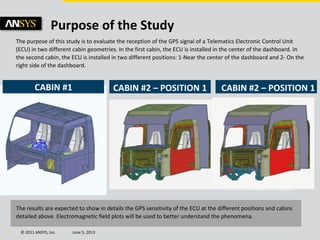
The purpose of this study is to evaluate the reception of the GPS signal of a Telematics Electronic Control Unit
(ECU) in two different cabin geometries. In the first cabin, the ECU is installed in the center of the dashboard. In
the second cabin, the ECU is installed in two different positions: 1-Near the center of the dashboard and 2- On the
right side of the dashboard.
The results are expected to show in details the GPS sensitivity of the ECU at the different positions and cabins
detailed above. Electromagnetic field plots will be used to better understand the phenomena.
© 2011 ANSYS, Inc. June 5, 20133
Telematics GPS ECU
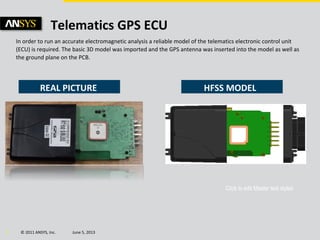
In order to run an accurate electromagnetic analysis a reliable model of the telematics electronic control unit
(ECU) is required. The basic 3D model was imported and the GPS antenna was inserted into the model as well as
the ground plane on the PCB.
REAL PICTURE
© 2011 ANSYS, Inc. June 5, 20134
Telematics GPS ECU
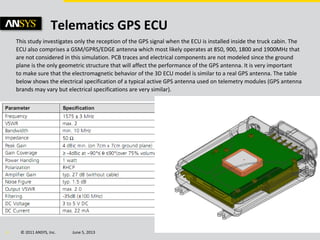
This study investigates only the reception of the GPS signal when the ECU is installed inside the truck cabin. The
ECU also comprises a GSM/GPRS/EDGE antenna which most likely operates at 850, 900, 1800 and 1900MHz that
are not considered in this simulation. PCB traces and electrical components are not modeled since the ground
plane is the only geometric structure that will affect the performance of the GPS antenna. It is very important
to make sure that the electromagnetic behavior of the 3D ECU model is similar to a real GPS antenna. The table
below shows the electrical specification of a typical active GPS antenna used on telemetry modules (GPS antenna
brands may vary but electrical specifications are very similar).
© 2011 ANSYS, Inc. June 5, 20135
Telematics GPS ECU
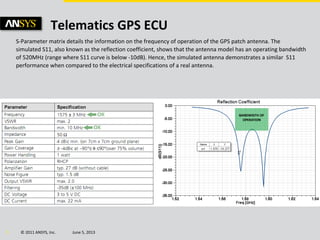
S-Parameter matrix details the information on the frequency of operation of the GPS patch antenna. The
simulated S11, also known as the reflection coefficient, shows that the antenna model has an operating bandwidth
of 520MHz (range where S11 curve is below -10dB). Hence, the simulated antenna demonstrates a similar S11
performance when compared to the electrical specifications of a real antenna.
© 2011 ANSYS, Inc. June 5, 20136
Telematics GPS ECU
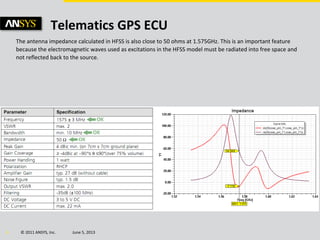
The antenna impedance calculated in HFSS is also close to 50 ohms at 1.575GHz. This is an important feature
because the electromagnetic waves used as excitations in the HFSS model must be radiated into free space and
not reflected back to the source.
© 2011 ANSYS, Inc. June 5, 20137
Telematics GPS ECU
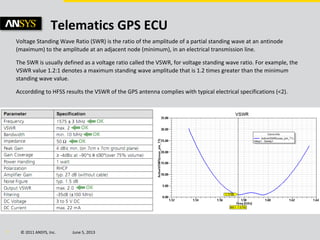
Voltage Standing Wave Ratio (SWR) is the ratio of the amplitude of a partial standing wave at an antinode
(maximum) to the amplitude at an adjacent node (minimum), in an electrical transmission line.
The SWR is usually defined as a voltage ratio called the VSWR, for voltage standing wave ratio. For example, the
VSWR value 1.2:1 denotes a maximum standing wave amplitude that is 1.2 times greater than the minimum
standing wave value.
Accordding to HFSS results the VSWR of the GPS antenna complies with typical electrical specifications (<2).
© 2011 ANSYS, Inc. June 5, 20138
Telematics GPS ECU
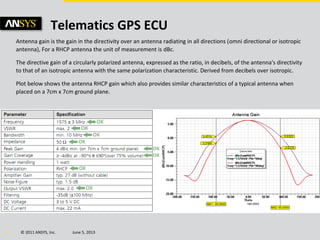
Antenna gain is the gain in the directivity over an antenna radiating in all directions (omni directional or isotropic
antenna), For a RHCP antenna the unit of measurement is dBc.
The directive gain of a circularly polarized antenna, expressed as the ratio, in decibels, of the antenna's directivity
to that of an isotropic antenna with the same polarization characteristic. Derived from decibels over isotropic.
Plot below shows the antenna RHCP gain which also provides similar characteristics of a typical antenna when
placed on a 7cm x 7cm ground plane.
© 2011 ANSYS, Inc. June 5, 20139
Telematics GPS ECU
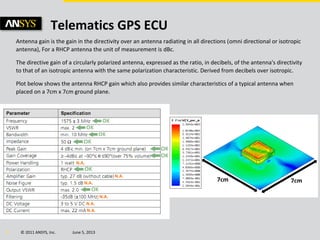
Antenna gain is the gain in the directivity over an antenna radiating in all directions (omni directional or isotropic
antenna), For a RHCP antenna the unit of measurement is dBc.
The directive gain of a circularly polarized antenna, expressed as the ratio, in decibels, of the antenna's directivity
to that of an isotropic antenna with the same polarization characteristic. Derived from decibels over isotropic.
Plot below shows the antenna RHCP gain which also provides similar characteristics of a typical antenna when
placed on a 7cm x 7cm ground plane.
© 2011 ANSYS, Inc. June 5, 201310
Telematics GPS ECU
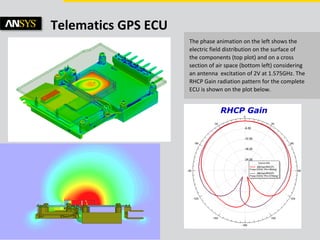
The phase animation on the left shows the
electric field distribution on the surface of
the components (top plot) and on a cross
section of air space (bottom left) considering
an antenna excitation of 2V at 1.575GHz. The
RHCP Gain radiation pattern for the complete
ECU is shown on the plot below.
© 2011 ANSYS, Inc. June 5, 201311
Results of the Study on Cabin #1
TRANSIENT ANALYSIS
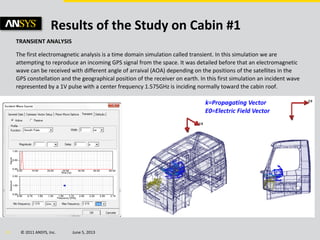
The first electromagnetic analysis is a time domain simulation called transient. In this simulation we are
attempting to reproduce an incoming GPS signal from the space. It was detailed before that an electromagnetic
wave can be received with different angle of arraival (AOA) depending on the positions of the satellites in the
GPS constellation and the geographical position of the receiver on earth. In this first simulation an incident wave
represented by a 1V pulse with a center frequency 1.575GHz is inciding normally toward the cabin roof.
© 2011 ANSYS, Inc. June 5, 201312
Results of the Study on Cabin #1
TRANSIENT ANALYSIS
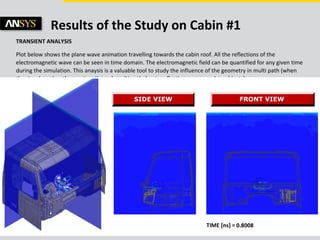
Plot below shows the plane wave animation travelling towards the cabin roof. All the reflections of the
electromagnetic wave can be seen in time domain. The electromagnetic field can be quantified for any given time
during the simulation. This anaysis is a valuable tool to study the influence of the geometry in multi path (when
the signal reaches the receiver through multi path due to reflections on secondary objects).
© 2011 ANSYS, Inc. June 5, 201313
Results of the Study on Cabin #1
TRANSIENT ANALYSIS
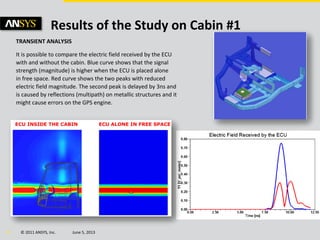
It is possible to compare the electric field received by the ECU
with and without the cabin. Blue curve shows that the signal
strength (magnitude) is higher when the ECU is placed alone
in free space. Red curve shows the two peaks with reduced
electric field magnitude. The second peak is delayed by 3ns and
is caused by reflections (multipath) on metallic structures and it
might cause errors on the GPS engine.
© 2011 ANSYS, Inc. June 5, 201314
Results of the Study on Cabin #1
ANTENNA COUPLING
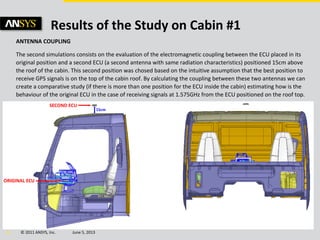
The second simulations consists on the evaluation of the electromagnetic coupling between the ECU placed in its
original position and a second ECU (a second antenna with same radiation characteristics) positioned 15cm above
the roof of the cabin. This second position was chosed based on the intuitive assumption that the best position to
receive GPS signals is on the top of the cabin roof. By calculating the coupling between these two antennas we can
create a comparative study (if there is more than one position for the ECU inside the cabin) estimating how is the
behaviour of the original ECU in the case of receiving signals at 1.575GHz from the ECU positioned on the roof top.
© 2011 ANSYS, Inc. June 5, 201315
Results of the Study on Cabin #1
ANTENNA COUPLING
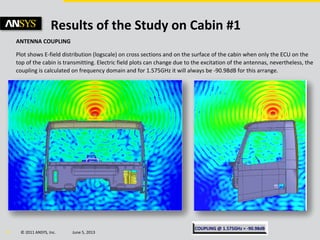
Plot shows E-field distribution (logscale) on cross sections and on the surface of the cabin when only the ECU on the
top of the cabin is transmitting. Electric field plots can change due to the excitation of the antennas, nevertheless, the
coupling is calculated on frequency domain and for 1.575GHz it will always be -90.98dB for this arrange.
© 2011 ANSYS, Inc. June 5, 201316
Results of the Study on Cabin #1
ANTENNA COUPLING
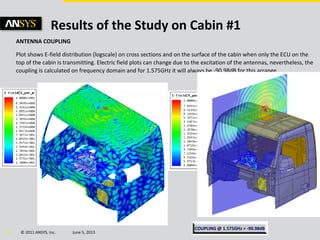
Plot shows E-field distribution (logscale) on cross sections and on the surface of the cabin when only the ECU on the
top of the cabin is transmitting. Electric field plots can change due to the excitation of the antennas, nevertheless, the
coupling is calculated on frequency domain and for 1.575GHz it will always be -90.98dB for this arrange.
© 2011 ANSYS, Inc. June 5, 201317
Results of the Study on Cabin #1
ANTENNA COUPLING
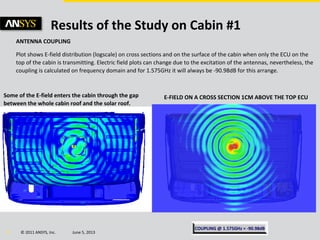
Plot shows E-field distribution (logscale) on cross sections and on the surface of the cabin when only the ECU on the
top of the cabin is transmitting. Electric field plots can change due to the excitation of the antennas, nevertheless, the
coupling is calculated on frequency domain and for 1.575GHz it will always be -90.98dB for this arrange.
E-FIELD ON A CROSS SECTION 1CM ABOVE THE TOP ECUSome of the E-field enters the cabin through the gap
between the whole cabin roof and the solar roof.
© 2011 ANSYS, Inc. June 5, 201318
Results of the Study on Cabin #1
RADIATION EFFICIENCY
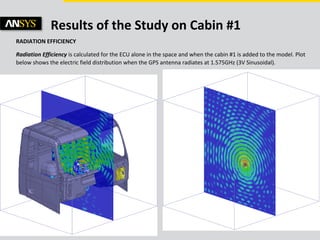
Radiation Efficiency is calculated for the ECU alone in the space and when the cabin #1 is added to the model. Plot
below shows the electric field distribution when the GPS antenna radiates at 1.575GHz (3V Sinusoidal).
© 2011 ANSYS, Inc. June 5, 201319
Results of the Study on Cabin #1
RADIATION EFFICIENCY
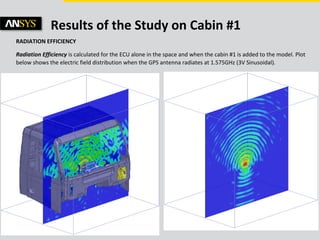
Radiation Efficiency is calculated for the ECU alone in the space and when the cabin #1 is added to the model. Plot
below shows the electric field distribution when the GPS antenna radiates at 1.575GHz (3V Sinusoidal).
© 2011 ANSYS, Inc. June 5, 201320
Results of the Study on Cabin #1
RADIATION EFFICIENCY
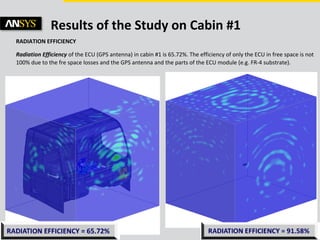
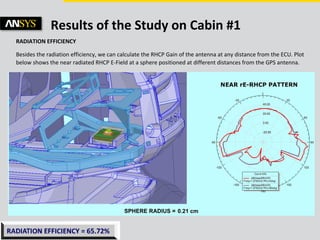
Radiation Efficiency of the ECU (GPS antenna) in cabin #1 is 65.72%. The efficiency of only the ECU in free space is not
100% due to the fre space losses and the GPS antenna and the parts of the ECU module (e.g. FR-4 substrate).
© 2011 ANSYS, Inc. June 5, 201321
Results of the Study on Cabin #1
RADIATION EFFICIENCY
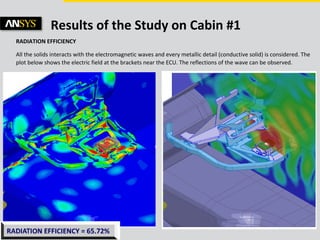
All the solids interacts with the electromagnetic waves and every metallic detail (conductive solid) is considered. The
plot below shows the electric field at the brackets near the ECU. The reflections of the wave can be observed.
© 2011 ANSYS, Inc. June 5, 201322
Results of the Study on Cabin #1
RADIATION EFFICIENCY
Besides the radiation efficiency, we can calculate the RHCP Gain of the antenna at any distance from the ECU. Plot
below shows the near radiated RHCP E-Field at a sphere positioned at different distances from the GPS antenna.
© 2011 ANSYS, Inc. June 5, 201323
Results of the Study on Cabin #1
RADIATION EFFICIENCY
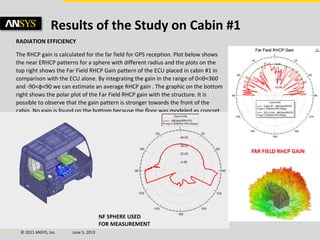
The RHCP gain is calculated for the far field for GPS reception. Plot below shows
the near ERHCP patterns for a sphere with different radius and the plots on the
top right shows the Far Field RHCP Gain pattern of the ECU placed in cabin #1 in
comparison with the ECU alone. By integrating the gain in the range of 0<Ɵ<360
and -90<φ<90 we can estimate an average RHCP gain . The graphic on the bottom
right shows the polar plot of the Far Field RHCP gain with the structure. It is
possible to observe that the gain pattern is stronger towards the front of the
cabin. No gain is found on the bottom because the floor was modeled as concret.
© 2011 ANSYS, Inc. June 5, 201324
Results of the Study on Cabin #2
POSITION OF THE ECUs
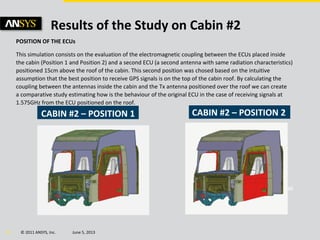
This simulation consists on the evaluation of the electromagnetic coupling between the ECUs placed inside
the cabin (Position 1 and Position 2) and a second ECU (a second antenna with same radiation characteristics)
positioned 15cm above the roof of the cabin. This second position was chosed based on the intuitive
assumption that the best position to receive GPS signals is on the top of the cabin roof. By calculating the
coupling between the antennas inside the cabin and the Tx antenna positioned over the roof we can create
a comparative study estimating how is the behaviour of the original ECU in the case of receiving signals at
1.575GHz from the ECU positioned on the roof.
© 2011 ANSYS, Inc. June 5, 201325
Results of the Study on Cabin #2
ANTENNA COUPLING
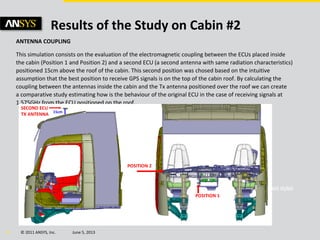
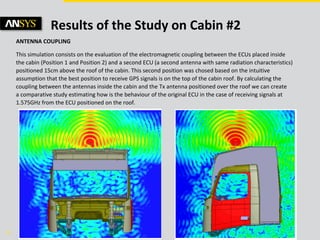
This simulation consists on the evaluation of the electromagnetic coupling between the ECUs placed inside
the cabin (Position 1 and Position 2) and a second ECU (a second antenna with same radiation characteristics)
positioned 15cm above the roof of the cabin. This second position was chosed based on the intuitive
assumption that the best position to receive GPS signals is on the top of the cabin roof. By calculating the
coupling between the antennas inside the cabin and the Tx antenna positioned over the roof we can create
a comparative study estimating how is the behaviour of the original ECU in the case of receiving signals at
1.575GHz from the ECU positioned on the roof.
© 2011 ANSYS, Inc. June 5, 201326
Results of the Study on Cabin #2
ANTENNA COUPLING
This simulation consists on the evaluation of the electromagnetic coupling between the ECUs placed inside
the cabin (Position 1 and Position 2) and a second ECU (a second antenna with same radiation characteristics)
positioned 15cm above the roof of the cabin. This second position was chosed based on the intuitive
assumption that the best position to receive GPS signals is on the top of the cabin roof. By calculating the
coupling between the antennas inside the cabin and the Tx antenna positioned over the roof we can create
a comparative study estimating how is the behaviour of the original ECU in the case of receiving signals at
1.575GHz from the ECU positioned on the roof.
© 2011 ANSYS, Inc. June 5, 201327
Results of the Study on Cabin #2
ANTENNA COUPLING
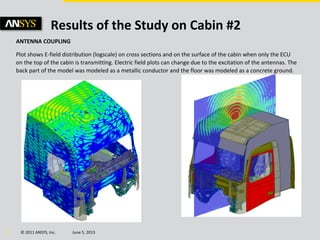
Plot shows E-field distribution (logscale) on cross sections and on the surface of the cabin when only the ECU
on the top of the cabin is transmitting. Electric field plots can change due to the excitation of the antennas. The
back part of the model was modeled as a metallic conductor and the floor was modeled as a concrete ground.
© 2011 ANSYS, Inc. June 5, 201328
Results of the Study on Cabin #2
RADIATION EFFICIENCY
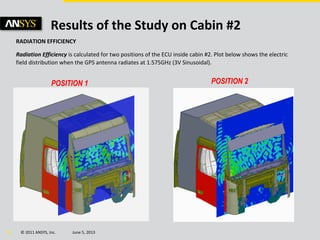
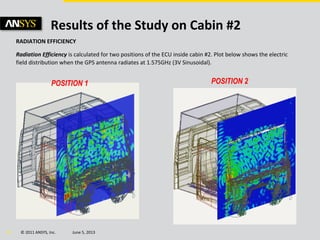
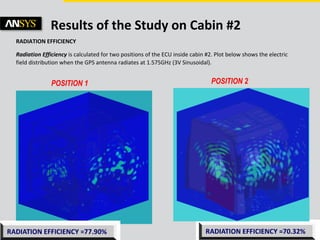
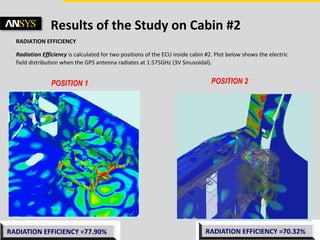
Radiation Efficiency is calculated for two positions of the ECU inside cabin #2. Plot below shows the electric
field distribution when the GPS antenna radiates at 1.575GHz (3V Sinusoidal).
POSITION 1 POSITION 2
© 2011 ANSYS, Inc. June 5, 201329
Results of the Study on Cabin #2
RADIATION EFFICIENCY
Radiation Efficiency is calculated for two positions of the ECU inside cabin #2. Plot below shows the electric
field distribution when the GPS antenna radiates at 1.575GHz (3V Sinusoidal).
POSITION 1 POSITION 2
© 2011 ANSYS, Inc. June 5, 201330
Results of the Study on Cabin #2
RADIATION EFFICIENCY
Radiation Efficiency is calculated for two positions of the ECU inside cabin #2. Plot below shows the electric
field distribution when the GPS antenna radiates at 1.575GHz (3V Sinusoidal).
POSITION 1 POSITION 2
© 2011 ANSYS, Inc. June 5, 201331
Results of the Study on Cabin #2
RADIATION EFFICIENCY
Radiation Efficiency is calculated for two positions of the ECU inside cabin #2. Plot below shows the electric
field distribution when the GPS antenna radiates at 1.575GHz (3V Sinusoidal).
POSITION 1 POSITION 2
© 2011 ANSYS, Inc. June 5, 201332
Results of the Study on Cabin #2
RHCP GAIN PATTERN
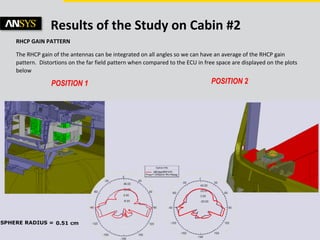
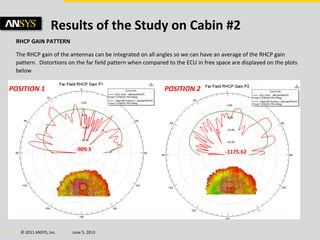
The RHCP gain of the antennas can be integrated on all angles so we can have an average of the RHCP gain
pattern. Distortions on the far field pattern when compared to the ECU in free space are displayed on the plots
below
POSITION 1 POSITION 2
© 2011 ANSYS, Inc. June 5, 201333
Results of the Study on Cabin #2
RHCP GAIN PATTERN
The RHCP gain of the antennas can be integrated on all angles so we can have an average of the RHCP gain
pattern. Distortions on the far field pattern when compared to the ECU in free space are displayed on the plots
below
© 2011 ANSYS, Inc. June 5, 201334
Summary of Results
From the parameters presented below, the Normalized Radiation Efficiency is usually used to quantify the GPS
sensitivity. It shows that when the ECU is placed in the specified position inside cabin #1, the efficiency of the
GPS antenna decreases to 71.76% (or reduces 28.24% in comparison with the ECU alone). For cabin #2, position
1 shows a better performance compared to position #2.
Only ECU Cabin #1
Cabin #2
Position 1
Cabin #2
Position 2
Peak Directivity 19.1815 7.40758 10.5449 8.06356
Peak Gain [dBi] 17.5678 4.86819 7.52303 5.19307
Radiated Power [W] 0.00589929 0.00390389 0.00423796 0.00382564
Radiation Efficiency 0.915871 0.6572 0.713427 0.644017
Normalized Radiation Efficiency 100.00% 71.76% 77.9% 70.32%
RHCP Gain Average [dBc] 1 -491.48 -1152.91 -909.30 -1175.62
2 Antenna Coupling [dB] -69.09 -90.98 -93.31 -96.25
Transient Average2 0.7921 0.6476 1.7708 0.7972
1 RHCP gain average was calculated by integrating the RHCP gain in a far field surface of 0<φ<360 -90<θ<90
2 Transient average is a time integration of the electric field received by the GPS antenna of the ECU. Cabin #2 shows higher values due to the high number of reflections
in the case of position 1, which retains the electromagnetic field, and the proximity of the ECU to the metallic sheets in the case of position #2.
NOTE: The studies were carried out considering only the geometry and the material properties of the cabin. In cabin #2,
the ECU when placed in position 1 is very close to the electrical center, which works with fuses and relays at very high
currents. It is also close to the radio which works with very high speed digital signals. The proximity of the ECU to these
devices can decrease the GPS performance due to electromagnetic interference (EMI). Further studies can be made
including additional ECUs to study EMI between them.

GPS Placement

  • 1.
    © 2011 ANSYS,Inc. June 5, 20131 GPS Placement Juliano Mologni, Ph.D. ESSS, Sao Paulo, Brasil October 3, 2011
  • 2.
    © 2011 ANSYS,Inc. June 5, 20132 Purpose of the Study The purpose of this study is to evaluate the reception of the GPS signal of a Telematics Electronic Control Unit (ECU) in two different cabin geometries. In the first cabin, the ECU is installed in the center of the dashboard. In the second cabin, the ECU is installed in two different positions: 1-Near the center of the dashboard and 2- On the right side of the dashboard. The results are expected to show in details the GPS sensitivity of the ECU at the different positions and cabins detailed above. Electromagnetic field plots will be used to better understand the phenomena.
  • 3.
    © 2011 ANSYS,Inc. June 5, 20133 Telematics GPS ECU In order to run an accurate electromagnetic analysis a reliable model of the telematics electronic control unit (ECU) is required. The basic 3D model was imported and the GPS antenna was inserted into the model as well as the ground plane on the PCB. REAL PICTURE
  • 4.
    © 2011 ANSYS,Inc. June 5, 20134 Telematics GPS ECU This study investigates only the reception of the GPS signal when the ECU is installed inside the truck cabin. The ECU also comprises a GSM/GPRS/EDGE antenna which most likely operates at 850, 900, 1800 and 1900MHz that are not considered in this simulation. PCB traces and electrical components are not modeled since the ground plane is the only geometric structure that will affect the performance of the GPS antenna. It is very important to make sure that the electromagnetic behavior of the 3D ECU model is similar to a real GPS antenna. The table below shows the electrical specification of a typical active GPS antenna used on telemetry modules (GPS antenna brands may vary but electrical specifications are very similar).
  • 5.
    © 2011 ANSYS,Inc. June 5, 20135 Telematics GPS ECU S-Parameter matrix details the information on the frequency of operation of the GPS patch antenna. The simulated S11, also known as the reflection coefficient, shows that the antenna model has an operating bandwidth of 520MHz (range where S11 curve is below -10dB). Hence, the simulated antenna demonstrates a similar S11 performance when compared to the electrical specifications of a real antenna.
  • 6.
    © 2011 ANSYS,Inc. June 5, 20136 Telematics GPS ECU The antenna impedance calculated in HFSS is also close to 50 ohms at 1.575GHz. This is an important feature because the electromagnetic waves used as excitations in the HFSS model must be radiated into free space and not reflected back to the source.
  • 7.
    © 2011 ANSYS,Inc. June 5, 20137 Telematics GPS ECU Voltage Standing Wave Ratio (SWR) is the ratio of the amplitude of a partial standing wave at an antinode (maximum) to the amplitude at an adjacent node (minimum), in an electrical transmission line. The SWR is usually defined as a voltage ratio called the VSWR, for voltage standing wave ratio. For example, the VSWR value 1.2:1 denotes a maximum standing wave amplitude that is 1.2 times greater than the minimum standing wave value. Accordding to HFSS results the VSWR of the GPS antenna complies with typical electrical specifications (<2).
  • 8.
    © 2011 ANSYS,Inc. June 5, 20138 Telematics GPS ECU Antenna gain is the gain in the directivity over an antenna radiating in all directions (omni directional or isotropic antenna), For a RHCP antenna the unit of measurement is dBc. The directive gain of a circularly polarized antenna, expressed as the ratio, in decibels, of the antenna's directivity to that of an isotropic antenna with the same polarization characteristic. Derived from decibels over isotropic. Plot below shows the antenna RHCP gain which also provides similar characteristics of a typical antenna when placed on a 7cm x 7cm ground plane.
  • 9.
    © 2011 ANSYS,Inc. June 5, 20139 Telematics GPS ECU Antenna gain is the gain in the directivity over an antenna radiating in all directions (omni directional or isotropic antenna), For a RHCP antenna the unit of measurement is dBc. The directive gain of a circularly polarized antenna, expressed as the ratio, in decibels, of the antenna's directivity to that of an isotropic antenna with the same polarization characteristic. Derived from decibels over isotropic. Plot below shows the antenna RHCP gain which also provides similar characteristics of a typical antenna when placed on a 7cm x 7cm ground plane.
  • 10.
    © 2011 ANSYS,Inc. June 5, 201310 Telematics GPS ECU The phase animation on the left shows the electric field distribution on the surface of the components (top plot) and on a cross section of air space (bottom left) considering an antenna excitation of 2V at 1.575GHz. The RHCP Gain radiation pattern for the complete ECU is shown on the plot below.
  • 11.
    © 2011 ANSYS,Inc. June 5, 201311 Results of the Study on Cabin #1 TRANSIENT ANALYSIS The first electromagnetic analysis is a time domain simulation called transient. In this simulation we are attempting to reproduce an incoming GPS signal from the space. It was detailed before that an electromagnetic wave can be received with different angle of arraival (AOA) depending on the positions of the satellites in the GPS constellation and the geographical position of the receiver on earth. In this first simulation an incident wave represented by a 1V pulse with a center frequency 1.575GHz is inciding normally toward the cabin roof.
  • 12.
    © 2011 ANSYS,Inc. June 5, 201312 Results of the Study on Cabin #1 TRANSIENT ANALYSIS Plot below shows the plane wave animation travelling towards the cabin roof. All the reflections of the electromagnetic wave can be seen in time domain. The electromagnetic field can be quantified for any given time during the simulation. This anaysis is a valuable tool to study the influence of the geometry in multi path (when the signal reaches the receiver through multi path due to reflections on secondary objects).
  • 13.
    © 2011 ANSYS,Inc. June 5, 201313 Results of the Study on Cabin #1 TRANSIENT ANALYSIS It is possible to compare the electric field received by the ECU with and without the cabin. Blue curve shows that the signal strength (magnitude) is higher when the ECU is placed alone in free space. Red curve shows the two peaks with reduced electric field magnitude. The second peak is delayed by 3ns and is caused by reflections (multipath) on metallic structures and it might cause errors on the GPS engine.
  • 14.
    © 2011 ANSYS,Inc. June 5, 201314 Results of the Study on Cabin #1 ANTENNA COUPLING The second simulations consists on the evaluation of the electromagnetic coupling between the ECU placed in its original position and a second ECU (a second antenna with same radiation characteristics) positioned 15cm above the roof of the cabin. This second position was chosed based on the intuitive assumption that the best position to receive GPS signals is on the top of the cabin roof. By calculating the coupling between these two antennas we can create a comparative study (if there is more than one position for the ECU inside the cabin) estimating how is the behaviour of the original ECU in the case of receiving signals at 1.575GHz from the ECU positioned on the roof top.
  • 15.
    © 2011 ANSYS,Inc. June 5, 201315 Results of the Study on Cabin #1 ANTENNA COUPLING Plot shows E-field distribution (logscale) on cross sections and on the surface of the cabin when only the ECU on the top of the cabin is transmitting. Electric field plots can change due to the excitation of the antennas, nevertheless, the coupling is calculated on frequency domain and for 1.575GHz it will always be -90.98dB for this arrange.
  • 16.
    © 2011 ANSYS,Inc. June 5, 201316 Results of the Study on Cabin #1 ANTENNA COUPLING Plot shows E-field distribution (logscale) on cross sections and on the surface of the cabin when only the ECU on the top of the cabin is transmitting. Electric field plots can change due to the excitation of the antennas, nevertheless, the coupling is calculated on frequency domain and for 1.575GHz it will always be -90.98dB for this arrange.
  • 17.
    © 2011 ANSYS,Inc. June 5, 201317 Results of the Study on Cabin #1 ANTENNA COUPLING Plot shows E-field distribution (logscale) on cross sections and on the surface of the cabin when only the ECU on the top of the cabin is transmitting. Electric field plots can change due to the excitation of the antennas, nevertheless, the coupling is calculated on frequency domain and for 1.575GHz it will always be -90.98dB for this arrange. E-FIELD ON A CROSS SECTION 1CM ABOVE THE TOP ECUSome of the E-field enters the cabin through the gap between the whole cabin roof and the solar roof.
  • 18.
    © 2011 ANSYS,Inc. June 5, 201318 Results of the Study on Cabin #1 RADIATION EFFICIENCY Radiation Efficiency is calculated for the ECU alone in the space and when the cabin #1 is added to the model. Plot below shows the electric field distribution when the GPS antenna radiates at 1.575GHz (3V Sinusoidal).
  • 19.
    © 2011 ANSYS,Inc. June 5, 201319 Results of the Study on Cabin #1 RADIATION EFFICIENCY Radiation Efficiency is calculated for the ECU alone in the space and when the cabin #1 is added to the model. Plot below shows the electric field distribution when the GPS antenna radiates at 1.575GHz (3V Sinusoidal).
  • 20.
    © 2011 ANSYS,Inc. June 5, 201320 Results of the Study on Cabin #1 RADIATION EFFICIENCY Radiation Efficiency of the ECU (GPS antenna) in cabin #1 is 65.72%. The efficiency of only the ECU in free space is not 100% due to the fre space losses and the GPS antenna and the parts of the ECU module (e.g. FR-4 substrate).
  • 21.
    © 2011 ANSYS,Inc. June 5, 201321 Results of the Study on Cabin #1 RADIATION EFFICIENCY All the solids interacts with the electromagnetic waves and every metallic detail (conductive solid) is considered. The plot below shows the electric field at the brackets near the ECU. The reflections of the wave can be observed.
  • 22.
    © 2011 ANSYS,Inc. June 5, 201322 Results of the Study on Cabin #1 RADIATION EFFICIENCY Besides the radiation efficiency, we can calculate the RHCP Gain of the antenna at any distance from the ECU. Plot below shows the near radiated RHCP E-Field at a sphere positioned at different distances from the GPS antenna.
  • 23.
    © 2011 ANSYS,Inc. June 5, 201323 Results of the Study on Cabin #1 RADIATION EFFICIENCY The RHCP gain is calculated for the far field for GPS reception. Plot below shows the near ERHCP patterns for a sphere with different radius and the plots on the top right shows the Far Field RHCP Gain pattern of the ECU placed in cabin #1 in comparison with the ECU alone. By integrating the gain in the range of 0<Ɵ<360 and -90<φ<90 we can estimate an average RHCP gain . The graphic on the bottom right shows the polar plot of the Far Field RHCP gain with the structure. It is possible to observe that the gain pattern is stronger towards the front of the cabin. No gain is found on the bottom because the floor was modeled as concret.
  • 24.
    © 2011 ANSYS,Inc. June 5, 201324 Results of the Study on Cabin #2 POSITION OF THE ECUs This simulation consists on the evaluation of the electromagnetic coupling between the ECUs placed inside the cabin (Position 1 and Position 2) and a second ECU (a second antenna with same radiation characteristics) positioned 15cm above the roof of the cabin. This second position was chosed based on the intuitive assumption that the best position to receive GPS signals is on the top of the cabin roof. By calculating the coupling between the antennas inside the cabin and the Tx antenna positioned over the roof we can create a comparative study estimating how is the behaviour of the original ECU in the case of receiving signals at 1.575GHz from the ECU positioned on the roof.
  • 25.
    © 2011 ANSYS,Inc. June 5, 201325 Results of the Study on Cabin #2 ANTENNA COUPLING This simulation consists on the evaluation of the electromagnetic coupling between the ECUs placed inside the cabin (Position 1 and Position 2) and a second ECU (a second antenna with same radiation characteristics) positioned 15cm above the roof of the cabin. This second position was chosed based on the intuitive assumption that the best position to receive GPS signals is on the top of the cabin roof. By calculating the coupling between the antennas inside the cabin and the Tx antenna positioned over the roof we can create a comparative study estimating how is the behaviour of the original ECU in the case of receiving signals at 1.575GHz from the ECU positioned on the roof.
  • 26.
    © 2011 ANSYS,Inc. June 5, 201326 Results of the Study on Cabin #2 ANTENNA COUPLING This simulation consists on the evaluation of the electromagnetic coupling between the ECUs placed inside the cabin (Position 1 and Position 2) and a second ECU (a second antenna with same radiation characteristics) positioned 15cm above the roof of the cabin. This second position was chosed based on the intuitive assumption that the best position to receive GPS signals is on the top of the cabin roof. By calculating the coupling between the antennas inside the cabin and the Tx antenna positioned over the roof we can create a comparative study estimating how is the behaviour of the original ECU in the case of receiving signals at 1.575GHz from the ECU positioned on the roof.
  • 27.
    © 2011 ANSYS,Inc. June 5, 201327 Results of the Study on Cabin #2 ANTENNA COUPLING Plot shows E-field distribution (logscale) on cross sections and on the surface of the cabin when only the ECU on the top of the cabin is transmitting. Electric field plots can change due to the excitation of the antennas. The back part of the model was modeled as a metallic conductor and the floor was modeled as a concrete ground.
  • 28.
    © 2011 ANSYS,Inc. June 5, 201328 Results of the Study on Cabin #2 RADIATION EFFICIENCY Radiation Efficiency is calculated for two positions of the ECU inside cabin #2. Plot below shows the electric field distribution when the GPS antenna radiates at 1.575GHz (3V Sinusoidal). POSITION 1 POSITION 2
  • 29.
    © 2011 ANSYS,Inc. June 5, 201329 Results of the Study on Cabin #2 RADIATION EFFICIENCY Radiation Efficiency is calculated for two positions of the ECU inside cabin #2. Plot below shows the electric field distribution when the GPS antenna radiates at 1.575GHz (3V Sinusoidal). POSITION 1 POSITION 2
  • 30.
    © 2011 ANSYS,Inc. June 5, 201330 Results of the Study on Cabin #2 RADIATION EFFICIENCY Radiation Efficiency is calculated for two positions of the ECU inside cabin #2. Plot below shows the electric field distribution when the GPS antenna radiates at 1.575GHz (3V Sinusoidal). POSITION 1 POSITION 2
  • 31.
    © 2011 ANSYS,Inc. June 5, 201331 Results of the Study on Cabin #2 RADIATION EFFICIENCY Radiation Efficiency is calculated for two positions of the ECU inside cabin #2. Plot below shows the electric field distribution when the GPS antenna radiates at 1.575GHz (3V Sinusoidal). POSITION 1 POSITION 2
  • 32.
    © 2011 ANSYS,Inc. June 5, 201332 Results of the Study on Cabin #2 RHCP GAIN PATTERN The RHCP gain of the antennas can be integrated on all angles so we can have an average of the RHCP gain pattern. Distortions on the far field pattern when compared to the ECU in free space are displayed on the plots below POSITION 1 POSITION 2
  • 33.
    © 2011 ANSYS,Inc. June 5, 201333 Results of the Study on Cabin #2 RHCP GAIN PATTERN The RHCP gain of the antennas can be integrated on all angles so we can have an average of the RHCP gain pattern. Distortions on the far field pattern when compared to the ECU in free space are displayed on the plots below
  • 34.
    © 2011 ANSYS,Inc. June 5, 201334 Summary of Results From the parameters presented below, the Normalized Radiation Efficiency is usually used to quantify the GPS sensitivity. It shows that when the ECU is placed in the specified position inside cabin #1, the efficiency of the GPS antenna decreases to 71.76% (or reduces 28.24% in comparison with the ECU alone). For cabin #2, position 1 shows a better performance compared to position #2. Only ECU Cabin #1 Cabin #2 Position 1 Cabin #2 Position 2 Peak Directivity 19.1815 7.40758 10.5449 8.06356 Peak Gain [dBi] 17.5678 4.86819 7.52303 5.19307 Radiated Power [W] 0.00589929 0.00390389 0.00423796 0.00382564 Radiation Efficiency 0.915871 0.6572 0.713427 0.644017 Normalized Radiation Efficiency 100.00% 71.76% 77.9% 70.32% RHCP Gain Average [dBc] 1 -491.48 -1152.91 -909.30 -1175.62 2 Antenna Coupling [dB] -69.09 -90.98 -93.31 -96.25 Transient Average2 0.7921 0.6476 1.7708 0.7972 1 RHCP gain average was calculated by integrating the RHCP gain in a far field surface of 0<φ<360 -90<θ<90 2 Transient average is a time integration of the electric field received by the GPS antenna of the ECU. Cabin #2 shows higher values due to the high number of reflections in the case of position 1, which retains the electromagnetic field, and the proximity of the ECU to the metallic sheets in the case of position #2. NOTE: The studies were carried out considering only the geometry and the material properties of the cabin. In cabin #2, the ECU when placed in position 1 is very close to the electrical center, which works with fuses and relays at very high currents. It is also close to the radio which works with very high speed digital signals. The proximity of the ECU to these devices can decrease the GPS performance due to electromagnetic interference (EMI). Further studies can be made including additional ECUs to study EMI between them.