ELF Magnetic Field Mitigation by Active Shielding
COnCettina BuCCdk&Memher. IEEE, Mauro Feliziani, Member. IEEE. VhCenZO F u k
Dept. of Electrical Eng., Univ. of L'Aquila, Poggio di Roio, 67040 L'Aquila, Italy,
Abstrncr -- The reduction of extremely low frequency (ELF)
magnetic field in an area excited by power frequency currents is
investigated by active shielding techniques. The magnetic field
inside a shielded area is measured in simple test configurations.The
performances of the proposed field-controlled active shield are
showed.
1.lNTRODUCTlON
An interesting problem from a scientific and technical point
of view is that of reducing the magnetic field produced by a
power frequency source in a delimited region of space.
Often, especially in the immediate proximity of an
electromagnetic source, the magnetic field can be large
enough to violate some electromagnetic field exposure
standards or to degrade the functionality of electrical and
electronic systems. In this case it is necessary to reduce the
electromagnetic field strength to an acceptable level. In
general, two different techniques exist to attenuate the
surrounding magnetic fields: passive shielding and active
shielding.
The passive shielding is extensively used for protection
against high frequency fields. To shield static and extremely
low frequency (ELF) magnetic fields, materials such as
ferromagnetic shields and thick eddy-current shields can be
used [I]-[Ill. However, in the design of large volume
shielded enclosures, the ferromagnetic shield becomes too
heavy and too expensive for the amount of material needed,
while the eddy-current shield provides a very poor shielding
at low frequency.
Active shielding is an alternative attenuation method n
which the disturbing magnetic field can be reduced by
superposing other magnetic fields having about the same
magnitude, but in the opposite direction [5].The opposite
fields are generally produced by currents injected into
adequately designed active coils. The principal problem of
active shielding can be given by the high currents requested
in order to obtain a significant value of the shielding
effectiveness. Furthermore, active shielding works only at a
given frequency, normally at the power frequency, and there
is not any magnetic field attenuation at other frequencies:
higher order harmonic or radio frequency fields are not
attenuated.
The active shielding technique is here investigated.
Experimental results in test configurations are showed.
11. MATHEMATICAL MODEL
0-7803-7369-3/02/$17.0002002 IEEE
where Ar = r-Y'is the difference between the position vector
r o f the point of observation P and the position vector r'of
the element d / ' . From (2) it is possible to derive the
magnetic field produced by a square loop current. Assuming
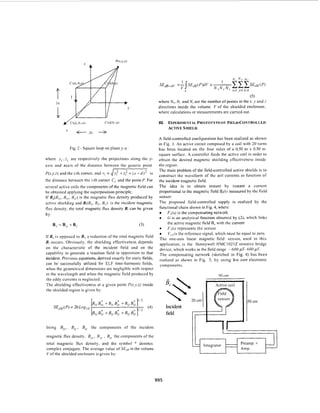
the square loop of dimensions 2 a X 2b and parallel to the+
plane at a distance d, the coordinates of the loop four
corners are: C,(d, -b. -U), C2(d4,U ) , C,(d, h, a ) and C,(d, b.
-U) as shown in Fig. 2. The components ofthe magnetic flux
density produced by the active shielding, B,,,, B,,., and B,,,,
are given at generic point P(YJ,z) by [5]:
994
x - d
4
B(,j.=-Z(-l)'+'-P O I
B,, =-Z(-l);+'P o l -
rj(1.j +z;)4n ;=I
41r ;=I
.Y -d
4
(1; +y; )
1’
1
2a +
Y
Fig. 2 - Square loop on plane y-z.
where y i ,zi are respectively the projections along the y-
axis and zaxis of the distance between the generic point
P(s.yz) and the i-tli corner, and rj = -,,/.I;! +z? + ( 5 -d)’ is
the distance between the i-th corner Ciand the point P. For
several active coils the components of the magnetic field can
be obtained applying the superposition principle.
If B,(B,,,,B,,?.,BJ is the magnetic flux density produced by
active shielding and B,(B,,.B,),BJ is the incident magnetic
flux density. the total magnetic flux density B, can be given
by:
B, = B,, +B, (3)
If B,,is opposed to B,,a reduction of the total magnetic field
B, occurs. Obviously, the shielding effectiveness depends
on the characteristic of the incident field and on the
capability to generate a reaction field in opposition to that
incident. Previous equations, derived exactly for static fields,
can be successfully utilized for ELF time-hamionic fields,
when the geometrical dimensions are negligible with respect
to the wavelength and when the magnetic field produced by
the eddy currents is neglected.
The shielding effectiveness at a given point P(s,,v,z) inside
the shielded region is given by:
being B,, Bi!.,Biz the components of the incident
magnetic flux density, B,,, Bf!,, B, the components of the
total magnetic flux density, and the symbol * denotes
complex conjugate. The average value of SE,,Bin the volume
/of the shielded enclosure is given by:
(5)
where N,. N, and N, are the number of points in thex. y and z
directions inside the volume V of the shielded enclosure,
where calculations or measurements are carried out.
111. EXPERIRIENT.11, PROTOTYPEOF RELD-CONTROLLED
ACTIVE SHIELD
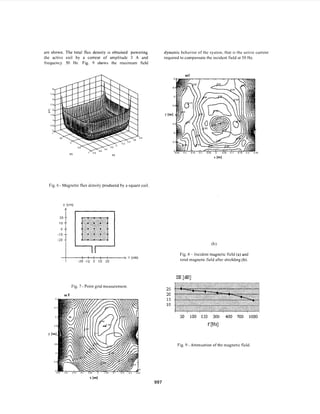
A field-controlled configuration has been realized as shown
in Fig. 3. An active circuit composed by a coil with 20 turns
has been located on the four sides of a 0.50 ni x 0.50 ni
square surface. A controller feeds the active coil in order to
obtain the desired magnetic shielding effectiveness inside
the region.
The main problem of the field-controlled active shields is to
construct the waveform of the coil currents as function of
the incident magnetic field.
The idea is to obtain instant by instant a current
proportional to the magnetic field B,(t) measured by the field
sensor.
The proposed field-controlled supply is realized by the
functional chain shown in Fig. 4. where:
F,(s) is the compensating network
G is an analytical function obtained by (2),which links
the active magnetic field B,, with the current
F2(s)represents the sensor
V,.,,.isthe reference signal, which must be equal to zero.
The one-axis linear magnetic field sensor, used in this
application, is the Honeywell HMC1021Z resistive bridge
device, which works in the field range - 600 ,UT-600 ,UT.
The compensating network (sketched in Fig. 4) has been
realized as shown in Fig. 5, by using bw cost electronic
components.
50 cni
Active coil
50 cm
Preamp. +
Amp.
Integrator -
995
Fig. 4 -Control system representation.
c1
vcc
T
vcc
T
vcc
T
a5
I-
Q6
I
vcc
I
vcc
Fig. 5 - Functional chain realization.
The magnetic field source has been realized by using a
square coil with 30 turns having each side of 1.50 m
crossed by a current of 7 A and frequency of 50 Hz. In the
central region of the coil plane the magnetic flux density
can be considered constant as show in Fig.6. In this zone
is placed the field sensor.
The ELF magnetic field inside the planar region has been
measured by the Wandel & Goltemian EFA-3 field sensor.
The measurements of magnetic field have been carried out
placing the field sensor in the points of a N,xN, point
grid, as shown in Fig. 7, with N , =N, =5, located in the
center of the square region. Five different measurements
of the mis magnetic field have been
acquired for each point of the grid in order to minimize the
influence of possible noise. The measured value has been
assumed to be the average one. The cross section of the
experimental configuration has been also analyzed by
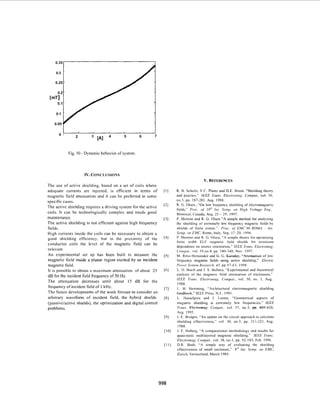
two-dimensional computer codes. The performance of the
proposed field-controlled active coils is shown in Fig. 8,
where the incident and total magnetic flux density maps
996
are shown. The total flux density is obtained powering
the active coil by a current of amplitude 3 A and required to compensate the incident field at 50 Hz.
frequency 50 Hz. Fig. 9 shows the maximum field
dynamic behavior of the system, that is the active current
3
2
-
E-
1
0
0 8
-1 -0 8 5
Fig. 6 - Magnetic flux density produced by a square coil.
II 1 l 1 , I :.:: (cm)
-20 -10 0 10 20
Fig. 7 - Point grid measurement.
mT
Fig. 8 - Incident magnetic field (a) and
total magnetic field after shielding (b).
. __..... ._-.. .,-. ...
25
20
15
i n
Fig. 9 - Attenuation of the magnetic field
0.3
0.25.
0.2 -
Fig. IO - Dynamic behavior of system.
IV. CONCLUSIONS
v.REFERENCES
The use of active shielding, based on a set of coils where
adequate currents are injected, is efficient in terms of
magnetic field attenuation and it can be preferred in some
specific cases.
The active shielding requires a driving system for the active
coils. It can be technologically complex and needs good
maintenance.
The active shielding is not efficient against high frequency
fields.
High currents inside the coils can be necessary to obtain a
good shielding efficiency, but in the proximity of the
conductor coils the level of the magnetic field can be
relevant.
An experimental set up has been built to measure the
magnetic field inside a planar region excited by an incident
magnetic field.
It is possible to obtain a maximum attenuation of about 25
dB for the incident field frequency of 50 Hz.
The attenuation decreases until about 15 dB for the
frequency of incident field of 1 kHz.
The future developments of the work foresee to consider an
arbitrary waveform of incident field, the hybrid shields
(passive/active shields), the optimization and digital control
problems.
[41
U. B. Schultz. V.C. Plantz and D.E. Brush, “Shielding theoiy
and practice.” lEEE Trans. Electromag. Compat.. vol. 30,
110.3. pp. 187-201. Aug. 1988.
R. C. Olsen.. “On low frequency shielding of electromagnetic
fields.” Proc. of’ IO’” /ut. Syrup. 011 High Voltage Etig.,
Montreal, Canada. Aug. 25 - 29. 1997.
P. Moreno and U. G. Olsen “A simple method for analyzing
the shielding of extremely low frequency magnetic fields by
shields of finite extent.’‘ Proc. of’ EMC’Yh ROMA - Irit.
Symp. ofi EMC, Rome. Italy. Sep. 17-20, 1996.
P. Moreno and R. G. Olsen, ”A simple theory for optimizing
finite width ELF magnetic lield shields for minimum
dependence on source orientation,” lEEE Tram. Electroriiag:.
Coriipat.. vol. 39.110.4. pp. 340-348, Nov. 1997.
M. Ret+Hernindez and G. G. Karaday. “Attenuation of low
frequency magnetic fields using active shielding.” Electric
Powrr Sisteiii Rrsearch, 45, pp.57-63. 1998.
L. 0. Hoeft and J . S. Hofstra, “Experimental and theoretical
analysis of the magnetic field attenuation of enclosures.“
/EEE Trans. Electrornng. Conrpt.. vol. 30. no. 3, Aug.
1988.
L. H. Hemming. “Architectural electromagnetic shielding
handbook,’’ IEEE Press. N.J., 1991.
L. Hasselgren and J. Luomi, “Geometrical aspects of
magnetic shielding at extremely low frequencies.” IEEE
Tr-ms. Elecmmog. Coinpat.. vol. 37. no.3. pp. 409-420.
J. E. Bridges. “An update on the circuit approach to calculate
shielding effectiveness,” vol. 30. 110.3. pp. 2 11-221, Aug.
1988.
J. F. Hoburg. “A coinputational niethodology and results for
quasi-static multilayered magnetic shielding.” lEEE Trarls.
Electromag. Caniput., vol. 38. 110.1. pp. 92-103. Feb. 1996.
D.R. Bush. “A simple way of evaluating the shielding
effectiveness of small enciosure.” 8”’ In/. .S.ivnp. on EMC,
Zurich, Switzerland. March 1989.
Aug. 1995.
998

Active shielding

  • 1.
    ELF Magnetic FieldMitigation by Active Shielding COnCettina BuCCdk&Memher. IEEE, Mauro Feliziani, Member. IEEE. VhCenZO F u k Dept. of Electrical Eng., Univ. of L'Aquila, Poggio di Roio, 67040 L'Aquila, Italy, Abstrncr -- The reduction of extremely low frequency (ELF) magnetic field in an area excited by power frequency currents is investigated by active shielding techniques. The magnetic field inside a shielded area is measured in simple test configurations.The performances of the proposed field-controlled active shield are showed. 1.lNTRODUCTlON An interesting problem from a scientific and technical point of view is that of reducing the magnetic field produced by a power frequency source in a delimited region of space. Often, especially in the immediate proximity of an electromagnetic source, the magnetic field can be large enough to violate some electromagnetic field exposure standards or to degrade the functionality of electrical and electronic systems. In this case it is necessary to reduce the electromagnetic field strength to an acceptable level. In general, two different techniques exist to attenuate the surrounding magnetic fields: passive shielding and active shielding. The passive shielding is extensively used for protection against high frequency fields. To shield static and extremely low frequency (ELF) magnetic fields, materials such as ferromagnetic shields and thick eddy-current shields can be used [I]-[Ill. However, in the design of large volume shielded enclosures, the ferromagnetic shield becomes too heavy and too expensive for the amount of material needed, while the eddy-current shield provides a very poor shielding at low frequency. Active shielding is an alternative attenuation method n which the disturbing magnetic field can be reduced by superposing other magnetic fields having about the same magnitude, but in the opposite direction [5].The opposite fields are generally produced by currents injected into adequately designed active coils. The principal problem of active shielding can be given by the high currents requested in order to obtain a significant value of the shielding effectiveness. Furthermore, active shielding works only at a given frequency, normally at the power frequency, and there is not any magnetic field attenuation at other frequencies: higher order harmonic or radio frequency fields are not attenuated. The active shielding technique is here investigated. Experimental results in test configurations are showed. 11. MATHEMATICAL MODEL 0-7803-7369-3/02/$17.0002002 IEEE where Ar = r-Y'is the difference between the position vector r o f the point of observation P and the position vector r'of the element d / ' . From (2) it is possible to derive the magnetic field produced by a square loop current. Assuming the square loop of dimensions 2 a X 2b and parallel to the+ plane at a distance d, the coordinates of the loop four corners are: C,(d, -b. -U), C2(d4,U ) , C,(d, h, a ) and C,(d, b. -U) as shown in Fig. 2. The components ofthe magnetic flux density produced by the active shielding, B,,,, B,,., and B,,,, are given at generic point P(YJ,z) by [5]: 994 x - d 4 B(,j.=-Z(-l)'+'-P O I B,, =-Z(-l);+'P o l - rj(1.j +z;)4n ;=I 41r ;=I .Y -d 4 (1; +y; )
  • 2.
    1’ 1 2a + Y Fig. 2- Square loop on plane y-z. where y i ,zi are respectively the projections along the y- axis and zaxis of the distance between the generic point P(s.yz) and the i-tli corner, and rj = -,,/.I;! +z? + ( 5 -d)’ is the distance between the i-th corner Ciand the point P. For several active coils the components of the magnetic field can be obtained applying the superposition principle. If B,(B,,,,B,,?.,BJ is the magnetic flux density produced by active shielding and B,(B,,.B,),BJ is the incident magnetic flux density. the total magnetic flux density B, can be given by: B, = B,, +B, (3) If B,,is opposed to B,,a reduction of the total magnetic field B, occurs. Obviously, the shielding effectiveness depends on the characteristic of the incident field and on the capability to generate a reaction field in opposition to that incident. Previous equations, derived exactly for static fields, can be successfully utilized for ELF time-hamionic fields, when the geometrical dimensions are negligible with respect to the wavelength and when the magnetic field produced by the eddy currents is neglected. The shielding effectiveness at a given point P(s,,v,z) inside the shielded region is given by: being B,, Bi!.,Biz the components of the incident magnetic flux density, B,,, Bf!,, B, the components of the total magnetic flux density, and the symbol * denotes complex conjugate. The average value of SE,,Bin the volume /of the shielded enclosure is given by: (5) where N,. N, and N, are the number of points in thex. y and z directions inside the volume V of the shielded enclosure, where calculations or measurements are carried out. 111. EXPERIRIENT.11, PROTOTYPEOF RELD-CONTROLLED ACTIVE SHIELD A field-controlled configuration has been realized as shown in Fig. 3. An active circuit composed by a coil with 20 turns has been located on the four sides of a 0.50 ni x 0.50 ni square surface. A controller feeds the active coil in order to obtain the desired magnetic shielding effectiveness inside the region. The main problem of the field-controlled active shields is to construct the waveform of the coil currents as function of the incident magnetic field. The idea is to obtain instant by instant a current proportional to the magnetic field B,(t) measured by the field sensor. The proposed field-controlled supply is realized by the functional chain shown in Fig. 4. where: F,(s) is the compensating network G is an analytical function obtained by (2),which links the active magnetic field B,, with the current F2(s)represents the sensor V,.,,.isthe reference signal, which must be equal to zero. The one-axis linear magnetic field sensor, used in this application, is the Honeywell HMC1021Z resistive bridge device, which works in the field range - 600 ,UT-600 ,UT. The compensating network (sketched in Fig. 4) has been realized as shown in Fig. 5, by using bw cost electronic components. 50 cni Active coil 50 cm Preamp. + Amp. Integrator - 995
  • 3.
    Fig. 4 -Controlsystem representation. c1 vcc T vcc T vcc T a5 I- Q6 I vcc I vcc Fig. 5 - Functional chain realization. The magnetic field source has been realized by using a square coil with 30 turns having each side of 1.50 m crossed by a current of 7 A and frequency of 50 Hz. In the central region of the coil plane the magnetic flux density can be considered constant as show in Fig.6. In this zone is placed the field sensor. The ELF magnetic field inside the planar region has been measured by the Wandel & Goltemian EFA-3 field sensor. The measurements of magnetic field have been carried out placing the field sensor in the points of a N,xN, point grid, as shown in Fig. 7, with N , =N, =5, located in the center of the square region. Five different measurements of the mis magnetic field have been acquired for each point of the grid in order to minimize the influence of possible noise. The measured value has been assumed to be the average one. The cross section of the experimental configuration has been also analyzed by two-dimensional computer codes. The performance of the proposed field-controlled active coils is shown in Fig. 8, where the incident and total magnetic flux density maps 996
  • 4.
    are shown. Thetotal flux density is obtained powering the active coil by a current of amplitude 3 A and required to compensate the incident field at 50 Hz. frequency 50 Hz. Fig. 9 shows the maximum field dynamic behavior of the system, that is the active current 3 2 - E- 1 0 0 8 -1 -0 8 5 Fig. 6 - Magnetic flux density produced by a square coil. II 1 l 1 , I :.:: (cm) -20 -10 0 10 20 Fig. 7 - Point grid measurement. mT Fig. 8 - Incident magnetic field (a) and total magnetic field after shielding (b). . __..... ._-.. .,-. ... 25 20 15 i n Fig. 9 - Attenuation of the magnetic field
  • 5.
    0.3 0.25. 0.2 - Fig. IO- Dynamic behavior of system. IV. CONCLUSIONS v.REFERENCES The use of active shielding, based on a set of coils where adequate currents are injected, is efficient in terms of magnetic field attenuation and it can be preferred in some specific cases. The active shielding requires a driving system for the active coils. It can be technologically complex and needs good maintenance. The active shielding is not efficient against high frequency fields. High currents inside the coils can be necessary to obtain a good shielding efficiency, but in the proximity of the conductor coils the level of the magnetic field can be relevant. An experimental set up has been built to measure the magnetic field inside a planar region excited by an incident magnetic field. It is possible to obtain a maximum attenuation of about 25 dB for the incident field frequency of 50 Hz. The attenuation decreases until about 15 dB for the frequency of incident field of 1 kHz. The future developments of the work foresee to consider an arbitrary waveform of incident field, the hybrid shields (passive/active shields), the optimization and digital control problems. [41 U. B. Schultz. V.C. Plantz and D.E. Brush, “Shielding theoiy and practice.” lEEE Trans. Electromag. Compat.. vol. 30, 110.3. pp. 187-201. Aug. 1988. R. C. Olsen.. “On low frequency shielding of electromagnetic fields.” Proc. of’ IO’” /ut. Syrup. 011 High Voltage Etig., Montreal, Canada. Aug. 25 - 29. 1997. P. Moreno and U. G. Olsen “A simple method for analyzing the shielding of extremely low frequency magnetic fields by shields of finite extent.’‘ Proc. of’ EMC’Yh ROMA - Irit. Symp. ofi EMC, Rome. Italy. Sep. 17-20, 1996. P. Moreno and R. G. Olsen, ”A simple theory for optimizing finite width ELF magnetic lield shields for minimum dependence on source orientation,” lEEE Tram. Electroriiag:. Coriipat.. vol. 39.110.4. pp. 340-348, Nov. 1997. M. Ret+Hernindez and G. G. Karaday. “Attenuation of low frequency magnetic fields using active shielding.” Electric Powrr Sisteiii Rrsearch, 45, pp.57-63. 1998. L. 0. Hoeft and J . S. Hofstra, “Experimental and theoretical analysis of the magnetic field attenuation of enclosures.“ /EEE Trans. Electrornng. Conrpt.. vol. 30. no. 3, Aug. 1988. L. H. Hemming. “Architectural electromagnetic shielding handbook,’’ IEEE Press. N.J., 1991. L. Hasselgren and J. Luomi, “Geometrical aspects of magnetic shielding at extremely low frequencies.” IEEE Tr-ms. Elecmmog. Coinpat.. vol. 37. no.3. pp. 409-420. J. E. Bridges. “An update on the circuit approach to calculate shielding effectiveness,” vol. 30. 110.3. pp. 2 11-221, Aug. 1988. J. F. Hoburg. “A coinputational niethodology and results for quasi-static multilayered magnetic shielding.” lEEE Trarls. Electromag. Caniput., vol. 38. 110.1. pp. 92-103. Feb. 1996. D.R. Bush. “A simple way of evaluating the shielding effectiveness of small enciosure.” 8”’ In/. .S.ivnp. on EMC, Zurich, Switzerland. March 1989. Aug. 1995. 998