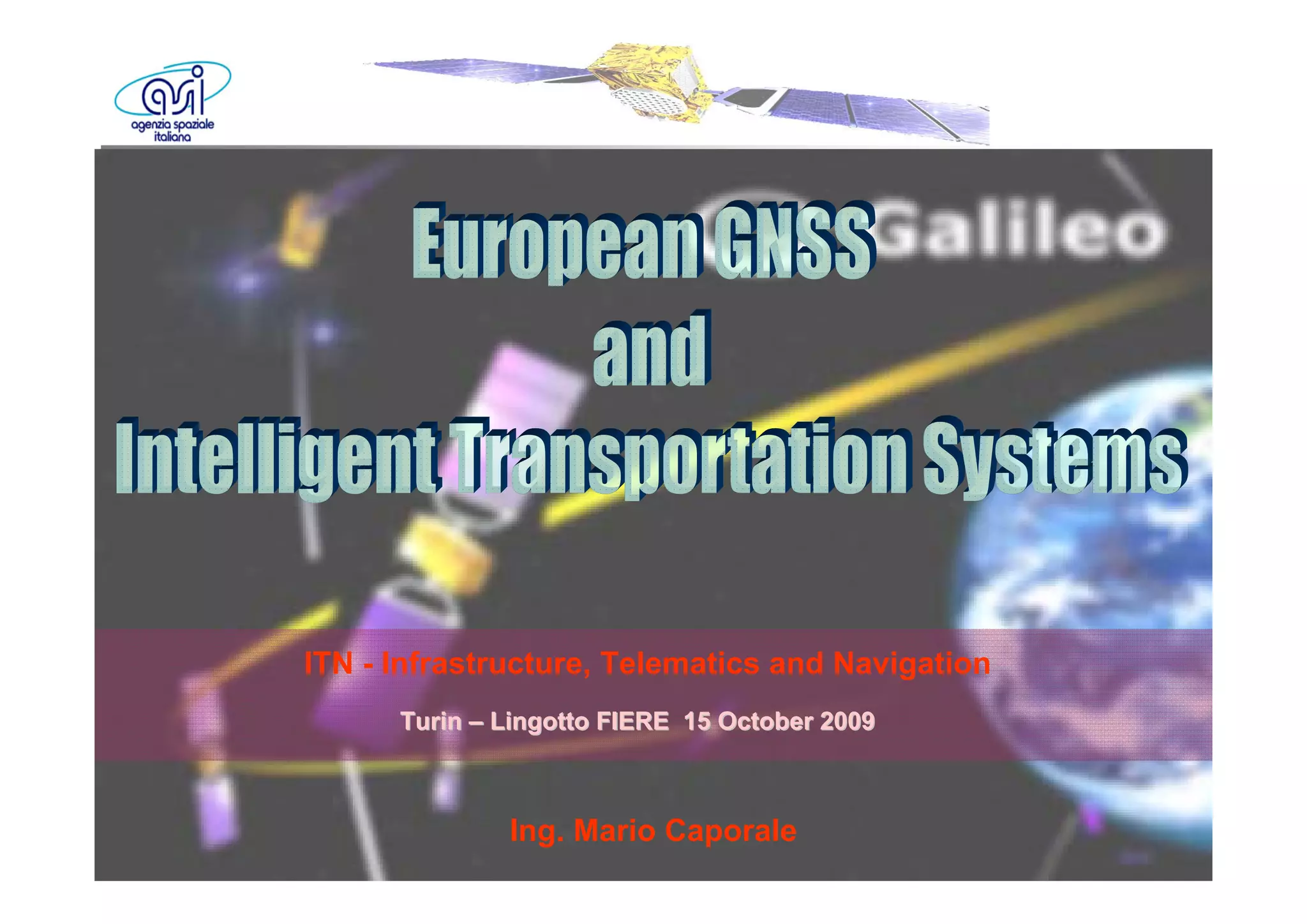
ITN - Infrastructure, Telematics and Navigation
      Turin – Lingotto FIERE 15 October 2009


              Ing. Mario Caporale
                                                  1
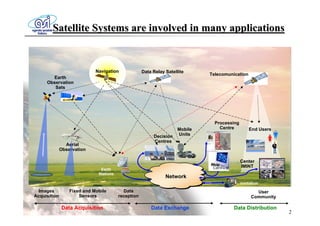
Satellite Systems are involved in many applications


                             Navigation              Data Relay Satellite
                                                                                Telecomunication
       Earth
     Observation
        Sats


                                                                                  Processing
                                                                      Mobile        Centre         End Users
                                                          Decision    Units
                                                          Centres
                Aerial
              Observation

                                                                                               Center
                                                                     ETS unit                  IMINT
                               Earth
                              Stations
                                                                Network
                                                                                               mediation

  Images          Fixed and Mobile         Data                                                       User
Acquisition           Sensors            reception                                                  Community

              Data Acquisition                           Data Exchange                    Data Distribution
                                                                                                                2
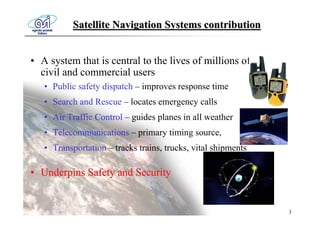
Satellite Navigation Systems contribution


• A system that is central to the lives of millions of
  civil and commercial users
   • Public safety dispatch – improves response time
   • Search and Rescue – locates emergency calls
   • Air Traffic Control – guides planes in all weather
   • Telecommunications – primary timing source,
   • Transportation – tracks trains, trucks, vital shipments

• Underpins Safety and Security


                                                               3
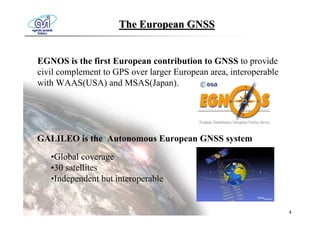
The European GNSS


EGNOS is the first European contribution to GNSS to provide
civil complement to GPS over larger European area, interoperable
with WAAS(USA) and MSAS(Japan).


GALILEO is the Autonomous European GNSS system

   •Global coverage
   •30 satellites
   •Independent but interoperable


                                                                   4
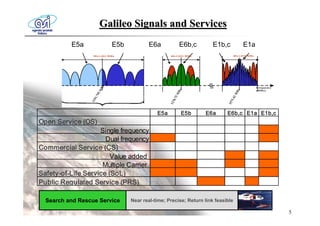
Galileo Signals and Services
          E5a           E5b          E6a           E6b,c          E1b,c              E1a


                                          E 5 a     E 5 b      E 6 a     E 6 b , c    E 1 a   E 1 b , c

Open Service (OS)
                    Single frequency
                      Dual frequency
Commercial Service (CS)
                        Value added
                     Multiple Carrier
Safety-of-Life Service (SoL)
Public Regulated Service (PRS)

  Search and Rescue Service   Near real-time; Precise; Return link feasible

                                                                                                          5
The new capabilities introduced by Galileo

  The European GALILEO system introduces new
capabilites:
    Signal Integrity
    Service Guarantee
    Signal diversity
    Certification for the Service “Safety of Life”
    Local Elements
 Increasing the Availability:
  – GPS alone: 55% of urban coverage
  – GPS + Galileo: 95% of urban coverage


                                                     6
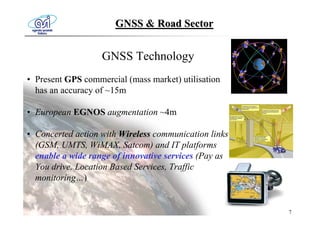
GNSS & Road Sector


                   GNSS Technology
• Present GPS commercial (mass market) utilisation
  has an accuracy of ~15m

• European EGNOS augmentation ~4m

• Concerted action with Wireless communication links
  (GSM, UMTS, WiMAX, Satcom) and IT platforms
  enable a wide range of innovative services (Pay as
  You drive, Location Based Services, Traffic
  monitoring…)


                                                       7
Impact of New Satellite Positioning Systems on ITS
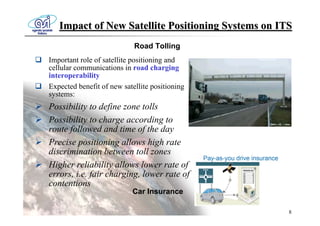
                            Road Tolling
Important role of satellite positioning and
cellular communications in road charging
interoperability
Expected benefit of new satellite positioning
systems:
Possibility to define zone tolls
Possibility to charge according to
route followed and time of the day
Precise positioning allows high rate
discrimination between toll zones
Higher reliability allows lower rate of
errors, i.e. fair charging, lower rate of
contentions
                           Car Insurance

                                                    8
Impact of New Satellite Positioning Systems on ITS
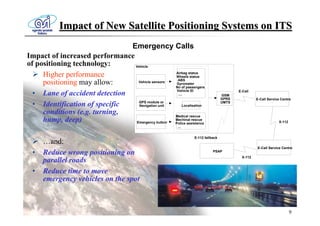
                               Emergency Calls
Impact of increased performance
of positioning technology:      Vehicle

     Higher performance                           Airbag status
                                                  Wheels status
                                                   ABS
     positioning may allow:      Vehicle sensors   Gyrometer
                                                  No of passengers
                                                   Vehicle ID                          E-Call
  • Lane of accident detection                      ....                        GSM
                                                                                GPRS             E-Call Service Centre
                                 GPS module or                                  UMTS
  • Identification of specific    Navigation unit      Localisation

     conditions (e.g. turning,                    Medical rescue
     hump, deep)                Emergency button
                                                  Mechinal rescue
                                                  Police assistance                                           X-112
                                                        ...


                                                               E-112 fallback
      …and:
                                                                                                 E-Call Service Centre
  •   Reduce wrong positioning on                                         PSAP
                                                                                         X-112
      parallel roads
  •   Reduce time to move
      emergency vehicles on the spot


                                                                                                                      9
Impact of New Satellite Positioning Systems on ITS
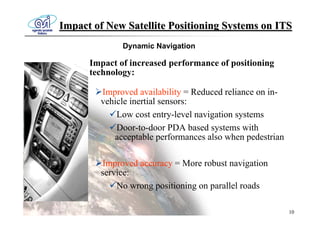
              Dynamic Navigation

      Impact of increased performance of positioning
      technology:

        Improved availability = Reduced reliance on in-
        vehicle inertial sensors:
            Low cost entry-level navigation systems
            Door-to-door PDA based systems with
           acceptable performances also when pedestrian

        Improved accuracy = More robust navigation
        service:
            No wrong positioning on parallel roads

                                                          10
Impact of New Satellite Positioning Systems on ITS
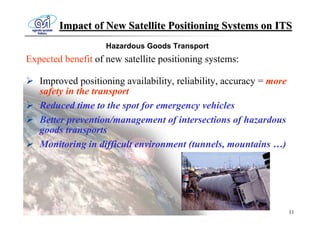
                    Hazardous Goods Transport
Expected benefit of new satellite positioning systems:

   Improved positioning availability, reliability, accuracy = more
   safety in the transport
   Reduced time to the spot for emergency vehicles
   Better prevention/management of intersections of hazardous
   goods transports
   Monitoring in difficult environment (tunnels, mountains …)


                                                                     11
Impact of New Satellite Positioning Systems on ITS
            Access Control
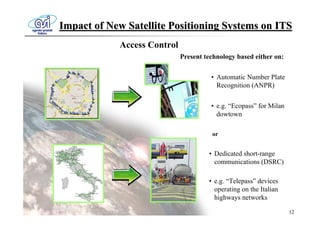
                             Present technology based either on:

                                       • Automatic Number Plate
                                         Recognition (ANPR)


                                       • e.g. “Ecopass” for Milan
                                         dowtown

                                       or


                                      • Dedicated short-range
                                        communications (DSRC)

                                      • e.g. “Telepass” devices
                                        operating on the Italian
                                        highways networks

                                                                    12
Impact of New Satellite Positioning Systems on ITS
                                     Access Control
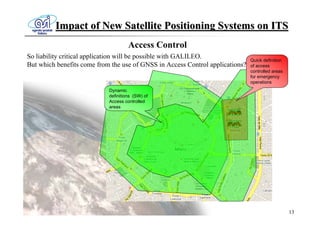
So liability critical application will be possible with GALILEO.               Quick definition
But which benefits come from the use of GNSS in Access Control applications?   of access
                                                                               controlled areas
                                                                               for emergency
                                                                               operations
                            Dynamic
                            definitions (SW) of
                            Access controlled
                            areas


                                                                                                  13
Impact of New Satellite Positioning Systems on ITS
                                            Law Enforcement
Liability critical Applications need law enforcement activities
*System could provide automatic law enforcement but citizen acceptance would be terribly low


Electronic Number Plate (ENP) starting from the present
governamental initiatives


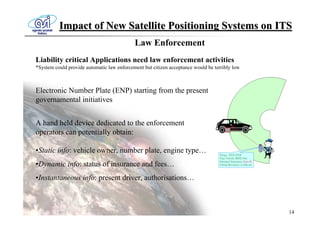
A hand held device dedicated to the enforcement
operators can potentially obtain:

•Static info: vehicle owner, number plate, engine type…
•Dynamic info: status of insurance and fees…
•Instantaneous info: present driver, authorisations…


                                                                                               14
Impact of New Satellite Positioning Systems on ITS

          ADAS (Advanced Driver Assistance Systems)

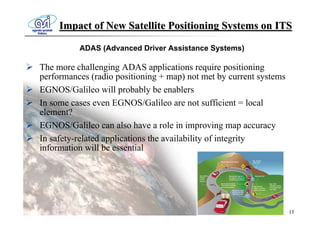
The more challenging ADAS applications require positioning
performances (radio positioning + map) not met by current systems
EGNOS/Galileo will probably be enablers
In some cases even EGNOS/Galileo are not sufficient = local
element?
EGNOS/Galileo can also have a role in improving map accuracy
In safety-related applications the availability of integrity
information will be essential


                                                                    15
National Projects on ITS

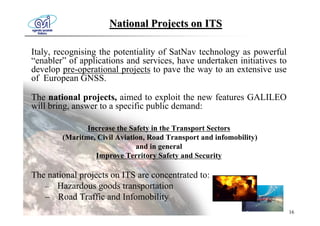
Italy, recognising the potentiality of SatNav technology as powerful
“enabler” of applications and services, have undertaken initiatives to
develop pre-operational projects to pave the way to an extensive use
of European GNSS.

The national projects, aimed to exploit the new features GALILEO
will bring, answer to a specific public demand:

               Increase the Safety in the Transport Sectors
        (Maritme, Civil Aviation, Road Transport and infomobility)
                              and in general
                 Improve Territory Safety and Security

The national projects on ITS are concentrated to:
   – Hazardous goods transportation
   – Road Traffic and Infomobility
                                                                         16
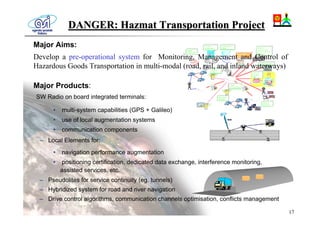
DANGER: Hazmat Transportation Project
Major Aims:
Develop a pre-operational system for Monitoring, Management and Control of
Hazardous Goods Transportation in multi-modal (road, rail, and inland waterways)

Major Products:
SW Radio on board integrated terminals:

      •   multi-system capabilities (GPS + Galileo)
      •   use of local augmentation systems
      •   communication components
 – Local Elements for:
      •   navigation performance augmentation
      •   positioning certification, dedicated data exchange, interference monitoring,
          assisted services, etc.
 – Pseudolites for service continuity (eg. tunnels)
 – Hybridized system for road and river navigation
 – Drive control algorithms, communication channels optimisation, conflicts management

                                                                                         17
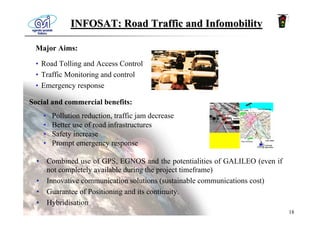
INFOSAT: Road Traffic and Infomobility

 Major Aims:

 • Road Tolling and Access Control
 • Traffic Monitoring and control
 • Emergency response

Social and commercial benefits:
      •    Pollution reduction, traffic jam decrease
      •    Better use of road infrastructures
      •    Safety increase
      •    Prompt emergency response

  •       Combined use of GPS, EGNOS and the potentialities of GALILEO (even if
          not completely available during the project timeframe)
  •       Innovative communication solutions (sustainable communications cost)
  •       Guarantee of Positioning and its continuity.
  •       Hybridisation
                                                                                  18
General Recommendations
                     to mitigate GNSS vulnerability

     Vulnerability Mitigation                       Risk Awareness
•    Ensure adequate backup systems         •   Emphasize education programs
•    GNSS modernization                     •   Conduct public outreach
•    Spectrum protection                    •   Grow awareness towards industry,
•    Enhance interference location              state/local Transportation Departments
     capabilities
                                                   Future Direction
    GNSS Receiver Enhancement               •   Intermodal radionavigation capabilities
•    Certify safety-critical GNSS receivers     assessment
•    Develop GNSS receiver standards        •   Make decision on the future of Loran-
•    Develop Hybridisation (Inertial            C
     sensors, chip atomic clocks, ..)       •   Develop European Radionavigation
                                                Plan


                                                                                    19
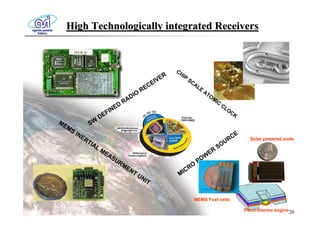
High Technologically integrated Receivers


                                               CH
                                                 IP
                                          ER          SC
                                       EIV               AL
                                    REC                     E
                                                                AT
                               IO                                 OM
                           RAD                                      IC
                       D                                                 CL
                    INE                                                    OC
                DEF                                                           K
ME         SW
  MS
       IN
         ER                                                                RCE      Solar powered node
           TIA
              LM                                                     S   OU
                EA                                             ER
                  SU                                          W
                    RM                                     PO
                      EN                              RO
                        T                       M   IC
                                UN
                                   IT


                                                         MEMS Fuel cells

                                                                                  Piezo-thermo engine20

Caporale_ASI

  • 1.
    ITN - Infrastructure,Telematics and Navigation Turin – Lingotto FIERE 15 October 2009 Ing. Mario Caporale 1
  • 2.
    Satellite Systems areinvolved in many applications Navigation Data Relay Satellite Telecomunication Earth Observation Sats Processing Mobile Centre End Users Decision Units Centres Aerial Observation Center ETS unit IMINT Earth Stations Network mediation Images Fixed and Mobile Data User Acquisition Sensors reception Community Data Acquisition Data Exchange Data Distribution 2
  • 3.
    Satellite Navigation Systemscontribution • A system that is central to the lives of millions of civil and commercial users • Public safety dispatch – improves response time • Search and Rescue – locates emergency calls • Air Traffic Control – guides planes in all weather • Telecommunications – primary timing source, • Transportation – tracks trains, trucks, vital shipments • Underpins Safety and Security 3
  • 4.
    The European GNSS EGNOSis the first European contribution to GNSS to provide civil complement to GPS over larger European area, interoperable with WAAS(USA) and MSAS(Japan). GALILEO is the Autonomous European GNSS system •Global coverage •30 satellites •Independent but interoperable 4
  • 5.
    Galileo Signals andServices E5a E5b E6a E6b,c E1b,c E1a E 5 a E 5 b E 6 a E 6 b , c E 1 a E 1 b , c Open Service (OS) Single frequency Dual frequency Commercial Service (CS) Value added Multiple Carrier Safety-of-Life Service (SoL) Public Regulated Service (PRS) Search and Rescue Service Near real-time; Precise; Return link feasible 5
  • 6.
    The new capabilitiesintroduced by Galileo The European GALILEO system introduces new capabilites: Signal Integrity Service Guarantee Signal diversity Certification for the Service “Safety of Life” Local Elements Increasing the Availability: – GPS alone: 55% of urban coverage – GPS + Galileo: 95% of urban coverage 6
  • 7.
    GNSS & RoadSector GNSS Technology • Present GPS commercial (mass market) utilisation has an accuracy of ~15m • European EGNOS augmentation ~4m • Concerted action with Wireless communication links (GSM, UMTS, WiMAX, Satcom) and IT platforms enable a wide range of innovative services (Pay as You drive, Location Based Services, Traffic monitoring…) 7
  • 8.
    Impact of NewSatellite Positioning Systems on ITS Road Tolling Important role of satellite positioning and cellular communications in road charging interoperability Expected benefit of new satellite positioning systems: Possibility to define zone tolls Possibility to charge according to route followed and time of the day Precise positioning allows high rate discrimination between toll zones Higher reliability allows lower rate of errors, i.e. fair charging, lower rate of contentions Car Insurance 8
  • 9.
    Impact of NewSatellite Positioning Systems on ITS Emergency Calls Impact of increased performance of positioning technology: Vehicle Higher performance Airbag status Wheels status ABS positioning may allow: Vehicle sensors Gyrometer No of passengers Vehicle ID E-Call • Lane of accident detection .... GSM GPRS E-Call Service Centre GPS module or UMTS • Identification of specific Navigation unit Localisation conditions (e.g. turning, Medical rescue hump, deep) Emergency button Mechinal rescue Police assistance X-112 ... E-112 fallback …and: E-Call Service Centre • Reduce wrong positioning on PSAP X-112 parallel roads • Reduce time to move emergency vehicles on the spot 9
  • 10.
    Impact of NewSatellite Positioning Systems on ITS Dynamic Navigation Impact of increased performance of positioning technology: Improved availability = Reduced reliance on in- vehicle inertial sensors: Low cost entry-level navigation systems Door-to-door PDA based systems with acceptable performances also when pedestrian Improved accuracy = More robust navigation service: No wrong positioning on parallel roads 10
  • 11.
    Impact of NewSatellite Positioning Systems on ITS Hazardous Goods Transport Expected benefit of new satellite positioning systems: Improved positioning availability, reliability, accuracy = more safety in the transport Reduced time to the spot for emergency vehicles Better prevention/management of intersections of hazardous goods transports Monitoring in difficult environment (tunnels, mountains …) 11
  • 12.
    Impact of NewSatellite Positioning Systems on ITS Access Control Present technology based either on: • Automatic Number Plate Recognition (ANPR) • e.g. “Ecopass” for Milan dowtown or • Dedicated short-range communications (DSRC) • e.g. “Telepass” devices operating on the Italian highways networks 12
  • 13.
    Impact of NewSatellite Positioning Systems on ITS Access Control So liability critical application will be possible with GALILEO. Quick definition But which benefits come from the use of GNSS in Access Control applications? of access controlled areas for emergency operations Dynamic definitions (SW) of Access controlled areas 13
  • 14.
    Impact of NewSatellite Positioning Systems on ITS Law Enforcement Liability critical Applications need law enforcement activities *System could provide automatic law enforcement but citizen acceptance would be terribly low Electronic Number Plate (ENP) starting from the present governamental initiatives A hand held device dedicated to the enforcement operators can potentially obtain: •Static info: vehicle owner, number plate, engine type… •Dynamic info: status of insurance and fees… •Instantaneous info: present driver, authorisations… 14
  • 15.
    Impact of NewSatellite Positioning Systems on ITS ADAS (Advanced Driver Assistance Systems) The more challenging ADAS applications require positioning performances (radio positioning + map) not met by current systems EGNOS/Galileo will probably be enablers In some cases even EGNOS/Galileo are not sufficient = local element? EGNOS/Galileo can also have a role in improving map accuracy In safety-related applications the availability of integrity information will be essential 15
  • 16.
    National Projects onITS Italy, recognising the potentiality of SatNav technology as powerful “enabler” of applications and services, have undertaken initiatives to develop pre-operational projects to pave the way to an extensive use of European GNSS. The national projects, aimed to exploit the new features GALILEO will bring, answer to a specific public demand: Increase the Safety in the Transport Sectors (Maritme, Civil Aviation, Road Transport and infomobility) and in general Improve Territory Safety and Security The national projects on ITS are concentrated to: – Hazardous goods transportation – Road Traffic and Infomobility 16
  • 17.
    DANGER: Hazmat TransportationProject Major Aims: Develop a pre-operational system for Monitoring, Management and Control of Hazardous Goods Transportation in multi-modal (road, rail, and inland waterways) Major Products: SW Radio on board integrated terminals: • multi-system capabilities (GPS + Galileo) • use of local augmentation systems • communication components – Local Elements for: • navigation performance augmentation • positioning certification, dedicated data exchange, interference monitoring, assisted services, etc. – Pseudolites for service continuity (eg. tunnels) – Hybridized system for road and river navigation – Drive control algorithms, communication channels optimisation, conflicts management 17
  • 18.
    INFOSAT: Road Trafficand Infomobility Major Aims: • Road Tolling and Access Control • Traffic Monitoring and control • Emergency response Social and commercial benefits: • Pollution reduction, traffic jam decrease • Better use of road infrastructures • Safety increase • Prompt emergency response • Combined use of GPS, EGNOS and the potentialities of GALILEO (even if not completely available during the project timeframe) • Innovative communication solutions (sustainable communications cost) • Guarantee of Positioning and its continuity. • Hybridisation 18
  • 19.
    General Recommendations to mitigate GNSS vulnerability Vulnerability Mitigation Risk Awareness • Ensure adequate backup systems • Emphasize education programs • GNSS modernization • Conduct public outreach • Spectrum protection • Grow awareness towards industry, • Enhance interference location state/local Transportation Departments capabilities Future Direction GNSS Receiver Enhancement • Intermodal radionavigation capabilities • Certify safety-critical GNSS receivers assessment • Develop GNSS receiver standards • Make decision on the future of Loran- • Develop Hybridisation (Inertial C sensors, chip atomic clocks, ..) • Develop European Radionavigation Plan 19
  • 20.
    High Technologically integratedReceivers CH IP ER SC EIV AL REC E AT IO OM RAD IC D CL INE OC DEF K ME SW MS IN ER RCE Solar powered node TIA LM S OU EA ER SU W RM PO EN RO T M IC UN IT MEMS Fuel cells Piezo-thermo engine20