
G O O D B Y E G C S
M A R K W I L S O N
Scale = individual components
Score = the total
What is consciousness?
Wakefulness
Content
“ L E V E L S O F
C O N S C I O U S N E S S "
• Metaconscious
• Conscious
• Confused
• Delirious
• Somnolent
• Obtunded
• Stuporous
• Comatose.
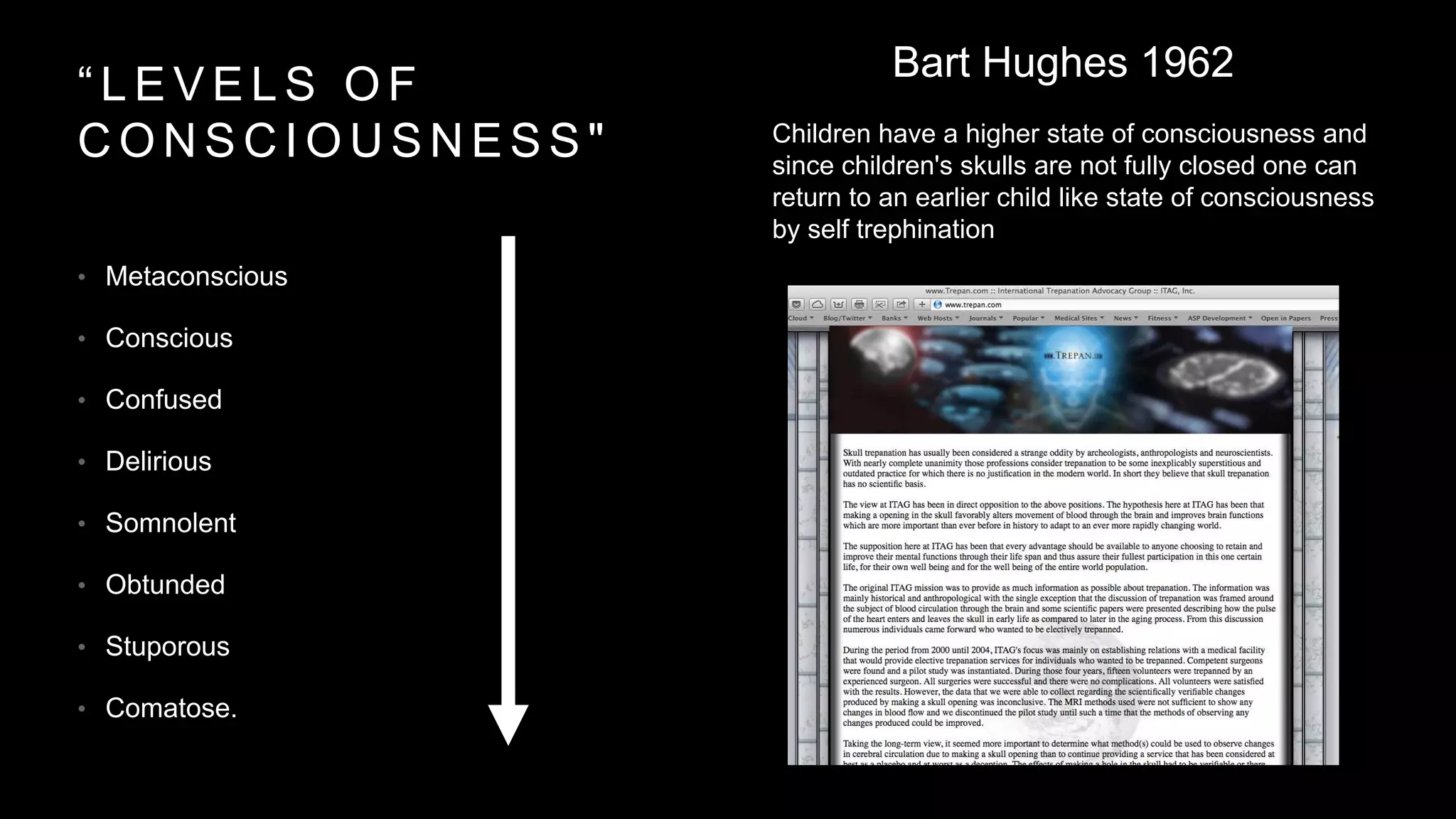
Bart Hughes 1962
Children have a higher state of consciousness and
since children's skulls are not fully closed one can
return to an earlier child like state of consciousness
by self trephination
Bryan Jennett 1926-2008
Sir Graham Teasdale
cited > 6,000 times
What was it meant for?
“The assessment of coma and impaired conciousness”
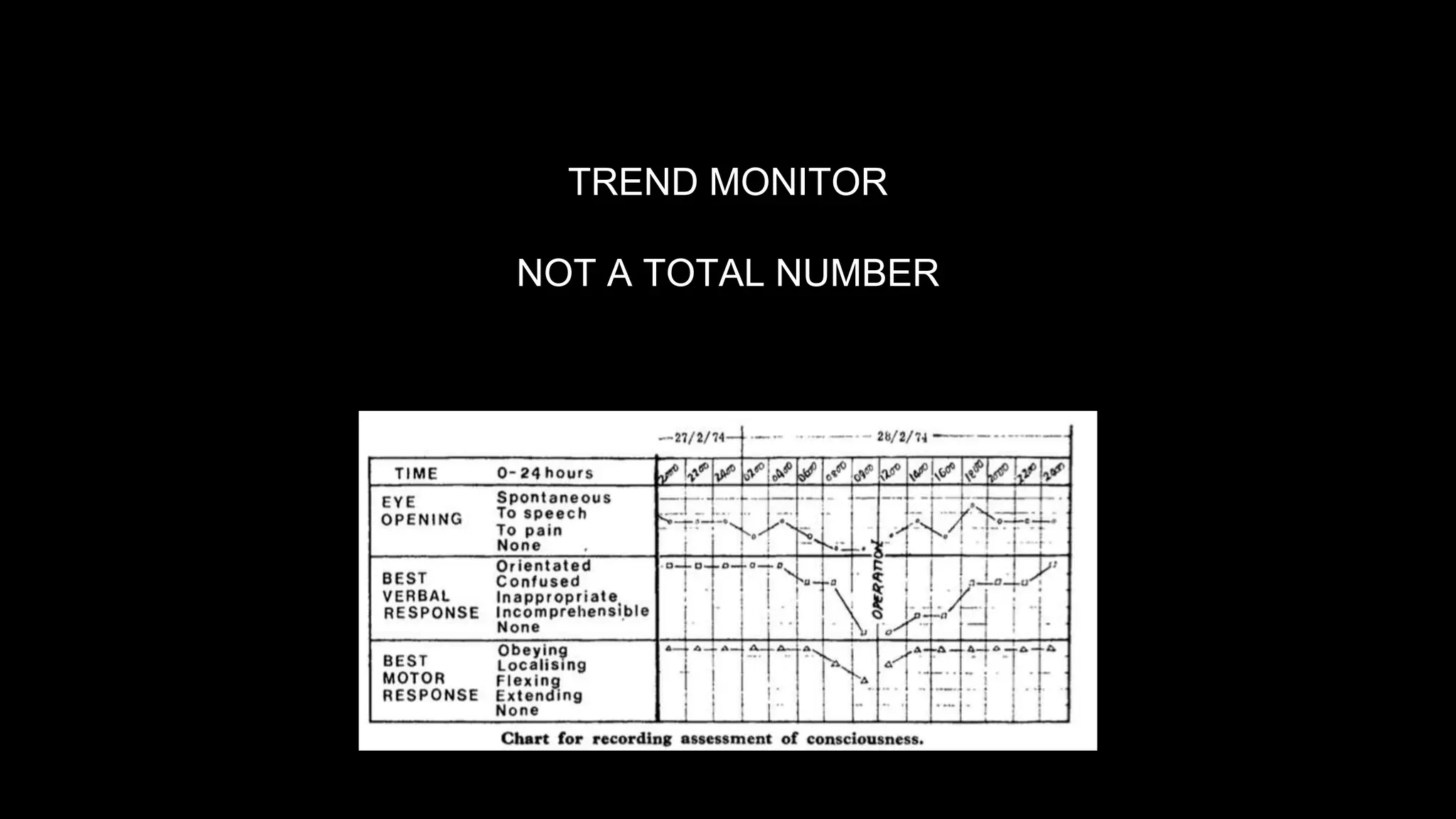
TREND MONITOR
NOT A TOTAL NUMBER
But what do we use it for now?
• Communication about all neuro patients
• Head Injury Severity Measure
• Prognostication tool
• Sedation Scale
• Depth of Coma
• All cause MENTAL STATUS MONITOR
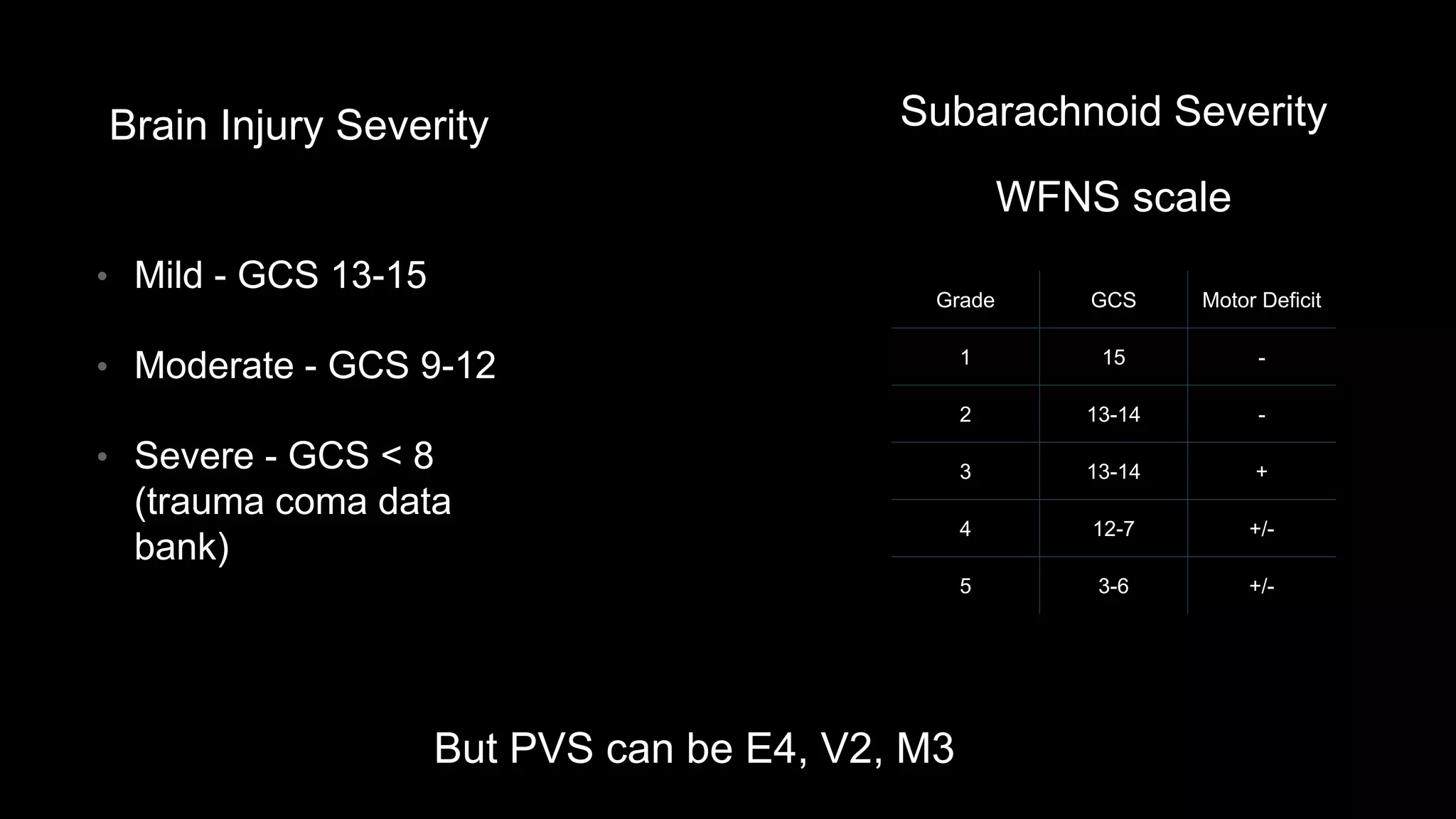
• Mild - GCS 13-15
• Moderate - GCS 9-12
• Severe - GCS < 8
(trauma coma data
bank)
But PVS can be E4, V2, M3
Brain Injury Severity Subarachnoid Severity
WFNS scale
Grade GCS Motor Deficit
1 15 -
2 13-14 -
3 13-14 +
4 12-7 +/-
5 3-6 +/-
E1􏰶 V1 M􏰶2 =
48%
E1 􏰶V2􏰶 M1 =
27%
E2􏰶 V1􏰶 M1 =
19%
Mortality of GCS 4
Healey C, Osler TM, Rogers FB, et al. Improving the Glasgow Coma Scale score: motor score alone is a better predictor J Trauma. 2003;54:671-678.
ITU GCS “12” is not the same as Pre-Hospital “12”
E3, V4, M5
S C O R I N G S Y S T E M S I N C O R P O R A T I N G G C S
• APACHE II
• RTS
• TRISS
• CRAMS
• + TBI Models eg
IMPACT (motor score)
P R O B L E M S W I T H G C S
• People Intubated prior Arrival
• No V when intubated
• Nothing about Brain Stem Reflexes
• The abnormal flexion bit…
• It is not linear - M score “more
important”
• Low Interrupter reliability (30% of
paired assessments are > 2 different)
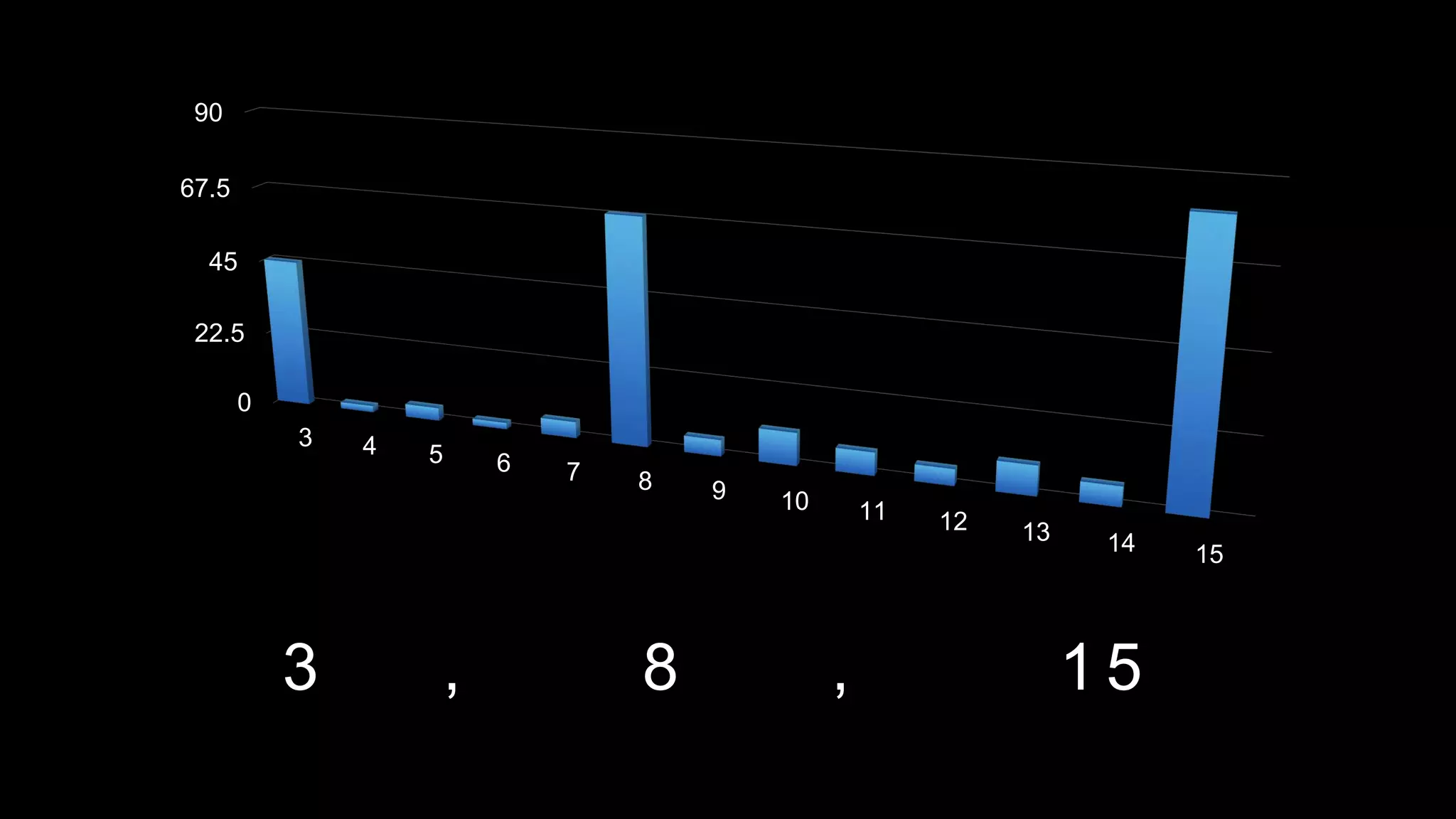
3 , 8 , 1 5
0
22.5
45
67.5
90
3 4 5 6 7 8 9 10 11 12 13 14 15
H I S T O R Y O F
S C O R E S
• Jouvet Coma Scale
• Moscow Coma Scale
• Glasgow Coma Scale
• Japan Coma Scale
• Bozza-Marrumbini Scale
• Grady Coma Scale
• Four Score
Full Outline of UnResponsiveness Score
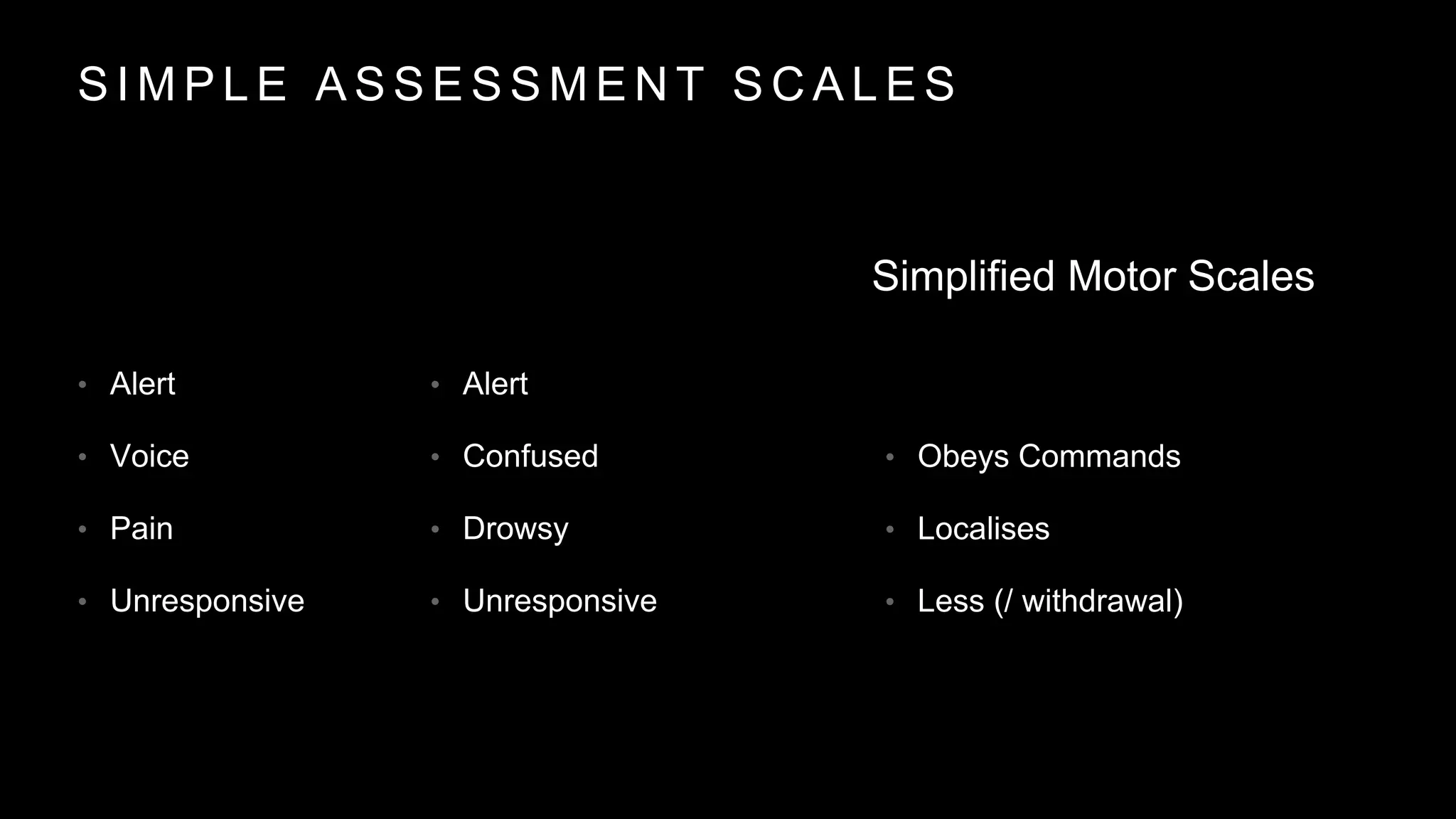
S I M P L E A S S E S S M E N T S C A L E S
• Alert
• Voice
• Pain
• Unresponsive
• Alert
• Confused
• Drowsy
• Unresponsive
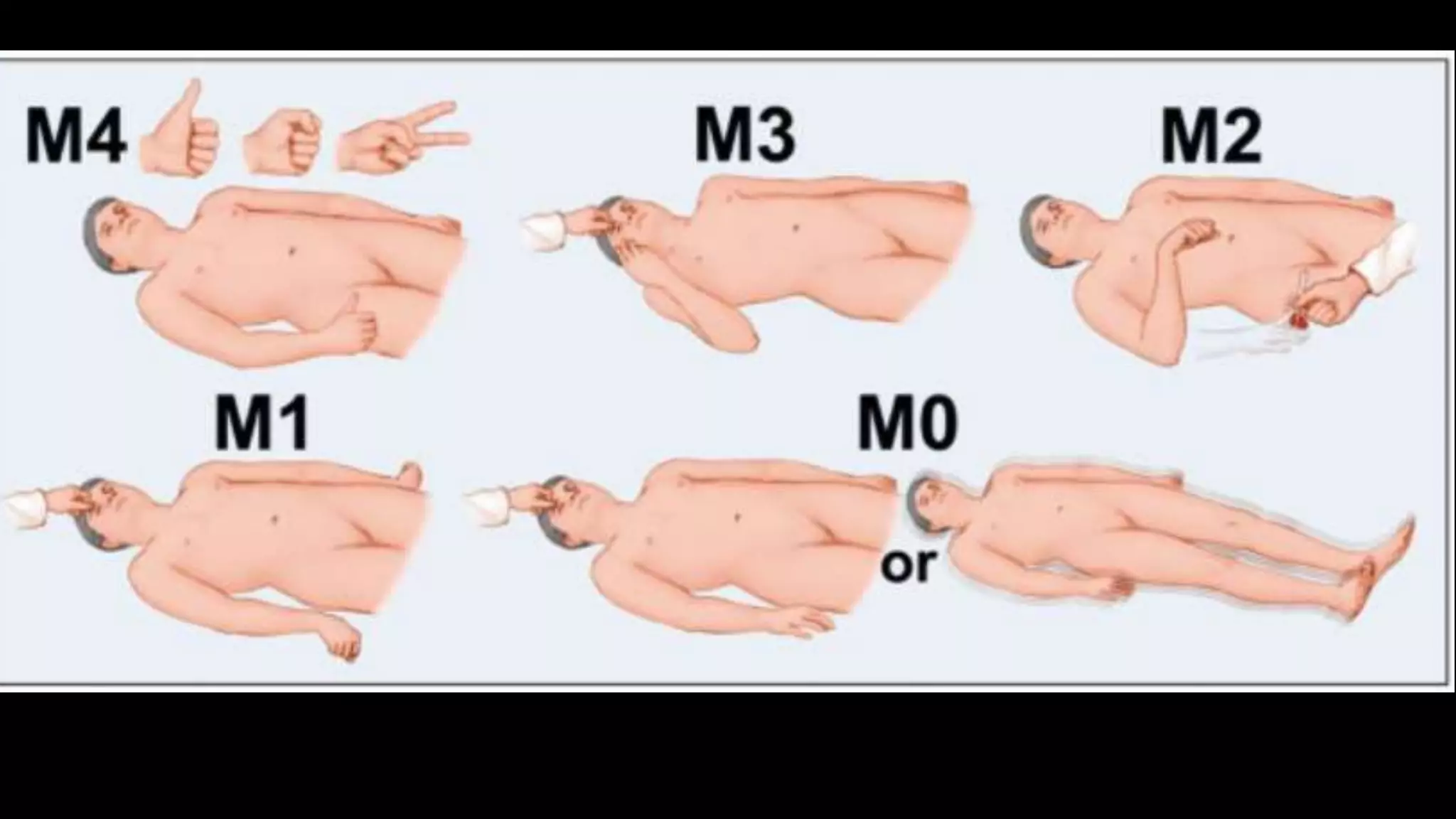
• Obeys Commands
• Localises
• Less (/ withdrawal)
Simplified Motor Scales
W H A T C A U S E S
F I X E D D I L A T E D
P U P I L S
• Hypoxia
• Seizures
• Drugs
• Orbital Trauma
• Brain Stem Injury
… and pressure on the occulomotor
nerve.
FUCD Meta-Analysis
EDH
SDH
Mortality
Good Outcome
Good Outcome
Mortality
29%
54%
66%
7%
It is underlying pathology that should predict outcome - not a “score”
W H A T ’ S T H E F U T U R E ?
• NIRS
• Ultrasound
• Mobile CT
T R Y T O L O O K T H R O U G H P A T I E N T S
W H Y S T I C K W I T H G C S ?
• It’s understood
• Do you really want different coma scores for TBI, stroke, sedation…?
• It is ingrained in so many scoring systems / models.
T A K E H O M E M E S S A G E
DESCRIBE WHAT YOU SEE
using the scale + pupils
But also think about the underlying pathology
@markhwilson

Goodbye GCS! - Mark Wilson

  • 1.
    G O OD B Y E G C S M A R K W I L S O N Scale = individual components Score = the total
  • 2.
  • 3.
    “ L EV E L S O F C O N S C I O U S N E S S " • Metaconscious • Conscious • Confused • Delirious • Somnolent • Obtunded • Stuporous • Comatose. Bart Hughes 1962 Children have a higher state of consciousness and since children's skulls are not fully closed one can return to an earlier child like state of consciousness by self trephination
  • 4.
  • 5.
  • 6.
    What was itmeant for? “The assessment of coma and impaired conciousness”
  • 7.
    TREND MONITOR NOT ATOTAL NUMBER
  • 8.
    But what dowe use it for now? • Communication about all neuro patients • Head Injury Severity Measure • Prognostication tool • Sedation Scale • Depth of Coma • All cause MENTAL STATUS MONITOR
  • 9.
    • Mild -GCS 13-15 • Moderate - GCS 9-12 • Severe - GCS < 8 (trauma coma data bank) But PVS can be E4, V2, M3 Brain Injury Severity Subarachnoid Severity WFNS scale Grade GCS Motor Deficit 1 15 - 2 13-14 - 3 13-14 + 4 12-7 +/- 5 3-6 +/-
  • 11.
    E1􏰶 V1 M􏰶2= 48% E1 􏰶V2􏰶 M1 = 27% E2􏰶 V1􏰶 M1 = 19% Mortality of GCS 4 Healey C, Osler TM, Rogers FB, et al. Improving the Glasgow Coma Scale score: motor score alone is a better predictor J Trauma. 2003;54:671-678.
  • 12.
    ITU GCS “12”is not the same as Pre-Hospital “12” E3, V4, M5
  • 13.
    S C OR I N G S Y S T E M S I N C O R P O R A T I N G G C S • APACHE II • RTS • TRISS • CRAMS • + TBI Models eg IMPACT (motor score)
  • 14.
    P R OB L E M S W I T H G C S • People Intubated prior Arrival • No V when intubated • Nothing about Brain Stem Reflexes • The abnormal flexion bit… • It is not linear - M score “more important” • Low Interrupter reliability (30% of paired assessments are > 2 different)
  • 15.
    3 , 8, 1 5 0 22.5 45 67.5 90 3 4 5 6 7 8 9 10 11 12 13 14 15
  • 17.
    H I ST O R Y O F S C O R E S • Jouvet Coma Scale • Moscow Coma Scale • Glasgow Coma Scale • Japan Coma Scale • Bozza-Marrumbini Scale • Grady Coma Scale • Four Score
  • 18.
    Full Outline ofUnResponsiveness Score
  • 24.
    S I MP L E A S S E S S M E N T S C A L E S • Alert • Voice • Pain • Unresponsive • Alert • Confused • Drowsy • Unresponsive • Obeys Commands • Localises • Less (/ withdrawal) Simplified Motor Scales
  • 25.
    W H AT C A U S E S F I X E D D I L A T E D P U P I L S • Hypoxia • Seizures • Drugs • Orbital Trauma • Brain Stem Injury … and pressure on the occulomotor nerve.
  • 26.
  • 28.
    It is underlyingpathology that should predict outcome - not a “score”
  • 29.
    W H AT ’ S T H E F U T U R E ?
  • 31.
  • 32.
    T R YT O L O O K T H R O U G H P A T I E N T S
  • 33.
    W H YS T I C K W I T H G C S ? • It’s understood • Do you really want different coma scores for TBI, stroke, sedation…? • It is ingrained in so many scoring systems / models.
  • 34.
    T A KE H O M E M E S S A G E DESCRIBE WHAT YOU SEE using the scale + pupils But also think about the underlying pathology @markhwilson