The Glasgow Coma Scale (GCS), developed in 1974 at the University of Glasgow, is a clinical tool for assessing consciousness in brain injury patients based on eye, verbal, and motor responses. It has a scoring system ranging from 3 (unresponsive) to 15 (fully conscious), with lower scores indicating deeper comas and potential need for intubation. An updated version called GCS-P includes an additional pupil reaction score to provide further insight into brain function.
Glasgow Coma Scale
MrYogendra Mehta
Lecturer, HOD (Adult Health Nursing)
TU IOM BRNC
2.
Introduction
• Experts atthe University of Glasgow in Scotland developed the GCS in
1974.
• It is a clinical scale used to reliably measure a person's level of
consciousness after a brain injury.
• GCS assesses a person based on their ability to perform eye
movements, speak, and move their body.
3.
Consciousness
In the medicalcontext, consciousness has three requirements.
To be conscious, you have to be:
• Awake: This includes whether you have the ability to wake up
because of voice or touch. That’s what makes a coma different from
just being asleep.
• Alert: This is how responsive you are to people talking to you and if
you’re able to understand what’s happening in your immediate
surroundings.
• Oriented: This means you know who you are, where you’re at, what
day it is and other details related to the here and now.
4.
Uses of GCS
•Neurological exam
• Concussions and traumatic brain injuries
• Low blood sugar (hypoglycemia)
• Poisoning or after a seizure.
5.
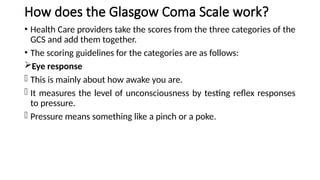
How does theGlasgow Coma Scale work?
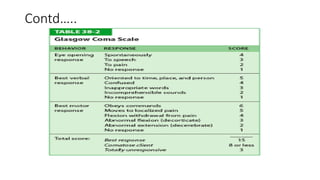
• Health Care providers take the scores from the three categories of the
GCS and add them together.
• The scoring guidelines for the categories are as follows:
Eye response
- This is mainly about how awake you are.
- It measures the level of unconsciousness by testing reflex responses
to pressure.
- Pressure means something like a pinch or a poke.
6.
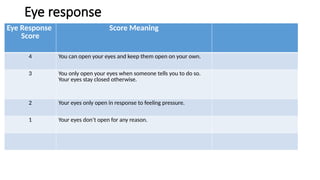
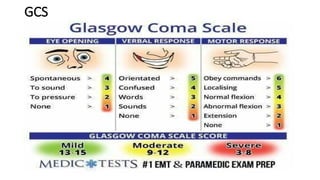
Eye response
Eye Response
Score
ScoreMeaning
4 You can open your eyes and keep them open on your own.
3 You only open your eyes when someone tells you to do so.
Your eyes stay closed otherwise.
2 Your eyes only open in response to feeling pressure.
1 Your eyes don’t open for any reason.
7.
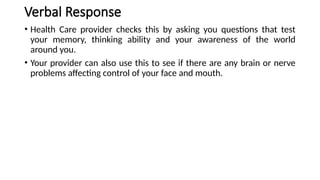
Verbal Response
• HealthCare provider checks this by asking you questions that test
your memory, thinking ability and your awareness of the world
around you.
• Your provider can also use this to see if there are any brain or nerve
problems affecting control of your face and mouth.
8.
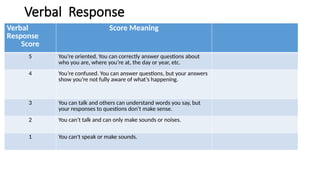
Verbal Response
Verbal
Response
Score
Score Meaning
5You’re oriented. You can correctly answer questions about
who you are, where you’re at, the day or year, etc.
4 You’re confused. You can answer questions, but your answers
show you’re not fully aware of what’s happening.
3 You can talk and others can understand words you say, but
your responses to questions don’t make sense.
2 You can’t talk and can only make sounds or noises.
1 You can't speak or make sounds.
9.
Motor Response
• Thispart can reveal any issues with the connections between your
nerves, spinal cord and brain.
• It also tests brain’s ability to control muscle movement and how well
you can understand and follow instructions.
10.
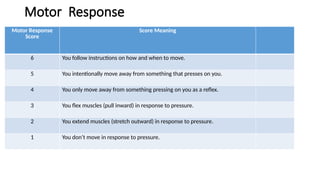
Motor Response
Motor Response
Score
ScoreMeaning
6 You follow instructions on how and when to move.
5 You intentionally move away from something that presses on you.
4 You only move away from something pressing on you as a reflex.
3 You flex muscles (pull inward) in response to pressure.
2 You extend muscles (stretch outward) in response to pressure.
1 You don’t move in response to pressure.
Glasgow Coma Score-P
•In 2018, a team of experts — including one of the original creators of
the GCS — published an updated version of the GCS called the “GCS-
P.”
• The P stands for “pupil,” as in the pupil of the eye.
• This is a fourth number that providers subtract from the standard GCS
score.
• Pupil reaction is important because it’s an indicator of your brain
function.
• When your pupils don’t react to light, it’s a sign that a serious
problem or injury is affecting your brain.
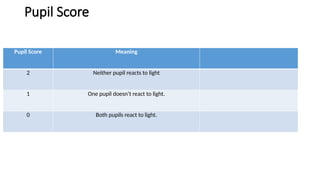
• The pupil score ranges from 0 to 2.
13.
Pupil Score
Pupil ScoreMeaning
2 Neither pupil reacts to light
1 One pupil doesn’t react to light.
0 Both pupils react to light.
14.
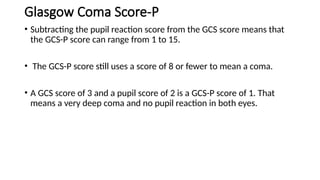
Glasgow Coma Score-P
•Subtracting the pupil reaction score from the GCS score means that
the GCS-P score can range from 1 to 15.
• The GCS-P score still uses a score of 8 or fewer to mean a coma.
• A GCS score of 3 and a pupil score of 2 is a GCS-P score of 1. That
means a very deep coma and no pupil reaction in both eyes.
15.
Results and Follow-Up
•The highest possible GCS score is 15, and the lowest is 3.
• A score of 15 means you’re fully awake, responsive and have no
problems with thinking ability or memory.
• Generally, having a score of 8 or fewer means you’re in a coma. The
lower the score, the deeper the coma is.
• Healthcare providers may abbreviate your GCS score using
letter/number combinations.
• A score of 15 would be “E4V5M6.” A score of 3 would be “E1V1M1.”
16.
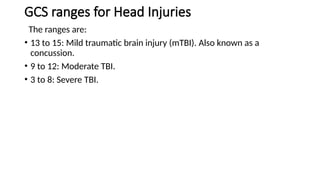
GCS ranges forHead Injuries
The ranges are:
• 13 to 15: Mild traumatic brain injury (mTBI). Also known as a
concussion.
• 9 to 12: Moderate TBI.
• 3 to 8: Severe TBI.
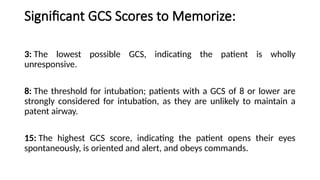
Significant GCS Scoresto Memorize:
3: The lowest possible GCS, indicating the patient is wholly
unresponsive.
8: The threshold for intubation; patients with a GCS of 8 or lower are
strongly considered for intubation, as they are unlikely to maintain a
patent airway.
15: The highest GCS score, indicating the patient opens their eyes
spontaneously, is oriented and alert, and obeys commands.