U.S. CULTURAL ETIQUETTE
By
Lara Camassa
Good manners are powerful
Social interaction is a crucial aspect of daily life, the
way we manage it can affect
• how people perceive us and
treat us
• the quality of life for each one of us
2
Manners and Etiquette
Having GOOD MANNERS means thinking about others before
ourselves, letting people feel at ease, acting with kindness and
showing appreciation
ETIQUETTE is a set of rules that helps us to find the common
ground of what is considered suitable, acceptable and convenient
in the community we live in.
“Respect for ourselves guides our morals, respect for
others guides our manners ”
Laurence Sterne
3
Etiquette
Etiquette is a customary code of conduct that is different
in almost every country and raises our cultural
awareness. It is related, but not limited to:
 Body language
 Meeting and greeting
 Dining etiquette
 Tech etiquette
4
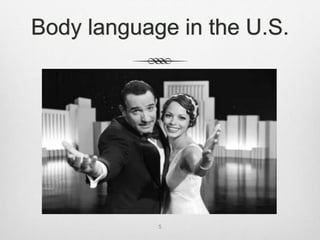
Body language in the U.S.
5
Body language in the U.S.
 Americans smile a lot, even if they do not know you, and
they like to have their smiles returned
 Keep your distance when conversing
 Americans are generally uncomfortable with same-sex
touching
 Stand still!
 Sitting up straight is important. A woman should not
cross her legs but if she does it has to be at the ankles,
especially if one is wearing a short skirt.
6
Meeting and greeting in the
U.S.
7
Meeting and greeting in the
U.S.
 Greetings
It is best to begin by using formal greetings and then
listen to how your colleagues or business partners greet
you.
The typical formal greetings in the U.S. are “How do you
do?”, “How are you doing?”. This is not a request for
information about your well-being, it is simply a
pleasantry so the answer must be "Fine," "Great," or
”Well, thank you.”
8
 Presentation
In formal circumstances, you may want to use titles and
surnames as a courtesy until you are invited to move to
a first name basis
Use professional titles when you are introducing people to
each other. Example: ”Dr Jane Chamber, meet Judge
Mark Temple." If you are introducing yourself, do not use
your professional title.
Stand while being introduced. Only old or disabled are
exempted.
9
Meeting and greeting in the
U.S.
Meeting and greeting in the
U.S.
 Handshakes
They are usually brief and confident. Light handshakes
are considered unpleasant. Eye contact is important
when shaking someone’s hand.
10
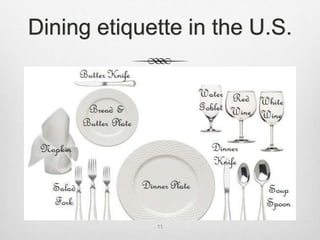
Dining etiquette in the U.S.
11
Dining etiquette in the U.S.
 Arrive on time, never before
 If you are invited for dinner or a party, bring a potted
plant, wine, chocolates or a gift from your country.
 Remain standing until invited to sit down
 Do not rest your elbows on the table
 Never begin eating until everyone is served and your
hosts have begun. Offer food or drink to others before
helping yourself.
12
 Raise your hand or index finger and make eye contact
to signal a server
 Chew with your mouth closed and avoid noises
 If you have not finished eating, cross your knife and
fork on your plate with the fork over the knife. Indicate
you have finished eating by laying your knife and fork
parallel across the right side of your plate.
 Say "please" and "thank you" to everyone for even
the smallest kindness: those words are very important
in the United States.
13
Dining etiquette in the U.S.
 When going to dinner or lunch, the person who invites
pays, whether it is a man or a woman.
 Send a written thank-you note the day after an
invitation
 Do not use toothpicks, blow your nose or perform other
bodily activities in front of others. Use the make-up
only in the toilet.
 Never smoke around a non-smoker.
 Say "Pardon" or "Excuse me" if you sneeze or cough
or do not understand something someone has said.
14
Dining etiquette in the U.S.
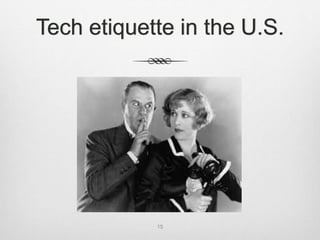
Tech etiquette in the U.S.
15
Tech etiquette in the U.S.
 Do not yell when you talk at the phone or any other
situation, do your call quietly
 Do not text messages or watch the phone during
a face-to-face conversation, if a professor is
speaking in the class, or during other social
interactions where you should pay attention and be
respectful
 Turn your cell phone off during movies, shows,
lectures, concerts, meal times and in general when
other people do not want to be distracted
16
And…
17
Q & A
18

Good manners

  • 1.
  • 2.
    Good manners arepowerful Social interaction is a crucial aspect of daily life, the way we manage it can affect • how people perceive us and treat us • the quality of life for each one of us 2
  • 3.
    Manners and Etiquette HavingGOOD MANNERS means thinking about others before ourselves, letting people feel at ease, acting with kindness and showing appreciation ETIQUETTE is a set of rules that helps us to find the common ground of what is considered suitable, acceptable and convenient in the community we live in. “Respect for ourselves guides our morals, respect for others guides our manners ” Laurence Sterne 3
  • 4.
    Etiquette Etiquette is acustomary code of conduct that is different in almost every country and raises our cultural awareness. It is related, but not limited to:  Body language  Meeting and greeting  Dining etiquette  Tech etiquette 4
  • 5.
    Body language inthe U.S. 5
  • 6.
    Body language inthe U.S.  Americans smile a lot, even if they do not know you, and they like to have their smiles returned  Keep your distance when conversing  Americans are generally uncomfortable with same-sex touching  Stand still!  Sitting up straight is important. A woman should not cross her legs but if she does it has to be at the ankles, especially if one is wearing a short skirt. 6
  • 7.
    Meeting and greetingin the U.S. 7
  • 8.
    Meeting and greetingin the U.S.  Greetings It is best to begin by using formal greetings and then listen to how your colleagues or business partners greet you. The typical formal greetings in the U.S. are “How do you do?”, “How are you doing?”. This is not a request for information about your well-being, it is simply a pleasantry so the answer must be "Fine," "Great," or ”Well, thank you.” 8
  • 9.
     Presentation In formalcircumstances, you may want to use titles and surnames as a courtesy until you are invited to move to a first name basis Use professional titles when you are introducing people to each other. Example: ”Dr Jane Chamber, meet Judge Mark Temple." If you are introducing yourself, do not use your professional title. Stand while being introduced. Only old or disabled are exempted. 9 Meeting and greeting in the U.S.
  • 10.
    Meeting and greetingin the U.S.  Handshakes They are usually brief and confident. Light handshakes are considered unpleasant. Eye contact is important when shaking someone’s hand. 10
  • 11.
  • 12.
    Dining etiquette inthe U.S.  Arrive on time, never before  If you are invited for dinner or a party, bring a potted plant, wine, chocolates or a gift from your country.  Remain standing until invited to sit down  Do not rest your elbows on the table  Never begin eating until everyone is served and your hosts have begun. Offer food or drink to others before helping yourself. 12
  • 13.
     Raise yourhand or index finger and make eye contact to signal a server  Chew with your mouth closed and avoid noises  If you have not finished eating, cross your knife and fork on your plate with the fork over the knife. Indicate you have finished eating by laying your knife and fork parallel across the right side of your plate.  Say "please" and "thank you" to everyone for even the smallest kindness: those words are very important in the United States. 13 Dining etiquette in the U.S.
  • 14.
     When goingto dinner or lunch, the person who invites pays, whether it is a man or a woman.  Send a written thank-you note the day after an invitation  Do not use toothpicks, blow your nose or perform other bodily activities in front of others. Use the make-up only in the toilet.  Never smoke around a non-smoker.  Say "Pardon" or "Excuse me" if you sneeze or cough or do not understand something someone has said. 14 Dining etiquette in the U.S.
  • 15.
    Tech etiquette inthe U.S. 15
  • 16.
    Tech etiquette inthe U.S.  Do not yell when you talk at the phone or any other situation, do your call quietly  Do not text messages or watch the phone during a face-to-face conversation, if a professor is speaking in the class, or during other social interactions where you should pay attention and be respectful  Turn your cell phone off during movies, shows, lectures, concerts, meal times and in general when other people do not want to be distracted 16
  • 17.
  • 18.