CLINICAL INVESTIGATION AND
EVALUATION OF MEDICAL DEVICES AND
IVDS
Prepared by,
Faizan Shaikh
M.Pharm (Sem – 1 )
Pharmaceutical Regulatory Affairs
CONTENTS
1. Introduction
2. Clinical investigation
3. Objective
4. General principles
5. Conduct of clinical investigation
6. Ethical consideration
7. Clinical evaluation
8. General principle
9. Clinical research report
10.References
2
DEFINATIONS
As per USFDA-
 An instrument, apparatus, implement, machine, contrivance,
implant, invitro reagent or other similar or other article, including
a component part, or accessory which is recognized in the official
National formulary or USP or any supplement to them ,intended
for use in diagnosis of disease or other condition or in the
intended, or prevention of other diseases in men and animals or
intended to affect structure or any function of the body of man or
other animal, and
 Which does not achieve any of it’s primary intended purpose
through chemical action within or on the body of man or other
animal which is not dependent being metabolized for the
achievement of any of its primary intended purposes
3
As per D & C Act,
Instrument intended for internal or external use in
the prevention of disease or disorder in human
being or animal as may be specified from time to
time by central government by notification in the
official gazette, after consultation with the board
4
Definition
 In India, at present only notified medical devices are regulated as
Drugs under the Drugs and Cosmetics Act 1940 and Rules made there
under in 1945
1. (1) substances used for in vitro diagnosis and surgical dressings,
surgical bandages, surgical staples, surgical sutures, ligatures, blood
and blood component collection bag with or without anticoagulant
covered under sub-clause (I);
2. (ii) substances including mechanical contraceptives (condoms,
intrauterine devices, tubal rings), disinfectants and insecticides
notified under sub-clause (ii); and
3. devices notified from time to time under sub-clause (iv), of clause (b)
of section 3 of the Drugs and Cosmetics Act, 1940;
5
Definitions
IVDS,
 Definition: In vitro diagnostic products are those reagents,
instruments, and systems intended for use in diagnosis of disease or
other conditions, including a determination of the state of health, in
order to cure, mitigate, treat, or prevent disease or its sequelae. Such
products are intended for use in the collection, preparation, and
examination of specimens taken from the human body. [21 CFR 809.3]
 IVDs are devices as defined in section 201(h) of the Federal Food,
Drug, and Cosmetic Act, and may also be biological products subject to
section 351 of the Public Health Service Act. Like other medical
devices, IVDs are subject to premarket and post market controls. IVDs
are generally also subject to categorization under the Clinical
Laboratory Improvement Amendments (CLIA '88) of 1988.
6
CDSCO (IMRDA) & MDD risk based
classification
Class A (Class-1)-Devices involving low risk levels
(Thermometer)
Class B (Class-2a)-Devices involving low to medium
risk (Hypodermic needle)
Class C (Class 2b)-Devices involving moderate to high
risk (Lung ventilator)
Class D (Class 3)-Devices involving high risk (Heart
valve, Implantable devices)
7
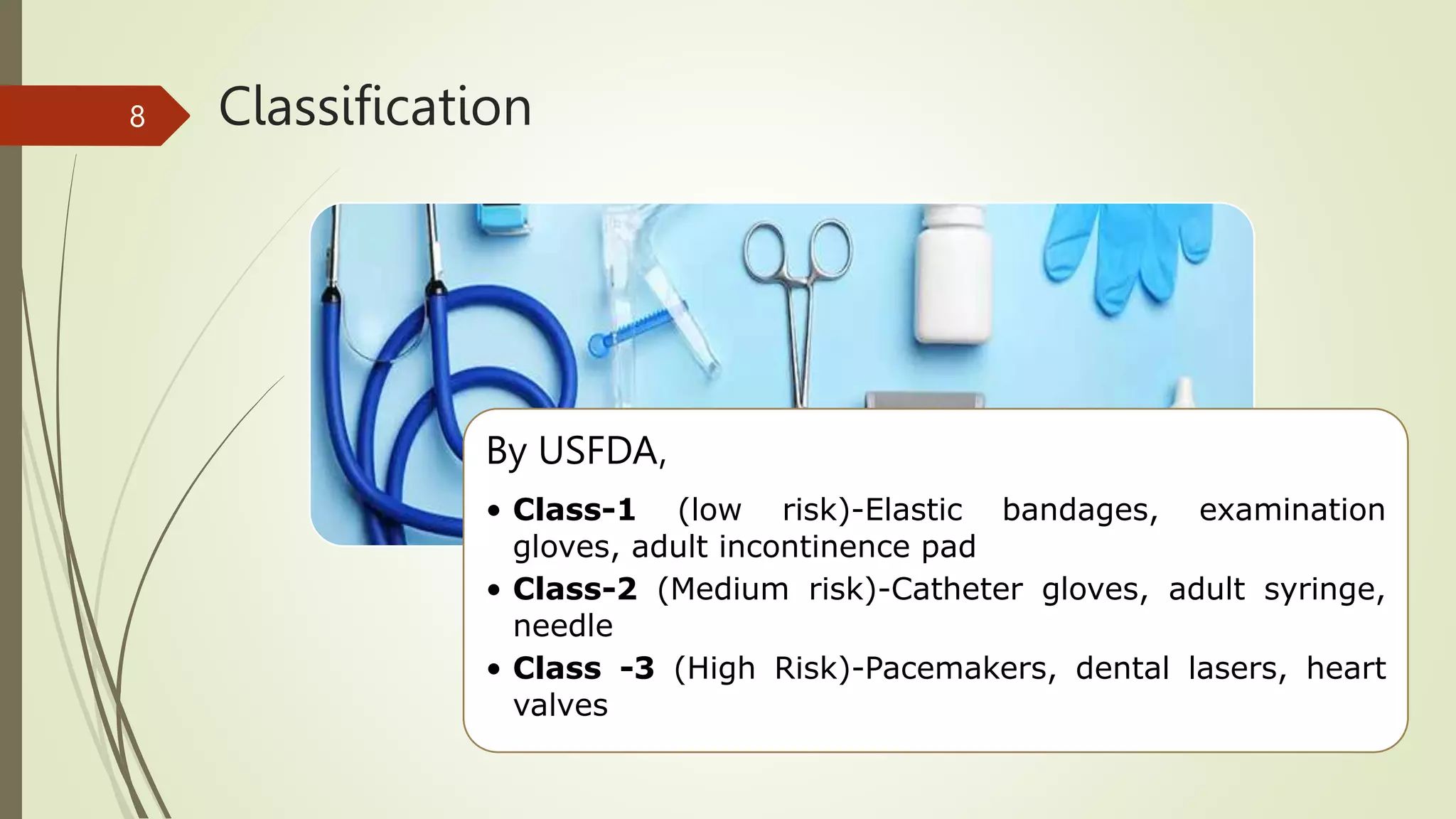
Classification
By USFDA,
• Class-1 (low risk)-Elastic bandages, examination
gloves, adult incontinence pad
• Class-2 (Medium risk)-Catheter gloves, adult syringe,
needle
• Class -3 (High Risk)-Pacemakers, dental lasers, heart
valves
8
Clinical Investigation
 A clinical investigation is defined as any systematic
investigation or study in or on one or more human subjects,
undertaken to assess the safety, clinical performance and/or
effectiveness of a medical device.
 The undertaking of a clinical investigation is a scientific process
that represents one method of generating clinical data.
9
Clinical Investigation
Objective
The objective of a clinical investigation is to
assess the safety, clinical performance and/or
effectiveness of a medical device for a particular
indication or intended use.
10
How it conducted?
ISO 14155: 2011 Clinical Investigation of
Medical Devices for Human Subjects — Good
clinical practice details the requirements for
the conduct of clinical investigations. Clinical
investigations must take into account scientific
principles underlying the collection of clinical
data along with accepted ethical standards
surrounding the use of human subjects.
11
Essential Principle applicable to all Medical
Device and IVDS
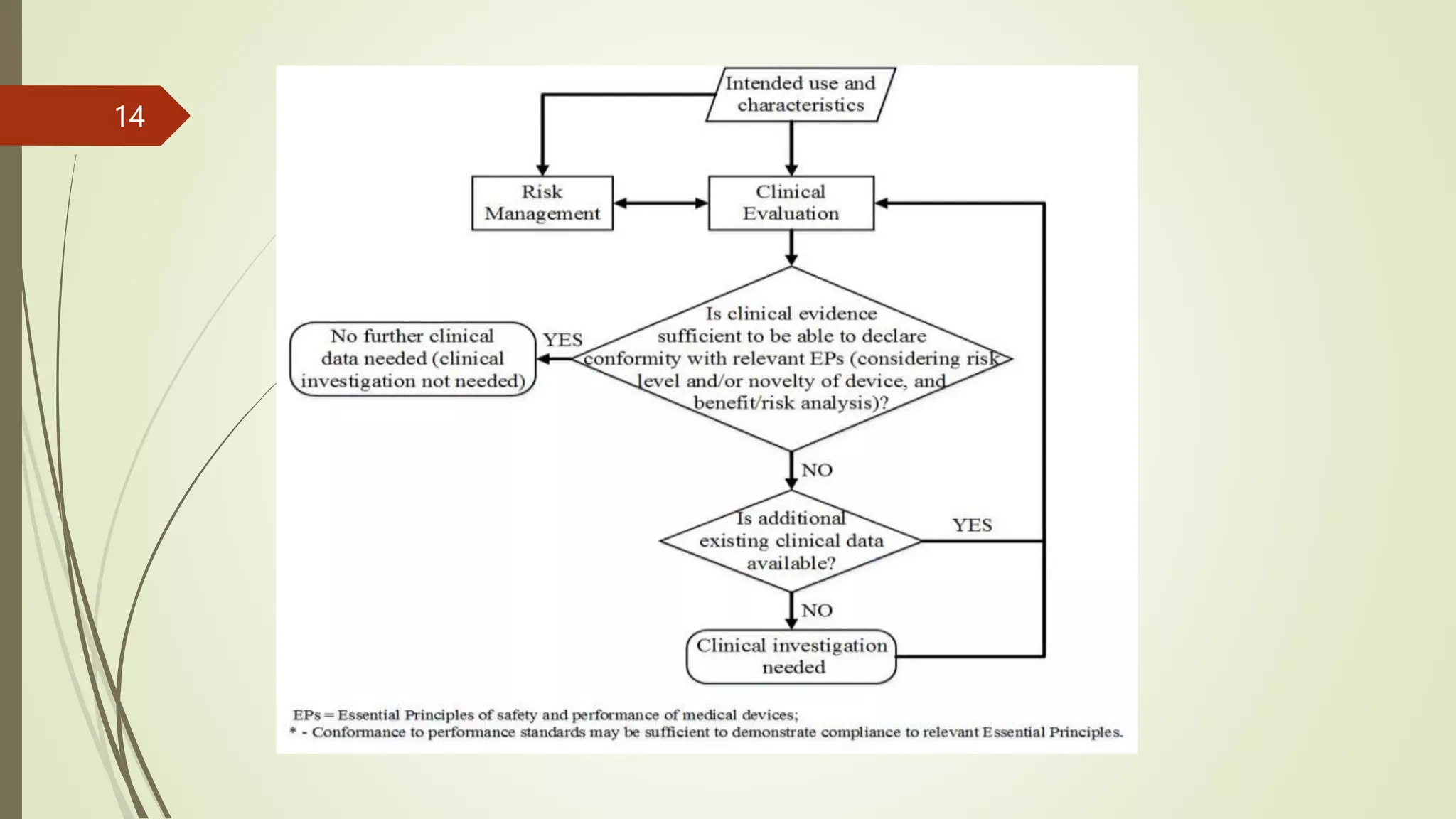
When should Clinical Investigation conducted?
Clinical investigations are necessary to provide data not
available through other sources (such as literature or
nonclinical testing)
When considering the need for a clinical investigation, one
should consider whether there are new questions of safety,
clinical performance and/or effectiveness for the particular
medical device and intended use that need to be addressed
in a clinical investigation.
12
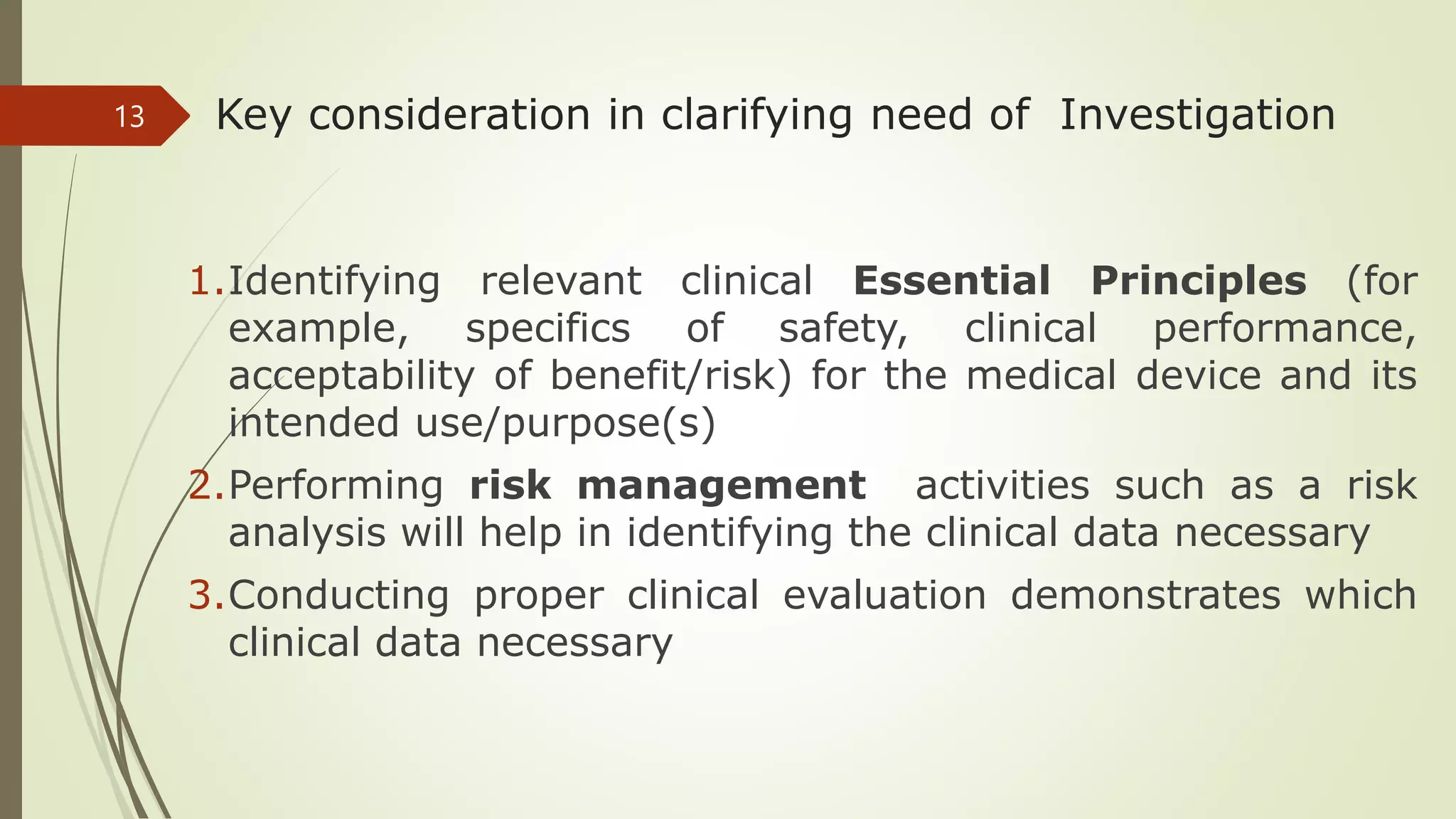
Key consideration in clarifying need of Investigation
1.Identifying relevant clinical Essential Principles (for
example, specifics of safety, clinical performance,
acceptability of benefit/risk) for the medical device and its
intended use/purpose(s)
2.Performing risk management activities such as a risk
analysis will help in identifying the clinical data necessary
3.Conducting proper clinical evaluation demonstrates which
clinical data necessary
13
14
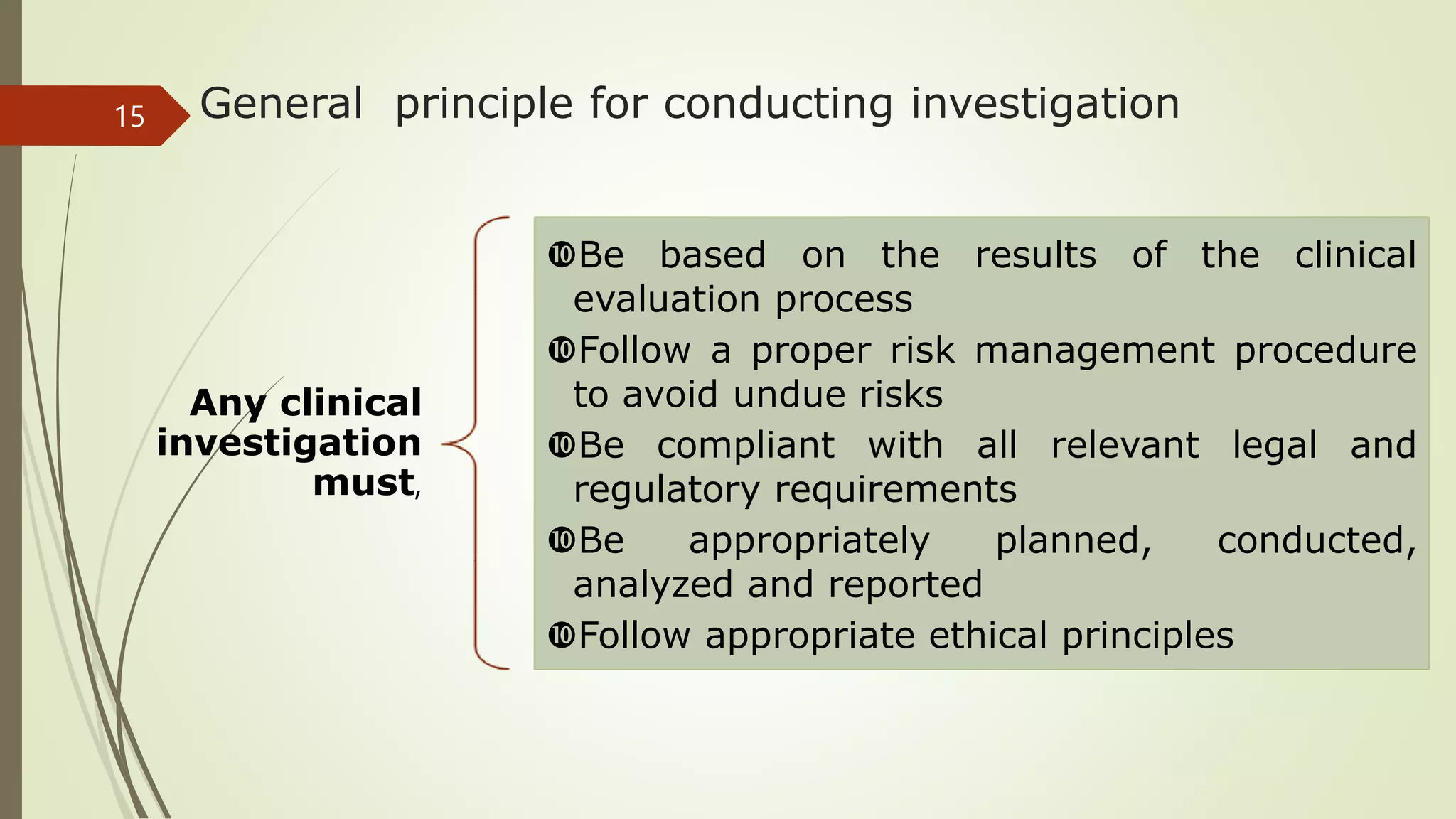
General principle for conducting investigation
Any clinical
investigation
must,
Be based on the results of the clinical
evaluation process
Follow a proper risk management procedure
to avoid undue risks
Be compliant with all relevant legal and
regulatory requirements
Be appropriately planned, conducted,
analyzed and reported
Follow appropriate ethical principles
15
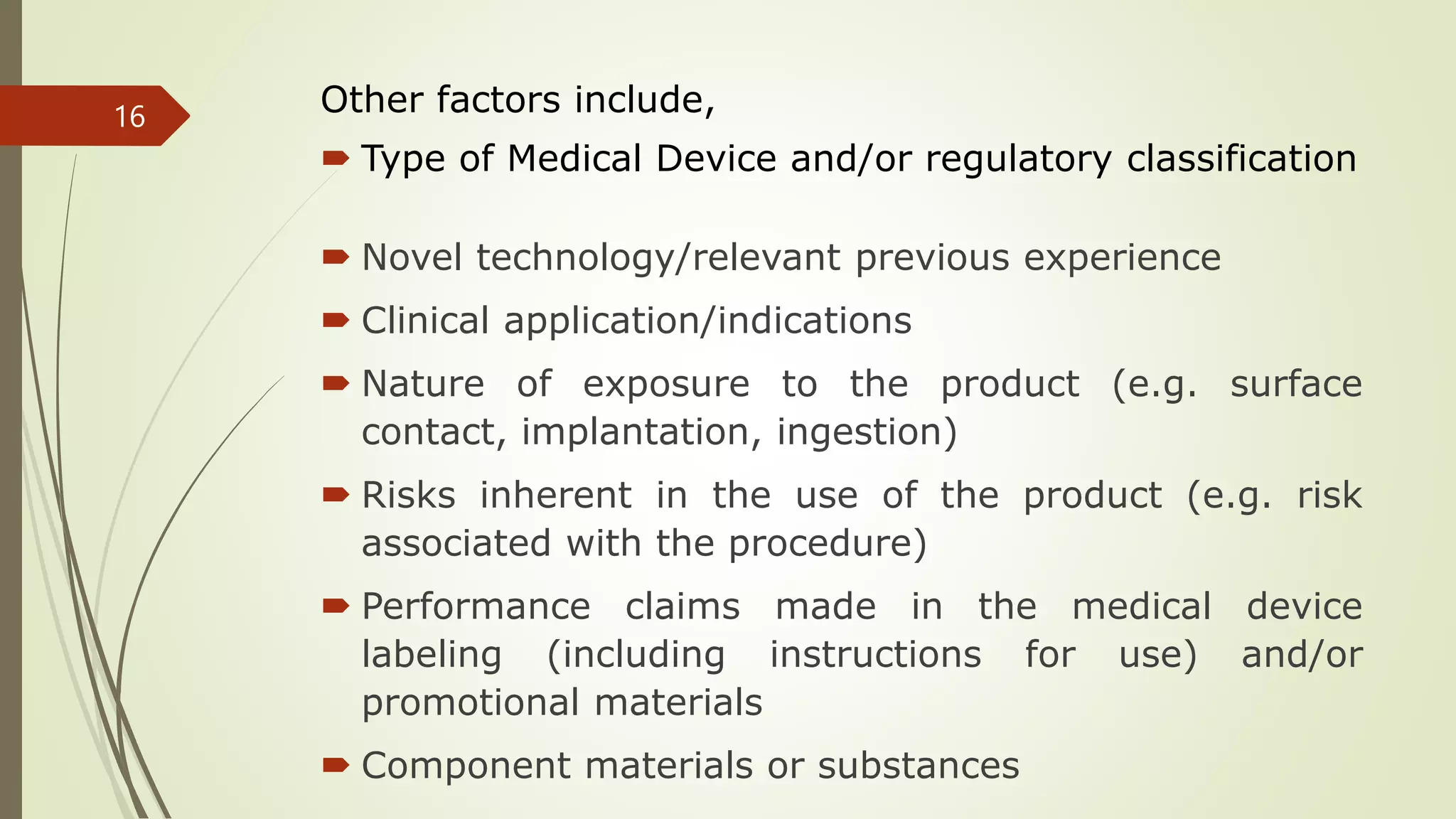
Other factors include,
 Type of Medical Device and/or regulatory classification
 Novel technology/relevant previous experience
 Clinical application/indications
 Nature of exposure to the product (e.g. surface
contact, implantation, ingestion)
 Risks inherent in the use of the product (e.g. risk
associated with the procedure)
 Performance claims made in the medical device
labeling (including instructions for use) and/or
promotional materials
 Component materials or substances
16
CONTI…..
 Demographic, geographic and cultural considerations (e.g. age,
ethnicity, gender)
 Potential impact of device failure
 Period of exposure to the medical device
 Expected lifetime of the medical device
 Availability of alternative treatments and current standard of
care
 Ethical considerations
17
Clear statement of objectives
Minimization of risk to subjects and those involved with
the conduct of the investigation
Adverse event definitions and reporting
Study endpoints
Appropriate subject population(s)
Minimization of bias (e.g.randomization,
blinding/masking, concealment of allocation)
Identification of confounding factors (e.g. concurrent
therapies, co-morbidities)
Factors needing consideration in
study protocols include:
18
CONTI…..
 Choice of Appropriate controls (e.g. active control, sham,
historical
 Design configuration (e.g. parallel, crossover, cohort
study, single arm)
 Type of comparison (e.g. superiority, non-inferiority,
equivalence)
 Follow-up duration and monitoring
19
In designing the study, Development of a statistical plan should include
consideration of the following:
 Clinically relevant endpoints
 Analysis population
 Statistical significance levels, power
 Sample size calculation and justification
 Analysis methodology
 Management of potential confounding factors
 Procedures for multiplicity control and adjustment of error probabilities
 Procedures for handling of missing, unused or spurious data, including
drop-outs
 Procedures for handling deviations from the original statistical analysis
plan
20
Conduct of Clinical Investigation
A properly conducted clinical investigation, including
compliance to the clinical investigation plan and local laws
and regulations, ensures the protection of human subjects,
the integrity of the data and that the data obtained is
acceptable for the purpose of demonstrating conformity to
the Essential Principles. ISO 14155 outlines good clinical
practice for clinical investigations of medical devices
21
Final study Report
The outcome of a clinical investigation should
be documented in a final study report. This
then forms part of the clinical data that is
included in the clinical evaluation process and
ultimately becomes integrated into the
clinical evaluation report
22
Ethical
consideration for
conducting
investigation
It should generate new data and answer specific safety,
clinical performance, and effectiveness questions that remain
unanswered by the current body of knowledge.
The desire to protect human subjects from unnecessary or
inappropriate experimentation must be balanced with the
need to protect public health through the use of clinical
investigations where they are indicated.
23
Clinical Evaluation of Medical Devices and IVDs
Clinical Evaluation
Clinical evaluation is a set of ongoing activities that
use scientifically sound methods for the assessment
and analysis of clinical data to verify the safety,
clinical performance and/or effectiveness of the
medical device when used as intended by the
manufacturer.
.
24
When is Clinical Evaluation undertaken?
 It is first performed during the development of a
medical device in order to identify data that need to
be generated for regulatory purposes and will inform
if a new device clinical investigation is necessary,
together with the outcomes which need to be studied.
This information is fed into the ongoing risk
management process (according to ISO 14971:2007)
and may result in changes to the manufacturer's risk
assessment, clinical investigation documents,
Instructions for Use and post market activities.
25
Why Clinical Evaluation important?
• When placing a medical device on the market, the
manufacturer must have demonstrated through
the use of appropriate conformity assessment
procedures that the medical device complies with
the Essential Principles of Safety and Performance
of Medical Devices.
• Generally, it is expected that the manufacturer
has demonstrated the medical device achieves its
intended performance during use according to its
labelling (i.e. information supplied by the
manufacturer) and that the known and
foreseeable risks are minimised and acceptable
when weighed against the benefits.
26
What is the process?
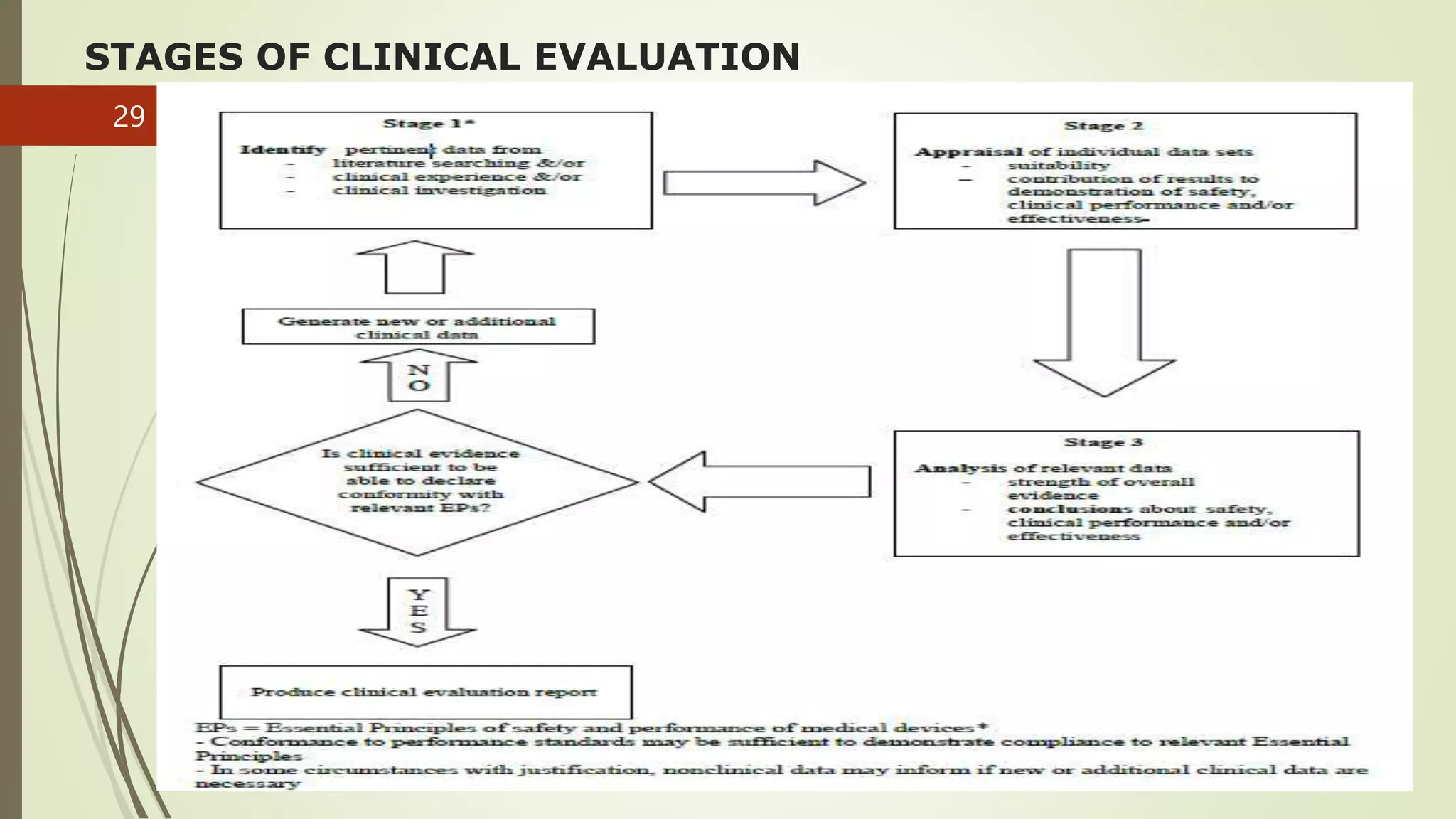
To conduct a clinical evaluation, a manufacturer needs to:
 Identify the Essential Principles that require support from
relevant clinical data;
 Identify available clinical data relevant to the medical device
and its intended use;
 Evaluate (appraise and analyses) clinical data in terms of its
suitability and contribution to demonstrating the safety, clinical
performance and/or effectiveness of the medical device in
relation to its intended use
 Generate clinical data needed to address remaining
questions of safety, clinical performance and/or effectiveness;
 Bring all the clinical data together to reach conclusions about
the safety, clinical performance and/or effectiveness of the
medical device
27
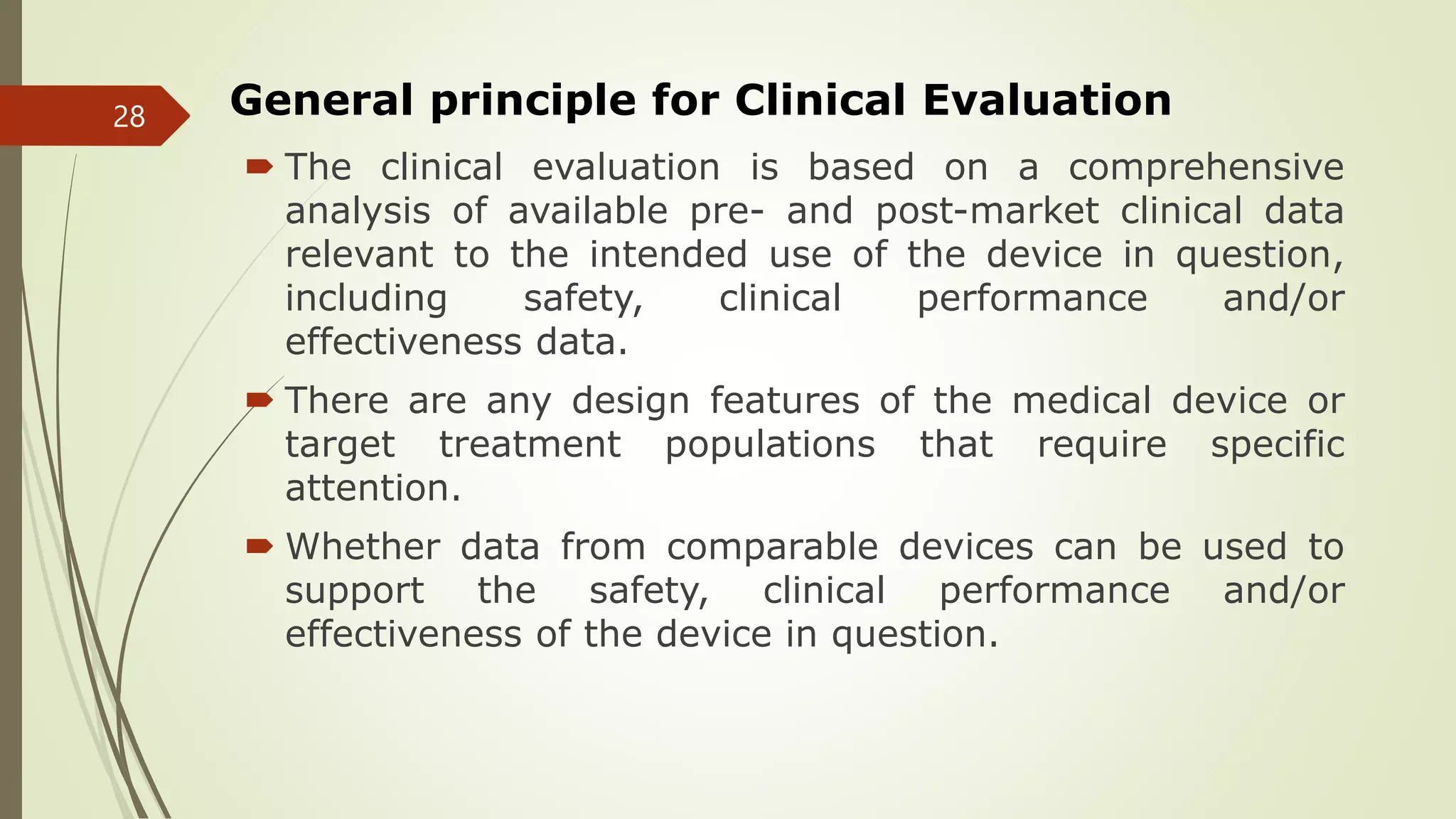
General principle for Clinical Evaluation
 The clinical evaluation is based on a comprehensive
analysis of available pre- and post-market clinical data
relevant to the intended use of the device in question,
including safety, clinical performance and/or
effectiveness data.
 There are any design features of the medical device or
target treatment populations that require specific
attention.
 Whether data from comparable devices can be used to
support the safety, clinical performance and/or
effectiveness of the device in question.
28
STAGES OF CLINICAL EVALUATION
29
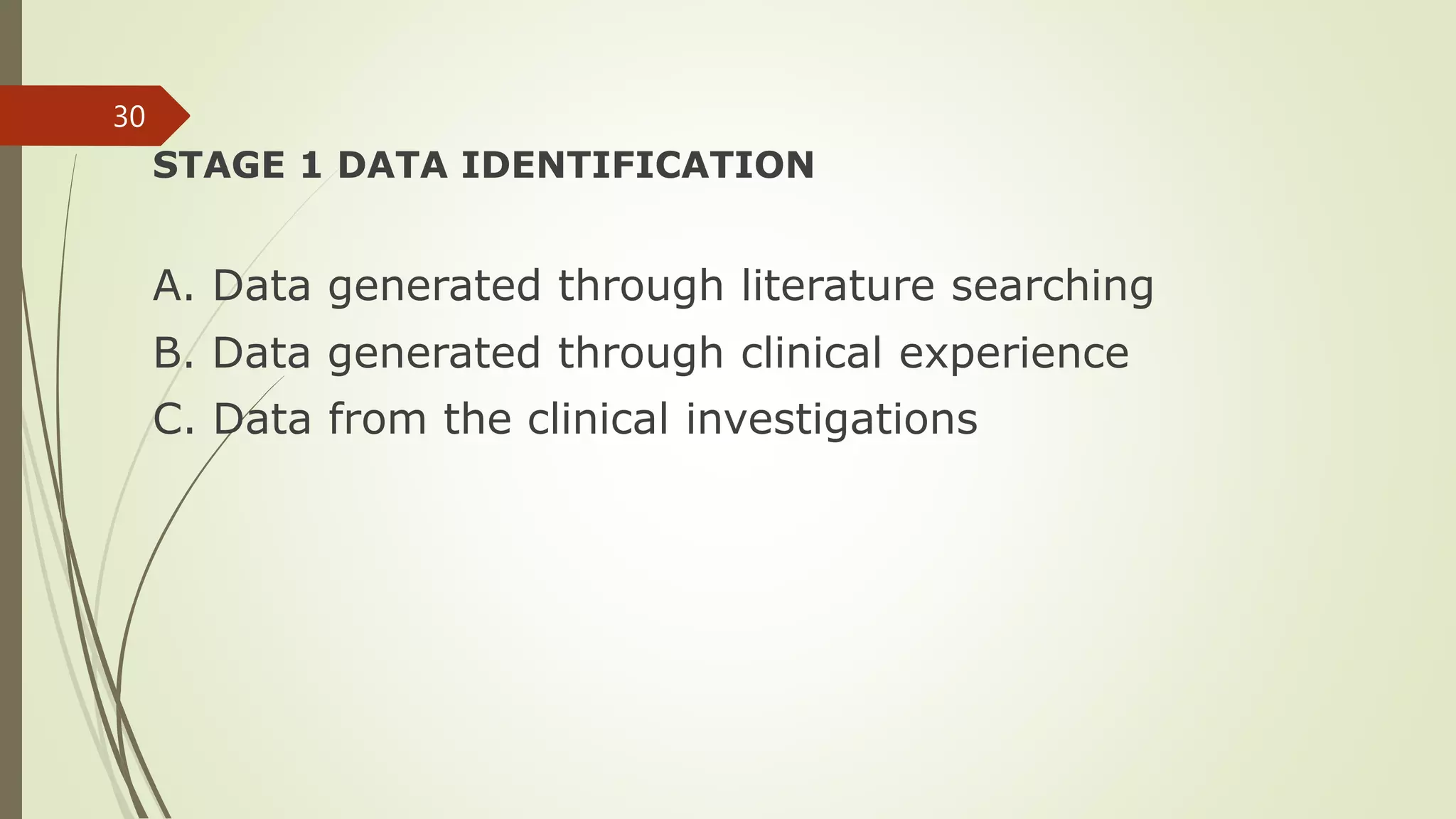
STAGE 1 DATA IDENTIFICATION
A. Data generated through literature searching
B. Data generated through clinical experience
C. Data from the clinical investigations
30
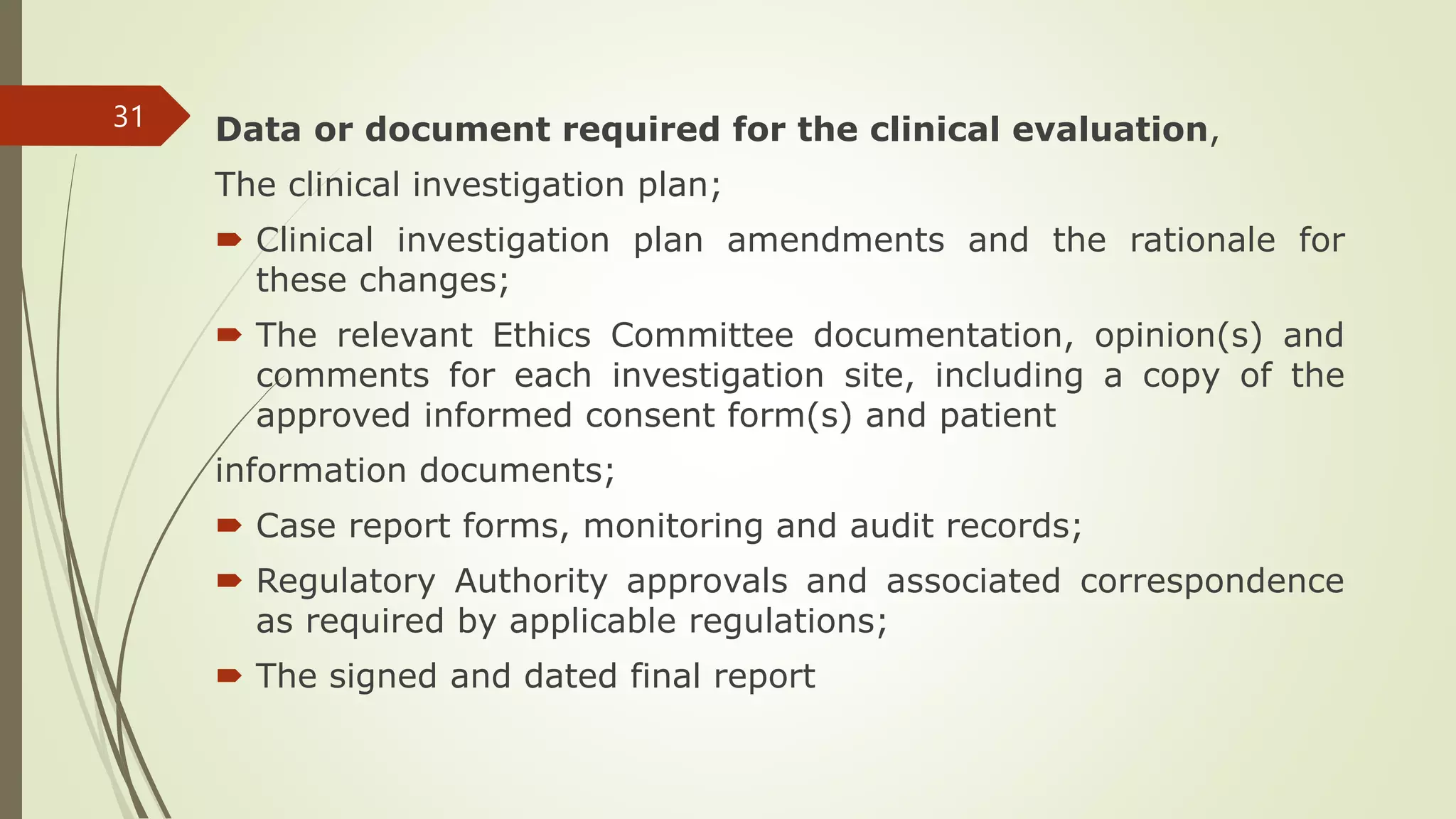
Data or document required for the clinical evaluation,
The clinical investigation plan;
 Clinical investigation plan amendments and the rationale for
these changes;
 The relevant Ethics Committee documentation, opinion(s) and
comments for each investigation site, including a copy of the
approved informed consent form(s) and patient
information documents;
 Case report forms, monitoring and audit records;
 Regulatory Authority approvals and associated correspondence
as required by applicable regulations;
 The signed and dated final report
31
STAGE 2 APPRAISAL OF CLINICAL DATA
PURPOSE
 Each piece of data is appraised to determine its suitability to address
questions about the device, and its contribution to demonstrating the
safety and performance of the device (including any specific claims about
safety or performance).
APPRAISAL COVER SHOULD INCLUDE,
 In addition, any reports or collection of data should contain sufficient
information for the evaluator to be able to undertake a rational and
objective assessment of the information and make a conclusion about its
significance with respect to the performance and safety of the device in
question. It should be assessed for its quality and for its relevance to the
device in question (i.e. the data must be either generated for the device
in question or for a comparable device) and its intended use.
32
STAGE 3 ANALYSIS OF CLINICAL DATA
 The goal of the analysis stage is to determine if the
appraised data sets available for a medical device collectively
demonstrate the clinical performance and safety of the
device in relation to its intended use
The methods available for analysis of clinical data generally
are either quantitative or qualitative.
33
As a final step the evaluator should consider the basis
on which it can be demonstrated that the combined
data show:
The device performs as intended by the
manufacturer
The device does not pose any undue safety
concerns to either the recipient or end-user; and
Any risks associated with the use of the device are
acceptable when weighed against the benefits to
the patient.
34
CLINICAL RESEARCH REPORT
 At the completion of the clinical evaluation process a report should be
compiled that outlines the scope and context of the evaluation; the inputs
(clinical data).
 The appraisal and analysis stages; and conclusions about the safety and
performance of the device in question.
 The clinical evaluation report should contain sufficient information to be
read as a stand alone document by an independent party (e.g. regulatory
authority or notified body).
 The technology on which the medical device is based, the intended use of
the device and any claims made about the device’s clinical performance or
safety
 The nature and extent of the clinical data that has been evaluated; and
 How the referenced information (recognized standards and/or clinical data)
demonstrate the clinical performance and safety of the device in question.
35
REFRENCES
1. GHTF SG1/ N044:2008 Role of Standards in the Assessment of Medical Devices,
02/01/2023
2. GHTF SG1/ N071:2012 Definition of the Terms ‘Medical Device’ and ‘In Vitro Diagnostic
(IVD) Medical Device’ 02/01/2023
3. GHTF SG1/ N78:2012 Principles of Conformity Assessment for Medical Devices
02/01/2023
4. IMDRF GRRP WG/N47 FINAL: 2018 Essential Principles of Safety and Performance of
Medical Devices and IVD Medical Devices 01/01/2023
5. GHTF/SG1/N45:2008 Principles of In Vitro Diagnostic Medical Devices Classification.
01/01/2023
6. https://www.fda.gov/training-and-continuing-education/cdrh-learn/overview-regulatory-
requirements-medical-devices 29/12/2022
7. https://cdsco.gov.in/opencms/opencms/en/Medical-Device-Diagnostics/ 29/12/2022
8. https://cdsco.gov.in/opencms/export/sites/CDSCO_WEB/Pdf-
documents/IVD/FAQs/FAQ_IVD_MDR-2017_2.pdf 29/12/2022
36
THANK YOU
37

CLINICAL INVESTIGATION AND EVALUATION OF MEDICAL DEVICES AND.pptx

  • 1.
    CLINICAL INVESTIGATION AND EVALUATIONOF MEDICAL DEVICES AND IVDS Prepared by, Faizan Shaikh M.Pharm (Sem – 1 ) Pharmaceutical Regulatory Affairs
  • 2.
    CONTENTS 1. Introduction 2. Clinicalinvestigation 3. Objective 4. General principles 5. Conduct of clinical investigation 6. Ethical consideration 7. Clinical evaluation 8. General principle 9. Clinical research report 10.References 2
  • 3.
    DEFINATIONS As per USFDA- An instrument, apparatus, implement, machine, contrivance, implant, invitro reagent or other similar or other article, including a component part, or accessory which is recognized in the official National formulary or USP or any supplement to them ,intended for use in diagnosis of disease or other condition or in the intended, or prevention of other diseases in men and animals or intended to affect structure or any function of the body of man or other animal, and  Which does not achieve any of it’s primary intended purpose through chemical action within or on the body of man or other animal which is not dependent being metabolized for the achievement of any of its primary intended purposes 3
  • 4.
    As per D& C Act, Instrument intended for internal or external use in the prevention of disease or disorder in human being or animal as may be specified from time to time by central government by notification in the official gazette, after consultation with the board 4
  • 5.
    Definition  In India,at present only notified medical devices are regulated as Drugs under the Drugs and Cosmetics Act 1940 and Rules made there under in 1945 1. (1) substances used for in vitro diagnosis and surgical dressings, surgical bandages, surgical staples, surgical sutures, ligatures, blood and blood component collection bag with or without anticoagulant covered under sub-clause (I); 2. (ii) substances including mechanical contraceptives (condoms, intrauterine devices, tubal rings), disinfectants and insecticides notified under sub-clause (ii); and 3. devices notified from time to time under sub-clause (iv), of clause (b) of section 3 of the Drugs and Cosmetics Act, 1940; 5
  • 6.
    Definitions IVDS,  Definition: Invitro diagnostic products are those reagents, instruments, and systems intended for use in diagnosis of disease or other conditions, including a determination of the state of health, in order to cure, mitigate, treat, or prevent disease or its sequelae. Such products are intended for use in the collection, preparation, and examination of specimens taken from the human body. [21 CFR 809.3]  IVDs are devices as defined in section 201(h) of the Federal Food, Drug, and Cosmetic Act, and may also be biological products subject to section 351 of the Public Health Service Act. Like other medical devices, IVDs are subject to premarket and post market controls. IVDs are generally also subject to categorization under the Clinical Laboratory Improvement Amendments (CLIA '88) of 1988. 6
  • 7.
    CDSCO (IMRDA) &MDD risk based classification Class A (Class-1)-Devices involving low risk levels (Thermometer) Class B (Class-2a)-Devices involving low to medium risk (Hypodermic needle) Class C (Class 2b)-Devices involving moderate to high risk (Lung ventilator) Class D (Class 3)-Devices involving high risk (Heart valve, Implantable devices) 7
  • 8.
    Classification By USFDA, • Class-1(low risk)-Elastic bandages, examination gloves, adult incontinence pad • Class-2 (Medium risk)-Catheter gloves, adult syringe, needle • Class -3 (High Risk)-Pacemakers, dental lasers, heart valves 8
  • 9.
    Clinical Investigation  Aclinical investigation is defined as any systematic investigation or study in or on one or more human subjects, undertaken to assess the safety, clinical performance and/or effectiveness of a medical device.  The undertaking of a clinical investigation is a scientific process that represents one method of generating clinical data. 9
  • 10.
    Clinical Investigation Objective The objectiveof a clinical investigation is to assess the safety, clinical performance and/or effectiveness of a medical device for a particular indication or intended use. 10
  • 11.
    How it conducted? ISO14155: 2011 Clinical Investigation of Medical Devices for Human Subjects — Good clinical practice details the requirements for the conduct of clinical investigations. Clinical investigations must take into account scientific principles underlying the collection of clinical data along with accepted ethical standards surrounding the use of human subjects. 11
  • 12.
    Essential Principle applicableto all Medical Device and IVDS When should Clinical Investigation conducted? Clinical investigations are necessary to provide data not available through other sources (such as literature or nonclinical testing) When considering the need for a clinical investigation, one should consider whether there are new questions of safety, clinical performance and/or effectiveness for the particular medical device and intended use that need to be addressed in a clinical investigation. 12
  • 13.
    Key consideration inclarifying need of Investigation 1.Identifying relevant clinical Essential Principles (for example, specifics of safety, clinical performance, acceptability of benefit/risk) for the medical device and its intended use/purpose(s) 2.Performing risk management activities such as a risk analysis will help in identifying the clinical data necessary 3.Conducting proper clinical evaluation demonstrates which clinical data necessary 13
  • 14.
  • 15.
    General principle forconducting investigation Any clinical investigation must, Be based on the results of the clinical evaluation process Follow a proper risk management procedure to avoid undue risks Be compliant with all relevant legal and regulatory requirements Be appropriately planned, conducted, analyzed and reported Follow appropriate ethical principles 15
  • 16.
    Other factors include, Type of Medical Device and/or regulatory classification  Novel technology/relevant previous experience  Clinical application/indications  Nature of exposure to the product (e.g. surface contact, implantation, ingestion)  Risks inherent in the use of the product (e.g. risk associated with the procedure)  Performance claims made in the medical device labeling (including instructions for use) and/or promotional materials  Component materials or substances 16
  • 17.
    CONTI…..  Demographic, geographicand cultural considerations (e.g. age, ethnicity, gender)  Potential impact of device failure  Period of exposure to the medical device  Expected lifetime of the medical device  Availability of alternative treatments and current standard of care  Ethical considerations 17
  • 18.
    Clear statement ofobjectives Minimization of risk to subjects and those involved with the conduct of the investigation Adverse event definitions and reporting Study endpoints Appropriate subject population(s) Minimization of bias (e.g.randomization, blinding/masking, concealment of allocation) Identification of confounding factors (e.g. concurrent therapies, co-morbidities) Factors needing consideration in study protocols include: 18
  • 19.
    CONTI…..  Choice ofAppropriate controls (e.g. active control, sham, historical  Design configuration (e.g. parallel, crossover, cohort study, single arm)  Type of comparison (e.g. superiority, non-inferiority, equivalence)  Follow-up duration and monitoring 19
  • 20.
    In designing thestudy, Development of a statistical plan should include consideration of the following:  Clinically relevant endpoints  Analysis population  Statistical significance levels, power  Sample size calculation and justification  Analysis methodology  Management of potential confounding factors  Procedures for multiplicity control and adjustment of error probabilities  Procedures for handling of missing, unused or spurious data, including drop-outs  Procedures for handling deviations from the original statistical analysis plan 20
  • 21.
    Conduct of ClinicalInvestigation A properly conducted clinical investigation, including compliance to the clinical investigation plan and local laws and regulations, ensures the protection of human subjects, the integrity of the data and that the data obtained is acceptable for the purpose of demonstrating conformity to the Essential Principles. ISO 14155 outlines good clinical practice for clinical investigations of medical devices 21
  • 22.
    Final study Report Theoutcome of a clinical investigation should be documented in a final study report. This then forms part of the clinical data that is included in the clinical evaluation process and ultimately becomes integrated into the clinical evaluation report 22
  • 23.
    Ethical consideration for conducting investigation It shouldgenerate new data and answer specific safety, clinical performance, and effectiveness questions that remain unanswered by the current body of knowledge. The desire to protect human subjects from unnecessary or inappropriate experimentation must be balanced with the need to protect public health through the use of clinical investigations where they are indicated. 23
  • 24.
    Clinical Evaluation ofMedical Devices and IVDs Clinical Evaluation Clinical evaluation is a set of ongoing activities that use scientifically sound methods for the assessment and analysis of clinical data to verify the safety, clinical performance and/or effectiveness of the medical device when used as intended by the manufacturer. . 24
  • 25.
    When is ClinicalEvaluation undertaken?  It is first performed during the development of a medical device in order to identify data that need to be generated for regulatory purposes and will inform if a new device clinical investigation is necessary, together with the outcomes which need to be studied. This information is fed into the ongoing risk management process (according to ISO 14971:2007) and may result in changes to the manufacturer's risk assessment, clinical investigation documents, Instructions for Use and post market activities. 25
  • 26.
    Why Clinical Evaluationimportant? • When placing a medical device on the market, the manufacturer must have demonstrated through the use of appropriate conformity assessment procedures that the medical device complies with the Essential Principles of Safety and Performance of Medical Devices. • Generally, it is expected that the manufacturer has demonstrated the medical device achieves its intended performance during use according to its labelling (i.e. information supplied by the manufacturer) and that the known and foreseeable risks are minimised and acceptable when weighed against the benefits. 26
  • 27.
    What is theprocess? To conduct a clinical evaluation, a manufacturer needs to:  Identify the Essential Principles that require support from relevant clinical data;  Identify available clinical data relevant to the medical device and its intended use;  Evaluate (appraise and analyses) clinical data in terms of its suitability and contribution to demonstrating the safety, clinical performance and/or effectiveness of the medical device in relation to its intended use  Generate clinical data needed to address remaining questions of safety, clinical performance and/or effectiveness;  Bring all the clinical data together to reach conclusions about the safety, clinical performance and/or effectiveness of the medical device 27
  • 28.
    General principle forClinical Evaluation  The clinical evaluation is based on a comprehensive analysis of available pre- and post-market clinical data relevant to the intended use of the device in question, including safety, clinical performance and/or effectiveness data.  There are any design features of the medical device or target treatment populations that require specific attention.  Whether data from comparable devices can be used to support the safety, clinical performance and/or effectiveness of the device in question. 28
  • 29.
    STAGES OF CLINICALEVALUATION 29
  • 30.
    STAGE 1 DATAIDENTIFICATION A. Data generated through literature searching B. Data generated through clinical experience C. Data from the clinical investigations 30
  • 31.
    Data or documentrequired for the clinical evaluation, The clinical investigation plan;  Clinical investigation plan amendments and the rationale for these changes;  The relevant Ethics Committee documentation, opinion(s) and comments for each investigation site, including a copy of the approved informed consent form(s) and patient information documents;  Case report forms, monitoring and audit records;  Regulatory Authority approvals and associated correspondence as required by applicable regulations;  The signed and dated final report 31
  • 32.
    STAGE 2 APPRAISALOF CLINICAL DATA PURPOSE  Each piece of data is appraised to determine its suitability to address questions about the device, and its contribution to demonstrating the safety and performance of the device (including any specific claims about safety or performance). APPRAISAL COVER SHOULD INCLUDE,  In addition, any reports or collection of data should contain sufficient information for the evaluator to be able to undertake a rational and objective assessment of the information and make a conclusion about its significance with respect to the performance and safety of the device in question. It should be assessed for its quality and for its relevance to the device in question (i.e. the data must be either generated for the device in question or for a comparable device) and its intended use. 32
  • 33.
    STAGE 3 ANALYSISOF CLINICAL DATA  The goal of the analysis stage is to determine if the appraised data sets available for a medical device collectively demonstrate the clinical performance and safety of the device in relation to its intended use The methods available for analysis of clinical data generally are either quantitative or qualitative. 33
  • 34.
    As a finalstep the evaluator should consider the basis on which it can be demonstrated that the combined data show: The device performs as intended by the manufacturer The device does not pose any undue safety concerns to either the recipient or end-user; and Any risks associated with the use of the device are acceptable when weighed against the benefits to the patient. 34
  • 35.
    CLINICAL RESEARCH REPORT At the completion of the clinical evaluation process a report should be compiled that outlines the scope and context of the evaluation; the inputs (clinical data).  The appraisal and analysis stages; and conclusions about the safety and performance of the device in question.  The clinical evaluation report should contain sufficient information to be read as a stand alone document by an independent party (e.g. regulatory authority or notified body).  The technology on which the medical device is based, the intended use of the device and any claims made about the device’s clinical performance or safety  The nature and extent of the clinical data that has been evaluated; and  How the referenced information (recognized standards and/or clinical data) demonstrate the clinical performance and safety of the device in question. 35
  • 36.
    REFRENCES 1. GHTF SG1/N044:2008 Role of Standards in the Assessment of Medical Devices, 02/01/2023 2. GHTF SG1/ N071:2012 Definition of the Terms ‘Medical Device’ and ‘In Vitro Diagnostic (IVD) Medical Device’ 02/01/2023 3. GHTF SG1/ N78:2012 Principles of Conformity Assessment for Medical Devices 02/01/2023 4. IMDRF GRRP WG/N47 FINAL: 2018 Essential Principles of Safety and Performance of Medical Devices and IVD Medical Devices 01/01/2023 5. GHTF/SG1/N45:2008 Principles of In Vitro Diagnostic Medical Devices Classification. 01/01/2023 6. https://www.fda.gov/training-and-continuing-education/cdrh-learn/overview-regulatory- requirements-medical-devices 29/12/2022 7. https://cdsco.gov.in/opencms/opencms/en/Medical-Device-Diagnostics/ 29/12/2022 8. https://cdsco.gov.in/opencms/export/sites/CDSCO_WEB/Pdf- documents/IVD/FAQs/FAQ_IVD_MDR-2017_2.pdf 29/12/2022 36
  • 37.