GOLD MARKET


Submitted to : Mr. Himal Parikh

 Submitted by : Prashant Maharshi
GOLD
 MOST-FAVORED INVESTMENT INSTRUMENT IN INDIA

   UNIQUE ASSET CLASS THAT COMBINES STEADY
     RETURNS, LIQUIDITY AND AN EMOTIONAL
           SATISFACTION OF BUYERS

HAS A STRONG DIVERSIFYING EFFECT ON A PORTFOLIO
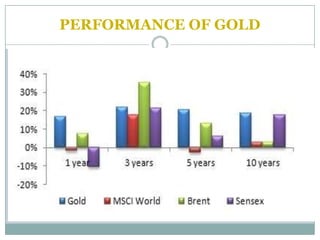
PERFORMANCE OF GOLD
WAYS OF INVESTING IN GOLD

 Physical gold purchase

  Gold Coins
  Gold Bars
  Jewellery


 PAPER GOLD

  Gold ETFs
  Gold FUND OF FUND (FOF)
  E-Gold
GOLD-ETFs


 Offered by Mutual Fund.


 Regulated by SEBI.


 held electronically in the Demat form.
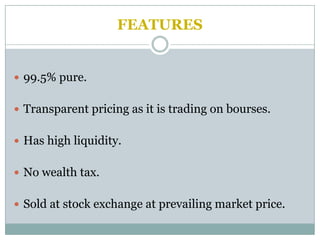
FEATURES


 99.5% pure.


 Transparent pricing as it is trading on bourses.


 Has high liquidity.


 No wealth tax.


 Sold at stock exchange at prevailing market price.
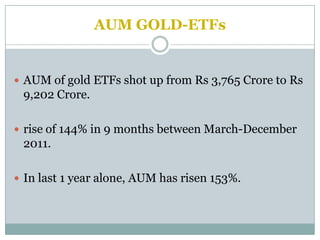
AUM GOLD-ETFs


 AUM of gold ETFs shot up from Rs 3,765 Crore to Rs
 9,202 Crore.

 rise of 144% in 9 months between March-December
 2011.

 In last 1 year alone, AUM has risen 153%.
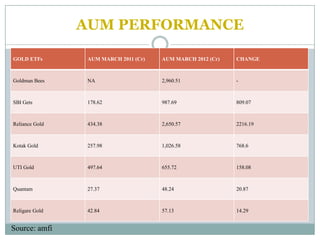
AUM PERFORMANCE

GOLD ETFs        AUM MARCH 2011 (Cr)   AUM MARCH 2012 (Cr)   CHANGE


Goldman Bees     NA                    2,960.51              -


SBI Gets         178.62                987.69                809.07


Reliance Gold    434.38                2,650.57              2216.19


Kotak Gold       257.98                1,026.58              768.6


UTI Gold         497.64                655.72                158.08


Quantam          27.37                 48.24                 20.87


Religare Gold    42.84                 57.13                 14.29


Source: amfi
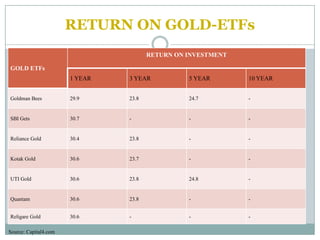
RETURN ON GOLD-ETFs
                                       RETURN ON INVESTMENT

GOLD ETFs
                       1 YEAR   3 YEAR           5 YEAR       10 YEAR


Goldman Bees           29.9     23.8             24.7         -


SBI Gets               30.7     -                -            -


Reliance Gold          30.4     23.8             -            -


Kotak Gold             30.6     23.7             -            -


UTI Gold               30.6     23.8             24.8         -


Quantam                30.6     23.8             -            -


Religare Gold          30.6     -                -            -

Source: Capital4.com
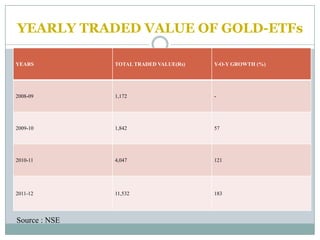
YEARLY TRADED VALUE OF GOLD-ETFs

YEARS          TOTAL TRADED VALUE(Rs)   Y-O-Y GROWTH (%)


2008-09        1,172                    -


2009-10        1,842                    57


2010-11        4,047                    121


2011-12        11,532                   183


Source : NSE
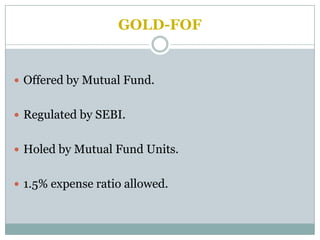
GOLD-FOF


 Offered by Mutual Fund.


 Regulated by SEBI.


 Holed by Mutual Fund Units.


 1.5% expense ratio allowed.
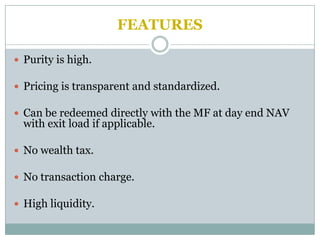
FEATURES

 Purity is high.

 Pricing is transparent and standardized.

 Can be redeemed directly with the MF at day end NAV
  with exit load if applicable.

 No wealth tax.

 No transaction charge.

 High liquidity.
E-GOLD


 Offered by National spot exchange.


 Holed by Demat Account.
FEATURE


 99.9% PURITY.


 Pricing is Transparent as it is traded on the
 exchange.

 Better liquidity.


 Bourses responsible for security.
WHY PAPER GOLD BETTER?

 Paper gold are highly liquid, one can buy or sell
    paper gold very fast.
   Price of the paper gold is completely transparent.
   Profits from Gold ETFs and Gold fund are treated as
    long-term capital gains and are taxed at lower rate, if
    holding period exceeds 1 year.
   Paper gold can be bought in small dominations.
   Paper Gold can be easily converted into physical gold
    by rematerialisation. Investors can convert their E-
    Gold into bars of 99.5% purity.
GOLD LOANS


 Gold loan is loan against Gold.


 most convenient way to receive cash in no time from
 any NBFC or Bank

 consist of minimal documentation & no processing
 time.
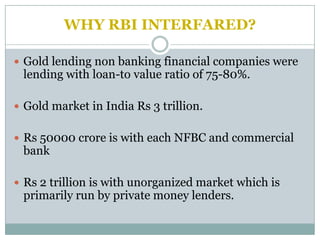
WHY RBI INTERFARED?

 Gold lending non banking financial companies were
 lending with loan-to value ratio of 75-80%.

 Gold market in India Rs 3 trillion.


 Rs 50000 crore is with each NFBC and commercial
 bank

 Rs 2 trillion is with unorganized market which is
 primarily run by private money lenders.
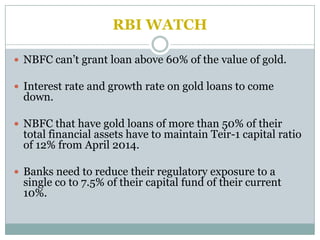
RBI WATCH

 NBFC can’t grant loan above 60% of the value of gold.

 Interest rate and growth rate on gold loans to come
 down.

 NBFC that have gold loans of more than 50% of their
 total financial assets have to maintain Teir-1 capital ratio
 of 12% from April 2014.

 Banks need to reduce their regulatory exposure to a
 single co to 7.5% of their capital fund of their current
 10%.
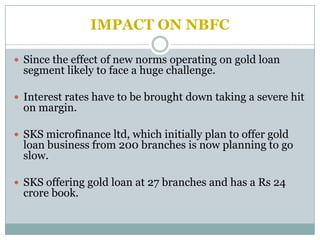
IMPACT ON NBFC

 Since the effect of new norms operating on gold loan
  segment likely to face a huge challenge.

 Interest rates have to be brought down taking a severe hit
  on margin.

 SKS microfinance ltd, which initially plan to offer gold
  loan business from 200 branches is now planning to go
  slow.

 SKS offering gold loan at 27 branches and has a Rs 24
  crore book.
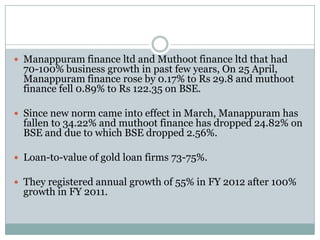
 Manappuram finance ltd and Muthoot finance ltd that had
  70-100% business growth in past few years, On 25 April,
  Manappuram finance rose by 0.17% to Rs 29.8 and muthoot
  finance fell 0.89% to Rs 122.35 on BSE.

 Since new norm came into effect in March, Manappuram has
  fallen to 34.22% and muthoot finance has dropped 24.82% on
  BSE and due to which BSE dropped 2.56%.

 Loan-to-value of gold loan firms 73-75%.

 They registered annual growth of 55% in FY 2012 after 100%
  growth in FY 2011.
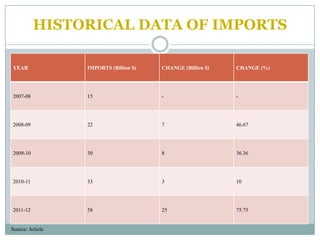
HISTORICAL DATA OF IMPORTS

YEAR              IMPORTS (Billion $)   CHANGE (Billion $)   CHANGE (%)


2007-08           15                    -                    -


2008-09           22                    7                    46.67


2009-10           30                    8                    36.36


2010-11           33                    3                    10


2011-12           58                    25                   75.75


Source: Article
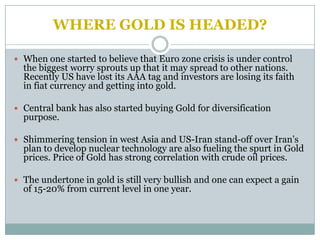
WHERE GOLD IS HEADED?

 When one started to believe that Euro zone crisis is under control
  the biggest worry sprouts up that it may spread to other nations.
  Recently US have lost its AAA tag and investors are losing its faith
  in fiat currency and getting into gold.

 Central bank has also started buying Gold for diversification
  purpose.

 Shimmering tension in west Asia and US-Iran stand-off over Iran’s
  plan to develop nuclear technology are also fueling the spurt in Gold
  prices. Price of Gold has strong correlation with crude oil prices.

 The undertone in gold is still very bullish and one can expect a gain
  of 15-20% from current level in one year.
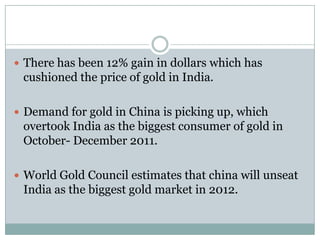
 There has been 12% gain in dollars which has
 cushioned the price of gold in India.

 Demand for gold in China is picking up, which
 overtook India as the biggest consumer of gold in
 October- December 2011.

 World Gold Council estimates that china will unseat
 India as the biggest gold market in 2012.
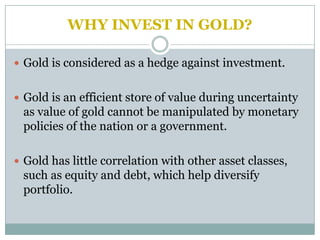
WHY INVEST IN GOLD?

 Gold is considered as a hedge against investment.


 Gold is an efficient store of value during uncertainty
 as value of gold cannot be manipulated by monetary
 policies of the nation or a government.

 Gold has little correlation with other asset classes,
 such as equity and debt, which help diversify
 portfolio.
INVESTORS REASON TO INVEST IN GOLD

 Investment option
 As when the market is volatile investor tends to
 move from risky assets to the assets like gold. Gold is
 traded on a ddollar-denominated basis. In the time
 of crisis, capital often flow out of emerging market
 this strengthen the dollar against emerging market
 currency. The hike in gold price is due to increase in
 international gold price or by appreciation of the
 dollar against rupees.
 Inflation-Hedge
 When economy is doing well inflation tend to
  increase due to increase in demand, income and
  consumption which lead to increase in cost of goods
  and services and due to increase in income people
  buy more car house etc which lead to increase in
  price f the fuel, metals etc.
 Even at the time of inflation purchasing power of the
  gold remain more or less constant as it does not
  generate income stream.
Thank You

Gold

  • 1.
    GOLD MARKET Submitted to: Mr. Himal Parikh Submitted by : Prashant Maharshi
  • 2.
    GOLD MOST-FAVORED INVESTMENTINSTRUMENT IN INDIA UNIQUE ASSET CLASS THAT COMBINES STEADY RETURNS, LIQUIDITY AND AN EMOTIONAL SATISFACTION OF BUYERS HAS A STRONG DIVERSIFYING EFFECT ON A PORTFOLIO
  • 3.
  • 4.
    WAYS OF INVESTINGIN GOLD  Physical gold purchase  Gold Coins  Gold Bars  Jewellery  PAPER GOLD  Gold ETFs  Gold FUND OF FUND (FOF)  E-Gold
  • 5.
    GOLD-ETFs  Offered byMutual Fund.  Regulated by SEBI.  held electronically in the Demat form.
  • 6.
    FEATURES  99.5% pure. Transparent pricing as it is trading on bourses.  Has high liquidity.  No wealth tax.  Sold at stock exchange at prevailing market price.
  • 7.
    AUM GOLD-ETFs  AUMof gold ETFs shot up from Rs 3,765 Crore to Rs 9,202 Crore.  rise of 144% in 9 months between March-December 2011.  In last 1 year alone, AUM has risen 153%.
  • 8.
    AUM PERFORMANCE GOLD ETFs AUM MARCH 2011 (Cr) AUM MARCH 2012 (Cr) CHANGE Goldman Bees NA 2,960.51 - SBI Gets 178.62 987.69 809.07 Reliance Gold 434.38 2,650.57 2216.19 Kotak Gold 257.98 1,026.58 768.6 UTI Gold 497.64 655.72 158.08 Quantam 27.37 48.24 20.87 Religare Gold 42.84 57.13 14.29 Source: amfi
  • 9.
    RETURN ON GOLD-ETFs RETURN ON INVESTMENT GOLD ETFs 1 YEAR 3 YEAR 5 YEAR 10 YEAR Goldman Bees 29.9 23.8 24.7 - SBI Gets 30.7 - - - Reliance Gold 30.4 23.8 - - Kotak Gold 30.6 23.7 - - UTI Gold 30.6 23.8 24.8 - Quantam 30.6 23.8 - - Religare Gold 30.6 - - - Source: Capital4.com
  • 10.
    YEARLY TRADED VALUEOF GOLD-ETFs YEARS TOTAL TRADED VALUE(Rs) Y-O-Y GROWTH (%) 2008-09 1,172 - 2009-10 1,842 57 2010-11 4,047 121 2011-12 11,532 183 Source : NSE
  • 11.
    GOLD-FOF  Offered byMutual Fund.  Regulated by SEBI.  Holed by Mutual Fund Units.  1.5% expense ratio allowed.
  • 12.
    FEATURES  Purity ishigh.  Pricing is transparent and standardized.  Can be redeemed directly with the MF at day end NAV with exit load if applicable.  No wealth tax.  No transaction charge.  High liquidity.
  • 13.
    E-GOLD  Offered byNational spot exchange.  Holed by Demat Account.
  • 14.
    FEATURE  99.9% PURITY. Pricing is Transparent as it is traded on the exchange.  Better liquidity.  Bourses responsible for security.
  • 15.
    WHY PAPER GOLDBETTER?  Paper gold are highly liquid, one can buy or sell paper gold very fast.  Price of the paper gold is completely transparent.  Profits from Gold ETFs and Gold fund are treated as long-term capital gains and are taxed at lower rate, if holding period exceeds 1 year.  Paper gold can be bought in small dominations.  Paper Gold can be easily converted into physical gold by rematerialisation. Investors can convert their E- Gold into bars of 99.5% purity.
  • 16.
    GOLD LOANS  Goldloan is loan against Gold.  most convenient way to receive cash in no time from any NBFC or Bank  consist of minimal documentation & no processing time.
  • 17.
    WHY RBI INTERFARED? Gold lending non banking financial companies were lending with loan-to value ratio of 75-80%.  Gold market in India Rs 3 trillion.  Rs 50000 crore is with each NFBC and commercial bank  Rs 2 trillion is with unorganized market which is primarily run by private money lenders.
  • 18.
    RBI WATCH  NBFCcan’t grant loan above 60% of the value of gold.  Interest rate and growth rate on gold loans to come down.  NBFC that have gold loans of more than 50% of their total financial assets have to maintain Teir-1 capital ratio of 12% from April 2014.  Banks need to reduce their regulatory exposure to a single co to 7.5% of their capital fund of their current 10%.
  • 19.
    IMPACT ON NBFC Since the effect of new norms operating on gold loan segment likely to face a huge challenge.  Interest rates have to be brought down taking a severe hit on margin.  SKS microfinance ltd, which initially plan to offer gold loan business from 200 branches is now planning to go slow.  SKS offering gold loan at 27 branches and has a Rs 24 crore book.
  • 20.
     Manappuram financeltd and Muthoot finance ltd that had 70-100% business growth in past few years, On 25 April, Manappuram finance rose by 0.17% to Rs 29.8 and muthoot finance fell 0.89% to Rs 122.35 on BSE.  Since new norm came into effect in March, Manappuram has fallen to 34.22% and muthoot finance has dropped 24.82% on BSE and due to which BSE dropped 2.56%.  Loan-to-value of gold loan firms 73-75%.  They registered annual growth of 55% in FY 2012 after 100% growth in FY 2011.
  • 21.
    HISTORICAL DATA OFIMPORTS YEAR IMPORTS (Billion $) CHANGE (Billion $) CHANGE (%) 2007-08 15 - - 2008-09 22 7 46.67 2009-10 30 8 36.36 2010-11 33 3 10 2011-12 58 25 75.75 Source: Article
  • 22.
    WHERE GOLD ISHEADED?  When one started to believe that Euro zone crisis is under control the biggest worry sprouts up that it may spread to other nations. Recently US have lost its AAA tag and investors are losing its faith in fiat currency and getting into gold.  Central bank has also started buying Gold for diversification purpose.  Shimmering tension in west Asia and US-Iran stand-off over Iran’s plan to develop nuclear technology are also fueling the spurt in Gold prices. Price of Gold has strong correlation with crude oil prices.  The undertone in gold is still very bullish and one can expect a gain of 15-20% from current level in one year.
  • 23.
     There hasbeen 12% gain in dollars which has cushioned the price of gold in India.  Demand for gold in China is picking up, which overtook India as the biggest consumer of gold in October- December 2011.  World Gold Council estimates that china will unseat India as the biggest gold market in 2012.
  • 24.
    WHY INVEST INGOLD?  Gold is considered as a hedge against investment.  Gold is an efficient store of value during uncertainty as value of gold cannot be manipulated by monetary policies of the nation or a government.  Gold has little correlation with other asset classes, such as equity and debt, which help diversify portfolio.
  • 25.
    INVESTORS REASON TOINVEST IN GOLD  Investment option  As when the market is volatile investor tends to move from risky assets to the assets like gold. Gold is traded on a ddollar-denominated basis. In the time of crisis, capital often flow out of emerging market this strengthen the dollar against emerging market currency. The hike in gold price is due to increase in international gold price or by appreciation of the dollar against rupees.
  • 26.
     Inflation-Hedge  Wheneconomy is doing well inflation tend to increase due to increase in demand, income and consumption which lead to increase in cost of goods and services and due to increase in income people buy more car house etc which lead to increase in price f the fuel, metals etc.  Even at the time of inflation purchasing power of the gold remain more or less constant as it does not generate income stream.
  • 27.