
Investing in Gold-A study
Puneet Arora-75141
Shantanu Vashishth-75150
Teacher-Ms. Vibhuti Vashishth
BFIA 2B
Contents
• Investment Channels
• Factors affecting Gold prices in India
• Evaluating performance of Gold
Investment Channels
Gold coins & bars
Accounts
Exchange Traded Products
Certificates
Derivatives,CFDs and spread bettings
Mining Companies
Contents
Gold bars & coins
 most traditional way of investing in gold is by buying bullion
gold bars
 these can easily be bought or sold at the major banks or
from bullion dealers
 gold bars carry lower premium over spot price than gold
coins.
 larger bars carry an increased risk of forgery.
 The Krugerrand is the most widely-held gold bullion coin,
with 46,000,000 troy ounces (1,400 tonnes) in circulation.
Accounts
Gold bullion banks offer two types of gold accounts -
allocated and unallocated:
1. Allocated account
2. Unallocated account
Other opportunities for smaller investors include:
1. Gold pool accounts
2. Electronic currencies
Exchange Traded Products
include ETFs, ETNs, and CEFs which are traded like shares
on the major stock exchanges.
Gold ETPs represent an easy way to gain exposure to the
gold price, without the inconvenience of storing physical bars.
Typically a small commission is charged for trading in gold
ETPs and a small annual storage fee is charged.
The annual expenses of the fund such as storage,
insurance, and management fees are charged by selling a
small amount of gold represented by each certificate, so the
amount of gold in each certificate will gradually decline over
time.
Certificates
Gold certificates allow gold investors to avoid the risks and
costs associated with the transfer and storage of physical
bullion (such as theft, large bid-offer spread, and metallurgical
assay costs)
It entails taking on a different set of risks and costs associated
with the certificate itself (such as commissions, storage fees,
and various types of credit risk).
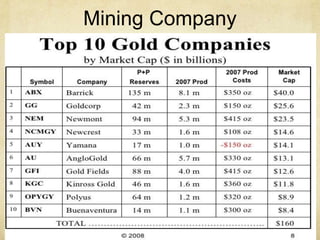
Mining Company
Factors affecting gold prices in
India
International prices.
Interest rates.
Dollar-Rupee Dynamics
Central Banks Reserves
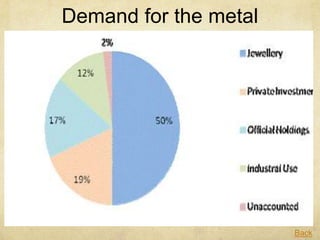
Demand for the metal
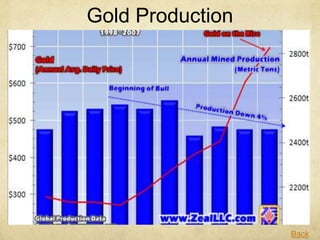
Gold Production
The changes in the CME restrictions.
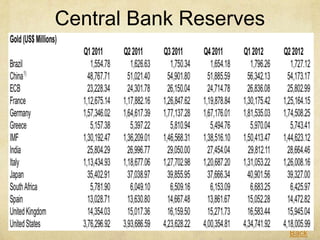
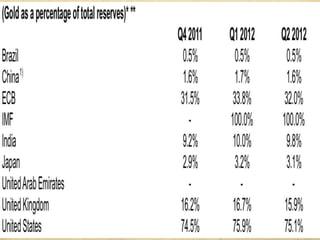
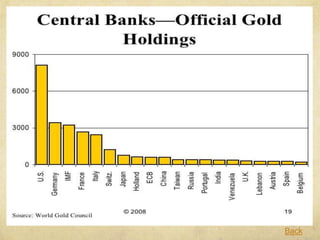
Central Bank Reserves
Back
Back
Demand for the metal
Back
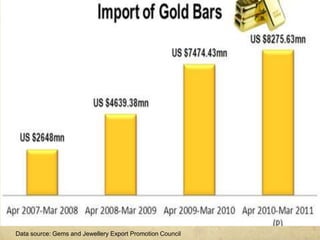
Data source: Gems and Jewellery Export Promotion Council
Gold Production
Back
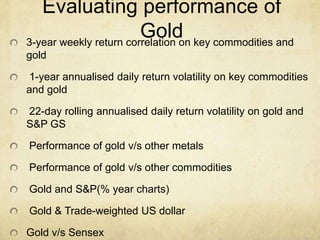
Evaluating performance of
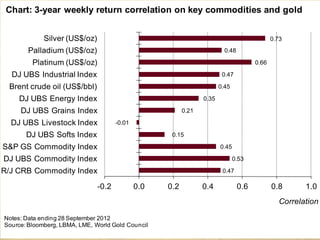
Gold3-year weekly return correlation on key commodities and
gold
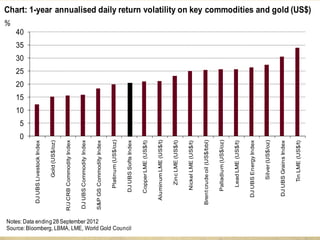
1-year annualised daily return volatility on key commodities
and gold
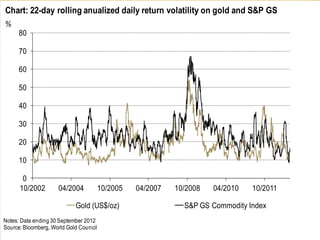
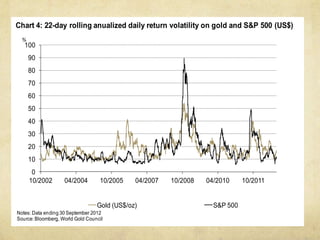
22-day rolling annualised daily return volatility on gold and
S&P GS
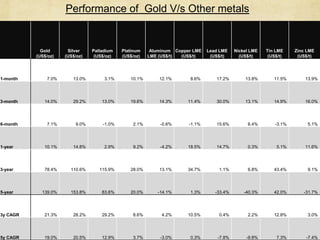
Performance of gold v/s other metals
Performance of gold v/s other commodities
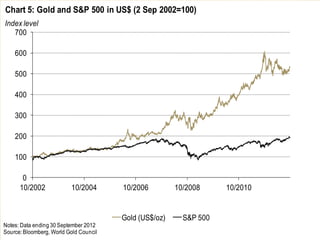
Gold and S&P(% year charts)
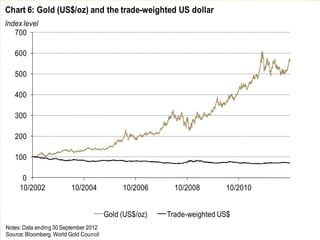
Gold & Trade-weighted US dollar
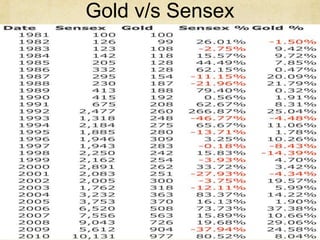
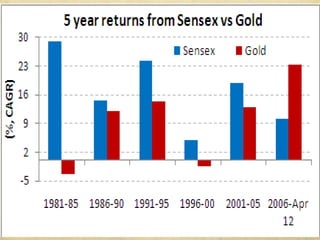
Gold v/s Sensex
0.47
0.53
0.45
0.15
-0.01
0.21
0.35
0.45
0.47
0.66
0.48
0.73
-0.2 0.0 0.2 0.4 0.6 0.8 1.0
R/J CRB Commodity Index
DJ UBS Commodity Index
S&P GS Commodity Index
DJ UBS Softs Index
DJ UBS Livestock Index
DJ UBS Grains Index
DJ UBS Energy Index
Brent crude oil (US$/bbl)
DJ UBS Industrial Index
Platinum (US$/oz)
Palladium (US$/oz)
Silver (US$/oz)
Correlation
Notes: Data ending 28 September 2012
Source: Bloomberg, LBMA, LME, World Gold Council
Chart: 3-year weekly return correlation on key commodities and gold
0
5
10
15
20
25
30
35
40
DJUBSLivestockIndex
Gold(US$/oz)
R/JCRBCommodityIndex
DJUBSCommodityIndex
S&PGSCommodityIndex
Platinum(US$/oz)
DJUBSSoftsIndex
CopperLME(US$/t)
AluminumLME(US$/t)
ZincLME(US$/t)
NickelLME(US$/t)
Brentcrudeoil(US$/bbl)
Palladium(US$/oz)
LeadLME(US$/t)
DJUBSEnergyIndex
Silver(US$/oz)
DJUBSGrainsIndex
TinLME(US$/t)
%
Notes: Data ending 28 September 2012
Source:Bloomberg, LBMA, LME, World Gold Council
Chart: 1-year annualised daily return volatility on key commodities and gold (US$)
0
10
20
30
40
50
60
70
80
10/2002 04/2004 10/2005 04/2007 10/2008 04/2010 10/2011
%
Gold (US$/oz) S&P GS Commodity Index
Notes: Data ending 30 September 2012
Source:Bloomberg, World Gold Council
Chart: 22-day rolling anualized daily return volatility on gold and S&P GS
Gold
(US$/oz)
Silver
(US$/oz)
Palladium
(US$/oz)
Platinum
(US$/oz)
Aluminum
LME (US$/t)
Copper LME
(US$/t)
Lead LME
(US$/t)
Nickel LME
(US$/t)
Tin LME
(US$/t)
Zinc LME
(US$/t)
1-month 7.0% 13.0% 3.1% 10.1% 12.1% 8.6% 17.2% 13.8% 11.5% 13.9%
3-month 14.0% 29.2% 13.0% 19.6% 14.3% 11.4% 30.0% 13.1% 14.9% 16.0%
6-month 7.1% 9.0% -1.0% 2.1% -0.6% -1.1% 15.6% 6.4% -3.1% 5.1%
1-year 10.1% 14.8% 2.9% 9.2% -4.2% 18.5% 14.7% 0.3% 5.1% 11.6%
3-year 78.4% 110.6% 115.9% 28.0% 13.1% 34.7% 1.1% 6.8% 43.4% 9.1%
5-year 139.0% 153.8% 83.6% 20.0% -14.1% 1.3% -33.4% -40.3% 42.0% -31.7%
3y CAGR 21.3% 28.2% 29.2% 8.6% 4.2% 10.5% 0.4% 2.2% 12.8% 3.0%
5y CAGR 19.0% 20.5% 12.9% 3.7% -3.0% 0.3% -7.8% -9.8% 7.3% -7.4%
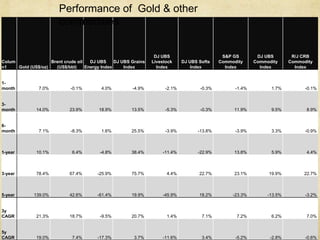
Performance of Gold V/s Other metals
Colum
n1 Gold (US$/oz)
Brent crude oil
(US$/bbl)
DJ UBS
Energy Index
DJ UBS Grains
Index
DJ UBS
Livestock
Index
DJ UBS Softs
Index
S&P GS
Commodity
Index
DJ UBS
Commodity
Index
R/J CRB
Commodity
Index
1-
month 7.0% -0.1% 4.0% -4.9% -2.1% -0.3% -1.4% 1.7% -0.1%
3-
month 14.0% 23.9% 18.9% 13.5% -5.3% -0.3% 11.9% 9.5% 8.9%
6-
month 7.1% -8.3% 1.6% 25.5% -3.9% -13.8% -3.9% 3.3% -0.9%
1-year 10.1% 6.4% -4.8% 38.4% -11.4% -22.9% 13.8% 5.9% 4.4%
3-year 78.4% 67.4% -25.9% 75.7% 4.4% 22.7% 23.1% 19.9% 22.7%
5-year 139.0% 42.6% -61.4% 19.9% -45.9% 18.2% -23.3% -13.5% -3.2%
3y
CAGR 21.3% 18.7% -9.5% 20.7% 1.4% 7.1% 7.2% 6.2% 7.0%
5y
CAGR 19.0% 7.4% -17.3% 3.7% -11.6% 3.4% -5.2% -2.8% -0.6%
Performance of Gold & other
commodities
0
100
200
300
400
500
600
700
10/2002 10/2004 10/2006 10/2008 10/2010
Index level
Gold (US$/oz) S&P 500
Notes: Data ending 30 September 2012
Source:Bloomberg, World Gold Council
Chart 5: Gold and S&P 500 in US$ (2 Sep 2002=100)
0
100
200
300
400
500
600
700
10/2002 10/2004 10/2006 10/2008 10/2010
Index level
Gold (US$/oz) Trade-weighted US$
Notes: Data ending 30 September 2012
Source:Bloomberg, World Gold Council
Chart 6: Gold (US$/oz) and the trade-weighted US dollar
0
10
20
30
40
50
60
70
80
90
100
10/2002 04/2004 10/2005 04/2007 10/2008 04/2010 10/2011
%
Gold (US$/oz) S&P 500
Chart 4: 22-day rolling anualized daily return volatility on gold and S&P 500 (US$)
Notes: Data ending 30 September 2012
Source:Bloomberg, World Gold Council
Gold v/s Sensex
Investing in gold a study

Investing in gold a study

  • 1.
    Investing in Gold-Astudy Puneet Arora-75141 Shantanu Vashishth-75150 Teacher-Ms. Vibhuti Vashishth BFIA 2B
  • 2.
    Contents • Investment Channels •Factors affecting Gold prices in India • Evaluating performance of Gold
  • 3.
    Investment Channels Gold coins& bars Accounts Exchange Traded Products Certificates Derivatives,CFDs and spread bettings Mining Companies Contents
  • 4.
    Gold bars &coins  most traditional way of investing in gold is by buying bullion gold bars  these can easily be bought or sold at the major banks or from bullion dealers  gold bars carry lower premium over spot price than gold coins.  larger bars carry an increased risk of forgery.  The Krugerrand is the most widely-held gold bullion coin, with 46,000,000 troy ounces (1,400 tonnes) in circulation.
  • 5.
    Accounts Gold bullion banksoffer two types of gold accounts - allocated and unallocated: 1. Allocated account 2. Unallocated account Other opportunities for smaller investors include: 1. Gold pool accounts 2. Electronic currencies
  • 6.
    Exchange Traded Products includeETFs, ETNs, and CEFs which are traded like shares on the major stock exchanges. Gold ETPs represent an easy way to gain exposure to the gold price, without the inconvenience of storing physical bars. Typically a small commission is charged for trading in gold ETPs and a small annual storage fee is charged. The annual expenses of the fund such as storage, insurance, and management fees are charged by selling a small amount of gold represented by each certificate, so the amount of gold in each certificate will gradually decline over time.
  • 7.
    Certificates Gold certificates allowgold investors to avoid the risks and costs associated with the transfer and storage of physical bullion (such as theft, large bid-offer spread, and metallurgical assay costs) It entails taking on a different set of risks and costs associated with the certificate itself (such as commissions, storage fees, and various types of credit risk).
  • 8.
  • 9.
    Factors affecting goldprices in India International prices. Interest rates. Dollar-Rupee Dynamics Central Banks Reserves Demand for the metal Gold Production The changes in the CME restrictions.
  • 10.
  • 12.
  • 13.
    Demand for themetal Back
  • 14.
    Data source: Gemsand Jewellery Export Promotion Council
  • 15.
  • 16.
    Evaluating performance of Gold3-yearweekly return correlation on key commodities and gold 1-year annualised daily return volatility on key commodities and gold 22-day rolling annualised daily return volatility on gold and S&P GS Performance of gold v/s other metals Performance of gold v/s other commodities Gold and S&P(% year charts) Gold & Trade-weighted US dollar Gold v/s Sensex
  • 17.
    0.47 0.53 0.45 0.15 -0.01 0.21 0.35 0.45 0.47 0.66 0.48 0.73 -0.2 0.0 0.20.4 0.6 0.8 1.0 R/J CRB Commodity Index DJ UBS Commodity Index S&P GS Commodity Index DJ UBS Softs Index DJ UBS Livestock Index DJ UBS Grains Index DJ UBS Energy Index Brent crude oil (US$/bbl) DJ UBS Industrial Index Platinum (US$/oz) Palladium (US$/oz) Silver (US$/oz) Correlation Notes: Data ending 28 September 2012 Source: Bloomberg, LBMA, LME, World Gold Council Chart: 3-year weekly return correlation on key commodities and gold
  • 18.
  • 19.
    0 10 20 30 40 50 60 70 80 10/2002 04/2004 10/200504/2007 10/2008 04/2010 10/2011 % Gold (US$/oz) S&P GS Commodity Index Notes: Data ending 30 September 2012 Source:Bloomberg, World Gold Council Chart: 22-day rolling anualized daily return volatility on gold and S&P GS
  • 20.
    Gold (US$/oz) Silver (US$/oz) Palladium (US$/oz) Platinum (US$/oz) Aluminum LME (US$/t) Copper LME (US$/t) LeadLME (US$/t) Nickel LME (US$/t) Tin LME (US$/t) Zinc LME (US$/t) 1-month 7.0% 13.0% 3.1% 10.1% 12.1% 8.6% 17.2% 13.8% 11.5% 13.9% 3-month 14.0% 29.2% 13.0% 19.6% 14.3% 11.4% 30.0% 13.1% 14.9% 16.0% 6-month 7.1% 9.0% -1.0% 2.1% -0.6% -1.1% 15.6% 6.4% -3.1% 5.1% 1-year 10.1% 14.8% 2.9% 9.2% -4.2% 18.5% 14.7% 0.3% 5.1% 11.6% 3-year 78.4% 110.6% 115.9% 28.0% 13.1% 34.7% 1.1% 6.8% 43.4% 9.1% 5-year 139.0% 153.8% 83.6% 20.0% -14.1% 1.3% -33.4% -40.3% 42.0% -31.7% 3y CAGR 21.3% 28.2% 29.2% 8.6% 4.2% 10.5% 0.4% 2.2% 12.8% 3.0% 5y CAGR 19.0% 20.5% 12.9% 3.7% -3.0% 0.3% -7.8% -9.8% 7.3% -7.4% Performance of Gold V/s Other metals
  • 21.
    Colum n1 Gold (US$/oz) Brentcrude oil (US$/bbl) DJ UBS Energy Index DJ UBS Grains Index DJ UBS Livestock Index DJ UBS Softs Index S&P GS Commodity Index DJ UBS Commodity Index R/J CRB Commodity Index 1- month 7.0% -0.1% 4.0% -4.9% -2.1% -0.3% -1.4% 1.7% -0.1% 3- month 14.0% 23.9% 18.9% 13.5% -5.3% -0.3% 11.9% 9.5% 8.9% 6- month 7.1% -8.3% 1.6% 25.5% -3.9% -13.8% -3.9% 3.3% -0.9% 1-year 10.1% 6.4% -4.8% 38.4% -11.4% -22.9% 13.8% 5.9% 4.4% 3-year 78.4% 67.4% -25.9% 75.7% 4.4% 22.7% 23.1% 19.9% 22.7% 5-year 139.0% 42.6% -61.4% 19.9% -45.9% 18.2% -23.3% -13.5% -3.2% 3y CAGR 21.3% 18.7% -9.5% 20.7% 1.4% 7.1% 7.2% 6.2% 7.0% 5y CAGR 19.0% 7.4% -17.3% 3.7% -11.6% 3.4% -5.2% -2.8% -0.6% Performance of Gold & other commodities
  • 22.
    0 100 200 300 400 500 600 700 10/2002 10/2004 10/200610/2008 10/2010 Index level Gold (US$/oz) S&P 500 Notes: Data ending 30 September 2012 Source:Bloomberg, World Gold Council Chart 5: Gold and S&P 500 in US$ (2 Sep 2002=100)
  • 23.
    0 100 200 300 400 500 600 700 10/2002 10/2004 10/200610/2008 10/2010 Index level Gold (US$/oz) Trade-weighted US$ Notes: Data ending 30 September 2012 Source:Bloomberg, World Gold Council Chart 6: Gold (US$/oz) and the trade-weighted US dollar
  • 24.
    0 10 20 30 40 50 60 70 80 90 100 10/2002 04/2004 10/200504/2007 10/2008 04/2010 10/2011 % Gold (US$/oz) S&P 500 Chart 4: 22-day rolling anualized daily return volatility on gold and S&P 500 (US$) Notes: Data ending 30 September 2012 Source:Bloomberg, World Gold Council
  • 25.

Editor's Notes

  • #9 Instead of buying gold itself, investors can buy the companies that produce the gold as shares in gold mining companies. If the gold price rises, the profits of the gold mining company could be expected to rise and the worth of the company will rise and presumably the share price will also rise.
  • #10 1: From 1970 to 1980 there has been a decline and then a stagnation in the world gold production resulting in a higher gold price (positive divergence). The price was too low for several decades, forcing some gold mines to close as production costs were above the selling price.Then from 1980 to 2001, for 20 years, the gold world production has increased resulting this time in a decrease of the gold price (negative divergence). Gold mines were producing more in order to compensate for the price decline from $850 to less than 250 dollars an ounce ...2: From 2001 to 2008, we had a decline in gold production and higher prices from 2008 to 2010 (positive divergence). Gold production decreased by 340 tonnes while the gold price has tripled. The prices were too low to encourage the opening of new gold mines as well as exploration.CME-during September 2011 the CME decided to raise margins on gold and silver contracts; the market’s reaction was very quick and bullion rates tumbled down. This is a type of market intervention. If the CME will raise margins due to another heat up in precious metals market, then prices are likely to tumble down;
  • #11 Central banks keep ignot reserves as a hedge against inflation.