Anne Thomas Manes
                         New Security Models for the Cloud
VP & Research Director
amanes@burtongroup.com
www.burtongroup.com
Twitter: @atmanes        November 19, 2009


                                                     All Contents © 2009 Burton Group. All rights reserved.
Cloud Computing                                  2


The set of disciplines, technologies, and business
      models used to deliver IT capabilities
         (software, platforms, hardware)
    as on-demand, scalable, elastic services


   How can I                        Look more
   make this...                      like this?
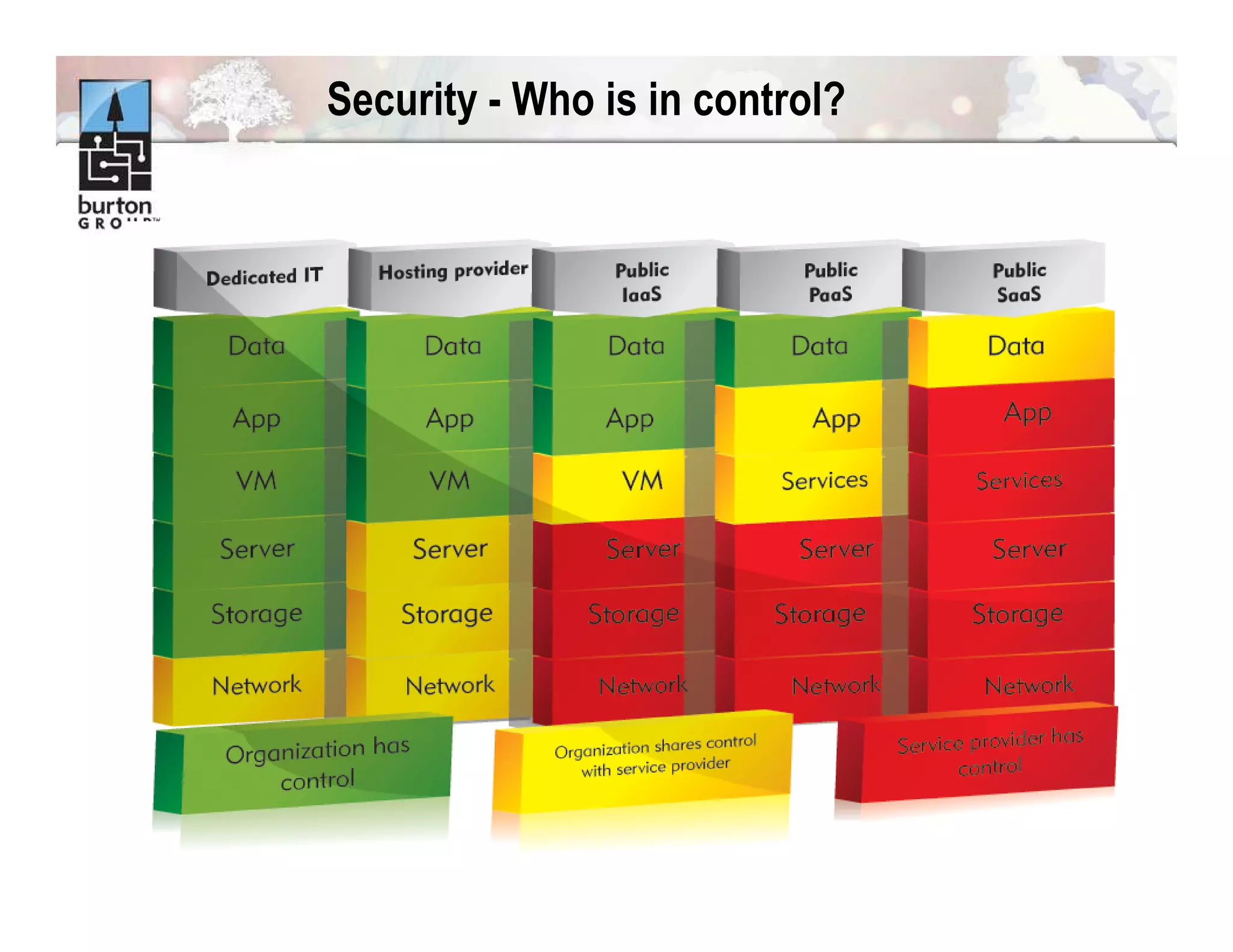
Security - Who is in control?
What…Me Worry?

• Public cloud’s multi-tenant,
  dynamic characteristics may
  put sensitive, or regulated
  data at risk
• Vendor viability creates
  strategic risk
• Denial of service attacks
  could create systemic risk
• A lack of transparency and
  accountability about security
  from cloud vendors lowers       IDC survey: 74% rate
  trust                           cloud security issues as
                                  “very significant”
How’s the Public Cloud Security?
Incidents
• November 2007: Salesforce Staff Speared by Phishers
• July, 2008 Hey Spammers, Get Off My Cloud!
• March 2009: Google Privacy Blunder Shares Your Docs…
• June 2009: Webhost hack wipes out data for 100,000 sites
• October 2009: Amazon Web Services DDoS Attack And The
  Cloud
• More at
  http://wiki.cloudcommunity.org/wiki/CloudComputing:Incidents_Database
Service
                                                                                                       consumer
                                                                                                         Service request
                                                                                                         (console or API)


                                                                         Service
Cloud Computing                                                          catalog                   Service interface


                                         Enterprise service management
                                         Enterprise service management
                                                                                                 Cloud
Requires a New                                                             Virtual DC          Virtual DC          Virtual DC
                                                                                                                                     External
                                                                                                                                   application(s)

Security
Architecture
                                                                                               Cloud OS

                                                                                               Service bus
                                                                                                                                     External service
• Virtual data centers    Internal IT                                                      Cloud management                              provider
• Service oriented       organization
                                                                                                                                     Service interface
                                                                                     Virtual infrastructure management
interfaces
• Next generation                  Traditional
                                                                                          Virtual infrastructure                         Cloud OS


operating systems and            infrastructure
                                                                           Compute       Network       Storage         Security     Virtual infrastructure

management tools                                                                         Physical infrastructure                   Physical infrastructure

                                                                            Compute       Network        Storage        Security
Rethinking Security Architecture
Security perimeters are changing
• Activities and data move across open, untrusted
  networks
• “Zones of trust” must become more logical than physical
   • Identity and application-aware firewalls
• Security vendors must embrace virtualization security
• Security management must span internal and external
  clouds
Rethinking Security Architecture
Service-oriented security and identity management
• Security must span internal and external clouds
• Service oriented interfaces must be secured
• Existing domain access control must give way to
  standards-based identity services
   • Multiple sources of identity
• Encryption and key management must “follow” sensitive
  data
Security Zone Model                                              9


                   Zone definition: “A grouping of IT resources which may
                   reside at multiple locations but have similar business
                   communication and network protection requirements”


Typical
organization
has
equivalent
of some or
all of these
zones


                                                                 * Audit zone
                                                                 optional
Changing Zone Implementations                                        10


     Physical view – “old school” zone implementation
     Separation between the enterprise resources (sites, servers,
      devices) and the untrusted zone accomplished by
                                 Perimeter Devices
 Enterprise Controlled/Owned                  Enterprise Controlled/Owned

 User Site                                                         Data Center
                  Not necessarily secure protocols                 Monitoring
                                                                      and
                                                                    Enforce-
                           Site to Site VPN                          ment
   Not
                           or Private WAN
Necessarily
                                                             Access              Server
  secure
                                                            Perimeter            “Farm”
 endpoint


                                                                    Internet
Changing Zone Implementations                                       11


          Physical view – “new school” zone implementation
          Separation between the enterprise resources (sites, servers,
           devices) and the untrusted zone accomplished by
           cryptography, e.g.
                                  Security Overlays
                                                    Enterprise Controlled/Owned
                                                            Data Center
                       Secure Protocols                     Monitoring
                                                VPN
                                                               and
                       Any network or         Or Proxy
                                                             Enforce-
                            site              System                                End to
                                                              ment
 Secure                                                                            End Sec
Endpoint
 (VPN client,                              End to     Access              Server
    system                                End Sec    Perimeter            “Farm”
firewall, etc.)


                          (resulting in this kind of topology)
Dynamic Perimeter Enforcement                                      12


New model: Logical zones with dynamic perimeters
• Numerous, coordinated endpoint security agents
   • Centralized policy controls connection rules
• Smarter firewalls
• Smarter switching fabric
• Common theme: Multi-layer enforcement (L4 + L7)
   • Access decisions based on identity and application protocol, not just
     IP address and port
Mutually Reinforcing SOA and Security                          13


• SOA adds a new dimension to the security landscape
  •   Loosely coupled connections
  •   Requirements for cross-domain federation
  •   Don’t assume the average developer understands all the issues
  •   Don’t assume that all services can safely combine in all security
      contexts
• Recommended strategy
  • Build on existing IdM strategy
  • Externalize security as much as possible (e.g. authentication,
    authorization, crypto, audit)
  • Combine transport-level and application-level protections
  • Use layered defenses
  • Establish good governance processes
Applying SOA to Security                                           14


     Layered defenses
           • Policy enforcement points (PEPs) as intermediaries and at endpoint s
           • Externalize security functions to the PEPs
                          Firewalls
                      (Perimeter PEPs)
                                                  Service      Service     Service
External
Service                                           Endpoint     Endpoint    Endpoint
                                                    PEP          PEP         PEP

External
Service
                         Centralized            Intermediary              Intermediary
                           PEP                       PEP                       PEP
External
Service
                                                  Endpoint     Endpoint    Endpoint

External
                           DMZ                      PEP          PEP         PEP

Service                                           Service      Service     Service
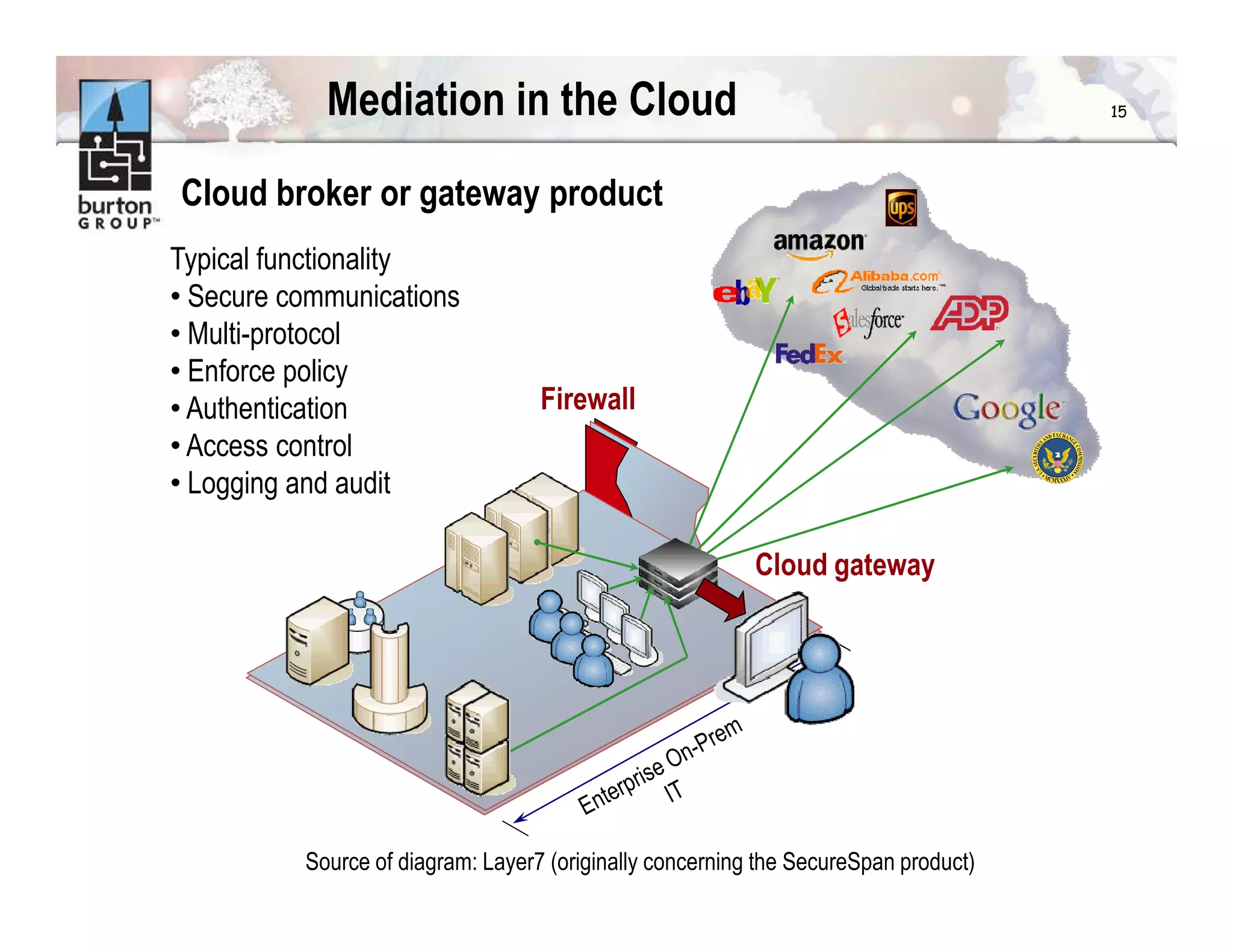
Mediation in the Cloud                                                   15


Cloud broker or gateway product
Typical functionality
• Secure communications
• Multi-protocol
• Enforce policy
• Authentication                   Firewall
• Access control
• Logging and audit

                                                          Cloud gateway


          Source of diagram: Layer7 (originally concerning the SecureSpan product)
New Security Models for the Cloud                  16


Recommendations and takeaways
• Think “service-oriented” when you’re thinking cloud
• Mutually reinforce SOA and security:
   • Secure communications methods
   • Layered defense
   • Good governance
• Consider cloud brokers to enforce policies in the cloud
New Security Model Requirements for the Cloud
 Enabling Safe Cloud Computing
 K. Scott Morrison
 CTO & Chief Architect
Trust is the fundamental requirement
                  of cloud computing
Anne showed us we need to:


      Understand Risk

      Control Boundaries


                    Trust is the measure of your confidence in these
But How Do We Gain Control Over SaaS?


                              Consider the degrees of
                              freedom SOA offers us
Pattern 1: Assert Outgoing Control

  Single Sign On
  Managed access to
authorized services
  SLA enforcement
                      Firewall
 Audit


      Directory


                                 NetOps
Pattern 2: Manage Access to Corporate Resources

       Access Control
       Alarms and audit
       Safe routing

                        DMZ   Firewall


            Secure
             Zone


Directory


                                                    SaaS
                                                  Application
                                         NetOps     User
How Do We Assert Control Over IaaS?
Pattern 3: Manage Cloud-Based SOA Apps with Virtual PEP
 Hardware PEP                             Virtual PEP


                                                                          Cloud
                                                                         Services
                Identical Functionality
                                                              Virtual
                                                               PEP


                                               Hardware PEP
                                                 Instances


                                                                        Secure Services, Not
                                                                        Networks
What Does Layered Defense Look Like In The Cloud?

                 Firewalls
             (Perimeter PEPs)
                                  Service      Service     Service
 External
 Service                          Endpoint     Endpoint    Endpoint
                                    PEP          PEP         PEP

 External
 Service
                Centralized     Intermediary              Intermediary
                  PEP                PEP                       PEP
 External
 Service
                                  Endpoint     Endpoint    Endpoint

 External
                  DMZ               PEP          PEP         PEP

 Service                          Service      Service     Service
Zones of Trust


                         ?                                      Application-
      ?                                                            Layer
                             ?                                   Isolation,
                                                                Monitoring, &
                                                                  Control


                                                      ?           ?
                                 Cloud Edge Virtual
        Secure Message                 PEP

                                                          This is true SOA
                                                          defense-in-depth
This Is The Ultimate Realization Of SOA

  Visibility
  Security
  Control


                                          Cloud Governance is the
                                          evolution of SOA
                                NetOps    Governance
For More Information:

K. Scott Morrison           Anne Thomas Manes
Layer 7 Technologies        Burton Group
CTO and Chief Architect     VP & Research Director


smorrison@layer7tech.com    amanes@burtongroup.com
http://www.layer7tech.com   http://www.brutongroup.com
Twitter: @kscottmorrison    Twitter: @atmanes

Layer 7 & Burton Group: New Cloud Security Model Requirements

  • 1.
    Anne Thomas Manes New Security Models for the Cloud VP & Research Director amanes@burtongroup.com www.burtongroup.com Twitter: @atmanes November 19, 2009 All Contents © 2009 Burton Group. All rights reserved.
  • 2.
    Cloud Computing 2 The set of disciplines, technologies, and business models used to deliver IT capabilities (software, platforms, hardware) as on-demand, scalable, elastic services How can I Look more make this... like this?
  • 3.
    Security - Whois in control?
  • 4.
    What…Me Worry? • Publiccloud’s multi-tenant, dynamic characteristics may put sensitive, or regulated data at risk • Vendor viability creates strategic risk • Denial of service attacks could create systemic risk • A lack of transparency and accountability about security from cloud vendors lowers IDC survey: 74% rate trust cloud security issues as “very significant”
  • 5.
    How’s the PublicCloud Security? Incidents • November 2007: Salesforce Staff Speared by Phishers • July, 2008 Hey Spammers, Get Off My Cloud! • March 2009: Google Privacy Blunder Shares Your Docs… • June 2009: Webhost hack wipes out data for 100,000 sites • October 2009: Amazon Web Services DDoS Attack And The Cloud • More at http://wiki.cloudcommunity.org/wiki/CloudComputing:Incidents_Database
  • 6.
    Service consumer Service request (console or API) Service Cloud Computing catalog Service interface Enterprise service management Enterprise service management Cloud Requires a New Virtual DC Virtual DC Virtual DC External application(s) Security Architecture Cloud OS Service bus External service • Virtual data centers Internal IT Cloud management provider • Service oriented organization Service interface Virtual infrastructure management interfaces • Next generation Traditional Virtual infrastructure Cloud OS operating systems and infrastructure Compute Network Storage Security Virtual infrastructure management tools Physical infrastructure Physical infrastructure Compute Network Storage Security
  • 7.
    Rethinking Security Architecture Securityperimeters are changing • Activities and data move across open, untrusted networks • “Zones of trust” must become more logical than physical • Identity and application-aware firewalls • Security vendors must embrace virtualization security • Security management must span internal and external clouds
  • 8.
    Rethinking Security Architecture Service-orientedsecurity and identity management • Security must span internal and external clouds • Service oriented interfaces must be secured • Existing domain access control must give way to standards-based identity services • Multiple sources of identity • Encryption and key management must “follow” sensitive data
  • 9.
    Security Zone Model 9 Zone definition: “A grouping of IT resources which may reside at multiple locations but have similar business communication and network protection requirements” Typical organization has equivalent of some or all of these zones * Audit zone optional
  • 10.
    Changing Zone Implementations 10 Physical view – “old school” zone implementation Separation between the enterprise resources (sites, servers, devices) and the untrusted zone accomplished by Perimeter Devices Enterprise Controlled/Owned Enterprise Controlled/Owned User Site Data Center Not necessarily secure protocols Monitoring and Enforce- Site to Site VPN ment Not or Private WAN Necessarily Access Server secure Perimeter “Farm” endpoint Internet
  • 11.
    Changing Zone Implementations 11 Physical view – “new school” zone implementation Separation between the enterprise resources (sites, servers, devices) and the untrusted zone accomplished by cryptography, e.g. Security Overlays Enterprise Controlled/Owned Data Center Secure Protocols Monitoring VPN and Any network or Or Proxy Enforce- site System End to ment Secure End Sec Endpoint (VPN client, End to Access Server system End Sec Perimeter “Farm” firewall, etc.) (resulting in this kind of topology)
  • 12.
    Dynamic Perimeter Enforcement 12 New model: Logical zones with dynamic perimeters • Numerous, coordinated endpoint security agents • Centralized policy controls connection rules • Smarter firewalls • Smarter switching fabric • Common theme: Multi-layer enforcement (L4 + L7) • Access decisions based on identity and application protocol, not just IP address and port
  • 13.
    Mutually Reinforcing SOAand Security 13 • SOA adds a new dimension to the security landscape • Loosely coupled connections • Requirements for cross-domain federation • Don’t assume the average developer understands all the issues • Don’t assume that all services can safely combine in all security contexts • Recommended strategy • Build on existing IdM strategy • Externalize security as much as possible (e.g. authentication, authorization, crypto, audit) • Combine transport-level and application-level protections • Use layered defenses • Establish good governance processes
  • 14.
    Applying SOA toSecurity 14 Layered defenses • Policy enforcement points (PEPs) as intermediaries and at endpoint s • Externalize security functions to the PEPs Firewalls (Perimeter PEPs) Service Service Service External Service Endpoint Endpoint Endpoint PEP PEP PEP External Service Centralized Intermediary Intermediary PEP PEP PEP External Service Endpoint Endpoint Endpoint External DMZ PEP PEP PEP Service Service Service Service
  • 15.
    Mediation in theCloud 15 Cloud broker or gateway product Typical functionality • Secure communications • Multi-protocol • Enforce policy • Authentication Firewall • Access control • Logging and audit Cloud gateway Source of diagram: Layer7 (originally concerning the SecureSpan product)
  • 16.
    New Security Modelsfor the Cloud 16 Recommendations and takeaways • Think “service-oriented” when you’re thinking cloud • Mutually reinforce SOA and security: • Secure communications methods • Layered defense • Good governance • Consider cloud brokers to enforce policies in the cloud
  • 17.
    New Security ModelRequirements for the Cloud Enabling Safe Cloud Computing K. Scott Morrison CTO & Chief Architect
  • 18.
    Trust is thefundamental requirement of cloud computing
  • 19.
    Anne showed uswe need to: Understand Risk Control Boundaries Trust is the measure of your confidence in these
  • 20.
    But How DoWe Gain Control Over SaaS? Consider the degrees of freedom SOA offers us
  • 21.
    Pattern 1: AssertOutgoing Control Single Sign On Managed access to authorized services SLA enforcement Firewall Audit Directory NetOps
  • 22.
    Pattern 2: ManageAccess to Corporate Resources Access Control Alarms and audit Safe routing DMZ Firewall Secure Zone Directory SaaS Application NetOps User
  • 23.
    How Do WeAssert Control Over IaaS?
  • 24.
    Pattern 3: ManageCloud-Based SOA Apps with Virtual PEP Hardware PEP Virtual PEP Cloud Services Identical Functionality Virtual PEP Hardware PEP Instances Secure Services, Not Networks
  • 25.
    What Does LayeredDefense Look Like In The Cloud? Firewalls (Perimeter PEPs) Service Service Service External Service Endpoint Endpoint Endpoint PEP PEP PEP External Service Centralized Intermediary Intermediary PEP PEP PEP External Service Endpoint Endpoint Endpoint External DMZ PEP PEP PEP Service Service Service Service
  • 26.
    Zones of Trust ? Application- ? Layer ? Isolation, Monitoring, & Control ? ? Cloud Edge Virtual Secure Message PEP This is true SOA defense-in-depth
  • 27.
    This Is TheUltimate Realization Of SOA Visibility Security Control Cloud Governance is the evolution of SOA NetOps Governance
  • 28.
    For More Information: K.Scott Morrison Anne Thomas Manes Layer 7 Technologies Burton Group CTO and Chief Architect VP & Research Director smorrison@layer7tech.com amanes@burtongroup.com http://www.layer7tech.com http://www.brutongroup.com Twitter: @kscottmorrison Twitter: @atmanes