Services & Network Administration
                 Cloud Computing


Presented by :
Zaibi Mohammed
                                    2011/2012
Outline
• Definition
• History of Computing
• Understanding the nature of the cloud (Characteristics)
• Examining the cloud elements (Service models)
• Green benefits of Cloud Computing
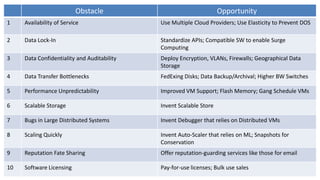
• Quick Preview of Top 10 Obstacles and Opportunities for
  Growth of Cloud Computing
What is cloud computing ?
• The cloud is a set of hardware, networks, storage,
  services, and interfaces that enable the delivery of
  computing as a service.
• Cloud services include the delivery of software,
  infrastructure, and storage over the Internet (either as
  separate components or a complete platform) based
  on user demand.


                                                             1
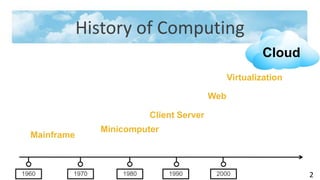
History of Computing
                                                          Cloud
                                                  Virtualization

                                            Web

                            Client Server
                 Minicomputer
  Mainframe


1960      1970       1980       1990         2000                  2
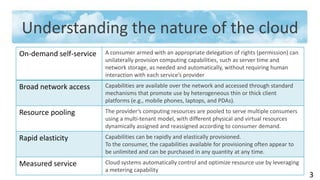
Understanding the nature of the cloud
On-demand self-service   A consumer armed with an appropriate delegation of rights (permission) can
                         unilaterally provision computing capabilities, such as server time and
                         network storage, as needed and automatically, without requiring human
                         interaction with each service’s provider
Broad network access     Capabilities are available over the network and accessed through standard
                         mechanisms that promote use by heterogeneous thin or thick client
                         platforms (e.g., mobile phones, laptops, and PDAs).
Resource pooling         The provider’s computing resources are pooled to serve multiple consumers
                         using a multi-tenant model, with different physical and virtual resources
                         dynamically assigned and reassigned according to consumer demand.
Rapid elasticity         Capabilities can be rapidly and elastically provisioned.
                         To the consumer, the capabilities available for provisioning often appear to
                         be unlimited and can be purchased in any quantity at any time.
Measured service         Cloud systems automatically control and optimize resource use by leveraging
                         a metering capability
                                                                                                        3
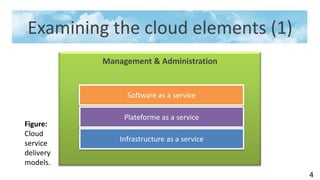
Examining the cloud elements (1)
           Management & Administration


                 Software as a service

                Plateforme as a service
Figure:
Cloud
               Infrastructure as a service
service
delivery
models.
                                             4
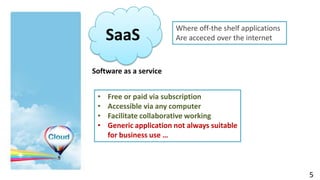
Where off-the shelf applications
     SaaS                Are acceced over the internet


Software as a service


 •   Free or paid via subscription
 •   Accessible via any computer
 •   Facilitate collaborative working
 •   Generic application not always suitable
     for business use …


                                                            5
exemples
Office Apps: Word Processors, Spreadsheets and Presentation Packages

Google Docs                        Zoho                     SlideRocket


                                                                          6
Provide envirement and tools
    PaaS                 for creating new applications


Plateform as a service


 • Rapid development at low coast
 • Private or public deployment
 • Limits developers to provider
   languages and tools


                                                         7
exemples
Platform as a Service (PaaS) Vendors :
Google App Engine            Windows Azure   Salesforce


                                                          8
Allows existing applications to be
    IaaS                      run on a cloud supplier’s hardware


Infrastructure as a service
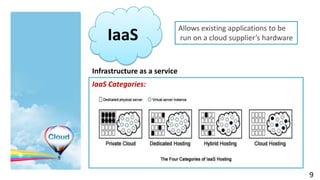
IaaS Categories:


                                                                   9
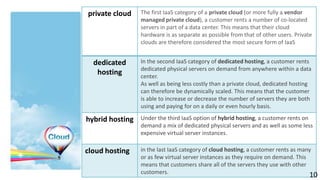
private cloud    The first IaaS category of a private cloud (or more fully a vendor
                 managed private cloud), a customer rents a number of co-located
                 servers in part of a data center. This means that their cloud
                 hardware is as separate as possible from that of other users. Private
                 clouds are therefore considered the most secure form of IaaS


  dedicated      In the second IaaS category of dedicated hosting, a customer rents
                 dedicated physical servers on demand from anywhere within a data
   hosting       center.
                 As well as being less costly than a private cloud, dedicated hosting
                 can therefore be dynamically scaled. This means that the customer
                 is able to increase or decrease the number of servers they are both
                 using and paying for on a daily or even hourly basis.

hybrid hosting   Under the third IaaS option of hybrid hosting, a customer rents on
                 demand a mix of dedicated physical servers and as well as some less
                 expensive virtual server instances.

cloud hosting    in the last IaaS category of cloud hosting, a customer rents as many
                 or as few virtual server instances as they require on demand. This
                 means that customers share all of the servers they use with other
                 customers.
                                                                                    10
exemples
IaaS Providers:
Amazon Web Services    GoGrid    Elastic Hosts


                                                 11
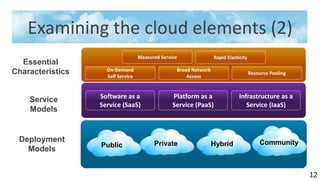
Examining the cloud elements (2)
                                   Measured Service               Rapid Elasticity
  Essential
Characteristics     On-Demand                     Broad Network
                                                                                     Resource Pooling
                    Self Service                      Access


                  Software as a                  Platform as a                Infrastructure as a
    Service
                  Service (SaaS)                 Service (PaaS)                  Service (IaaS)
    Models


 Deployment                              Private                                         Community
                  Public                                          Hybrid
   Models


                                                                                                        12
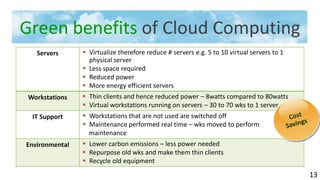
Green benefits of Cloud Computing
   Servers       Virtualize therefore reduce # servers e.g. 5 to 10 virtual servers to 1
                  physical server
                 Less space required
                 Reduced power
                 More energy efficient servers
Workstations     Thin clients and hence reduced power – 8watts compared to 80watts
                 Virtual workstations running on servers – 30 to 70 wks to 1 server
 IT Support      Workstations that are not used are switched off
                 Maintenance performed real time – wks moved to perform
                  maintenance
Environmental    Lower carbon emissions – less power needed
                 Repurpose old wks and make them thin clients
                 Recycle old equipment
                                                                                            13
Obstacle                                   Opportunity
1             Quick Preview of Top MultipleObstacles Elasticity to Prevent DOS
     Availability of Service     Use 10 Cloud Providers; Use and

2     Opportunities for Growth of APIs; Compatible SW to enable Surge
     Data Lock-In                Standardize Cloud Computing
                                             Computing
3    Data Confidentiality and Auditability   Deploy Encryption, VLANs, Firewalls; Geographical Data
                                             Storage
4    Data Transfer Bottlenecks               FedExing Disks; Data Backup/Archival; Higher BW Switches

5    Performance Unpredictability            Improved VM Support; Flash Memory; Gang Schedule VMs

6    Scalable Storage                        Invent Scalable Store

7    Bugs in Large Distributed Systems       Invent Debugger that relies on Distributed VMs

8    Scaling Quickly                         Invent Auto-Scaler that relies on ML; Snapshots for
                                             Conservation
9    Reputation Fate Sharing                 Offer reputation-guarding services like those for email

10   Software Licensing                      Pay-for-use licenses; Bulk use sales
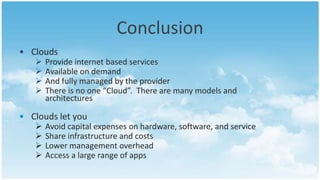
Conclusion
• Clouds
      Provide internet based services
      Available on demand
      And fully managed by the provider
      There is no one “Cloud”. There are many models and
       architectures

• Clouds let you
      Avoid capital expenses on hardware, software, and service
      Share infrastructure and costs
      Lower management overhead
      Access a large range of apps
Thank you for giving us the
       opportunity
    to present this subject

Cloud computing

  • 1.
    Services & NetworkAdministration Cloud Computing Presented by : Zaibi Mohammed 2011/2012
  • 2.
    Outline • Definition • Historyof Computing • Understanding the nature of the cloud (Characteristics) • Examining the cloud elements (Service models) • Green benefits of Cloud Computing • Quick Preview of Top 10 Obstacles and Opportunities for Growth of Cloud Computing
  • 3.
    What is cloudcomputing ? • The cloud is a set of hardware, networks, storage, services, and interfaces that enable the delivery of computing as a service. • Cloud services include the delivery of software, infrastructure, and storage over the Internet (either as separate components or a complete platform) based on user demand. 1
  • 4.
    History of Computing Cloud Virtualization Web Client Server Minicomputer Mainframe 1960 1970 1980 1990 2000 2
  • 5.
    Understanding the natureof the cloud On-demand self-service A consumer armed with an appropriate delegation of rights (permission) can unilaterally provision computing capabilities, such as server time and network storage, as needed and automatically, without requiring human interaction with each service’s provider Broad network access Capabilities are available over the network and accessed through standard mechanisms that promote use by heterogeneous thin or thick client platforms (e.g., mobile phones, laptops, and PDAs). Resource pooling The provider’s computing resources are pooled to serve multiple consumers using a multi-tenant model, with different physical and virtual resources dynamically assigned and reassigned according to consumer demand. Rapid elasticity Capabilities can be rapidly and elastically provisioned. To the consumer, the capabilities available for provisioning often appear to be unlimited and can be purchased in any quantity at any time. Measured service Cloud systems automatically control and optimize resource use by leveraging a metering capability 3
  • 6.
    Examining the cloudelements (1) Management & Administration Software as a service Plateforme as a service Figure: Cloud Infrastructure as a service service delivery models. 4
  • 7.
    Where off-the shelfapplications SaaS Are acceced over the internet Software as a service • Free or paid via subscription • Accessible via any computer • Facilitate collaborative working • Generic application not always suitable for business use … 5
  • 8.
    exemples Office Apps: WordProcessors, Spreadsheets and Presentation Packages Google Docs Zoho SlideRocket 6
  • 9.
    Provide envirement andtools PaaS for creating new applications Plateform as a service • Rapid development at low coast • Private or public deployment • Limits developers to provider languages and tools 7
  • 10.
    exemples Platform as aService (PaaS) Vendors : Google App Engine Windows Azure Salesforce 8
  • 11.
    Allows existing applicationsto be IaaS run on a cloud supplier’s hardware Infrastructure as a service IaaS Categories: 9
  • 12.
    private cloud The first IaaS category of a private cloud (or more fully a vendor managed private cloud), a customer rents a number of co-located servers in part of a data center. This means that their cloud hardware is as separate as possible from that of other users. Private clouds are therefore considered the most secure form of IaaS dedicated In the second IaaS category of dedicated hosting, a customer rents dedicated physical servers on demand from anywhere within a data hosting center. As well as being less costly than a private cloud, dedicated hosting can therefore be dynamically scaled. This means that the customer is able to increase or decrease the number of servers they are both using and paying for on a daily or even hourly basis. hybrid hosting Under the third IaaS option of hybrid hosting, a customer rents on demand a mix of dedicated physical servers and as well as some less expensive virtual server instances. cloud hosting in the last IaaS category of cloud hosting, a customer rents as many or as few virtual server instances as they require on demand. This means that customers share all of the servers they use with other customers. 10
  • 13.
    exemples IaaS Providers: Amazon WebServices GoGrid Elastic Hosts 11
  • 14.
    Examining the cloudelements (2) Measured Service Rapid Elasticity Essential Characteristics On-Demand Broad Network Resource Pooling Self Service Access Software as a Platform as a Infrastructure as a Service Service (SaaS) Service (PaaS) Service (IaaS) Models Deployment Private Community Public Hybrid Models 12
  • 15.
    Green benefits ofCloud Computing Servers  Virtualize therefore reduce # servers e.g. 5 to 10 virtual servers to 1 physical server  Less space required  Reduced power  More energy efficient servers Workstations  Thin clients and hence reduced power – 8watts compared to 80watts  Virtual workstations running on servers – 30 to 70 wks to 1 server IT Support  Workstations that are not used are switched off  Maintenance performed real time – wks moved to perform maintenance Environmental  Lower carbon emissions – less power needed  Repurpose old wks and make them thin clients  Recycle old equipment 13
  • 16.
    Obstacle Opportunity 1 Quick Preview of Top MultipleObstacles Elasticity to Prevent DOS Availability of Service Use 10 Cloud Providers; Use and 2 Opportunities for Growth of APIs; Compatible SW to enable Surge Data Lock-In Standardize Cloud Computing Computing 3 Data Confidentiality and Auditability Deploy Encryption, VLANs, Firewalls; Geographical Data Storage 4 Data Transfer Bottlenecks FedExing Disks; Data Backup/Archival; Higher BW Switches 5 Performance Unpredictability Improved VM Support; Flash Memory; Gang Schedule VMs 6 Scalable Storage Invent Scalable Store 7 Bugs in Large Distributed Systems Invent Debugger that relies on Distributed VMs 8 Scaling Quickly Invent Auto-Scaler that relies on ML; Snapshots for Conservation 9 Reputation Fate Sharing Offer reputation-guarding services like those for email 10 Software Licensing Pay-for-use licenses; Bulk use sales
  • 17.
    Conclusion • Clouds  Provide internet based services  Available on demand  And fully managed by the provider  There is no one “Cloud”. There are many models and architectures • Clouds let you  Avoid capital expenses on hardware, software, and service  Share infrastructure and costs  Lower management overhead  Access a large range of apps
  • 18.
    Thank you forgiving us the opportunity to present this subject