montblanc-project.eu | @MontBlanc_EU
This project has received funding from the European Union's Horizon 2020 research and innovation program under grant agreement n° 671697
The Mont-Blanc project
Updates from the Barcelona Supercomputing Center
Filippo Mantovani
Mont-Blanc
The “legacy” Mont-Blanc vision
Denver, Nov 13th 2017Arm HPC User Group2
Vision: to leverage the fast growing market of mobile technology for
scientific computation, HPC and data centers.
2012 2013 2014 20162015 2017 2018
Mont-Blanc 2
Mont-Blanc 3
Mont-Blanc
The “legacy” Mont-Blanc vision
Phases share a common structure
 Experiment with real hardware
 Android dev-kits, mini-clusters, prototypes, production ready systems
 Push software development
 System software, HPC benchmarks/mini-apps/production codes
 Study next generation architectures
 Learn from hardware deployment and evaluation for planning new systems
Denver, Nov 13th 2017Arm HPC User Group3
Vision: to leverage the fast growing market of mobile technology for
scientific computation, HPC and data centers.
2012 2013 2014 20162015 2017 2018
Mont-Blanc 2
Mont-Blanc 3
We started here We ended up here
Hardware platforms
Denver, Nov 13th 2017Arm HPC User Group4
N. Rajovic et al., “The Mont-Blanc Prototype: An Alternative Approach
for HPC Systems,” in Proceedings of SC’16, p. 38:1–38:12.
We started here We ended up here
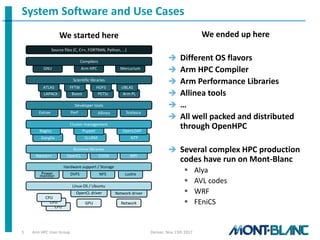
 Different OS flavors
 Arm HPC Compiler
 Arm Performance Libraries
 Allinea tools
 …
 All well packed and distributed
through OpenHPC
 Several complex HPC production
codes have run on Mont-Blanc
 Alya
 AVL codes
 WRF
 FEniCS
System Software and Use Cases
Denver, Nov 13th 2017Arm HPC User Group5
Source files (C, C++, FORTRAN, Python, …)
GNU Arm HPC Mercurium
Compilers
Network driverOpenCL driver
Linux OS / Ubuntu
LAPACK Boost PETSc Arm PL
FFTW HDF5ATLAS clBLAS
Scientific libraries
ScalascaPerfExtrae Allinea
Developer tools
SLURMGanglia NTP
OpenLDAPNagios Puppet
Cluster management
Nanos++ OpenCL CUDA MPI
Runtime libraries
Power
monitor
Power
monitor LustreNFSDVFS
Hardware support / Storage
CPU
GPUCPU
CPU
Network
We started here We ended up here
 A Multi-level Simulation
Approach (MUSA) allows us:
 To gather performance traces on
any current HPC architecture
 To replay them using almost any
architecture configuration
 To study scalability and
performance figures at scale,
changing the number of MPI
processes simulated
Study of Next-Generation Architectures
Denver, Nov 13th 2017Arm HPC User Group6
Credits: N. Rajovic
Credits: MUSA team @ BSC
Where BSC is contributing today?
 Evaluation of solutions
 Hardware solutions
• Mini-clusters deployed liaising with SoC providers and system integrators
 Software solutions
• Arm Performance Libraries, Arm HPC Compiler
 Use cases
 Alya: finite element code where we experiment atomics-avoiding techniques
• GOAL: test new runtime features to be pushed into OpenMP
 HPCG: benchmark where we started looking at vectorization
• GOAL: explore techniques for exploitation of the Arm Scalable Vector Extension
 Simulation of next generation large clusters
 MUSA: Combining detailed trace driven simulation with sampling strategies for
exploring how architectural parameters affects the performance at scale.
Denver, Nov 13th 2017Arm HPC User Group7
T. Grass et al., “MUSA: A Multi-level Simulation Approach for
Next-Generation HPC Machines,” in SC16 proceedings, pp. 526–537.
F. Banchelli et al., “Is Arm software ecosystem
ready for HPC?”, poster at SC17.
Evaluation of Arm Performance Libraries
 Goal
 Test an HPC code making use of arithmetic and FFT libraries
 Method
 Quantum Espresso pwscf input
 Compiled with GCC 7.1.0
 Platform configuration #1 (poster SC17)
 AMD Seattle
 Arm PL 2.2
 ATLAS 3.11.39
 OpenBLAS 0.2.20
 FFTW 3.3.6
 Platform configuration #2
 Cavium ThunderX2
 Arm PL v18.0
 OpenBLAS 0.2.20
 FFTW 3.3.7
Denver, Nov 13th 2017Arm HPC User Group8
Evaluation of the Arm HPC Compiler
 Goal
 Evaluate the Arm HPC Compilers v18.0 vs v1.4
 Method
 Run Polybench benchmark suite
 Including 30 benchmarks by Ohio State University
 Run on Cavium ThunderX2
Denver, Nov 13th 2017Arm HPC User Group9
Execution time increment v18.0 vs v1.4
SIMD instructions v18.0 vs v1.4
High Performance Conjugate Gradient
 Problem
 Scalability of HPCG is very limited
 OpenMP parallelization of the reference HPCG version is poor
 Goals
1. Improve OpenMP parallelization of HPCG
2. Study current auto-vectorization for leveraging SVE
3. Analyze other performance limitations (e.g. cache effects)
Denver, Nov 13th 2017Arm HPC User Group10
0,00
2,00
4,00
6,00
8,00
10,00
12,00
1 2 4 8 16 28
SpeedUp
OpenMP Threads
Arm HPC Compiler 1.4 GCC 7.1.0
0,00
2,00
4,00
6,00
8,00
10,00
12,00
1 2 4 8 16 28
SpeedUp
OpenMP Threads
Arm HPC Compiler 1.4 GCC 7.1.0
On Cavium ThunderX2
High Performance Conjugate Gradient
 Problem
 Scalability of HPCG is very limited
 OpenMP parallelization of the reference HPCG version is poor
 Goals
1. Improve OpenMP parallelization of HPCG
2. Study current auto-vectorization for leveraging SVE
3. Analyze other performance limitations (e.g. cache effects)
Denver, Nov 13th 2017Arm HPC User Group11
On Cavium ThunderX2
HPCG - SIMD parallelization
 First approach
 Check auto-vectorization in current platforms
 Method
 Count SIMD instructions in the “ComputeSYMGS” region
 On Cavium ThunderX2 using Arm HPC Compiler v18.0
 On Intel Xeon Platinum 8160 (Skylake) using ICC supporting AVX512
Denver, Nov 13th 2017Arm HPC User Group12
x106
HPCG - SVE emulation
 First approach
 Check auto-vectorization when SVE is enabled
 Method
 Evaluate auto-vectorization in a whole execution of HPCG (one iteration)
 Generate binary using Arm HPC Compiler v1.4 enabling SVE
 Emulate SVE instruction using Arm Instruction Emulator in Cavium ThunderX2
Denver, Nov 13th 2017Arm HPC User Group13
0
5
10
15
20
25
30
35
SVE 128b SVE 256b SVE 512b SVE 1024b SVE 2048b
IncrementinSIMDinstructionsagainstNEON
HPGC - Memory access evaluation
 Cache hit ratio degraded when using multi-coloring approaches
 Data related to ComputeSYMGS
 Gathered on Cavium ThunderX2
 Compiled with GCC
 Next steps
 Optimize data access patterns in memory
 Simulate “SVE gather load” instructions in order to quantify the benefits
Denver, Nov 13th 2017Arm HPC User Group14
~13% L1D miss ratio ~35% L2D miss ratio
0% 100% 0% 100%
Alya: BSC code for multi-physics problems
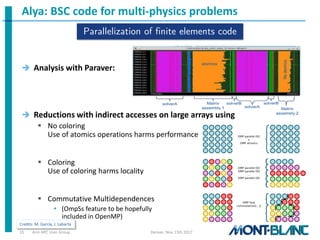
 Analysis with Paraver:
 Reductions with indirect accesses on large arrays using
 No coloring
Use of atomics operations harms performance
 Coloring
Use of coloring harms locality
 Commutative Multidependences
• (OmpSs feature to be hopefully
included in OpenMP)
Denver, Nov 13th 2017Arm HPC User Group15
Parallelization of finite elements code
Credits: M. Garcia, J. Labarta
Alya: taskification and dynamic load balancing
 Goal
 Quantify the effect of commutative dependences and DLB on an HPC code
 Method
 Run the “Assembly phase” of Alya (containing atomics)
 On MareNostrum 3, 2x Intel Xeon SandyBridge-EP E5-2670
 On Cavium ThunderX, 2x CN8890
Denver, Nov 13th 2017Arm HPC User Group16
16 nodes x P processes/node x T threads/process
Assembly phase
Credits: M. Josep, M. Garcia, J. Labarta
Multi-Level Simulation Approach
 Level 1: Trace generation
Denver, Nov 13th 2017Arm HPC User Group17
HPC application execution
OpenMP Runtime
System Plugin
MPI Call
Instrumenatation
Pintool /
DynamoRIO
Task / chunk
creation events,
dependencies
MPI calls
Dynamic
instructions
Trace
Credits: T. Grass, C. Gomez, M. Casas, M. Moreto
 Level 2: Network simulation (Dimemas)
 Level 3: Multi-core simulation (TaskSim + Ramulator + McPAT)
Multi-Level Simulation Approach
Time
Rank 1
Rank 2
……
Network simulator
Multi-core simulator
Thread 1
Thread 2
……
Time
Denver, Nov 13th 2017Arm HPC User Group18
Trace
Credits: T. Grass, C. Gomez, M. Casas, M. Moreto
Multi-Level Parameters
 Architectural
 CPU architecture
 Number of cores
 Core frequency
 Threads per core
 Reorder buffer size
 SIMD width
 Micro-architectural
 L1/2/3 Cache size/latency
 Main memory
 Memory technology
 Capacity
 Bandwidth
 Latency
Problem:
Simulation time diverges
Solution:
We supported different modes
(Burst, Detailed, Sampling)
trading accuracy for speed
Denver, Nov 13th 2017Arm HPC User Group19
Credits: T. Grass, C. Gomez, M. Casas, M. Moreto
MUSA: status
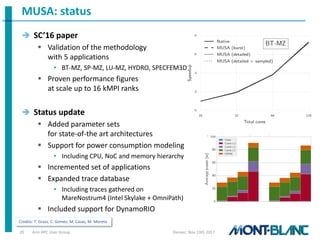
 SC’16 paper
 Validation of the methodology
with 5 applications
• BT-MZ, SP-MZ, LU-MZ, HYDRO, SPECFEM3D
 Proven performance figures
at scale up to 16 kMPI ranks
 Status update
 Added parameter sets
for state-of-the art architectures
 Support for power consumption modeling
• Including CPU, NoC and memory hierarchy
 Incremented set of applications
 Expanded trace database
• Including traces gathered on
MareNostrum4 (Intel Skylake + OmniPath)
 Included support for DynamoRIO
Denver, Nov 13th 2017Arm HPC User Group20
Credits: T. Grass, C. Gomez, M. Casas, M. Moreto
Student Cluster Competition
 Rules
 12 teams of 6 undergraduate students
 1 cluster operating within 3 kW power budget
 3 HPC applications + 2 benchmarks
 One team from University
Politècnica de Catalunya (UPC-Spain)
 Participating with
Mont-Blanc technology
 3 awards to win
 Best HPL
 1st, 2nd, 3rd overall places
 Fan favorite
We are looking for
an Arm-based
cluster for 2018!!!
Denver, Nov 13th 2017Arm HPC User Group21
Interested in any of the topics presented?
Follow us!
montblanc-project.eu @MontBlanc_EU filippo.mantovani@bsc.es
Visit our booths @ SC17!
booth #1694
booth #1925
booth #1975
Denver, Nov 13th 2017Arm HPC User Group22

Update on the Mont-Blanc Project for ARM-based HPC

  • 1.
    montblanc-project.eu | @MontBlanc_EU Thisproject has received funding from the European Union's Horizon 2020 research and innovation program under grant agreement n° 671697 The Mont-Blanc project Updates from the Barcelona Supercomputing Center Filippo Mantovani
  • 2.
    Mont-Blanc The “legacy” Mont-Blancvision Denver, Nov 13th 2017Arm HPC User Group2 Vision: to leverage the fast growing market of mobile technology for scientific computation, HPC and data centers. 2012 2013 2014 20162015 2017 2018 Mont-Blanc 2 Mont-Blanc 3
  • 3.
    Mont-Blanc The “legacy” Mont-Blancvision Phases share a common structure  Experiment with real hardware  Android dev-kits, mini-clusters, prototypes, production ready systems  Push software development  System software, HPC benchmarks/mini-apps/production codes  Study next generation architectures  Learn from hardware deployment and evaluation for planning new systems Denver, Nov 13th 2017Arm HPC User Group3 Vision: to leverage the fast growing market of mobile technology for scientific computation, HPC and data centers. 2012 2013 2014 20162015 2017 2018 Mont-Blanc 2 Mont-Blanc 3
  • 4.
    We started hereWe ended up here Hardware platforms Denver, Nov 13th 2017Arm HPC User Group4 N. Rajovic et al., “The Mont-Blanc Prototype: An Alternative Approach for HPC Systems,” in Proceedings of SC’16, p. 38:1–38:12.
  • 5.
    We started hereWe ended up here  Different OS flavors  Arm HPC Compiler  Arm Performance Libraries  Allinea tools  …  All well packed and distributed through OpenHPC  Several complex HPC production codes have run on Mont-Blanc  Alya  AVL codes  WRF  FEniCS System Software and Use Cases Denver, Nov 13th 2017Arm HPC User Group5 Source files (C, C++, FORTRAN, Python, …) GNU Arm HPC Mercurium Compilers Network driverOpenCL driver Linux OS / Ubuntu LAPACK Boost PETSc Arm PL FFTW HDF5ATLAS clBLAS Scientific libraries ScalascaPerfExtrae Allinea Developer tools SLURMGanglia NTP OpenLDAPNagios Puppet Cluster management Nanos++ OpenCL CUDA MPI Runtime libraries Power monitor Power monitor LustreNFSDVFS Hardware support / Storage CPU GPUCPU CPU Network
  • 6.
    We started hereWe ended up here  A Multi-level Simulation Approach (MUSA) allows us:  To gather performance traces on any current HPC architecture  To replay them using almost any architecture configuration  To study scalability and performance figures at scale, changing the number of MPI processes simulated Study of Next-Generation Architectures Denver, Nov 13th 2017Arm HPC User Group6 Credits: N. Rajovic Credits: MUSA team @ BSC
  • 7.
    Where BSC iscontributing today?  Evaluation of solutions  Hardware solutions • Mini-clusters deployed liaising with SoC providers and system integrators  Software solutions • Arm Performance Libraries, Arm HPC Compiler  Use cases  Alya: finite element code where we experiment atomics-avoiding techniques • GOAL: test new runtime features to be pushed into OpenMP  HPCG: benchmark where we started looking at vectorization • GOAL: explore techniques for exploitation of the Arm Scalable Vector Extension  Simulation of next generation large clusters  MUSA: Combining detailed trace driven simulation with sampling strategies for exploring how architectural parameters affects the performance at scale. Denver, Nov 13th 2017Arm HPC User Group7 T. Grass et al., “MUSA: A Multi-level Simulation Approach for Next-Generation HPC Machines,” in SC16 proceedings, pp. 526–537. F. Banchelli et al., “Is Arm software ecosystem ready for HPC?”, poster at SC17.
  • 8.
    Evaluation of ArmPerformance Libraries  Goal  Test an HPC code making use of arithmetic and FFT libraries  Method  Quantum Espresso pwscf input  Compiled with GCC 7.1.0  Platform configuration #1 (poster SC17)  AMD Seattle  Arm PL 2.2  ATLAS 3.11.39  OpenBLAS 0.2.20  FFTW 3.3.6  Platform configuration #2  Cavium ThunderX2  Arm PL v18.0  OpenBLAS 0.2.20  FFTW 3.3.7 Denver, Nov 13th 2017Arm HPC User Group8
  • 9.
    Evaluation of theArm HPC Compiler  Goal  Evaluate the Arm HPC Compilers v18.0 vs v1.4  Method  Run Polybench benchmark suite  Including 30 benchmarks by Ohio State University  Run on Cavium ThunderX2 Denver, Nov 13th 2017Arm HPC User Group9 Execution time increment v18.0 vs v1.4 SIMD instructions v18.0 vs v1.4
  • 10.
    High Performance ConjugateGradient  Problem  Scalability of HPCG is very limited  OpenMP parallelization of the reference HPCG version is poor  Goals 1. Improve OpenMP parallelization of HPCG 2. Study current auto-vectorization for leveraging SVE 3. Analyze other performance limitations (e.g. cache effects) Denver, Nov 13th 2017Arm HPC User Group10 0,00 2,00 4,00 6,00 8,00 10,00 12,00 1 2 4 8 16 28 SpeedUp OpenMP Threads Arm HPC Compiler 1.4 GCC 7.1.0 0,00 2,00 4,00 6,00 8,00 10,00 12,00 1 2 4 8 16 28 SpeedUp OpenMP Threads Arm HPC Compiler 1.4 GCC 7.1.0 On Cavium ThunderX2
  • 11.
    High Performance ConjugateGradient  Problem  Scalability of HPCG is very limited  OpenMP parallelization of the reference HPCG version is poor  Goals 1. Improve OpenMP parallelization of HPCG 2. Study current auto-vectorization for leveraging SVE 3. Analyze other performance limitations (e.g. cache effects) Denver, Nov 13th 2017Arm HPC User Group11 On Cavium ThunderX2
  • 12.
    HPCG - SIMDparallelization  First approach  Check auto-vectorization in current platforms  Method  Count SIMD instructions in the “ComputeSYMGS” region  On Cavium ThunderX2 using Arm HPC Compiler v18.0  On Intel Xeon Platinum 8160 (Skylake) using ICC supporting AVX512 Denver, Nov 13th 2017Arm HPC User Group12 x106
  • 13.
    HPCG - SVEemulation  First approach  Check auto-vectorization when SVE is enabled  Method  Evaluate auto-vectorization in a whole execution of HPCG (one iteration)  Generate binary using Arm HPC Compiler v1.4 enabling SVE  Emulate SVE instruction using Arm Instruction Emulator in Cavium ThunderX2 Denver, Nov 13th 2017Arm HPC User Group13 0 5 10 15 20 25 30 35 SVE 128b SVE 256b SVE 512b SVE 1024b SVE 2048b IncrementinSIMDinstructionsagainstNEON
  • 14.
    HPGC - Memoryaccess evaluation  Cache hit ratio degraded when using multi-coloring approaches  Data related to ComputeSYMGS  Gathered on Cavium ThunderX2  Compiled with GCC  Next steps  Optimize data access patterns in memory  Simulate “SVE gather load” instructions in order to quantify the benefits Denver, Nov 13th 2017Arm HPC User Group14 ~13% L1D miss ratio ~35% L2D miss ratio 0% 100% 0% 100%
  • 15.
    Alya: BSC codefor multi-physics problems  Analysis with Paraver:  Reductions with indirect accesses on large arrays using  No coloring Use of atomics operations harms performance  Coloring Use of coloring harms locality  Commutative Multidependences • (OmpSs feature to be hopefully included in OpenMP) Denver, Nov 13th 2017Arm HPC User Group15 Parallelization of finite elements code Credits: M. Garcia, J. Labarta
  • 16.
    Alya: taskification anddynamic load balancing  Goal  Quantify the effect of commutative dependences and DLB on an HPC code  Method  Run the “Assembly phase” of Alya (containing atomics)  On MareNostrum 3, 2x Intel Xeon SandyBridge-EP E5-2670  On Cavium ThunderX, 2x CN8890 Denver, Nov 13th 2017Arm HPC User Group16 16 nodes x P processes/node x T threads/process Assembly phase Credits: M. Josep, M. Garcia, J. Labarta
  • 17.
    Multi-Level Simulation Approach Level 1: Trace generation Denver, Nov 13th 2017Arm HPC User Group17 HPC application execution OpenMP Runtime System Plugin MPI Call Instrumenatation Pintool / DynamoRIO Task / chunk creation events, dependencies MPI calls Dynamic instructions Trace Credits: T. Grass, C. Gomez, M. Casas, M. Moreto
  • 18.
     Level 2:Network simulation (Dimemas)  Level 3: Multi-core simulation (TaskSim + Ramulator + McPAT) Multi-Level Simulation Approach Time Rank 1 Rank 2 …… Network simulator Multi-core simulator Thread 1 Thread 2 …… Time Denver, Nov 13th 2017Arm HPC User Group18 Trace Credits: T. Grass, C. Gomez, M. Casas, M. Moreto
  • 19.
    Multi-Level Parameters  Architectural CPU architecture  Number of cores  Core frequency  Threads per core  Reorder buffer size  SIMD width  Micro-architectural  L1/2/3 Cache size/latency  Main memory  Memory technology  Capacity  Bandwidth  Latency Problem: Simulation time diverges Solution: We supported different modes (Burst, Detailed, Sampling) trading accuracy for speed Denver, Nov 13th 2017Arm HPC User Group19 Credits: T. Grass, C. Gomez, M. Casas, M. Moreto
  • 20.
    MUSA: status  SC’16paper  Validation of the methodology with 5 applications • BT-MZ, SP-MZ, LU-MZ, HYDRO, SPECFEM3D  Proven performance figures at scale up to 16 kMPI ranks  Status update  Added parameter sets for state-of-the art architectures  Support for power consumption modeling • Including CPU, NoC and memory hierarchy  Incremented set of applications  Expanded trace database • Including traces gathered on MareNostrum4 (Intel Skylake + OmniPath)  Included support for DynamoRIO Denver, Nov 13th 2017Arm HPC User Group20 Credits: T. Grass, C. Gomez, M. Casas, M. Moreto
  • 21.
    Student Cluster Competition Rules  12 teams of 6 undergraduate students  1 cluster operating within 3 kW power budget  3 HPC applications + 2 benchmarks  One team from University Politècnica de Catalunya (UPC-Spain)  Participating with Mont-Blanc technology  3 awards to win  Best HPL  1st, 2nd, 3rd overall places  Fan favorite We are looking for an Arm-based cluster for 2018!!! Denver, Nov 13th 2017Arm HPC User Group21
  • 22.
    Interested in anyof the topics presented? Follow us! montblanc-project.eu @MontBlanc_EU filippo.mantovani@bsc.es Visit our booths @ SC17! booth #1694 booth #1925 booth #1975 Denver, Nov 13th 2017Arm HPC User Group22