Spark-Powered Smart Data Warehouse
Sim Simeonov,Founder & CTO, Swoop
Goal-Based Data Production
petabyte scale data engineering & ML
run our business
What is a data-powered culture?
answer questions 10x easier with
goal-based data production
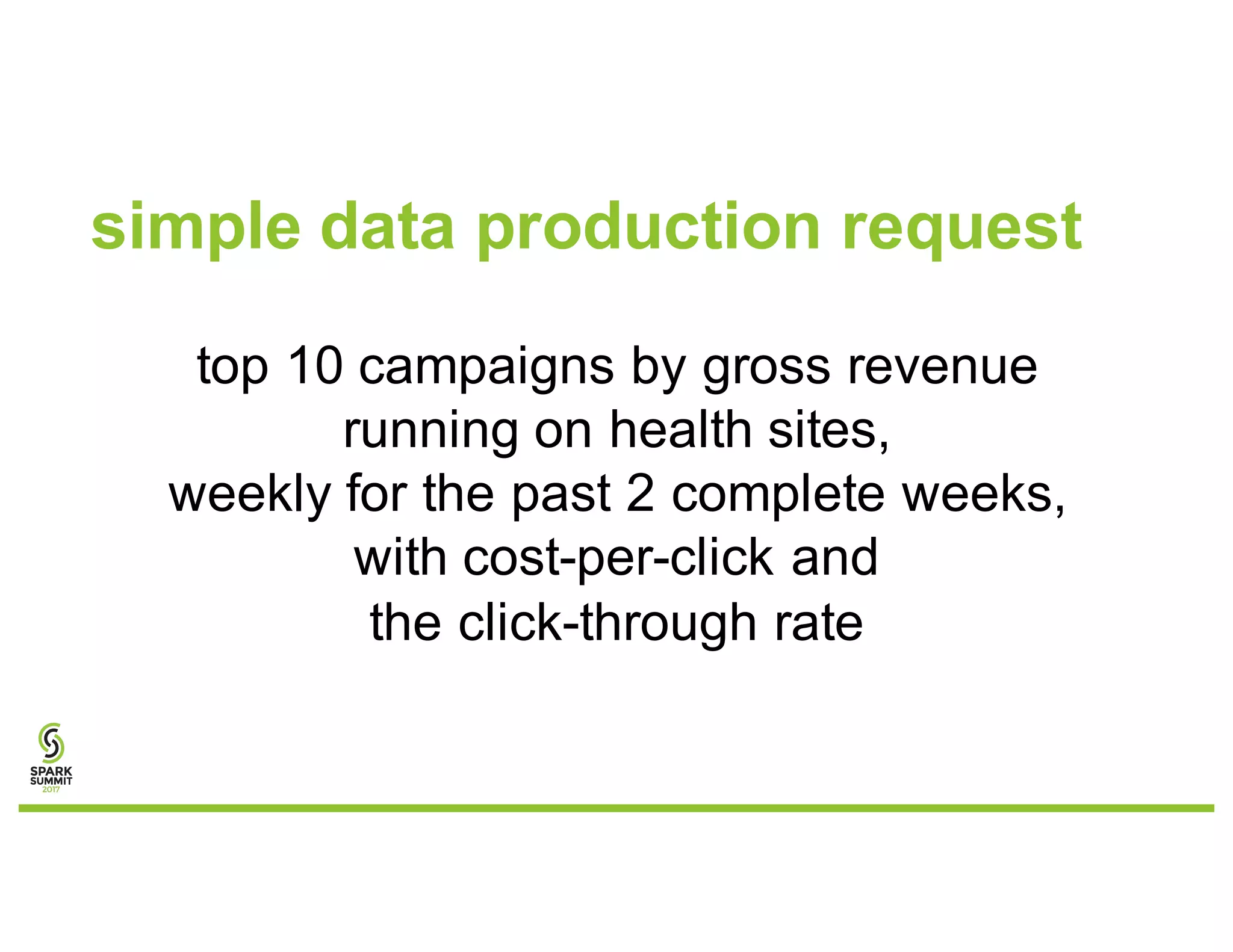
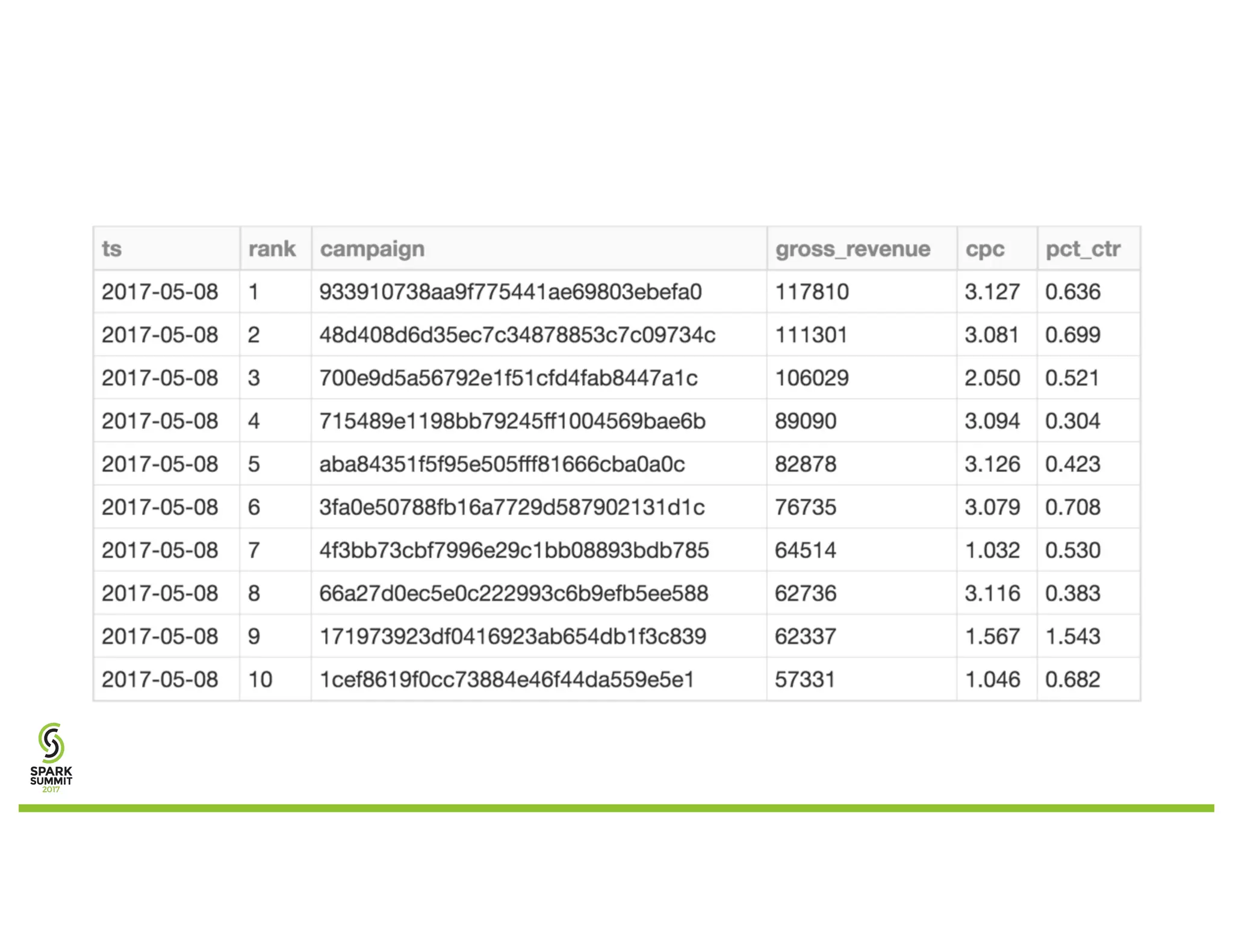
simple data production request
top 10 campaigns by gross revenue
running on health sites,
weekly for the past 2 complete weeks,
with cost-per-click and
the click-through rate
with
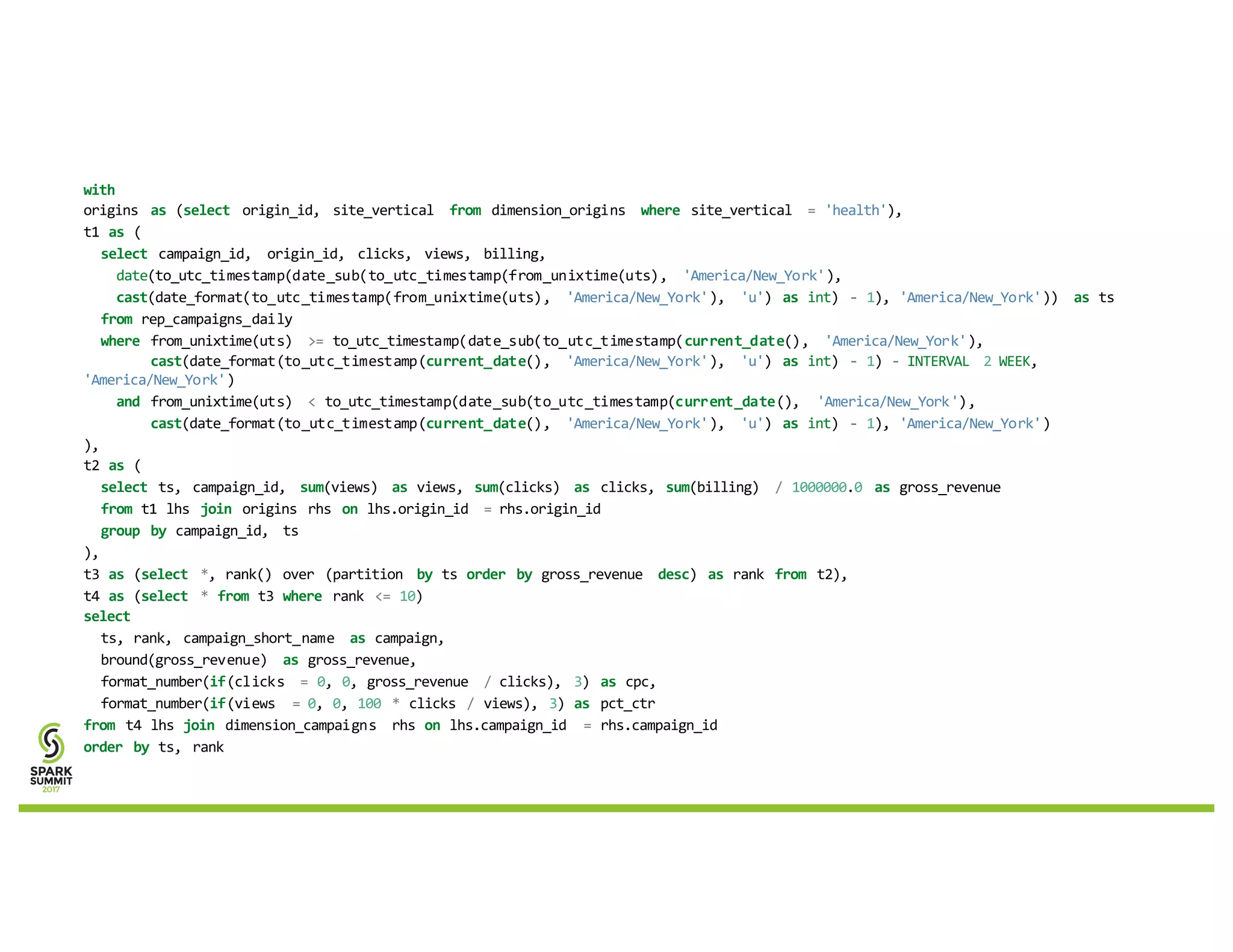
origins as (select origin_id, site_vertical from dimension_origins where site_vertical = 'health'),
t1 as (
select campaign_id, origin_id, clicks, views, billing,
date(to_utc_timestamp(date_sub(to_utc_timestamp(from_unixtime(uts), 'America/New_York'),
cast(date_format(to_utc_timestamp(from_unixtime(uts), 'America/New_York'), 'u') as int) - 1), 'America/New_York')) as ts
from rep_campaigns_daily
where from_unixtime(uts) >= to_utc_timestamp(date_sub(to_utc_timestamp(current_date(), 'America/New_York'),
cast(date_format(to_utc_timestamp(current_date(), 'America/New_York'), 'u') as int) - 1) - INTERVAL 2 WEEK,
'America/New_York')
and from_unixtime(uts) < to_utc_timestamp(date_sub(to_utc_timestamp(current_date(), 'America/New_York'),
cast(date_format(to_utc_timestamp(current_date(), 'America/New_York'), 'u') as int) - 1), 'America/New_York')
),
t2 as (
select ts, campaign_id, sum(views) as views, sum(clicks) as clicks, sum(billing) / 1000000.0 as gross_revenue
from t1 lhs join origins rhs on lhs.origin_id = rhs.origin_id
group by campaign_id, ts
),
t3 as (select *, rank() over (partition by ts order by gross_revenue desc) as rank from t2),
t4 as (select * from t3 where rank <= 10)
select
ts, rank, campaign_short_name as campaign,
bround(gross_revenue) as gross_revenue,
format_number(if(clicks = 0, 0, gross_revenue / clicks), 3) as cpc,
format_number(if(views = 0, 0, 100 * clicks / views), 3) as pct_ctr
from t4 lhs join dimension_campaigns rhs on lhs.campaign_id = rhs.campaign_id
order by ts, rank
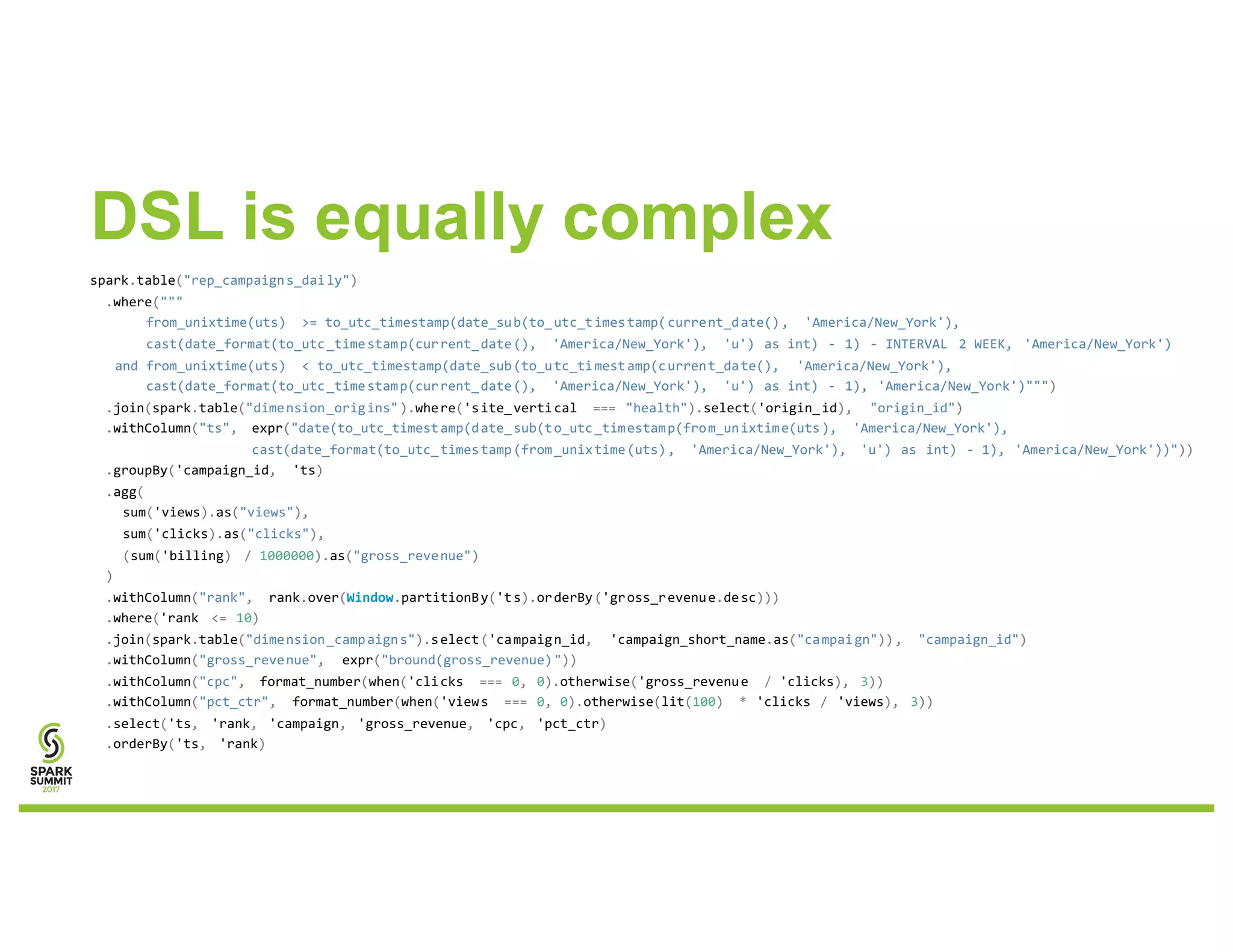
DSL is equally complex
spark.table("rep_campaigns_daily")
.where("""
from_unixtime(uts) >= to_utc_timestamp(date_sub(to_utc_timestamp(current_date(), 'America/New_York'),
cast(date_format(to_utc_timestamp(current_date(), 'America/New_York'), 'u') as int) - 1) - INTERVAL 2 WEEK, 'America/New_York')
and from_unixtime(uts) < to_utc_timestamp(date_sub(to_utc_timestamp(current_date(), 'America/New_York'),
cast(date_format(to_utc_timestamp(current_date(), 'America/New_York'), 'u') as int) - 1), 'America/New_York')""")
.join(spark.table("dimension_origins").where('site_vertical === "health").select('origin_id), "origin_id")
.withColumn("ts", expr("date(to_utc_timestamp(date_sub(to_utc_timestamp(from_unixtime(uts), 'America/New_York'),
cast(date_format(to_utc_timestamp(from_unixtime(uts), 'America/New_York'), 'u') as int) - 1), 'America/New_York'))"))
.groupBy('campaign_id, 'ts)
.agg(
sum('views).as("views"),
sum('clicks).as("clicks"),
(sum('billing) / 1000000).as("gross_revenue")
)
.withColumn("rank", rank.over(Window.partitionBy('ts).orderBy('gross_revenue.desc)))
.where('rank <= 10)
.join(spark.table("dimension_campaigns").select('campaign_id, 'campaign_short_name.as("campaign")), "campaign_id")
.withColumn("gross_revenue", expr("bround(gross_revenue)"))
.withColumn("cpc", format_number(when('clicks === 0, 0).otherwise('gross_revenue / 'clicks), 3))
.withColumn("pct_ctr", format_number(when('views === 0, 0).otherwise(lit(100) * 'clicks / 'views), 3))
.select('ts, 'rank, 'campaign, 'gross_revenue, 'cpc, 'pct_ctr)
.orderBy('ts, 'rank)
Spark needs to know
what you want and
how to produce it
General data processing requires
detailed instructions every single time
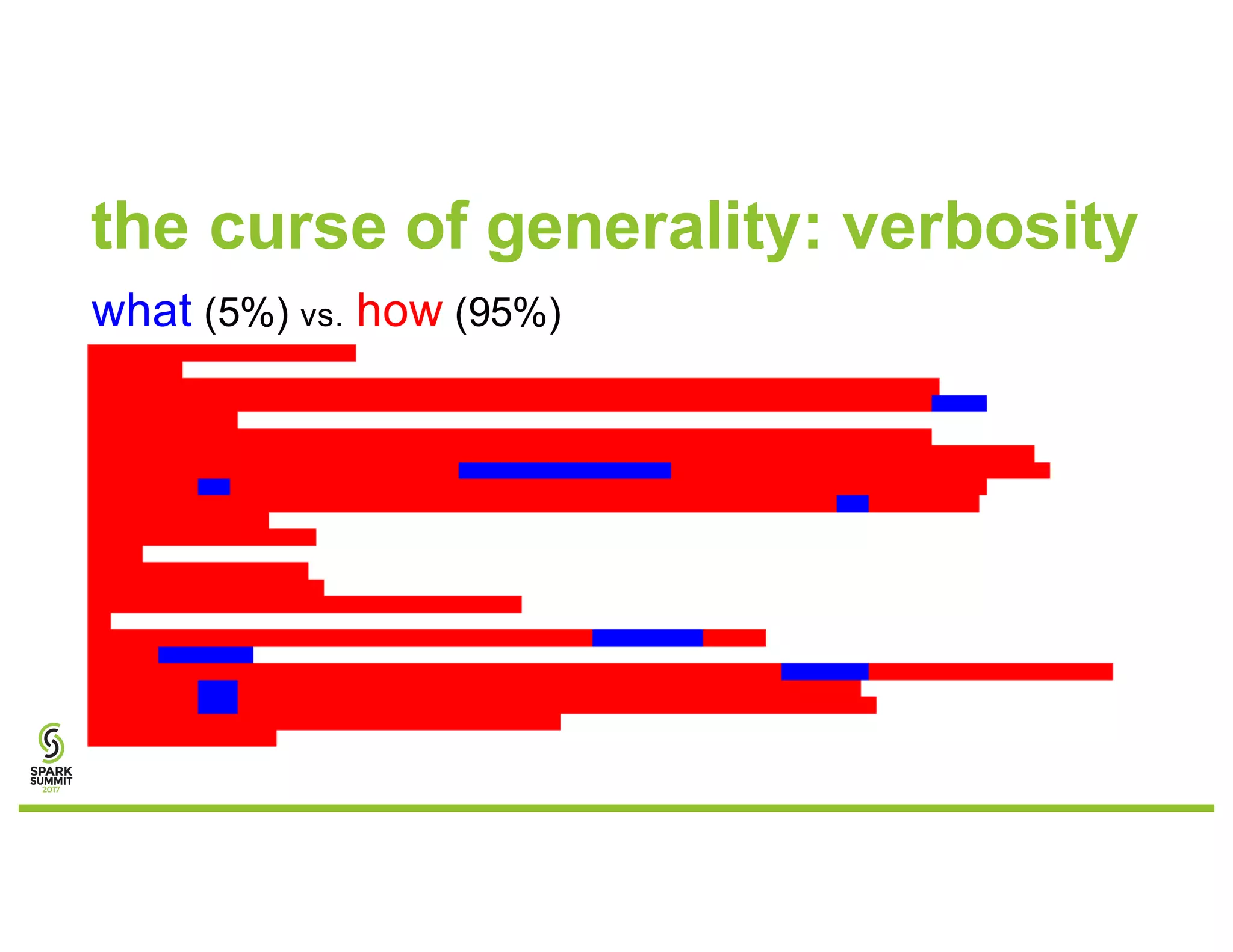
the curse of generality: verbosity
what (5%) vs. how (95%)
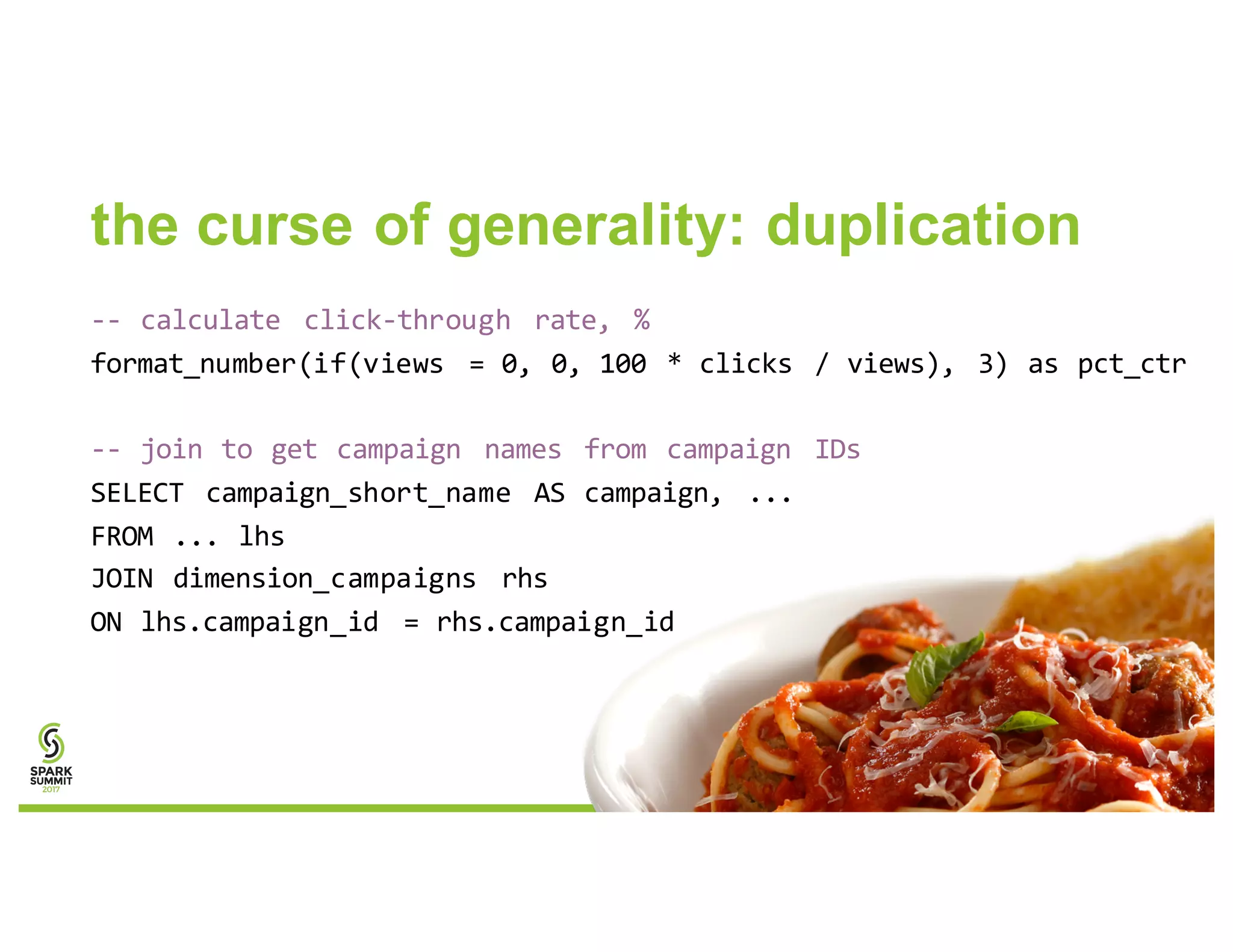
the curse of generality: duplication
-- calculate click-through rate, %
format_number(if(views = 0, 0, 100 * clicks / views), 3) as pct_ctr
-- join to get campaign names from campaign IDs
SELECT campaign_short_name AS campaign, ...
FROM ... lhs
JOIN dimension_campaigns rhs
ON lhs.campaign_id = rhs.campaign_id
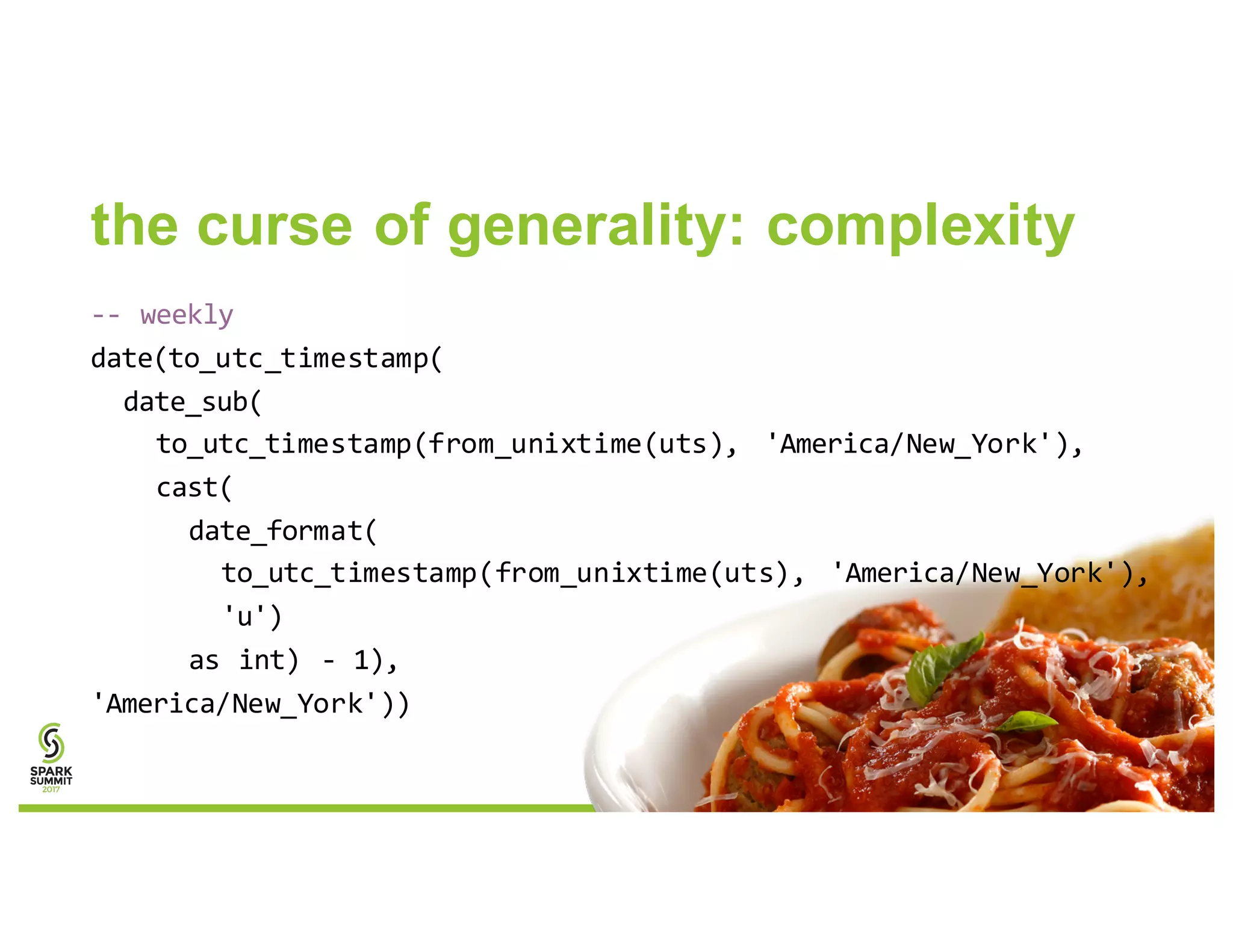
the curse of generality: complexity
-- weekly
date(to_utc_timestamp(
date_sub(
to_utc_timestamp(from_unixtime(uts), 'America/New_York'),
cast(
date_format(
to_utc_timestamp(from_unixtime(uts), 'America/New_York'),
'u')
as int) - 1),
'America/New_York'))
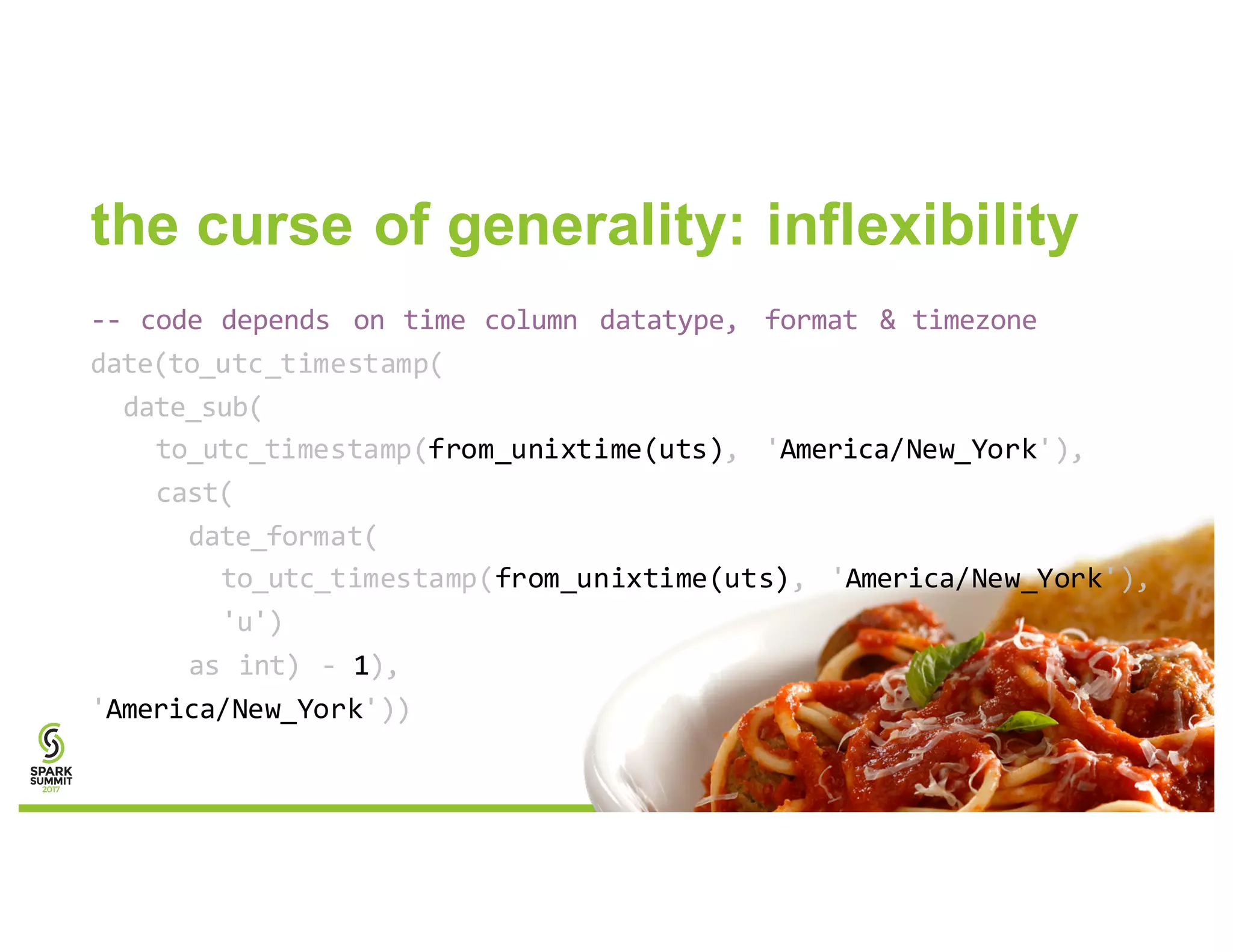
the curse of generality: inflexibility
-- code depends on time column datatype, format & timezone
date(to_utc_timestamp(
date_sub(
to_utc_timestamp(from_unixtime(uts), 'America/New_York'),
cast(
date_format(
to_utc_timestamp(from_unixtime(uts), 'America/New_York'),
'u')
as int) - 1),
'America/New_York'))
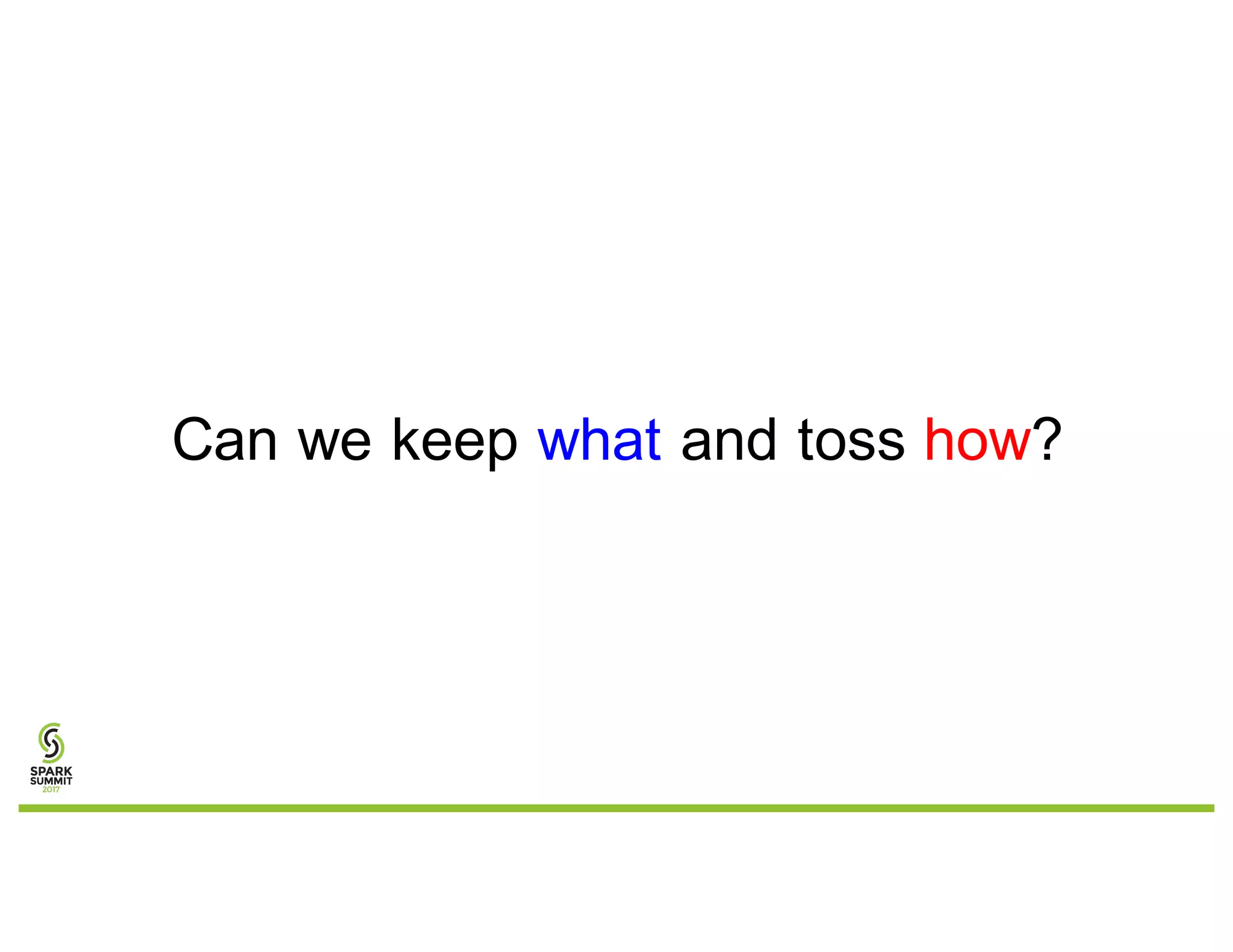
Can we keep what and toss how?
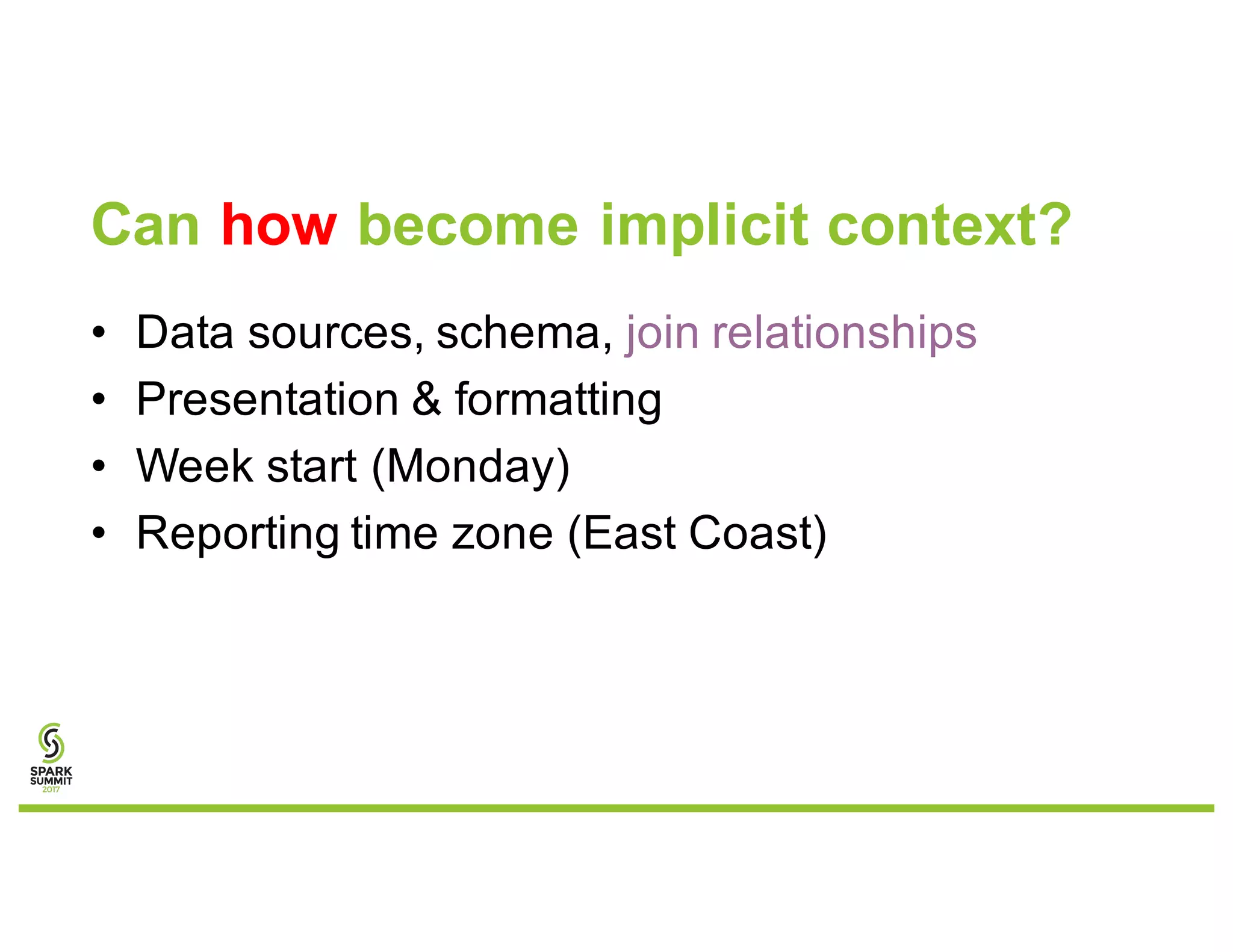
Can how become implicit context?
• Data sources, schema, join relationships
• Presentation & formatting
• Week start (Monday)
• Reporting time zone (East Coast)
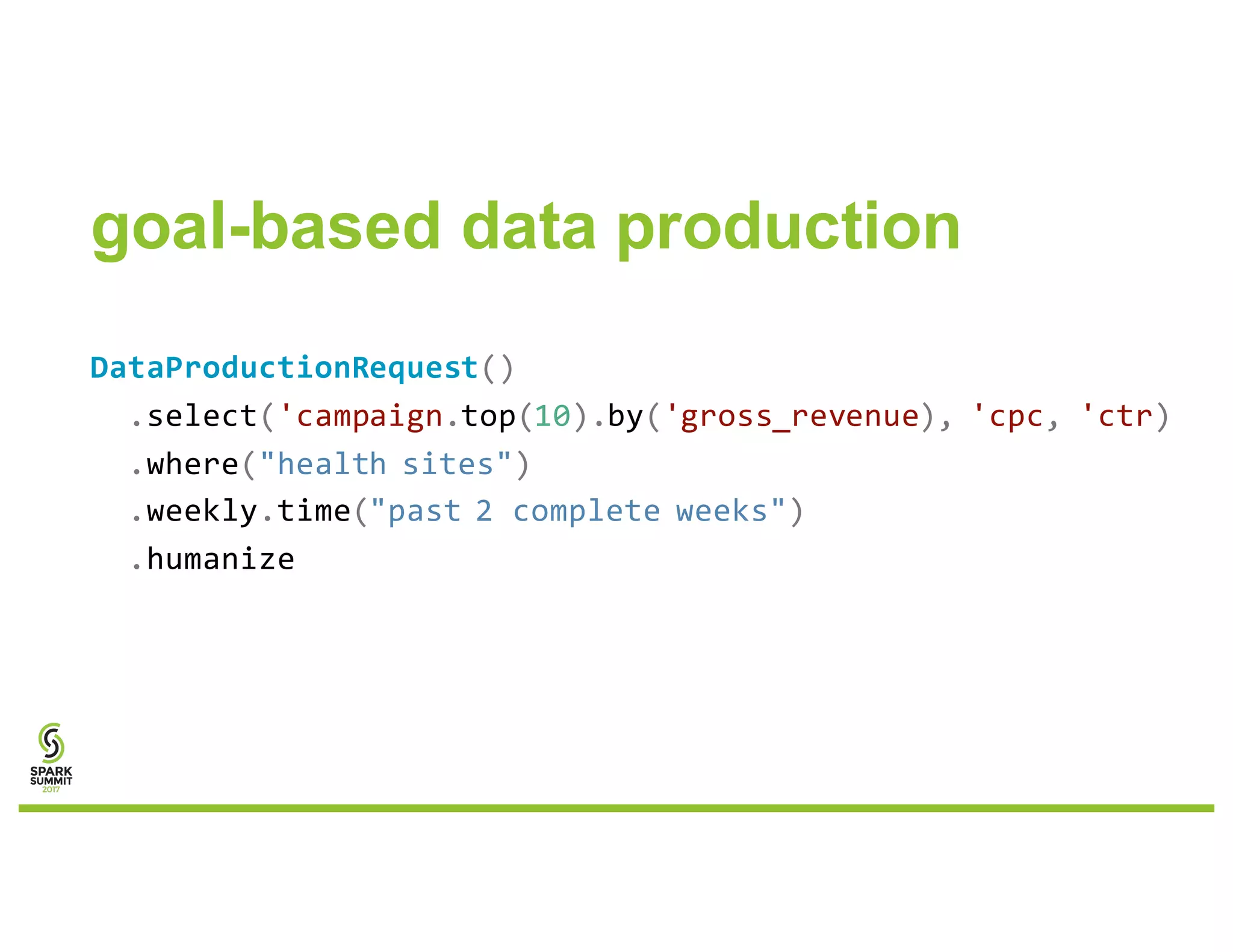
goal-based data production
DataProductionRequest()
.select('campaign.top(10).by('gross_revenue), 'cpc, 'ctr)
.where("health sites")
.weekly.time("past 2 complete weeks")
.humanize
let’s go behind the curtain
the DSL is not as important as the
processing & configuration models
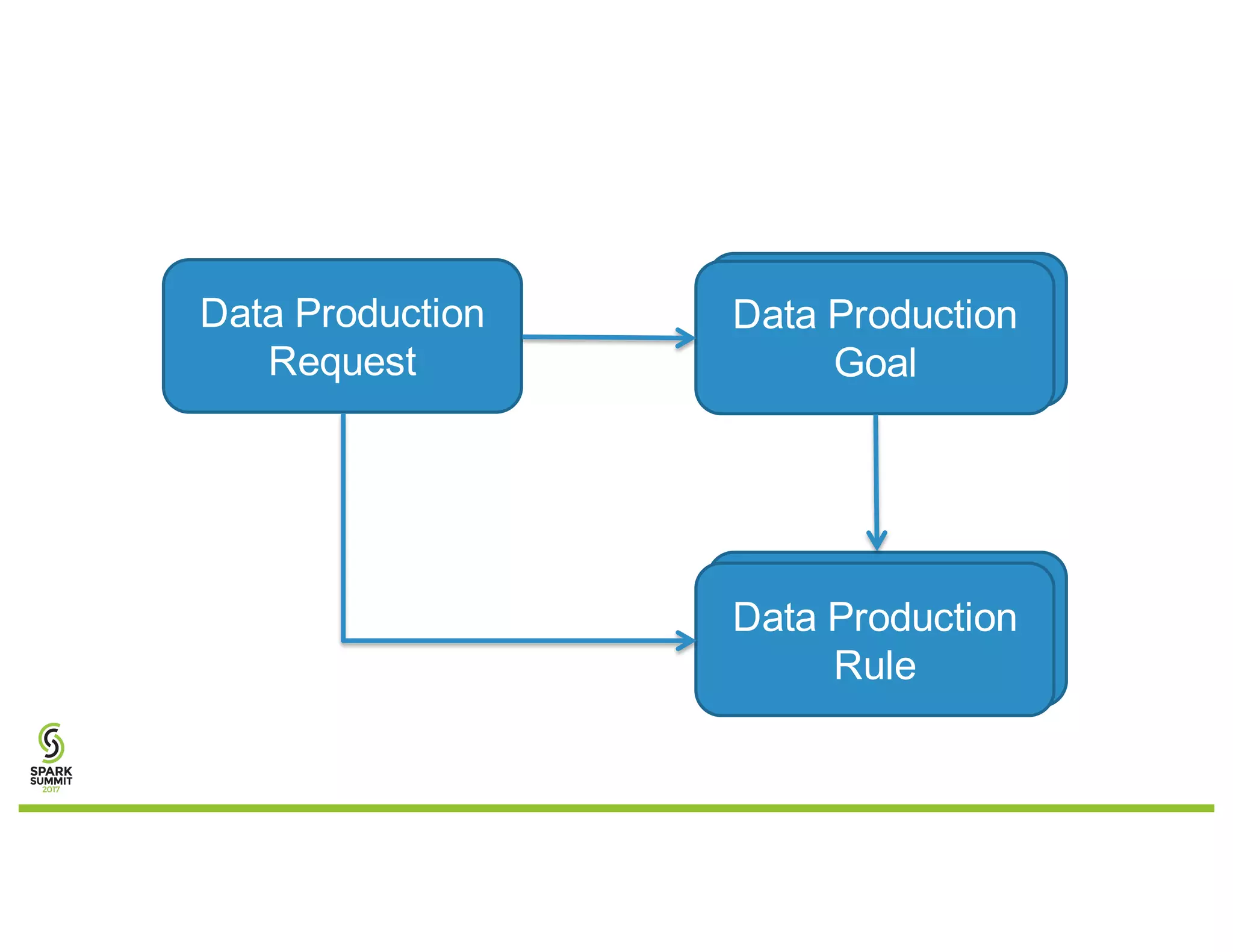
Data Production
Request
Data Production
Goal
Data Production
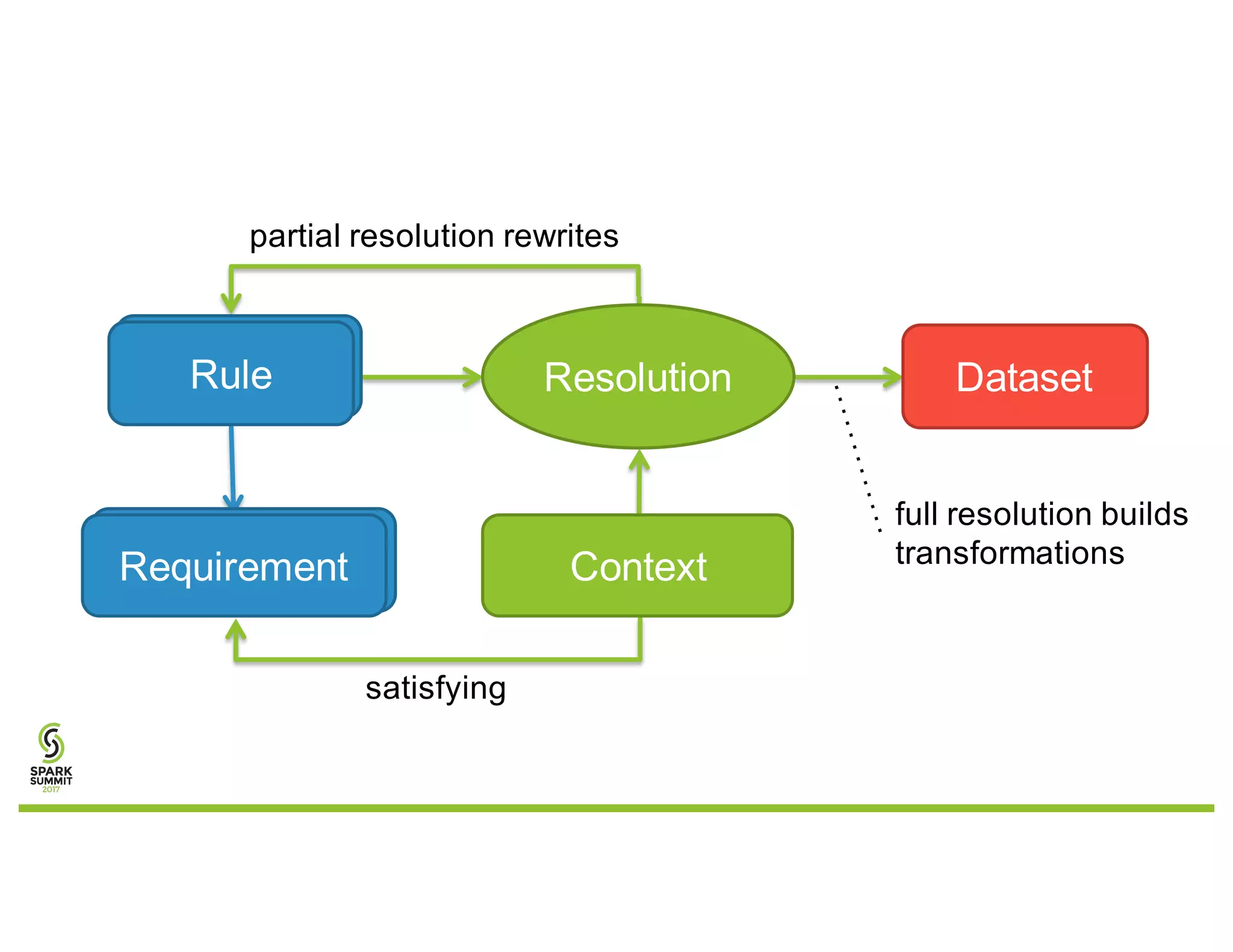
Rule
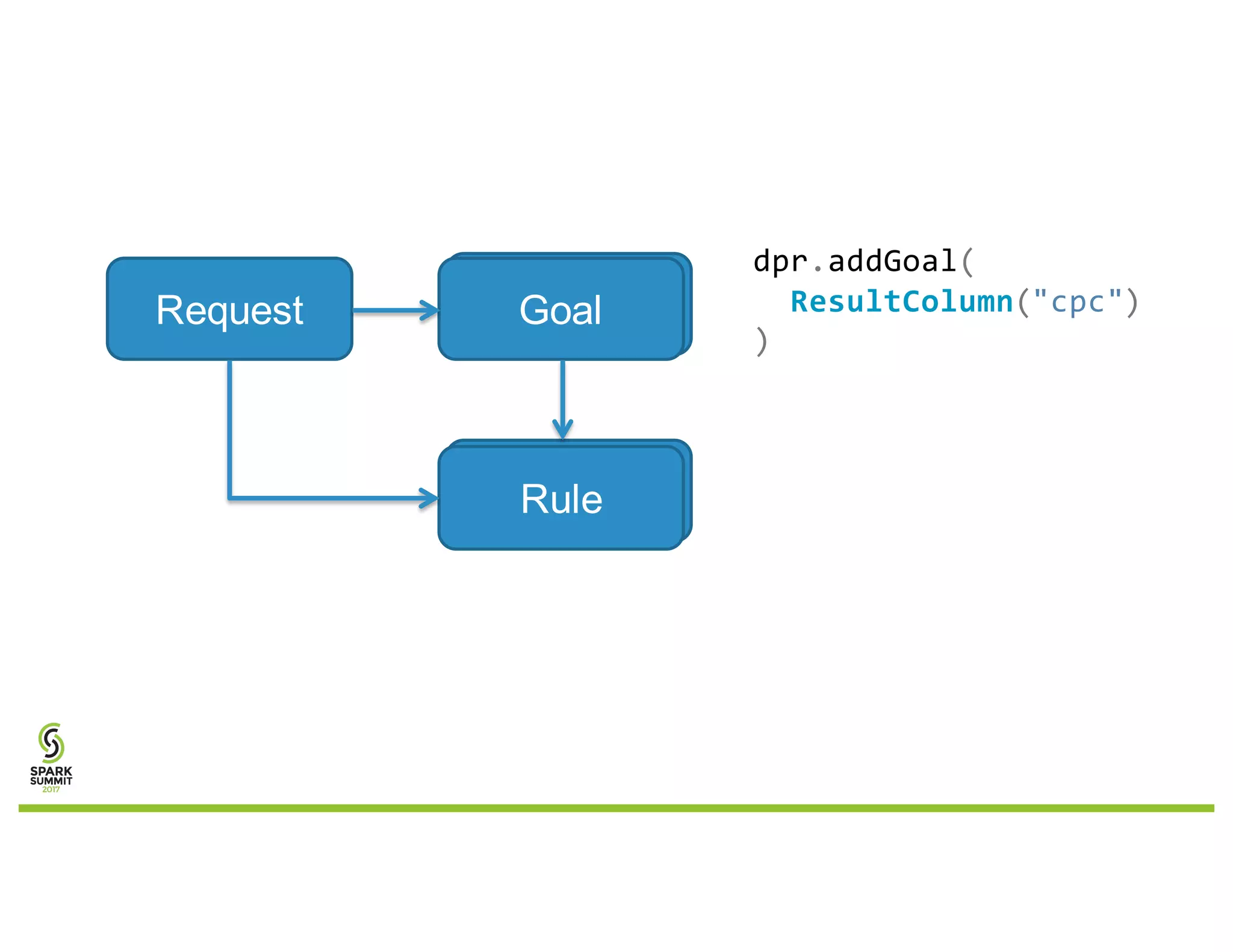
Request Goal
Rule
dpr.addGoal(
ResultColumn("cpc")
)
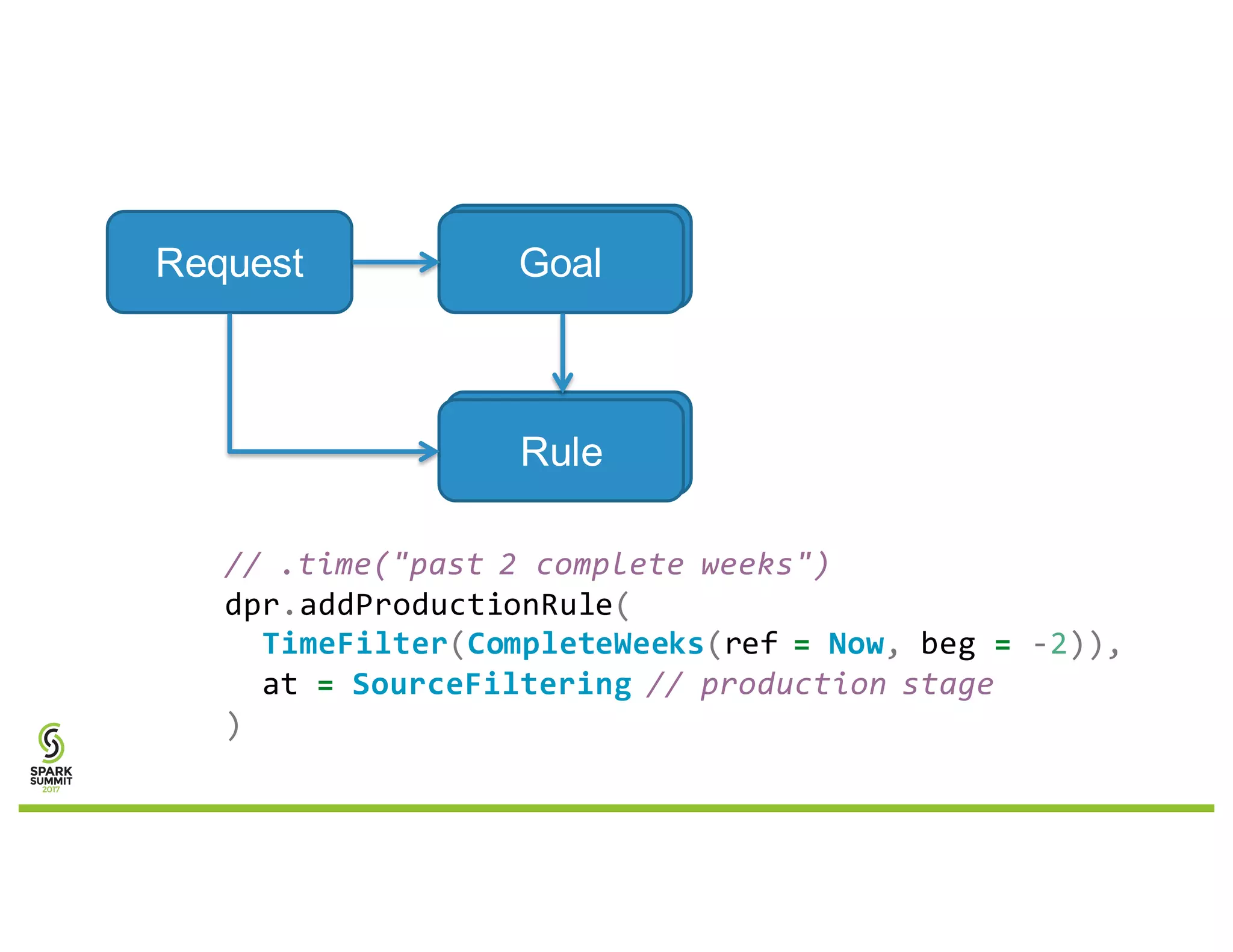
Request Goal
Rule
// .time("past 2 complete weeks")
dpr.addProductionRule(
TimeFilter(CompleteWeeks(ref = Now, beg = -2)),
at = SourceFiltering // production stage
)
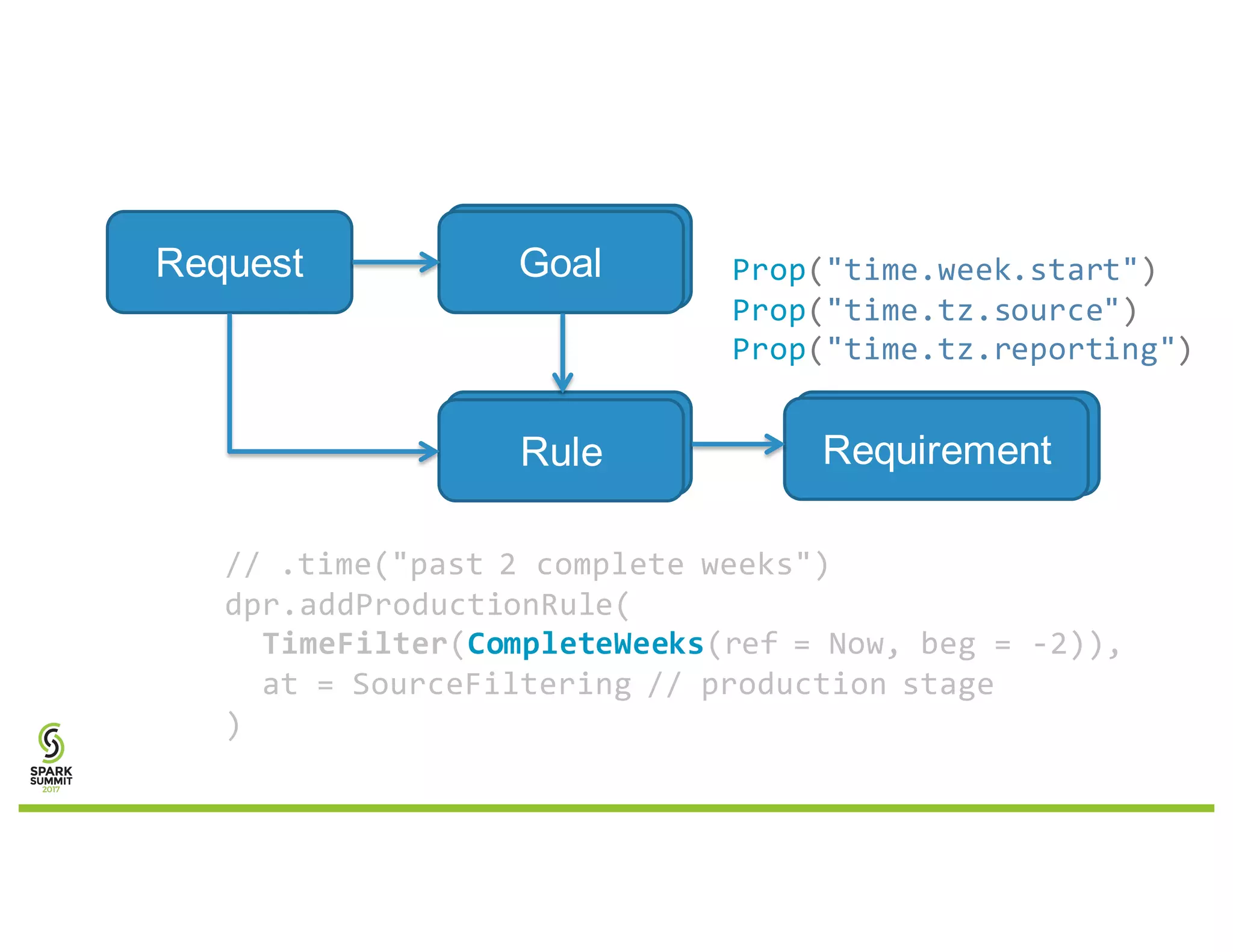
Request Goal
Rule
// .time("past 2 complete weeks")
dpr.addProductionRule(
TimeFilter(CompleteWeeks(ref = Now, beg = -2)),
at = SourceFiltering // production stage
)
Requirement
SourceColumn(
role = TimeDimension()
)
Request Goal
Rule
// .time("past 2 complete weeks")
dpr.addProductionRule(
TimeFilter(CompleteWeeks(ref = Now, beg = -2)),
at = SourceFiltering // production stage
)
Requirement
Prop("time.week.start")
Prop("time.tz.source")
Prop("time.tz.reporting")
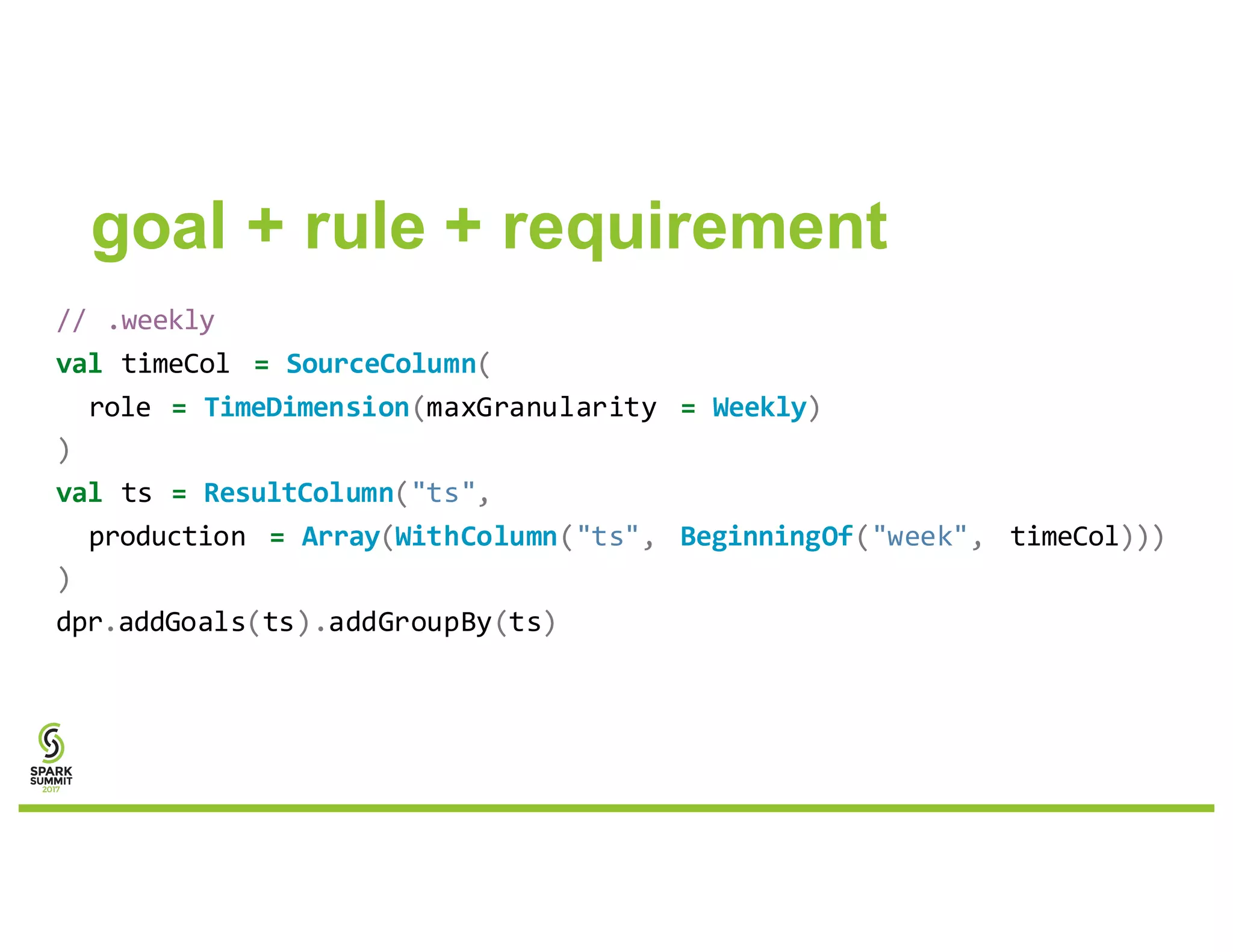
goal + rule + requirement
// .weekly
val timeCol = SourceColumn(
role = TimeDimension(maxGranularity = Weekly)
)
val ts = ResultColumn("ts",
production = Array(WithColumn("ts", BeginningOf("week", timeCol)))
)
dpr.addGoals(ts).addGroupBy(ts)
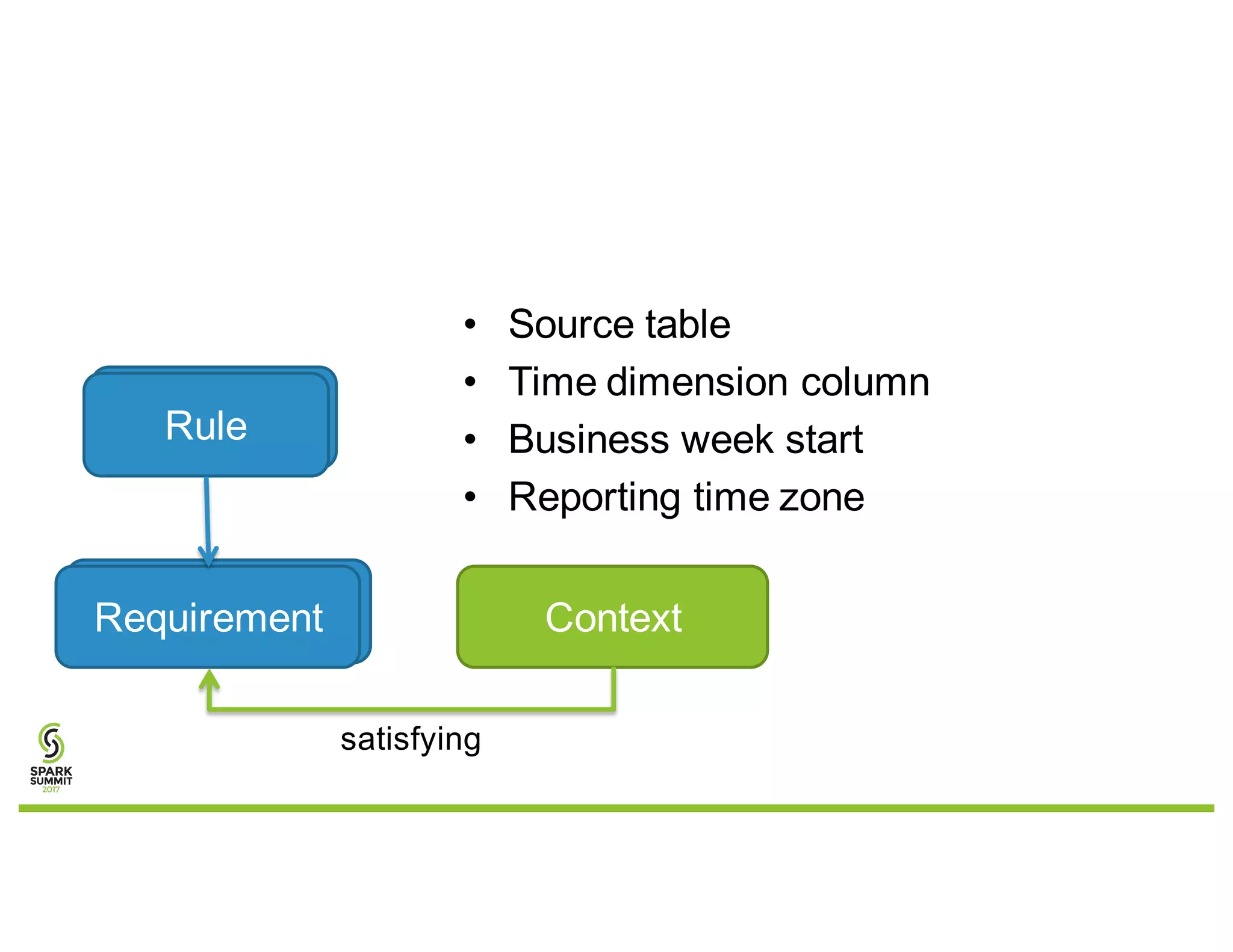
Rule
Requirement Context
satisfying
• Source table
• Time dimension column
• Business week start
• Reporting time zone
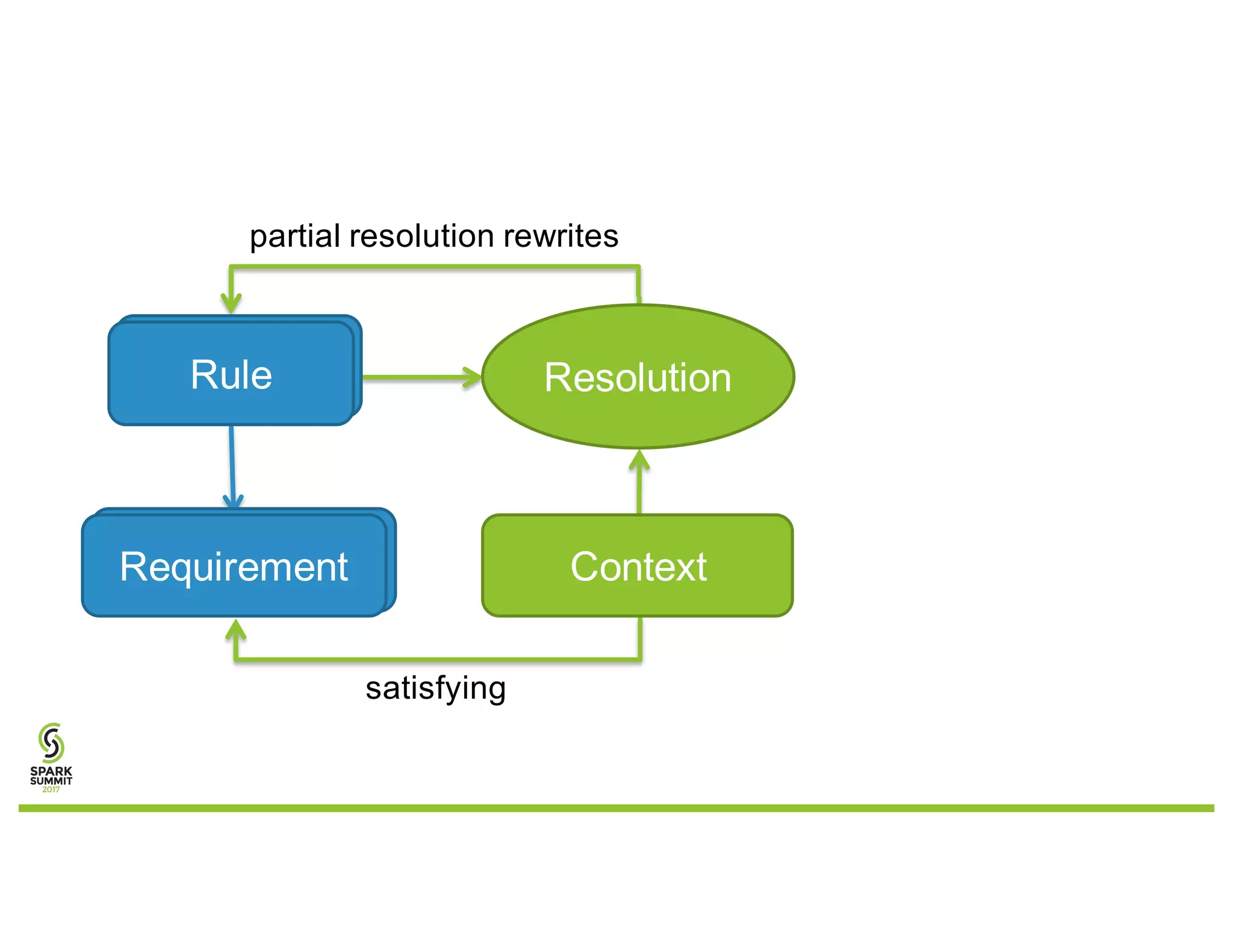
Rule
Requirement Context
Resolution
satisfying
partial resolution rewrites
Rule
Requirement Context
Resolution Dataset
satisfying
partial resolution rewrites
full resolution builds
transformations
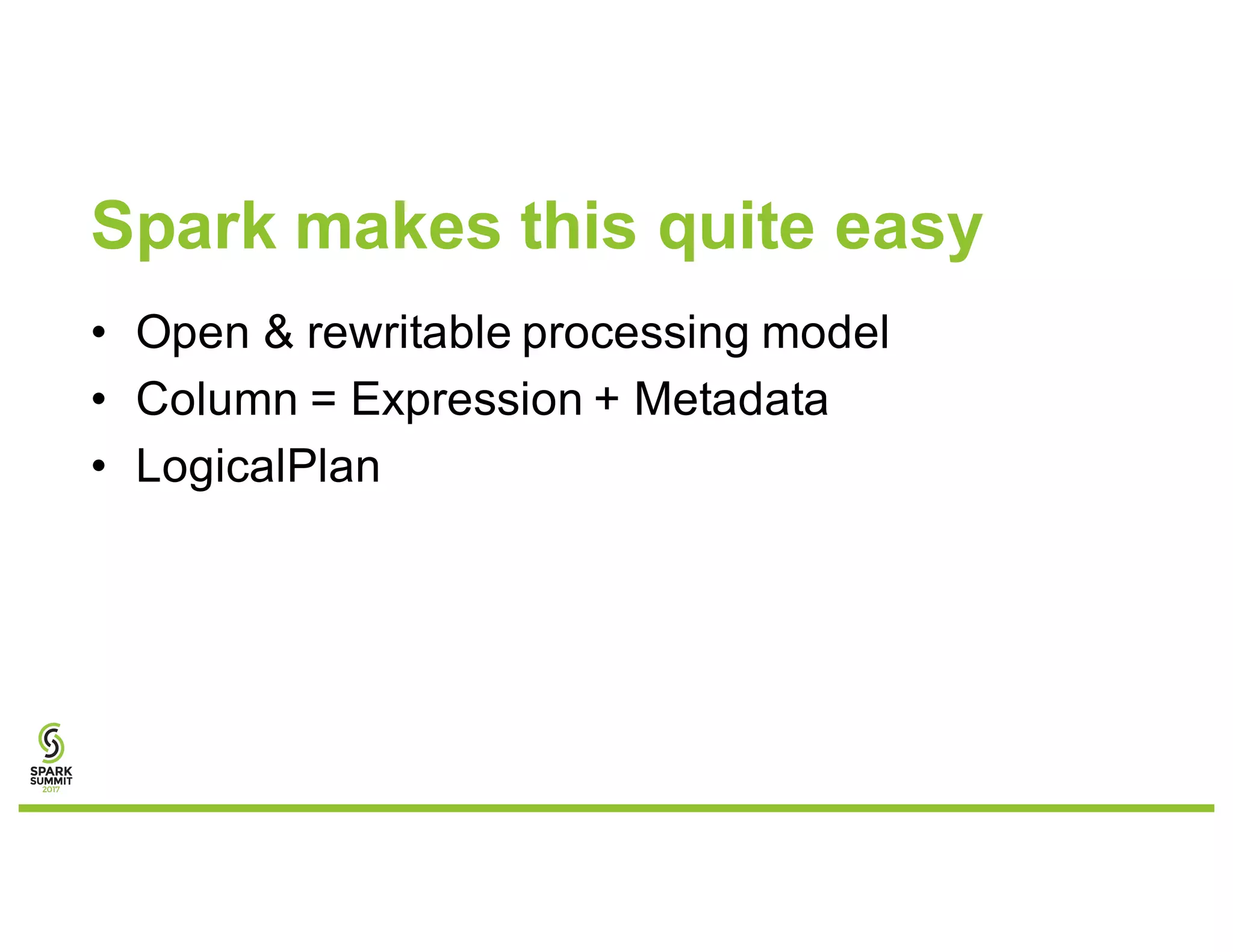
Spark makes this quite easy
• Open & rewritable processing model
• Column = Expression + Metadata
• LogicalPlan
not your typical enterprise/BI
death-by-configuration system
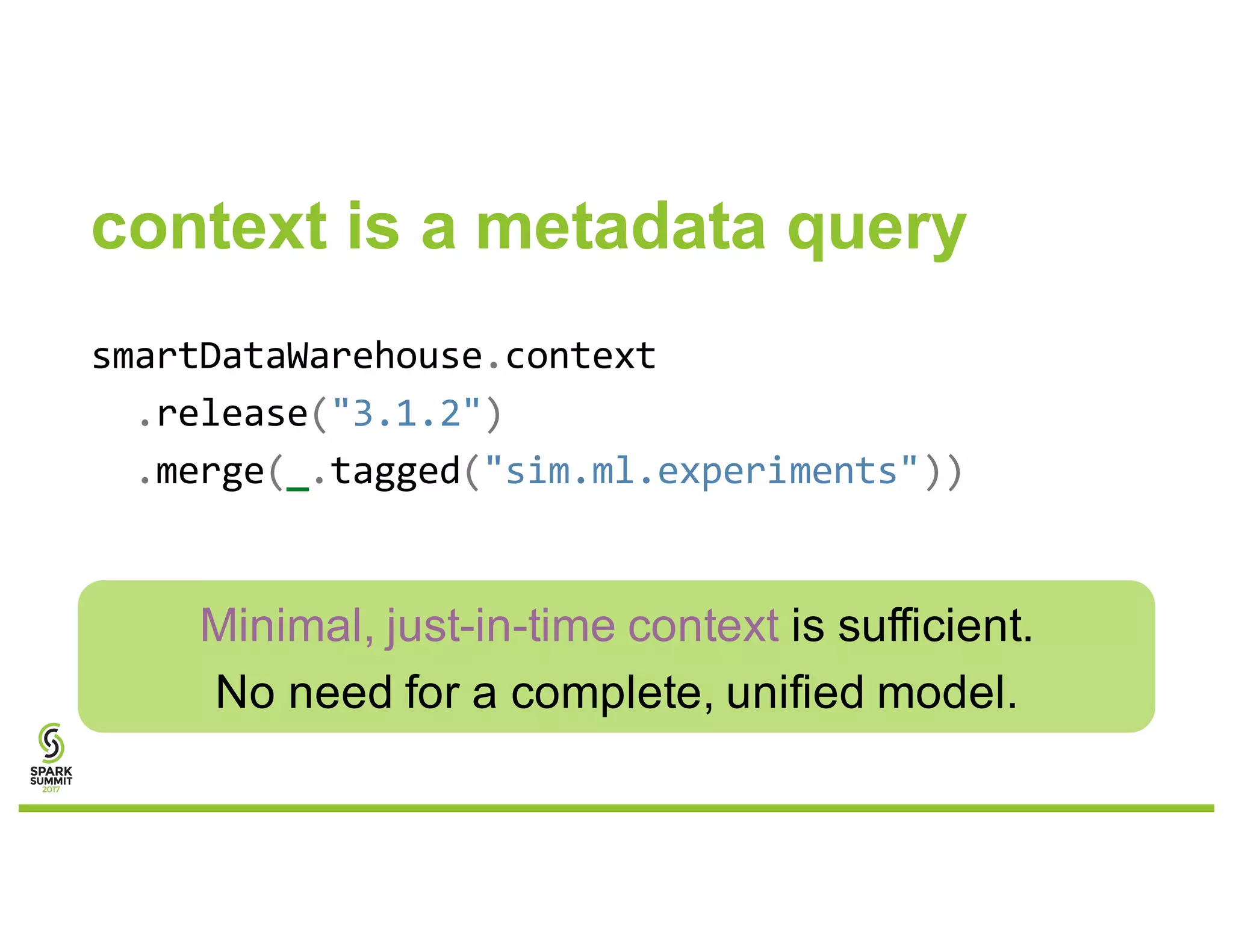
context is a metadata query
smartDataWarehouse.context
.release("3.1.2")
.merge(_.tagged("sim.ml.experiments"))
Minimal, just-in-time context is sufficient.
No need for a complete, unified model.
automatic joins by column name
{
"table": "dimension_campaigns",
"primary_key": ["campaign_id"]
"joins": [ {"fields": ["campaign_id"]} ]
}
join any table with campaign_id column
automatic semantic joins
{
"table": "dimension_campaigns",
"primary_key": ["campaign_id"]
"joins": [ {"fields": ["ref:swoop.campaign.id"]} ]
}
join any table with a Swoop campaign ID
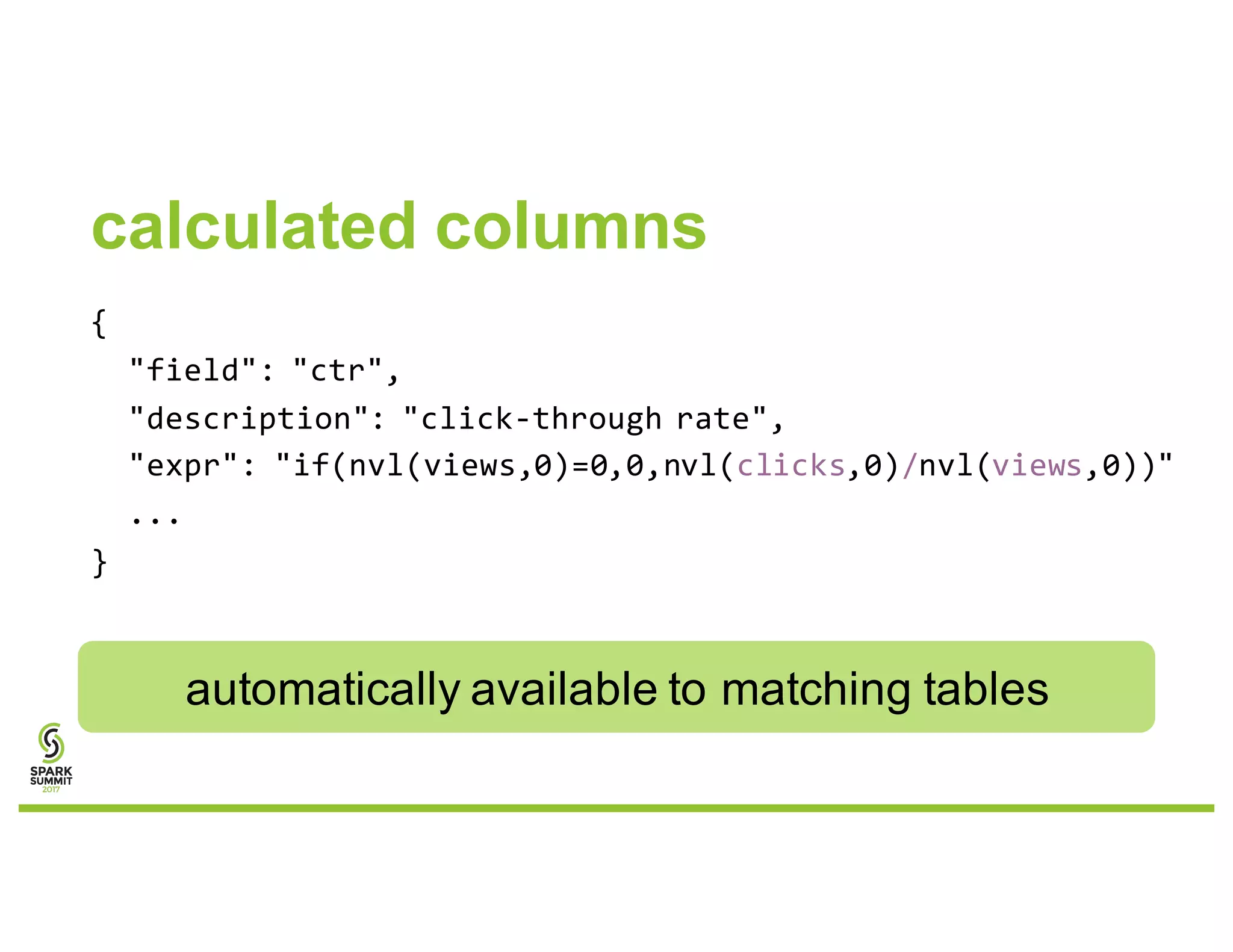
calculated columns
{
"field": "ctr",
"description": "click-through rate",
"expr": "if(nvl(views,0)=0,0,nvl(clicks,0)/nvl(views,0))"
...
}
automatically available to matching tables
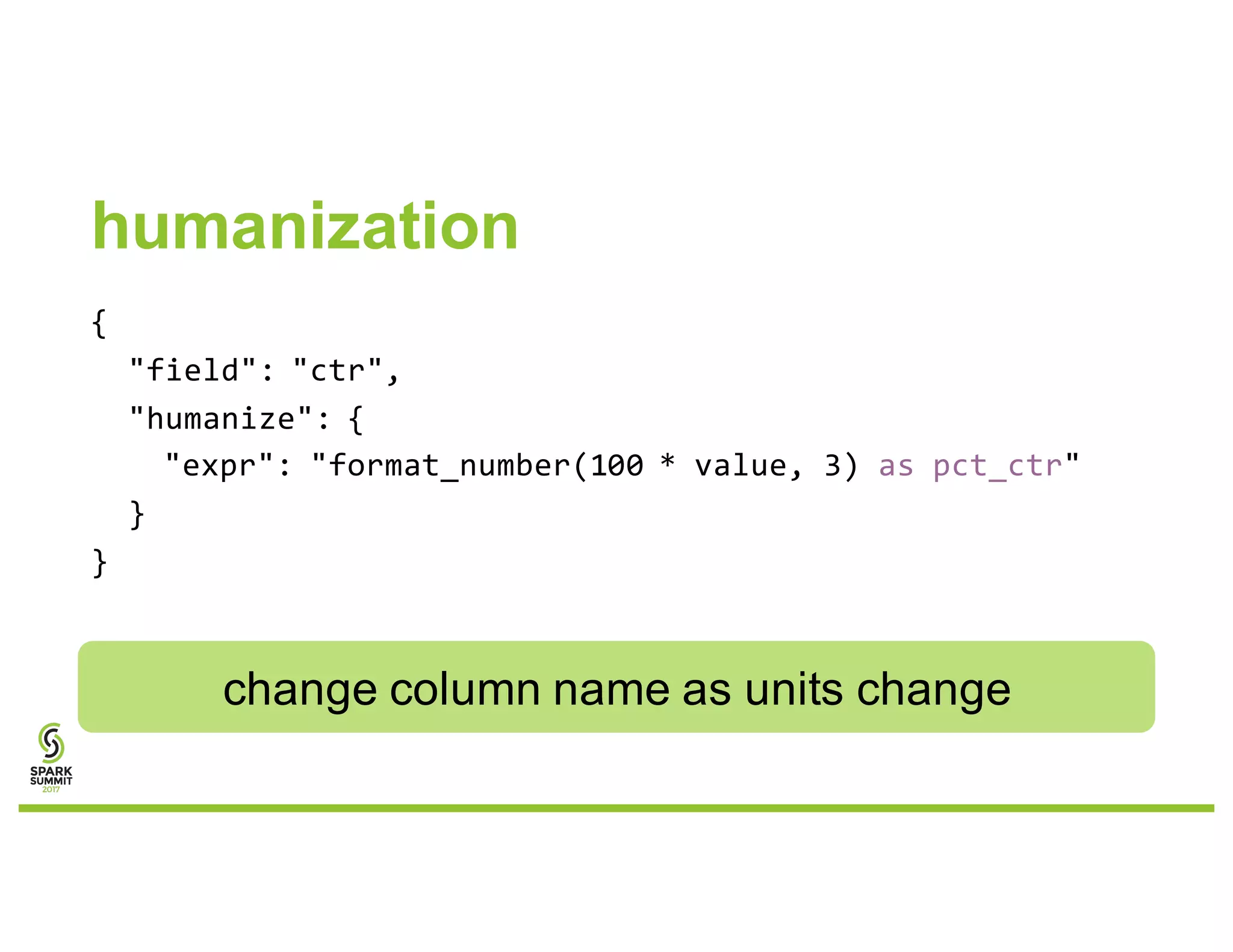
humanization
{
"field": "ctr",
"humanize": {
"expr": "format_number(100 * value, 3) as pct_ctr"
}
}
change column name as units change
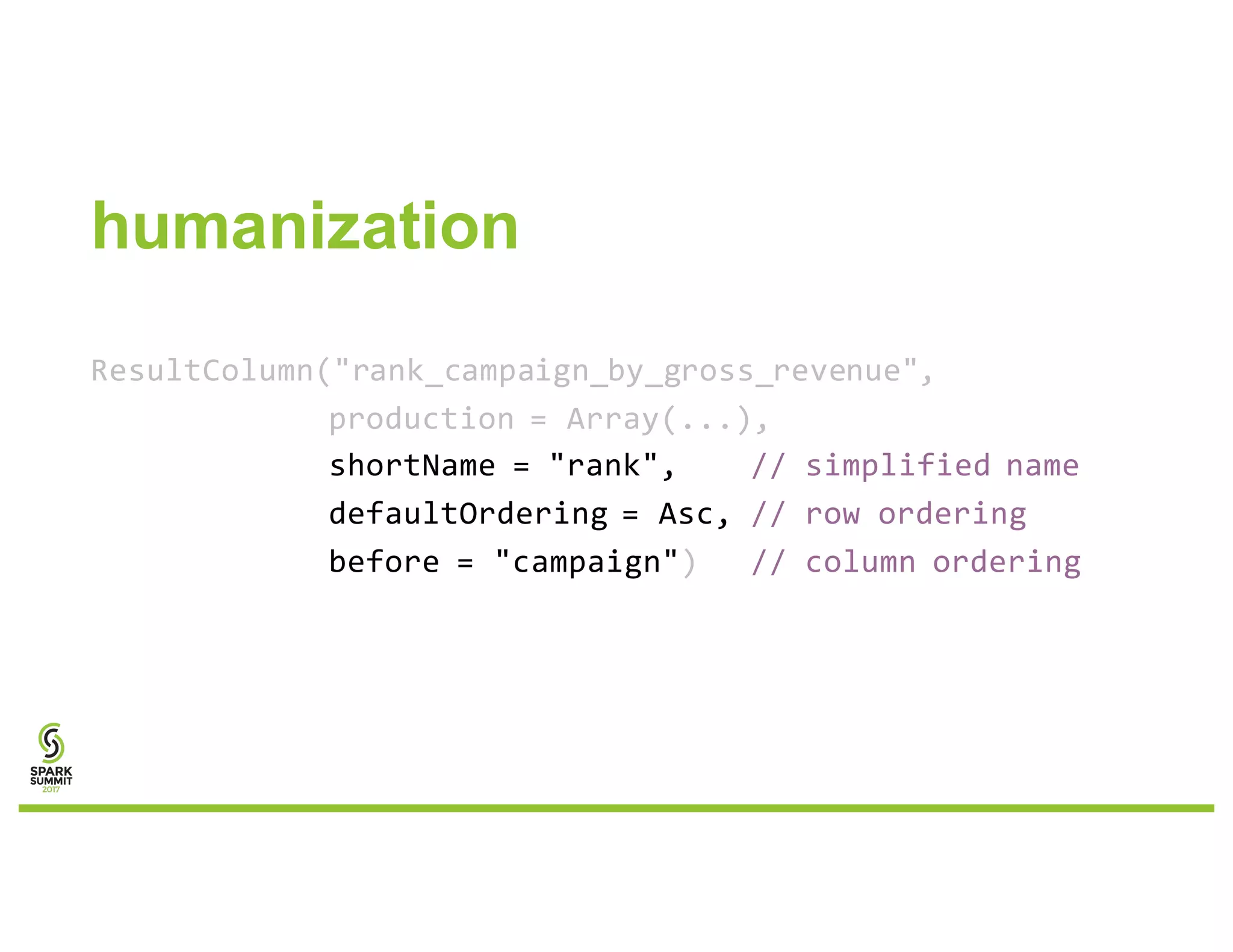
humanization
ResultColumn("rank_campaign_by_gross_revenue",
production = Array(...),
shortName = "rank", // simplified name
defaultOrdering = Asc, // row ordering
before = "campaign") // column ordering
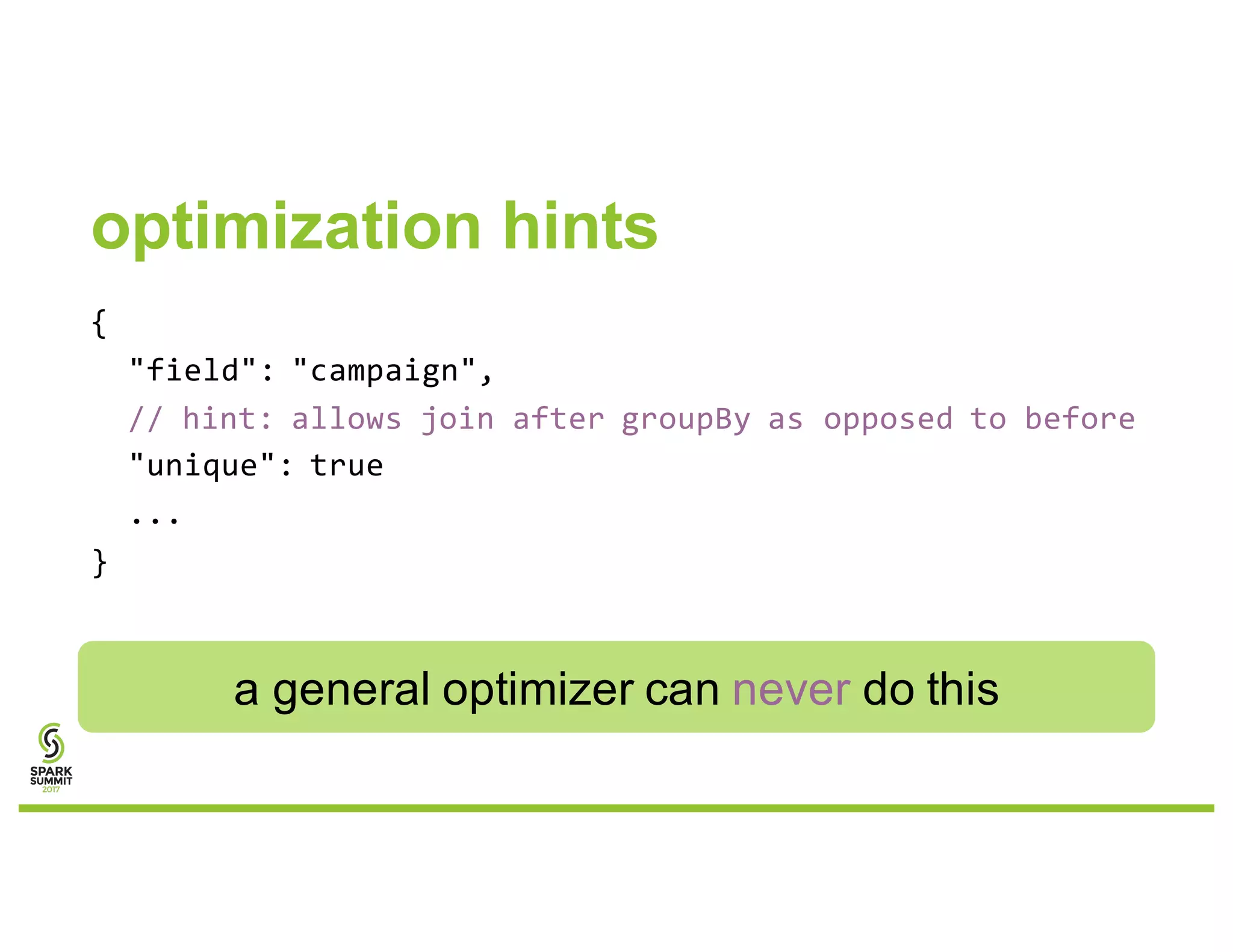
optimization hints
{
"field": "campaign",
// hint: allows join after groupBy as opposed to before
"unique": true
...
}
a general optimizer can never do this
automatic source & join selection
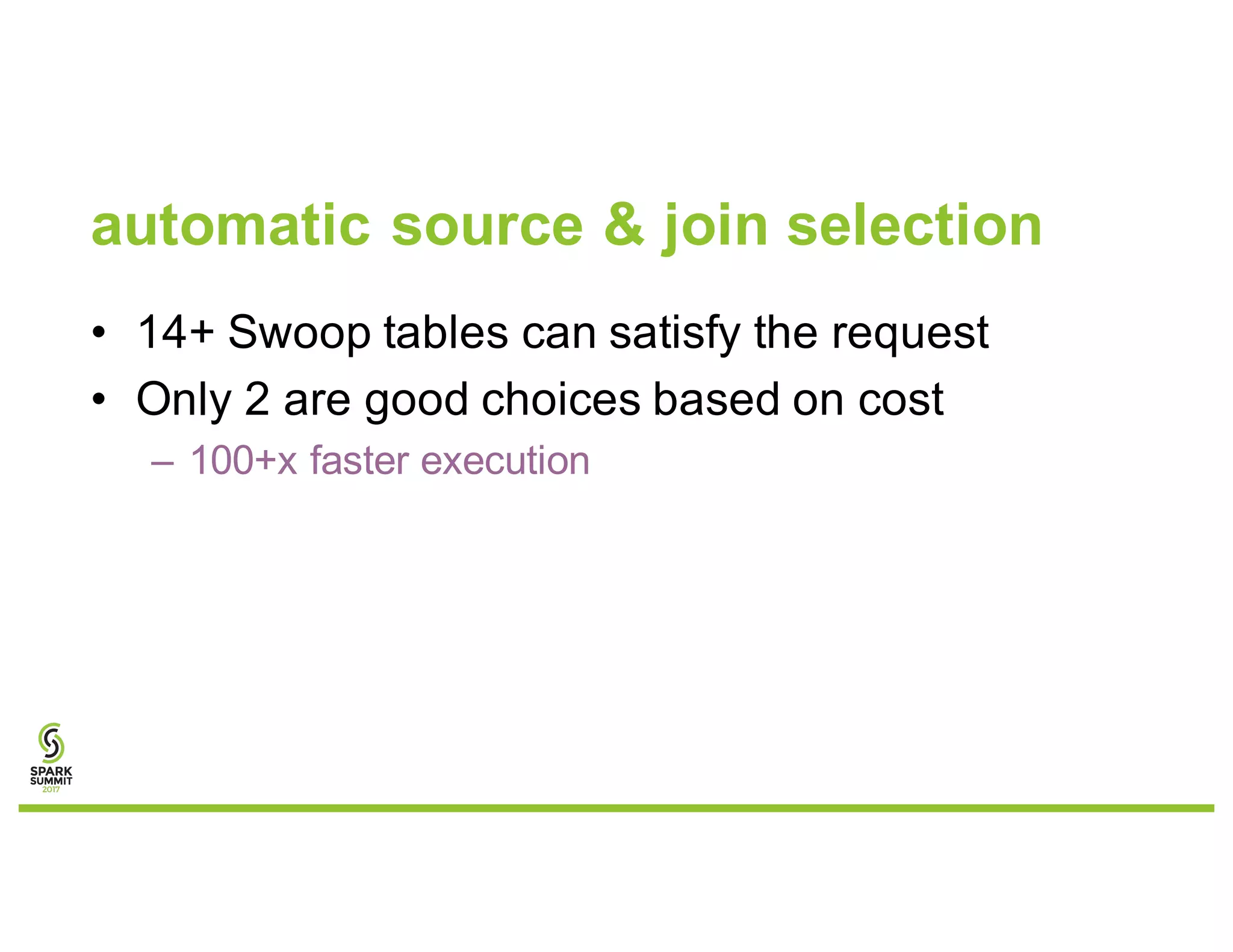
• 14+ Swoop tables can satisfy the request
• Only 2 are good choices based on cost
– 100+x faster execution
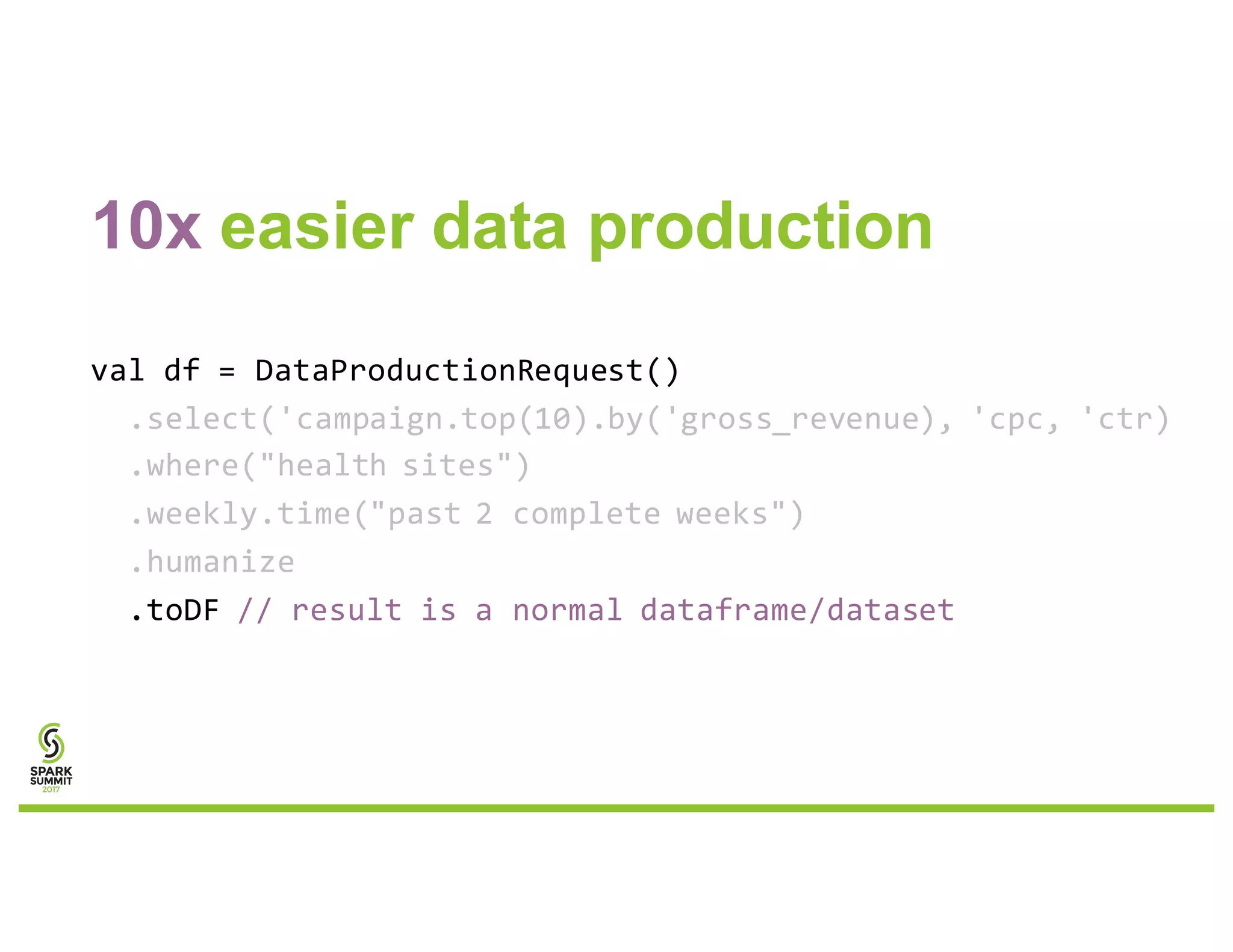
10x easier data production
val df = DataProductionRequest()
.select('campaign.top(10).by('gross_revenue), 'cpc, 'ctr)
.where("health sites")
.weekly.time("past 2 complete weeks")
.humanize
.toDF // result is a normal dataframe/dataset
revolutionary benefits
• Increased productivity & flexibility
• Improved performance & lower costs
• Easy collaboration (even across companies!)
• Business users can query Spark
At Swoop, we are committed to making
goal-based data production
the best free & open-source
interface for Spark data production
Interested in contributing?
Email spark@swoop.com
Join our open-source work.
Email spark@swoop.com
More Spark magic: http://bit.ly/spark-records

Goal Based Data Production with Sim Simeonov

  • 1.
    Spark-Powered Smart DataWarehouse Sim Simeonov,Founder & CTO, Swoop Goal-Based Data Production
  • 2.
    petabyte scale dataengineering & ML run our business
  • 3.
    What is adata-powered culture?
  • 4.
    answer questions 10xeasier with goal-based data production
  • 5.
    simple data productionrequest top 10 campaigns by gross revenue running on health sites, weekly for the past 2 complete weeks, with cost-per-click and the click-through rate
  • 7.
    with origins as (selectorigin_id, site_vertical from dimension_origins where site_vertical = 'health'), t1 as ( select campaign_id, origin_id, clicks, views, billing, date(to_utc_timestamp(date_sub(to_utc_timestamp(from_unixtime(uts), 'America/New_York'), cast(date_format(to_utc_timestamp(from_unixtime(uts), 'America/New_York'), 'u') as int) - 1), 'America/New_York')) as ts from rep_campaigns_daily where from_unixtime(uts) >= to_utc_timestamp(date_sub(to_utc_timestamp(current_date(), 'America/New_York'), cast(date_format(to_utc_timestamp(current_date(), 'America/New_York'), 'u') as int) - 1) - INTERVAL 2 WEEK, 'America/New_York') and from_unixtime(uts) < to_utc_timestamp(date_sub(to_utc_timestamp(current_date(), 'America/New_York'), cast(date_format(to_utc_timestamp(current_date(), 'America/New_York'), 'u') as int) - 1), 'America/New_York') ), t2 as ( select ts, campaign_id, sum(views) as views, sum(clicks) as clicks, sum(billing) / 1000000.0 as gross_revenue from t1 lhs join origins rhs on lhs.origin_id = rhs.origin_id group by campaign_id, ts ), t3 as (select *, rank() over (partition by ts order by gross_revenue desc) as rank from t2), t4 as (select * from t3 where rank <= 10) select ts, rank, campaign_short_name as campaign, bround(gross_revenue) as gross_revenue, format_number(if(clicks = 0, 0, gross_revenue / clicks), 3) as cpc, format_number(if(views = 0, 0, 100 * clicks / views), 3) as pct_ctr from t4 lhs join dimension_campaigns rhs on lhs.campaign_id = rhs.campaign_id order by ts, rank
  • 8.
    DSL is equallycomplex spark.table("rep_campaigns_daily") .where(""" from_unixtime(uts) >= to_utc_timestamp(date_sub(to_utc_timestamp(current_date(), 'America/New_York'), cast(date_format(to_utc_timestamp(current_date(), 'America/New_York'), 'u') as int) - 1) - INTERVAL 2 WEEK, 'America/New_York') and from_unixtime(uts) < to_utc_timestamp(date_sub(to_utc_timestamp(current_date(), 'America/New_York'), cast(date_format(to_utc_timestamp(current_date(), 'America/New_York'), 'u') as int) - 1), 'America/New_York')""") .join(spark.table("dimension_origins").where('site_vertical === "health").select('origin_id), "origin_id") .withColumn("ts", expr("date(to_utc_timestamp(date_sub(to_utc_timestamp(from_unixtime(uts), 'America/New_York'), cast(date_format(to_utc_timestamp(from_unixtime(uts), 'America/New_York'), 'u') as int) - 1), 'America/New_York'))")) .groupBy('campaign_id, 'ts) .agg( sum('views).as("views"), sum('clicks).as("clicks"), (sum('billing) / 1000000).as("gross_revenue") ) .withColumn("rank", rank.over(Window.partitionBy('ts).orderBy('gross_revenue.desc))) .where('rank <= 10) .join(spark.table("dimension_campaigns").select('campaign_id, 'campaign_short_name.as("campaign")), "campaign_id") .withColumn("gross_revenue", expr("bround(gross_revenue)")) .withColumn("cpc", format_number(when('clicks === 0, 0).otherwise('gross_revenue / 'clicks), 3)) .withColumn("pct_ctr", format_number(when('views === 0, 0).otherwise(lit(100) * 'clicks / 'views), 3)) .select('ts, 'rank, 'campaign, 'gross_revenue, 'cpc, 'pct_ctr) .orderBy('ts, 'rank)
  • 9.
    Spark needs toknow what you want and how to produce it
  • 10.
    General data processingrequires detailed instructions every single time
  • 11.
    the curse ofgenerality: verbosity what (5%) vs. how (95%)
  • 12.
    the curse ofgenerality: duplication -- calculate click-through rate, % format_number(if(views = 0, 0, 100 * clicks / views), 3) as pct_ctr -- join to get campaign names from campaign IDs SELECT campaign_short_name AS campaign, ... FROM ... lhs JOIN dimension_campaigns rhs ON lhs.campaign_id = rhs.campaign_id
  • 13.
    the curse ofgenerality: complexity -- weekly date(to_utc_timestamp( date_sub( to_utc_timestamp(from_unixtime(uts), 'America/New_York'), cast( date_format( to_utc_timestamp(from_unixtime(uts), 'America/New_York'), 'u') as int) - 1), 'America/New_York'))
  • 14.
    the curse ofgenerality: inflexibility -- code depends on time column datatype, format & timezone date(to_utc_timestamp( date_sub( to_utc_timestamp(from_unixtime(uts), 'America/New_York'), cast( date_format( to_utc_timestamp(from_unixtime(uts), 'America/New_York'), 'u') as int) - 1), 'America/New_York'))
  • 15.
    Can we keepwhat and toss how?
  • 16.
    Can how becomeimplicit context? • Data sources, schema, join relationships • Presentation & formatting • Week start (Monday) • Reporting time zone (East Coast)
  • 17.
    goal-based data production DataProductionRequest() .select('campaign.top(10).by('gross_revenue),'cpc, 'ctr) .where("health sites") .weekly.time("past 2 complete weeks") .humanize
  • 18.
    let’s go behindthe curtain
  • 19.
    the DSL isnot as important as the processing & configuration models
  • 20.
  • 21.
  • 22.
    Request Goal Rule // .time("past2 complete weeks") dpr.addProductionRule( TimeFilter(CompleteWeeks(ref = Now, beg = -2)), at = SourceFiltering // production stage )
  • 23.
    Request Goal Rule // .time("past2 complete weeks") dpr.addProductionRule( TimeFilter(CompleteWeeks(ref = Now, beg = -2)), at = SourceFiltering // production stage ) Requirement SourceColumn( role = TimeDimension() )
  • 24.
    Request Goal Rule // .time("past2 complete weeks") dpr.addProductionRule( TimeFilter(CompleteWeeks(ref = Now, beg = -2)), at = SourceFiltering // production stage ) Requirement Prop("time.week.start") Prop("time.tz.source") Prop("time.tz.reporting")
  • 25.
    goal + rule+ requirement // .weekly val timeCol = SourceColumn( role = TimeDimension(maxGranularity = Weekly) ) val ts = ResultColumn("ts", production = Array(WithColumn("ts", BeginningOf("week", timeCol))) ) dpr.addGoals(ts).addGroupBy(ts)
  • 26.
    Rule Requirement Context satisfying • Sourcetable • Time dimension column • Business week start • Reporting time zone
  • 27.
  • 28.
    Rule Requirement Context Resolution Dataset satisfying partialresolution rewrites full resolution builds transformations
  • 29.
    Spark makes thisquite easy • Open & rewritable processing model • Column = Expression + Metadata • LogicalPlan
  • 30.
    not your typicalenterprise/BI death-by-configuration system
  • 31.
    context is ametadata query smartDataWarehouse.context .release("3.1.2") .merge(_.tagged("sim.ml.experiments")) Minimal, just-in-time context is sufficient. No need for a complete, unified model.
  • 32.
    automatic joins bycolumn name { "table": "dimension_campaigns", "primary_key": ["campaign_id"] "joins": [ {"fields": ["campaign_id"]} ] } join any table with campaign_id column
  • 33.
    automatic semantic joins { "table":"dimension_campaigns", "primary_key": ["campaign_id"] "joins": [ {"fields": ["ref:swoop.campaign.id"]} ] } join any table with a Swoop campaign ID
  • 34.
    calculated columns { "field": "ctr", "description":"click-through rate", "expr": "if(nvl(views,0)=0,0,nvl(clicks,0)/nvl(views,0))" ... } automatically available to matching tables
  • 35.
    humanization { "field": "ctr", "humanize": { "expr":"format_number(100 * value, 3) as pct_ctr" } } change column name as units change
  • 36.
    humanization ResultColumn("rank_campaign_by_gross_revenue", production = Array(...), shortName= "rank", // simplified name defaultOrdering = Asc, // row ordering before = "campaign") // column ordering
  • 37.
    optimization hints { "field": "campaign", //hint: allows join after groupBy as opposed to before "unique": true ... } a general optimizer can never do this
  • 38.
    automatic source &join selection • 14+ Swoop tables can satisfy the request • Only 2 are good choices based on cost – 100+x faster execution
  • 39.
    10x easier dataproduction val df = DataProductionRequest() .select('campaign.top(10).by('gross_revenue), 'cpc, 'ctr) .where("health sites") .weekly.time("past 2 complete weeks") .humanize .toDF // result is a normal dataframe/dataset
  • 40.
    revolutionary benefits • Increasedproductivity & flexibility • Improved performance & lower costs • Easy collaboration (even across companies!) • Business users can query Spark
  • 41.
    At Swoop, weare committed to making goal-based data production the best free & open-source interface for Spark data production Interested in contributing? Email spark@swoop.com
  • 42.
    Join our open-sourcework. Email spark@swoop.com More Spark magic: http://bit.ly/spark-records