D3 WORKSHOP
WEB STANDARDS

D3 provides transformation;
  no new representation.
MAPPING DATA TO ELEMENTS

Visualisation requires visual encoding:
      mapping data to elements.
NOTHING NEW
       D3 refers to


  Data-Driven Documents


W3C Document Object Model.
D3 = STANDARDS

Learning D3 is largely learning web standards
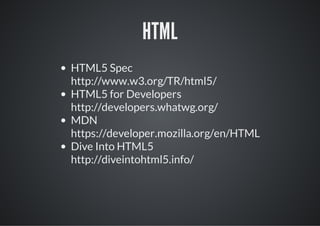
HTML
HTML5 Spec
http://www.w3.org/TR/html5/
HTML5 for Developers
http://developers.whatwg.org/
MDN
https://developer.mozilla.org/en/HTML
Dive Into HTML5
http://diveintohtml5.info/
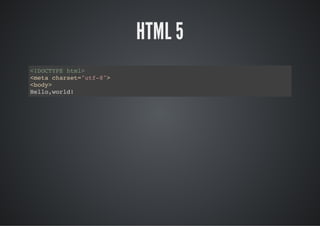
HTML 5
<DCYEhm>
!OTP tl
<eacast"t-"
mt hre=uf8>
<oy
bd>
Hlowrd
el,ol!
SVG
SVG Spec
http://www.w3.org/TR/SVG/
MDN
https://developer.mozilla.org/en/SVG
D3 API Reference
https://github.com/mbostock/d3/wiki/SVG-Shapes
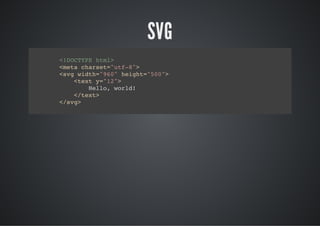
SVG
<DCYEhm>
!OTP tl
<eacast"t-"
mt hre=uf8>
<v wdh"6"hih=50>
sg it=90 egt"0"
  <ety"2>
   tx =1"
     Hlo wrd
     el, ol!
  <tx>
   /et
<sg
/v>
SVG != HTML
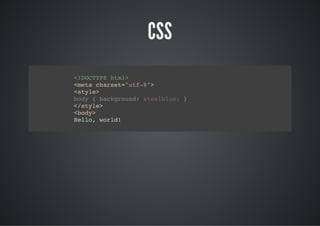
CSS
CSS Spec
http://www.w3.org/TR/CSS2/
Selectors Spec
http://www.w3.org/TR/selectors/
CSS
<DCYEhm>
 !OTP tl
<eacast"t-"
 mt hre=uf8>
<tl>
 sye
bd {bcgon:selle }
 oy  akrud tebu;
<sye
 /tl>
<oy
 bd>
Hlo wrd
 el, ol!
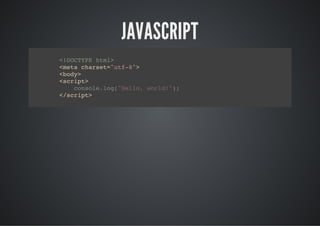
JAVASCRIPT
MDN
https://developer.mozilla.org/en/JavaScript

Douglas Crockford’s JavaScript: The Good Parts
http://shop.oreilly.com/product/9780596517748.do
http://javascript.crockford.com/
JAVASCRIPT
<DCYEhm>
!OTP tl
<eacast"t-"
mt hre=uf8>
<oy
bd>
<cit
srp>
  cnoelg"el,wrd";
   osl.o(Hlo ol!)
<srp>
/cit
STARTING WITH D3
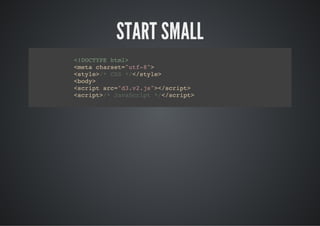
START SMALL
<DCYEhm>
 !OTP tl
<eacast"t-"
 mt hre=uf8>
<tl>*CS*<sye
 sye/ S //tl>
<oy
 bd>
<citsc"3v.s>/cit
 srp r=d.2j"<srp>
<cit/ JvSrp *<srp>
 srp>* aacit //cit
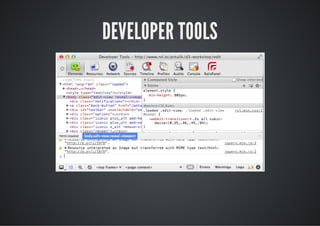
DEVELOPER TOOLS
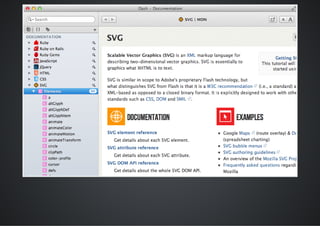
DASH
latest version
D3 RESOURCES
D3 API Reference
https://github.com/mbostock/d3/wiki/API-Reference
D3 Wiki
https://github.com/mbostock/d3/wiki
D3 Group
https://groups.google.com/group/d3-js
D3 Stack Overflow
http://stackoverflow.com/questions/tagged/d3.js
SELECTORS
CSS SELECTORS
  pe cd {
   r, oe
    fn-aiy "el" mnsae
    otfml: Mno, oopc;
    fn-ie 4p;
    otsz: 8x
  }


        CSS style selectors
#o
 fo     / <n i=fo>
         / ay d"o"
fo
 o      / <o>
         / fo
.o
 fo     / <n cas"o"
         / ay ls=fo>
[o=a]
 fobr   / <n fo"a"
         / ay o=br>
fobr
 o a    / <o>br<fo
         / fo<a>/o>

fobr
 o.a    / <o cas"a"
         / fo ls=br>
fobr
 o#a    / <o i=br>
         / fo d"a"
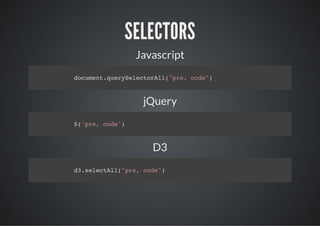
SELECTORS
           Javascript
dcmn.urSlcoAl"r,cd"
 ouetqeyeetrl(pe oe)


            jQuery
$'r,cd'
 (pe oe)


              D3
d.eetl(pe cd"
 3slcAl"r, oe)
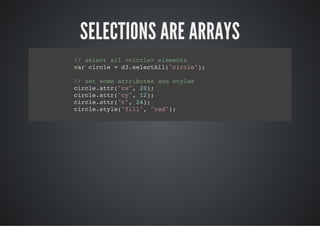
SELECTIONS ARE ARRAYS
/ slc al<ice eeet
 / eet l crl> lmns
vrcrl =d.eetl(crl";
 a ice   3slcAl"ice)

/ stsm atiue adsye
 / e oe trbts n tls
crl.tr"x,2)
 iceat(c" 0;
crl.tr"y,1)
 iceat(c" 2;
crl.tr"" 2)
 iceat(r, 4;
crl.tl(fl" "e";
 icesye"il, rd)
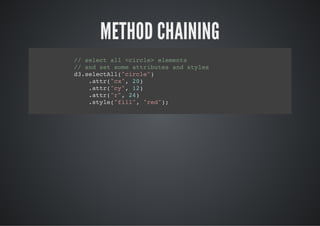
METHOD CHAINING
/ slc al<ice eeet
 / eet l crl> lmns
/ adstsm atiue adsye
 / n e oe trbts n tls
d.eetl(crl"
 3slcAl"ice)
   .tr"x,2)
    at(c" 0
   .tr"y,1)
    at(c" 2
   .tr"" 2)
    at(r, 4
   .tl(fl" "e";
    sye"il, rd)
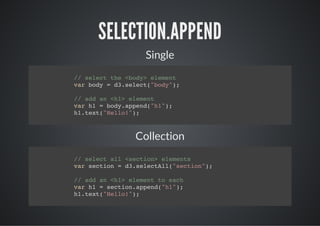
SELECTION.APPEND
           Single
/ slc te<oy eeet
 / eet h bd> lmn
vrbd =d.eet"oy)
 a oy   3slc(bd";

/ ada <1 eeet
 / d n h> lmn
vrh =bd.ped"1)
 a 1  oyapn(h";
h.et"el!)
 1tx(Hlo";


         Collection
/ slc al<eto>eeet
 / eet l scin lmns
vrscin=d.eetl(scin)
 a eto   3slcAl"eto";

/ ada <1 eeett ec
 / d n h> lmn o ah
vrh =scinapn(h";
 a 1  eto.ped"1)
h.et"el!)
 1tx(Hlo";
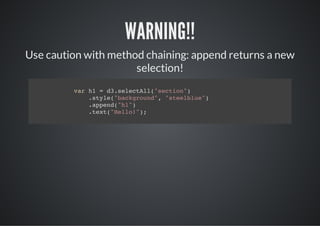
WARNING!!
Use caution with method chaining: append returns a new
                      selection!
         vrh =d.eetl(scin)
          a 1  3slcAl"eto"
            .tl(bcgon" "tebu"
            sye"akrud, selle)
            .ped"1)
            apn(h"
            .et"el!)
            tx(Hlo";
DATA
DATA ARE ARRAYS
 Selections are arrays
 Data are arrays

   Coincidence?
DATA
          Numbers
/ Abrcat pras
 /  a hr, ehp?
vrdt =[,1 2 3 5 8;
 a aa  1 , , , , ]


           Objects
/ Asatrlt pras
 /   ctepo, ehp?
vrdt =[
 a aa
  {:1.,y 91}
   x 00 : .4,
  {: 80 y 81}
   x  ., : .4,
  {:1.,y 87}
   x 30 : .4,
  {: 90 y 87}
   x  ., : .7,
  {:1.,y 92}
   x 10 : .6
];
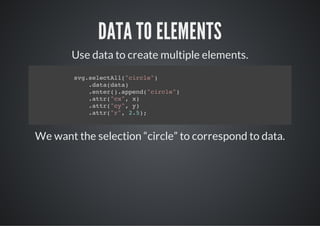
DATA TO ELEMENTS
       Use data to create multiple elements.
        sgslcAl"ice)
         v.eetl(crl"
           .aadt)
           dt(aa
           .ne(.ped"ice)
           etr)apn(crl"
           .tr"x,x
           at(c" )
           .tr"y,y
           at(c" )
           .tr"" 25;
           at(r, .)


We want the selection “circle” to correspond to data.
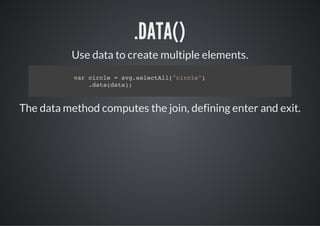
.DATA()
          Use data to create multiple elements.
           vrcrl =sgslcAl"ice)
            a ice  v.eetl(crl"
              .aadt)
              dt(aa;


The data method computes the join, defining enter and exit.
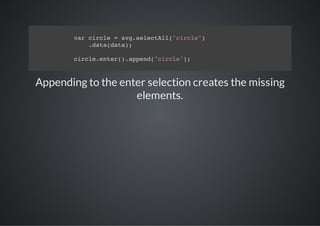
vrcrl =sgslcAl"ice)
         a ice  v.eetl(crl"
           .aadt)
           dt(aa;

        crl.ne(.ped"ice)
         iceetr)apn(crl";


Appending to the enter selection creates the missing
                    elements.
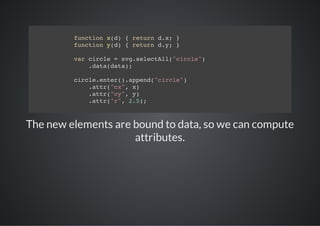
fnto xd {rtr dx }
          ucin ()  eun .;
         fnto yd {rtr dy }
          ucin ()  eun .;

         vrcrl =sgslcAl"ice)
          a ice  v.eetl(crl"
            .aadt)
            dt(aa;

         crl.ne(.ped"ice)
          iceetr)apn(crl"
            .tr"x,x
            at(c" )
            .tr"y,y
            at(c" )
            .tr"" 25;
            at(r, .)


The new elements are bound to data, so we can compute
                     attributes.
ENTER, UPDATE & EXIT
   Thinking with Joins
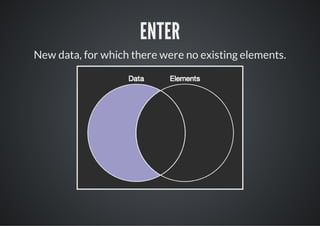
ENTER
New data, for which there were no existing elements.
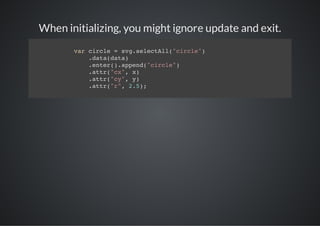
When initializing, you might ignore update and exit.
       vrcrl =sgslcAl"ice)
        a ice  v.eetl(crl"
          .aadt)
          dt(aa
          .ne(.ped"ice)
          etr)apn(crl"
          .tr"x,x
          at(c" )
          .tr"y,y
          at(c" )
          .tr"" 25;
          at(r, .)
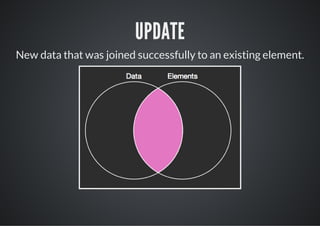
UPDATE
New data that was joined successfully to an existing element.
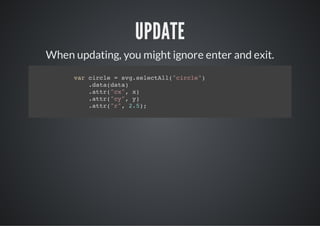
UPDATE
When updating, you might ignore enter and exit.
     vrcrl =sgslcAl"ice)
      a ice  v.eetl(crl"
        .aadt)
        dt(aa
        .tr"x,x
        at(c" )
        .tr"y,y
        at(c" )
        .tr"" 25;
        at(r, .)
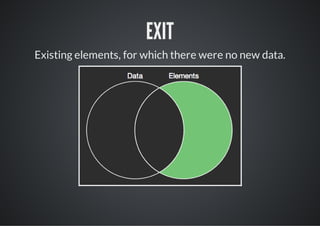
EXIT
Existing elements, for which there were no new data.
EXIT
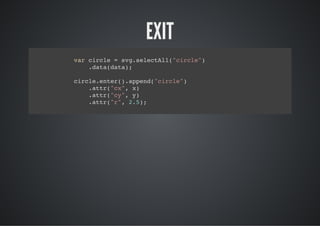
vrcrl =sgslcAl"ice)
 a ice  v.eetl(crl"
   .aadt)
   dt(aa;

crl.ne(.ped"ice)
 iceetr)apn(crl"
   .tr"x,x
   at(c" )
   .tr"y,y
   at(c" )
   .tr"" 25;
   at(r, .)
ENTER + UPDATE
Entering nodes are added to update on append.
ENTER + UPDATE
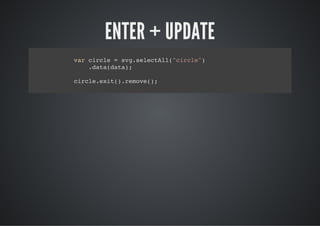
vrcrl =sgslcAl"ice)
 a ice  v.eetl(crl"
   .aadt)
   dt(aa;

crl.xt)rmv(;
 iceei(.eoe)
KEY FUNCTION
   You can control the join;
by default, the join is by index.
/ Asatrlt pras
        /   ctepo, ehp?
       vrdt =[
        a aa
         {ae "lc" x 1.,y 91}
          nm: Aie, : 00 : .4,
         {ae
          nm: "o" x 80 y 81}
               Bb, : ., : .4,
         {ae "ao" x 1.,y 87}
          nm: Crl, : 30 : .4,
         {ae "ae,x 90 y 87}
          nm: Dv" : ., : .7,
         {ae "dt" x 1.,y 92}
          nm: Eih, : 10 : .6
       ];


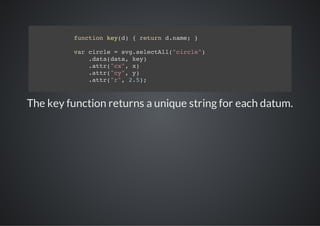
If needed, data should have a unique key for joining.
fnto kyd {rtr dnm;}
          ucin e()  eun .ae

         vrcrl =sgslcAl"ice)
          a ice  v.eetl(crl"
            .aadt,ky
            dt(aa e)
            .tr"x,x
            at(c" )
            .tr"y,y
            at(c" )
            .tr"" 25;
            at(r, .)


The key function returns a unique string for each datum.
LOADING DATA
D3 provides several convenience routines using
              XMLHttpRequest .
                     CSV
                     JSON
D3 AND ARRAY
D3 AND ARRAY
JavaScript has a number of useful built-in array methods.
                array. {filter,map,sort,…}
D3 also has a variety of data-transform methods; explore the
                             API .
                   d3. {nest,keys,values,…}
SCALES
DOMAIN => RANGE
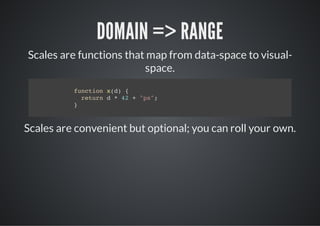
Scales are functions that map from data-space to visual-
                         space.
          fnto xd {
           ucin ()
            rtr d*4 +"x;
             eun   2  p"
          }


Scales are convenient but optional; you can roll your own.
QUANTITATIVE SCALES
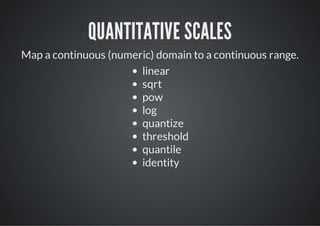
Map a continuous (numeric) domain to a continuous range.
                       linear
                       sqrt
                       pow
                       log
                       quantize
                       threshold
                       quantile
                       identity
vrx=d.cl.ier)
 a    3saelna(
   .oan[2 2]
   dmi(1, 4)
   .ag(0 70)
   rne[, 2];

x1) / 20
 (6; / 4


vrx=d.cl.qt)
 a    3saesr(
   .oan[2 2]
   dmi(1, 4)
   .ag(0 70)
   rne[, 2];

x1) / 289592053
 (6; / 6.069638


vrx=d.cl.o(
 a    3saelg)
   .oan[2 2]
   dmi(1, 4)
   .ag(0 70)
   rne[, 2];

x1) / 288694063
 (6; / 9.2998777
DOMAINS & RANGES
Typically, domains are derived from data while ranges are
                        constant.
vrx=d.cl.ier)
 a    3saelna(
   .oan[,d.a(ubr))
   dmi(0 3mxnmes]
   .ag(0 70)
   rne[, 2];


vrx=d.cl.o(
 a    3saelg)
   .oand.xetnmes)
   dmi(3etn(ubr)
   .ag(0 70)
   rne[, 2];


fnto vled {rtr dvle }
 ucin au() eun .au;

vrx=d.cl.o(
 a    3saelg)
   .oand.xetojcs vle)
   dmi(3etn(bet, au)
   .ag(0 70)
   rne[, 2];
INTERPOLATORS
Quantitative scales support multiple interpolators.
vrx=d.cl.ier)
 a    3saelna(
   .oan[2 2]
   dmi(1, 4)
   .ag("tebu" "rw")
   rne[selle, bon];

x1) / #656
 (6; / 668


vrx=d.cl.ier)
 a    3saelna(
   .oan[2 2]
   dmi(1, 4)
   .ag("p" "2p")
   rne[0x, 70x];

x1) / 20x
 (6; / 4p


vrx=d.cl.ier)
 a    3saelna(
   .oan[2 2]
   dmi(1, 4)
   .ag("tebu" "rw")
   rne[selle, bon]
   .neplt(3itroaes)
   itroaed.nepltHl;

x1) / #c0f
 (6; / 3b5
OBJECT INTERPOLATION
     just to mention
DIVERGING SCALES
Sometimes, you want a compound (“polylinear”) scale.
        vrx=d.cl.ier)
         a    3saelna(
           .oan[1,0 10)
           dmi(-0 , 0]
           .ag("e" "ht" "re")
           rne[rd, wie, gen];

        x-) / #f00
         (5; / f88
        x5) / #000
         (0; / 8c8
ORDINAL SCALES
An ordinal scale is essentially an explicit mapping.
      vrx=d.cl.ria(
       a    3saeodnl)
         .oan[A,"" "" "")
         dmi("" B, C, D]
         .ag(0 1,2,3];
         rne[, 0 0 0)

      x"";/ 1
       (B) / 0
vrx=d.cl.aeoy0)
 a    3saectgr2(
   .oan[A,"" "" "")
   dmi("" B, C, D];

x"";/ #e78
 (B) / ace


vrx=d.cl.aeoy0)
 a    3saectgr2(
   .oan[A,"" "" "")
   dmi("" B, C, D];

x"";/ #c0c
 (E) / 2a2
x"";/ #c0c
 (E) / 2a2
xdmi(;/ A B C D E
 .oan) / , , , ,
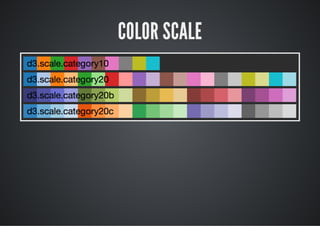
COLOR SCALE
Ordinal ranges can be derived from continuous ranges.
        vrx=d.cl.ria(
         a    3saeodnl)
           .oan[A,"" "" "")
           dmi("" B, C, D]
           .agPit(0 70)
           rneons[, 2];

        x"";/ 20
         (B) / 4


        vrx=d.cl.ria(
         a    3saeodnl)
           .oan[A,"" "" "")
           dmi("" B, C, D]
           .agRudad(0 70,.)
           rneonBns[, 2] 2;

        x"";/ 26 brpsto
         (B) / 0, a oiin
        xrnead) / 17 brwdh
         .agBn(; / 3, a it
AXIS
AXIS
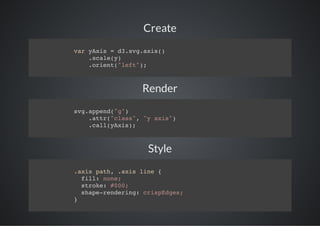
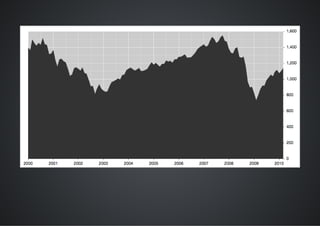
D3 provides convenient labeling for scales.
Create
vryxs=d.v.xs)
 a Ai   3sgai(
   .cl()
   saey
   .ret"et)
   oin(lf";


          Render
sgapn(g)
 v.ped""
   .tr"ls" " ai"
   at(cas, y xs)
   .alyxs;
   cl(Ai)


           Style
.xspt,.xsln {
 ai ah ai ie
  fl:nn;
   il oe
  srk:#0;
   toe 00
  saerneig cipde;
   hp-edrn: rsEgs
}
TICKS
Quantitative scales can be queried for “human-readable”
                         values.
         vrx=d.cl.ier)
          a    3saelna(
            .oan[2 2]
            dmi(1, 4)
            .ag(0 70)
            rne[, 2];

         xtcs5;/ [2 1,1,1,2,2,2]
          .ik() / 1, 4 6 8 0 2 4


The requested count is only a hint (for better or worse).
TICK FORMATS
  d3.format
  d3.time.format
MARKS/SHAPES
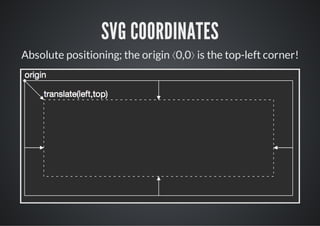
SVG COORDINATES
Absolute positioning; the origin ⟨0,0⟩ is the top-left corner!
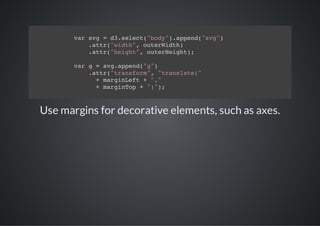
vrsg=d.eet"oy)apn(sg)
        a v  3slc(bd".ped"v"
          .tr"it" otrit)
          at(wdh, ueWdh
          .tr"egt,otregt;
          at(hih" ueHih)

       vrg=sgapn(g)
        a    v.ped""
          .tr"rnfr" "rnlt(
          at(tasom, tasae"
           +mriLf +""
             agnet  ,
           +mriTp+"";
             agno  ))


Use margins for decorative elements, such as axes.
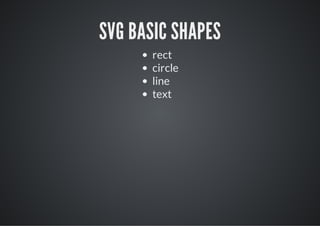
SVG BASIC SHAPES
       rect
       circle
       line
       text
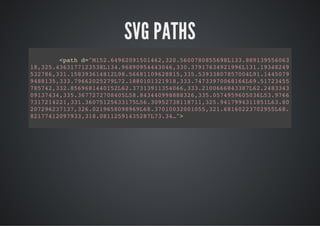
SVG PATHS
    <ahd"126929516,2.608859L3.819503
    pt =M5.460104230507056813893566
1,2.337133L3.6994406303973919L3.9429
8354617258149805434,3.7164296111384
528,3.5331829.6819285355930870L11409
37631189641L85610681,3.33875049.457
9815337622297.800311,3.43906166.1245
483,3.96057L21811298337737086L95735
754,3.598405L23331346,3.106838L22833
8723286614126.71915063320664376.434
0173,3.677780L8834988363507990065.76
93443537220455.4409882,3.545653L396
71242,3.67153155.05781713591941816.0
37121313052637L63923181,2.479315L38
279273,2.295086L83003015,2.86230956.
0263173601689996.7102005316102725L8
8171073,1.81513277.4"
2742993380129458L33…>
PATH GENERATORS
Configurable functions for generating paths from data.
                      d3.svg.line
                      d3.svg.area
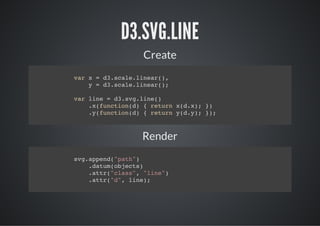
D3.SVG.LINE
          Create
vrx=d.cl.ier)
 a    3saelna(,
   y=d.cl.ier)
      3saelna(;

vrln =d.v.ie)
 a ie  3sgln(
   .(ucind {rtr xdx;}
   xfnto()   eun (.) )
   .(ucind {rtr ydy;};
   yfnto()   eun (.) )


          Render
sgapn(pt"
 v.ped"ah)
   .au(bet)
   dtmojcs
   .tr"ls" "ie)
   at(cas, ln"
   .tr"" ln)
   at(d, ie;
D3.SVG.AREA
Check the docs
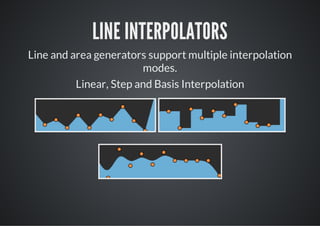
LINE INTERPOLATORS
Line and area generators support multiple interpolation
                        modes.
          Linear, Step and Basis Interpolation
RADIAL AREAS & LINES
Similar to d3.svg.{area,line}, except in polar coordinates.
                          d3.svg.arc
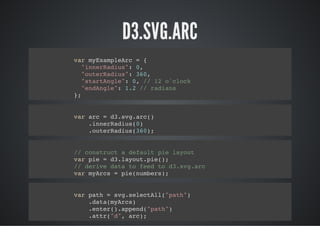
D3.SVG.ARC
vrmEaper ={
 a yxmlAc
  "neRdu" 0
   inrais: ,
  "ueRdu" 30
   otrais: 6,
  "trAge:0 / 1 ocok
   satnl" , / 2 'lc
  "nAge:12/ rdas
   ednl" . / ain
};


vrac=d.v.r(
 a r  3sgac)
   .neRdu()
   inrais0
   .ueRdu(6)
   otrais30;


/ cntutadfutpelyu
 / osrc   eal i aot
vrpe=d.aotpe)
 a i   3lyu.i(;
/ drv dt t fe t d.v.r
 / eie aa o ed o 3sgac
vrmAc =penmes;
 a yrs   i(ubr)


vrpt =sgslcAl"ah)
 a ah  v.eetl(pt"
   .aamAc)
   dt(yrs
   .ne(.ped"ah)
   etr)apn(pt"
   .tr"" ac;
   at(d, r)
LAYOUTS
LAYOUTS ARE DATA
Layouts are reusable algorithms that generate data, not
                        display.
LAYOUTS ARE VARIED
Each layout is different. Most are stateless, but not all.
HIERARCHICAL LAYOUTS
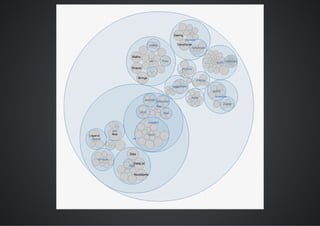
There are lots of ways to visualize hierarchical data!
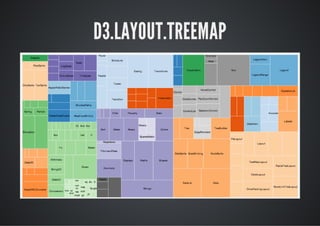
                  d3.layout.treemap
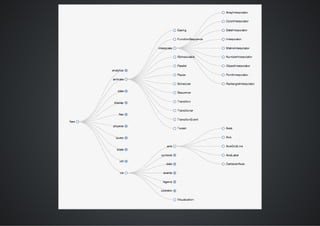
                  d3.layout.tree
                  d3.layout.pack
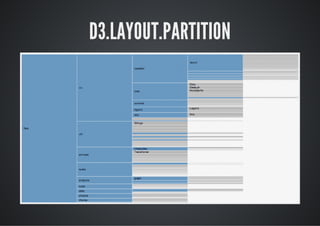
                  d3.layout.partition
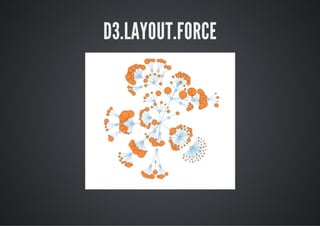
                  d3.layout.force
                  d3.layout.bundle
                  d3.geom.voronoi
                  d3.geom.chord
D3.LAYOUT.TREEMAP
D3.LAYOUT.TREE
D3.LAYOUT.PACK
D3.LAYOUT.PARTITION
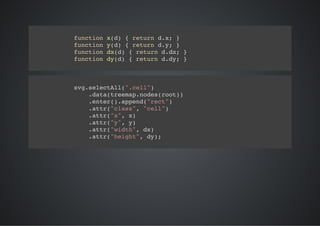
Layouts are configurable functions.
vrtemp=d.aottemp)
 a rea   3lyu.rea(
   .adn()
   pdig4
   .ie[it,hih];
   sz(wdh egt)
fnto xd {rtr dx }
 ucin ()  eun .;
fnto yd {rtr dy }
 ucin ()  eun .;
fnto d(){rtr dd;}
 ucin xd   eun .x
fnto d(){rtr dd;}
 ucin yd   eun .y


sgslcAl"cl"
 v.eetl(.el)
   .aatempndsro)
   dt(rea.oe(ot)
   .ne(.ped"et)
   etr)apn(rc"
   .tr"ls" "el)
   at(cas, cl"
   .tr"" x
   at(x, )
   .tr"" y
   at(y, )
   .tr"it" d)
   at(wdh, x
   .tr"egt,d)
   at(hih" y;
D3.LAYOUT.FORCE
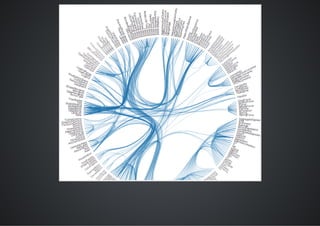
D3.LAYOUT.BUNDLE
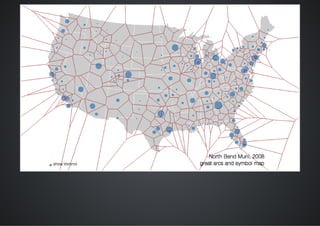
D3.GEOM.VORONOI
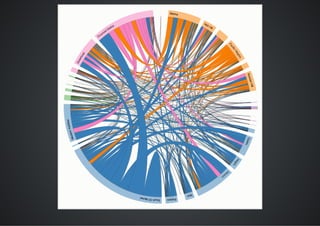
D3.LAYOUT.CHORD
SUM UP
Selectors
Data
Joins (enter, update, exit)
Scales
Axis
Shapes
Layouts
NOW YOU KNOW D3JS
REFERENCES
http://bost.ocks.org/mike/d3/workshop/
LET'S BUILD SOME STUFF

D3.js workshop

  • 1.
  • 2.
    WEB STANDARDS D3 providestransformation; no new representation.
  • 3.
    MAPPING DATA TOELEMENTS Visualisation requires visual encoding: mapping data to elements.
  • 4.
    NOTHING NEW D3 refers to Data-Driven Documents W3C Document Object Model.
  • 5.
    D3 = STANDARDS LearningD3 is largely learning web standards
  • 6.
    HTML HTML5 Spec http://www.w3.org/TR/html5/ HTML5 forDevelopers http://developers.whatwg.org/ MDN https://developer.mozilla.org/en/HTML Dive Into HTML5 http://diveintohtml5.info/
  • 7.
    HTML 5 <DCYEhm> !OTP tl <eacast"t-" mthre=uf8> <oy bd> Hlowrd el,ol!
  • 8.
  • 9.
    SVG <DCYEhm> !OTP tl <eacast"t-" mt hre=uf8> <vwdh"6"hih=50> sg it=90 egt"0" <ety"2> tx =1" Hlo wrd el, ol! <tx> /et <sg /v>
  • 10.
  • 11.
  • 12.
    CSS <DCYEhm> !OTP tl <eacast"t-" mt hre=uf8> <tl> sye bd {bcgon:selle } oy akrud tebu; <sye /tl> <oy bd> Hlo wrd el, ol!
  • 13.
    JAVASCRIPT MDN https://developer.mozilla.org/en/JavaScript Douglas Crockford’s JavaScript:The Good Parts http://shop.oreilly.com/product/9780596517748.do http://javascript.crockford.com/
  • 14.
  • 15.
  • 16.
    START SMALL <DCYEhm> !OTPtl <eacast"t-" mt hre=uf8> <tl>*CS*<sye sye/ S //tl> <oy bd> <citsc"3v.s>/cit srp r=d.2j"<srp> <cit/ JvSrp *<srp> srp>* aacit //cit
  • 17.
  • 18.
  • 20.
    D3 RESOURCES D3 APIReference https://github.com/mbostock/d3/wiki/API-Reference D3 Wiki https://github.com/mbostock/d3/wiki D3 Group https://groups.google.com/group/d3-js D3 Stack Overflow http://stackoverflow.com/questions/tagged/d3.js
  • 21.
  • 22.
    CSS SELECTORS pe cd { r, oe fn-aiy "el" mnsae otfml: Mno, oopc; fn-ie 4p; otsz: 8x } CSS style selectors #o fo / <n i=fo> / ay d"o" fo o / <o> / fo .o fo / <n cas"o" / ay ls=fo> [o=a] fobr / <n fo"a" / ay o=br> fobr o a / <o>br<fo / fo<a>/o> fobr o.a / <o cas"a" / fo ls=br> fobr o#a / <o i=br> / fo d"a"
  • 23.
    SELECTORS Javascript dcmn.urSlcoAl"r,cd" ouetqeyeetrl(pe oe) jQuery $'r,cd' (pe oe) D3 d.eetl(pe cd" 3slcAl"r, oe)
  • 24.
    SELECTIONS ARE ARRAYS /slc al<ice eeet / eet l crl> lmns vrcrl =d.eetl(crl"; a ice 3slcAl"ice) / stsm atiue adsye / e oe trbts n tls crl.tr"x,2) iceat(c" 0; crl.tr"y,1) iceat(c" 2; crl.tr"" 2) iceat(r, 4; crl.tl(fl" "e"; icesye"il, rd)
  • 25.
    METHOD CHAINING / slcal<ice eeet / eet l crl> lmns / adstsm atiue adsye / n e oe trbts n tls d.eetl(crl" 3slcAl"ice) .tr"x,2) at(c" 0 .tr"y,1) at(c" 2 .tr"" 2) at(r, 4 .tl(fl" "e"; sye"il, rd)
  • 26.
    SELECTION.APPEND Single / slc te<oy eeet / eet h bd> lmn vrbd =d.eet"oy) a oy 3slc(bd"; / ada <1 eeet / d n h> lmn vrh =bd.ped"1) a 1 oyapn(h"; h.et"el!) 1tx(Hlo"; Collection / slc al<eto>eeet / eet l scin lmns vrscin=d.eetl(scin) a eto 3slcAl"eto"; / ada <1 eeett ec / d n h> lmn o ah vrh =scinapn(h"; a 1 eto.ped"1) h.et"el!) 1tx(Hlo";
  • 27.
    WARNING!! Use caution withmethod chaining: append returns a new selection! vrh =d.eetl(scin) a 1 3slcAl"eto" .tl(bcgon" "tebu" sye"akrud, selle) .ped"1) apn(h" .et"el!) tx(Hlo";
  • 28.
  • 29.
    DATA ARE ARRAYS Selections are arrays Data are arrays Coincidence?
  • 30.
    DATA Numbers / Abrcat pras / a hr, ehp? vrdt =[,1 2 3 5 8; a aa 1 , , , , ] Objects / Asatrlt pras / ctepo, ehp? vrdt =[ a aa {:1.,y 91} x 00 : .4, {: 80 y 81} x ., : .4, {:1.,y 87} x 30 : .4, {: 90 y 87} x ., : .7, {:1.,y 92} x 10 : .6 ];
  • 31.
    DATA TO ELEMENTS Use data to create multiple elements. sgslcAl"ice) v.eetl(crl" .aadt) dt(aa .ne(.ped"ice) etr)apn(crl" .tr"x,x at(c" ) .tr"y,y at(c" ) .tr"" 25; at(r, .) We want the selection “circle” to correspond to data.
  • 32.
    .DATA() Use data to create multiple elements. vrcrl =sgslcAl"ice) a ice v.eetl(crl" .aadt) dt(aa; The data method computes the join, defining enter and exit.
  • 33.
    vrcrl =sgslcAl"ice) a ice v.eetl(crl" .aadt) dt(aa; crl.ne(.ped"ice) iceetr)apn(crl"; Appending to the enter selection creates the missing elements.
  • 34.
    fnto xd {rtrdx } ucin () eun .; fnto yd {rtr dy } ucin () eun .; vrcrl =sgslcAl"ice) a ice v.eetl(crl" .aadt) dt(aa; crl.ne(.ped"ice) iceetr)apn(crl" .tr"x,x at(c" ) .tr"y,y at(c" ) .tr"" 25; at(r, .) The new elements are bound to data, so we can compute attributes.
  • 35.
    ENTER, UPDATE &EXIT Thinking with Joins
  • 36.
    ENTER New data, forwhich there were no existing elements.
  • 37.
    When initializing, youmight ignore update and exit. vrcrl =sgslcAl"ice) a ice v.eetl(crl" .aadt) dt(aa .ne(.ped"ice) etr)apn(crl" .tr"x,x at(c" ) .tr"y,y at(c" ) .tr"" 25; at(r, .)
  • 38.
    UPDATE New data thatwas joined successfully to an existing element.
  • 39.
    UPDATE When updating, youmight ignore enter and exit. vrcrl =sgslcAl"ice) a ice v.eetl(crl" .aadt) dt(aa .tr"x,x at(c" ) .tr"y,y at(c" ) .tr"" 25; at(r, .)
  • 40.
    EXIT Existing elements, forwhich there were no new data.
  • 41.
    EXIT vrcrl =sgslcAl"ice) aice v.eetl(crl" .aadt) dt(aa; crl.ne(.ped"ice) iceetr)apn(crl" .tr"x,x at(c" ) .tr"y,y at(c" ) .tr"" 25; at(r, .)
  • 42.
    ENTER + UPDATE Enteringnodes are added to update on append.
  • 43.
    ENTER + UPDATE vrcrl=sgslcAl"ice) a ice v.eetl(crl" .aadt) dt(aa; crl.xt)rmv(; iceei(.eoe)
  • 44.
    KEY FUNCTION You can control the join; by default, the join is by index.
  • 45.
    / Asatrlt pras / ctepo, ehp? vrdt =[ a aa {ae "lc" x 1.,y 91} nm: Aie, : 00 : .4, {ae nm: "o" x 80 y 81} Bb, : ., : .4, {ae "ao" x 1.,y 87} nm: Crl, : 30 : .4, {ae "ae,x 90 y 87} nm: Dv" : ., : .7, {ae "dt" x 1.,y 92} nm: Eih, : 10 : .6 ]; If needed, data should have a unique key for joining.
  • 46.
    fnto kyd {rtrdnm;} ucin e() eun .ae vrcrl =sgslcAl"ice) a ice v.eetl(crl" .aadt,ky dt(aa e) .tr"x,x at(c" ) .tr"y,y at(c" ) .tr"" 25; at(r, .) The key function returns a unique string for each datum.
  • 47.
    LOADING DATA D3 providesseveral convenience routines using XMLHttpRequest . CSV JSON
  • 48.
  • 49.
    D3 AND ARRAY JavaScripthas a number of useful built-in array methods. array. {filter,map,sort,…}
  • 50.
    D3 also hasa variety of data-transform methods; explore the API . d3. {nest,keys,values,…}
  • 51.
  • 52.
    DOMAIN => RANGE Scalesare functions that map from data-space to visual- space. fnto xd { ucin () rtr d*4 +"x; eun 2 p" } Scales are convenient but optional; you can roll your own.
  • 53.
    QUANTITATIVE SCALES Map acontinuous (numeric) domain to a continuous range. linear sqrt pow log quantize threshold quantile identity
  • 54.
    vrx=d.cl.ier) a 3saelna( .oan[2 2] dmi(1, 4) .ag(0 70) rne[, 2]; x1) / 20 (6; / 4 vrx=d.cl.qt) a 3saesr( .oan[2 2] dmi(1, 4) .ag(0 70) rne[, 2]; x1) / 289592053 (6; / 6.069638 vrx=d.cl.o( a 3saelg) .oan[2 2] dmi(1, 4) .ag(0 70) rne[, 2]; x1) / 288694063 (6; / 9.2998777
  • 55.
    DOMAINS & RANGES Typically,domains are derived from data while ranges are constant.
  • 56.
    vrx=d.cl.ier) a 3saelna( .oan[,d.a(ubr)) dmi(0 3mxnmes] .ag(0 70) rne[, 2]; vrx=d.cl.o( a 3saelg) .oand.xetnmes) dmi(3etn(ubr) .ag(0 70) rne[, 2]; fnto vled {rtr dvle } ucin au() eun .au; vrx=d.cl.o( a 3saelg) .oand.xetojcs vle) dmi(3etn(bet, au) .ag(0 70) rne[, 2];
  • 57.
  • 58.
    vrx=d.cl.ier) a 3saelna( .oan[2 2] dmi(1, 4) .ag("tebu" "rw") rne[selle, bon]; x1) / #656 (6; / 668 vrx=d.cl.ier) a 3saelna( .oan[2 2] dmi(1, 4) .ag("p" "2p") rne[0x, 70x]; x1) / 20x (6; / 4p vrx=d.cl.ier) a 3saelna( .oan[2 2] dmi(1, 4) .ag("tebu" "rw") rne[selle, bon] .neplt(3itroaes) itroaed.nepltHl; x1) / #c0f (6; / 3b5
  • 59.
    OBJECT INTERPOLATION just to mention
  • 60.
    DIVERGING SCALES Sometimes, youwant a compound (“polylinear”) scale. vrx=d.cl.ier) a 3saelna( .oan[1,0 10) dmi(-0 , 0] .ag("e" "ht" "re") rne[rd, wie, gen]; x-) / #f00 (5; / f88 x5) / #000 (0; / 8c8
  • 61.
    ORDINAL SCALES An ordinalscale is essentially an explicit mapping. vrx=d.cl.ria( a 3saeodnl) .oan[A,"" "" "") dmi("" B, C, D] .ag(0 1,2,3]; rne[, 0 0 0) x"";/ 1 (B) / 0
  • 62.
    vrx=d.cl.aeoy0) a 3saectgr2( .oan[A,"" "" "") dmi("" B, C, D]; x"";/ #e78 (B) / ace vrx=d.cl.aeoy0) a 3saectgr2( .oan[A,"" "" "") dmi("" B, C, D]; x"";/ #c0c (E) / 2a2 x"";/ #c0c (E) / 2a2 xdmi(;/ A B C D E .oan) / , , , ,
  • 63.
  • 64.
    Ordinal ranges canbe derived from continuous ranges. vrx=d.cl.ria( a 3saeodnl) .oan[A,"" "" "") dmi("" B, C, D] .agPit(0 70) rneons[, 2]; x"";/ 20 (B) / 4 vrx=d.cl.ria( a 3saeodnl) .oan[A,"" "" "") dmi("" B, C, D] .agRudad(0 70,.) rneonBns[, 2] 2; x"";/ 26 brpsto (B) / 0, a oiin xrnead) / 17 brwdh .agBn(; / 3, a it
  • 65.
  • 66.
    AXIS D3 provides convenientlabeling for scales.
  • 67.
    Create vryxs=d.v.xs) a Ai 3sgai( .cl() saey .ret"et) oin(lf"; Render sgapn(g) v.ped"" .tr"ls" " ai" at(cas, y xs) .alyxs; cl(Ai) Style .xspt,.xsln { ai ah ai ie fl:nn; il oe srk:#0; toe 00 saerneig cipde; hp-edrn: rsEgs }
  • 69.
    TICKS Quantitative scales canbe queried for “human-readable” values. vrx=d.cl.ier) a 3saelna( .oan[2 2] dmi(1, 4) .ag(0 70) rne[, 2]; xtcs5;/ [2 1,1,1,2,2,2] .ik() / 1, 4 6 8 0 2 4 The requested count is only a hint (for better or worse).
  • 70.
    TICK FORMATS d3.format d3.time.format
  • 71.
  • 72.
    SVG COORDINATES Absolute positioning;the origin ⟨0,0⟩ is the top-left corner!
  • 73.
    vrsg=d.eet"oy)apn(sg) a v 3slc(bd".ped"v" .tr"it" otrit) at(wdh, ueWdh .tr"egt,otregt; at(hih" ueHih) vrg=sgapn(g) a v.ped"" .tr"rnfr" "rnlt( at(tasom, tasae" +mriLf +"" agnet , +mriTp+""; agno )) Use margins for decorative elements, such as axes.
  • 74.
    SVG BASIC SHAPES rect circle line text
  • 75.
    SVG PATHS <ahd"126929516,2.608859L3.819503 pt =M5.460104230507056813893566 1,2.337133L3.6994406303973919L3.9429 8354617258149805434,3.7164296111384 528,3.5331829.6819285355930870L11409 37631189641L85610681,3.33875049.457 9815337622297.800311,3.43906166.1245 483,3.96057L21811298337737086L95735 754,3.598405L23331346,3.106838L22833 8723286614126.71915063320664376.434 0173,3.677780L8834988363507990065.76 93443537220455.4409882,3.545653L396 71242,3.67153155.05781713591941816.0 37121313052637L63923181,2.479315L38 279273,2.295086L83003015,2.86230956. 0263173601689996.7102005316102725L8 8171073,1.81513277.4" 2742993380129458L33…>
  • 76.
    PATH GENERATORS Configurable functionsfor generating paths from data. d3.svg.line d3.svg.area
  • 77.
    D3.SVG.LINE Create vrx=d.cl.ier) a 3saelna(, y=d.cl.ier) 3saelna(; vrln =d.v.ie) a ie 3sgln( .(ucind {rtr xdx;} xfnto() eun (.) ) .(ucind {rtr ydy;}; yfnto() eun (.) ) Render sgapn(pt" v.ped"ah) .au(bet) dtmojcs .tr"ls" "ie) at(cas, ln" .tr"" ln) at(d, ie;
  • 78.
  • 79.
    LINE INTERPOLATORS Line andarea generators support multiple interpolation modes. Linear, Step and Basis Interpolation
  • 80.
    RADIAL AREAS &LINES Similar to d3.svg.{area,line}, except in polar coordinates. d3.svg.arc
  • 81.
    D3.SVG.ARC vrmEaper ={ ayxmlAc "neRdu" 0 inrais: , "ueRdu" 30 otrais: 6, "trAge:0 / 1 ocok satnl" , / 2 'lc "nAge:12/ rdas ednl" . / ain }; vrac=d.v.r( a r 3sgac) .neRdu() inrais0 .ueRdu(6) otrais30; / cntutadfutpelyu / osrc eal i aot vrpe=d.aotpe) a i 3lyu.i(; / drv dt t fe t d.v.r / eie aa o ed o 3sgac vrmAc =penmes; a yrs i(ubr) vrpt =sgslcAl"ah) a ah v.eetl(pt" .aamAc) dt(yrs .ne(.ped"ah) etr)apn(pt" .tr"" ac; at(d, r)
  • 83.
  • 84.
    LAYOUTS ARE DATA Layoutsare reusable algorithms that generate data, not display.
  • 85.
    LAYOUTS ARE VARIED Eachlayout is different. Most are stateless, but not all.
  • 86.
    HIERARCHICAL LAYOUTS There arelots of ways to visualize hierarchical data! d3.layout.treemap d3.layout.tree d3.layout.pack d3.layout.partition d3.layout.force d3.layout.bundle d3.geom.voronoi d3.geom.chord
  • 87.
  • 88.
  • 90.
  • 92.
  • 93.
    Layouts are configurablefunctions. vrtemp=d.aottemp) a rea 3lyu.rea( .adn() pdig4 .ie[it,hih]; sz(wdh egt)
  • 94.
    fnto xd {rtrdx } ucin () eun .; fnto yd {rtr dy } ucin () eun .; fnto d(){rtr dd;} ucin xd eun .x fnto d(){rtr dd;} ucin yd eun .y sgslcAl"cl" v.eetl(.el) .aatempndsro) dt(rea.oe(ot) .ne(.ped"et) etr)apn(rc" .tr"ls" "el) at(cas, cl" .tr"" x at(x, ) .tr"" y at(y, ) .tr"it" d) at(wdh, x .tr"egt,d) at(hih" y;
  • 95.
  • 96.
  • 98.
  • 100.
  • 102.
    SUM UP Selectors Data Joins (enter,update, exit) Scales Axis Shapes Layouts
  • 103.
  • 104.
  • 105.