Glycogen Metabolism
Dr. Endriyas Kelta (DMD, MSc)
Assistant Professor, AAU
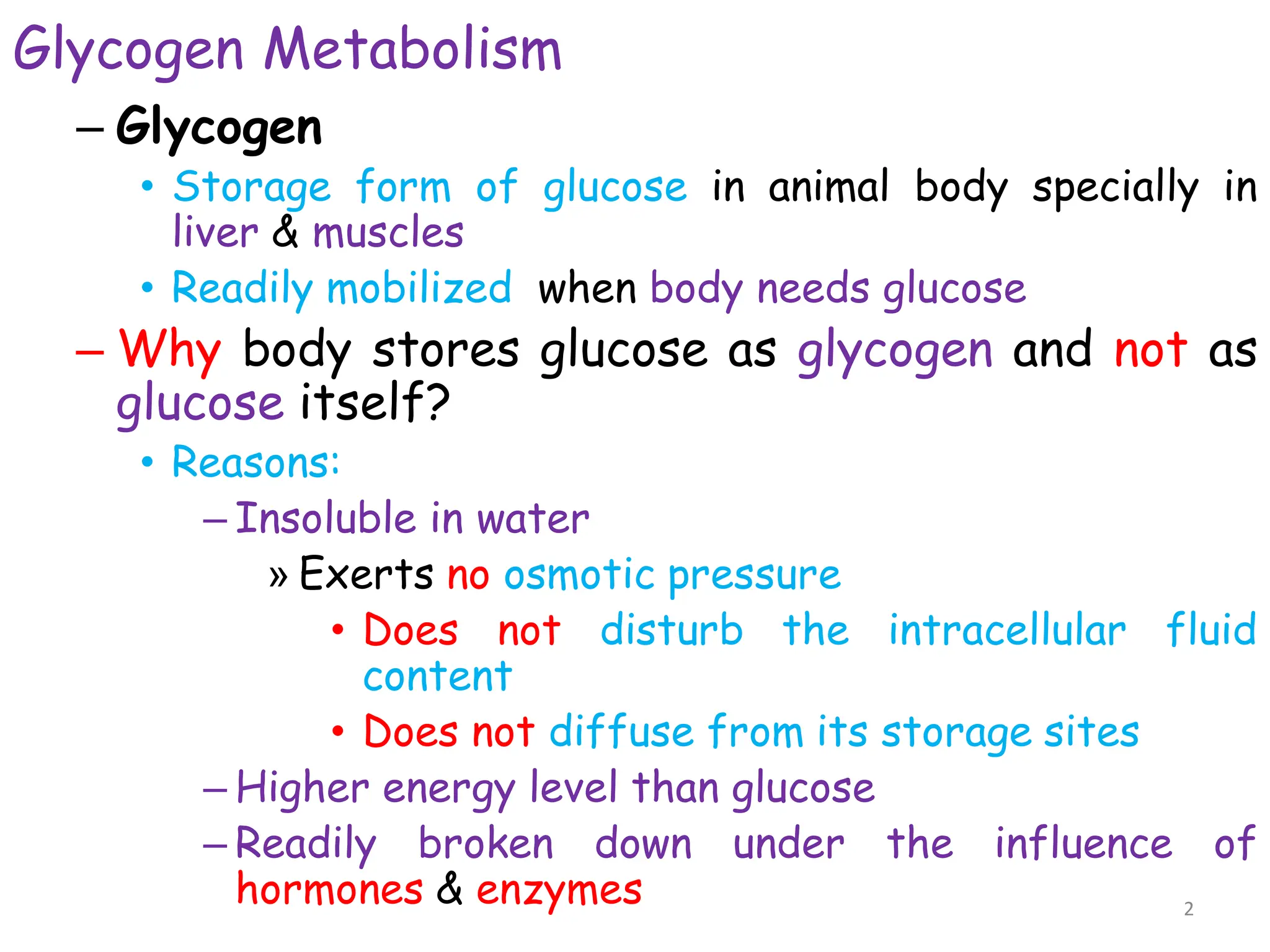
Glycogen Metabolism
– Glycogen
• Storage form of glucose in animal body specially in
liver & muscles
• Readily mobilized when body needs glucose
– Why body stores glucose as glycogen and not as
glucose itself?
• Reasons:
– Insoluble in water
» Exerts no osmotic pressure
• Does not disturb the intracellular fluid
content
• Does not diffuse from its storage sites
– Higher energy level than glucose
– Readily broken down under the influence of
hormones & enzymes 2
Cont…
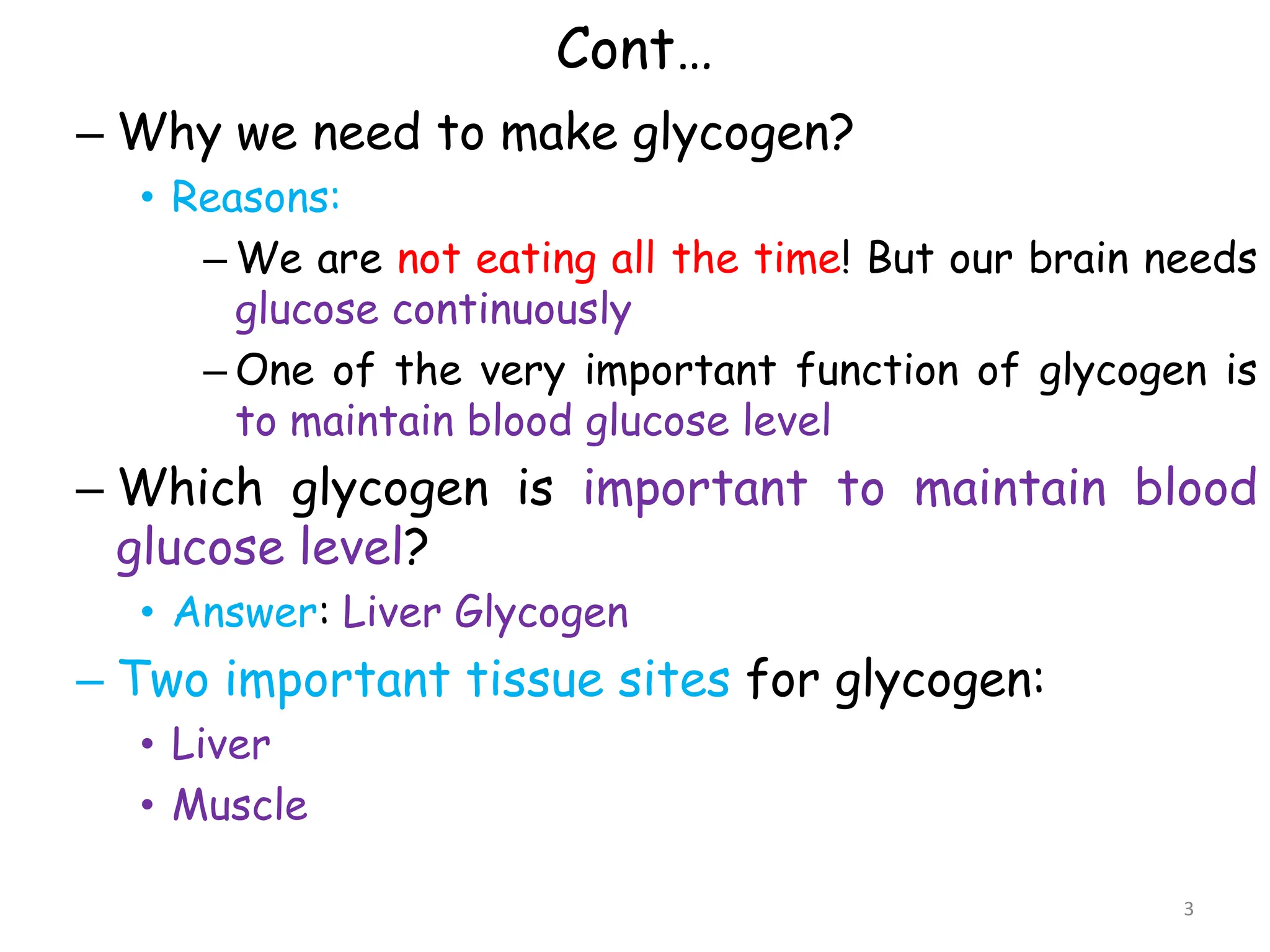
– Why we need to make glycogen?
• Reasons:
– We are not eating all the time! But our brain needs
glucose continuously
– One of the very important function of glycogen is
to maintain blood glucose level
– Which glycogen is important to maintain blood
glucose level?
• Answer: Liver Glycogen
– Two important tissue sites for glycogen:
• Liver
• Muscle
3
Cont…
– What are the most important differences b/n liver
& muscle glycogen?
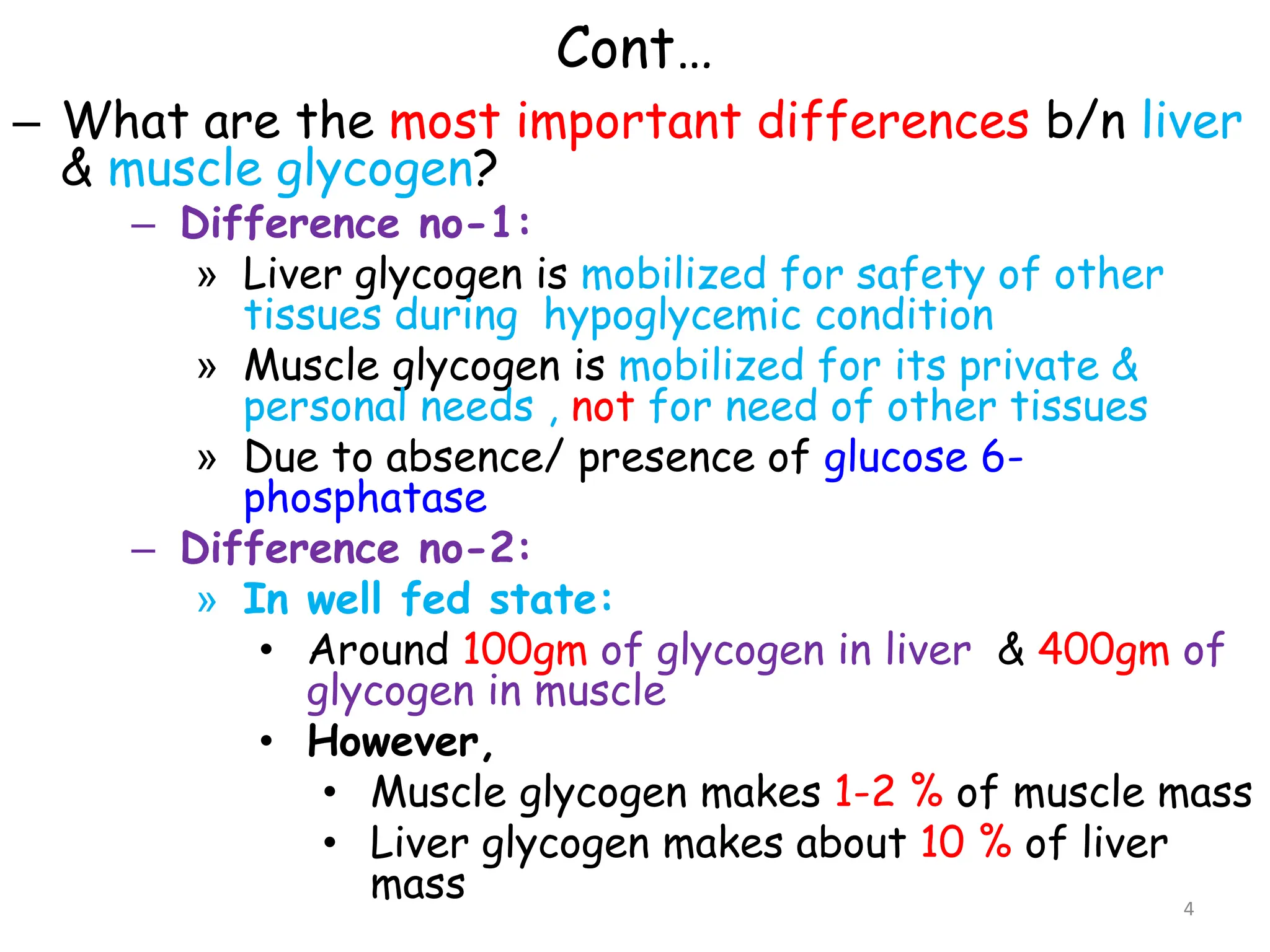
– Difference no-1:
» Liver glycogen is mobilized for safety of other
tissues during hypoglycemic condition
» Muscle glycogen is mobilized for its private &
personal needs , not for need of other tissues
» Due to absence/ presence of glucose 6-
phosphatase
– Difference no-2:
» In well fed state:
• Around 100gm of glycogen in liver & 400gm of
glycogen in muscle
• However,
• Muscle glycogen makes 1-2 % of muscle mass
• Liver glycogen makes about 10 % of liver
mass 4
Cont…
• Difference no-3:
– Glycogen stores in liver & muscle fluctuate
» Liver glycogen stores fluctuate according to
Fed/Fasting state of body
» Muscle glycogen stores fluctuate according to
resting/exercising state of muscle
– Glycogen metabolism can be discussed under two
phases:
• Synthetic phase
– Formation of glycogen (Glycogenesis )
• Catabolic phase
– Breakdown of glycogen (Glycogenolysis)
5
Cont…
– Characteristics of two phases:
• Breakdown pathway is not a ‘reversal’ of synthetic
pathway
• When glycogenesis occurs, glycogenolysis does not
take place and vice versa
• Both phases are regulated finally, at substrate level,
by end-products & hormonally
Glycogenesis
– Formation of glycogen from glucose
– Starts with phosphorylation of glucose at C-6 6
Cont…
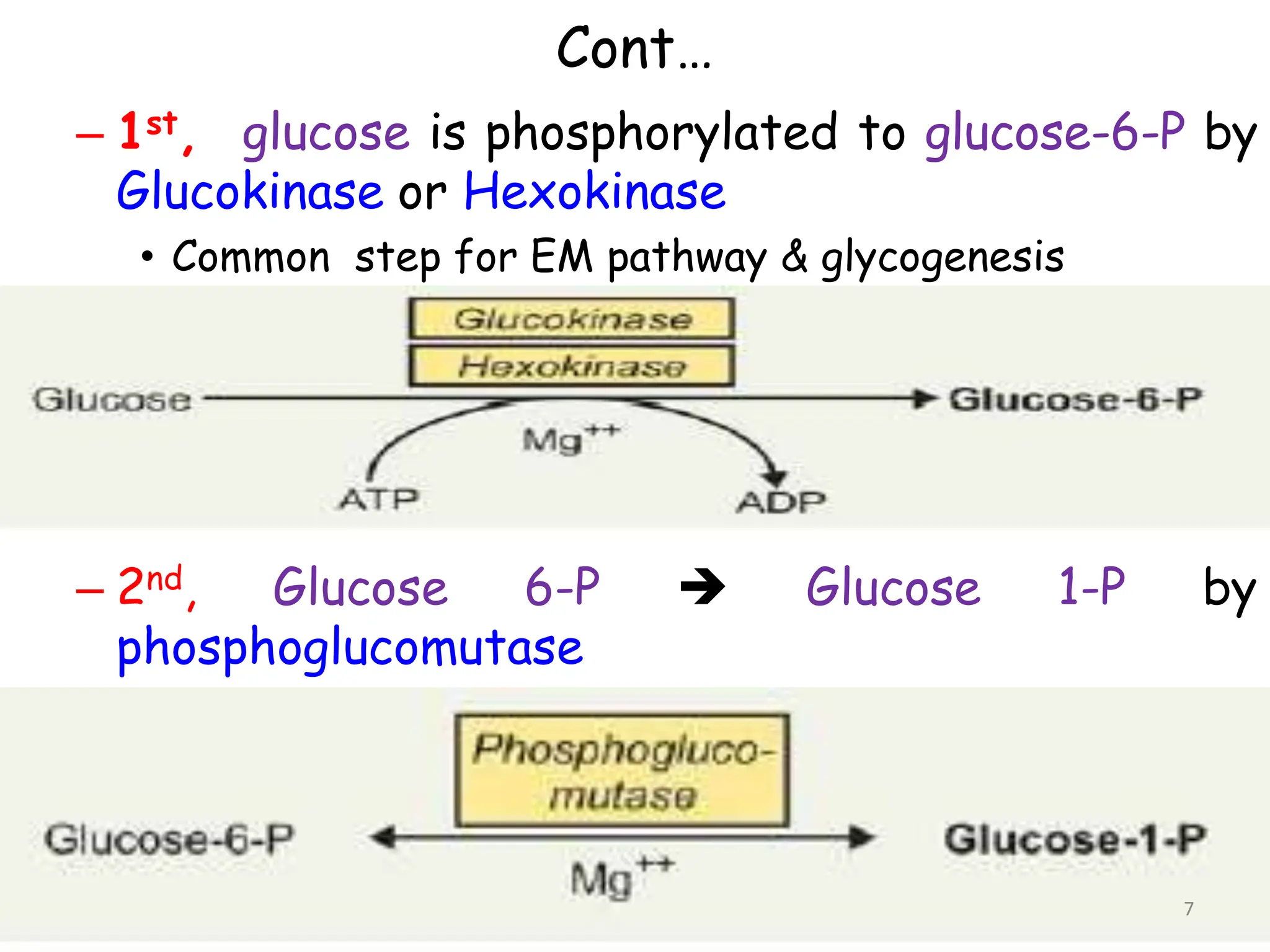
– 1st, glucose is phosphorylated to glucose-6-P by
Glucokinase or Hexokinase
• Common step for EM pathway & glycogenesis
– 2nd, Glucose 6-P  Glucose 1-P by
phosphoglucomutase
7
Cont…
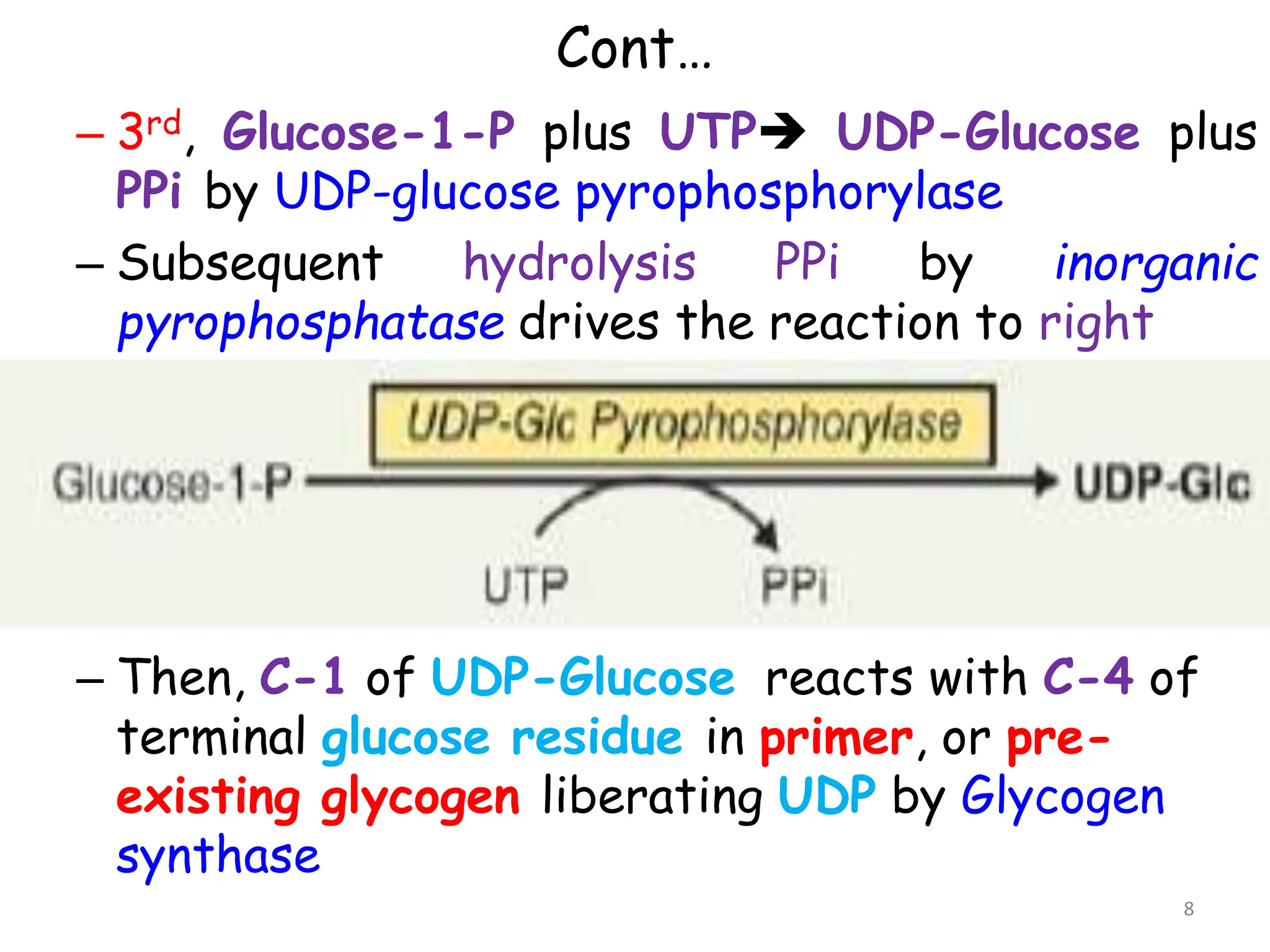
– 3rd, Glucose-1-P plus UTP UDP-Glucose plus
PPi by UDP-glucose pyrophosphorylase
– Subsequent hydrolysis PPi by inorganic
pyrophosphatase drives the reaction to right
– Then, C-1 of UDP-Glucose reacts with C-4 of
terminal glucose residue in primer, or pre-
existing glycogen liberating UDP by Glycogen
synthase
8
– Pre-existing glycogen molecule, or “primer” must
be present to initiate glycogen synthase reaction
– Glycogenin
• Protein primer on which glycogen ‘primer’ is formed
• Glycosylated on a specific tyrosine residue by UDPGlc
• An existing glycogen chain can be repeatedly extended
by one glucose unit
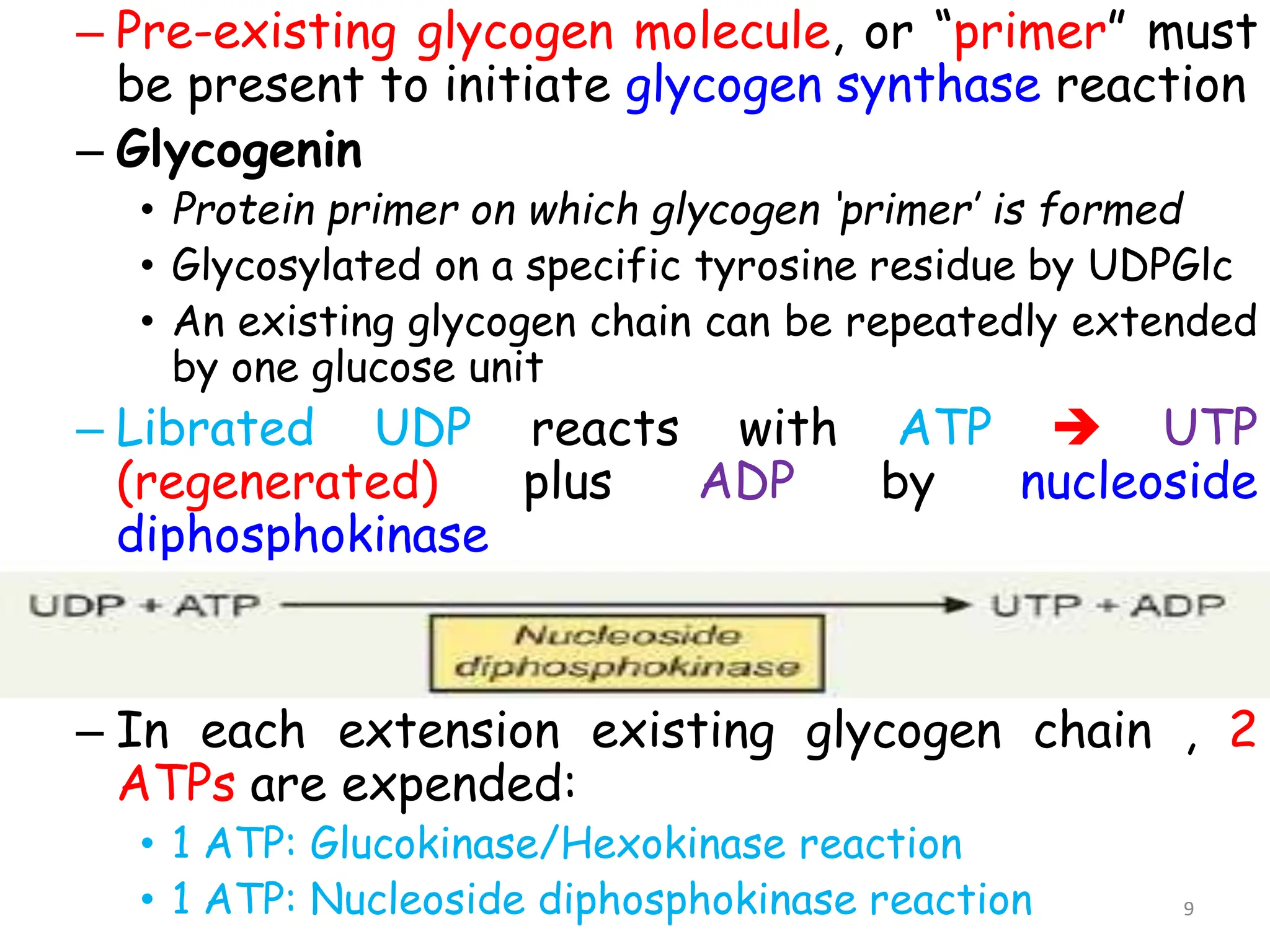
– Librated UDP reacts with ATP  UTP
(regenerated) plus ADP by nucleoside
diphosphokinase
– In each extension existing glycogen chain , 2
ATPs are expended:
• 1 ATP: Glucokinase/Hexokinase reaction
• 1 ATP: Nucleoside diphosphokinase reaction 9
Cont…
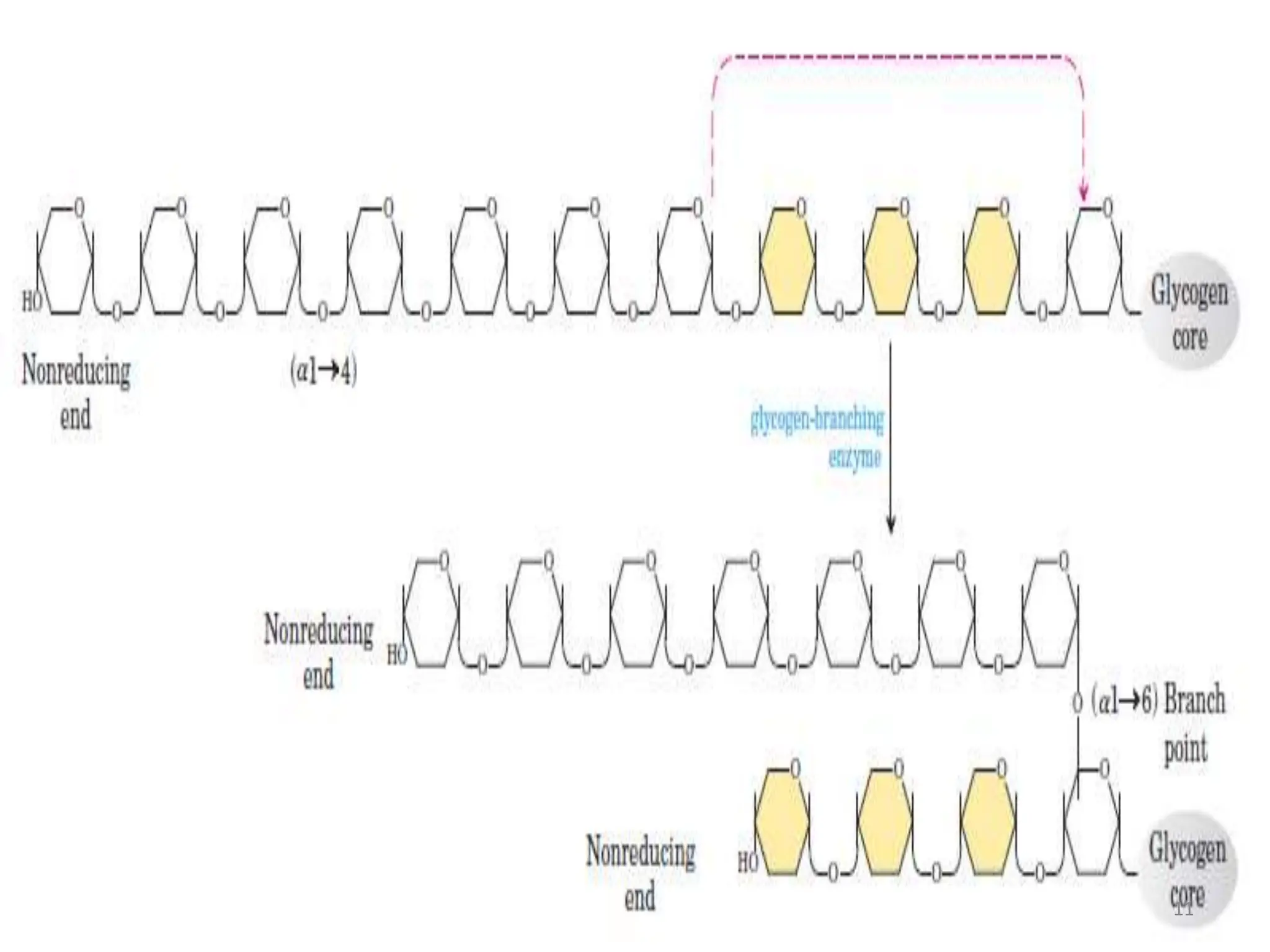
– When a minimum of 11 glucose residues reached,
• Another enzyme called Branching enzyme (Amylo-1, 4
→ 1, 6-transglucosidase)
– Cleaves α-1 → 4 glycosidic linkage on growing
glycogen chain
– Transfers a minimum of 6 glucose residues to
neighboring chain
– Forms α-1 → 6 glycosidic linkage in the neighboring
chain
– Branches grow by further additions of α- (1 → 4)
glucosyl units by glycogen synthase activity &
further branching by branching enzyme activity
10
11
Cont…
Glycogenolysis
– Breakdown of glycogen to glucose or glucose 6- P
– Involves two steps:
• Phosphorolysis
• De-branching
• Phosphorlysis:
– Cleavage of bond by addition of phosphate
groups
– Catalyzed by Glycogen Phosphorylase
• Pyridoxal phosphate (PLP) dependant enzyme
• Removes glycosyl residues from non-reducing end of
glycogen by adding Pi group
12
Cont…
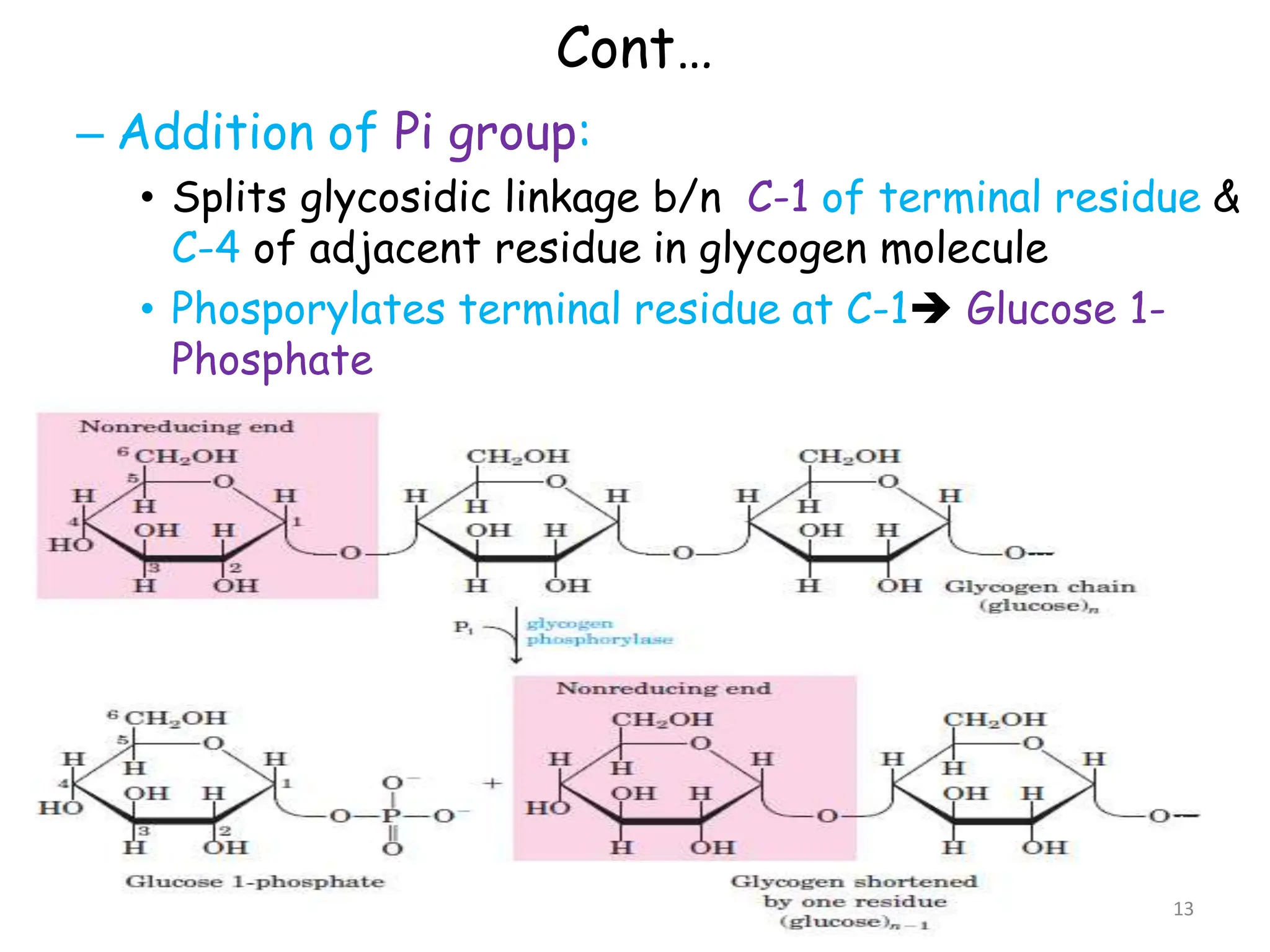
– Addition of Pi group:
• Splits glycosidic linkage b/n C-1 of terminal residue &
C-4 of adjacent residue in glycogen molecule
• Phosporylates terminal residue at C-1 Glucose 1-
Phosphate
13
Cont…
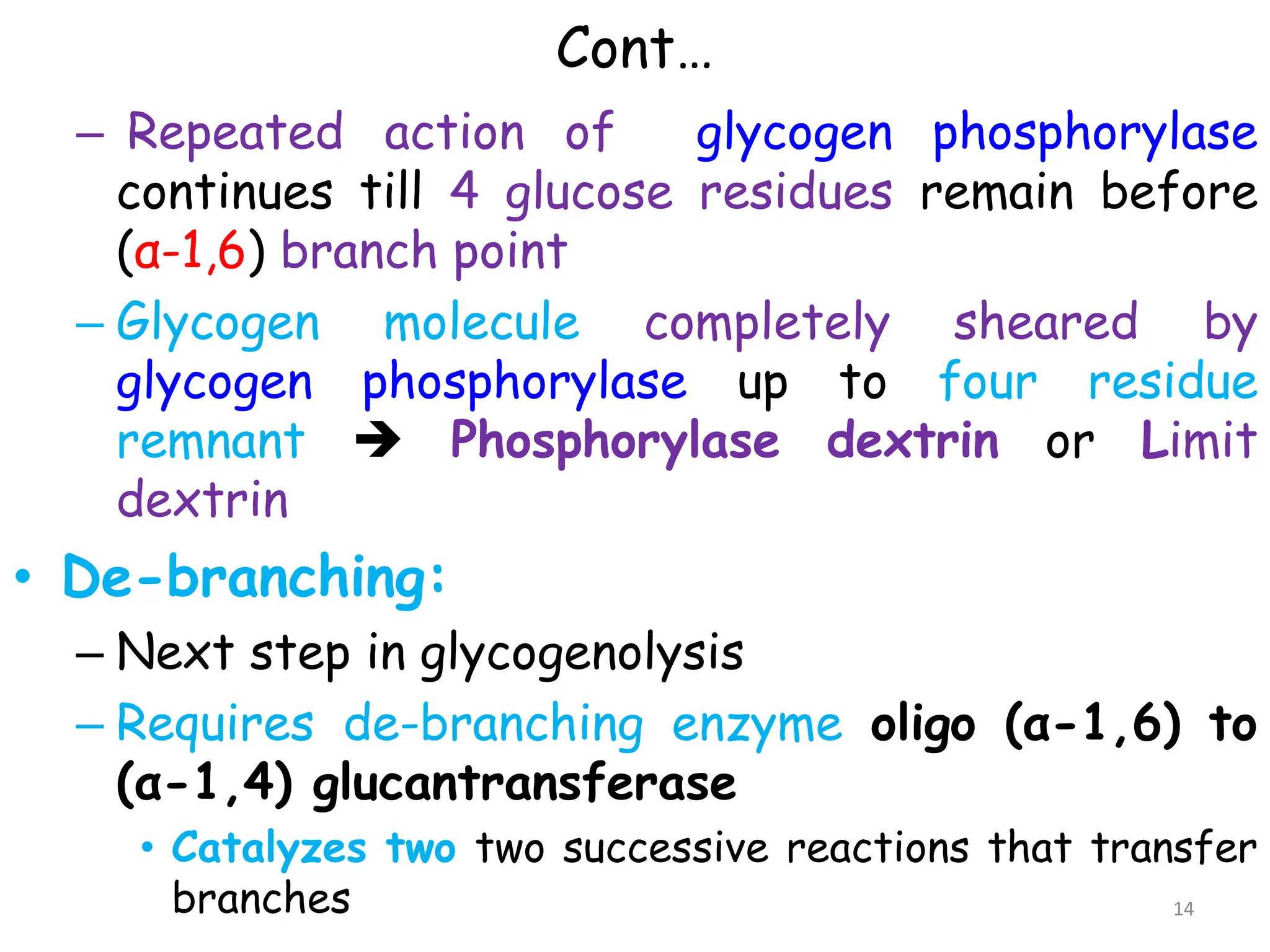
– Repeated action of glycogen phosphorylase
continues till 4 glucose residues remain before
(α-1,6) branch point
– Glycogen molecule completely sheared by
glycogen phosphorylase up to four residue
remnant  Phosphorylase dextrin or Limit
dextrin
• De-branching:
– Next step in glycogenolysis
– Requires de-branching enzyme oligo (α-1,6) to
(α-1,4) glucantransferase
• Catalyzes two two successive reactions that transfer
branches 14
Cont…
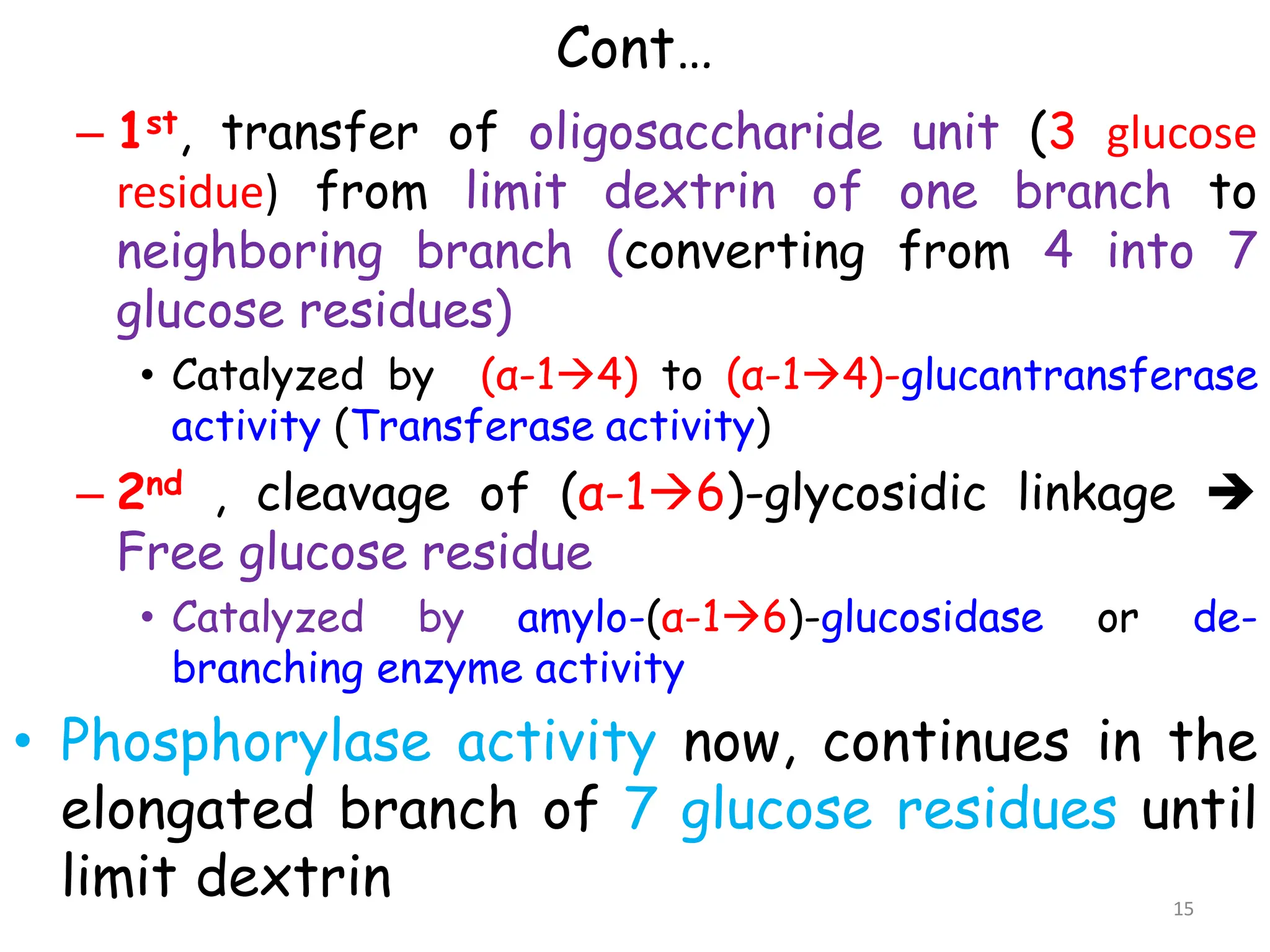
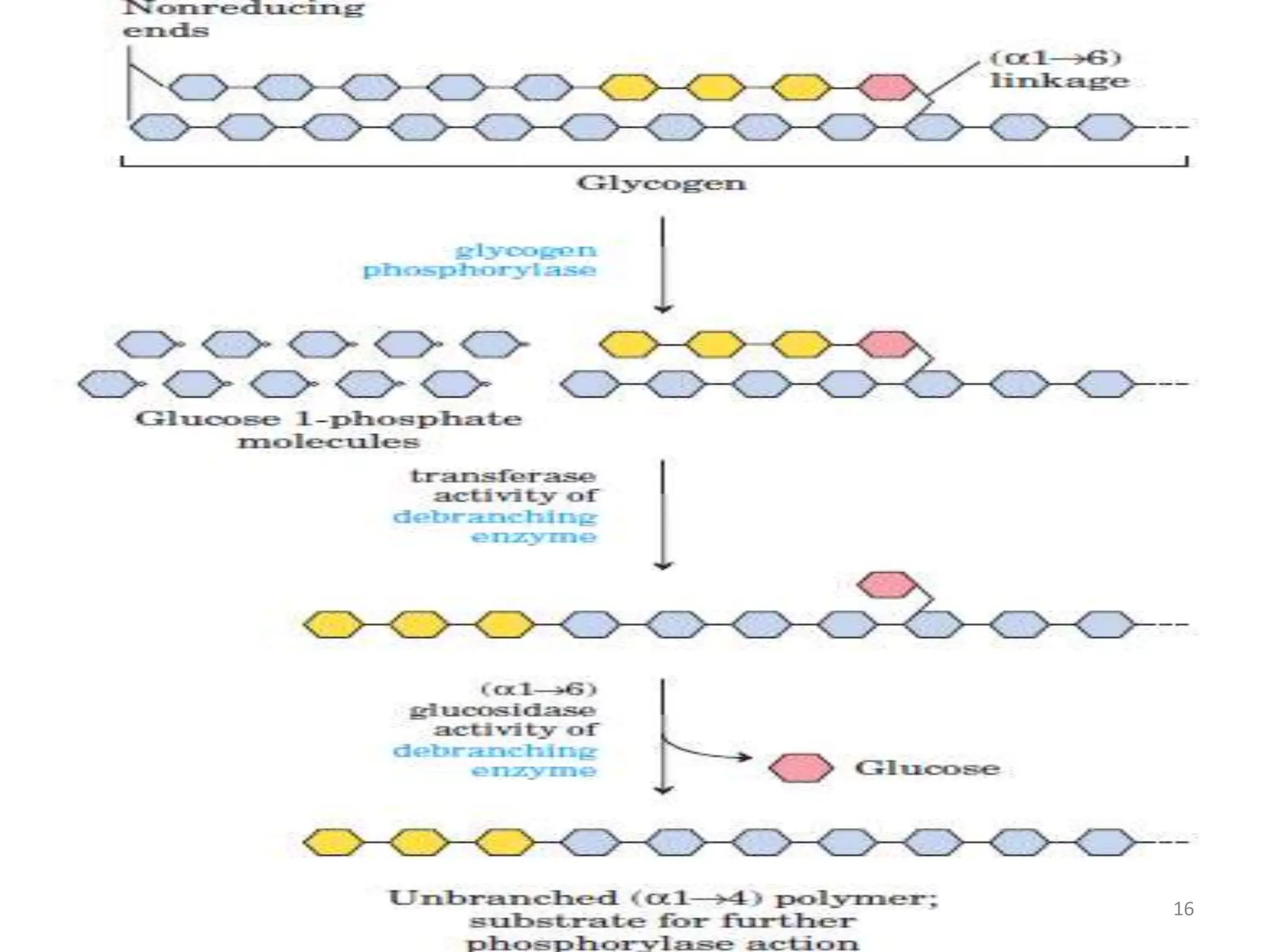
– 1st, transfer of oligosaccharide unit (3 glucose
residue) from limit dextrin of one branch to
neighboring branch (converting from 4 into 7
glucose residues)
• Catalyzed by (α-14) to (α-14)-glucantransferase
activity (Transferase activity)
– 2nd , cleavage of (α-16)-glycosidic linkage 
Free glucose residue
• Catalyzed by amylo-(α-16)-glucosidase or de-
branching enzyme activity
• Phosphorylase activity now, continues in the
elongated branch of 7 glucose residues until
limit dextrin 15
16
Cont…
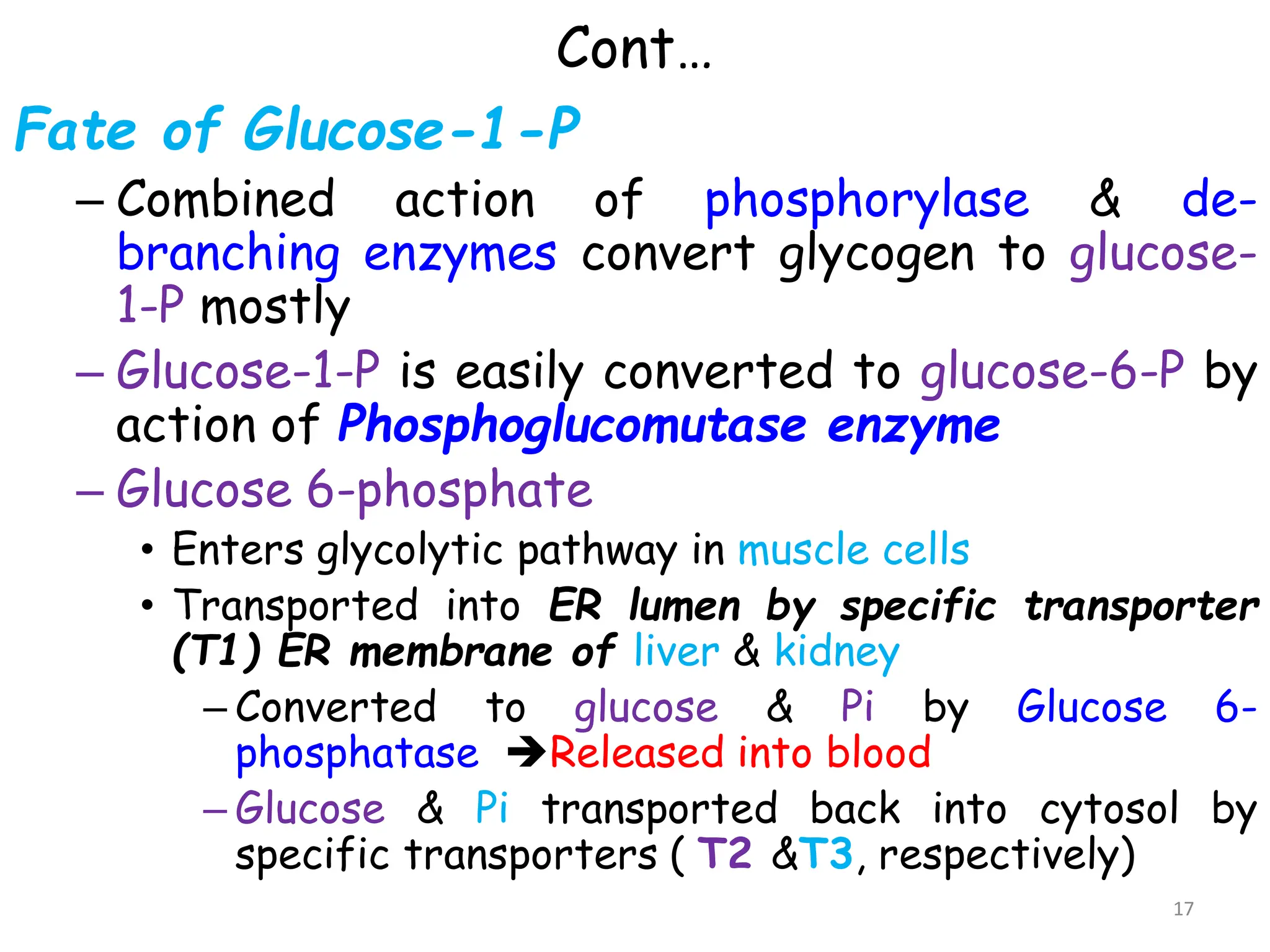
Fate of Glucose-1-P
– Combined action of phosphorylase & de-
branching enzymes convert glycogen to glucose-
1-P mostly
– Glucose-1-P is easily converted to glucose-6-P by
action of Phosphoglucomutase enzyme
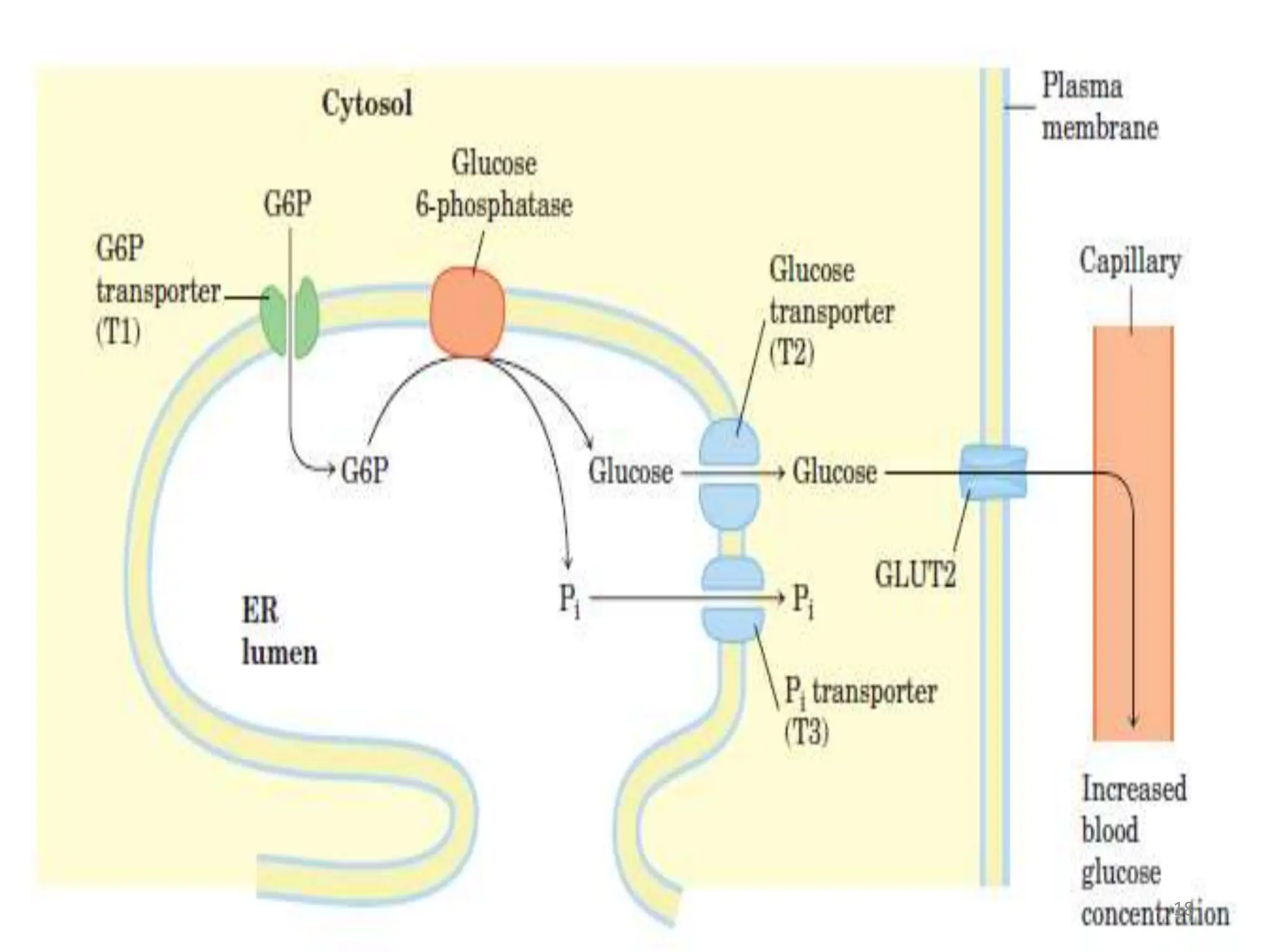
– Glucose 6-phosphate
• Enters glycolytic pathway in muscle cells
• Transported into ER lumen by specific transporter
(T1) ER membrane of liver & kidney
– Converted to glucose & Pi by Glucose 6-
phosphatase Released into blood
– Glucose & Pi transported back into cytosol by
specific transporters ( T2 &T3, respectively)
17
18
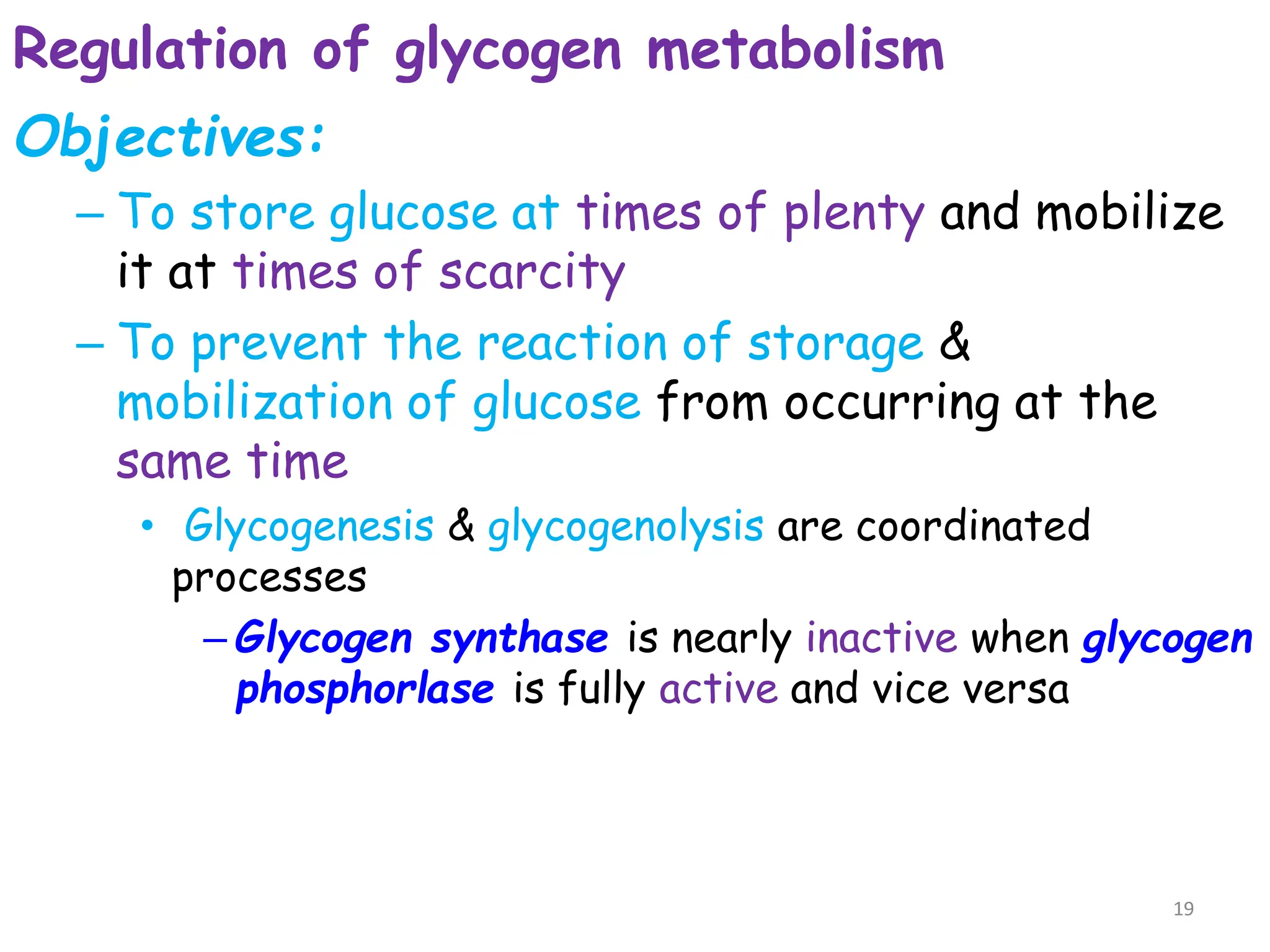
Regulation of glycogen metabolism
Objectives:
– To store glucose at times of plenty and mobilize
it at times of scarcity
– To prevent the reaction of storage &
mobilization of glucose from occurring at the
same time
• Glycogenesis & glycogenolysis are coordinated
processes
– Glycogen synthase is nearly inactive when glycogen
phosphorlase is fully active and vice versa
19
Cont…
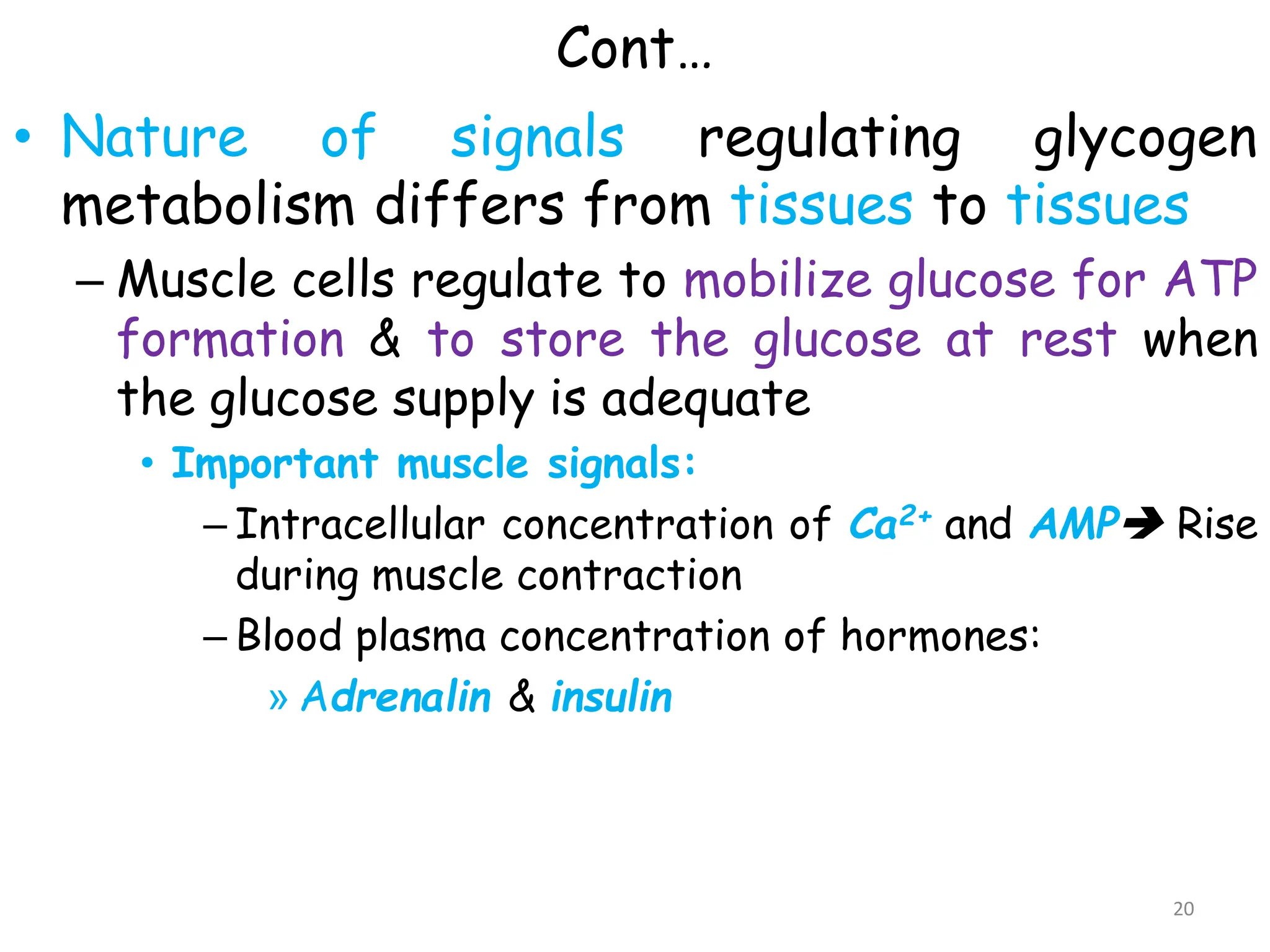
• Nature of signals regulating glycogen
metabolism differs from tissues to tissues
– Muscle cells regulate to mobilize glucose for ATP
formation & to store the glucose at rest when
the glucose supply is adequate
• Important muscle signals:
– Intracellular concentration of Ca2+ and AMP Rise
during muscle contraction
– Blood plasma concentration of hormones:
» Adrenalin & insulin
20
Cont…
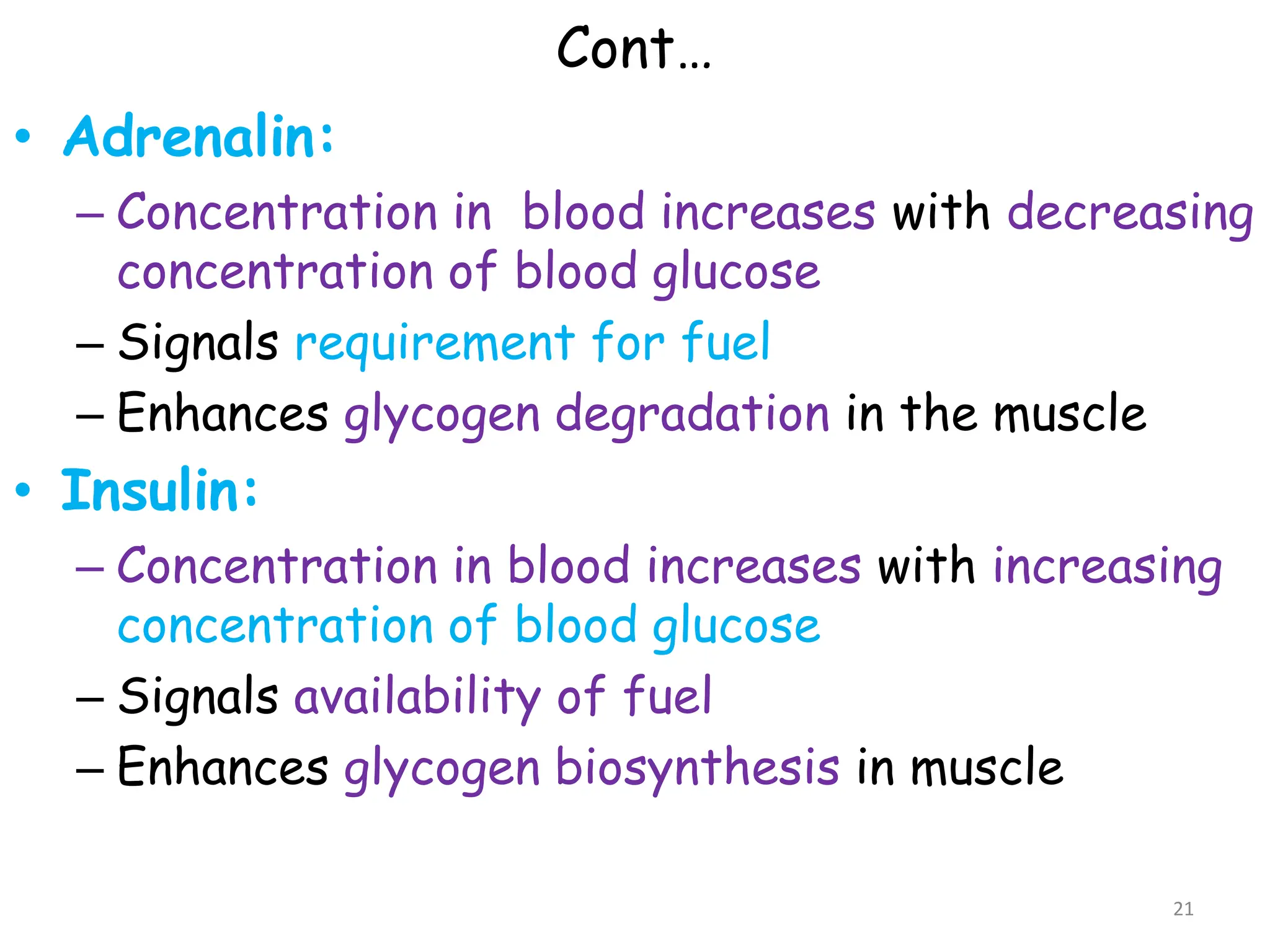
• Adrenalin:
– Concentration in blood increases with decreasing
concentration of blood glucose
– Signals requirement for fuel
– Enhances glycogen degradation in the muscle
• Insulin:
– Concentration in blood increases with increasing
concentration of blood glucose
– Signals availability of fuel
– Enhances glycogen biosynthesis in muscle
21
Cont…
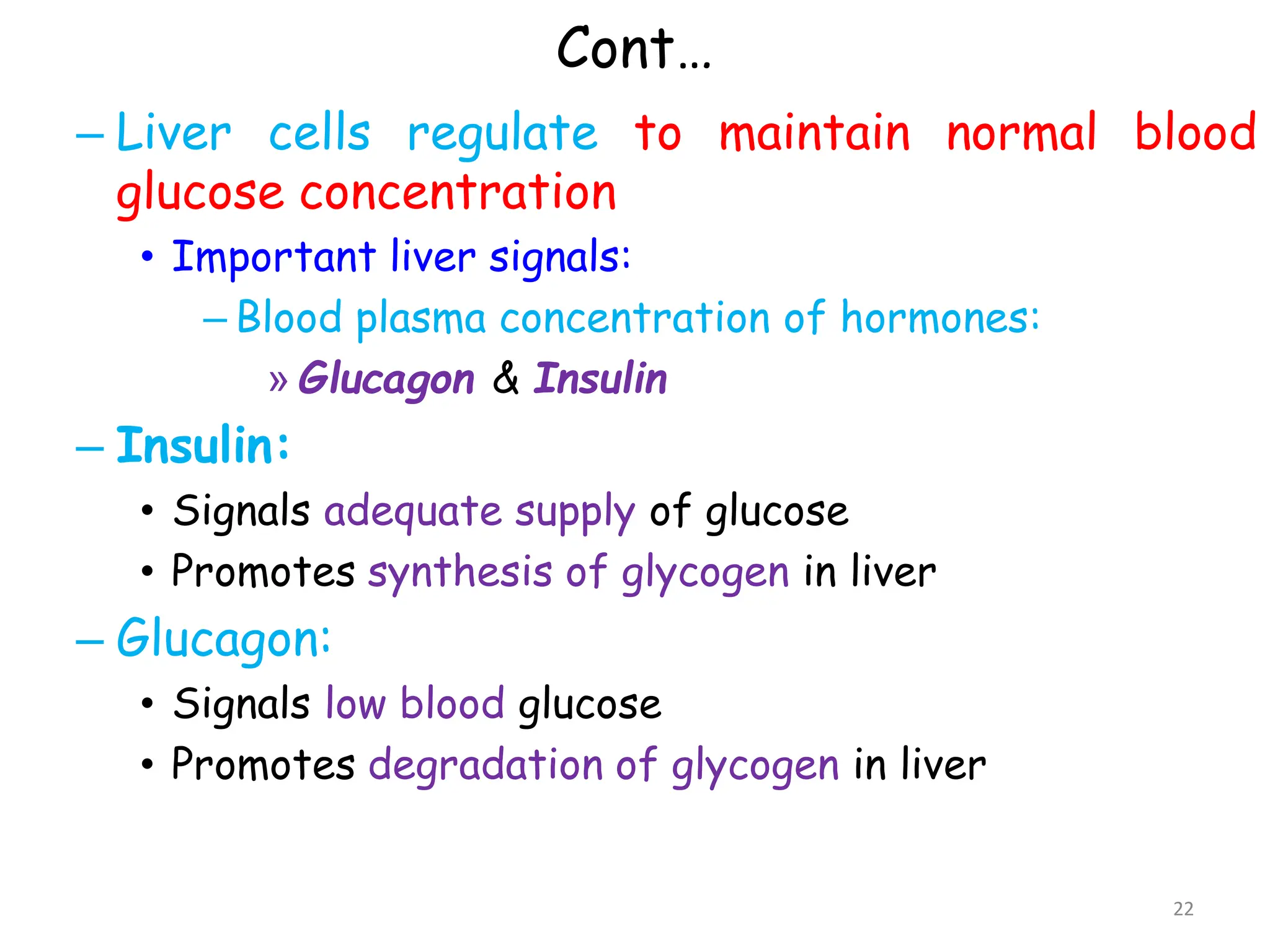
– Liver cells regulate to maintain normal blood
glucose concentration
• Important liver signals:
– Blood plasma concentration of hormones:
» Glucagon & Insulin
– Insulin:
• Signals adequate supply of glucose
• Promotes synthesis of glycogen in liver
– Glucagon:
• Signals low blood glucose
• Promotes degradation of glycogen in liver
22
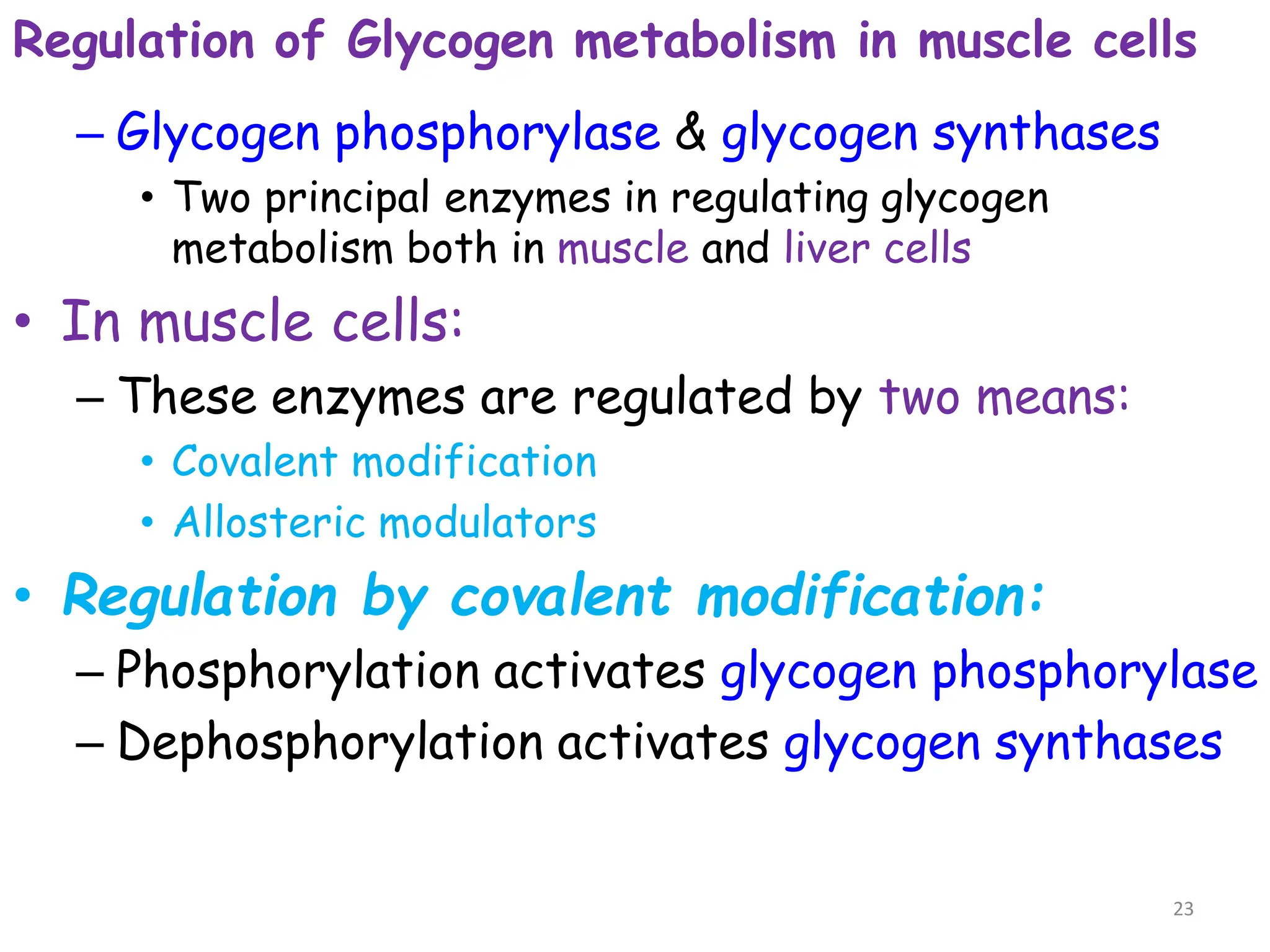
Regulation of Glycogen metabolism in muscle cells
– Glycogen phosphorylase & glycogen synthases
• Two principal enzymes in regulating glycogen
metabolism both in muscle and liver cells
• In muscle cells:
– These enzymes are regulated by two means:
• Covalent modification
• Allosteric modulators
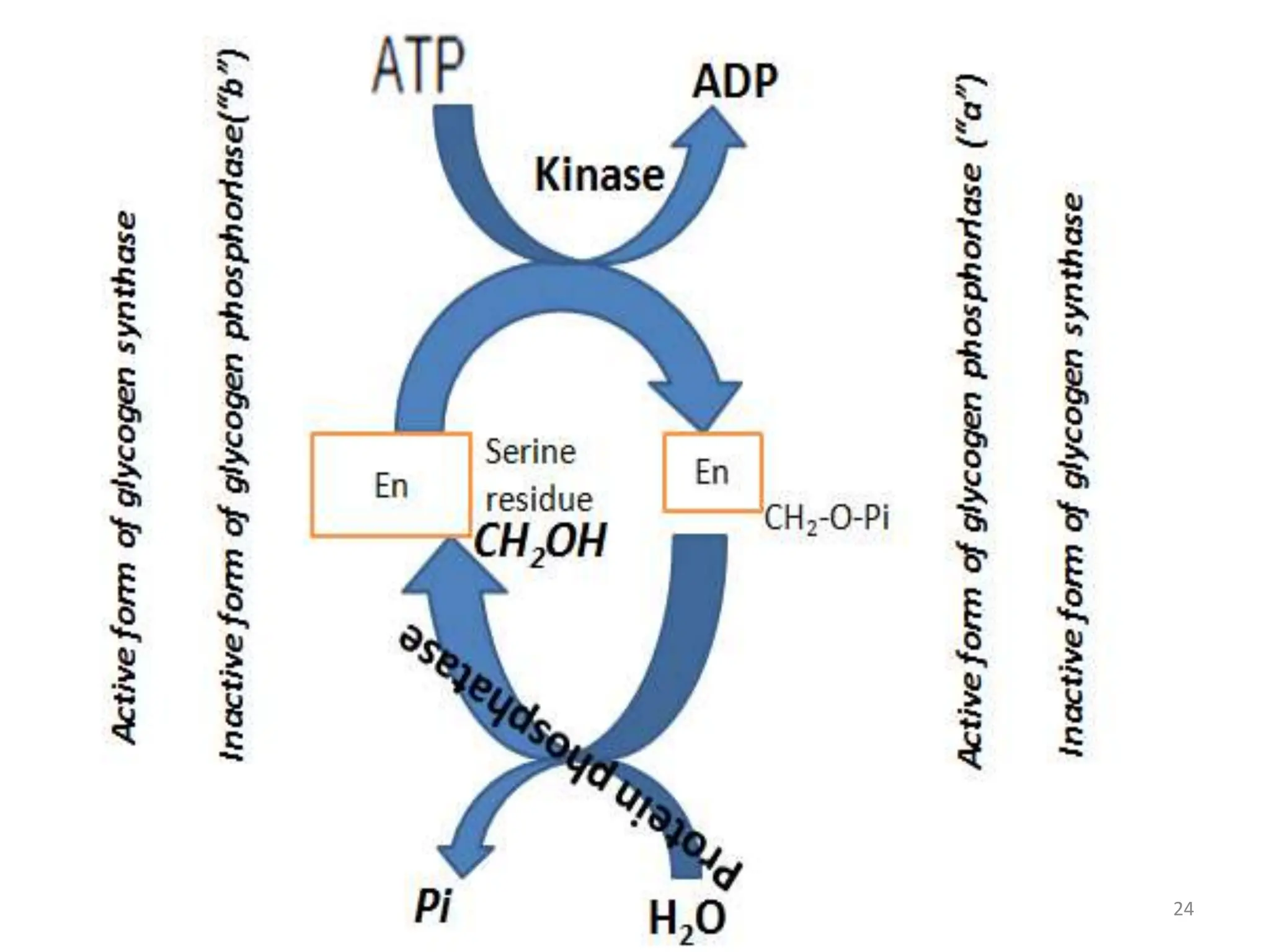
• Regulation by covalent modification:
– Phosphorylation activates glycogen phosphorylase
– Dephosphorylation activates glycogen synthases
23
24
Cont…
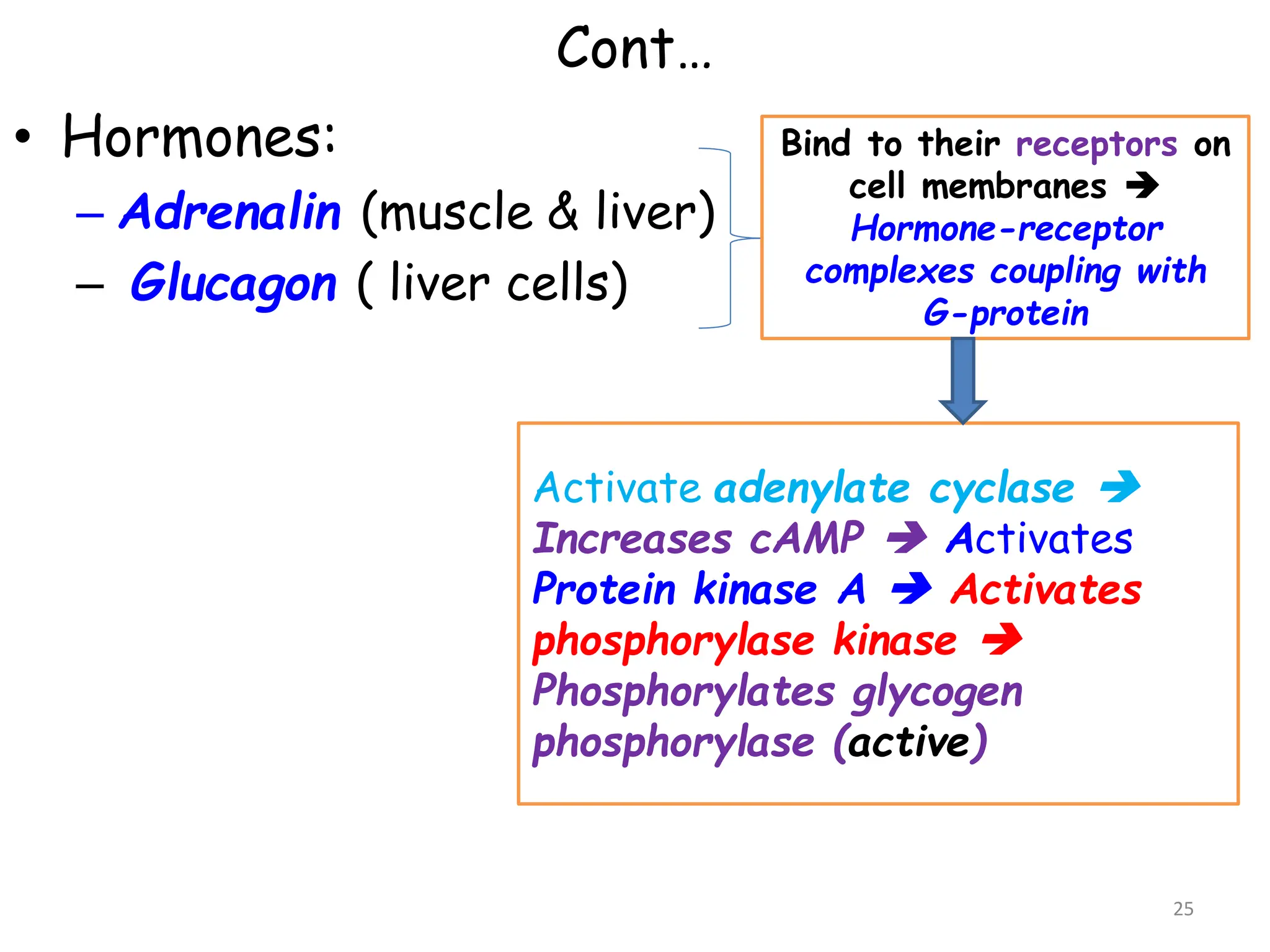
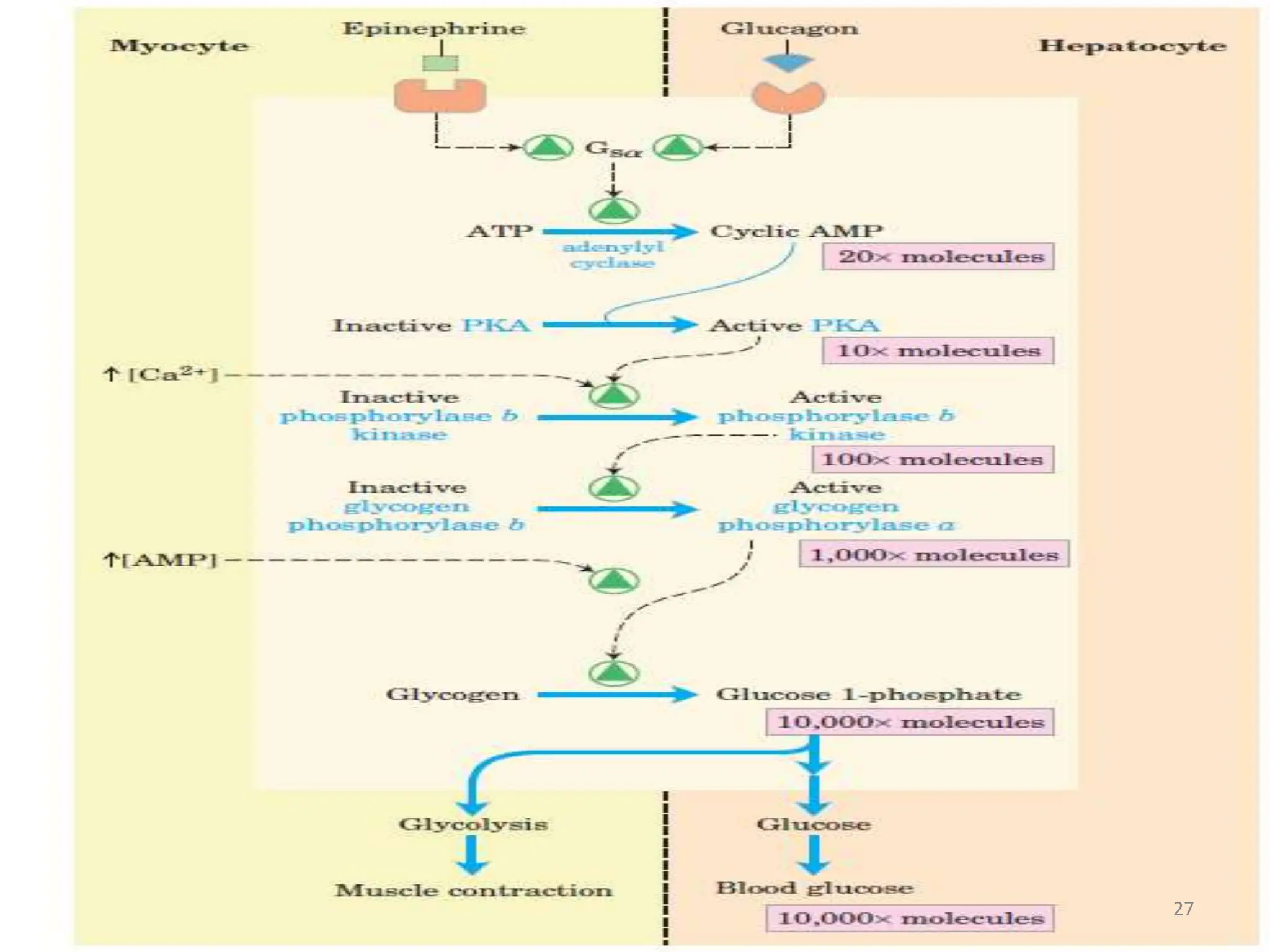
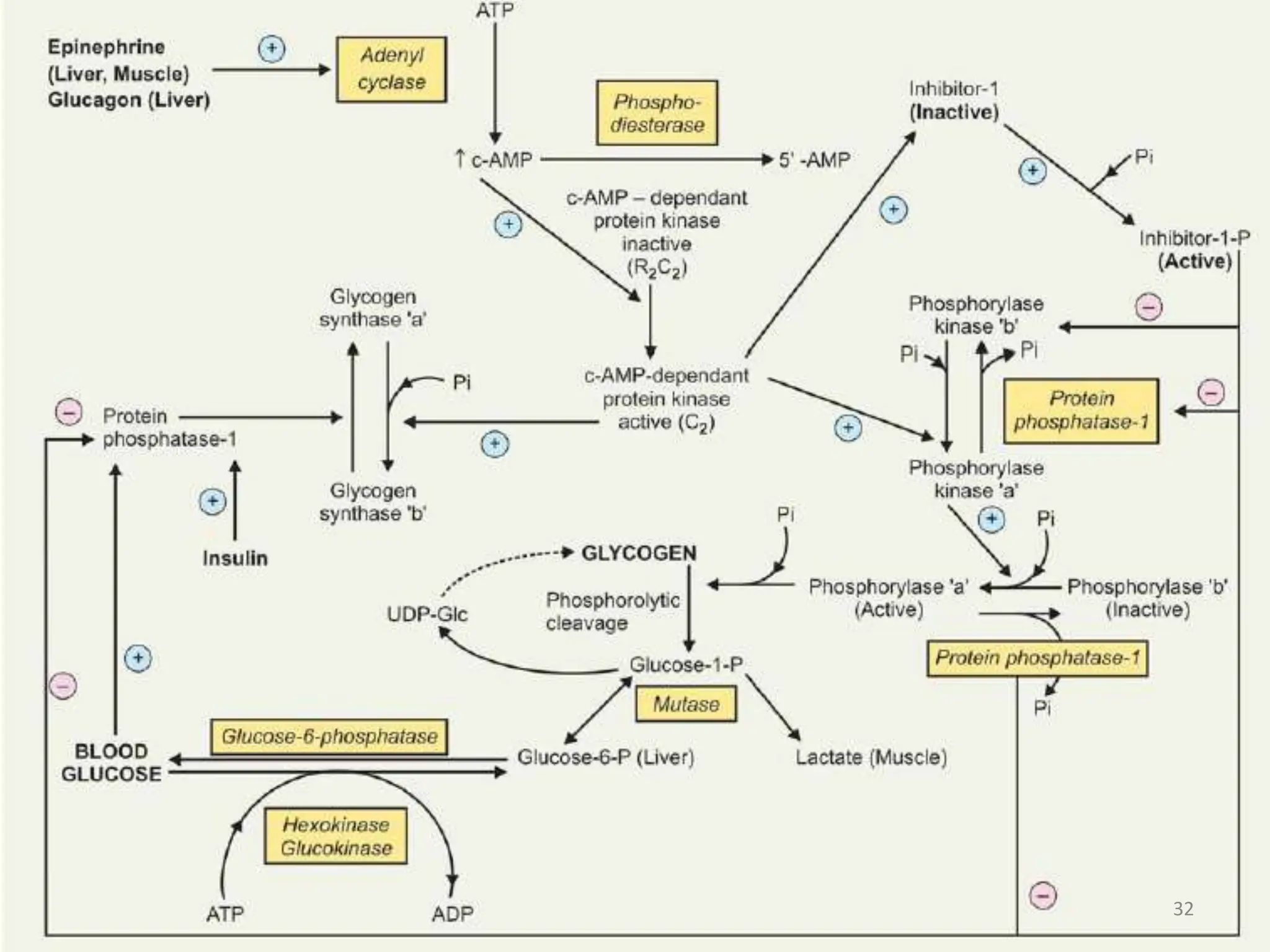
• Hormones:
– Adrenalin (muscle & liver)
– Glucagon ( liver cells)
Bind to their receptors on
cell membranes 
Hormone-receptor
complexes coupling with
G-protein
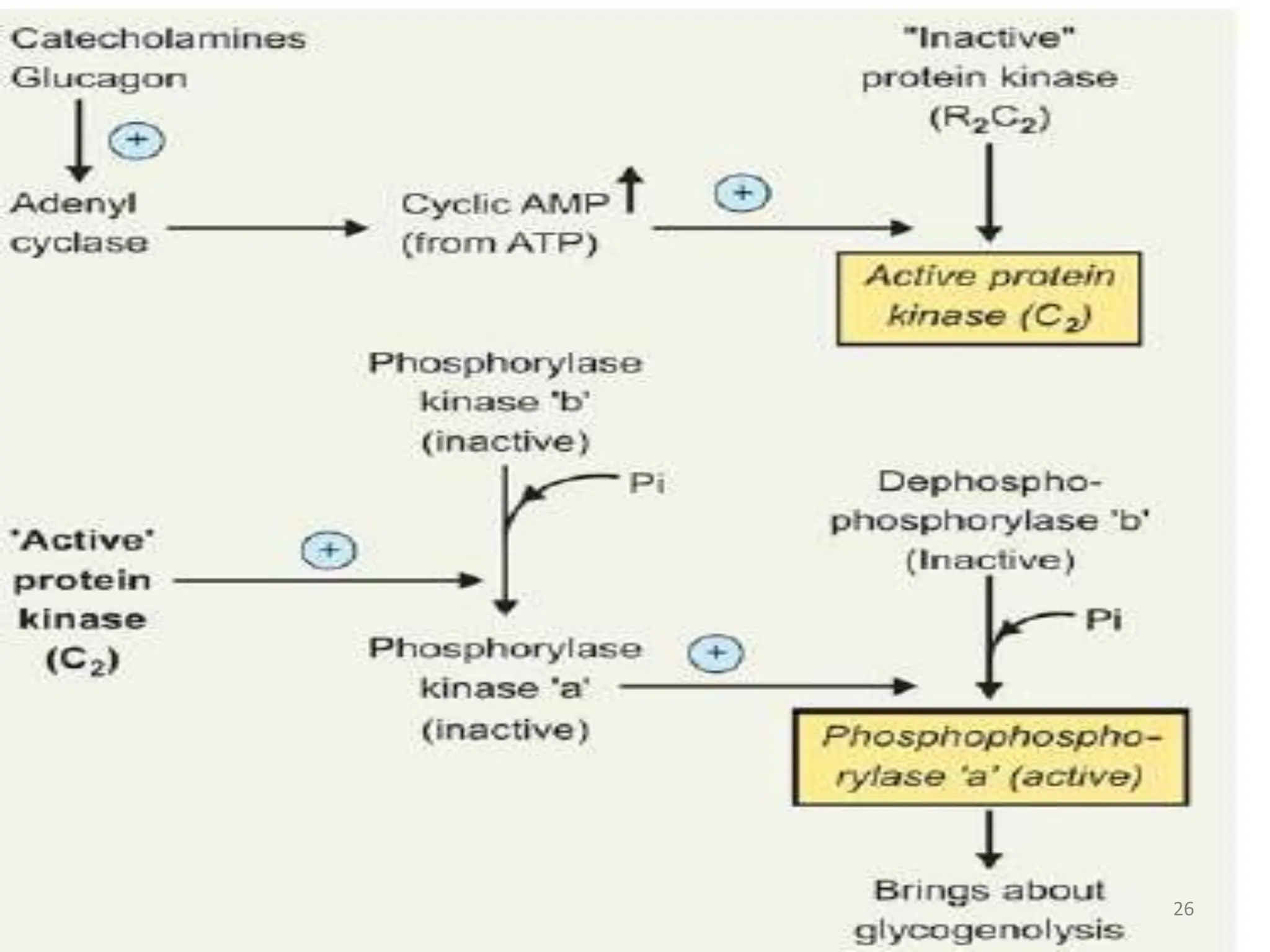
Activate adenylate cyclase 
Increases cAMP  Activates
Protein kinase A  Activates
phosphorylase kinase 
Phosphorylates glycogen
phosphorylase (active)
25
26
27
Cont…
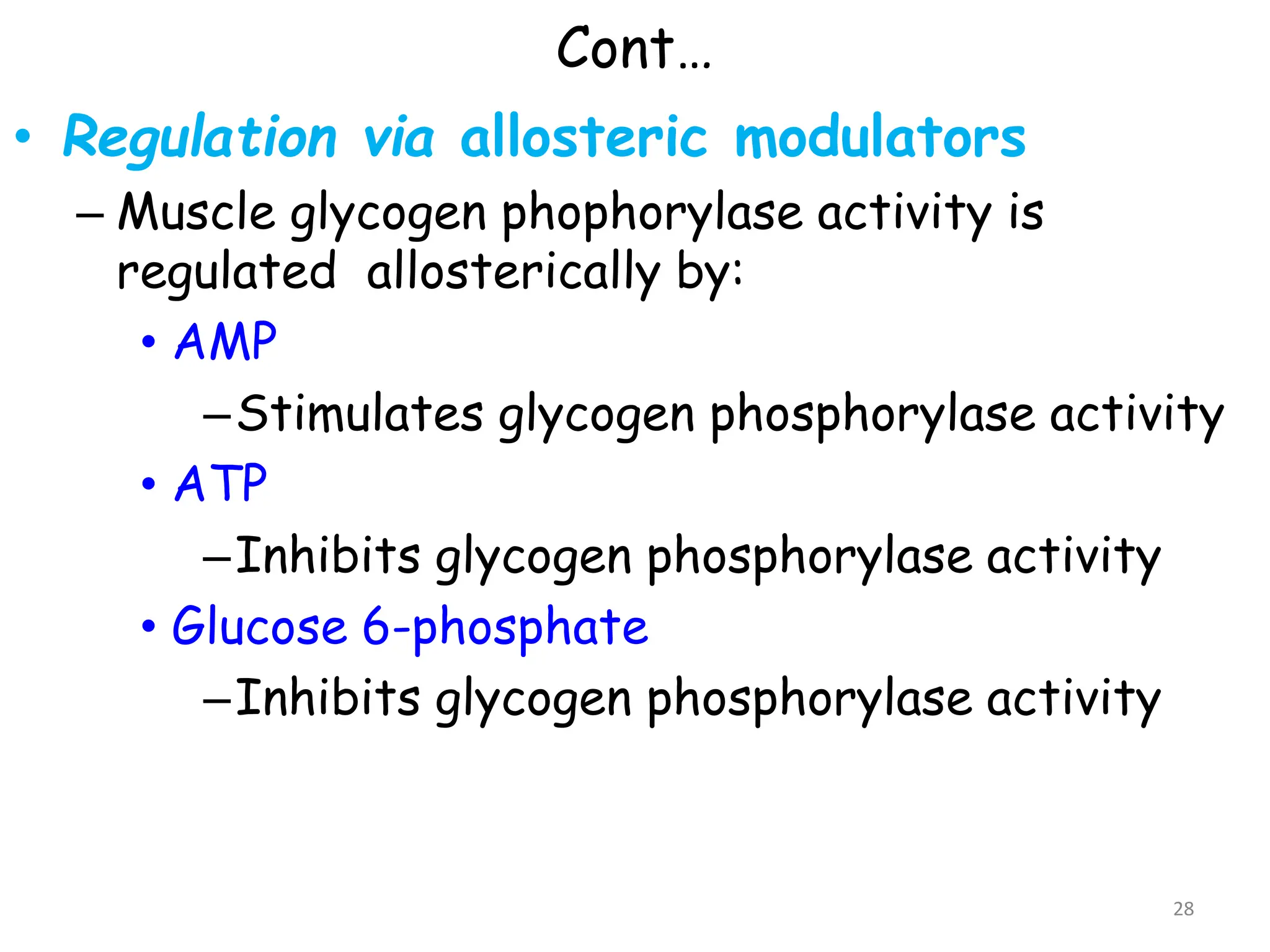
• Regulation via allosteric modulators
– Muscle glycogen phophorylase activity is
regulated allosterically by:
• AMP
–Stimulates glycogen phosphorylase activity
• ATP
–Inhibits glycogen phosphorylase activity
• Glucose 6-phosphate
–Inhibits glycogen phosphorylase activity
28
Regulation of Glycogen metabolism in liver cells
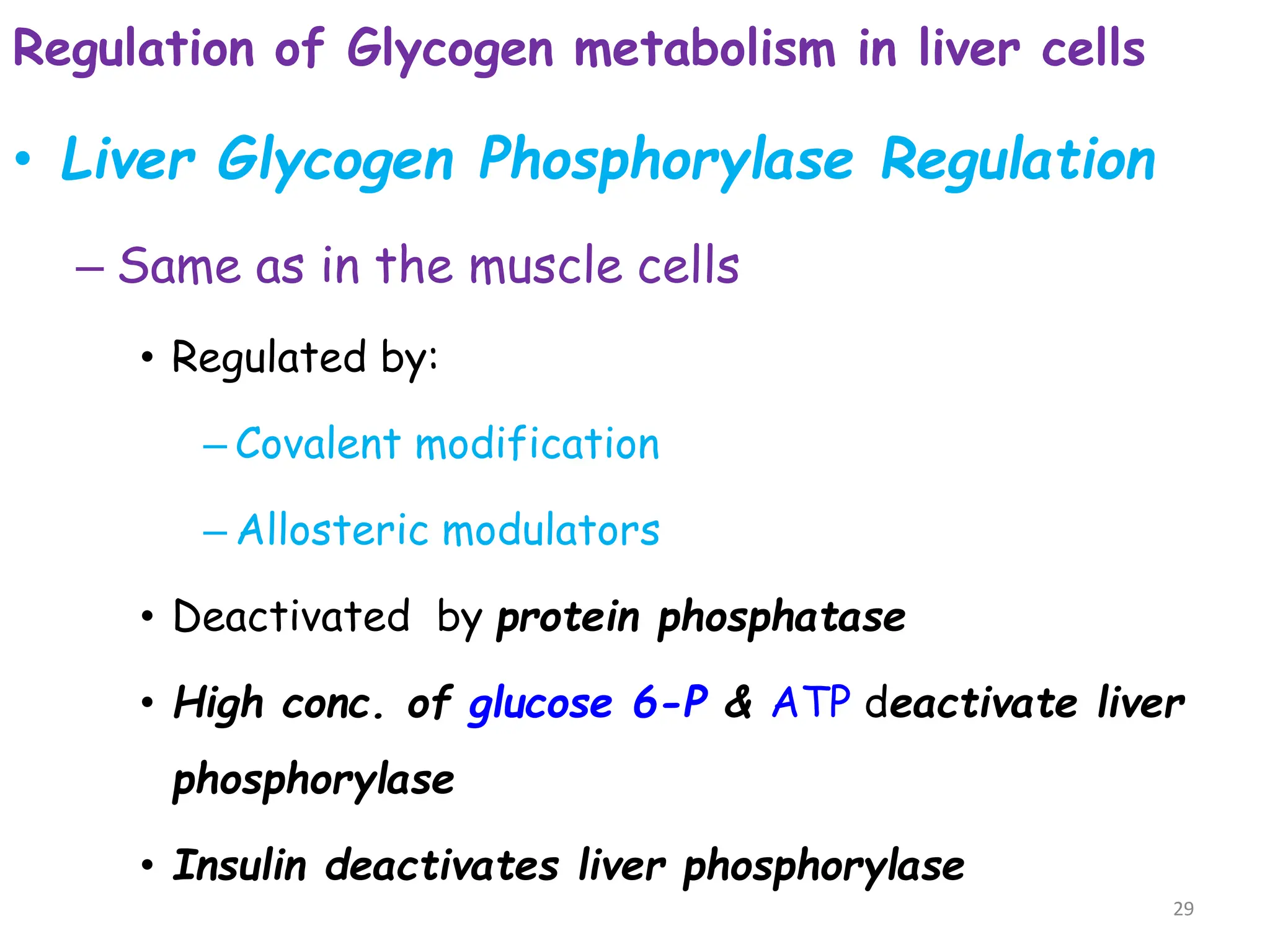
• Liver Glycogen Phosphorylase Regulation
– Same as in the muscle cells
• Regulated by:
– Covalent modification
– Allosteric modulators
• Deactivated by protein phosphatase
• High conc. of glucose 6-P & ATP deactivate liver
phosphorylase
• Insulin deactivates liver phosphorylase
29
Cont…
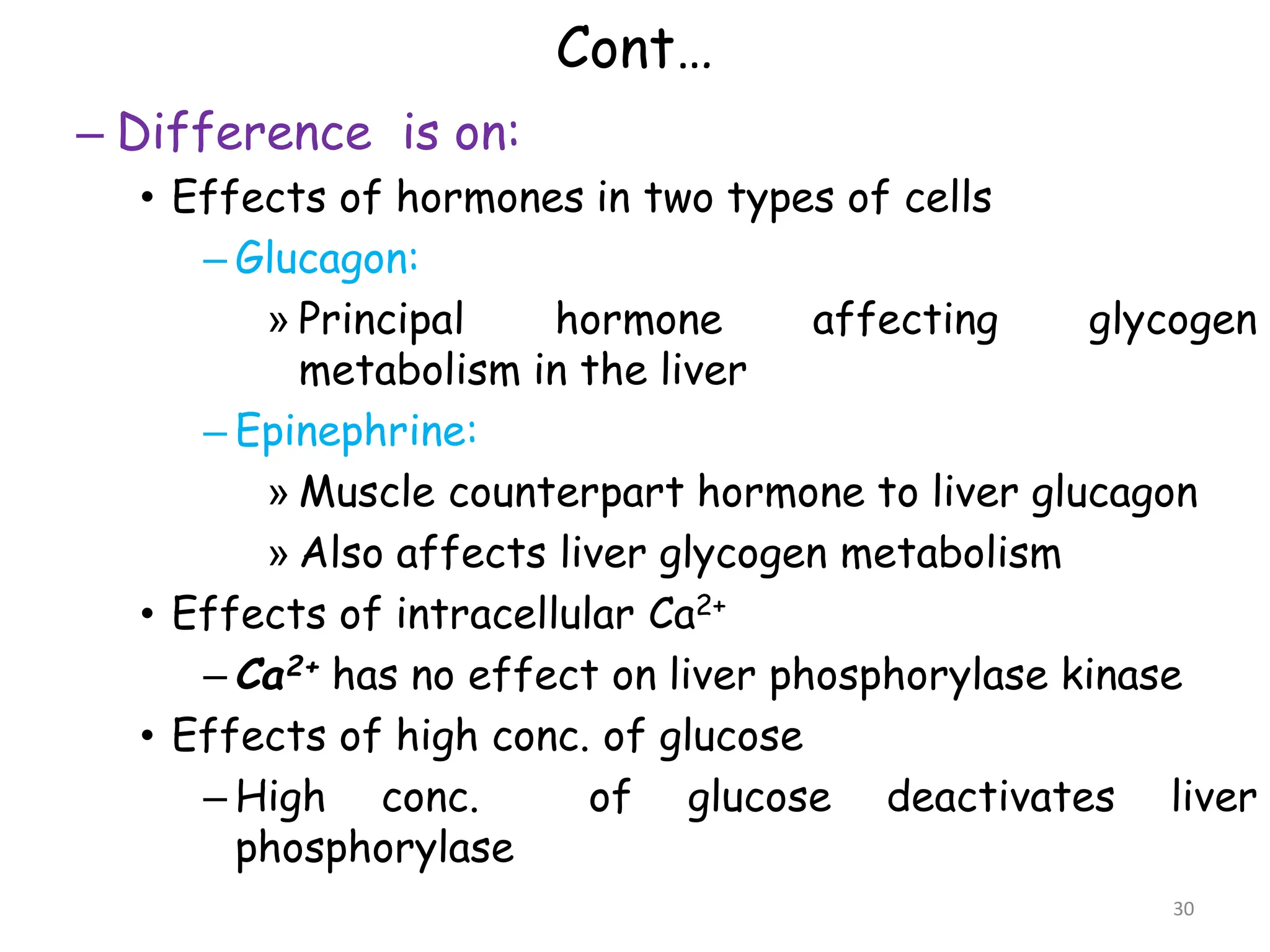
– Difference is on:
• Effects of hormones in two types of cells
– Glucagon:
» Principal hormone affecting glycogen
metabolism in the liver
– Epinephrine:
» Muscle counterpart hormone to liver glucagon
» Also affects liver glycogen metabolism
• Effects of intracellular Ca2+
– Ca2+ has no effect on liver phosphorylase kinase
• Effects of high conc. of glucose
– High conc. of glucose deactivates liver
phosphorylase
30
Cont…
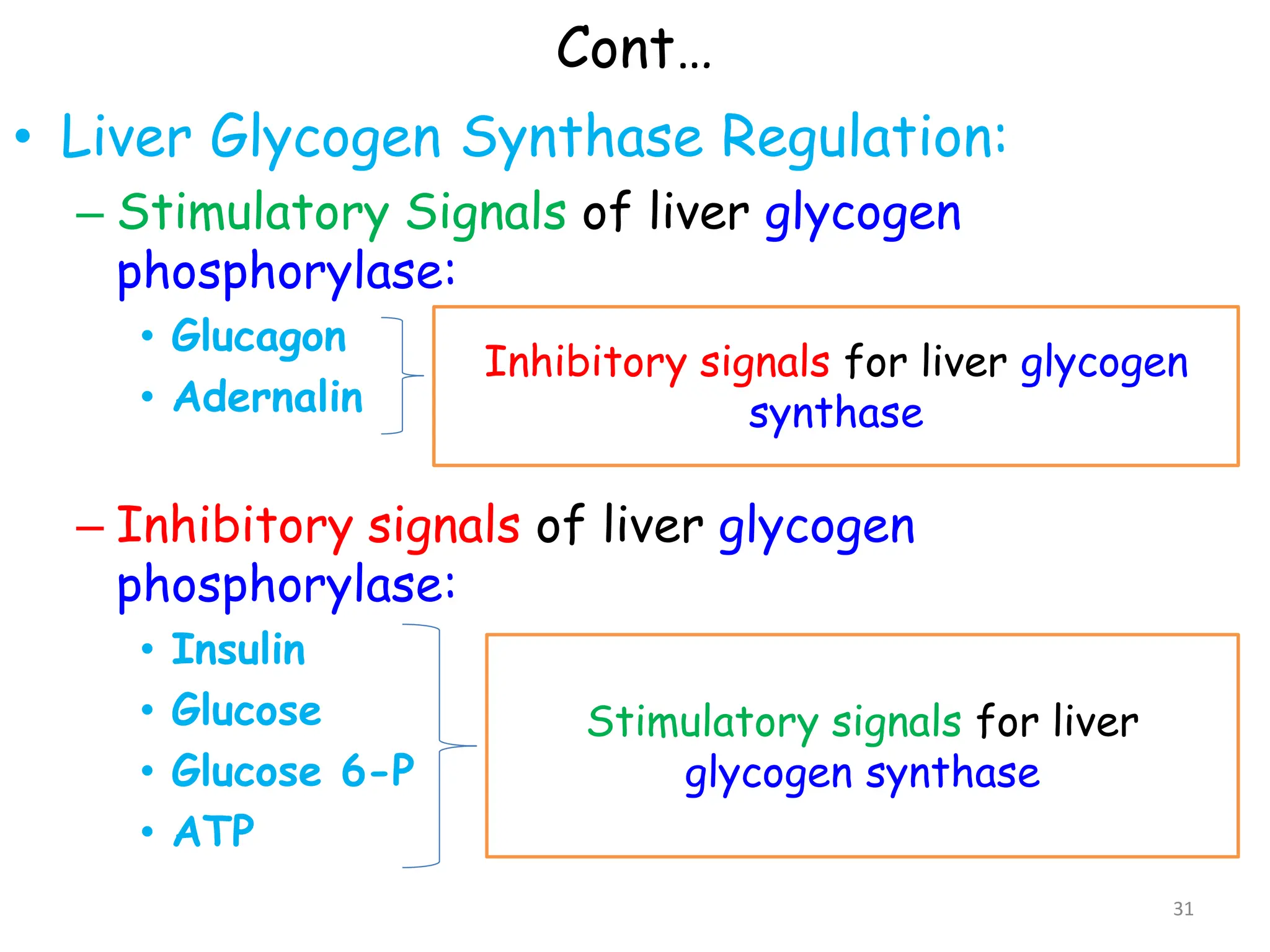
• Liver Glycogen Synthase Regulation:
– Stimulatory Signals of liver glycogen
phosphorylase:
• Glucagon
• Adernalin
– Inhibitory signals of liver glycogen
phosphorylase:
• Insulin
• Glucose
• Glucose 6-P
• ATP
Inhibitory signals for liver glycogen
synthase
Stimulatory signals for liver
glycogen synthase
31
32
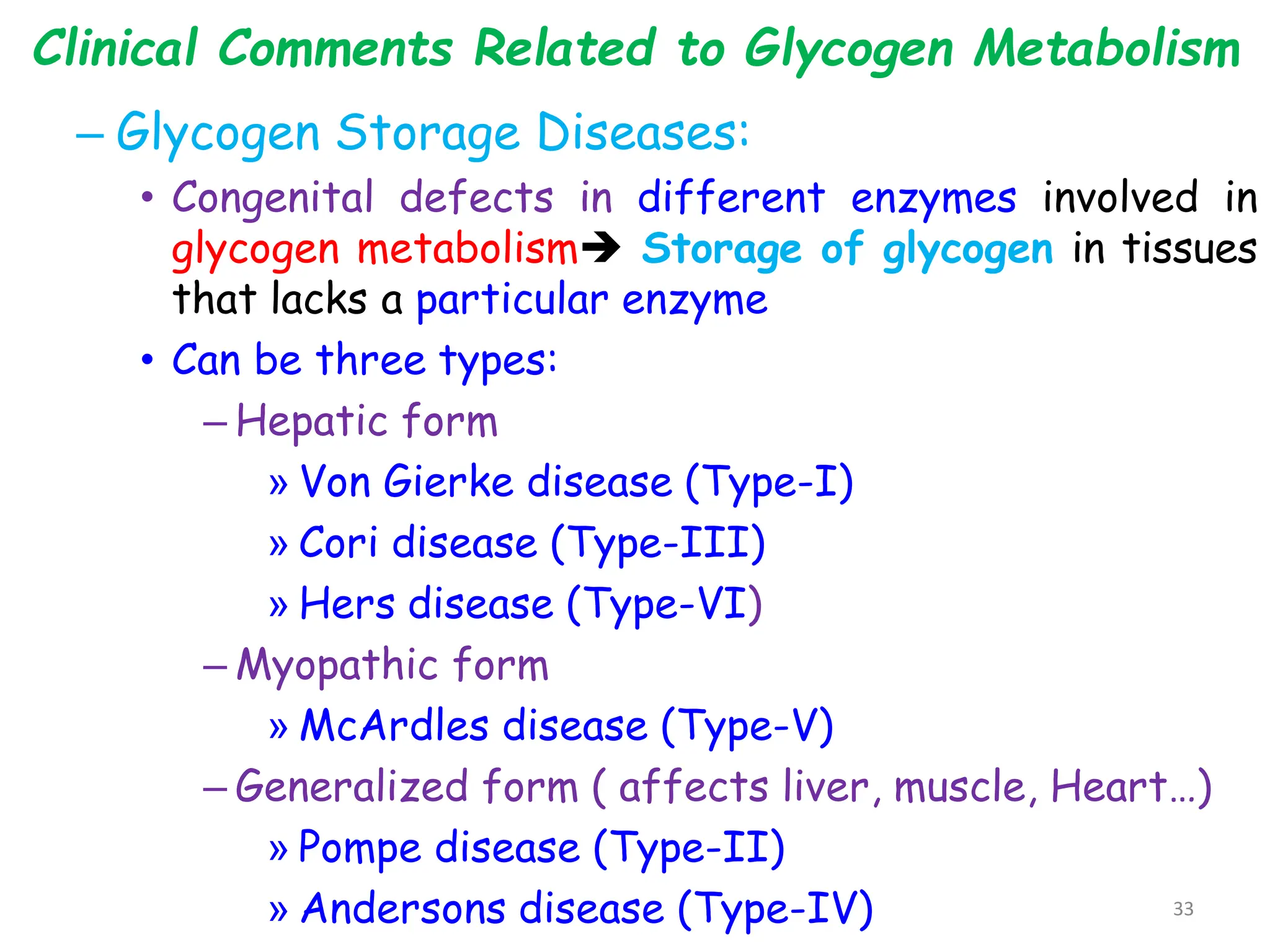
Clinical Comments Related to Glycogen Metabolism
– Glycogen Storage Diseases:
• Congenital defects in different enzymes involved in
glycogen metabolism Storage of glycogen in tissues
that lacks a particular enzyme
• Can be three types:
– Hepatic form
» Von Gierke disease (Type-I)
» Cori disease (Type-III)
» Hers disease (Type-VI)
– Myopathic form
» McArdles disease (Type-V)
– Generalized form ( affects liver, muscle, Heart…)
» Pompe disease (Type-II)
» Andersons disease (Type-IV) 33
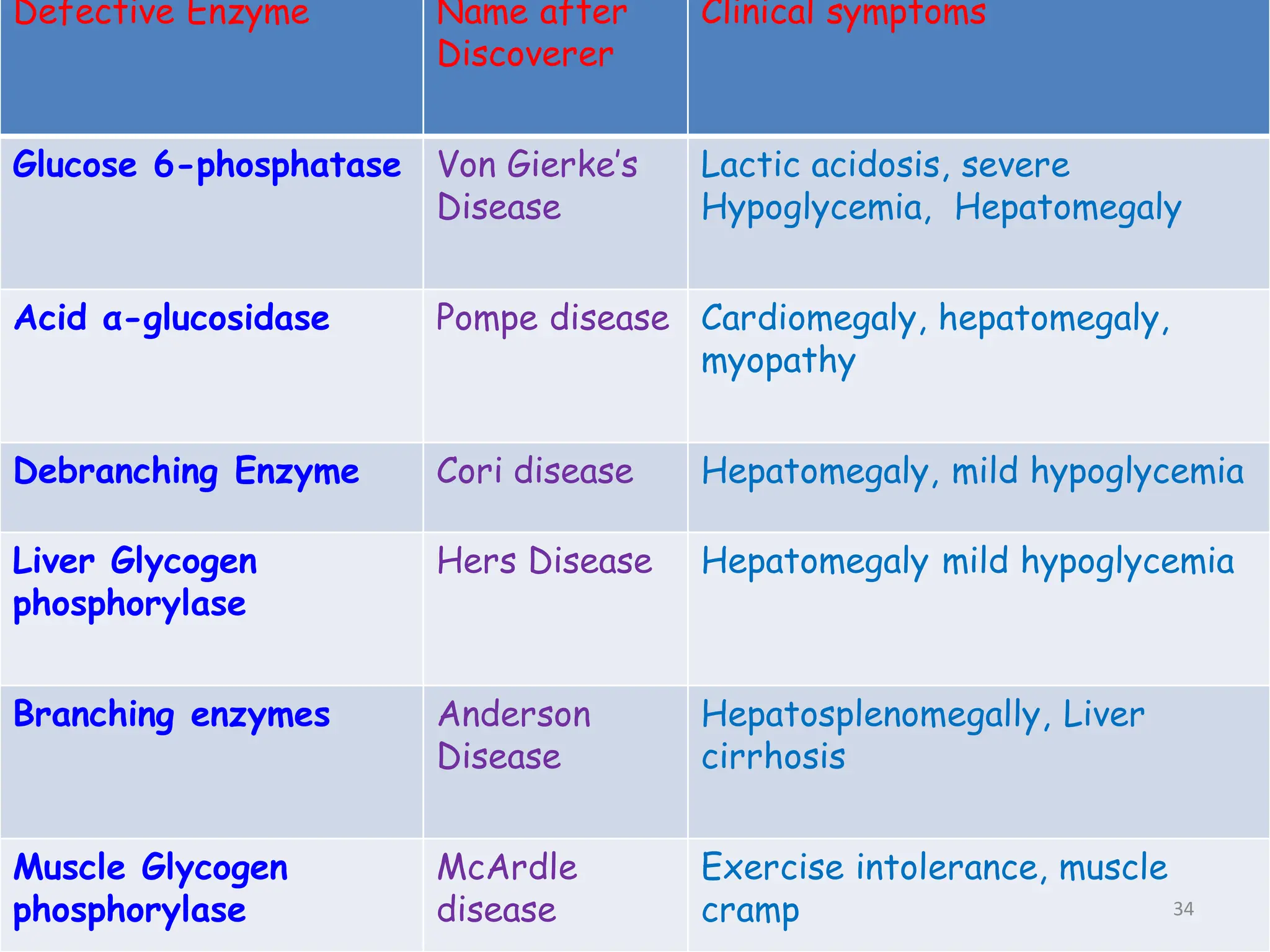
Defective Enzyme Name after
Discoverer
Clinical symptoms
Glucose 6-phosphatase Von Gierke’s
Disease
Lactic acidosis, severe
Hypoglycemia, Hepatomegaly
Acid α-glucosidase Pompe disease Cardiomegaly, hepatomegaly,
myopathy
Debranching Enzyme Cori disease Hepatomegaly, mild hypoglycemia
Liver Glycogen
phosphorylase
Hers Disease Hepatomegaly mild hypoglycemia
Branching enzymes Anderson
Disease
Hepatosplenomegally, Liver
cirrhosis
Muscle Glycogen
phosphorylase
McArdle
disease
Exercise intolerance, muscle
cramp 34
Thank you!
35

Lecture-5 on CHO Metabolism.pdf

  • 1.
    Glycogen Metabolism Dr. EndriyasKelta (DMD, MSc) Assistant Professor, AAU
  • 2.
    Glycogen Metabolism – Glycogen •Storage form of glucose in animal body specially in liver & muscles • Readily mobilized when body needs glucose – Why body stores glucose as glycogen and not as glucose itself? • Reasons: – Insoluble in water » Exerts no osmotic pressure • Does not disturb the intracellular fluid content • Does not diffuse from its storage sites – Higher energy level than glucose – Readily broken down under the influence of hormones & enzymes 2
  • 3.
    Cont… – Why weneed to make glycogen? • Reasons: – We are not eating all the time! But our brain needs glucose continuously – One of the very important function of glycogen is to maintain blood glucose level – Which glycogen is important to maintain blood glucose level? • Answer: Liver Glycogen – Two important tissue sites for glycogen: • Liver • Muscle 3
  • 4.
    Cont… – What arethe most important differences b/n liver & muscle glycogen? – Difference no-1: » Liver glycogen is mobilized for safety of other tissues during hypoglycemic condition » Muscle glycogen is mobilized for its private & personal needs , not for need of other tissues » Due to absence/ presence of glucose 6- phosphatase – Difference no-2: » In well fed state: • Around 100gm of glycogen in liver & 400gm of glycogen in muscle • However, • Muscle glycogen makes 1-2 % of muscle mass • Liver glycogen makes about 10 % of liver mass 4
  • 5.
    Cont… • Difference no-3: –Glycogen stores in liver & muscle fluctuate » Liver glycogen stores fluctuate according to Fed/Fasting state of body » Muscle glycogen stores fluctuate according to resting/exercising state of muscle – Glycogen metabolism can be discussed under two phases: • Synthetic phase – Formation of glycogen (Glycogenesis ) • Catabolic phase – Breakdown of glycogen (Glycogenolysis) 5
  • 6.
    Cont… – Characteristics oftwo phases: • Breakdown pathway is not a ‘reversal’ of synthetic pathway • When glycogenesis occurs, glycogenolysis does not take place and vice versa • Both phases are regulated finally, at substrate level, by end-products & hormonally Glycogenesis – Formation of glycogen from glucose – Starts with phosphorylation of glucose at C-6 6
  • 7.
    Cont… – 1st, glucoseis phosphorylated to glucose-6-P by Glucokinase or Hexokinase • Common step for EM pathway & glycogenesis – 2nd, Glucose 6-P  Glucose 1-P by phosphoglucomutase 7
  • 8.
    Cont… – 3rd, Glucose-1-Pplus UTP UDP-Glucose plus PPi by UDP-glucose pyrophosphorylase – Subsequent hydrolysis PPi by inorganic pyrophosphatase drives the reaction to right – Then, C-1 of UDP-Glucose reacts with C-4 of terminal glucose residue in primer, or pre- existing glycogen liberating UDP by Glycogen synthase 8
  • 9.
    – Pre-existing glycogenmolecule, or “primer” must be present to initiate glycogen synthase reaction – Glycogenin • Protein primer on which glycogen ‘primer’ is formed • Glycosylated on a specific tyrosine residue by UDPGlc • An existing glycogen chain can be repeatedly extended by one glucose unit – Librated UDP reacts with ATP  UTP (regenerated) plus ADP by nucleoside diphosphokinase – In each extension existing glycogen chain , 2 ATPs are expended: • 1 ATP: Glucokinase/Hexokinase reaction • 1 ATP: Nucleoside diphosphokinase reaction 9
  • 10.
    Cont… – When aminimum of 11 glucose residues reached, • Another enzyme called Branching enzyme (Amylo-1, 4 → 1, 6-transglucosidase) – Cleaves α-1 → 4 glycosidic linkage on growing glycogen chain – Transfers a minimum of 6 glucose residues to neighboring chain – Forms α-1 → 6 glycosidic linkage in the neighboring chain – Branches grow by further additions of α- (1 → 4) glucosyl units by glycogen synthase activity & further branching by branching enzyme activity 10
  • 11.
  • 12.
    Cont… Glycogenolysis – Breakdown ofglycogen to glucose or glucose 6- P – Involves two steps: • Phosphorolysis • De-branching • Phosphorlysis: – Cleavage of bond by addition of phosphate groups – Catalyzed by Glycogen Phosphorylase • Pyridoxal phosphate (PLP) dependant enzyme • Removes glycosyl residues from non-reducing end of glycogen by adding Pi group 12
  • 13.
    Cont… – Addition ofPi group: • Splits glycosidic linkage b/n C-1 of terminal residue & C-4 of adjacent residue in glycogen molecule • Phosporylates terminal residue at C-1 Glucose 1- Phosphate 13
  • 14.
    Cont… – Repeated actionof glycogen phosphorylase continues till 4 glucose residues remain before (α-1,6) branch point – Glycogen molecule completely sheared by glycogen phosphorylase up to four residue remnant  Phosphorylase dextrin or Limit dextrin • De-branching: – Next step in glycogenolysis – Requires de-branching enzyme oligo (α-1,6) to (α-1,4) glucantransferase • Catalyzes two two successive reactions that transfer branches 14
  • 15.
    Cont… – 1st, transferof oligosaccharide unit (3 glucose residue) from limit dextrin of one branch to neighboring branch (converting from 4 into 7 glucose residues) • Catalyzed by (α-14) to (α-14)-glucantransferase activity (Transferase activity) – 2nd , cleavage of (α-16)-glycosidic linkage  Free glucose residue • Catalyzed by amylo-(α-16)-glucosidase or de- branching enzyme activity • Phosphorylase activity now, continues in the elongated branch of 7 glucose residues until limit dextrin 15
  • 16.
  • 17.
    Cont… Fate of Glucose-1-P –Combined action of phosphorylase & de- branching enzymes convert glycogen to glucose- 1-P mostly – Glucose-1-P is easily converted to glucose-6-P by action of Phosphoglucomutase enzyme – Glucose 6-phosphate • Enters glycolytic pathway in muscle cells • Transported into ER lumen by specific transporter (T1) ER membrane of liver & kidney – Converted to glucose & Pi by Glucose 6- phosphatase Released into blood – Glucose & Pi transported back into cytosol by specific transporters ( T2 &T3, respectively) 17
  • 18.
  • 19.
    Regulation of glycogenmetabolism Objectives: – To store glucose at times of plenty and mobilize it at times of scarcity – To prevent the reaction of storage & mobilization of glucose from occurring at the same time • Glycogenesis & glycogenolysis are coordinated processes – Glycogen synthase is nearly inactive when glycogen phosphorlase is fully active and vice versa 19
  • 20.
    Cont… • Nature ofsignals regulating glycogen metabolism differs from tissues to tissues – Muscle cells regulate to mobilize glucose for ATP formation & to store the glucose at rest when the glucose supply is adequate • Important muscle signals: – Intracellular concentration of Ca2+ and AMP Rise during muscle contraction – Blood plasma concentration of hormones: » Adrenalin & insulin 20
  • 21.
    Cont… • Adrenalin: – Concentrationin blood increases with decreasing concentration of blood glucose – Signals requirement for fuel – Enhances glycogen degradation in the muscle • Insulin: – Concentration in blood increases with increasing concentration of blood glucose – Signals availability of fuel – Enhances glycogen biosynthesis in muscle 21
  • 22.
    Cont… – Liver cellsregulate to maintain normal blood glucose concentration • Important liver signals: – Blood plasma concentration of hormones: » Glucagon & Insulin – Insulin: • Signals adequate supply of glucose • Promotes synthesis of glycogen in liver – Glucagon: • Signals low blood glucose • Promotes degradation of glycogen in liver 22
  • 23.
    Regulation of Glycogenmetabolism in muscle cells – Glycogen phosphorylase & glycogen synthases • Two principal enzymes in regulating glycogen metabolism both in muscle and liver cells • In muscle cells: – These enzymes are regulated by two means: • Covalent modification • Allosteric modulators • Regulation by covalent modification: – Phosphorylation activates glycogen phosphorylase – Dephosphorylation activates glycogen synthases 23
  • 24.
  • 25.
    Cont… • Hormones: – Adrenalin(muscle & liver) – Glucagon ( liver cells) Bind to their receptors on cell membranes  Hormone-receptor complexes coupling with G-protein Activate adenylate cyclase  Increases cAMP  Activates Protein kinase A  Activates phosphorylase kinase  Phosphorylates glycogen phosphorylase (active) 25
  • 26.
  • 27.
  • 28.
    Cont… • Regulation viaallosteric modulators – Muscle glycogen phophorylase activity is regulated allosterically by: • AMP –Stimulates glycogen phosphorylase activity • ATP –Inhibits glycogen phosphorylase activity • Glucose 6-phosphate –Inhibits glycogen phosphorylase activity 28
  • 29.
    Regulation of Glycogenmetabolism in liver cells • Liver Glycogen Phosphorylase Regulation – Same as in the muscle cells • Regulated by: – Covalent modification – Allosteric modulators • Deactivated by protein phosphatase • High conc. of glucose 6-P & ATP deactivate liver phosphorylase • Insulin deactivates liver phosphorylase 29
  • 30.
    Cont… – Difference ison: • Effects of hormones in two types of cells – Glucagon: » Principal hormone affecting glycogen metabolism in the liver – Epinephrine: » Muscle counterpart hormone to liver glucagon » Also affects liver glycogen metabolism • Effects of intracellular Ca2+ – Ca2+ has no effect on liver phosphorylase kinase • Effects of high conc. of glucose – High conc. of glucose deactivates liver phosphorylase 30
  • 31.
    Cont… • Liver GlycogenSynthase Regulation: – Stimulatory Signals of liver glycogen phosphorylase: • Glucagon • Adernalin – Inhibitory signals of liver glycogen phosphorylase: • Insulin • Glucose • Glucose 6-P • ATP Inhibitory signals for liver glycogen synthase Stimulatory signals for liver glycogen synthase 31
  • 32.
  • 33.
    Clinical Comments Relatedto Glycogen Metabolism – Glycogen Storage Diseases: • Congenital defects in different enzymes involved in glycogen metabolism Storage of glycogen in tissues that lacks a particular enzyme • Can be three types: – Hepatic form » Von Gierke disease (Type-I) » Cori disease (Type-III) » Hers disease (Type-VI) – Myopathic form » McArdles disease (Type-V) – Generalized form ( affects liver, muscle, Heart…) » Pompe disease (Type-II) » Andersons disease (Type-IV) 33
  • 34.
    Defective Enzyme Nameafter Discoverer Clinical symptoms Glucose 6-phosphatase Von Gierke’s Disease Lactic acidosis, severe Hypoglycemia, Hepatomegaly Acid α-glucosidase Pompe disease Cardiomegaly, hepatomegaly, myopathy Debranching Enzyme Cori disease Hepatomegaly, mild hypoglycemia Liver Glycogen phosphorylase Hers Disease Hepatomegaly mild hypoglycemia Branching enzymes Anderson Disease Hepatosplenomegally, Liver cirrhosis Muscle Glycogen phosphorylase McArdle disease Exercise intolerance, muscle cramp 34
  • 35.