Gluconeogenesis
Kamal Singh Khadka and Manoj Sigdel
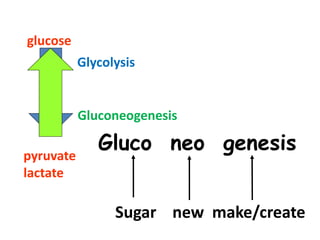
Gluco neo genesis
glucose
pyruvate
lactate
Sugar new make/create
Glycolysis
Gluconeogenesis
Gluconeogenesis
• Formation of glucose or glycogen from non-
carbohydrate precursors
• Occurs in all animals, plants, fungi and microbes
• Occurs largely in the liver ( about 1 kg /day) ; some
in renal cortex and in the epithelial cells that line
the inside of the small intestine
• Mainly a cytosolic pathway, but the first step occur
in mitochondria
• Of 10 enzymatic steps, 7 are reversals of glycolytic
reactions
Conditions when
Gluconeogenesis is especially Active
• Active primarily when a person is in the fasted
state:
– When dietary carbohydrates have been utilized
or stored as glycogen, and
– When the plasma concentration of glucose has
declined
• Also increases during prolonged physical exercise
• In the neonates-first few hours after delivery
Significance of Gluconeogenesis
1) Maintains blood glucose homeostasis in the lack of
carbohydrate in the diet
2) Ensures a continuous supply of glucose to the
tissues which require a continuous supply of
glucose such as brain, RBCs, lens, cornea of the eye
and kidney medulla
Human brain alone requires about 120 gm of
glucose per day, out of 160 gm needed by the entire
body
3) Clears the products of the metabolism of
other tissues from the blood, e.g.
-Lactate, produced by muscle and RBCs
and
-Gylcerol produced by adipose tissue
Substrates for Gluconeogenesis
The substrate for gluconeogenesis are:
–Lactate
–Glycerol
–Glucogenic amino acids
–Propionate, and
–Intermediates of citric acid cycle
Substrates for Gluconeogenesis
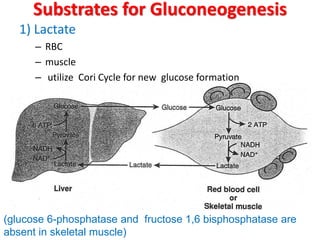
1) Lactate
– RBC
– muscle
– utilize Cori Cycle for new glucose formation
(glucose 6-phosphatase and fructose 1,6 bisphosphatase are
absent in skeletal muscle)
Substrates for Gluconeogenesis
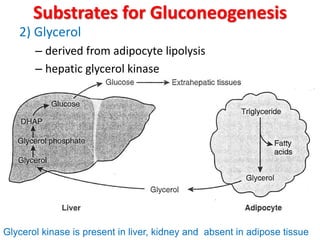
2) Glycerol
– derived from adipocyte lipolysis
– hepatic glycerol kinase
Glycerol kinase is present in liver, kidney and absent in adipose tissue
Substrates for Gluconeogenesis
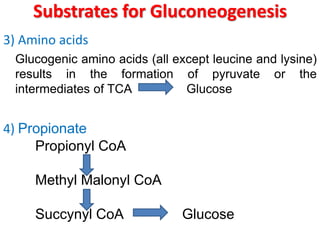
3) Amino acids
Glucogenic amino acids (all except leucine and lysine)
results in the formation of pyruvate or the
intermediates of TCA Glucose
4) Propionate
Propionyl CoA
Methyl Malonyl CoA
Succynyl CoA Glucose
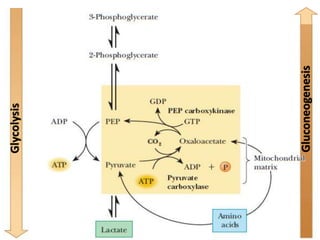
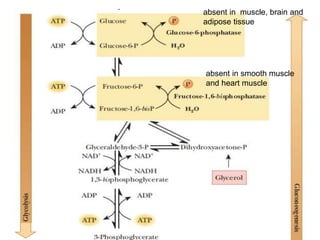
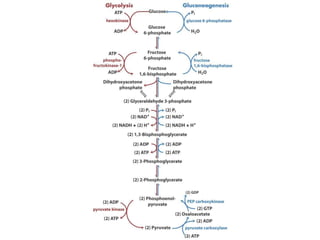
• Of 10 enzymatic steps, 7 are reversals of
glycolytic reactions
• 3 irreversible steps are bypassed by a separate
set of enzymes
Gluconeogenesis Pathway
Glycolysis
Gluconeogenesis
.
absent in muscle, brain and
adipose tissue
absent in smooth muscle
and heart muscle
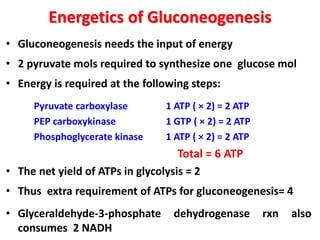
Energetics of Gluconeogenesis
• Gluconeogenesis needs the input of energy
• 2 pyruvate mols required to synthesize one glucose mol
• Energy is required at the following steps:
Pyruvate carboxylase 1 ATP ( × 2) = 2 ATP
PEP carboxykinase 1 GTP ( × 2) = 2 ATP
Phosphoglycerate kinase 1 ATP ( × 2) = 2 ATP
Total = 6 ATP
• The net yield of ATPs in glycolysis = 2
• Thus extra requirement of ATPs for gluconeogenesis= 4
• Glyceraldehyde-3-phosphate dehydrogenase rxn also
consumes 2 NADH
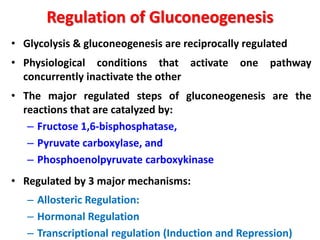
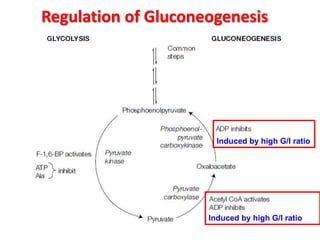
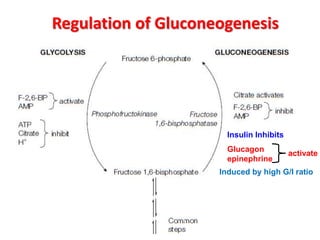
Regulation of Gluconeogenesis
• Glycolysis & gluconeogenesis are reciprocally regulated
• Physiological conditions that activate one pathway
concurrently inactivate the other
• The major regulated steps of gluconeogenesis are the
reactions that are catalyzed by:
– Fructose 1,6-bisphosphatase,
– Pyruvate carboxylase, and
– Phosphoenolpyruvate carboxykinase
• Regulated by 3 major mechanisms:
– Allosteric Regulation:
– Hormonal Regulation
– Transcriptional regulation (Induction and Repression)
Regulation of Gluconeogenesis
Induced by high G/I ratio
Regulation of Gluconeogenesis
Insulin activates
Glucagon
epinephrine
inhibit
Induced by high G/I ratio
Insulin Inhibits
Glucagon
epinephrine
activate
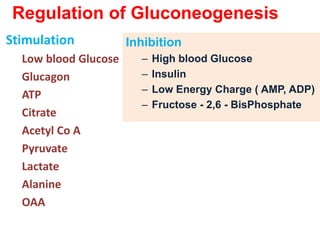
Regulation of Gluconeogenesis
Stimulation
Low blood Glucose
Glucagon
ATP
Citrate
Acetyl Co A
Pyruvate
Lactate
Alanine
OAA
Inhibition
– High blood Glucose
– Insulin
– Low Energy Charge ( AMP, ADP)
– Fructose - 2,6 - BisPhosphate

Gluconeogenesis

  • 1.
  • 2.
    Gluco neo genesis glucose pyruvate lactate Sugarnew make/create Glycolysis Gluconeogenesis
  • 3.
    Gluconeogenesis • Formation ofglucose or glycogen from non- carbohydrate precursors • Occurs in all animals, plants, fungi and microbes • Occurs largely in the liver ( about 1 kg /day) ; some in renal cortex and in the epithelial cells that line the inside of the small intestine • Mainly a cytosolic pathway, but the first step occur in mitochondria • Of 10 enzymatic steps, 7 are reversals of glycolytic reactions
  • 4.
    Conditions when Gluconeogenesis isespecially Active • Active primarily when a person is in the fasted state: – When dietary carbohydrates have been utilized or stored as glycogen, and – When the plasma concentration of glucose has declined • Also increases during prolonged physical exercise • In the neonates-first few hours after delivery
  • 5.
    Significance of Gluconeogenesis 1)Maintains blood glucose homeostasis in the lack of carbohydrate in the diet 2) Ensures a continuous supply of glucose to the tissues which require a continuous supply of glucose such as brain, RBCs, lens, cornea of the eye and kidney medulla Human brain alone requires about 120 gm of glucose per day, out of 160 gm needed by the entire body
  • 6.
    3) Clears theproducts of the metabolism of other tissues from the blood, e.g. -Lactate, produced by muscle and RBCs and -Gylcerol produced by adipose tissue
  • 7.
    Substrates for Gluconeogenesis Thesubstrate for gluconeogenesis are: –Lactate –Glycerol –Glucogenic amino acids –Propionate, and –Intermediates of citric acid cycle
  • 8.
    Substrates for Gluconeogenesis 1)Lactate – RBC – muscle – utilize Cori Cycle for new glucose formation (glucose 6-phosphatase and fructose 1,6 bisphosphatase are absent in skeletal muscle)
  • 9.
    Substrates for Gluconeogenesis 2)Glycerol – derived from adipocyte lipolysis – hepatic glycerol kinase Glycerol kinase is present in liver, kidney and absent in adipose tissue
  • 10.
    Substrates for Gluconeogenesis 3)Amino acids Glucogenic amino acids (all except leucine and lysine) results in the formation of pyruvate or the intermediates of TCA Glucose 4) Propionate Propionyl CoA Methyl Malonyl CoA Succynyl CoA Glucose
  • 11.
    • Of 10enzymatic steps, 7 are reversals of glycolytic reactions • 3 irreversible steps are bypassed by a separate set of enzymes Gluconeogenesis Pathway
  • 12.
  • 13.
    . absent in muscle,brain and adipose tissue absent in smooth muscle and heart muscle
  • 14.
    Energetics of Gluconeogenesis •Gluconeogenesis needs the input of energy • 2 pyruvate mols required to synthesize one glucose mol • Energy is required at the following steps: Pyruvate carboxylase 1 ATP ( × 2) = 2 ATP PEP carboxykinase 1 GTP ( × 2) = 2 ATP Phosphoglycerate kinase 1 ATP ( × 2) = 2 ATP Total = 6 ATP • The net yield of ATPs in glycolysis = 2 • Thus extra requirement of ATPs for gluconeogenesis= 4 • Glyceraldehyde-3-phosphate dehydrogenase rxn also consumes 2 NADH
  • 16.
    Regulation of Gluconeogenesis •Glycolysis & gluconeogenesis are reciprocally regulated • Physiological conditions that activate one pathway concurrently inactivate the other • The major regulated steps of gluconeogenesis are the reactions that are catalyzed by: – Fructose 1,6-bisphosphatase, – Pyruvate carboxylase, and – Phosphoenolpyruvate carboxykinase • Regulated by 3 major mechanisms: – Allosteric Regulation: – Hormonal Regulation – Transcriptional regulation (Induction and Repression)
  • 17.
    Regulation of Gluconeogenesis Inducedby high G/I ratio Induced by high G/I ratio
  • 18.
    Regulation of Gluconeogenesis Insulinactivates Glucagon epinephrine inhibit Induced by high G/I ratio Insulin Inhibits Glucagon epinephrine activate
  • 19.
    Regulation of Gluconeogenesis Stimulation Lowblood Glucose Glucagon ATP Citrate Acetyl Co A Pyruvate Lactate Alanine OAA Inhibition – High blood Glucose – Insulin – Low Energy Charge ( AMP, ADP) – Fructose - 2,6 - BisPhosphate

Editor's Notes

  • #14 Fructose 1,6 bisphosphatase is absent in smooth muscle and heart muscle. (glucose 6 phosphatase is absent in muscle brain and adipose tissue)
  • #17 Glucagon increases the transcription of the PEP carboxykinase gene