• Globalization essentially means integration of
the national economy with the world economy.
• It implies a free flow of information, ideas,
technology, goods and services, capital and
even people across different countries and
societies.
• It increases connectivity between different
markets in the form of trade, investments and
cultural exchanges.
• There is a decline in the number of people living below the poverty line in due to
increase investments, trade and rising employment opportunities.
• Free flow of capital and technology enables
to speed up the process of industrialization
and lay the path for
faster economic process.
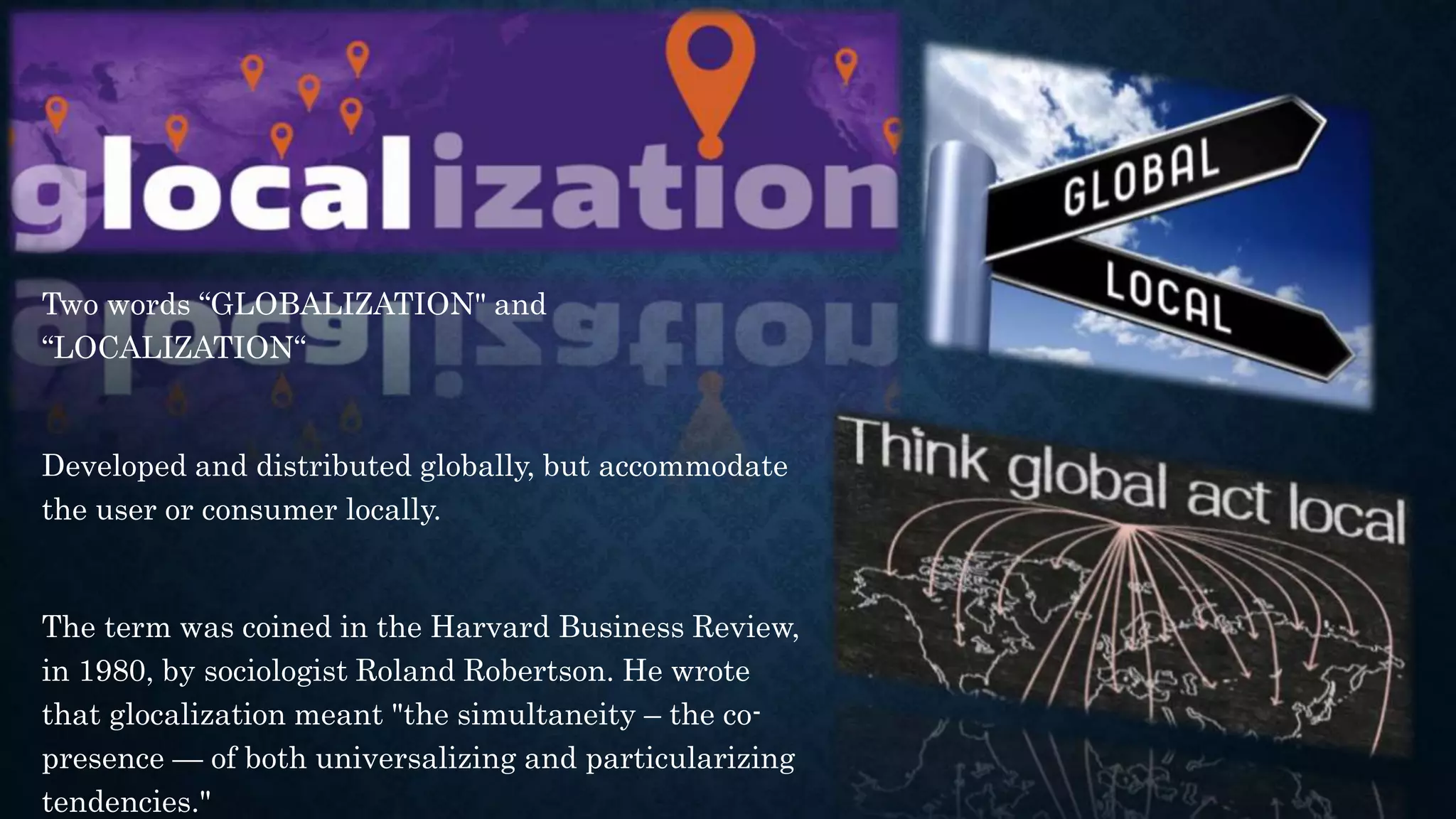
Two words “GLOBALIZATION" and
“LOCALIZATION“
Developed and distributed globally, but accommodate
the user or consumer locally.
The term was coined in the Harvard Business Review,
in 1980, by sociologist Roland Robertson. He wrote
that glocalization meant "the simultaneity – the co-
presence — of both universalizing and particularizing
tendencies."
• KFC has a vegetarian thali (a mixed meal with rice and
cooked vegetables) and Chana Snacker (Burger with
chickpeas) to cater to vegetarians in India.
ADVANTAGES OF GLOCALIZATION
• Attract more consumer in a market
• As it is flexible, therefore higher profits.
• Adapts to different countries and avoid ethical issues
CULTURAL ASPECTS OF GLOBALIZATION
Transmission of ideas, meanings, and values
Examples:
• United States: Hollywood music, American pop music
• United Kingdom: British music, British movies, British literature
• Japan: Japanese anime
• Korea: Hallyu wave, kpop music, k dramas
• China: Chinese food
ECONOMIC ASPECTS OF GLOBALIZATION
Widespread international movement of
goods, capital, services, technology and
information
Examples:
• Multinational corporations
• Outsourcing
• Some automobiles companies
• The European Union
• The North American Free Trade Agreement
(N.A.F.T.A.)
• Shirts
• McDonald's
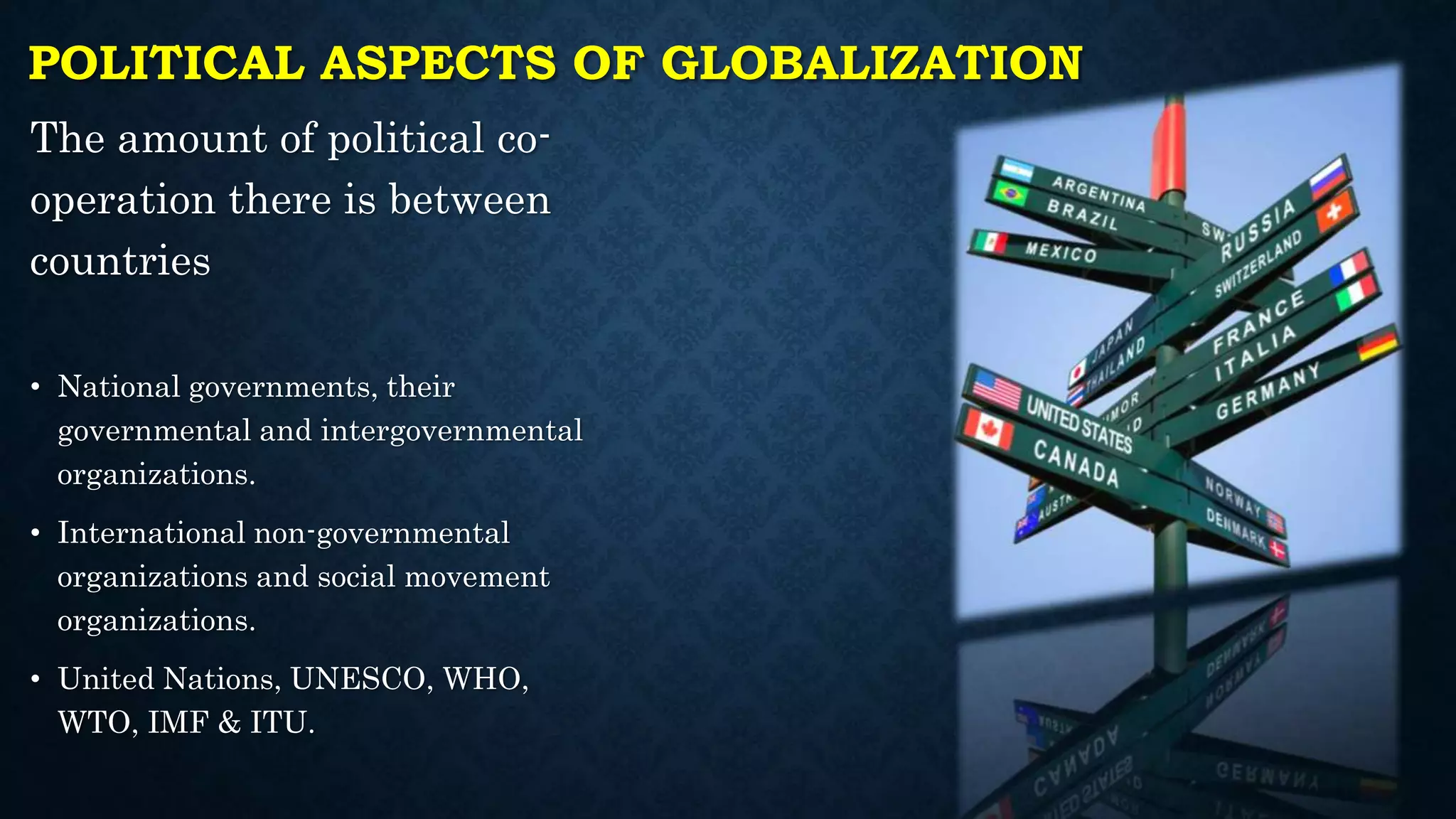
POLITICAL ASPECTS OF GLOBALIZATION
The amount of political co-
operation there is between
countries
• National governments, their
governmental and intergovernmental
organizations.
• International non-governmental
organizations and social movement
organizations.
• United Nations, UNESCO, WHO,
WTO, IMF & ITU.
Trump as Globalist
– Global business empire
– Controversial statement on climate change
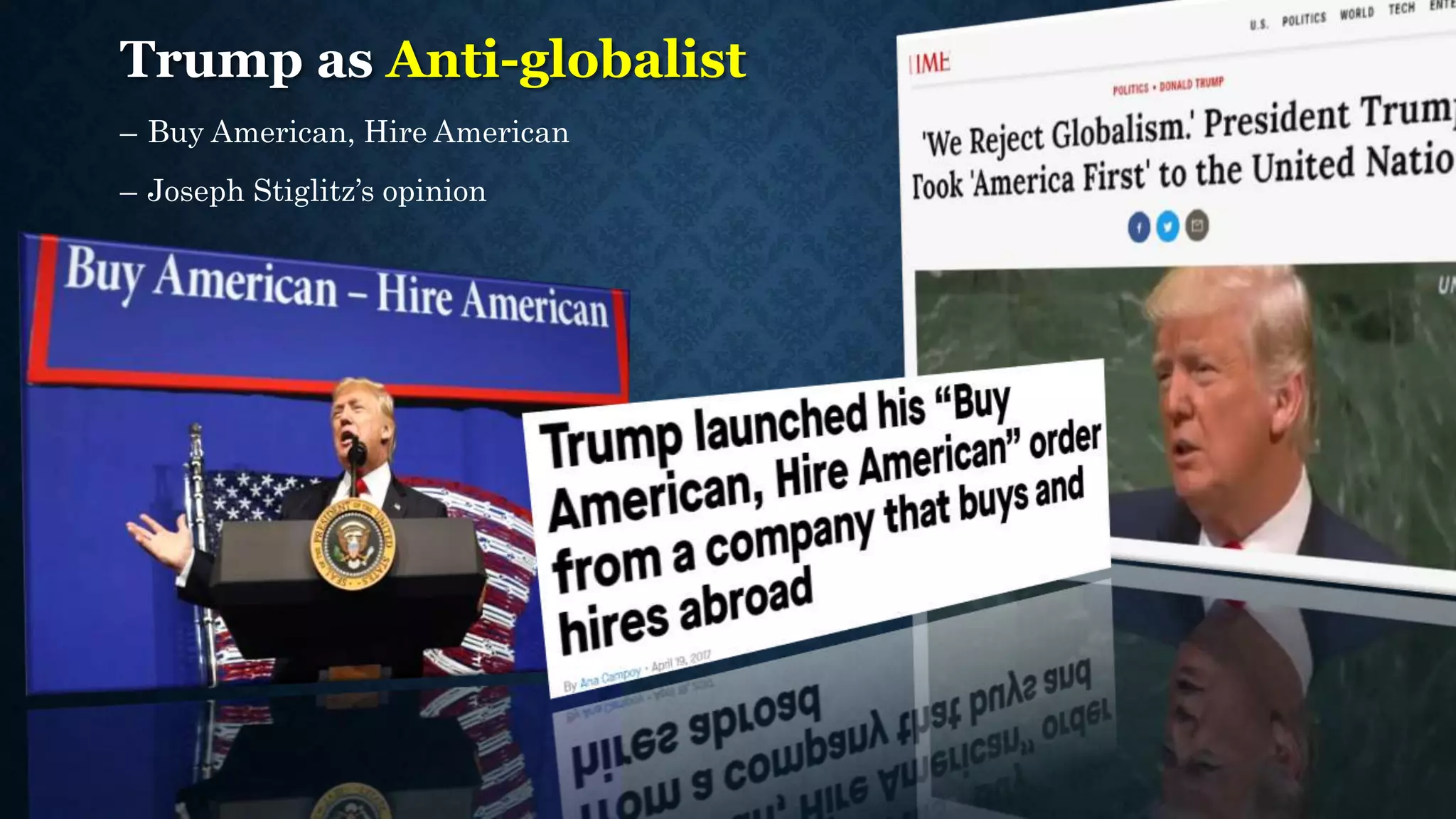
Trump as Anti-globalist
– Buy American, Hire American
– Joseph Stiglitz’s opinion

Globalization and Glocalization

  • 2.
    • Globalization essentiallymeans integration of the national economy with the world economy. • It implies a free flow of information, ideas, technology, goods and services, capital and even people across different countries and societies. • It increases connectivity between different markets in the form of trade, investments and cultural exchanges.
  • 3.
    • There isa decline in the number of people living below the poverty line in due to increase investments, trade and rising employment opportunities. • Free flow of capital and technology enables to speed up the process of industrialization and lay the path for faster economic process.
  • 4.
    Two words “GLOBALIZATION"and “LOCALIZATION“ Developed and distributed globally, but accommodate the user or consumer locally. The term was coined in the Harvard Business Review, in 1980, by sociologist Roland Robertson. He wrote that glocalization meant "the simultaneity – the co- presence — of both universalizing and particularizing tendencies."
  • 5.
    • KFC hasa vegetarian thali (a mixed meal with rice and cooked vegetables) and Chana Snacker (Burger with chickpeas) to cater to vegetarians in India.
  • 6.
    ADVANTAGES OF GLOCALIZATION •Attract more consumer in a market • As it is flexible, therefore higher profits. • Adapts to different countries and avoid ethical issues
  • 7.
    CULTURAL ASPECTS OFGLOBALIZATION Transmission of ideas, meanings, and values Examples: • United States: Hollywood music, American pop music • United Kingdom: British music, British movies, British literature • Japan: Japanese anime • Korea: Hallyu wave, kpop music, k dramas • China: Chinese food
  • 8.
    ECONOMIC ASPECTS OFGLOBALIZATION Widespread international movement of goods, capital, services, technology and information Examples: • Multinational corporations • Outsourcing • Some automobiles companies • The European Union • The North American Free Trade Agreement (N.A.F.T.A.) • Shirts • McDonald's
  • 9.
    POLITICAL ASPECTS OFGLOBALIZATION The amount of political co- operation there is between countries • National governments, their governmental and intergovernmental organizations. • International non-governmental organizations and social movement organizations. • United Nations, UNESCO, WHO, WTO, IMF & ITU.
  • 10.
    Trump as Globalist –Global business empire – Controversial statement on climate change
  • 11.
    Trump as Anti-globalist –Buy American, Hire American – Joseph Stiglitz’s opinion