THE
CONTEMPO
RARY
WORLD
C H AP T E R 1 : G L O B A L I Z AT I O N
D E F I N E D
Conceptions of Globalization
Definitions of Globalization
Philisophies of the definitions of Globalization
WHat is
Globalization?
Is theincreasing interaction of people, states or countries through the
growth of the international flow of money, ideas, and culture. Thus,
globalization is primarily focused on economic process of integration that has
social and cultural aspects.
It is the interconnectedness of
people and business across the
world that eventually lead to
global, cultural, political, and
economic integration.
It is the ability to move and
communicate easily with others
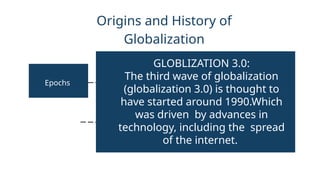
all over the world in order to
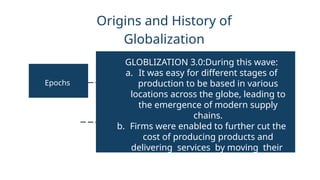
conduct business
internationally.
5.
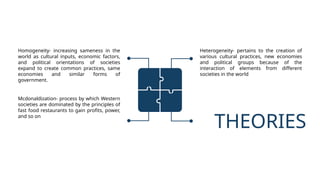
Globalization
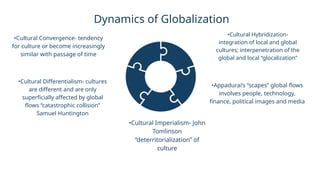
It is thefree movement of
goods, services, and
people across the world in
a seamless and integrated
market
In such a system:
-Goods can be imported and exported
without heavy restrictions or tariffs.
-Services like banking, IT, and consulting can
operate across countries without significant
barriers.
-People can move between countries for
work, travel, or study more easily.
where borders between countries
are reduced or eliminated for
trade, investment, and labor.
The goal is to create a unified global
marketplace where economies are
interconnected, fostering efficiency and
economic growth. However, this also raises
challenges like regulation, cultural impact, and
uneven benefits.
6.
Globalization
It refers tocountries
acting like magnets
attracting global capital by
opening up their
economies to
multinational corporations
Opening their economies: Reducing trade barriers,
lowering taxes, and creating favorable regulations
for foreign companies.
Acting like magnets: Offering incentives such as tax
holidays, relaxed labor laws, or access to natural
resources to lure multinational corporations
(MNCs).
Fostering global competition: Encouraging MNCs to
set up operations, which brings capital, technology,
and jobs to the local economy.
refers to the concept of economic liberalization or
foreign direct investment (FDI) strategies. It
highlights how countries try to attract international
capital and investments by:
This approach can boost economic
growth but might also lead to
concerns about exploitation,
environmental impact, and the
erosion of local industries.
7.
Globalization
It is theliberalization of
countries of their impact
protocols and welcome
foreign investment into
sectors that are
mainstrays of its economy
1. Liberalization of impact protocols: Loosening
strict rules or bureaucratic hurdles that may
have previously discouraged foreign investors.
This could involve environmental, trade, or
labor regulations.
refers to a country's effort to relax regulations or
simplify protocols in key economic sectors to
attract foreign investment. Here's what it means:
8.
Globalization
It is theliberalization of
countries of their impact
protocols and welcome
foreign investment into
sectors that are
mainstrays of its economy
2. Welcoming foreign investment: Opening up
critical industries (such as manufacturing,
agriculture, energy, or technology) to
international investors, which are vital to the
country's economic stability and growth.
refers to a country's effort to relax regulations or
simplify protocols in key economic sectors to
attract foreign investment. Here's what it means:
9.
Globalization
It is theliberalization of
countries of their impact
protocols and welcome
foreign investment into
sectors that are
mainstrays of its economy
3. Mainstays of the economy: Refers to the
core industries that significantly contribute to
the nation's GDP and employment. By targeting
these sectors, countries aim to enhance their
competitiveness and attract global capital.
refers to a country's effort to relax regulations or
simplify protocols in key economic sectors to
attract foreign investment. Here's what it means:
The goal is to boost economic
growth and development, but it can
come with trade-offs like potential
overdependence on foreign firms
or concerns about the exploitation
10.
According to MartinSteger,
“the expansion and intensification of social
relations and consciousness across world-
time and across world-space.”
Globalization
11.
Globalization as
Positive
Phenomenon
- asthe process of world
shrinkage, of distances getting
shorter, things moving closer
(Thomas Larsson)
-onset of the borderless world
(Ohmae)
-Globalization as
colonization (Martin
Khor)
Globalization as
Negative
Phenomenon
12.
Economic
Integration
Free trade acrossborders,
reducing tariffs and trade barriers.
Global supply chains and
multinational
corporations operating in
multiple countries.
Characteristics of Globalization
Increased flow of goods, services,
capital, and labor.
13.
Cultural Exchange
Spread ofideas, values, and
cultural practices across borders.
Popularization of global
entertainment, cuisine,
fashion, and lifestyles.
Characteristics of Globalization
Potential for cultural
homogenization or hybridization.
14.
Technological
Advancements
Rapid growth ofcommunication
technologies like the internet
and mobile phones.
Easier access to global
information, innovation,
and research.
Characteristics of Globalization
Enhanced transportation
systems connecting the
world faster.
15.
Increased Mobility
Free movementof people for
work, education, and tourism.
Immigration and migration
creating more diverse
populations in many
countries.
Characteristics of Globalization
Enhanced transportation
systems connecting the
world faster.
16.
Interdependence of
Nations
Economies are
interconnected,making
countries reliant on each
other.
Global issues like climate
change, pandemics, and
financial crises requiring
collective action.
Characteristics of Globalization
17.
Global Institutions and
Governance
Organizationslike the United
Nations, World Trade
Organization, and World Bank
playing roles in international
cooperation.
Standardization of rules,
policies, and agreements.
Characteristics of Globalization
18.
Environmental Impact
Increased industrialization
andurbanization contributing
to climate change and
resource depletion.
Awareness and initiatives for
sustainable development at a
global level.
Characteristics of Globalization
19.
Social Inequalities
Uneven distributionof the
benefits of globalization, with
wealth concentrated in
developed countries.
Challenges like exploitation of
labor, widening income gaps,
and cultural dominance.
Characteristics of Globalization
20.
Origins and Historyof
Globalization
Epochs
GLOBLIZATION 1.0:
Globalization 1.0 refers to the rapid growth in world
trade, mainly during the
nineteenth century or it can be called the pre-1914
period. It was driven by
innovations in transport and communications,
including the railways,
steamships and the electric telegraph which further
reduced the cost of
global transport and enabled the separation of
production and consumption
across international borders.
21.
Origins and Historyof
Globalization
Epochs
GLOBLIZATION 2.0:
Globalization 2.0 or post 1945 era
refers to the international
industrialization after the Second
World War. It is driven by greater
international cooperation. The post-
war period saw less
protectionism and a rapid
growth in world trade, at least in
western economies.
22.
Origins and Historyof
Globalization
Epochs
GLOBLIZATION 3.0:
The third wave of globalization
(globalization 3.0) is thought to
have started around 1990.Which
was driven by advances in
technology, including the spread
of the internet.
23.
Origins and Historyof
Globalization
Epochs
GLOBLIZATION 3.0:During this wave:
a. It was easy for different stages of
production to be based in various
locations across the globe, leading to
the emergence of modern supply
chains.
b. Firms were enabled to further cut the
cost of producing products and
delivering services by moving their
operations to cheaper locations,
known as offshoring.
24.
Origins and Historyof
Globalization
Epochs
GLOBALIZATION 4.0
The current wave, Globalization 4.0,
is a set to be driven by the
Fourth Industrial Revolution, which is
happening right now. In 2011, the
term Industry 4.0 was introduced by
the German government and
Siemens. Industry 4.0 shifts
manufacturing away from analog
and mechanical technologies and
toward all things digital.
25.
THEORIES
Homogeneity- increasing samenessin the
world as cultural inputs, economic factors,
and political orientations of societies
expand to create common practices, same
economies and similar forms of
government.
Heterogeneity- pertains to the creation of
various cultural practices, new economies
and political groups because of the
interaction of elements from different
societies in the world
Mcdonaldization- process by which Western
societies are dominated by the principles of
fast food restaurants to gain profits, power,
and so on
26.
Dynamics of Globalization
•CulturalImperialism- John
Tomlinson
“deterritorialization” of
culture
•Cultural Differentialism- cultures
are different and are only
superficially affected by global
flows “catastrophic collision”
Samuel Huntington
•Cultural Hybridization-
integration of local and global
cultures; interpenetration of the
global and local “glocalization”
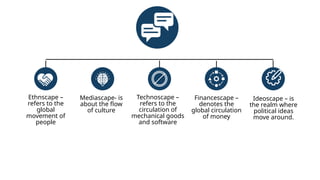
•Appadurai’s “scapes” global flows
involves people, technology,
finance, political images and media
•Cultural Convergence- tendency
for culture or become increasingly
similar with passage of time
27.
Ethnscape –
refers tothe
global
movement of
people
Mediascape- is
about the flow
of culture
Technoscape –
refers to the
circulation of
mechanical goods
and software
Financescape –
denotes the
global circulation
of money
Ideoscape – is
the realm where
political ideas
move around.
28.
MERITS OF
GLOBALIZATION
1.An openeconomy super fast
innovation with fresh ideas from
abroad
2.Exports jobs often pay more than
other jobs
3.Productively grows more quickly
when countries produce goods and
services in which they are
comparative advantageous