Introduction to Globalization
*Globalization is the process of increasing
interconnectedness and interdependence among
countries through trade, communication,
technology, and culture. It allows for the free flow of
goods, services, information, and people across
borders.
Example: The internet connects people worldwide,
enabling instant communication and online business
transactions.
2
2.
GLOBALIZATION
PG 1 :-INTRODUCTION
PG 2 :- DIMENSIONS OF
GLOBALIZATION
PG 3 :-MEANING OF
GLOBALIZATION
PG 4 :- ADVANTAGE AND
DIS ADVANTAGES OF
GLOBALIZATION
PG 5 :- FIGHTING THE
NEGATIVE IMPACTS OF
GLOBALIZATION
PG 6 :- MAJOR GLOBAL
ISSUE
SAFARI ACADEMY
CITIZEN GROUP
ASSIGNMENT
1
3.
What is globalization
*Examplesof Globalization:
*Economic Globalization:
*Cultural Globalization:
*Technological Globalization.
*Political Globalization:
*Environmental Globalization:
What is Globalization?
*.Globalization is the process of
increasing interconnectedness
and interdependence among
countries, businesses, and
people worldwide. It involves
the exchange of goods, services,
information, culture, and
technology across international
borders
4.
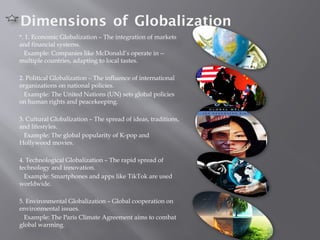
Dimensions of Globalization
*.1. Economic Globalization – The integration of markets
and financial systems.
Example: Companies like McDonald’s operate in --
multiple countries, adapting to local tastes.
2. Political Globalization – The influence of international
organizations on national policies.
Example: The United Nations (UN) sets global policies
on human rights and peacekeeping.
3. Cultural Globalization – The spread of ideas, traditions,
and lifestyles.
Example: The global popularity of K-pop and
Hollywood movies.
4. Technological Globalization – The rapid spread of
technology and innovation.
Example: Smartphones and apps like TikTok are used
worldwide.
5. Environmental Globalization – Global cooperation on
environmental issues.
Example: The Paris Climate Agreement aims to combat
global warming.
5.
Advantages of Globalization
*.1. Economic Growth – Boosts trade and investment opportunities.
Example: China’s rapid development due to global trade.
2. Cultural Exchange – Promotes diversity and understanding.
Example: Sushi, originally from Japan, is now popular worldwide.
3. Technological Advancement – Faster spread of innovations.
Example: Medical breakthroughs like vaccines reach multiple countries
quickly.
4. Job Opportunities – More employment in multinational companies.
Example: Indian IT professionals work for global firms like Microsoft and
Google.
6.
Disadvantages of
Globalization
*. 1.Job Loss & Exploitation – Some jobs move to cheaper labor markets.
- *Example:* U.S. manufacturing jobs outsourced to China and Mexico.
2. Environmental Damage – Increased industrialization leads to pollution.
- *Example:* Amazon rainforest deforestation for global beef demand.
3. Cultural Erosion – Western culture often overshadows local traditions.
- *Example:* Fast food replacing traditional meals in many countries.
4. Economic Inequality – The rich get richer, and the poor struggle.
- *Example:* Billion-dollar corporations profit while factory workers earn
minimum wages.



![Getting Started with Apache Spark: Big Data Made Simple [Free Meetup]](https://cdn.slidesharecdn.com/ss_thumbnails/apachesparkgettingstarted-260203175547-8361bcc3-thumbnail.jpg?width=640&height=640&fit=bounds)


