GLOBALIZATIO
N
Subject: IR & CA
Presented By: Mahboob Alam Mir
Presented To: Mr. Atif Shabbir
Globalization is the process of
international integration arising
from the interchange of world
views, products, ideas, and other
aspects of culture.
Globalization
Globalization means rapid increase in the
share of economic activities taking place
across national borders.
Global Village
A place in which every person of the world is
connected to each other somehow.
Continuing…
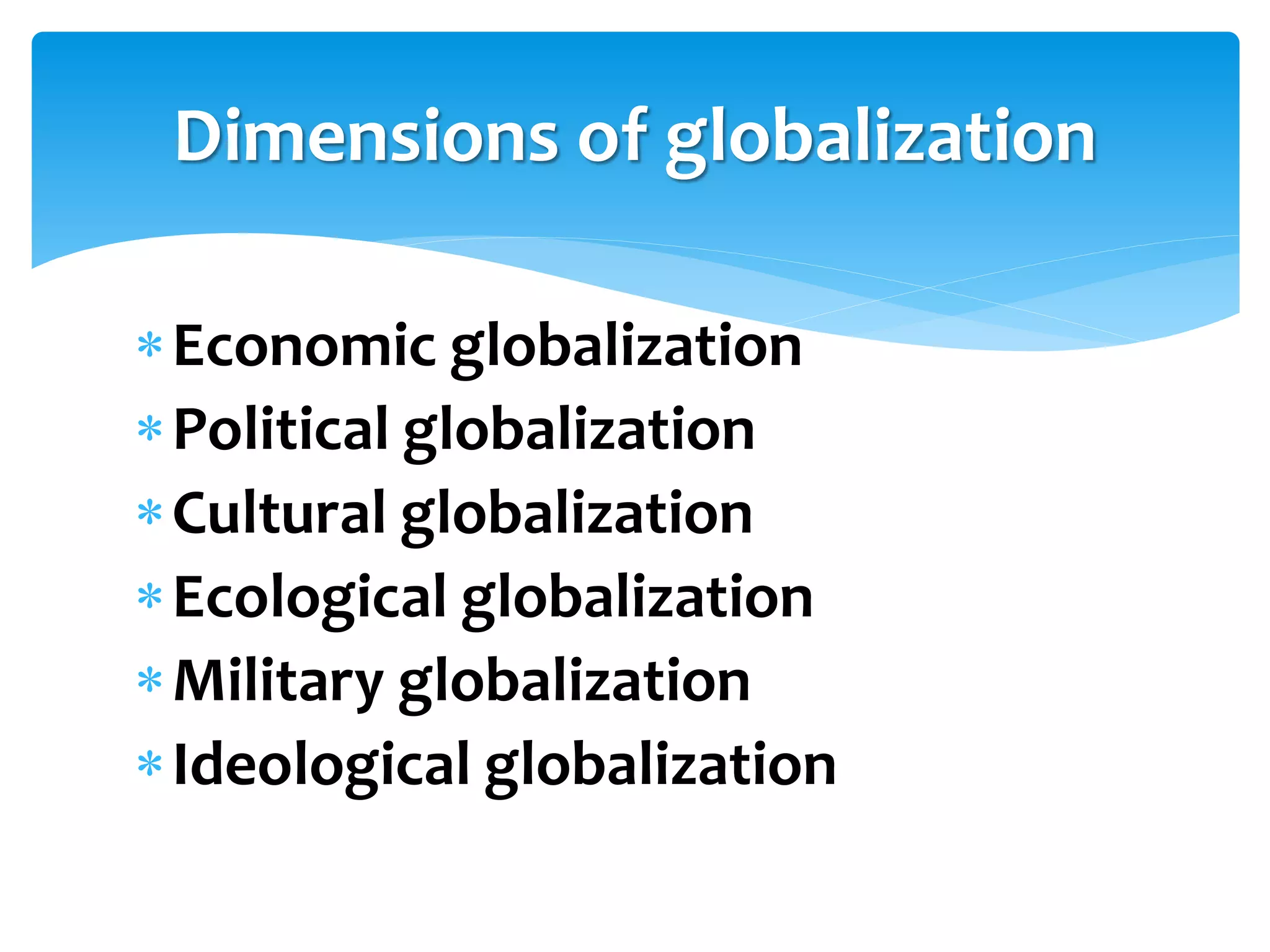
Economic globalization
Political globalization
Cultural globalization
Ecological globalization
Military globalization
Ideological globalization
Dimensions of globalization
 Economic globalization is the intensification
and stretching of economic interrelations
around the globe.
 It encompasses such things as the emergence
of a new global economic order, the
internationalization of trade and finance, the
changing power of transnational
corporations, and the enhanced role of
international economic institutions.
Economic Globalization
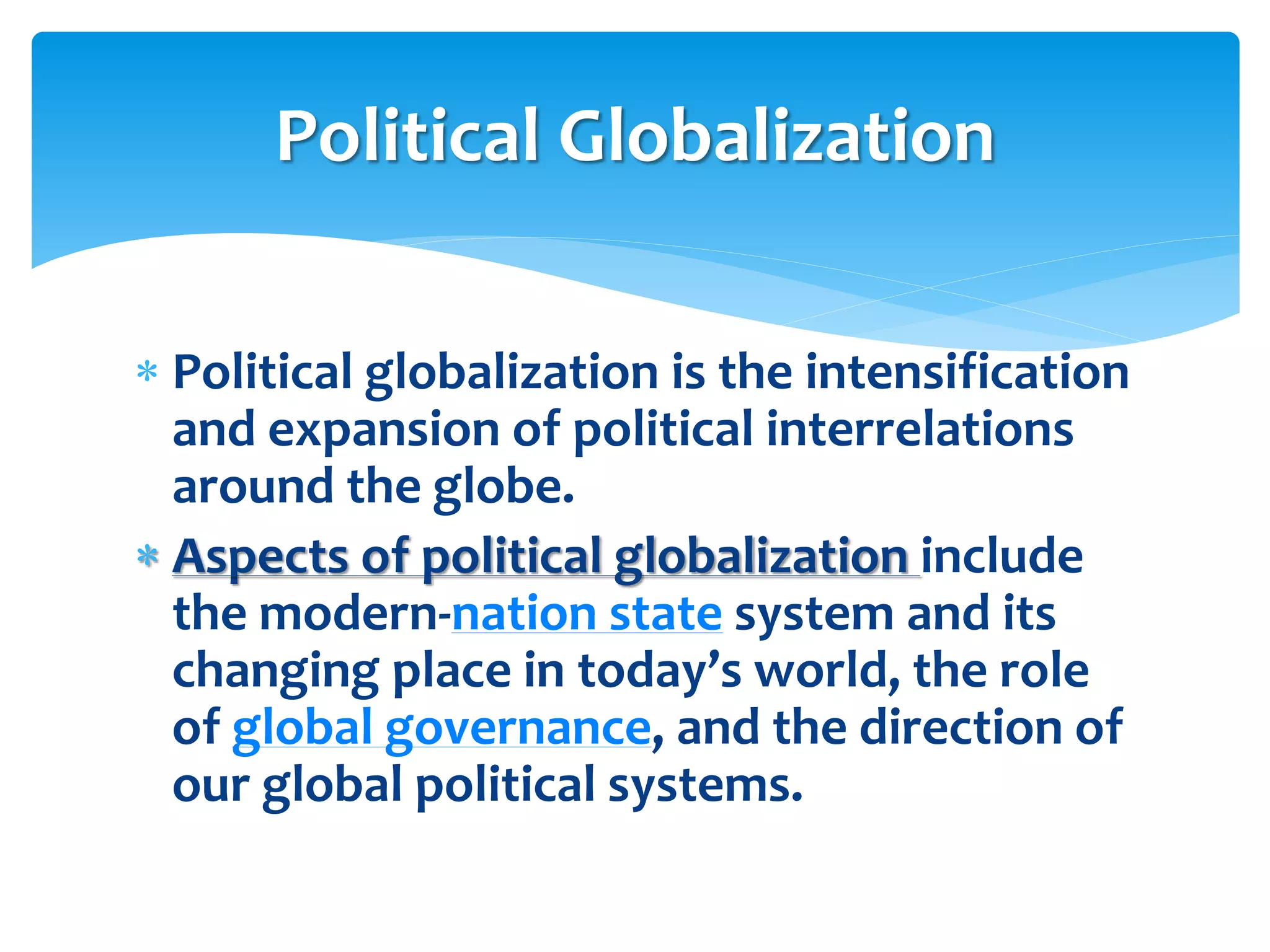
 Political globalization is the intensification
and expansion of political interrelations
around the globe.
 Aspects of political globalization include
the modern-nation state system and its
changing place in today’s world, the role
of global governance, and the direction of
our global political systems.
Political Globalization
The intensification of worldwide social relations.
link distant localities.
local happenings shaped by events occurring
many miles away.
Social globalization pertains to human
interaction within communities
Social Networking sites –
Facebook,Twitter,whatsapp etc
Social Globalization
 Military globalization, as subdomain of
political globalization, is the intensification
and stretching of military power across the
globe through various means of military
power (nuclear military weapons, radiation
weapons simply weapons of mass
destruction).
 This form of globalization occurs across
offensive and defensive uses of power and
survival in international field.
Military Globalization
 Ecological globalization include
population growth, access to food,
worldwide reduction in biodiversity,
the gap between rich and poor as well
as between the global North and global
South, human-induced climate change,
and global environmental degradation.
Ecological Globalization
 Cultural globalization is the intensification and
expansion of cultural flows across the globe.
 Culture is a very broad concept and refer to
 “the symbolic construction, articulation, and
dissemination of meaning.” Topics under this
heading include discussion about the
development of a global culture
 the role of the media in shaping our identities
and desires, and the globalization of languages.
Cultural Globalization
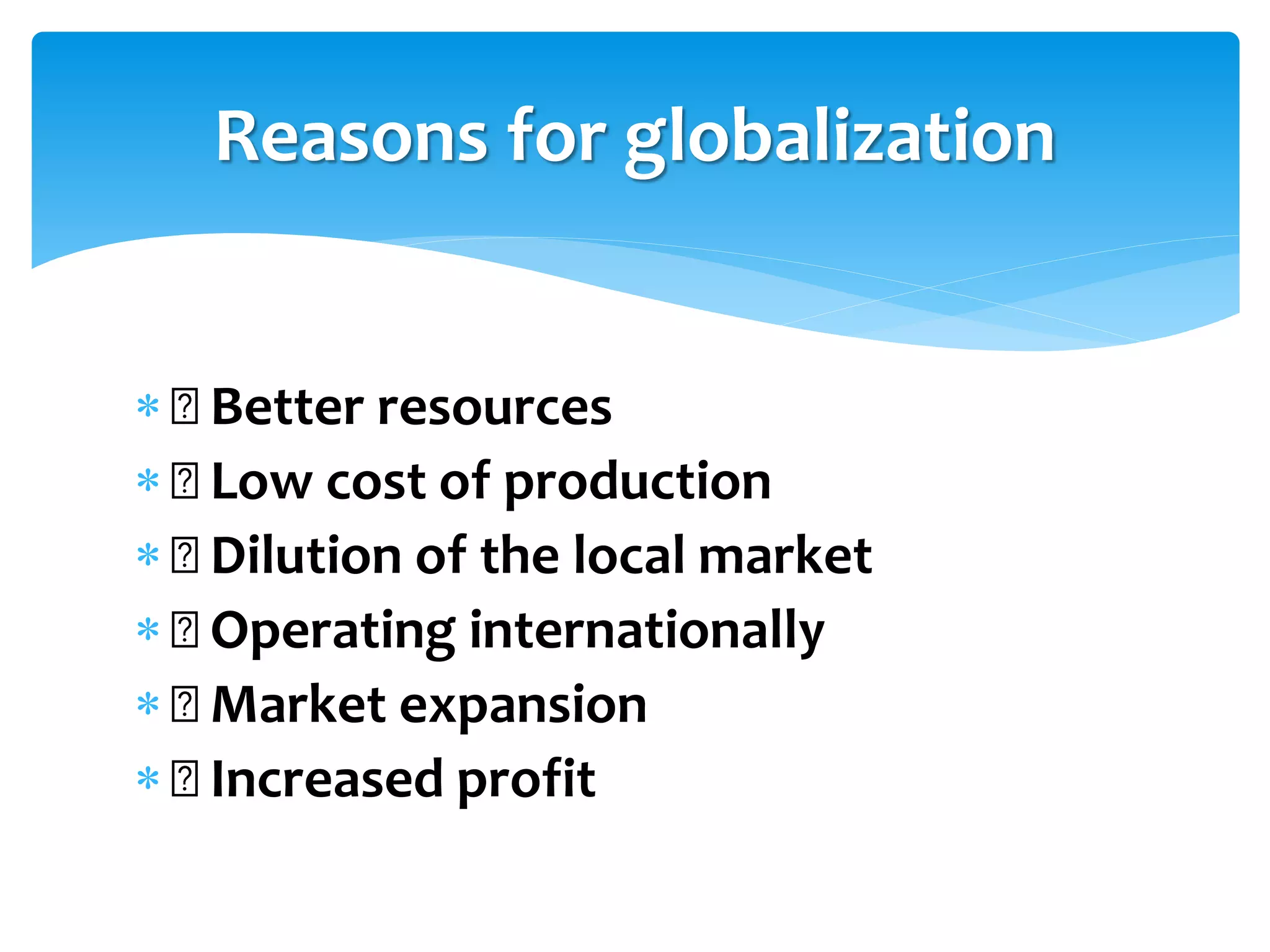
 Better resources
 Low cost of production
 Dilution of the local market
 Operating internationally
 Market expansion
 Increased profit
Reasons for globalization
Globalization brings a culture of
pluralism, "with overlapping but
distinctive ethics and interests”
Essentially, the world’s leading religious
traditions:
Hinduism, Buddhism, Judaism,
Christianity, and Islam—teach values
such as human dignity, equality, freedom,
peace, and solidarity.
Religion
Religions maintain the Golden Rule:
“what you do not wish done to yourself,
do not do to others.”
Example:
UN (united nations)
OIC (organization of Islamic Council)
Continuing…
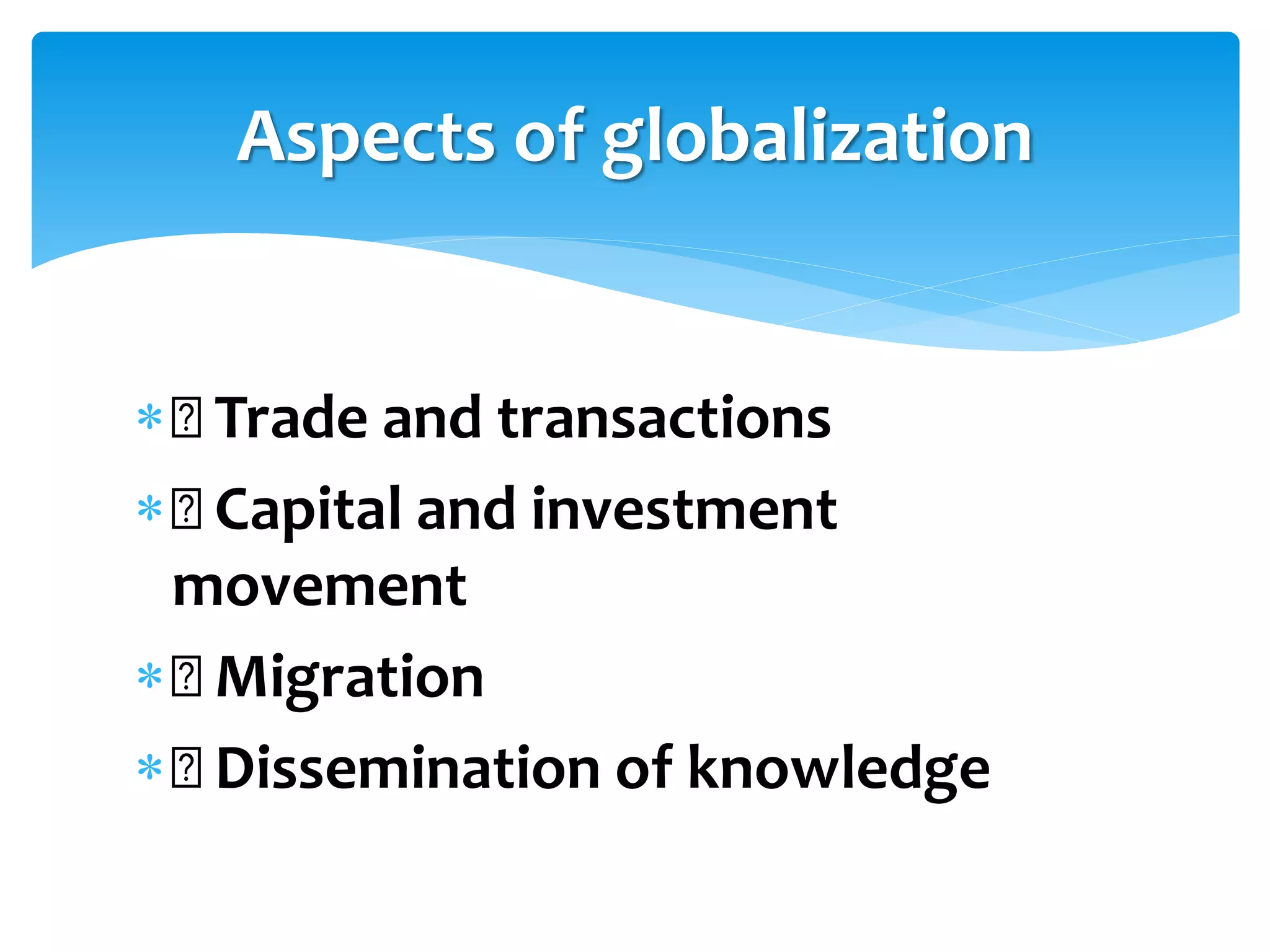
 Trade and transactions
 Capital and investment
movement
 Migration
 Dissemination of knowledge
Aspects of globalization
Any question???

Globalization

  • 1.
    GLOBALIZATIO N Subject: IR &CA Presented By: Mahboob Alam Mir Presented To: Mr. Atif Shabbir
  • 2.
    Globalization is theprocess of international integration arising from the interchange of world views, products, ideas, and other aspects of culture. Globalization
  • 3.
    Globalization means rapidincrease in the share of economic activities taking place across national borders. Global Village A place in which every person of the world is connected to each other somehow. Continuing…
  • 4.
    Economic globalization Political globalization Culturalglobalization Ecological globalization Military globalization Ideological globalization Dimensions of globalization
  • 5.
     Economic globalizationis the intensification and stretching of economic interrelations around the globe.  It encompasses such things as the emergence of a new global economic order, the internationalization of trade and finance, the changing power of transnational corporations, and the enhanced role of international economic institutions. Economic Globalization
  • 6.
     Political globalizationis the intensification and expansion of political interrelations around the globe.  Aspects of political globalization include the modern-nation state system and its changing place in today’s world, the role of global governance, and the direction of our global political systems. Political Globalization
  • 7.
    The intensification ofworldwide social relations. link distant localities. local happenings shaped by events occurring many miles away. Social globalization pertains to human interaction within communities Social Networking sites – Facebook,Twitter,whatsapp etc Social Globalization
  • 8.
     Military globalization,as subdomain of political globalization, is the intensification and stretching of military power across the globe through various means of military power (nuclear military weapons, radiation weapons simply weapons of mass destruction).  This form of globalization occurs across offensive and defensive uses of power and survival in international field. Military Globalization
  • 9.
     Ecological globalizationinclude population growth, access to food, worldwide reduction in biodiversity, the gap between rich and poor as well as between the global North and global South, human-induced climate change, and global environmental degradation. Ecological Globalization
  • 10.
     Cultural globalizationis the intensification and expansion of cultural flows across the globe.  Culture is a very broad concept and refer to  “the symbolic construction, articulation, and dissemination of meaning.” Topics under this heading include discussion about the development of a global culture  the role of the media in shaping our identities and desires, and the globalization of languages. Cultural Globalization
  • 11.
     Better resources Low cost of production  Dilution of the local market  Operating internationally  Market expansion  Increased profit Reasons for globalization
  • 12.
    Globalization brings aculture of pluralism, "with overlapping but distinctive ethics and interests” Essentially, the world’s leading religious traditions: Hinduism, Buddhism, Judaism, Christianity, and Islam—teach values such as human dignity, equality, freedom, peace, and solidarity. Religion
  • 13.
    Religions maintain theGolden Rule: “what you do not wish done to yourself, do not do to others.” Example: UN (united nations) OIC (organization of Islamic Council) Continuing…
  • 14.
     Trade andtransactions  Capital and investment movement  Migration  Dissemination of knowledge Aspects of globalization
  • 15.