Master of Business Administration  University of Hertfordshire, UK July 2009 Prepared by Yaw Chooi Fun  Norazian Abdullah Lee Tai Keong Eu Wee Khai
International business (IB) is the study of business activities that cross national borders. It is concerned with firms that undertake business and the national governments that regulate them  Business with interventions of governments of home and host countries in inter-country business activity
No unique theory to explain responses of business to government policies and policy making of governments towards international firms Lack of theoretical focus has diverted emphasis on policies to conflicts and cooperation among corporations and governments.
Seek growth (efficiency) and distribution of benefits (equity) Markets appropriately distorted to achieve objectives Provide differential barriers and incentives to foreign business
Free trade and stable or fixed exchange rates; same considerations for inter/intra – national trade and investments Theory of specialisation and division of labour (comparative advantage);  general explanation of benefits of division of labour for domestic & international Other theories applied; explains production and income generation
Adapted for us in IB to characterise and analyse business govt negotiation  policy making and behaviour Focuses on bargaining resources and stakes of participant  economic and commercial conclusions Focuses on collection of assets, interests and abilities of bargaining parties  economic, political and social issues
Resources of businesses  technology, funds, skills, foreign markets, employment opportunities & trade relations with home govt Resources of host govts access to market, natural resources, low cost labour, funding opportunities
Stakes of businesses availability of markets, sources of supplies, importance of successful negotiation and inter-relatedness of host country to business’s global interests Stakes of host govts vailability of business opportunities, importance of business and negotiation to host govt and relevance to country’s overall interests.
Strategic alliance with business for desired resource – technology, local ownership or foreign distribution network Purchase / contracting agreement for acquiring desired resource
Diversification and Multiple Locations of activities  reduce control of host govt Joint venture with local businesses  lobbying govt for favourable policies Strategic alliance with other businesses  raise govt’s stakes in bargain
Offer more benefits to host country during initial negotiations Involve host govt in business venture (GLCs) – mutual interests Meet key concerns of host govt – profit remittances, financing, imports or training
Government concerns with TNC – negotiations, trade offs and resolutions  Patterns of exports and imports Gains from trade Reasons and directions of FDI and contractual relations
Strategies and operations in international production – effects of govt intervention Cross cultural aspects Differential barriers and incentives imposed by govts to determine distribution of benefits.
Difference among Governments as to their goals in dealing with TNC/INC initiatives and operations Assessment and management of conflicting rules of the game, i.e difference in lega, regulatory and institutional enviroments in the two or more countries country risk that arises from different treatment of business activities by home and host countries Exchange risks
Synthesis with culture differences for IB Phenomena? Brian Toyne and Douglas Nigh “ Introduce a new paradigm that believe would enrich IB inquiry by shifting attention away from the firm as the central unit of analysis to a more comprehensive multilevel, hierarchical view of the international business process.” http://www.jstor.org/pss/155414
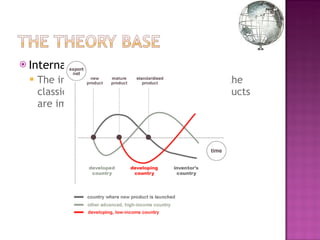
International product cycle The international product cycle removes the classical assumption that factors and products are immobile internationally.
Synthesis  Conflict with Hamel? Product can sustain longer now with globalization McKinsey Quarterly quoted Gary Hamel,  “ Company must become as purposefully and creatively experimental in thinking about their management systems and processes as they already are in thinking about R&D or new-product development.” http://www.interknowledgetech.com/Innovative%20Management.pdf
Imperfect competition success factors Proprietary technology  Multi-country access to factors of production and to consumers additional scale economies in production distribution, purchasing etc.
Production, distribution and consumption of materials, components, factors and some products and services occur entirely within the units of the firm Economics of vertical and horizontal integration Emphasis on the advantage to the individual firm of keeping decisions internal Dynamic nature of competition
Transactions are carried out internally Reduce cost of transaction in larger markets, with improved, unfettered communications and transportation. Difference from internalization: does not considers the functioning of all the firm’s internal activities such as managing people and use of a monopoly position
Firm specific competitive advantages that enable individual firms to outcompete Synthesis with the FSA and CSA article “The international competitiveness of asian firms”? Or porters diamond model
Combination of location theory, competitive advantages and the concept of internalization Covers all the market-related factors Product, firm, industry and economy But interactions between Governments and companies and among Governments are left aside
Finance theory, arbitrage national financial conditions National currencies create unique difference for INCs and directly involve governmental decisions International firms must pass through the foreign-exchange barrier
Existence of governmental policies differentiates a theory of international business from domestic business Governments are satisfied with gains generated by an IB activity in open markets, they impose no barriers and, hence no theory of international business is necessary
More synthesis?

Globalization International Business

  • 1.
    Master of BusinessAdministration University of Hertfordshire, UK July 2009 Prepared by Yaw Chooi Fun Norazian Abdullah Lee Tai Keong Eu Wee Khai
  • 2.
    International business (IB)is the study of business activities that cross national borders. It is concerned with firms that undertake business and the national governments that regulate them Business with interventions of governments of home and host countries in inter-country business activity
  • 3.
    No unique theoryto explain responses of business to government policies and policy making of governments towards international firms Lack of theoretical focus has diverted emphasis on policies to conflicts and cooperation among corporations and governments.
  • 4.
    Seek growth (efficiency)and distribution of benefits (equity) Markets appropriately distorted to achieve objectives Provide differential barriers and incentives to foreign business
  • 5.
    Free trade andstable or fixed exchange rates; same considerations for inter/intra – national trade and investments Theory of specialisation and division of labour (comparative advantage); general explanation of benefits of division of labour for domestic & international Other theories applied; explains production and income generation
  • 6.
    Adapted for usin IB to characterise and analyse business govt negotiation policy making and behaviour Focuses on bargaining resources and stakes of participant economic and commercial conclusions Focuses on collection of assets, interests and abilities of bargaining parties economic, political and social issues
  • 7.
    Resources of businesses technology, funds, skills, foreign markets, employment opportunities & trade relations with home govt Resources of host govts access to market, natural resources, low cost labour, funding opportunities
  • 8.
    Stakes of businessesavailability of markets, sources of supplies, importance of successful negotiation and inter-relatedness of host country to business’s global interests Stakes of host govts vailability of business opportunities, importance of business and negotiation to host govt and relevance to country’s overall interests.
  • 9.
    Strategic alliance withbusiness for desired resource – technology, local ownership or foreign distribution network Purchase / contracting agreement for acquiring desired resource
  • 10.
    Diversification and MultipleLocations of activities reduce control of host govt Joint venture with local businesses lobbying govt for favourable policies Strategic alliance with other businesses raise govt’s stakes in bargain
  • 11.
    Offer more benefitsto host country during initial negotiations Involve host govt in business venture (GLCs) – mutual interests Meet key concerns of host govt – profit remittances, financing, imports or training
  • 12.
    Government concerns withTNC – negotiations, trade offs and resolutions Patterns of exports and imports Gains from trade Reasons and directions of FDI and contractual relations
  • 13.
    Strategies and operationsin international production – effects of govt intervention Cross cultural aspects Differential barriers and incentives imposed by govts to determine distribution of benefits.
  • 14.
    Difference among Governmentsas to their goals in dealing with TNC/INC initiatives and operations Assessment and management of conflicting rules of the game, i.e difference in lega, regulatory and institutional enviroments in the two or more countries country risk that arises from different treatment of business activities by home and host countries Exchange risks
  • 15.
    Synthesis with culturedifferences for IB Phenomena? Brian Toyne and Douglas Nigh “ Introduce a new paradigm that believe would enrich IB inquiry by shifting attention away from the firm as the central unit of analysis to a more comprehensive multilevel, hierarchical view of the international business process.” http://www.jstor.org/pss/155414
  • 16.
    International product cycleThe international product cycle removes the classical assumption that factors and products are immobile internationally.
  • 17.
    Synthesis Conflictwith Hamel? Product can sustain longer now with globalization McKinsey Quarterly quoted Gary Hamel, “ Company must become as purposefully and creatively experimental in thinking about their management systems and processes as they already are in thinking about R&D or new-product development.” http://www.interknowledgetech.com/Innovative%20Management.pdf
  • 18.
    Imperfect competition successfactors Proprietary technology Multi-country access to factors of production and to consumers additional scale economies in production distribution, purchasing etc.
  • 19.
    Production, distribution andconsumption of materials, components, factors and some products and services occur entirely within the units of the firm Economics of vertical and horizontal integration Emphasis on the advantage to the individual firm of keeping decisions internal Dynamic nature of competition
  • 20.
    Transactions are carriedout internally Reduce cost of transaction in larger markets, with improved, unfettered communications and transportation. Difference from internalization: does not considers the functioning of all the firm’s internal activities such as managing people and use of a monopoly position
  • 21.
    Firm specific competitiveadvantages that enable individual firms to outcompete Synthesis with the FSA and CSA article “The international competitiveness of asian firms”? Or porters diamond model
  • 22.
    Combination of locationtheory, competitive advantages and the concept of internalization Covers all the market-related factors Product, firm, industry and economy But interactions between Governments and companies and among Governments are left aside
  • 23.
    Finance theory, arbitragenational financial conditions National currencies create unique difference for INCs and directly involve governmental decisions International firms must pass through the foreign-exchange barrier
  • 24.
    Existence of governmentalpolicies differentiates a theory of international business from domestic business Governments are satisfied with gains generated by an IB activity in open markets, they impose no barriers and, hence no theory of international business is necessary
  • 25.