Hemant,Phillip,Nitin  & Munaf
CONTENT Vision & Mission General environment 5 forces model SWOT Business strategy Competitors Problems and Solution Stake holders Acquisition Strategy Organizational Structure Strategic Leadership Strategic Entrepreneurship
Vision “ Nestlé's aim is to meet the various needs of the consumer everyday by marketing and selling foods of a consistently high quality.”
Mission “ We strive to bring consumers foods that are safe, of high quality and provide optimal nutrient to meet physiological needs. Nestle helps provide selections for all individual taste and lifestyle preferences.”
General environment Demographic trends: - Nearly all age from young to old people. - All six continents (customers) Economic trends: - Most countries all over the world are affected by the global economic crisis.
General environment Political/Legal trends: - More countries join WTO: allow more free trade across the nations Sociocultural trends: - The world people care more about their health, especially with foods and beverages.
General environment Technological trends: - Use most of latest technology( in researching, producing…) - Try to find new way of create new product - Improve the quality of products. Global trends: - Improve operational efficiency by integrating the company’s businesses on a global scale. - “We’re now transitioning to become a genuinely global food company, to behave as one”
Five forces model New entrants Multinational companies More companies joint in domestic market High pressure Substitute products Diversity products Confectionery, instant foods Not many firms focus on pet foods Average pressure
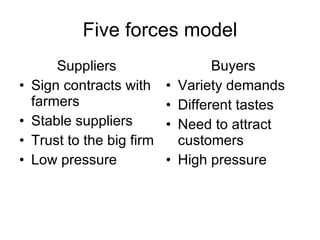
Five forces model Suppliers Sign contracts with farmers Stable suppliers Trust to the big firm Low pressure Buyers Variety demands Different tastes Need to attract customers High pressure
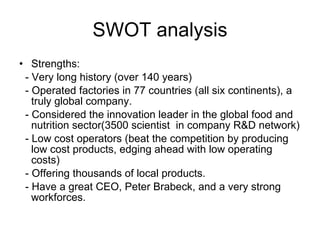
SWOT analysis Strengths: - Very long history (over 140 years) - Operated factories in 77 countries (all six continents), a truly global company. - Considered the innovation leader in the global food and nutrition sector(3500 scientist  in company R&D network) - Low cost operators (beat the competition by producing low cost products, edging ahead with low operating costs) - Offering thousands of local products. - Have a great CEO, Peter Brabeck, and a very strong workforces.
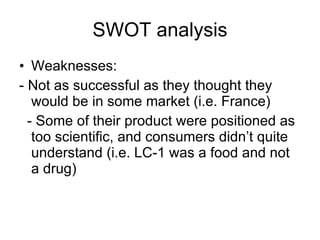
SWOT analysis Weaknesses: - Not as successful as they thought they would be in some market (i.e. France) - Some of their product were positioned as too scientific, and consumers didn’t quite understand (i.e. LC-1 was a food and not a drug)
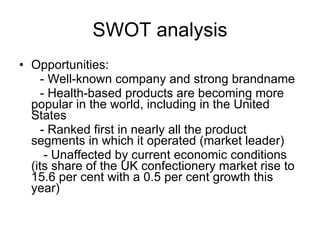
SWOT analysis Opportunities: - Well-known company and strong brandname - Health-based products are becoming more popular in the world, including in the United States  - Ranked first in nearly all the product segments in which it operated (market leader) - Unaffected by current economic conditions (its   share of the UK confectionery market rise to 15.6 per cent with a 0.5 per cent growth this year)
SWOT analysis Threats: - Some markets they are entering are already mature - Global competitors. - There are intense competitions in the United States, especially yogurt market (General Mills)
Business-level strategy Nestlé business-level strategy is integrated cost leadership/differentiation - Wide range of products (over 20 categories: coffee, milk, mineral water, pet foods, cereals…) - Low cost operators.
Competitors Many competitors The same qualities The same prices Unilever, Kraft, Master foods… High pressure
Problem High market share Low growth Competitive pressure Want to expand Don’t have enough resources
Solution Cut investment budgets, overheads, frill Maximizing existing assets, capacity, distribution Target internal growth rate Improve supply chain, productivity, optimize planning
PROBLEMS TO NESTLE Storm of Melamine in 2008 + Melamine: increasing high protein affectedly => kidney stone, cancer Relate with Nestle ???
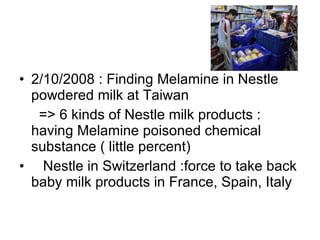
2/10/2008 : Finding Melamine in Nestle powdered milk at Taiwan => 6 kinds of Nestle milk products : having Melamine poisoned chemical substance ( little percent) Nestle in Switzerland :force to take back baby milk products in France, Spain, Italy
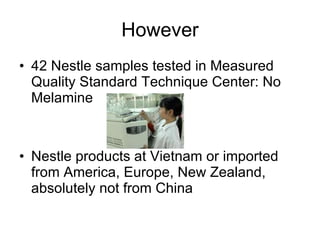
However 42 Nestle samples tested in Measured Quality Standard Technique Center: No Melamine  Nestle products at Vietnam or imported from America, Europe, New Zealand, absolutely not from China
Stakeholders Shareholders:  profits Employees: stable job, promotion  Consumers: high quality products, reasonable price Business partners: long-term, trusted relationships Local environment: need Nestle has responsibilities
Acquisition Strategy 90’s year: Baby product’s of Nestle were not concerned 1998: Peter Brabeck became Director => Begin biggest A&M cases: + Drerer’s Grand ice-cream Company + Rlaston Purina- Pet food biggest North-American : 11 billion USD
Why acquisition??? Diversifying size of economic: + Baby milk + Nutrition + Cafe + Food product Expanding the size of company
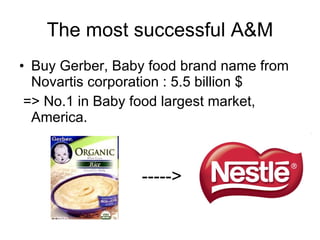
The most successful A&M Buy Gerber, Baby food brand name from Novartis corporation : 5.5 billion $ => No.1 in Baby food largest market, America. ----->
Not only buy but sell Selling the Milk manufacturing Industry in BaVi to Anco Company ( during 1 year) Are they right when selling ??? + The truth : spend money to focus on different field Invest 4 million$ ( maybe money from selling Milk industry 1 year) to Maggi produce industry
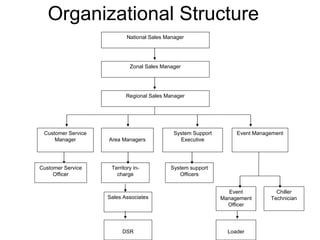
Organizational Structure Zonal Sales Manager Regional Sales Manager National Sales Manager Area Managers System Support Executive System support Officers Territory in- charge Event Management Officer Loader DSR Sales Associates Event Management Chiller Technician Customer Service Manager Customer Service Officer
Strategic Leadership To force the businesses to become more efficient. To create a regional manufacturing network. To integrate the company’s business on a global scale. To reduce marketing expenditures by exploiting the synergies between brands.
Nestle’ strategic entrepreneurship Develop R&D network Acquisition
Develop R&D network >3,500 scientists work on improving existing products and creating tomorrow’s nourishments Two thirds of company’s R&D activities are dedicated to renovating existing products, the remaining third is reserved for radical product innovations. Improve on operational level A number of organizational changes.
Acquisition Reaching a critical mass in terms of market share + the acquisition of Dreyer’s + the acquisition of Ralson Purina + the acquisition of Jenny Craig Gain expert knowledge for further expansion into new product segments. + Life Ventures fund + The Nestle Growth fund
THANK YOU FOR LISTENING!!!!

17495022 nestle-business-presentation

  • 1.
  • 2.
    CONTENT Vision &Mission General environment 5 forces model SWOT Business strategy Competitors Problems and Solution Stake holders Acquisition Strategy Organizational Structure Strategic Leadership Strategic Entrepreneurship
  • 3.
    Vision “ Nestlé'saim is to meet the various needs of the consumer everyday by marketing and selling foods of a consistently high quality.”
  • 4.
    Mission “ Westrive to bring consumers foods that are safe, of high quality and provide optimal nutrient to meet physiological needs. Nestle helps provide selections for all individual taste and lifestyle preferences.”
  • 5.
    General environment Demographictrends: - Nearly all age from young to old people. - All six continents (customers) Economic trends: - Most countries all over the world are affected by the global economic crisis.
  • 6.
    General environment Political/Legaltrends: - More countries join WTO: allow more free trade across the nations Sociocultural trends: - The world people care more about their health, especially with foods and beverages.
  • 7.
    General environment Technologicaltrends: - Use most of latest technology( in researching, producing…) - Try to find new way of create new product - Improve the quality of products. Global trends: - Improve operational efficiency by integrating the company’s businesses on a global scale. - “We’re now transitioning to become a genuinely global food company, to behave as one”
  • 8.
    Five forces modelNew entrants Multinational companies More companies joint in domestic market High pressure Substitute products Diversity products Confectionery, instant foods Not many firms focus on pet foods Average pressure
  • 9.
    Five forces modelSuppliers Sign contracts with farmers Stable suppliers Trust to the big firm Low pressure Buyers Variety demands Different tastes Need to attract customers High pressure
  • 10.
    SWOT analysis Strengths:- Very long history (over 140 years) - Operated factories in 77 countries (all six continents), a truly global company. - Considered the innovation leader in the global food and nutrition sector(3500 scientist in company R&D network) - Low cost operators (beat the competition by producing low cost products, edging ahead with low operating costs) - Offering thousands of local products. - Have a great CEO, Peter Brabeck, and a very strong workforces.
  • 11.
    SWOT analysis Weaknesses:- Not as successful as they thought they would be in some market (i.e. France) - Some of their product were positioned as too scientific, and consumers didn’t quite understand (i.e. LC-1 was a food and not a drug)
  • 12.
    SWOT analysis Opportunities:- Well-known company and strong brandname - Health-based products are becoming more popular in the world, including in the United States - Ranked first in nearly all the product segments in which it operated (market leader) - Unaffected by current economic conditions (its share of the UK confectionery market rise to 15.6 per cent with a 0.5 per cent growth this year)
  • 13.
    SWOT analysis Threats:- Some markets they are entering are already mature - Global competitors. - There are intense competitions in the United States, especially yogurt market (General Mills)
  • 14.
    Business-level strategy Nestlébusiness-level strategy is integrated cost leadership/differentiation - Wide range of products (over 20 categories: coffee, milk, mineral water, pet foods, cereals…) - Low cost operators.
  • 15.
    Competitors Many competitorsThe same qualities The same prices Unilever, Kraft, Master foods… High pressure
  • 16.
    Problem High marketshare Low growth Competitive pressure Want to expand Don’t have enough resources
  • 17.
    Solution Cut investmentbudgets, overheads, frill Maximizing existing assets, capacity, distribution Target internal growth rate Improve supply chain, productivity, optimize planning
  • 18.
    PROBLEMS TO NESTLEStorm of Melamine in 2008 + Melamine: increasing high protein affectedly => kidney stone, cancer Relate with Nestle ???
  • 19.
    2/10/2008 : FindingMelamine in Nestle powdered milk at Taiwan => 6 kinds of Nestle milk products : having Melamine poisoned chemical substance ( little percent) Nestle in Switzerland :force to take back baby milk products in France, Spain, Italy
  • 20.
    However 42 Nestlesamples tested in Measured Quality Standard Technique Center: No Melamine Nestle products at Vietnam or imported from America, Europe, New Zealand, absolutely not from China
  • 21.
    Stakeholders Shareholders: profits Employees: stable job, promotion Consumers: high quality products, reasonable price Business partners: long-term, trusted relationships Local environment: need Nestle has responsibilities
  • 22.
    Acquisition Strategy 90’syear: Baby product’s of Nestle were not concerned 1998: Peter Brabeck became Director => Begin biggest A&M cases: + Drerer’s Grand ice-cream Company + Rlaston Purina- Pet food biggest North-American : 11 billion USD
  • 23.
    Why acquisition??? Diversifyingsize of economic: + Baby milk + Nutrition + Cafe + Food product Expanding the size of company
  • 24.
    The most successfulA&M Buy Gerber, Baby food brand name from Novartis corporation : 5.5 billion $ => No.1 in Baby food largest market, America. ----->
  • 25.
    Not only buybut sell Selling the Milk manufacturing Industry in BaVi to Anco Company ( during 1 year) Are they right when selling ??? + The truth : spend money to focus on different field Invest 4 million$ ( maybe money from selling Milk industry 1 year) to Maggi produce industry
  • 26.
    Organizational Structure ZonalSales Manager Regional Sales Manager National Sales Manager Area Managers System Support Executive System support Officers Territory in- charge Event Management Officer Loader DSR Sales Associates Event Management Chiller Technician Customer Service Manager Customer Service Officer
  • 27.
    Strategic Leadership Toforce the businesses to become more efficient. To create a regional manufacturing network. To integrate the company’s business on a global scale. To reduce marketing expenditures by exploiting the synergies between brands.
  • 28.
    Nestle’ strategic entrepreneurshipDevelop R&D network Acquisition
  • 29.
    Develop R&D network>3,500 scientists work on improving existing products and creating tomorrow’s nourishments Two thirds of company’s R&D activities are dedicated to renovating existing products, the remaining third is reserved for radical product innovations. Improve on operational level A number of organizational changes.
  • 30.
    Acquisition Reaching acritical mass in terms of market share + the acquisition of Dreyer’s + the acquisition of Ralson Purina + the acquisition of Jenny Craig Gain expert knowledge for further expansion into new product segments. + Life Ventures fund + The Nestle Growth fund
  • 31.
    THANK YOU FORLISTENING!!!!