


National Law School of India University, Bangalore.
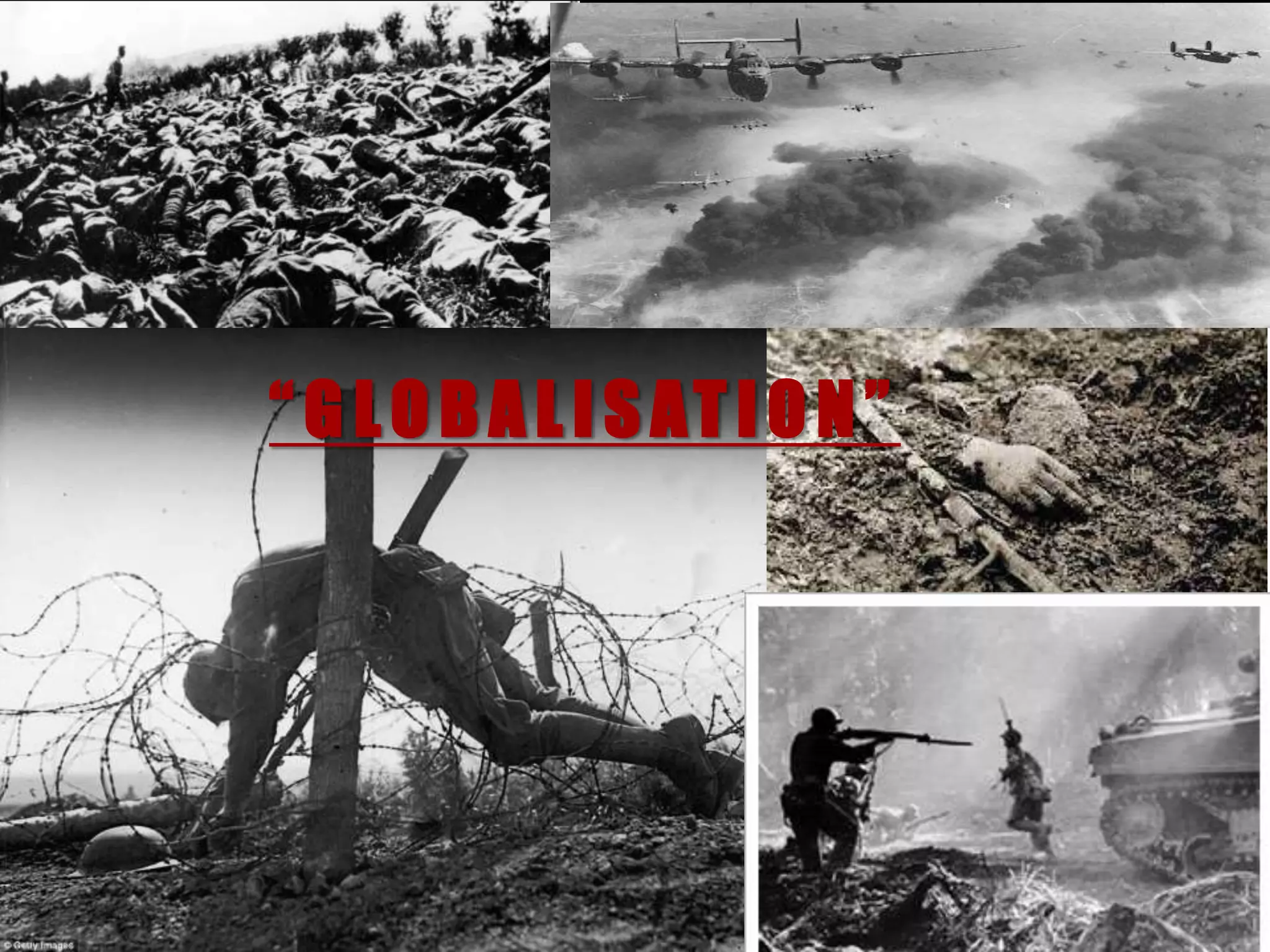
“ G LOB AL IS AT ION”
KUMAR SALVA RAGHUVANSHI
LL.M (BUSINESS LAWS)-730
National Law School of India University, Bangalore.
 Basic concepts.
 Theories.
 Dimensions of development.
 Role of Institutions.
 MDG to SDG.
 Conclusion.
• Improvement in country’s economic and social conditions.
• The capacity of a state to increase its human resource with the
aim of achieving higher outcome of production for the
satisfaction of the basic needs of majority of its citizens and
empowering them to make demands on the government.
• In economic sense, the developmental State is one that acts
authoritatively, credibly and legitimately in promoting
industrialisation, economic growth and expansion of human
capabilities.
• New dimensions of globalization have increased both
opportunities and risks for the nations to achieve
development for their citizens.
National Law School of India University, Bangalore.
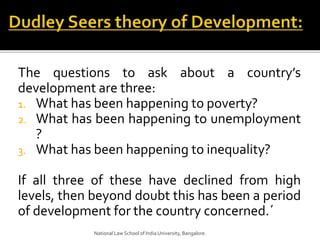
The questions to ask about a country’s
development are three:
1. What has been happening to poverty?
2. What has been happening to unemployment
?
3. What has been happening to inequality?
If all three of these have declined from high
levels, then beyond doubt this has been a period
of development for the country concerned.´
National Law School of India University, Bangalore.
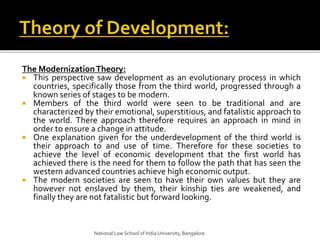
The ModernizationTheory:
 This perspective saw development as an evolutionary process in which
countries, specifically those from the third world, progressed through a
known series of stages to be modern.
 Members of the third world were seen to be traditional and are
characterized by their emotional, superstitious, and fatalistic approach to
the world. There approach therefore requires an approach in mind in
order to ensure a change in attitude.
 One explanation given for the underdevelopment of the third world is
their approach to and use of time. Therefore for these societies to
achieve the level of economic development that the first world has
achieved there is the need for them to follow the path that has seen the
western advanced countries achieve high economic output.
 The modern societies are seen to have their own values but they are
however not enslaved by them, their kinship ties are weakened, and
finally they are not fatalistic but forward looking.
National Law School of India University, Bangalore.
The Dependency Theory:
 This school of thought argued that the global economic
structure was an exploitative system which generated and
maintained the development of underdevelopment in
nations of the periphery.
 This exploitation is clearly seen in accounts of merchant
capitalism, colonialism, and neo-colonialism.
 Andre Gunder Frank also explained the dependency
theory in another way which differs from that offered by
classical Marxism. To him the growth of capitalism and
industry led to the underdevelopment of the countries
whose economic surplus was exploited by theWest.
National Law School of India University, Bangalore.
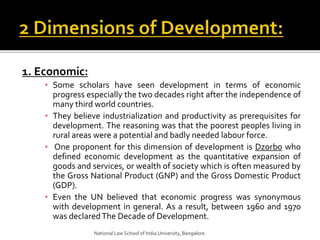
1. Economic:
▪ Some scholars have seen development in terms of economic
progress especially the two decades right after the independence of
many third world countries.
▪ They believe industrialization and productivity as prerequisites for
development. The reasoning was that the poorest peoples living in
rural areas were a potential and badly needed labour force.
▪ One proponent for this dimension of development is Dzorbo who
defined economic development as the quantitative expansion of
goods and services, or wealth of society which is often measured by
the Gross National Product (GNP) and the Gross Domestic Product
(GDP).
▪ Even the UN believed that economic progress was synonymous
with development in general. As a result, between 1960 and 1970
was declaredThe Decade of Development.
National Law School of India University, Bangalore.
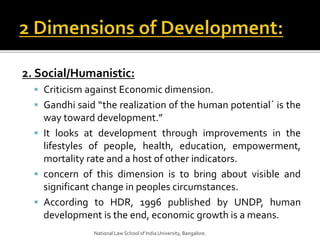
2. Social/Humanistic:
 Criticism against Economic dimension.
 Gandhi said “the realization of the human potential´ is the
way toward development.”
 It looks at development through improvements in the
lifestyles of people, health, education, empowerment,
mortality rate and a host of other indicators.
 concern of this dimension is to bring about visible and
significant change in peoples circumstances.
 According to HDR, 1996 published by UNDP, human
development is the end, economic growth is a means.
National Law School of India University, Bangalore.
1. UNDP works in nearly 170 countries and territories,
helping to achieve the eradication of poverty, and the
reduction of inequalities and exclusion. It help countries
to develop policies, leadership skills, partnering abilities,
institutional capabilities and build resilience in order to
sustain development results.
2. UNDP is working to strengthen new frameworks for
development, disaster risk reduction and climate
change.
3. UNDP focuses on helping countries build and share
solutions in three main areas:
▪ Sustainable development
▪ Democratic governance and peacebuilding
▪ Climate and disaster resilience
N a t i o n a l L a w S c h o o l o f I n d i a U n i v e r s i t y , B a n g a l o r e .
“Economic gains have benefitted greatly a few
countries, at the expense of many….The global
gap between the rich and poor is widening
everyday….The world has more economically
polarized, both between countries and within
countries….If present trend continue, economic
disparities between industrial and developing
nations will move from inequitable to
inhuman”.
National Law School of India University, Bangalore.
 The right to development was proclaimed in the
Declaration to Right to Development, adopted
in 1986 by UNGA in its resolution 41/128.
 Also recognized and re-affirmed in:
African Charter on Human and people’s rights
Arab Charter on Human Rights
1992 Rio Declaration on Environment and Development,
1993Vienna Declaration and Programme of Action,
Millennium Declaration,
2002 Monterrey Consensus,
2005World summit outcome document
2007 Declaration on the Rights of indigenous peoples.
N a t i o n a l L a w S c h o o l o f I n d i a U n i v e r s i t y , B a n g a l o r e .
1. Article 1: The right to development is an inalienable human right by
virtue of which every human person and all peoples are entitled to
participate in, contribute to, and enjoy economic, social, cultural and
political development, in which all human rights and fundamental
freedoms can be fully realized.
2. Article 2: The human person is the central subject of development and
should be the active participant and beneficiary of the right to
development.
▪ States have the right and the duty to formulate appropriate national development policies that
aim at the constant improvement of the well-being of the entire population and of all individual
3. Article 3: States have the primary responsibility for the creation of
national and international conditions favourable to the realization of
the right to development.
4. Article 4: States have the duty to take steps, individually and
collectively, to formulate international development policies with a
view to facilitating the full realization of the right to development.
National Law School of India University, Bangalore.
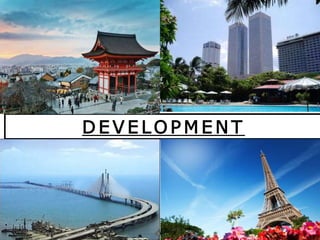
D E V E LOPME N T
 Williamson originally coined the phrase in 1990
“to refer to the lowest common denominator of
policy advice being addressed by the
Washington-based institutions to Latin
American countries as of 1989.”
 Set of 10 economic policy prescriptions
considered to constitute the “standard” reform
package prompted for crisis wracked developing
countries by Washington D.C based institutions
such as IMF,World Bank and USTreasury Dept.
National Law School of India University, Bangalore.
 Fiscal discipline
 A redirection of public expenditure priorities toward fields
offering both high economic returns and the potential to
improve income distribution, such as primary health care,
primary education, and infrastructure
 Tax reform (to lower marginal rates and broaden the tax
base)
 Interest rate liberalization
 A competitive exchange rate
 Trade liberalization
 Liberalization of inflows of foreign direct investment
 Privatization
 Deregulation (to abolish barriers to entry and exit)
 Secure property rights
National Law School of India University, Bangalore.
 ”I of course never intended my term to imply
policies like capital account
liberalization...monetarism, supply-side
economics, or a minimal state (getting the
state out of welfare provision and income
redistribution), which I think of as the
quintessentially neoliberal ideas”.
National Law School of India University, Bangalore.
1. Not an ideology, need also to avoid crisis.
2. Incomplete or Neglected: need to fully
address things continuously first and second
generation.
3. Too narrow: need to concentrate more on
poverty reduction and distribution & less on
just higher GDP.
National Law School of India University, Bangalore.
Dani Rodrik argues that there noe exists an
“Augmented” Washington consensus, which in addition
toWC-1, adds:
1. Corporate governance
2. Anti-corruption
3. Flexible labor markets
4. WTO agreements
5. Financial codes and standards
6. “Prudent” capital-account opening
7. Non-intermediate exchange rate regimes
8. Independent central banks/inflation targeting
9. Social safety nets
10. Targeted poverty reduction
National Law School of India University, Bangalore.
 At the Millennium Summit in September 2000 adopted UN Millennium
Declaration, towards new global partnership to reduce extreme poverty and
setting out a series of time-bound targets, with a deadline of 2015.
 The MDGs are the world's time-bound and quantified targets for addressing
extreme poverty, hunger, disease, lack of adequate shelter, and exclusion-
while promoting gender equality, education, and environmental sustainability.
 Sub-Saharan Africa is the epicentre of crisis, with continuing food insecurity, a
rise of extreme poverty, stunningly high child and maternal mortality, and
large numbers of people living in slums, and a widespread shortfall for most of
the MDGs.
 Asia is the region with the fastest progress, but even there hundreds of
millions of people remain in extreme poverty, and even fast-growing countries
fail to achieve some of the non-income Goals.
 Other regions have mixed records, notably Latin America, the transition
economies, and the Middle East and North Africa, often with slow or no
progress on some of the Goals and persistent inequalities undermining
progress on others.
National Law School of India University, Bangalore.
1. To eradicate extreme poverty and hunger:
2. To achieve universal primary education
3. To promote gender equality and empower
women
4. To reduce child mortality
5. To improve maternal health.
6. To combat HIV/AIDS, malaria, and other
diseases.
7. To ensure environmental sustainability
8. To develop a global partnership for
development
National Law School of India University, Bangalore.
 MDG 1: The number of people living on less than $1.25 a day has been reduced from 1.9 billion in
1990 to 836 million in 2015, although the target of halving the proportion of people suffering from
hunger was narrowly missed.
 MDG 2: Primary school enrolment figures have shown an impressive rise, but the goal of achieving
universal primary education has just been missed, with the net enrolment rate increasing from 83%
in 2000 to 91% this year.
 MDG 3: About two-thirds of developing countries have achieved gender parity in primary
education.
 MDG 4: The child mortality rate has reduced by more than half over the past 25 years – falling from
90 to 43 deaths per 1,000 live births – but it has failed to meet the MDG target of a drop of two-
thirds.
 MDG 5: The global maternal mortality ratio has fallen by nearly half – short of the two-thirds
reduction the MDGs aimed for.
 MDG 6: The target of halting and beginning to reverse the spread of HIV/Aids by 2015 has not
been met, although the number of new HIV infections fell by around 40% between 2000 and 2013.
 MDG 7: Some 2.6 billion people have gained access to improved drinking water since 1990, so the
target of halving the proportion of people without access to improved sources of water was
achieved in 2010 – five years ahead of schedule. However, 663 million people across the world still do
not have access to improved drinking water.
 MDG 8: Between 2000 and 2014, overseas development assistance from rich nations to developing
countries increased by 66% in real terms, and in 2013 reached the record figure of $134.8bnNational Law School of India University, Bangalore.
 Target 1: Halve, between 1990 and 2015, the proportion of people whose
income is less than one dollar a day.
1. The all India Poverty Head Count Ratio (PHCR) estimate was 47.8% in 1990.
In order to meet the target the PHCR level has to be 23.9% by 2015. In 2011-12,
the PHCR at all India level is 21.9%, which shows that, India has already
achieved the target well ahead of time.
2. During 2004-05 to 2011-12, the Poverty Gap Ratio reduced both in rural and
urban areas. While the rural PGR declined from 9.64 in 2004-05 to 5.05 in 2011-
12 in the urban areas it declined from 6.08 to 2.70 during the same period. A
nearly 50% decline in PGR both in rural and urban areas during 2004-05 to
2011-12 reflects that the conditions of poor have improved both in urban and
rural areas.
3. At all India level, the share of the poorest quintile in the total consumption is
lower in the urban areas than in rural areas. During 1993-94 to 2011-12, in
urban areas, the indicator (URP methodology) showed a decline from 8.0% in
1993-94 to 6.97% in 2009-10, and then showed a slight improvement 7.1% in
2011-12. In rural areas, the share of poorest quintile steadily declined from
9.6% in 1993-94 to 9.1% in 2011-12.
National Law School of India University, Bangalore.
 Target 2: Halve, between 1990 and 2015, the
proportion of people who suffer from hunger.
It is estimated that in 1990, the proportion of underweight
children below 3 years as 52%. In order to meet the target,
the proportion of under-weight children should decrease
to 26% by 2015. The National Family Health Survey shows
that, the proportion of under-weight children below 3 year
declined from 43% in 1998-99 to 40% in 2005-06. At this
rate of decline the proportion of underweight children
below 3 years is expected to reduce to 33% by 2015, which
indicates India is falling short of the target.
National Law School of India University, Bangalore.
 Target 6: Reduce by three quarters between 1990 and 2015, the
Maternal Morality Ratio.
1. In 1990, the estimated MMR was 437 per 1,00,000 live births. In
order to meet the MDG target, the MMR should be reduced to
109 per 1,00,000 live births by 2015. As per the latest estimates,
the MMR status at all India level is at 167 in 2011-13. As per the
historical trend, MMR is likely to reach the level of 140 maternal
deaths by 2015,
2. The Coverage Evaluation Survey conducted by Government of
India and UNICEF in 2009 shows that 76.2% percentage of births
were attended by skilled health personnel in 2009. The latest
results of Sample Registration System (SRS) 2013, reveal that,
the percentage of live births attended by skilled health
personnel (Government hospitals, Private hospital, qualified
professional) is 87.1% in 2013, which indicates a better status.
National Law School of India University, Bangalore.
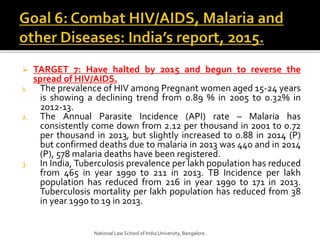
 TARGET 7: Have halted by 2015 and begun to reverse the
spread of HIV/AIDS.
1. The prevalence of HIV among Pregnant women aged 15-24 years
is showing a declining trend from 0.89 % in 2005 to 0.32% in
2012-13.
2. The Annual Parasite Incidence (API) rate – Malaria has
consistently come down from 2.12 per thousand in 2001 to 0.72
per thousand in 2013, but slightly increased to 0.88 in 2014 (P)
but confirmed deaths due to malaria in 2013 was 440 and in 2014
(P), 578 malaria deaths have been registered.
3. In India, Tuberculosis prevalence per lakh population has reduced
from 465 in year 1990 to 211 in 2013. TB Incidence per lakh
population has reduced from 216 in year 1990 to 171 in 2013.
Tuberculosis mortality per lakh population has reduced from 38
in year 1990 to 19 in 2013.
National Law School of India University, Bangalore.
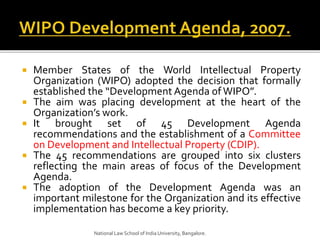
 Member States of the World Intellectual Property
Organization (WIPO) adopted the decision that formally
established the “Development Agenda of WIPO”.
 The aim was placing development at the heart of the
Organization’s work.
 It brought set of 45 Development Agenda
recommendations and the establishment of a Committee
on Development and Intellectual Property (CDIP).
 The 45 recommendations are grouped into six clusters
reflecting the main areas of focus of the Development
Agenda.
 The adoption of the Development Agenda was an
important milestone for the Organization and its effective
implementation has become a key priority.
National Law School of India University, Bangalore.
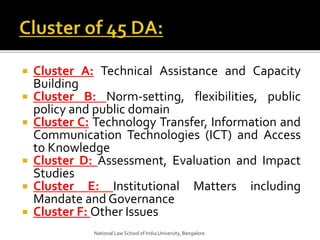
 Cluster A: Technical Assistance and Capacity
Building
 Cluster B: Norm-setting, flexibilities, public
policy and public domain
 Cluster C: Technology Transfer, Information and
Communication Technologies (ICT) and Access
to Knowledge
 Cluster D: Assessment, Evaluation and Impact
Studies
 Cluster E: Institutional Matters including
Mandate and Governance
 Cluster F: Other Issues
National Law School of India University, Bangalore.
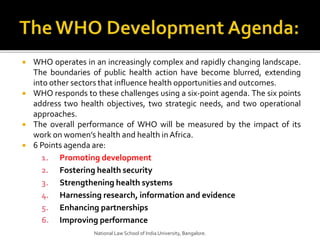
 WHO operates in an increasingly complex and rapidly changing landscape.
The boundaries of public health action have become blurred, extending
into other sectors that influence health opportunities and outcomes.
 WHO responds to these challenges using a six-point agenda. The six points
address two health objectives, two strategic needs, and two operational
approaches.
 The overall performance of WHO will be measured by the impact of its
work on women’s health and health inAfrica.
 6 Points agenda are:
1. Promoting development
2. Fostering health security
3. Strengthening health systems
4. Harnessing research, information and evidence
5. Enhancing partnerships
6. Improving performance
National Law School of India University, Bangalore.
 During the past decade, health has achieved unprecedented
prominence as a key driver of socioeconomic progress, and more
resources than ever are being invested in health.
 Yet poverty continues to contribute to poor health, and poor
health anchors large populations in poverty. Health development
is directed by the ethical principle of equity: Access to life-saving
or health-promoting interventions should not be denied for unfair
reasons, including those with economic or social roots
(Compulsory licensing of pharmaceutical drugs)
 Commitment to this principle ensures that WHO activities aimed
at health development give priority to health outcomes in poor,
disadvantaged or vulnerable groups.
 Attainment of the health-related Millennium Development Goals,
preventing and treating chronic diseases and addressing the
neglected tropical diseases are the cornerstones of the health and
development agenda.
National Law School of India University, Bangalore.
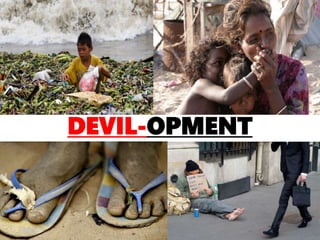
DEVIL-OPMENT
 On September 25th 2015, countries adopted a set of goals
to end poverty, protect the planet, and ensure prosperity
for all as part of a new sustainable development agenda.
 Each goal has specific targets to be achieved over the next 15
years.
 These 17 Goals build on the successes of the Millennium
Development Goals, while including new areas such as
climate change, economic inequality, innovation, sustainable
consumption, peace and justice, among other priorities. The
goals are interconnected – often the key to success on one
will involve tackling issues more commonly associated with
another.
National Law School of India University, Bangalore.
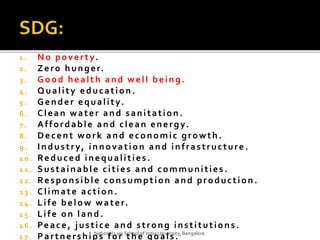
1 . No poverty.
2 . Zero hunger.
3 . Good health and well being.
4 . Quality education .
5 . Gender equality.
6 . Clean water and sanitation .
7 . Affordable and clean energy.
8 . Decent work and economic growth.
9 . Industry, innovation and infrastructure .
1 0 . Reduced inequalities .
1 1 . Sustainable cities and communities .
1 2 . Responsible consumption and production .
1 3 . Climate action.
1 4 . Life below water.
1 5 . Life on land.
1 6 . Peace, justice and strong institutions.
1 7 . Partnerships for the goals.National Law School of India University, Bangalore.
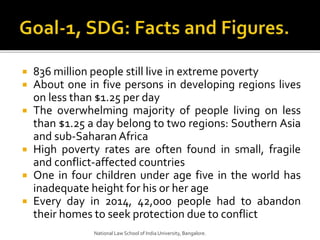
 836 million people still live in extreme poverty
 About one in five persons in developing regions lives
on less than $1.25 per day
 The overwhelming majority of people living on less
than $1.25 a day belong to two regions: Southern Asia
and sub-Saharan Africa
 High poverty rates are often found in small, fragile
and conflict-affected countries
 One in four children under age five in the world has
inadequate height for his or her age
 Every day in 2014, 42,000 people had to abandon
their homes to seek protection due to conflict
National Law School of India University, Bangalore.
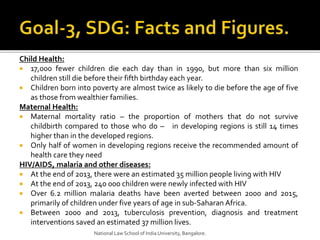
Child Health:
 17,000 fewer children die each day than in 1990, but more than six million
children still die before their fifth birthday each year.
 Children born into poverty are almost twice as likely to die before the age of five
as those from wealthier families.
Maternal Health:
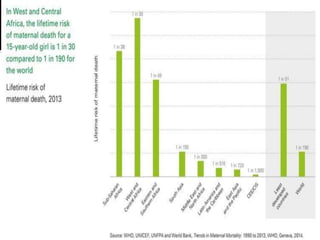
 Maternal mortality ratio – the proportion of mothers that do not survive
childbirth compared to those who do – in developing regions is still 14 times
higher than in the developed regions.
 Only half of women in developing regions receive the recommended amount of
health care they need
HIV/AIDS, malaria and other diseases:
 At the end of 2013, there were an estimated 35 million people living with HIV
 At the end of 2013, 240 000 children were newly infected with HIV
 Over 6.2 million malaria deaths have been averted between 2000 and 2015,
primarily of children under five years of age in sub-Saharan Africa.
 Between 2000 and 2013, tuberculosis prevention, diagnosis and treatment
interventions saved an estimated 37 million lives.
National Law School of India University, Bangalore.

Globalisation and development

  • 1.
    National Law Schoolof India University, Bangalore. “ G LOB AL IS AT ION”
  • 2.
    KUMAR SALVA RAGHUVANSHI LL.M(BUSINESS LAWS)-730 National Law School of India University, Bangalore.
  • 3.
    National Law Schoolof India University, Bangalore.  Basic concepts.  Theories.  Dimensions of development.  Role of Institutions.  MDG to SDG.  Conclusion.
  • 4.
    • Improvement incountry’s economic and social conditions. • The capacity of a state to increase its human resource with the aim of achieving higher outcome of production for the satisfaction of the basic needs of majority of its citizens and empowering them to make demands on the government. • In economic sense, the developmental State is one that acts authoritatively, credibly and legitimately in promoting industrialisation, economic growth and expansion of human capabilities. • New dimensions of globalization have increased both opportunities and risks for the nations to achieve development for their citizens. National Law School of India University, Bangalore.
  • 5.
    The questions toask about a country’s development are three: 1. What has been happening to poverty? 2. What has been happening to unemployment ? 3. What has been happening to inequality? If all three of these have declined from high levels, then beyond doubt this has been a period of development for the country concerned.´ National Law School of India University, Bangalore.
  • 6.
    The ModernizationTheory:  Thisperspective saw development as an evolutionary process in which countries, specifically those from the third world, progressed through a known series of stages to be modern.  Members of the third world were seen to be traditional and are characterized by their emotional, superstitious, and fatalistic approach to the world. There approach therefore requires an approach in mind in order to ensure a change in attitude.  One explanation given for the underdevelopment of the third world is their approach to and use of time. Therefore for these societies to achieve the level of economic development that the first world has achieved there is the need for them to follow the path that has seen the western advanced countries achieve high economic output.  The modern societies are seen to have their own values but they are however not enslaved by them, their kinship ties are weakened, and finally they are not fatalistic but forward looking. National Law School of India University, Bangalore.
  • 7.
    The Dependency Theory: This school of thought argued that the global economic structure was an exploitative system which generated and maintained the development of underdevelopment in nations of the periphery.  This exploitation is clearly seen in accounts of merchant capitalism, colonialism, and neo-colonialism.  Andre Gunder Frank also explained the dependency theory in another way which differs from that offered by classical Marxism. To him the growth of capitalism and industry led to the underdevelopment of the countries whose economic surplus was exploited by theWest. National Law School of India University, Bangalore.
  • 8.
    1. Economic: ▪ Somescholars have seen development in terms of economic progress especially the two decades right after the independence of many third world countries. ▪ They believe industrialization and productivity as prerequisites for development. The reasoning was that the poorest peoples living in rural areas were a potential and badly needed labour force. ▪ One proponent for this dimension of development is Dzorbo who defined economic development as the quantitative expansion of goods and services, or wealth of society which is often measured by the Gross National Product (GNP) and the Gross Domestic Product (GDP). ▪ Even the UN believed that economic progress was synonymous with development in general. As a result, between 1960 and 1970 was declaredThe Decade of Development. National Law School of India University, Bangalore.
  • 9.
    2. Social/Humanistic:  Criticismagainst Economic dimension.  Gandhi said “the realization of the human potential´ is the way toward development.”  It looks at development through improvements in the lifestyles of people, health, education, empowerment, mortality rate and a host of other indicators.  concern of this dimension is to bring about visible and significant change in peoples circumstances.  According to HDR, 1996 published by UNDP, human development is the end, economic growth is a means. National Law School of India University, Bangalore.
  • 10.
    National Law Schoolof India University, Bangalore.
  • 11.
    1. UNDP worksin nearly 170 countries and territories, helping to achieve the eradication of poverty, and the reduction of inequalities and exclusion. It help countries to develop policies, leadership skills, partnering abilities, institutional capabilities and build resilience in order to sustain development results. 2. UNDP is working to strengthen new frameworks for development, disaster risk reduction and climate change. 3. UNDP focuses on helping countries build and share solutions in three main areas: ▪ Sustainable development ▪ Democratic governance and peacebuilding ▪ Climate and disaster resilience N a t i o n a l L a w S c h o o l o f I n d i a U n i v e r s i t y , B a n g a l o r e .
  • 12.
    “Economic gains havebenefitted greatly a few countries, at the expense of many….The global gap between the rich and poor is widening everyday….The world has more economically polarized, both between countries and within countries….If present trend continue, economic disparities between industrial and developing nations will move from inequitable to inhuman”. National Law School of India University, Bangalore.
  • 13.
     The rightto development was proclaimed in the Declaration to Right to Development, adopted in 1986 by UNGA in its resolution 41/128.  Also recognized and re-affirmed in: African Charter on Human and people’s rights Arab Charter on Human Rights 1992 Rio Declaration on Environment and Development, 1993Vienna Declaration and Programme of Action, Millennium Declaration, 2002 Monterrey Consensus, 2005World summit outcome document 2007 Declaration on the Rights of indigenous peoples. N a t i o n a l L a w S c h o o l o f I n d i a U n i v e r s i t y , B a n g a l o r e .
  • 14.
    1. Article 1:The right to development is an inalienable human right by virtue of which every human person and all peoples are entitled to participate in, contribute to, and enjoy economic, social, cultural and political development, in which all human rights and fundamental freedoms can be fully realized. 2. Article 2: The human person is the central subject of development and should be the active participant and beneficiary of the right to development. ▪ States have the right and the duty to formulate appropriate national development policies that aim at the constant improvement of the well-being of the entire population and of all individual 3. Article 3: States have the primary responsibility for the creation of national and international conditions favourable to the realization of the right to development. 4. Article 4: States have the duty to take steps, individually and collectively, to formulate international development policies with a view to facilitating the full realization of the right to development. National Law School of India University, Bangalore.
  • 15.
    National Law Schoolof India University, Bangalore. D E V E LOPME N T
  • 16.
     Williamson originallycoined the phrase in 1990 “to refer to the lowest common denominator of policy advice being addressed by the Washington-based institutions to Latin American countries as of 1989.”  Set of 10 economic policy prescriptions considered to constitute the “standard” reform package prompted for crisis wracked developing countries by Washington D.C based institutions such as IMF,World Bank and USTreasury Dept. National Law School of India University, Bangalore.
  • 17.
     Fiscal discipline A redirection of public expenditure priorities toward fields offering both high economic returns and the potential to improve income distribution, such as primary health care, primary education, and infrastructure  Tax reform (to lower marginal rates and broaden the tax base)  Interest rate liberalization  A competitive exchange rate  Trade liberalization  Liberalization of inflows of foreign direct investment  Privatization  Deregulation (to abolish barriers to entry and exit)  Secure property rights National Law School of India University, Bangalore.
  • 18.
     ”I ofcourse never intended my term to imply policies like capital account liberalization...monetarism, supply-side economics, or a minimal state (getting the state out of welfare provision and income redistribution), which I think of as the quintessentially neoliberal ideas”. National Law School of India University, Bangalore.
  • 19.
    1. Not anideology, need also to avoid crisis. 2. Incomplete or Neglected: need to fully address things continuously first and second generation. 3. Too narrow: need to concentrate more on poverty reduction and distribution & less on just higher GDP. National Law School of India University, Bangalore.
  • 20.
    Dani Rodrik arguesthat there noe exists an “Augmented” Washington consensus, which in addition toWC-1, adds: 1. Corporate governance 2. Anti-corruption 3. Flexible labor markets 4. WTO agreements 5. Financial codes and standards 6. “Prudent” capital-account opening 7. Non-intermediate exchange rate regimes 8. Independent central banks/inflation targeting 9. Social safety nets 10. Targeted poverty reduction National Law School of India University, Bangalore.
  • 21.
     At theMillennium Summit in September 2000 adopted UN Millennium Declaration, towards new global partnership to reduce extreme poverty and setting out a series of time-bound targets, with a deadline of 2015.  The MDGs are the world's time-bound and quantified targets for addressing extreme poverty, hunger, disease, lack of adequate shelter, and exclusion- while promoting gender equality, education, and environmental sustainability.  Sub-Saharan Africa is the epicentre of crisis, with continuing food insecurity, a rise of extreme poverty, stunningly high child and maternal mortality, and large numbers of people living in slums, and a widespread shortfall for most of the MDGs.  Asia is the region with the fastest progress, but even there hundreds of millions of people remain in extreme poverty, and even fast-growing countries fail to achieve some of the non-income Goals.  Other regions have mixed records, notably Latin America, the transition economies, and the Middle East and North Africa, often with slow or no progress on some of the Goals and persistent inequalities undermining progress on others. National Law School of India University, Bangalore.
  • 22.
    1. To eradicateextreme poverty and hunger: 2. To achieve universal primary education 3. To promote gender equality and empower women 4. To reduce child mortality 5. To improve maternal health. 6. To combat HIV/AIDS, malaria, and other diseases. 7. To ensure environmental sustainability 8. To develop a global partnership for development National Law School of India University, Bangalore.
  • 23.
     MDG 1:The number of people living on less than $1.25 a day has been reduced from 1.9 billion in 1990 to 836 million in 2015, although the target of halving the proportion of people suffering from hunger was narrowly missed.  MDG 2: Primary school enrolment figures have shown an impressive rise, but the goal of achieving universal primary education has just been missed, with the net enrolment rate increasing from 83% in 2000 to 91% this year.  MDG 3: About two-thirds of developing countries have achieved gender parity in primary education.  MDG 4: The child mortality rate has reduced by more than half over the past 25 years – falling from 90 to 43 deaths per 1,000 live births – but it has failed to meet the MDG target of a drop of two- thirds.  MDG 5: The global maternal mortality ratio has fallen by nearly half – short of the two-thirds reduction the MDGs aimed for.  MDG 6: The target of halting and beginning to reverse the spread of HIV/Aids by 2015 has not been met, although the number of new HIV infections fell by around 40% between 2000 and 2013.  MDG 7: Some 2.6 billion people have gained access to improved drinking water since 1990, so the target of halving the proportion of people without access to improved sources of water was achieved in 2010 – five years ahead of schedule. However, 663 million people across the world still do not have access to improved drinking water.  MDG 8: Between 2000 and 2014, overseas development assistance from rich nations to developing countries increased by 66% in real terms, and in 2013 reached the record figure of $134.8bnNational Law School of India University, Bangalore.
  • 24.
     Target 1:Halve, between 1990 and 2015, the proportion of people whose income is less than one dollar a day. 1. The all India Poverty Head Count Ratio (PHCR) estimate was 47.8% in 1990. In order to meet the target the PHCR level has to be 23.9% by 2015. In 2011-12, the PHCR at all India level is 21.9%, which shows that, India has already achieved the target well ahead of time. 2. During 2004-05 to 2011-12, the Poverty Gap Ratio reduced both in rural and urban areas. While the rural PGR declined from 9.64 in 2004-05 to 5.05 in 2011- 12 in the urban areas it declined from 6.08 to 2.70 during the same period. A nearly 50% decline in PGR both in rural and urban areas during 2004-05 to 2011-12 reflects that the conditions of poor have improved both in urban and rural areas. 3. At all India level, the share of the poorest quintile in the total consumption is lower in the urban areas than in rural areas. During 1993-94 to 2011-12, in urban areas, the indicator (URP methodology) showed a decline from 8.0% in 1993-94 to 6.97% in 2009-10, and then showed a slight improvement 7.1% in 2011-12. In rural areas, the share of poorest quintile steadily declined from 9.6% in 1993-94 to 9.1% in 2011-12. National Law School of India University, Bangalore.
  • 25.
     Target 2:Halve, between 1990 and 2015, the proportion of people who suffer from hunger. It is estimated that in 1990, the proportion of underweight children below 3 years as 52%. In order to meet the target, the proportion of under-weight children should decrease to 26% by 2015. The National Family Health Survey shows that, the proportion of under-weight children below 3 year declined from 43% in 1998-99 to 40% in 2005-06. At this rate of decline the proportion of underweight children below 3 years is expected to reduce to 33% by 2015, which indicates India is falling short of the target. National Law School of India University, Bangalore.
  • 26.
     Target 6:Reduce by three quarters between 1990 and 2015, the Maternal Morality Ratio. 1. In 1990, the estimated MMR was 437 per 1,00,000 live births. In order to meet the MDG target, the MMR should be reduced to 109 per 1,00,000 live births by 2015. As per the latest estimates, the MMR status at all India level is at 167 in 2011-13. As per the historical trend, MMR is likely to reach the level of 140 maternal deaths by 2015, 2. The Coverage Evaluation Survey conducted by Government of India and UNICEF in 2009 shows that 76.2% percentage of births were attended by skilled health personnel in 2009. The latest results of Sample Registration System (SRS) 2013, reveal that, the percentage of live births attended by skilled health personnel (Government hospitals, Private hospital, qualified professional) is 87.1% in 2013, which indicates a better status. National Law School of India University, Bangalore.
  • 27.
     TARGET 7:Have halted by 2015 and begun to reverse the spread of HIV/AIDS. 1. The prevalence of HIV among Pregnant women aged 15-24 years is showing a declining trend from 0.89 % in 2005 to 0.32% in 2012-13. 2. The Annual Parasite Incidence (API) rate – Malaria has consistently come down from 2.12 per thousand in 2001 to 0.72 per thousand in 2013, but slightly increased to 0.88 in 2014 (P) but confirmed deaths due to malaria in 2013 was 440 and in 2014 (P), 578 malaria deaths have been registered. 3. In India, Tuberculosis prevalence per lakh population has reduced from 465 in year 1990 to 211 in 2013. TB Incidence per lakh population has reduced from 216 in year 1990 to 171 in 2013. Tuberculosis mortality per lakh population has reduced from 38 in year 1990 to 19 in 2013. National Law School of India University, Bangalore.
  • 28.
     Member Statesof the World Intellectual Property Organization (WIPO) adopted the decision that formally established the “Development Agenda of WIPO”.  The aim was placing development at the heart of the Organization’s work.  It brought set of 45 Development Agenda recommendations and the establishment of a Committee on Development and Intellectual Property (CDIP).  The 45 recommendations are grouped into six clusters reflecting the main areas of focus of the Development Agenda.  The adoption of the Development Agenda was an important milestone for the Organization and its effective implementation has become a key priority. National Law School of India University, Bangalore.
  • 29.
     Cluster A:Technical Assistance and Capacity Building  Cluster B: Norm-setting, flexibilities, public policy and public domain  Cluster C: Technology Transfer, Information and Communication Technologies (ICT) and Access to Knowledge  Cluster D: Assessment, Evaluation and Impact Studies  Cluster E: Institutional Matters including Mandate and Governance  Cluster F: Other Issues National Law School of India University, Bangalore.
  • 30.
     WHO operatesin an increasingly complex and rapidly changing landscape. The boundaries of public health action have become blurred, extending into other sectors that influence health opportunities and outcomes.  WHO responds to these challenges using a six-point agenda. The six points address two health objectives, two strategic needs, and two operational approaches.  The overall performance of WHO will be measured by the impact of its work on women’s health and health inAfrica.  6 Points agenda are: 1. Promoting development 2. Fostering health security 3. Strengthening health systems 4. Harnessing research, information and evidence 5. Enhancing partnerships 6. Improving performance National Law School of India University, Bangalore.
  • 31.
     During thepast decade, health has achieved unprecedented prominence as a key driver of socioeconomic progress, and more resources than ever are being invested in health.  Yet poverty continues to contribute to poor health, and poor health anchors large populations in poverty. Health development is directed by the ethical principle of equity: Access to life-saving or health-promoting interventions should not be denied for unfair reasons, including those with economic or social roots (Compulsory licensing of pharmaceutical drugs)  Commitment to this principle ensures that WHO activities aimed at health development give priority to health outcomes in poor, disadvantaged or vulnerable groups.  Attainment of the health-related Millennium Development Goals, preventing and treating chronic diseases and addressing the neglected tropical diseases are the cornerstones of the health and development agenda. National Law School of India University, Bangalore.
  • 32.
    National Law Schoolof India University, Bangalore. DEVIL-OPMENT
  • 34.
     On September25th 2015, countries adopted a set of goals to end poverty, protect the planet, and ensure prosperity for all as part of a new sustainable development agenda.  Each goal has specific targets to be achieved over the next 15 years.  These 17 Goals build on the successes of the Millennium Development Goals, while including new areas such as climate change, economic inequality, innovation, sustainable consumption, peace and justice, among other priorities. The goals are interconnected – often the key to success on one will involve tackling issues more commonly associated with another. National Law School of India University, Bangalore.
  • 35.
    1 . Nopoverty. 2 . Zero hunger. 3 . Good health and well being. 4 . Quality education . 5 . Gender equality. 6 . Clean water and sanitation . 7 . Affordable and clean energy. 8 . Decent work and economic growth. 9 . Industry, innovation and infrastructure . 1 0 . Reduced inequalities . 1 1 . Sustainable cities and communities . 1 2 . Responsible consumption and production . 1 3 . Climate action. 1 4 . Life below water. 1 5 . Life on land. 1 6 . Peace, justice and strong institutions. 1 7 . Partnerships for the goals.National Law School of India University, Bangalore.
  • 36.
     836 millionpeople still live in extreme poverty  About one in five persons in developing regions lives on less than $1.25 per day  The overwhelming majority of people living on less than $1.25 a day belong to two regions: Southern Asia and sub-Saharan Africa  High poverty rates are often found in small, fragile and conflict-affected countries  One in four children under age five in the world has inadequate height for his or her age  Every day in 2014, 42,000 people had to abandon their homes to seek protection due to conflict National Law School of India University, Bangalore.
  • 37.
    Child Health:  17,000fewer children die each day than in 1990, but more than six million children still die before their fifth birthday each year.  Children born into poverty are almost twice as likely to die before the age of five as those from wealthier families. Maternal Health:  Maternal mortality ratio – the proportion of mothers that do not survive childbirth compared to those who do – in developing regions is still 14 times higher than in the developed regions.  Only half of women in developing regions receive the recommended amount of health care they need HIV/AIDS, malaria and other diseases:  At the end of 2013, there were an estimated 35 million people living with HIV  At the end of 2013, 240 000 children were newly infected with HIV  Over 6.2 million malaria deaths have been averted between 2000 and 2015, primarily of children under five years of age in sub-Saharan Africa.  Between 2000 and 2013, tuberculosis prevention, diagnosis and treatment interventions saved an estimated 37 million lives. National Law School of India University, Bangalore.
  • 38.
    National Law Schoolof India University, Bangalore.

Editor's Notes

  • #2 Talking in terms of World War II, I see globalization as a main factor to support this whole war for such a long time. Globalization increases urbanization, industrialization, communication, creation of new technologies, mainly it increases power. And power increases the money, money which is used to achieve and accomplish all kinds of goals. We can see with globalization alot of developmental works are being produced at each step, but it is equally important to remember that globalization is very powerful matter itself. It has the capability of destruction too, and World War II is deadliest destructive example of globalization. Uncountable numbers of lives, properties, places, countries have been destroyed during World War II.
  • #6 These three things are considered the centralchallenges that nations battle with and try to combat or at least try to minimize. To Seers, all these 3 must be at low levels before we can declare that society as a developed one. This invariably means that a rise in any one of these central challenges disqualifies that society from being called developed.
  • #7 https://www.academia.edu/466731/THE_CONCEPT_OF_DEVELOPMENT
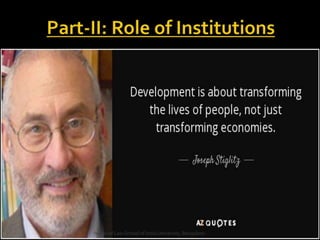
  • #11 Joseph Eugene Stiglitz is an American economist and a professor at Columbia University. He is a recipient of the Nobel Memorial Prize in Economic Sciences and the John Bates Clark Medal.
  • #14 http://www.un.org/documents/ga/res/41/a41r128.htm
  • #30 http://www.wipo.int/ip-development/en/agenda/recommendations.html
  • #38 Provide access to affordable essential medicines and vaccines, in accordance with the Doha Declaration on the TRIPS Agreement and Public Health, which affirms the right of developing countries to use to the full the provisions in the Agreement on Trade Related Aspects of Intellectual Property Rights regarding flexibilities to protect public health, and, in particular, provide access to medicines for all.