Class Lecture-1
Definition of Development Studies
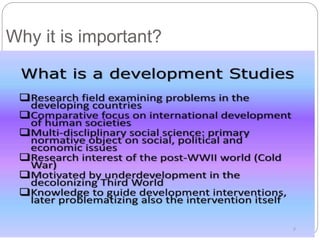
 Development Studies, as an academic field of study, is
also characterized by normative and policy concerns
about inclusive and sustainable development. It aims
to contribute to possible solutions to societal problems
and is increasingly applied in focus and engaged with
policy and practice.
 Development Studies (also known as ‘international
development studies’ or ‘international development’) is a
multi- and inter-disciplinary field of study rather than a
single discipline. It seeks to understand the interplay
between social, economic, political, technological,
ecological, cultural and gendered aspects of societal
2
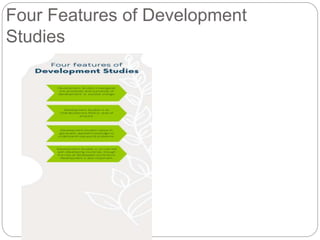
Four Features of Development
Studies
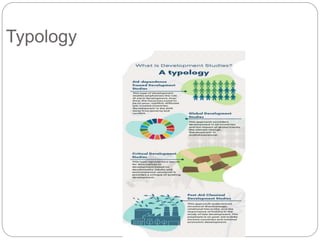
Typology
Why it is important?
 The international agenda began to focus on development
beginning in the second half of the twentieth century. An
understanding developed that economic growth did not
necessarily lead to a rise in the level and quality of life for
populations all over the world; there was a need to place
an emphasis on specific policies that would channel
resources and enable social and economic mobility for
various layers of the population.
Scholarly Perspectives
 Through the years, professionals and various researchers
developed a number of definitions and emphases for the
term “development.” Amartya Sen, for example, developed
the “capability approach,” which defined development as a
tool enabling people to reach the highest level of their
ability, through granting freedom of action, i.e., freedom of
economic, social and family actions, etc. This approach
became a basis for the measurement of development by
the HDI (Human Development Index), which was
developed by the UN Development Program (UNDP) in
1990. Martha Nussbaum developed the abilities approach
in the field of gender and emphasized the empowerment
of women as a development tool.
 In contrast, professionals like Jeffrey Sachs and Paul
Collier focused on mechanisms that prevent or oppress
development in various countries, and cause them to
linger in abject poverty for dozens of years. These are the
various poverty traps, including civil wars, natural
resources and poverty itself. The identification of these
traps enables relating to political – economic – social
conditions in a country in an attempt to advance
development. One of the emphases in the work of Jeffrey
Sacks is the promotion of sustainable development, which
believes in growth and development in order to raise the
standard of living for citizens of the world today, through
relating to the needs of environmental resources and the
Operationalization of Development
 ‘Development’ is a concept which is contested both
theoretically and politically, and is inherently both complex
and ambiguous.
 Development is a process that creates growth,
progress, positive change or the addition of physical,
economic, environmental, social and demographic
components.
 Why?
If development means good change, questions arise about
what is good and what sort of change matters…
It would be an understatement to say that the definition of
‘development’ has been controversial and unstable over
time.
Development is ‘contested, … complex, and ambiguous.
Objectives of Development
 increases in availability and improvements in the
distribution of food, shelter, education, health, protection,
etc. through relevant growth processes.
 improvements in ‘levels of living, including income, jobs,
education, etc. by creating conditions conducive to the
growth through the establishment of social, political and
economic systems and institutions which promote human
dignity and respect.
 expansions in the range of economic and social choices
available to individuals and nations e.g. varieties of goods
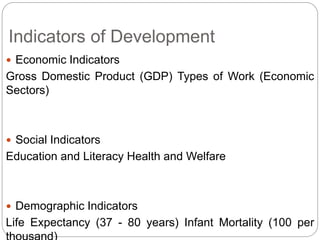
Indicators of Development
 Economic Indicators
Gross Domestic Product (GDP) Types of Work (Economic
Sectors)
 Social Indicators
Education and Literacy Health and Welfare
 Demographic Indicators
Life Expectancy (37 - 80 years) Infant Mortality (100 per
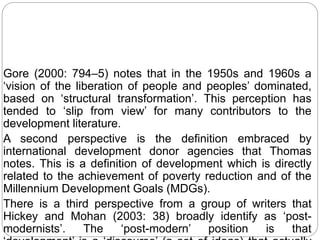
Gore (2000: 794–5) notes that in the 1950s and 1960s a
‘vision of the liberation of people and peoples’ dominated,
based on ‘structural transformation’. This perception has
tended to ‘slip from view’ for many contributors to the
development literature.
A second perspective is the definition embraced by
international development donor agencies that Thomas
notes. This is a definition of development which is directly
related to the achievement of poverty reduction and of the
Millennium Development Goals (MDGs).
There is a third perspective from a group of writers that
Hickey and Mohan (2003: 38) broadly identify as ‘post-
modernists’. The ‘post-modern’ position is that
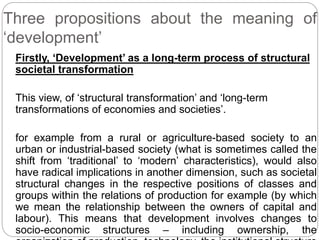
Three propositions about the meaning of
‘development’
Firstly, ‘Development’ as a long-term process of structural
societal transformation
This view, of ‘structural transformation’ and ‘long-term
transformations of economies and societies’.
for example from a rural or agriculture-based society to an
urban or industrial-based society (what is sometimes called the
shift from ‘traditional’ to ‘modern’ characteristics), would also
have radical implications in another dimension, such as societal
structural changes in the respective positions of classes and
groups within the relations of production for example (by which
we mean the relationship between the owners of capital and
labour). This means that development involves changes to
socio-economic structures – including ownership, the
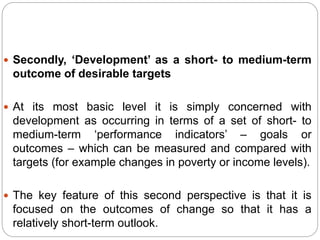
 Secondly, ‘Development’ as a short- to medium-term
outcome of desirable targets
 At its most basic level it is simply concerned with
development as occurring in terms of a set of short- to
medium-term ‘performance indicators’ – goals or
outcomes – which can be measured and compared with
targets (for example changes in poverty or income levels).
 The key feature of this second perspective is that it is
focused on the outcomes of change so that it has a
relatively short-term outlook.
 Thirdly, Development’ as a dominant ‘discourse’ of
Western modernity
Sustainable Development
 Defined as development that is likely to achieve human
needs and improvement of the quality of life and
encompasses:
Reducing Poverty
Environmental Protection
Sustainable natural resource management
Water and food security
MDGs - SDGs
Cycle of underdevelopment
High Birth Rate> Large Families>Low PCI> Poverty> Low Output
Per Worker> Low PCI> Low Productivity> Poor
Health>Inadequate Housing Remedy > Downward spiral not
reversible without mass
Natural and Human Systems
External and Internal Conditions;
Colonialism
Globalization
Foreign Aid
Governance
 Q & A

Class-Lecture-1.pptx

  • 1.
  • 2.
    Definition of DevelopmentStudies  Development Studies, as an academic field of study, is also characterized by normative and policy concerns about inclusive and sustainable development. It aims to contribute to possible solutions to societal problems and is increasingly applied in focus and engaged with policy and practice.  Development Studies (also known as ‘international development studies’ or ‘international development’) is a multi- and inter-disciplinary field of study rather than a single discipline. It seeks to understand the interplay between social, economic, political, technological, ecological, cultural and gendered aspects of societal 2
  • 3.
    Four Features ofDevelopment Studies
  • 4.
  • 5.
    Why it isimportant?
  • 6.
     The internationalagenda began to focus on development beginning in the second half of the twentieth century. An understanding developed that economic growth did not necessarily lead to a rise in the level and quality of life for populations all over the world; there was a need to place an emphasis on specific policies that would channel resources and enable social and economic mobility for various layers of the population.
  • 7.
    Scholarly Perspectives  Throughthe years, professionals and various researchers developed a number of definitions and emphases for the term “development.” Amartya Sen, for example, developed the “capability approach,” which defined development as a tool enabling people to reach the highest level of their ability, through granting freedom of action, i.e., freedom of economic, social and family actions, etc. This approach became a basis for the measurement of development by the HDI (Human Development Index), which was developed by the UN Development Program (UNDP) in 1990. Martha Nussbaum developed the abilities approach in the field of gender and emphasized the empowerment of women as a development tool.
  • 8.
     In contrast,professionals like Jeffrey Sachs and Paul Collier focused on mechanisms that prevent or oppress development in various countries, and cause them to linger in abject poverty for dozens of years. These are the various poverty traps, including civil wars, natural resources and poverty itself. The identification of these traps enables relating to political – economic – social conditions in a country in an attempt to advance development. One of the emphases in the work of Jeffrey Sacks is the promotion of sustainable development, which believes in growth and development in order to raise the standard of living for citizens of the world today, through relating to the needs of environmental resources and the
  • 9.
    Operationalization of Development ‘Development’ is a concept which is contested both theoretically and politically, and is inherently both complex and ambiguous.  Development is a process that creates growth, progress, positive change or the addition of physical, economic, environmental, social and demographic components.  Why?
  • 10.
    If development meansgood change, questions arise about what is good and what sort of change matters… It would be an understatement to say that the definition of ‘development’ has been controversial and unstable over time. Development is ‘contested, … complex, and ambiguous.
  • 11.
    Objectives of Development increases in availability and improvements in the distribution of food, shelter, education, health, protection, etc. through relevant growth processes.  improvements in ‘levels of living, including income, jobs, education, etc. by creating conditions conducive to the growth through the establishment of social, political and economic systems and institutions which promote human dignity and respect.  expansions in the range of economic and social choices available to individuals and nations e.g. varieties of goods
  • 12.
    Indicators of Development Economic Indicators Gross Domestic Product (GDP) Types of Work (Economic Sectors)  Social Indicators Education and Literacy Health and Welfare  Demographic Indicators Life Expectancy (37 - 80 years) Infant Mortality (100 per
  • 13.
    Gore (2000: 794–5)notes that in the 1950s and 1960s a ‘vision of the liberation of people and peoples’ dominated, based on ‘structural transformation’. This perception has tended to ‘slip from view’ for many contributors to the development literature. A second perspective is the definition embraced by international development donor agencies that Thomas notes. This is a definition of development which is directly related to the achievement of poverty reduction and of the Millennium Development Goals (MDGs). There is a third perspective from a group of writers that Hickey and Mohan (2003: 38) broadly identify as ‘post- modernists’. The ‘post-modern’ position is that
  • 14.
    Three propositions aboutthe meaning of ‘development’ Firstly, ‘Development’ as a long-term process of structural societal transformation This view, of ‘structural transformation’ and ‘long-term transformations of economies and societies’. for example from a rural or agriculture-based society to an urban or industrial-based society (what is sometimes called the shift from ‘traditional’ to ‘modern’ characteristics), would also have radical implications in another dimension, such as societal structural changes in the respective positions of classes and groups within the relations of production for example (by which we mean the relationship between the owners of capital and labour). This means that development involves changes to socio-economic structures – including ownership, the
  • 15.
     Secondly, ‘Development’as a short- to medium-term outcome of desirable targets  At its most basic level it is simply concerned with development as occurring in terms of a set of short- to medium-term ‘performance indicators’ – goals or outcomes – which can be measured and compared with targets (for example changes in poverty or income levels).  The key feature of this second perspective is that it is focused on the outcomes of change so that it has a relatively short-term outlook.
  • 16.
     Thirdly, Development’as a dominant ‘discourse’ of Western modernity
  • 17.
    Sustainable Development  Definedas development that is likely to achieve human needs and improvement of the quality of life and encompasses: Reducing Poverty Environmental Protection Sustainable natural resource management Water and food security MDGs - SDGs
  • 18.
    Cycle of underdevelopment HighBirth Rate> Large Families>Low PCI> Poverty> Low Output Per Worker> Low PCI> Low Productivity> Poor Health>Inadequate Housing Remedy > Downward spiral not reversible without mass Natural and Human Systems External and Internal Conditions; Colonialism Globalization Foreign Aid Governance
  • 19.