BIOINTENSIVE
                                                                  INTEGRATED PEST MANAGEMENT
                                                                              (IPM)
                                                                              FUNDAMENTALS OF SUSTAINABLE AGRICULTURE

  ATTRA is the national sustainable agriculture information center funded by the USDA’s Rural Business--Cooperative Service.
Abstract: This publication provides the rationale for biointensive Integrated
Pest Management (IPM), outlines the concepts and tools of biointensive IPM,
and suggests steps and provides informational resources for implementing IPM.
It is targeted to individuals interested in agriculture at all levels.

By Rex Dufour
NCAT Agriculture Specialist
July 2001

                                                                                Contents
  “Conventional” and “Biointensive” IPM ......................................................................................................... 2
  Why Move to Biointensive IPM? ....................................................................................................................... 4
  Components of Biointensive IPM ...................................................................................................................... 5
     How to Get Started ......................................................................................................................................... 5
     The Pest Manager/Ecosystem Manager ..................................................................................................... 5
     Proactive Strategies (Cultural Controls) ...................................................................................................... 6
     Biological Controls ........................................................................................................................................ 11
     Mechanical and Physical Controls ............................................................................................................. 12
     Pest Identification ......................................................................................................................................... 12
     Monitoring ..................................................................................................................................................... 13
     Economic Injury & Action Levels ............................................................................................................... 14
  Special Considerations ...................................................................................................................................... 14
     Cosmetic Damage and Aesthetics .............................................................................................................. 14
     Record-keeping ............................................................................................................................................. 14
     Chemical Controls ........................................................................................................................................ 14
  Integrated Weed Management Systems ......................................................................................................... 17
  Current Status of IPM ....................................................................................................................................... 19
     Crops with Developed IPM Programs ...................................................................................................... 19
     Government Policy ....................................................................................................................................... 19
  The Future of IPM .............................................................................................................................................. 20
     Food Quality Protection Act ........................................................................................................................ 20
     New Options ................................................................................................................................................. 20
     More Weed IPM ............................................................................................................................................ 20
  On-farm Resources ............................................................................................................................................ 21
  IPM On-line ........................................................................................................................................................ 21
  IPM Certification and Marketing .................................................................................................................... 21
  Summary ............................................................................................................................................................. 22
  References ........................................................................................................................................................... 23
  Appendices:
     A: IPM Planning Considerations ................................................................................................................ 25
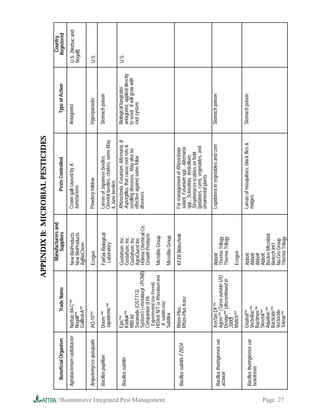
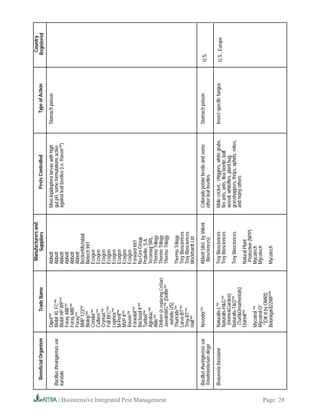
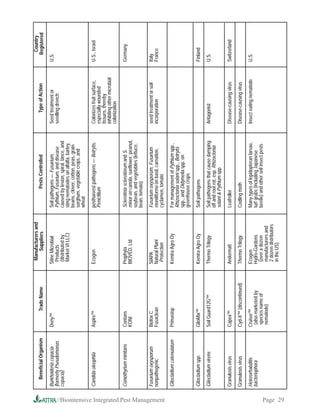
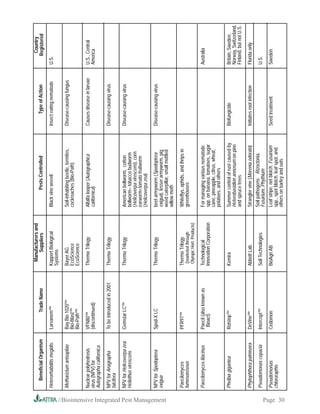
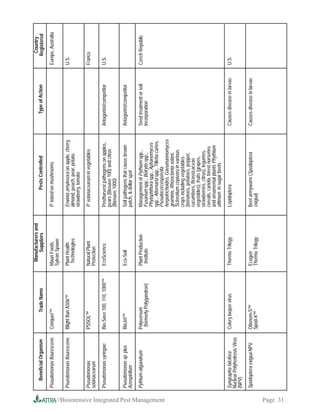
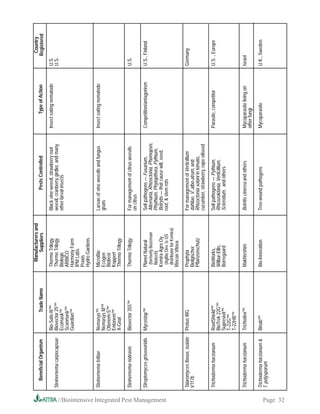
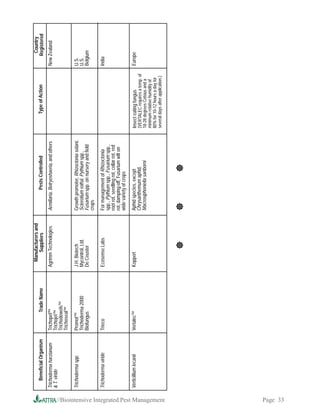
     B: Microbial Pesticides ................................................................................................................................ 27
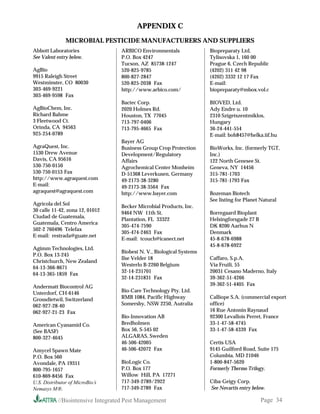
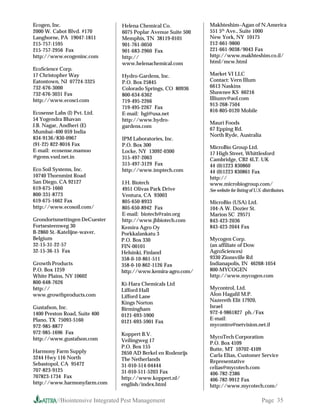
     C: Microbial Pesticide Manufacturers and Suppliers ............................................................................. 34
     D: Conservation Security Act 2000 ............................................................................................................ 37
     E: Pest Management Practices in Major Crops ........................................................................................ 38
     F: IPM Information Resources ................................................................................................................... 39

                   ATTRA is a project of the National Center for Appropriate Technology
“Conventional” and “Biointensive” IPM                                                        ○ ○ ○ ○ ○


Pest management is an ecological matter. The             A conception of a managed resource, such
size of a pest population and the damage it              as a cropping system on a farm, as a
inflicts is, to a great extent, a reflection of the      component of a functioning ecosystem.
design and management of a particular agricul-           Actions are taken to restore and enhance
tural ecosystem.                                         natural balances in the system, not to
                                                         eliminate species. Regular monitoring
We humans compete with other organisms for               makes it possible to evaluate the popula-
food and fiber from our crops. We wish to                tions of pest and beneficial organisms. The
secure a maximum amount of the food re-                  producer can then take steps to enhance
source from a given area with minimum input              natural controls (or at least avoid or limit
of resources and energy. However, if the                 the disruption of natural controls) of the
agricultural system design and/or manage-                target pest(s).
ment is faulty—making it easy for pests to
develop and expand their populations or,                 An understanding that the presence of a
conversely, making it difficult for predators            pest does not necessarily constitute a
and parasites of pests to exist—then we will be          problem. Before a potentially disruptive
expending unnecessary resources for pest                 control method is employed, appropriate
management. Therefore, the first step in sus-            decision-making criteria are used to deter-
tainable and effective pest management is                mine whether or not pest management
looking at the design of the agricultural ecosys-        actions are needed.
tem and considering what ecological concepts
can be applied to the design and management              A consideration of all possible pest manage-
of the system to better manage pests and their           ment options before action is taken.
parasites and predators.
                                                         A philosophy that IPM strategies integrate
The design and management of our agricul-                a combination of all suitable techniques in
tural systems need re-examining. We’ve come              as compatible a manner as possible; it is
to accept routine use of biological poisons in           important that one technique not conflict
our food systems as normal. But routine use of           with another (1).
synthetic chemicals represents significant
energy inputs into the agricultural system, and       However, IPM has strayed from its ecological
carries both obvious and hidden costs to the          roots. Critics of what might be termed “con-
farmer and society. Attempting to implement           ventional” IPM note that it has been imple-
an ecology-based discipline like IPM in large         mented as Integrated Pesticide Management
monocultures, which substitute chemical               (or even Improved Pesticide Marketing) with
inputs for ecological design, can be an exercise      an emphasis on using pesticides as a tool of
in futility and inefficiency.                         first resort. What has been missing from this
                                                      approach, which is essentially reactive, is an
IPM, as it was originally conceived, proposed         understanding of the ecological basis of pest
to manage pests though an understanding of            infestations (see first bullet above). Also
their interactions with other organisms and the       missing from the conventional approach are
environment. Most of the 77 definitions for           guidelines for ecology-based manipulations of the
IPM listed in The Database of IPM Resources           farm agroecosystem that address the questions:
(DIR) website, <http://www.ipmnet.org/
DIR/>, despite some differences in emphasis,             Why is the pest there?
agree with this idea and have the following              How did it arrive?
elements in common:                                      Why doesn’t the parasite/predator
                                                         complex control the pest?


          //Biointensive Integrated Pest Management                                           Page 2
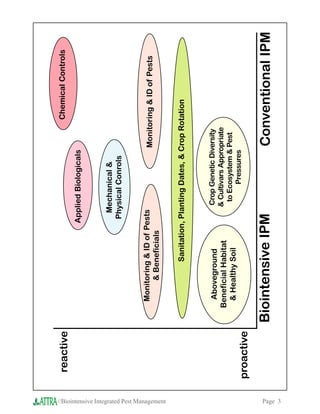
reactive                                                           Chemical Controls
                                                                                Applied Biologicals


                                                                                  Mechanical &
                                                                                 Physical Conrols


                                                           Monitoring & ID of Pests                    Monitoring & ID of Pests
                                                                & Beneficials


//Biointensive Integrated Pest Management
                                                                      Sanitation, Planting Dates, & Crop Rotation


                                                            Aboveground               Crop Genetic Diversity
                                                          Beneficial Habitat          & Cultivars Appropriate
                                                           & Healthy Soil              to Ecosystem & Pest
                                                                                             Pressures
                                            proactive

                                                        Biointensive IPM                               Conventional IPM


Page 3
Why Move to Biointensive IPM?                                                   ○ ○ ○ ○ ○


Biointensive IPM incorporates ecological and       dominated by farms. Although some pending
economic factors into agricultural system design   legislation has recognized the costs to farmers
and decision making, and addresses public          of providing these ecological services (see
concerns about environmental quality and food      Appendix D), it’s clear that farmers and
safety. The benefits of implementing               ranchers will be required to manage their land
biointensive IPM can include reduced chemical      with greater attention to direct and indirect off-
input costs, reduced on-farm and off-farm          farm impacts of various farming practices on
environmental impacts, and more effective          water, soil, and wildlife resources. With this
and sustainable pest management. An                likely future in mind, reducing dependence on
ecology-based IPM has the potential of             chemical pesticides in favor of ecosystem
decreasing inputs of fuel, machinery, and          manipulations is a good strategy for farmers.
synthetic chemicals—all of which are energy
intensive and increasingly costly in terms of      Consumers Union, a group that has carried
financial and environmental impact. Such           out research and advocacy on various
reductions will benefit the grower and society.    pesticide problems for many years, defines
                                                   biointensive IPM as the highest level of IPM:
Over-reliance on the use of synthetic pesticides
in crop protection programs around the world          “a systems approach to pest management
has resulted in disturbances to the environ-          based on an understanding of pest ecology.
ment, pest resurgence, pest resistance to pesti-      It begins with steps to accurately diagnose
                                                      the nature and source of pest problems,
cides, and lethal and sub-lethal effects on non-
                                                      and then relies on a range of preventive
target organisms, including humans (3). These         tactics and biological controls to keep pest
side effects have raised public concern about         populations within acceptable limits.
the routine use and safety of pesticides. At the      Reduced-risk pesticides are used if other
same time, population increases are placing           tactics have not been adequately effective,
ever-greater demands upon the “ecological             as a last resort, and with care to minimize
services”—that is, provision of clean air, water      risks.” (2)
and wildlife habitat—of a landscape
                                                   This “biointensive” approach sounds remark-
  Prior to the mid-1970s, lygus bugs were          ably like the original concept of IPM. Such a
  considered to be the key pest in California      “systems” approach makes sense both intu-
  cotton. Yet in large-scale studies on insec-     itively and in practice.
  ticidal control of lygus bugs, yields in un-
  treated plots were not significantly differ-     The primary goal of biointensive IPM is to
  ent from those on treated plots. This was        provide guidelines and options for the effective
  because the insecticides often induced out-      management of pests and beneficial organisms
  breaks of secondary lepidopterous larvae         in an ecological context. The flexibility and
  (i.e., cabbage looper, beet armyworm, and        environmental compatibility of a biointensive
  bollworm) and mite pests which caused ad-        IPM strategy make it useful in all types of
  ditional damage as well as pest resurgence       cropping systems.
  of the lygus bug itself. These results, from
  an economic point of view, seem paradoxi-        Even conventional IPM strategies help to
  cal, as the lygus bug treatments were costly,    prevent pest problems from developing, and
  yet the treated plots consistently had lower     reduce or eliminate the use of chemicals in
  yields (i.e., it cost farmers money to lose      managing problems that do arise. Results of 18
  money). This paradox was first pointed out       economic evaluations of conventional IPM on
  by R. van den Bosch, V. Stern, and L. A.         cotton showed a decrease in production costs
  Falcon, who forced a reevaluation of the         of 7 percent and an average decrease in pesti-
  economic basis of Lygus control in Califor-      cide use of 15 percent (4). Biointensive IPM
  nia cotton (5).                                  would likely decrease chemical use and costs
                                                   even further.

         //Biointensive Integrated Pest Management                                          Page 4
Components of Biointensive IPM                                                       ○ ○ ○ ○ ○


An important difference between conventional         When planning a biointensive IPM program,
and biointensive IPM is that the emphasis of         some considerations include:
the latter is on proactive measures to redesign         Options for design changes in the agricul-
the agricultural ecosystem to the disadvantage          tural system (beneficial organism habitat,
of a pest and to the advantage of its parasite          crop rotations)
and predator complex. At the same time,                 Choice of pest-resistant cultivars
biointensive IPM shares many of the same                Technical information needs
components as conventional IPM, including               Monitoring options, record keeping, equip-
monitoring, use of economic thresholds, record          ment, etc.
keeping, and planning.
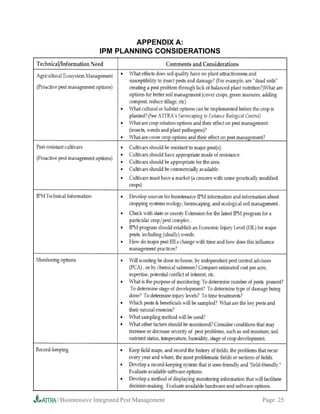
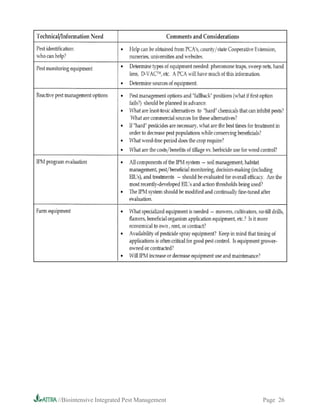
                                                     The table in Appendix A provides more details
How To Get Started With IPM                          about these and other ideas that should be
— PLANNING, PLANNING, PLANNING                       considered when implementing a biointensive
                                                     IPM program.
Good planning must precede implementation
of any IPM program, but is particularly impor-       The Pest Manager / Ecosystem Manager
tant in a biointensive program. Planning
should be done before planting because many          The pest manager is the most important link in
pest strategies require steps or inputs, such as     a successful IPM program. The manager must
beneficial organism habitat management, that         know the biology of the pest and the beneficial
must be considered well in advance. Attempt-         organisms associated with the pest, and under-
ing to jump-start an IPM program in the begin-       stand their interactions within the farm envi-
ning or middle of a cropping season generally        ronment. As a detailed knowledge of the pest
does not work.                                       is developed, weak links in its life cycle

                              Blocks on the Pesticide Treadmill

 Resistance: Pesticide use exerts a powerful selection pressure for changing the genetic make-up of
 a pest population. Naturally resistant individuals in a pest population are able to survive pesti-
 cide treatments. The survivors pass on the resistance trait to their offspring. The result is a much
 higher percentage of the pest population resistant to a pesticide. In the last decade, the number of
 weed species known to be resistant to herbicides rose from 48 to 270, and the number of plant
 pathogens resistant to fungicides grew from 100 to 150. Resistance to insecticides is so common —
 more than 500 species — that nobody is really keeping score (2).

 Resurgence: Pesticides often kill off natural enemies along with the pest. With their natural en-
 emies eliminated, there is little to prevent recovered pest populations from exploding to higher,
 more damaging numbers than existed before pesticides were applied. Additional chemical pesti-
 cide treatments only repeat this cycle.

 Secondary Pests: Some potential pests that are normally kept under good control by natural en-
 emies become actual pests after their natural enemies are destroyed by pesticides. Mite outbreaks
 after pesticide applications are a classic example.

 Residues: Only a minute portion of any pesticide application contacts the target organism. The
 remainder may degrade harmlessly, but too often water, wind, and soil will carries pesticides to
 non-target areas and organisms, affecting the health of human and wildlife populations. Public
 concerns over residues are deepened by the lack of research and knowledge about possible syner-
 gistic interactions between pesticide residues and the hundreds of other synthetic chemical resi-
 dues now found in the environment.


         //Biointensive Integrated Pest Management                                           Page 5
become apparent. These weak links are phases                 The second set of options is more reactive.
of the life cycle when the pest is most suscep-              This simply means that the grower responds to
tible to control measures. The manager must                  a situation, such as an economically damaging
integrate this knowledge with tools and tech-                population of pests, with some type of short-
niques of biointensive IPM to manage not one,                term suppressive action. Reactive methods
but several pests. A more accurate title for the             generally include inundative releases of bio-
pest manager is “ecosystem doctor,” for he or                logical controls, mechanical and physical
                                                             controls, and chemical controls.
she must pay close attention to the pulse of the
managed ecosystem and stay abreast of devel-
                                                             Proactive Strategies (Cultural Control)
opments in IPM and crop/pest biology and
ecology. In this way, the ecosystem manager                  •   Healthy, biologically active soils (increasing
can take a proactive approach to managing                        belowground diversity)
pests, developing ideas about system manipu-
lations, testing them, and observing the results.            •   Habitat for beneficial organisms (increasing
                                                                 aboveground diversity)
IPM options may be considered proactive or
reactive. Proactive options, such as crop                    •   Appropriate plant cultivars
rotations and creation of habitat for beneficial
organisms, permanently lower the carrying                    Cultural controls are manipulations of the
capacity of the farm for the pest. The carrying              agroecosystem that make the cropping system
capacity is determined by factors like food,                 less friendly to the establishment and prolifera-
shelter, natural enemies complex, and weather,               tion of pest populations. Although they are
                                                             designed to have positive effects on farm
which affect the reproduction and survival of a
                                                             ecology and pest management, negative im-
species. Cultural controls are generally consid-
                                                             pacts may also result, due to variations in
ered to be proactive strategies.                             weather or changes in crop management.


                  Carrying Capacity of Farm Systems for Pest Populations:

In a non-farmscaped system, where pests have fewer natural controls and thus reach higher average
populations, they are more likely to approach or exceed the economic threshold level for the crop, making
pesticide treatments likely. In a farmscaped system, greater and more consistent populations of beneficial
organisms put more ecological pressure on the pests, with the result that pest populations are less likely to
approach the economic threshold. In other words, the ecological carrying capacity for a pest will probably be lower in
a farmscaped system. For more on farmscaping, see p. 11.


           //Biointensive Integrated Pest Management                                                      Page 6
Maintaining and increasing biological diversity      occur there as well. For example, larvae of one
of the farm system is a primary strategy of          species of blister beetle consume about 43
cultural control. Decreased biodiversity tends       grasshopper eggs before maturing (10). Both
to result in agroecosystems that are unstable        are found in the soil. (Unfortunately, although
and prone to recurrent pest outbreaks and            blister beetle larvae can help reduce grasshop-
many other problems (5). Systems high in             per populations, the adult beetles can be a
biodiversity tend to be more “dynamically            serious pest for many vegetable growers.)
stable”—that is, the variety of organisms            Overall, a healthy soil with a diversity of
provide more checks and balances on each             beneficial organisms and high organic matter
other, which helps prevent one species (i.e.,        content helps maintain pest populations below
pest species) from overwhelming the system.          their economic thresholds.

There are many ways to manage and increase          Genetic diversity of a particular crop may be
biodiversity on a farm, both above ground and       increased by planting more than one cultivar.
in the soil. In fact,                                                              For example, a
diversity above             “When we kill off the natural                          recent experiment
ground influences                                                                  in China (11)
                            enemies of a pest we inherit
diversity below                                                                    demonstrated that
                            their work”  Carl Huffaker                            disease-susceptible
ground. Research has
shown that up to half                                                             rice varieties
of a plant’s photosynthetic production (carbo-      planted in mixtures with resistant varieties had
hydrates) is sent to the roots, and half of that    89% greater yield and a 94% lower incidence of
(along with various amino acids and other           rice blast (a fungus) compared to when they
plant products) leaks out the roots into the        were grown in monoculture. The experiment,
surrounding soil, providing a food source for       which involved five townships in 1998 and ten
microorganisms. These root exudates vary            townships in 1999, was so successful that
from plant species to plant species and this        fungicidal sprays were no longer applied by
variation influences the type of organisms          the end of the two-year program.
associated with the root exudates (6).
                                                    Species diversity of the associated plant and
Factors influencing the health and biodiversity     animal community can be increased by allow-
of soils include the amount of soil organic         ing trees and other native plants to grow in
matter; soil pH; nutrient balance; moisture; and    fence rows or along water ways, and by inte-
parent material of the soil. Healthy soils with a   grating livestock into the farm system. Use of
diverse community of organisms support plant        the following cropping schemes are additional
health and nutrition better than soils deficient    ways to increase species diversity. (See
in organic matter and low in species diversity.     ATTRA’s Farmscaping to Enhance Biological
Research has shown that excess nutrients (e.g.,     Control for more information on this topic.)
too much nitrogen) as well as relative nutrient
balance (i.e., ratios of nutrientsfor example,     Crop rotations radically alter the environment
twice as much calcium as magnesium, com-            both above and below ground, usually to the
pared to equal amounts of both) in soils affect     disadvantage of pests of the previous crop.
insect pest response to plants (7, 8). Imbalances   The same crop grown year after year on the
in the soil can make a plant more attractive to     same field will inevitably build up populations
insect pests (7, 8), less able to recover from pest of organisms that feed on that plant, or, in the
damage, or more susceptible to secondary            case of weeds, have a life cycle similar to that
infections by plant pathogens (8). Soils rich in    of the crop. Add to this the disruptive effect of
organic matter tend to suppress plant patho-        pesticides on species diversity, both above and
gens (9). In addition, it is estimated that 75% of  below ground, and the result is an unstable
all insect pests spend part of their life cycle in  system in which slight stresses (e.g., new pest
the soil, and many of their natural enemies         variety or drought) can devastate the crop.

         //Biointensive Integrated Pest Management                                          Page 7
An enforced rotation program in the Imperial Val-          direct return per acre than the alternate crop,
    ley of California has effectively controlled the           but may also lower management costs for the
    sugar beet cyst nematode. Under this program,              alternate crop (by reducing weed pressure, for
    sugar beets may not be grown more than two                 example, and thus avoiding one tillage or
    years in a row or more than four years out of ten          herbicide application), with a net increase in
    in clean fields (i.e., non-infested fields). In infested   profit.
    fields, every year of a sugar beet crop must be
    followed by three years of a non-host crop. Other          Other Cropping Structure Options
    nematode pests commonly controlled with crop
    rotation methods include the golden nematode               Multiple cropping is the sequential production
    of potato, many root-knot nematodes, and the               of more than one crop on the same land in one
    soybean cyst nematode.                                     year. Depending on the type of cropping
                                                               sequence used, multiple cropping can be useful
When making a decision about crop rotation,
                                                               as a weed control measure, particularly when
consider the following questions: Is there an
                                                               the second crop is interplanted into the first.
economically sustainable crop that can be
rotated into the cropping system? Is it compat-
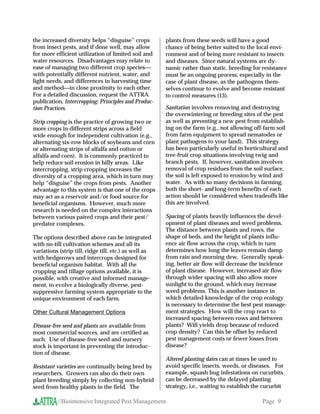
                                                               Interplanting is seeding or planting a crop into a
ible? Important considerations when develop-
                                                               growing stand, for example overseeding a
ing a crop rotation are:
                                                               cover crop into a grain stand. There may be
                                                               microclimate advantages (e.g., timing, wind
•    What two (or three or several) crops can
                                                               protection, and less radical temperature and
     provide an economic return when considered
                                                               humidity changes) as well as disadvantages
     together as a biological and economic system
                                                               (competition for light, water, nutrients) to this
     that includes considerations of sustainable soil
                                                               strategy. By keeping the soil covered, inter-
     management?
                                                               planting may also help protect soil against
                                                               erosion from wind and rain.
•    What are the impacts of this season’s crop-
     ping practices on subsequent crops?                       Intercropping is the practice of growing two or
                                                               more crops in the same, alternate, or paired
•    What specialized equipment is necessary for               rows in the same area. This technique is
     the crops?                                                particularly appropriate in vegetable produc-
                                                               tion. The advantage of intercropping is that
•    What markets are available for the rotation
     crops?

A corn/soybean rotation is one example of
rotating compatible economic crops. Corn is a
grass; soybean is a leguminous broadleaf. The
pest complex of each, including soil organisms,
is quite different. Corn rootworm, one of the
major pests of corn, is virtually eliminated by
using this rotation. Both crops generally
provide a reasonable return. Even rotations,
however, create selection pressures that will
ultimately alter pest genetics. A good example
is again the corn rootworm: the corn/bean
rotation has apparently selected for a small
population that can survive a year of non-corn
(i.e., soybean) cropping (12).

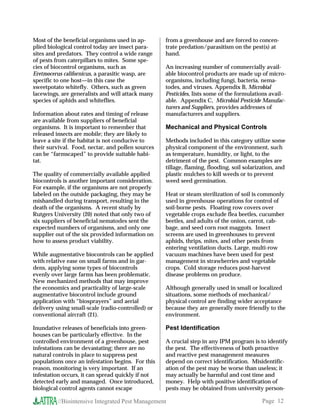
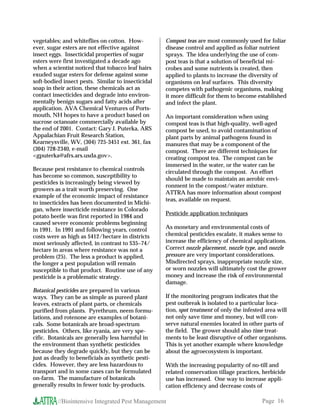
Management factors should also be considered.                         Intercropping French beans with cilantro
For example, one crop may provide a lower                             —a potential control for symphylans.


              //Biointensive Integrated Pest Management                                                          Page 8
the increased diversity helps “disguise” crops         plants from these seeds will have a good
from insect pests, and if done well, may allow         chance of being better suited to the local envi-
for more efficient utilization of limited soil and     ronment and of being more resistant to insects
water resources. Disadvantages may relate to           and diseases. Since natural systems are dy-
ease of managing two different crop species           namic rather than static, breeding for resistance
with potentially different nutrient, water, and        must be an ongoing process, especially in the
light needs, and differences in harvesting time        case of plant disease, as the pathogens them-
and methodin close proximity to each other.           selves continue to evolve and become resistant
For a detailed discussion, request the ATTRA           to control measures (13).
publication, Intercropping: Principles and Produc-
tion Practices.                                        Sanitation involves removing and destroying
                                                       the overwintering or breeding sites of the pest
Strip cropping is the practice of growing two or       as well as preventing a new pest from establish-
more crops in different strips across a field          ing on the farm (e.g., not allowing off-farm soil
wide enough for independent cultivation (e.g.,         from farm equipment to spread nematodes or
alternating six-row blocks of soybeans and corn        plant pathogens to your land). This strategy
or alternating strips of alfalfa and cotton or         has been particularly useful in horticultural and
alfalfa and corn). It is commonly practiced to         tree-fruit crop situations involving twig and
help reduce soil erosion in hilly areas. Like          branch pests. If, however, sanitation involves
intercropping, strip cropping increases the            removal of crop residues from the soil surface,
diversity of a cropping area, which in turn may        the soil is left exposed to erosion by wind and
help “disguise” the crops from pests. Another          water. As with so many decisions in farming,
advantage to this system is that one of the crops      both the short- and long-term benefits of each
may act as a reservoir and/or food source for          action should be considered when tradeoffs like
beneficial organisms. However, much more               this are involved.
research is needed on the complex interactions
between various paired crops and their pest/           Spacing of plants heavily influences the devel-
predator complexes.                                    opment of plant diseases and weed problems.
                                                       The distance between plants and rows, the
The options described above can be integrated          shape of beds, and the height of plants influ-
with no-till cultivation schemes and all its           ence air flow across the crop, which in turn
variations (strip till, ridge till, etc.) as well as   determines how long the leaves remain damp
with hedgerows and intercrops designed for             from rain and morning dew. Generally speak-
beneficial organism habitat. With all the              ing, better air flow will decrease the incidence
cropping and tillage options available, it is          of plant disease. However, increased air flow
possible, with creative and informed manage-           through wider spacing will also allow more
ment, to evolve a biologically diverse, pest-          sunlight to the ground, which may increase
suppressive farming system appropriate to the          weed problems. This is another instance in
unique environment of each farm.                       which detailed knowledge of the crop ecology
                                                       is necessary to determine the best pest manage-
Other Cultural Management Options                      ment strategies. How will the crop react to
                                                       increased spacing between rows and between
Disease-free seed and plants are available from        plants? Will yields drop because of reduced
most commercial sources, and are certified as          crop density? Can this be offset by reduced
such. Use of disease-free seed and nursery             pest management costs or fewer losses from
stock is important in preventing the introduc-         disease?
tion of disease.
                                                       Altered planting dates can at times be used to
Resistant varieties are continually being bred by      avoid specific insects, weeds, or diseases. For
researchers. Growers can also do their own             example, squash bug infestations on cucurbits
plant breeding simply by collecting non-hybrid         can be decreased by the delayed planting
seed from healthy plants in the field. The             strategy, i.e., waiting to establish the cucurbit

          //Biointensive Integrated Pest Management                                            Page 9
crop until overwintering adult squash bugs         to vegetables by insect pests when hay or straw
have died. To assist with disease management       was used as mulch. The difference was due to
decisions, the Cooperative Extension Service       spiders, which find mulch more habitable than
(CES) will often issue warnings of “infection      bare ground (15). Other researchers have
periods” for certain diseases, based upon the      found that living mulches of various clovers
weather.                                           reduce insect pest damage to vegetables and
                                                   orchard crops (16). Again, this reduction is due
In some cases, the CES also keeps track of         to natural predators and parasites provided
“degree days” needed for certain important         habitat by the clovers. Vetch has been used as
insect pests to develop. Insects, being cold-      both a nitrogen source and as a weed suppres-
blooded, will not develop below or above           sive mulch in tomatoes in Maryland (17).
certain threshold temperatures. Calculating        Growers must be aware that mulching may
accumulated degree days, that is, the number       also provide a more friendly environment for
of days above the threshold development            slugs and snails, which can be particularly
temperature for an insect pest, makes the          damaging at the seedling stage.
prediction of certain events, such as egg hatch,
possible. University of California has an excel-   Mulching helps to minimize the spread of soil-
lent website that uses weather station data from   borne plant pathogens by preventing their
around the state to help California growers        transmission through soil splash. Mulch, if
predict pest emergence: <http://
                                                   heavy enough, prevents the germination of
www.ipm.ucdavis.edu/WEATHER/
                                                   many annual weed seeds. Winged aphids are
ddretrieve.html>.
                                                   repelled by silver- or aluminum-colored
                                                   mulches (18). Recent springtime field tests at
Some growers gauge the emergence of insect
                                                   the Agricultural Research Service in Florence,
pests by the flowering of certain non-crop plant
                                                   South Carolina, have indicated that red plastic
species native to the farm. This method uses
the “natural degree days” accumulated by           mulch suppresses root-knot nematode damage
plants. For example, a grower might time           in tomatoes by diverting resources away from
cabbage planting for three weeks after the         the roots (and nematodes) and into foliage and
Amelanchier species (also known as saskatoon,      fruit (19).
shadbush, or serviceberry) on their farm are in
bloom. This will enable the grower to avoid        Biotech Crops. Gene transfer technology is being
peak egg-laying time of the cabbage maggot fly,    used by several companies to develop cultivars
as the egg hatch occurs about the time             resistant to insects, diseases, and herbicides.
Amelanchier species are flowering (14). Using      An example is the incorporation of genetic
this information, cabbage maggot management        material from Bacillus thuringiensis (Bt), a
efforts could be concentrated during a known       naturally occurring bacterium, into cotton,
time frame when the early instars (the most        corn, and potatoes, to make the plant tissues
easily managed stage) are active.                  toxic to bollworm, earworm, and potato beetle
                                                   larvae, respectively.
Optimum growing conditions are always impor-
tant. Plants that grow quickly and are healthy     Whether or not this technology should be
can compete with and resist pests better than      adopted is the subject of much debate. Oppo-
slow-growing, weak plants. Too often, plants       nents are concerned that by introducing Bt
grown outside their natural ecosystem range        genes into plants, selection pressure for resis-
must rely on pesticides to overcome conditions     tance to the Bt toxin will intensify and a valu-
and pests to which they are not adapted.           able biological control tool will be lost. There
                                                   are also concerns about possible impacts of
Mulches, living or non-living, are useful for      genetically-modified plant products (i.e., root
suppression of weeds, insect pests, and some       exudates) on non-target organisms as well as
plant diseases. Hay and straw, for example,        fears of altered genes being transferred to weed
provide habitat for spiders. Research in Ten-      relatives of crop plants. Whether there is a
nessee showed a 70% reduction in damage            market for gene-altered crops is also a

         //Biointensive Integrated Pest Management                                       Page 10
consideration for farmers and processors.             example, focuses on the establishment of
Proponents of this technology argue that use of       flowering annual or perennial plants that
such crops decreases the need to use toxic            provide pollen and nectar needed during
chemical pesticides.                                  certain parts of the insect life cycle. Other
                                                      habitat features provided by farmscaping
Biological Control                                    include water, alternative prey, perching sites,
                                                      overwintering sites, and wind protection.
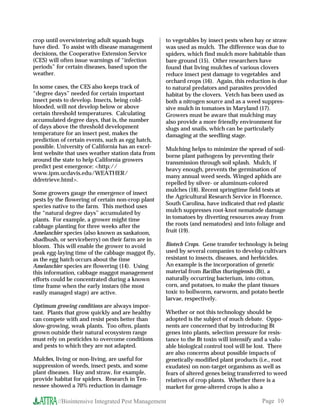
Biological control is the use of living organisms     Beneficial insects and other beneficial organ-
—parasites, predators, or pathogens—to main-          isms should be viewed as mini-livestock, with
tain pest populations below economically              specific habitat and food needs to be included
damaging levels, and may be either natural or         in farm planning.
applied. A first step in setting up a biointensive
IPM program is to assess the populations of           The success of such efforts depends on knowl-
beneficials and their interactions within the         edge of the pests and beneficial organisms
local ecosystem. This will                                                        within the cropping
help to determine the                                                             system. Where do
potential role of natural                                                         the pests and bene-
enemies in the managed                                                            ficials overwinter?
agricultural ecosystem. It                                                        What plants are hosts
should be noted that some                                                          and non-hosts?
groups of beneficials (e.g.,                                                       When this kind of
spiders, ground beetles,                                                           knowledge informs
bats) may be absent or                                                             planning, the eco-
scarce on some farms                                                               logical balance can
because of lack of habitat.                                                        be manipulated in
These organisms might                                                              favor of beneficials
make significant contri-                                                            and against the
butions to pest manage-        Beneficial organisms should be viewed as             pests.
ment if provided with          mini-livestock, with specific habitat and
adequate habitat.              food needs to be included in farm planning. It should be kept in
                                                                                   mind that ecosystem
Natural biological control results when naturally     manipulation is a two-edged sword. Some
occurring enemies maintain pests at a lower           plant pests (such as the tarnished plant bug
level than would occur without them, and is           and lygus bug) are attracted to the same plants
generally characteristic of biodiverse systems.       that attract beneficials. The development of
Mammals, birds, bats, insects, fungi, bacteria,       beneficial habitats with a mix of plants that
and viruses all have a role to play as predators      flower throughout the year can help prevent
and parasites in an agricultural system. By           such pests from migrating en masse from
their very nature, pesticides decrease the            farmscaped plants to crop plants.
biodiversity of a system, creating the potential
for instability and future problems. Pesticides,      See ATTRA’s Farmscaping to Enhance Biological
whether synthetically or botanically derived,         Control for a detailed treatment of this subject.
are powerful tools and should be used with
caution.                                              Applied biological control, also known as aug-
                                                      mentative biocontrol, involves supplementa-
Creation of habitat to enhance the chances for        tion of beneficial organism populations, for
survival and reproduction of beneficial organ-        example through periodic releases of parasites,
isms is a concept included in the definition of       predators, or pathogens. This can be effective
natural biocontrol. Farmscaping is a term coined      in many situations—well-timed inundative
to describe such efforts on farms.                    releases of Trichogramma egg wasps for co-
Habitat enhancement for beneficial insects, for       dling moth control, for instance.

          //Biointensive Integrated Pest Management                                          Page 11
Most of the beneficial organisms used in ap-       from a greenhouse and are forced to concen-
plied biological control today are insect para-    trate predation/parasitism on the pest(s) at
sites and predators. They control a wide range     hand.
of pests from caterpillars to mites. Some spe-
cies of biocontrol organisms, such as              An increasing number of commercially avail-
Eretmocerus californicus, a parasitic wasp, are    able biocontrol products are made up of micro-
specific to one host—in this case the              organisms, including fungi, bacteria, nema-
sweetpotato whitefly. Others, such as green        todes, and viruses. Appendix B, Microbial
lacewings, are generalists and will attack many    Pesticides, lists some of the formulations avail-
species of aphids and whiteflies.                  able. Appendix C, Microbial Pesticide Manufac-
                                                   turers and Suppliers, provides addresses of
Information about rates and timing of release      manufacturers and suppliers.
are available from suppliers of beneficial
organisms. It is important to remember that        Mechanical and Physical Controls
released insects are mobile; they are likely to
leave a site if the habitat is not conducive to    Methods included in this category utilize some
their survival. Food, nectar, and pollen sources   physical component of the environment, such
can be “farmscaped” to provide suitable habi-      as temperature, humidity, or light, to the
tat.                                               detriment of the pest. Common examples are
                                                   tillage, flaming, flooding, soil solarization, and
The quality of commercially available applied      plastic mulches to kill weeds or to prevent
biocontrols is another important consideration.    weed seed germination.
For example, if the organisms are not properly
labeled on the outside packaging, they may be      Heat or steam sterilization of soil is commonly
mishandled during transport, resulting in the      used in greenhouse operations for control of
death of the organisms. A recent study by          soil-borne pests. Floating row covers over
Rutgers University (20) noted that only two of     vegetable crops exclude flea beetles, cucumber
six suppliers of beneficial nematodes sent the     beetles, and adults of the onion, carrot, cab-
expected numbers of organisms, and only one        bage, and seed corn root maggots. Insect
supplier out of the six provided information on    screens are used in greenhouses to prevent
how to assess product viability.                   aphids, thrips, mites, and other pests from
                                                   entering ventilation ducts. Large, multi-row
While augmentative biocontrols can be applied      vacuum machines have been used for pest
with relative ease on small farms and in gar-      management in strawberries and vegetable
dens, applying some types of biocontrols           crops. Cold storage reduces post-harvest
evenly over large farms has been problematic.      disease problems on produce.
New mechanized methods that may improve
the economics and practicality of large-scale      Although generally used in small or localized
augmentative biocontrol include ground             situations, some methods of mechanical/
application with “biosprayers” and aerial          physical control are finding wider acceptance
delivery using small-scale (radio-controlled) or   because they are generally more friendly to the
conventional aircraft (21).                        environment.

Inundative releases of beneficials into green-     Pest Identification
houses can be particularly effective. In the
controlled environment of a greenhouse, pest       A crucial step in any IPM program is to identify
infestations can be devastating; there are no      the pest. The effectiveness of both proactive
natural controls in place to suppress pest         and reactive pest management measures
populations once an infestation begins. For this   depend on correct identification. Misidentific-
reason, monitoring is very important. If an        ation of the pest may be worse than useless; it
infestation occurs, it can spread quickly if not   may actually be harmful and cost time and
detected early and managed. Once introduced,       money. Help with positive identification of
biological control agents cannot escape            pests may be obtained from university person-

         //Biointensive Integrated Pest Management                                         Page 12
nel, private consultants, the Cooperative Exten-         Monitoring
sion Service, and books and websites listed
under Useful Resources at the end of this                Monitoring involves systematically checking
publication.                                             crop fields for pests and beneficials, at regular
                                                         intervals and at critical times, to gather infor-
After a pest is identified, appropriate and              mation about the crop, pests, and natural
effective management depends on knowing                  enemies. Sweep nets, sticky traps, and phero-
                                                         mone traps can be used to collect insects for
answers to a number of questions. These may
                                                         both identification and population density
include:
                                                         information. Leaf counts are one method for
                                                         recording plant growth stages. Square-foot or
•   What plants are hosts and non-hosts of this          larger grids laid out in a field can provide a
    pest?                                                basis for comparative weed counts. Records of
                                                         rainfall and temperature are sometimes used to
•   When does the pest emerge or first appear?           predict the likelihood of disease infections.

•   Where does it lay its eggs? In the case of           Specific scouting methods have been developed
    weeds, where is the seed source? For plant           for many crops. The Cooperative Extension
    pathogens, where is the source(s) of                 Service can provide a list of IPM manuals
    inoculum?                                            available in each state. Many resources are
                                                         now available via Internet (see Appendix F for
•   Where, how, and in what form does the pest           IPM-related websites).
    overwinter?
                                                         The more often a crop is monitored, the more
                                                         information the grower has about what is
•   How might the cropping system be altered
                                                         happening in the fields. Monitoring activity
    to make life more difficult for the pest and         should be balanced against its costs. Frequency
    easier for its natural controls?                     may vary with temperature, crop, growth
                                                         phase of the crop, and pest populations. If a
Monitoring (field scouting) and economic                 pest population is approaching economically
injury and action levels are used to help answer         damaging levels, the grower will want to
these and additional questions (22).                     monitor more frequently.


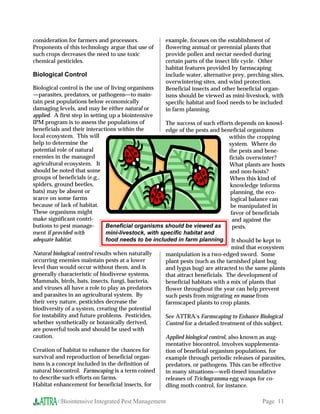
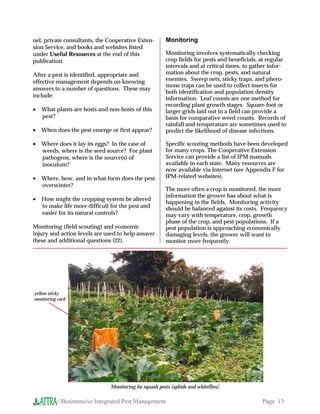
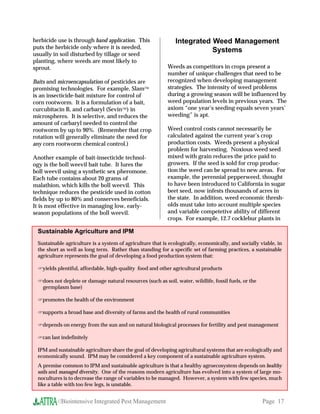
yellow sticky
monitoring card


                               Monitoring for squash pests (aphids and whiteflies).

           //Biointensive Integrated Pest Management                                            Page 13
Economic Injury and Action Levels                 cutworm can do more damage to an emerging
                                                  cotton plant than to a plant that is six weeks
The economic injury level (EIL) is the pest       old. Clearly, this pest’s EIL will change as the
population that inflicts crop damage greater      cotton crop develops.
than the cost of control measures. Because
growers will generally want to act before a       ETLs are intimately related to the value of the
population reaches EIL, IPM programs use the      crop and the part of the crop being attacked.
concept of an economic threshold level (ETL or    For example, a pest that attacks the fruit or
ET), also known as an action threshold. The       vegetable will have a much lower ETL (that is,
ETL is closely related to the EIL, and is the     the pest must be controlled at lower popula-
point at which suppression tactics should be      tions) than a pest that attacks a non-saleable
applied in order to prevent pest populations      part of the plant. The exception to this rule is
from increasing to injurious levels.              an insect or nematode pest that is also a disease
                                                  vector. Depending on the severity of the
In practice, many crops have no established       disease, the grower may face a situation where
EILs or ETLs, or the EILs that have been devel-   the ETL for a particular pest is zero, i.e., the
oped may be static over the course of a season    crop cannot tolerate the presence of a single
and thus not reflect the changing nature of the   pest of that particular species because the
agricultural ecosystem. For example, a single     disease it transmits is so destructive.

Special Considerations                                            ○ ○ ○ ○ ○


Cosmetic Damage and Aesthetics                    Time and Resources

Consumer attitudes toward how produce looks       A successful biointensive IPM program takes
is often a major factor when determining a        time, money, patience, short- and long-term
crop’s sale price. Cosmetic damage is an          planning, flexibility, and commitment. The
important factor when calculating the EIL,        pest manager must spend time on self-educa-
since pest damage, however superficial, lowers    tion and on making contacts with Extension
a crop’s market value. Growers selling to a       and research personnel. Be aware that some
market that is informed about IPM or about        IPM strategies, such as increasing beneficial
organically grown produce may be able to          insect habitat, may take more than a year to
tolerate higher levels of cosmetic damage to      show results.
their produce.
                                                  A well-run biointensive IPM system may
Record-keeping: “Past is prologue”                require a larger initial outlay in terms of time
                                                  and money than a conventional IPM program.
Monitoring goes hand-in-hand with record-         In the long run, however, a good biointensive
keeping, which forms the collective “memory”      IPM program should pay for itself. Direct
of the farm. Records should not only provide      pesticide application costs are saved and
information about when and where pest             equipment wear and tear may be reduced.
problems have occurred, but should also
incorporate information about cultural prac-      Chemical Controls
tices (irrigation, cultivation, fertilization,
mowing, etc.) and their effect on pest and        Included in this category are both synthetic
beneficial populations. The effects of non-       pesticides and botanical pesticides.
biotic factors, especially weather, on pest and
beneficial populations should also be noted.      Synthetic pesticides comprise a wide range of
Record-keeping is simply a systematic ap-         man-made chemicals used to control
proach to learning from experience. A variety     insects, mites, weeds, nematodes, plant dis-
of software programs are now available to help    eases, and vertebrate and invertebrate pests.
growers keep track of—and access—data on          These powerful chemicals are fast acting and
their farm’s inputs and outputs.                  relatively inexpensive to purchase.

         //Biointensive Integrated Pest Management                                       Page 14
Pesticides are the option of last resort in IPM            Biorational pesticides. Although use of this term
programs because of their potential negative               is relatively common, there is no legally ac-
impacts on the environment, which result from              cepted definition (24). Biorational pesticides
the manufacturing process as well as from their            are generally considered to be derived from
application on the farm. Pesticides should be              naturally occurring compounds or are formula-
used only when other measures, such as bio-                tions of microorganisms. Biorationals have a
logical or cultural controls, have failed to keep          narrow target range and are environmentally
pest populations from approaching economi-                 benign. Formulations of Bacillus thuringiensis,
cally damaging levels.                                     commonly known as Bt, are perhaps the best-
                                                           known biorational pesticide. Other examples
                                                           include silica aerogels, insect growth regula-
                                                           tors, and particle film barriers.

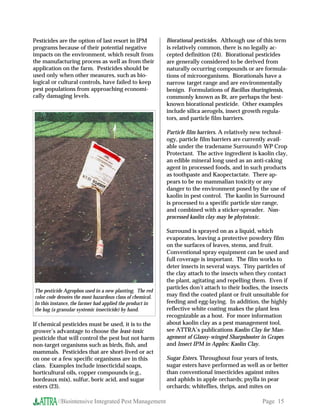
                                                           Particle film barriers. A relatively new technol-
                                                           ogy, particle film barriers are currently avail-
                                                           able under the tradename Surround WP Crop
                                                           Protectant. The active ingredient is kaolin clay,
                                                           an edible mineral long used as an anti-caking
                                                           agent in processed foods, and in such products
                                                           as toothpaste and Kaopectactate. There ap-
                                                           pears to be no mammalian toxicity or any
                                                           danger to the environment posed by the use of
                                                           kaolin in pest control. The kaolin in Surround
                                                           is processed to a specific particle size range,
                                                           and combined with a sticker-spreader. Non-
                                                           processed kaolin clay may be phytotoxic.

                                                           Surround is sprayed on as a liquid, which
                                                           evaporates, leaving a protective powdery film
                                                           on the surfaces of leaves, stems, and fruit.
                                                           Conventional spray equipment can be used and
                                                           full coverage is important. The film works to
                                                           deter insects in several ways. Tiny particles of
                                                           the clay attach to the insects when they contact
                                                           the plant, agitating and repelling them. Even if
                                                           particles don’t attach to their bodies, the insects
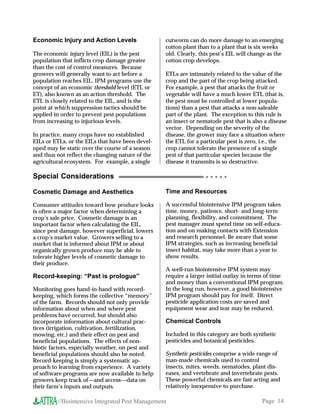
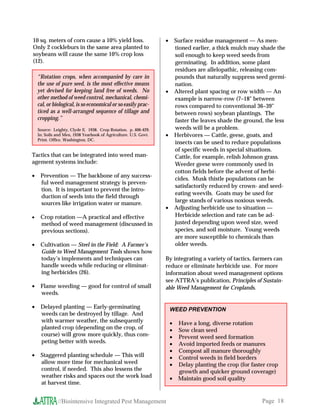
The pesticide Agrophos used in a new planting. The red
color code denotes the most hazardous class of chemical.   may find the coated plant or fruit unsuitable for
In this instance, the farmer had applied the product in    feeding and egg-laying. In addition, the highly
the bag (a granular systemic insecticide) by hand.         reflective white coating makes the plant less
                                                           recognizable as a host. For more information
If chemical pesticides must be used, it is to the          about kaolin clay as a pest management tool,
grower’s advantage to choose the least-toxic               see ATTRA’s publications Kaolin Clay for Man-
pesticide that will control the pest but not harm          agement of Glassy-winged Sharpshooter in Grapes
non-target organisms such as birds, fish, and              and Insect IPM in Apples: Kaolin Clay.
mammals. Pesticides that are short-lived or act
on one or a few specific organisms are in this             Sugar Esters. Throughout four years of tests,
class. Examples include insecticidal soaps,                sugar esters have performed as well as or better
horticultural oils, copper compounds (e.g.,                than conventional insecticides against mites
bordeaux mix), sulfur, boric acid, and sugar               and aphids in apple orchards; psylla in pear
esters (23).                                               orchards; whiteflies, thrips, and mites on

          //Biointensive Integrated Pest Management                                                Page 15
vegetables; and whiteflies on cotton. How-          Compost teas are most commonly used for foliar
ever, sugar esters are not effective against        disease control and applied as foliar nutrient
insect eggs. Insecticidal properties of sugar       sprays. The idea underlying the use of com-
esters were first investigated a decade ago         post teas is that a solution of beneficial mi-
when a scientist noticed that tobacco leaf hairs    crobes and some nutrients is created, then
exuded sugar esters for defense against some        applied to plants to increase the diversity of
soft-bodied insect pests. Similar to insecticidal   organisms on leaf surfaces. This diversity
soap in their action, these chemicals act as        competes with pathogenic organisms, making
contact insecticides and degrade into environ-      it more difficult for them to become established
mentally benign sugars and fatty acids after        and infect the plant.
application. AVA Chemical Ventures of Ports-
mouth, NH hopes to have a product based on          An important consideration when using
sucrose octanoate commercially available by         compost teas is that high-quality, well-aged
the end of 2001. Contact: Gary J. Puterka, ARS      compost be used, to avoid contamination of
Appalachian Fruit Research Station,                 plant parts by animal pathogens found in
Kearneysville, WV, (304) 725-3451 ext. 361, fax     manures that may be a component of the
(304) 728-2340, e-mail                              compost. There are different techniques for
<gputerka@afrs.ars.usda.gov>.                       creating compost tea. The compost can be
                                                    immersed in the water, or the water can be
Because pest resistance to chemical controls
                                                    circulated through the compost. An effort
has become so common, susceptibility to
                                                    should be made to maintain an aerobic envi-
pesticides is increasingly being viewed by
                                                    ronment in the compost/water mixture.
growers as a trait worth preserving. One
                                                    ATTRA has more information about compost
example of the economic impact of resistance
                                                    teas, available on request.
to insecticides has been documented in Michi-
gan, where insecticide resistance in Colorado
                                                    Pesticide application techniques
potato beetle was first reported in 1984 and
caused severe economic problems beginning
in 1991. In 1991 and following years, control       As monetary and environmental costs of
costs were as high as $412/hectare in districts     chemical pesticides escalate, it makes sense to
most seriously affected, in contrast to $35−74/     increase the efficiency of chemical applications.
hectare in areas where resistance was not a         Correct nozzle placement, nozzle type, and nozzle
problem (25). The less a product is applied,        pressure are very important considerations.
the longer a pest population will remain            Misdirected sprays, inappropriate nozzle size,
susceptible to that product. Routine use of any     or worn nozzles will ultimately cost the grower
pesticide is a problematic strategy.                money and increase the risk of environmental
                                                    damage.
Botanical pesticides are prepared in various
ways. They can be as simple as pureed plant         If the monitoring program indicates that the
leaves, extracts of plant parts, or chemicals       pest outbreak is isolated to a particular loca-
purified from plants. Pyrethrum, neem formu-        tion, spot treatment of only the infested area will
lations, and rotenone are examples of botani-       not only save time and money, but will con-
cals. Some botanicals are broad-spectrum            serve natural enemies located in other parts of
pesticides. Others, like ryania, are very spe-      the field. The grower should also time treat-
cific. Botanicals are generally less harmful in     ments to be least disruptive of other organisms.
the environment than synthetic pesticides           This is yet another example where knowledge
because they degrade quickly, but they can be       about the agroecosystem is important.
just as deadly to beneficials as synthetic pesti-
cides. However, they are less hazardous to          With the increasing popularity of no-till and
transport and in some cases can be formulated       related conservation tillage practices, herbicide
on-farm. The manufacture of botanicals              use has increased. One way to increase appli-
generally results in fewer toxic by-products.       cation efficiency and decrease costs of

          //Biointensive Integrated Pest Management                                         Page 16
herbicide use is through band application. This                Integrated Weed Management
puts the herbicide only where it is needed,
                                                                          Systems
usually in soil disturbed by tillage or seed
planting, where weeds are most likely to
sprout.                                                    Weeds as competitors in crops present a
                                                           number of unique challenges that need to be
Baits and microencapsulation of pesticides are             recognized when developing management
promising technologies. For example, Slam                 strategies. The intensity of weed problems
is an insecticide-bait mixture for control of              during a growing season will be influenced by
corn rootworm. It is a formulation of a bait,              weed population levels in previous years. The
curcubitacin B, and carbaryl (Sevin) in                   axiom “one year’s seeding equals seven years’
microspheres. It is selective, and reduces the             weeding” is apt.
amount of carbaryl needed to control the
rootworm by up to 90%. (Remember that crop                 Weed control costs cannot necessarily be
rotation will generally eliminate the need for             calculated against the current year’s crop
any corn rootworm chemical control.)                       production costs. Weeds present a physical
                                                           problem for harvesting. Noxious weed seed
Another example of bait-insecticide technol-               mixed with grain reduces the price paid to
ogy is the boll weevil bait tube. It lures the             growers. If the seed is sold for crop produc-
boll weevil using a synthetic sex pheromone.               tion the weed can be spread to new areas. For
Each tube contains about 20 grams of                       example, the perennial pepperweed, thought
malathion, which kills the boll weevil. This               to have been introduced to California in sugar
technique reduces the pesticide used in cotton             beet seed, now infests thousands of acres in
fields by up to 80% and conserves beneficials.             the state. In addition, weed economic thresh-
It is most effective in managing low, early-               olds must take into account multiple species
season populations of the boll weevil.                     and variable competetive ability of different
                                                           crops. For example, 12.7 cocklebur plants in

 Sustainable Agriculture and IPM
 Sustainable agriculture is a system of agriculture that is ecologically, economically, and socially viable, in
 the short as well as long term. Rather than standing for a specific set of farming practices, a sustainable
 agriculture represents the goal of developing a food production system that:

 yields plentiful, affordable, high-quality food and other agricultural products

 does not deplete or damage natural resources (such as soil, water, wildlife, fossil fuels, or the
  germplasm base)

 promotes the health of the environment

 supports a broad base and diversity of farms and the health of rural communities

 depends on energy from the sun and on natural biological processes for fertility and pest management

 can last indefinitely

 IPM and sustainable agriculture share the goal of developing agricultural systems that are ecologically and
 economically sound. IPM may be considered a key component of a sustainable agriculture system.
 A premise common to IPM and sustainable agriculture is that a healthy agroecosystem depends on healthy
 soils and managed diversity. One of the reasons modern agriculture has evolved into a system of large mo-
 nocultures is to decrease the range of variables to be managed. However, a system with few species, much
 like a table with too few legs, is unstable.


         //Biointensive Integrated Pest Management                                                    Page 17
10 sq. meters of corn cause a 10% yield loss.                     •       Surface residue management — As men-
Only 2 cockleburs in the same area planted to                             tioned earlier, a thick mulch may shade the
soybeans will cause the same 10% crop loss                                soil enough to keep weed seeds from
(12).                                                                     germinating. In addition, some plant
                                                                          residues are allelopathic, releasing com-
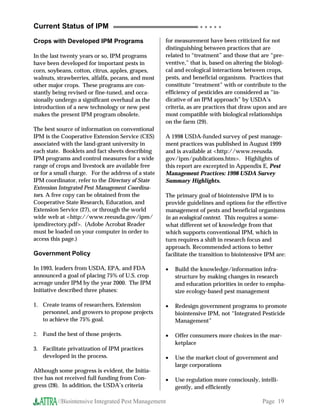
    “Rotation crops, when accompanied by care in                          pounds that naturally suppress seed germi-
    the use of pure seed, is the most effective means                     nation.
    yet devised for keeping land free of weeds. No                •       Altered plant spacing or row width — An
    other method of weed control, mechanical, chemi-                      example is narrow-row (7–18 between
    cal, or biological, is so economical or so easily prac-               rows compared to conventional 36–39
    ticed as a well-arranged sequence of tillage and                      between rows) soybean plantings. The
    cropping.”                                                            faster the leaves shade the ground, the less
    Source: Leighty, Clyde E. 1938. Crop Rotation. p. 406-429.            weeds will be a problem.
    In: Soils and Men, 1938 Yearbook of Agriculture. U.S. Govt.   •       Herbivores — Cattle, geese, goats, and
    Print. Office, Washington, DC.
                                                                          insects can be used to reduce populations
                                                                          of specific weeds in special situations.
Tactics that can be integrated into weed man-                             Cattle, for example, relish Johnson grass.
agement systems include:                                                  Weeder geese were commonly used in
                                                                          cotton fields before the advent of herbi-
•    Prevention — The backbone of any success-
                                                                          cides. Musk thistle populations can be
     ful weed management strategy is preven-
                                                                          satisfactorily reduced by crown- and seed-
     tion. It is important to prevent the intro-
                                                                          eating weevils. Goats may be used for
     duction of seeds into the field through
     sources like irrigation water or manure.                             large stands of various noxious weeds.
                                                                  •       Adjusting herbicide use to situation —
•    Crop rotation —A practical and effective                             Herbicide selection and rate can be ad-
     method of weed management (discussed in                              justed depending upon weed size, weed
     previous sections).                                                  species, and soil moisture. Young weeds
                                                                          are more susceptible to chemicals than
•    Cultivation — Steel in the Field: A Farmer’s                         older weeds.
     Guide to Weed Management Tools shows how
     today’s implements and techniques can                        By integrating a variety of tactics, farmers can
     handle weeds while reducing or eliminat-                     reduce or eliminate herbicide use. For more
     ing herbicides (26).                                         information about weed management options
                                                                  see ATTRA’s publication, Principles of Sustain-
•    Flame weeding — good for control of small                    able Weed Management for Croplands.
     weeds.

•    Delayed planting — Early-germinating                             WEED PREVENTION
     weeds can be destroyed by tillage. And
     with warmer weather, the subsequently                            •    Have a long, diverse rotation
     planted crop (depending on the crop, of                          •    Sow clean seed
     course) will grow more quickly, thus com-                        •    Prevent weed seed formation
     peting better with weeds.                                        •    Avoid imported feeds or manures
                                                                      •    Compost all manure thoroughly
•    Staggered planting schedule — This will                          •    Control weeds in field borders
     allow more time for mechanical weed                              •    Delay planting the crop (for faster crop
     control, if needed. This also lessens the                             growth and quicker ground coverage)
     weather risks and spaces out the work load                       •    Maintain good soil quality
     at harvest time.


              //Biointensive Integrated Pest Management                                                     Page 18
Current Status of IPM                                             ○ ○ ○ ○ ○


Crops with Developed IPM Programs                   for measurement have been criticized for not
                                                    distinguishing between practices that are
In the last twenty years or so, IPM programs        related to “treatment” and those that are “pre-
have been developed for important pests in          ventive,” that is, based on altering the biologi-
corn, soybeans, cotton, citrus, apples, grapes,     cal and ecological interactions between crops,
walnuts, strawberries, alfalfa, pecans, and most    pests, and beneficial organisms. Practices that
other major crops. These programs are con-          constitute “treatment” with or contribute to the
stantly being revised or fine-tuned, and occa-      efficiency of pesticides are considered as “in-
sionally undergo a significant overhaul as the      dicative of an IPM approach” by USDA’s
introduction of a new technology or new pest        criteria, as are practices that draw upon and are
makes the present IPM program obsolete.             most compatible with biological relationships
                                                    on the farm (29).
The best source of information on conventional
IPM is the Cooperative Extension Service (CES)      A 1998 USDA-funded survey of pest manage-
associated with the land-grant university in        ment practices was published in August 1999
each state. Booklets and fact sheets describing     and is available at http://www.reeusda.
IPM programs and control measures for a wide        gov/ipm/publications.htm. Highlights of
range of crops and livestock are available free     this report are excerpted in Appendix E, Pest
or for a small charge. For the address of a state   Management Practices: 1998 USDA Survey
IPM coordinator, refer to the Directory of State    Summary Highlights.
Extension Integrated Pest Management Coordina-
tors. A free copy can be obtained from the          The primary goal of biointensive IPM is to
Cooperative State Research, Education, and          provide guidelines and options for the effective
Extension Service (27), or through the world        management of pests and beneficial organisms
wide web at http://www.reeusda.gov/ipm/            in an ecological context. This requires a some-
ipmdirectory.pdf. (Adobe Acrobat Reader            what different set of knowledge from that
must be loaded on your computer in order to         which supports conventional IPM, which in
access this page.)                                  turn requires a shift in research focus and
                                                    approach. Recommended actions to better
Government Policy                                   facilitate the transition to biointensive IPM are:

In 1993, leaders from USDA, EPA, and FDA            •   Build the knowledge/information infra-
announced a goal of placing 75% of U.S. crop            structure by making changes in research
acreage under IPM by the year 2000. The IPM             and education priorities in order to empha-
Initiative described three phases:                      size ecology-based pest management

1. Create teams of researchers, Extension           •   Redesign government programs to promote
   personnel, and growers to propose projects           biointensive IPM, not “Integrated Pesticide
   to achieve the 75% goal.                             Management”

2.   Fund the best of those projects.               •   Offer consumers more choices in the mar-
                                                        ketplace
3. Facilitate privatization of IPM practices
   developed in the process.                        •   Use the market clout of government and
                                                        large corporations
Although some progress is evident, the Initia-
tive has not received full funding from Con-        •   Use regulation more consciously, intelli-
gress (28). In addition, the USDA’s criteria            gently, and efficiently

          //Biointensive Integrated Pest Management                                        Page 19
The Future of IPM                                       ○ ○ ○ ○


As this publication has highlighted, IPM in the        helped open the market for a new generation of
future will emphasize biological and ecological        microbial pesticides. For more information about
knowledge in managing pests. Beyond that,              microbial and “biopesticides”, see Appendix B,
specific areas are described here that will            Microbial Pesticides, and Appendix C, Microbial
impact research and implementation of IPM in           Pesticide Manufacturers and Suppliers, and visit
the future.                                            EPA’s biopesticides website at: http://
                                                       www.epa.gov/pesticides/biopesticides/.
Food Quality Protection Act (FQPA)                     (Please note that this website will be discontin-
                                                       ued sometime in 2001.)
The FQPA, the amended Federal Insecticide,
Fungicide, and Rodenticide Act (FIFRA),               Research is proceeding on natural endophytes —
requires the EPA to review all federally regis-       fungi or bacteria that have a symbiotic (mutu-
tered pesticides in the next 10 years and to use      ally beneficial) relationship with their host
a more comprehensive health standard when             plant—and their effects on plant pests. This
allowing re-registra-                                                                     research might
tion. The ultimate                                                                        yield products
impact is unknown,                                                                        that could be
                            “A convergence of technical, environmental and
but FQPA will most                                                                        used to inocu-
                            social forces is moving agriculture towards more
likely result in stricter                                                                 late plants
                            non-pesticide pest management alternatives like
regulations concern-                                                                      against certain
                            biological control, host plant resistance and
ing pesticide residues                                                                    pests.
                            cultural management.”
in food, particularly                —Michael Fitzner, National IPM Program Leader,
with respect to                                                                           Synthetic
                                                            USDA Extension Service
organochlorines,                                                                          beneficial
organophosphates,                                                                         attractants such
and carbamates. Some of the most toxic pesti-         as Predfeed IPM and L-tryptophan may help
cides have already been “de-registered” with          increase the efficacy of natural controls by
respect to some of their former uses. These           attracting beneficials to a crop in greater num-
regulations may provide incentive for more            bers than usual.
widespread adoption of IPM. More informa-
tion, including implementation status (from an        More Weed IPM
August 1999 Progress Report) can be found at
the FQPA homepage: http://www.epa.gov/               Weeds are the major deterrent to the develop-
opppsps1/fqpa/.                                      ment of more sustainable agricultural systems,
                                                      particularly in agronomic crops. Problems
New Options                                           associated with soil erosion and water quality
                                                      are generally the result of weed control mea-
Pest control methods are evolving and diversi-        sures like tillage, herbicides, cultivation, plant-
fying in response to public awareness of              ing date and pattern, etc. (30). In the future,
environmental and health impacts of synthetic         research will focus not on symptoms, such as
chemical pesticides and resulting legislation.        soil erosion, but on basic problems such as how
The strong growth of the organic foods mar-           to sustainably manage soils. Weeds, as an
ket—20% annual expansion for the past several         important facet of sustainable soil manage-
years—may also be a factor in the accelerated         ment, will consequently receive more emphasis
development of organic pest management                in IPM or Integrated Crop Management (ICM)
methods.                                              programs.

Agricultural pests are developing resistance to
many synthetic agrichemicals, and new syn-
thetic chemicals are being registered at a
slower rate than in the past. This situation has

          //Biointensive Integrated Pest Management                                            Page 20
On-farm Resources                                 selves with the Internet. See Appendix F for a
                                                  thorough listing of IPM resources available on
As farm management strategies become in-          the Internet.
creasingly fine-tuned to preserve a profitable
bottom line, the conservation, utilization, and   IPM Certification and Marketing
development of on-farm resources will take on
added importance. In the context of                                 Certification of crops raised
IPM, this will mean greater empha-                                  according to IPM or some
sis on soil management as well as                                   other ecology-based standards
on conserving beneficial organisms,                                 may give growers a marketing
retaining and developing beneficial                                 advantage as public concerns
habitats, and perhaps developing                                    about health and environmen-
on-farm insectaries for rearing                                     tal safety increase. For ex-
beneficial insects.                                                 ample, since 1995, Wegmans
                                                                    has sold IPM-labeled fresh-
IPM On-line                                                         market sweet corn in its
                                                                    Corning, Geneva, Ithaca,
There is an increasing body of infor-                               Syracuse, and Rochester, New
mation about production, market-                                    York stores. Wegmans has
ing, and recordkeeping available to                                 also
growers via the Internet. The                                       added IPM-labeled corn,
Internet is also a good source of in-                               beets, and beans to its shelves
formation about IPM, beneficial insects, prod-    of canned vegetables. One goal of the program,
ucts, and pest control options for individual     in addition to being a marketing vehicle, is to
crops. IPM specialists are generating high-       educate consumers about agriculture and the
quality websites as a modern educational deliv-   food system. Another goal is to keep all grow-
ery tool, and many Extension Service leaflets     ers moving along the “IPM Continuum.”
are now being made available in electronic for-   Growers must have an 80% “score” on the IPM
mat only. This trend will only accelerate as      program elements within three years, or face
more and more agriculturists familiarize them-    losing Wegmans as a buyer.


              One Generic Model for Ecolabel/IPM Certification Standards*


         //Biointensive Integrated Pest Management                                       Page 21
These “ecolabels,” as they’re known, are             There has been an IPM labeling program
becoming more popular, with over a dozen             casualty in 2000. Massachusetts’s “Partners
brands now in existence. They may provide            with Nature” marketing program closed its
for a more certain market and perhaps a price        doors after losing funding support from the
premium to help growers offset any costs             Massachusetts Department of Food and Agri-
associated with implementing sustainable             culture. The program, which included IPM
farming practices. A possible downside to            production guidelines, had operated since
implementing such programs is that they              1994, with 51 growers participating in 1999.
require additional paperwork, development of
standards and guidelines, and inspections.           A bibliography of IPM Certification, Labeling,
There is concern from some quarters that IPM         and Marketing can be found at: http://
labeling will cause consumers to raise more          www.ipminstitute.org/ipm_bibliography.htm.
questions about pesticide use and the safety of
conventional produce. Some advocates of             Summary                                        ○ ○ ○ ○
organic farming worry about consumer confu-
sion over the relationship of the ecolabel to the
                                                     IPM can be a flexible and valuable tool when
“Certified Organic” label.
                                                     used as a concept with which to approach pest
                                                     management. IPM is not a cookbook recipe for
Mothers  Others for a Livable Planet, a
                                                     pest control, but a flexible approach for dealing
national, non-profit, consumer advocacy and
                                                     with agriculture’s ever-changing financial,
environmental education organization, has
                                                     regulatory, and physical environment.
partnered with apple farmers in the Northeast
region to create a supportive market environ-
                                                     The key to effective IPM is the farmer’s under-
ment for farm products that are locally grown
                                                     standing of its concepts. In 1916, Liberty Hyde
and ecologically responsible. The result is the
                                                     Bailey wrote a small book, entitled The Prin-
Core Values eco-label:
                                                     ciples of Fruit Growing, as part of a Rural Science
                                                     Series published by MacMillan Co. The text is
                                                     a marvelous mix of scientific theory and prac-
                                                     tice. Bailey ended with the following note:

A CORE Values Northeast apple is locally               “We have now completed the fruit book,
grown in the Northeast (New York and New               having surveyed the field. It is a field of
England) by farmers who are striving to pro-           great variety, demanding many qualities on
vide apples of superior taste and quality while        the part of the successful grower. The
maintaining healthy, ecologically balanced             grower should first apprehend the prin-
growing environments. Growers whose apples             ciples and the underlying reasons, and to
bear the CORE Values Northeast seal are                teach this is the prime purpose of the book.
accredited in knowledge-based biointensive             If the grower knows why, he will teach
Integrated Pest Management (IPM) production            himself how” (31).
methods. For more information about this
program, visit: http://www.corevalues.org/
cvn/home.html.
                                                                               Feedback
The ecolabel to the right is a result of a                        Help us better help farmers. If you
collaboration between the World Wild-                             have suggestions for improvement of
life Fund (WWF), the Wisconsin                                    this publi-cation, areas about which
Potato and Vegetable Growers                                      you’d like more information or detail,
Association (WPVGA), and the                                      ideas, case studies, or sources of good
University of Wisconsin. Raising                                  IPM information (articles or websites),
consumer demand for biology-based-                                please call Rex Dufour at 530-756-8518
                                                                  ext. 39, or e-mail at rexd@ncat.org.
IPM farm products is the goal of the program.

         //Biointensive Integrated Pest Management                                             Page 22
References:                                              13) Elwell, Henry and Anita Maas. 1995. Natural
                                                             Pest and Disease Control. Natural Farming
1) Flint, M.L. and van den Bosch, R. 1977. A Source          Network. Harare, Zimbabwe. 128 p.
   Book on Integrated Pest Management. p. 173-174.
   Limited distribution. Supported by grant              14) Couch, G.J. 1994. The use of growing degree
   #G007500907 to UC International Center for                days and plant phenology in scheduling pest
   Integrated and Biological Control.                        management activities. Yankee Nursery Quar-
                                                             terly. Fall. p. 12-17.
2) Benbrook, Charles M. 1996. Pest Management at
   the Crossroads. Consumers Union, Yonkers, NY.         15) Reichert, Susan E. and Leslie Bishop. 1989. Prey
   272 p.                                                    control by an assemblage of generalist predators:
                                                             Spiders in garden test systems. Ecology. Fall.
3) Prakash, Anand and Jagadiswari Rao. 1997.                 p. 1441-1450.
   Botanical Pesticides in Agriculture. CRC Press,
   Boca Raton, FL. 461 p.                                16) Bugg, Robert L., Sharad C. Phatak, and James D.
                                                             Dutcher. 1990. Insects associated with cool-
4) Norton, G.W. and J. Mullen. 1994. Economic                season cover crops in southern Georgia: Implica-
   Evaluation of Integrated Pest Management                  tions for pest control in truck-farm and pecan
   Programs: A Literature Review. Virginia Coop-             agroecosystems. Biological Agriculture and
   erative Extension Publication 448-120.                    Horticulture. p. 17-45.
   112 p.
                                                         17) Abdul-Baki, Aref A., and John Teasdale. 1997.
5) Altieri, Miguel A. 1994. Biodiversity and Pest            Sustainable Production of Fresh Market Toma-
   Management in Agroecosystems. The Haworth                 toes and Other Summer Vegetables with Organic
   Press, Binghamton, NY. 185 p.                             Mulches. Farmers’ Bulletin No. 2279. USDA-
                                                             Agriculture Research Service, Washington, D.C.
6) Marschner, H. 1998. Soil-Root Interface: Biologi-         23 p. http://www.ars.usda.gov/is/np/
   cal and Biochemical Processes. p. 191-232. In: Soil       tomatoes.html.
   Chemistry and Ecosystem Health. P.M. Huang
   (ed.). Soil Science Society of America, Inc.,         18) Anon. 1999. Green Peach Aphid And Other
   Madison, WI.                                              Early Season Aphids. Webpage, Statewide IPM
                                                             Project, University of California, Division of
7) Phelan, L. 1997. Soil-management history and the          Agriculture and Natural Resources. http://
   role of plant mineral balance as a determinant of         axp.ipm.ucdavis.edu/PMG/r783300711.html.
   maize susceptibility to the European Corn Borer.
   Biological Agriculture and Horticulture. Vol. 15.     19) Adams, Sean. 1997. Seein’ red: colored mulch
   (1-4). p. 25-34.                                          starves nematodes. Agricultural Research.
                                                             October. p. 18.
8) Daane, K.M. et al. 1995. Excess nitrogen raises
   nectarine susceptibility to disease and insects.      20) Zien, S.M. 2001. B.U.G.S. Flyer. March. p. 1-3.
   California Agriculture. July-August. p. 13-18.
                                                         21) Marh, S. 2000. Mechanized delivery of beneficial
9) Schneider, R.W. 1982. Suppressive Soils and               insects. The IPM Practitioner. April. p. 1-5.
   Plant Disease. The American Phytopathological
   Society. St. Paul, MN. 88 p.                          22) Adams, Roger G. and Jennifer C. Clark (ed.).
                                                             1995. Northeast Sweet Corn Production and
10) Metcalf, Robert L. 1993. Destructive and Useful          Integrated Pest Management Manual. Univ. of
    Insects: Their Habits and Control, 5th ed.               Connecticut Coop. Ext. Service. 120 p.
    McGraw-Hill, NewYork, NY.
                                                         23) McBride, J. 2000. Environmentally friendly
11) Zhu, Y., H. et al. 2000. Genetic diversity and           insecticides are sugar-coated—For real.
    desease control in rice. Nature. 17 August.              ARS News and Information. March 10. http://
    p. 718-722.                                              www.ars.usda.gov/is/pr/2000/000310.htm.

12) Leslie, Anne R. and Gerritt Cuperus. 1993.           24) Williamson, R. C. 1999. Biorational pesticides:
    Successful Implementation of Integrated Pest             What are they anyway? Golf Course Manage
    Management for Agricultural Crops. CRC Press,            ment website. http://www.gcsaa.org/gcm/
    Boca Raton, FL. 193 p.                                   1999/oct99/10biorational.html.


          //Biointensive Integrated Pest Management                                                Page 23
25) Grafius, E. 1997. Economic impact of insecticide
    resistance in the Colorado potato beetle
    (Coleoptera: Chrysomelidae) on the Michigan
    potato industry. Journal of Economic Entomology.
    October. p. 1144.

26) Bowman, Greg (ed.). 1997. Steel in the Field.
    USDA Sustainable Agriculture Network.
    Burlington, VT. 128 p.

27) Directory of State Extension Pest Management
    Coordinators
    Wendy Leight/Michael Fitzner
    Ag Box 2220
    Coop State Research, Education, 
    Extension Service, USDA
    Washington, D.C. 20250-2220
    http://www.reeusda.gov/nipmn/

28) Green, Thomas A. 1997. The USDA IPM Initia-
    tive: What has been accomplished? IPM Solu-
    tions, Gempler’s Inc., Mt. Horeb, WI. November
    4 p.

29) Hoppin, Polly J. 1996. Reducing pesticide reliance
    and risk through adoption of IPM: An environ-
    mental and agricultural win-win. Third National
    IPM Forum. February. 9 p.

30) Wyse, Donald. 1994. New Technologies and
    Approaches for Weed Management in Sustainable
    Agriculture Systems. Weed Technology,
    Vol. 8. p. 403-407.

31) Steiner, P.W. 1994. IPM: What it is, what it isn’t..
    IPMnet NEWS. October.


           //Biointensive Integrated Pest Management       Page 24
APPENDIX A:
                IPM PLANNING CONSIDERATIONS


//Biointensive Integrated Pest Management     Page 25
//Biointensive Integrated Pest Management   Page 26
APPENDIX B: MICROBIAL PESTICIDES
                                                                                                           Manufacturers and                                                                             Country
                                               Beneficial Organism                   Trade Name               Suppliers                 Pests Controlled                    Type of Action              Registered
                                            Agrobacterium radiobacter     Norbac 84-C™                   New BioProducts       Crown gall caused by A.                Antagonist                     U.S. (Norbac and
                                                                          Nogall™                        New BioProducts       tumefaciens                                                           Nogall)
                                                                          Galltrol-A™                    AgBioChem
                                            Ampelomyces quisqualis        AQ-10™                         Ecogen                Powdery mildew                         Hyperparasite                  U.S.
                                            Bacillus popilliae            Doom ™                         Fairfax Biological    Larvae of Japanese beetles,            Stomach poison
                                                                          Japademic™                      Laboratory           Oriental beetles, chafers, some May
                                                                                                                                June beetles
                                                                          Epic™                          Gustafson, Inc.       Rhizoctonia, Fusarium, Alternaria,    Biological fungicide/          U.S.
                                            Bacillus subtilis                                                                  Aspergillus, that cause root rots     antagonist, applied directly
                                                                          Kodiak™                        Gustafson, Inc.
                                                                          MBI 60                         Gustafson, Inc        seedling diseases. May also be         to seed. It will grow with
                                                                          Seranade (QST713)              AgraQuest Inc         effective against some foliar          root system.
                                                                          System3 (+metalaxyl +PCNB)     Helena Chemical Co.   diseases.
                                                                          Companion (EPA                 Growth Products
                                                                           Experimental Use Permit)
                                                                          HiStick N/T (a Rhizobium and   MicroBio Group


//Biointensive Integrated Pest Management
                                                                           B. subtilis mix)
                                                                          Subtilex                       MicroBio Group
                                                                          Rhizo-Plus,                    KFZB Biotechnik       For management of Rhizoctonia
                                            Bacillus subtilis FZB24                                                            solani, Fusarium spp., Alternaria
                                                                          Rhizo-Plus Konz
                                                                                                                               spp., Sclerotinia, Verticillium,
                                                                                                                               Streptomyces scabies on field
                                                                                                                               (potatoes, corn), vegetables, and
                                                                                                                               ornamental plants

                                                                          XenTari DF™                    Abbott                Lepidotera in vegetables and corn      Stomach poison
                                            Bacillus thuringiensis var.
                                            aizawai                       Agree™ (Turex outside US)      Thermo Trilogy
                                                                          Design™ (discontinued in       Thermo Trilogy
                                                                          2000)
                                                                          Mattch™                        Ecogen
                                                                          Gnatrol™                       Abbott                Larvae of mosquitoes, black flies     Stomach poison
                                            Bacillus thuringiensis var.                                                        midges
                                            israelensis                   VectoBac™                      Abbott
                                                                          Bactimos™                      Abbott
                                                                          Skeetal™                       Abbott
                                                                          Aquabac™                       Becker Microbial
                                                                          Bacticide™                     Biotech Int’l
                                                                          Vectocide                      Nu-Gro Group


Page 27
                                                                          Teknar™                        Thermo Trilogy
Manufacturers and                                                                            Country
                                               Beneficial Organism                 Trade Name                 Suppliers                      Pests Controlled                   Type of Action         Registered
                                                                          Dipel™                          Abbott                    Most lepidoptera larvae with high      Stomach poison
                                            Bacillus thruingiensis var.   Biobit XL FC™                   Abbott                    gut pH, some formulations active
                                            kurstaki                      Biobit HP WP™                   Abbott                    against leaf beetles (i.e. Raven™)
                                                                          Foray 48B™                      Abbott
                                                                          Foray 68B™                      Abbott
                                                                          Foray™                          Abbott
                                                                          BMP 123™                        BeckerMicrobial
                                                                          Biolep™                         Biotech Int’l
                                                                          Condor™                         Ecogen
                                                                          Cutlass™                        Ecogen
                                                                          Crymax™                         Ecogen
                                                                          Foil BFC™                       Ecogen
                                                                          Lepinox™                        Ecogen
                                                                          M-Peril™                        Ecogen
                                                                          MVP II™                         Ecogen
                                                                          Raven™                          Ecogen
                                                                          Forwabit™                       Forward Int’l
                                                                          Bactosid K™                     Nu-Gro Group
                                                                          Turibel™                        Probelte, S.A.
                                                                          Agrobac™                        Tecomag SRL,
                                                                          Able™                           Thermo Trilogy
                                                                          Deliver (is replacing CoStar)   Thermo Trilogy


//Biointensive Integrated Pest Management
                                                                          JavelinWG™ (Delfin™             Thermo Trilogy
                                                                           outside US)
                                                                          Thuricide™                      Thermo Trilogy
                                                                          Larvo-BT™                       Troy Biosciences
                                                                          Troy-BT™                        Troy Biosciences
                                                                          Halt™                           Wockhardt Ltd

                                            Bacillus thuringiensis var.   Novodor™                        Abbott (dist. by Valent   Colorado potato beetle and some        Stomach poison           U.S.
                                            Tenebrionis/san diego                                          Biosciences)             other leaf beetles
                                            Beauveria bassiana            Naturalis-L™                    Troy Biosciences          Mole cricket, chiggers, white grubs,   Insect specific fungus   U.S., Europe
                                                                          Naturalis-HG™                  Troy Biosciences          fire ants, ants, flea beetle, boll
                                                                           (HomeGarden)                                            weevil, whiteflies, plant bug,
                                                                          Naturalis-TO™                  Troy Biosciences          grasshoppers, thrips, aphids, mites,
                                                                           (TurfOrnamentals)                                       and many others
                                                                          Ostrinil™                       Natural Plant
                                                                                                           Protection (NPP)
                                                                          Mycotrol ™                      Mycotech
                                                                          Mycotrol-O*                     Mycotech
                                                                           *(OK’d by OMRI)
                                                                          Botanigard22WP™                 Mycotech


Page 28
Manufacturers and                                                                              Country
                                               Beneficial Organism              Trade Name        Suppliers                        Pests Controlled                Type of Action            Registered
                                            Burkholderia cepacia      Deny™                   Stine Microbial         Soil pathogens — Fusarium,             Seed treatment or            U.S.
                                            (formerly Pseudomonas                              Products               Pythium, Fusarium, and disease         seedling drench
                                            cepacia)                                           (distributed by        caused by lesion, spiral, lance, and
                                                                                               Market VI LLC)         sting nematodes on alfalfa, barley,
                                                                                                                      beans, clover, cotton, peas, grain
                                                                                                                      sorghum, vegetable crops, and
                                                                                                                      wheat

                                            Candida oleophila         Aspire™                 Ecogen                  postharvest pathogens — Botrytis,      Colonizes fruit surface,     U.S., Israel
                                                                                                                      Penicillium                            especially wounded
                                                                                                                                                             tissues, thereby
                                                                                                                                                             inhibiting other microbial
                                                                                                                                                             colonization

                                            Coniothyrium minitans     Contans                 Prophyta                Sclerotinia sclerotiorum and S.                                     Germany
                                                                      KONI                    BIOVED, Ltd             minor on canola, sunflower, peanut,
                                                                                                                      soybean, and vegetables (lettuce,
                                                                                                                      bean, tomato)

                                            Fusarium oxysporum        Biofox C                SIAPA                   Fusarium oxysporum, Fusarium           seed treatment or soil       Italy
                                            nonpathogenic             Fusaclean               Natural Plant           moniliforme on basil, carnation,       incorporation                France
                                                                                               Protection             cyclamen, tomato


//Biointensive Integrated Pest Management
                                            Gliocladium catenulatum   Primastop               Kemira Agro Oy          For management of Pythium spp.,
                                                                                                                      Rhizoctonia solani spp., Botrytis
                                                                                                                      spp., and Didymella spp. on
                                                                                                                      greenhouse crops

                                            Gliocladium spp.          GlioMix™                Kemira Agro Oy          Soil pathogens                                                      Finland
                                            Gliocladium virens        Soil Guard12G™          Thermo Trilogy          Soil pathogens that cause damping      Antagonist                   U.S.
                                                                                                                      off and root rot, esp. Rhizoctonia
                                                                                                                      solani  Pythium spp.

                                            Granulosis virus          Capex™                  Andermatt               Leafroller                             Disease-causing virus        Switzerland
                                            Granulosis virus          Cyd-X™ (discontinued)   Thermo Trilogy          Codling moth                           Disease-causing virus

                                            Heterorhabditis           Cruiser™                Ecogen                  Many types of lepidopteran larvae,     Insect eating nematode       U.S.
                                            bacteriophora              (also marketed by      Hydro-Gardens           turf grubs (including Japanese
                                                                       species name of         (over a dozen          beetle) and other soil insect pests
                                                                       nematode)               manufacturers and
                                                                                               2 dozen distributors
                                                                                               in the US)


Page 29
Manufacturers and                                                                               Country
                                               Beneficial Organism             Trade Name              Suppliers                      Pests Controlled                  Type of Action             Registered
                                            Heterorhabditis megidis.   Larvanem™                  Koppert Biological         Black vine weevil                   Insect eating nematode     U.S.
                                                                                                  Systems

                                            Metharizium anisopliae     Bay Bio 1020™              Bayer AG                   Soil-inhabiting beetle, termites,   Disease-causing fungus
                                                                       Bio-Blast™                 EcoScience                 cockroaches (Bio-Path)
                                                                       Bio-Path™                  EcoScience
                                            Nuclear polyhedrosis       VFN80™                     Thermo Trilogy             Alfalfa looper (Autographica        Causes disease in larvae   U.S., Central
                                            virus (NPV) for            (discontinued)                                        californica)                                                   America
                                            Autographa californica
                                            NPV for Anagrapha          To be introduced in 2001   Thermo Trilogy                                                 Disease-causing virus
                                            falcifera
                                            NPV for Helicoverpa zea    Gemstar LC™                Thermo Trilogy             American bollworm, cotton           Disease-causing virus
                                            Heliothus virescens                                                              bollworm= tobacco budworm
                                                                                                                             (Helicoverpa virescens), corn
                                                                                                                             earworm=tomato fruitworm
                                                                                                                             (Helicoverpa zea)
                                            NPV for Spodoptera         Spod-X LC                  Thermo Trilogy             beet armyworm (Spodoptera           Disease-causing virus
                                            exigua                                                                           exigua), lesser armyworm, pig


//Biointensive Integrated Pest Management
                                                                                                                             weed caterpillar, small mottled
                                                                                                                             willow moth

                                            Paecilomyces               PFR97™                     Thermo Trilogy             Whiteflys, aphids, and thrips in
                                            fumosoroseus                                           (marketed through         greenhouses
                                                                                                   Olympic Hort. Products)

                                            Paecilomyces lilacinus     Paecil (also known as      Technological              For managing various nematode                                  Australia
                                                                        Bioact)                   Innovation Corporation     spp. on banana, tomatoes, sugar
                                                                                                                             cane, pineapple, citrus, wheat,
                                                                                                                             potatoes, and others

                                            Phelbia gigantea           Rotstop™                   Kemira                     Summer control of rust caused by    Biofungicide               Britain, Sweden,
                                                                                                                             Heterobasidion annosum on pine                                 Norway, Switzerland,
                                                                                                                             and spruce trees                                               Finland, but not U.S.

                                            Phytophthora palmivora     DeVine™                    Abbott Lab.                Strangler vine (Morenia odorato)    Initiates root infection   Florida only
                                                                                                                             Soil pathogens: Rizoctonia,
                                            Pseudomonas cepacia        Intercept™                 Soil Technologies          Fusarium, Phythium                                             U.S.

                                            Pseudomonas                Cedomon                    BioAgri AB                 Leaf stripe, net blotch, Fusarium   Seed treatment             Sweden
                                            chlororaphis                                                                     spp., spot blotch, leaf spot, and
                                                                                                                             others on barley and oats


Page 30
Manufacturers and                                                                                Country
                                               Beneficial Organism                 Trade Name            Suppliers                 Pests Controlled                       Type of Action              Registered
                                            Pseudomonas flourescens      Conquer™                   Mauri Foods           P. tolasii on mushrooms                                              Europe, Australia
                                                                                                    Sylvan Spawn

                                            Psuedomonas flourescens      Blight Ban A506™           Plant Health          Erwinia amylovora on apple, cherry,                                  U.S.
                                                                                                     Technologies         almond, peach, pear, potato,
                                                                                                                          strawberry, tomato

                                            Pseudomonas                  PSSOL™                     Natural Plant         P. solanacearum in vegetables                                        France
                                            solanacearum                                            Protection
                                            Pseudomonas syringae         Bio-Save 100, 110, 1000™   EcoScience            Postharvest pathogens on apples,          Antagonist/competitor      U.S.
                                                                                                                          pears (Biosave 100) and citrus
                                                                                                                          (Biosave 1000)

                                            Pseudomonas sp. plus         BioJet™                    Eco-Soil              Soil pathogens that cause brown           Antagonist/competitor
                                            Azospirillum                                                                  patch,  dollar spot

                                            Pythium oligandrum           Polyversum                 Plant Production      Management of Pythium spp.,               Seed treatment or soil     Czech Republic
                                                                          (formerly Polygandron)     Institute            Fusarium spp., Botrytis spp.,             incorporation
                                                                                                                          Phytophthora spp., Aphanomyces
                                                                                                                          spp., Alternaria spp., Tilletia caries,
                                                                                                                          Pseudocercosporella


//Biointensive Integrated Pest Management
                                                                                                                          herpotrichoides, Gaeumannomyces
                                                                                                                          graminis, Rhizoctonia solani,
                                                                                                                          Sclerotium cepivoru in various
                                                                                                                          crops including vegetables
                                                                                                                          (tomatoes, potatoes, pepper,
                                                                                                                          cucumbers, Brassicaceae
                                                                                                                          vegetables), fruits (grapes,
                                                                                                                          strawberries, citrus), legumes,
                                                                                                                          cereals, canola, forest nurseries
                                                                                                                          and ornamental plants Phythium
                                                                                                                          ultimum in sugar beets

                                            Syngrapha falcifera          Celery looper virus        Thermo Trilogy        Lepidoptera                               Causes disease in larvae   U.S.
                                            Nuclear Polyhedrosis Virus
                                            (NPV)
                                            Spodoptera exigua NPV        Otienem-S™                 Ecogen                Beet armyworm (Spodoptera                 Causes disease in larvae
                                                                         Spod-X™                    Thermo Trilogy        exigua)


Page 31
Manufacturers and                                                                              Country
                                               Beneficial Organism                 Trade Name         Suppliers                       Pests Controlled                  Type of Action           Registered
                                                                          Bio-Safe-N™           Thermo Trilogy             Black vine weevil, strawberry root    Insect eating nematode   U.S.
                                            Steinernema carpocapsae       Biovector 25™         Thermo Trilogy             weevil, cranberry girdler, and many                            U.S.
                                                                          Ecomask™              Biologic                   other larval insects
                                                                          Scanmask™             ARBICO
                                                                          Guardian™             Harmony Farm
                                                                                                IPM Labs.
                                                                                                Praxis
                                                                                                Hydro Gardens
                                            Steinernema feltiae           Nemasys™              MicroBio                   Larvae of vine weevils and fungus     Insect eating nematode
                                                                          Nemasys M™            Ecogen                     gnats
                                                                          Otienem-S™            Biobest
                                                                          Entonem™              Koppert
                                                                          X-Gnat                Thermo Trilogy
                                            Steinernema riobravis         Biovector 355™        Thermo Trilogy             For management of citrus weevils                               U.S.
                                                                                                                           on citrus
                                            Streptomyces griseoviridis    Mycostop™             Planet Natural             Soil pathogens — Fusarium,            Competition/antagonism   U.S., Finland
                                                                                                 (formerly Bozeman         Alternaria, Rhizoctonia, Phomopsis,
                                                                                                 Biotech)                  Phythium, Phytopthora, Pythium,
                                                                                                Kemira Agro Oy             Botrytis — that cause wilt, seed,


//Biointensive Integrated Pest Management
                                                                                                 (AgBio Dev. is US         root,  stem rots
                                                                                                 distributor for Kemira)
                                                                                                Rincon Vitova
                                            Talaromyces flavus, isolate   Protus WG             Prophyta                   For management of Verticillium                                 Germany
                                            V117b                                               Biolgischer                dahliae, V. albo-atrum, and
                                                                                                Pflanzenschutz             Rhizoctonia solani in tomato,
                                                                                                                           cucumber, strawberry, rape oilseed

                                            Trichoderma harzianum         RootShield™           BioWorks,                  Soil pathogens — Pythium,             Parasite, competitor     U.S. , Europe
                                                                          BioTrek 22G™          Wilbur-Ellis,              Rhicozoktonia, Verticillium,
                                                                          Supresivit™           Borregaard                 Sclerotium, and others
                                                                          T-22G™
                                                                          T-22HB™

                                            Trichoderma harzianum         Trichodex™            Makhteshim                 Botritis cinerea and others           Mycoparasite living on   Israel
                                                                                                                                                                 other fungi
                                            Trichoderma harzianum        Binab™                Bio-Innovation             Tree-wound pathogens                  Mycoparasite             U.K., Sweden
                                            T. polysporum


Page 32
Manufacturers and                                                                                         Country
                                                Beneficial Organism            Trade Name        Suppliers                    Pests Controlled                      Type of Action                     Registered
                                            Trichoderma harzianum     Trichopel™            Agrimm Technologies   Armillaria, Botryoshaeria, and others                                        New Zealand
                                             T. viride               Trichojet™
                                                                      Trichodowels™
                                                                      Trichoseal™

                                            Trichoderma spp.          Promot™               J.H. Biotech          Growth promoter, Rhizoctonia solani,                                         U.S.
                                                                      Trichoderma 2000      Mycontrol, Ltd.       Sclerotium rolfsii, Pythium spp.,                                            U.S.
                                                                      Biofungus             De Ceuster            Fusarium spp. on nursery and field                                           Belgium
                                                                                                                  crops
                                            Trichoderma viride        Trieco                Ecosense Labs         For management of Rhizoctonia                                                India
                                                                                                                  spp., Pythium spp., Fusarium spp.,
                                                                                                                  root rot, seedling rot, collar rot, red
                                                                                                                  rot, damping-off, Fusarium wilt on
                                                                                                                  wide variety of crops
                                            Verticillium lecanii      Vertalec™             Koppert               Aphid species, except                     Insect eating fungus               Europe
                                                                                                                  Chrysanthemum aphid,                      (VERTALEC requires a temp. of
                                                                                                                  Macrosiphoniella sanborni                 18-28 degrees Celsius and a
                                                                                                                                                            minimum relative humidity of
                                                                                                                                                            80% for 10-12 hours a day for
                                                                                                                                                            several days after application.)


//Biointensive Integrated Pest Management
Page 33
APPENDIX C
               MICROBIAL PESTICIDE MANUFACTURERS AND SUPPLIERS
Abbott Laboratories                ARBICO Environmentals               Biopreparaty Ltd.
See Valent entry below.            P.O. Box 4247                       Tylisovska 1, 160 00
                                   Tucson, AZ 85738-1247               Prague 6, Czech Republic
AgBio                              520-825-9785                        (4202) 311 42 98
9915 Raleigh Street                800-827-2847                        (4202) 3332 12 17 Fax
Westminster, CO 80030              520-825-2038 Fax                    E-mail:
303-469-9221                       http://www.arbico.com/              biopreparaty@mbox.vol.c
303-469-9598 Fax
                                   Bactec Corp.                        BIOVED, Ltd.
AgBioChem, Inc.                    2020 Holmes Rd.                     Ady Endre u. 10
Richard Bahme                      Houston, TX 77045                   2310 Szigetszentmiklos,
3 Fleetwood Ct.                    713-797-0406                        Hungary
Orinda, CA 94563                   713-795-4665 Fax                    36-24-441-554
925-254-0789                                                           E-mail: boh8457@helka.iif.hu
                                   Bayer AG
AgraQuest, Inc.                    Business Group Crop Protection      BioWorks, Inc. (formerly TGT,
1530 Drew Avenue                   Development/Regulatory              Inc.)
Davis, CA 95616                    Affairs                             122 North Genesee St.
530-750-0150                       Agrochemical Center Monheim         Geneva, NY 14456
530-750-0153 Fax                   D-51368 Leverkusen, Germany         315-781-1703
http://www.agraquest.com           49-2173-38-3280                     315-781-1793 Fax
E-mail:                            49-2173-38-3564 Fax
agraquest@agraquest.com            http://www.bayer.com                Bozeman Biotech
                                                                       See listing for Planet Natural
Agricola del Sol                   Becker Microbial Products, Inc.
30 calle 11-42, zona 12, 01012
                                   9464 NW 11th St.                    Borregaard Bioplant
Ciudad de Guatemala,
                                   Plantation, FL 33322                Helsingforsgade 27 B
Guatemala, Centro America
                                   305-474-7590                        DK 8200 Aarhus N
502-2 760496 Telefax
                                   305-474-2463 Fax                    Denmark
E-mail: restrada@guate.net
                                   E-mail: tcouch@icanect.net          45-8-678-6988
                                                                       45-8-678-6922
Agimm Technologies, Ltd.
                                   Biobest N. V., Biological Systems
P.O. Box 13-245
                                   Ilse Velder 18                      Caffaro, S.p.A.
Christchurch, New Zealand
                                   Westerlo B-2260 Belgium             Via Fruili, 55
64-13-366-8671
                                   32-14-231701                        20031 Cesano Maderno, Italy
64-13-365-1859 Fax
                                   32-14-231831 Fax                    39-362-51-4266
Andermatt Biocontrol AG                                                39-362-51-4405 Fax
Unterdorf, CH-6146                 Bio-Care Technology Pty. Ltd.
Grossdietwil, Switzerland          RMB 1084, Pacific Highway           Calliope S.A. (commercial export
062-927-28-40                      Somersby, NSW 2250, Autralia        office)
062-927-21-23 Fax                                                      16 Rue Antonin Raynaud
                                   Bio-Innovation AB                   92300 Levallois Perret, France
American Cyanamid Co.              Bredholmen                          33-1-47-58-4745
(See BASF)                         Box 56, S-545 02                    33-1-47-58-4339 Fax
800-327-4645                       ALGARAS, Sweden
                                   46-506-42005                        Certis USA
Amycel Spawn Mate                  46-506-42072 Fax                    9145 Guilford Road, Suite 175
P.O. Box 560                                                           Columbia, MD 21046
Avondale, PA 19311                 BioLogic Co.                        1-800-847-5620
800-795-1657                       P.O. Box 177                        Formerly Thermo Trilogy.
610-869-8456 Fax                   Willow Hill, PA 17271
U.S. Distributor of MicroBio’s     717-349-2789/2922                   Ciba-Geigy Corp.
Nemasys M.                        717-349-2789 Fax                    See Novartis entry below.

           //Biointensive Integrated Pest Management                                          Page 34
Ecogen, Inc.                      Helena Chemical Co.            Makhteshim–Agan of N.America
2000 W. Cabot Blvd. #170          6075 Poplar Avenue Suite 500   551 5th Ave., Suite 1000
Langhorne, PA 19047-1811          Memphis, TN 38119-0101         New York, NY 10175
215-757-1595                      901-761-0050                   212-661-9800
215-757-2956 Fax                  901-683-2960 Fax               221-661-9038/9043 Fax
http://www.ecogeninc.com          http://                        http://www.makhteshim.co.il/
                                  www.helenachemical.com         html/mcw.html
EcoScience Corp.
17 Christopher Way                Hydro-Gardens, Inc.            Market VI LLC
Eatontown, NJ 07724-3325          P.O. Box 25845                 Contact: Vern Illum
732-676-3000                      Colorado Springs, CO 80936     6613 Naskins
732-676-3031 Fax                  800-634-6362                   Shawnee KS 66216
http://www.ecosci.com                                            Illiumv@aol.com
                                  719-495-2266
                                                                 913-268-7504
                                  719-495-2267 Fax
Ecosense Labs (I) Pvt. Ltd.                                      816-805-0120 Mobile
                                  E-mail: hgi@usa.net
54 Yogendra Bhavan                http://www.hydro-
                                                                 Mauri Foods
J.B. Nagar, Andheri (E)           gardens.com
                                                                 67 Epping Rd.
Mumbai–400 059 India
                                                                 North Ryde, Australia
834-9136/830-0967                 IPM Laboratories, Inc.
(91-22) 822-8016 Fax              P.O. Box 300                   MicroBio Group Ltd.
E-mail: ecosense.mamoo            Locke, NY 13092-0300           17 High Street, Whittlesford
@gems.vsnl.net.in                 315-497-2063                   Cambridge, CB2 4LT. UK
                                  315-497-3129 Fax               44 (0)1223 830860
Eco Soil Systems, Inc.            http://www.imptech.com         44 (0)1223 830861 Fax
10740 Thornmint Road                                             http://
San Diego, CA 92127               J.H. Biotech                   www.microbiogroup.com/
619-675-1660                      4951 Olivas Park Drive         See website for listing of U.S. distributors.
800-331-8773                      Ventura, CA 93003
619-675-1662 Fax                  805-650-8933                   MicroBio (USA) Ltd.
http://www.ecosoil.com/           805-650-8942 Fax               104-A W. Dozier St.
                                  E-mail: biotech@rain.org       Marion SC 29571
Grondortsmettingen DeCuester      http://www.jhbiotech.com       843-423-2036
Fortsesteenweg 30                 Kemira Agro Oy                 843-423-2044 Fax
B-2860 St.-Katelijne-waver,       Porkkalankatu 3
Belgium                           P.O. Box 330                   Mycogen Corp.
32-15-31-22-57                    FIN-00101                      (an affiliate of Dow
32-15-36-15 Fax                   Helsinki, Finland              AgroSciences)
                                  358-0-10-861-511               9330 Zionsville Rd
Growth Products                   358-0-10-862-1126 Fax          Indianapolis, IN 46268-1054
P.O. Box 1259                     http://www.kemira-agro.com/    800-MYCOGEN
White Plains, NY 10602                                           http://www.mycogen.com
800-648-7626                      Ki-Hara Chemicals Ltd
http://                           Lifford Hall                   Mycontrol, Ltd.
www.growthproducts.com            Lifford Lane                   Alon Hagalil M.P.
                                  Kings Norton                   Nazereth Elit 17920,
Gustafson, Inc.                                                  Israel
                                  Birmingham
1400 Preston Road, Suite 400                                     972-4-9861827 ph./Fax
                                  0121-693-5900
Plano, TX 75093-5160                                             E-mail:
                                  0121-693-5901 Fax
972-985-8877                                                     mycontro@netvision.net.il
972-985-1696 Fax                  Koppert B.V.
http://www.gustafson.com                                         MycoTech Corporation
                                  Veilingweg 17
                                                                 P.O. Box 4109
                                  P.O. Box 155                   Butte, MT 59702-4109
Harmony Farm Supply               2650 AD Berkel en Rodenrijs
3244 Hwy 116 North                                               Carla Elias, Customer Service
                                  The Netherlands                Representative
Sebastopol, CA 95472              31-010-514-04444               celias@mycotech.com
707-823-9125                      31-010-511-5203 Fax            406-782-2386
707823-1734 Fax                   http://www.koppert.nl/         406-782-9912 Fax
http://www.harmonyfarm.com        english/index.html             http://www.mycotech.com/

          //Biointensive Integrated Pest Management                                             Page 35
Natural Plant Protection           Sandoz Agro, Inc                   Technological Innovation
B.P. 80                            Sandoz merged with Ciba Geigy in   Corporation Pty. Ltd.
Route D’Artix                      1996 to form a new company,        Innovation House
64150 Noguères, France             Novartis                           124 Gymnasium Dr.
33-59-84-1045                      http://www.novartis.com            Macquarie University
33-59-84-8955 Fax                                                     Sydney NSW, 2109 Australia
                                   Sanex, Inc. (see Nu-Gro Group)     61 2 9850 8216
New BioProducts, Inc.                                                 61 2 9884 7290 Fax
2166 NW Fritz Pl                   San Jacinto Environmental          http://www.ticorp.com.au
Corvallis, OR 97330                Supplies
541-752-2045                       2221-A West 34th Street            Tecomag SRL
541-754-3968 Fax                   Houston, TX 77018-6004             Via Quattro Passi 108
http://www.newbioproducts.com      713-957-0909                       Formigine (Modena) Italy 41043
                                   800-444-1290                       39-59-573745
Novo Nordisk BioChem               713-957-707 Fax                    39-59-572170 Fax
North America, Inc.                http://sanjacorganic.com           http://www.tecomag.com
77 Perry Chapel Road               E-mail: sjes@aol.com               E-mail: inc@tecomag.com
Box 576
Franklinton, NC 27525              S.I.A.P.A.                         Thermo Trilogy
919-494-3000                       Via Vitorio Veneto                 See Certis entry above.
919-494-3450 Fax                   1 Galliera, 40010
                                   Bologna, Italy                     Troy BioSciences
Nu-Gro Professional                39-051-815508                      113 S. 47th Ave
 Consumer Group                   39-051-812069 Fax                  Phoenix, AZ 85043
2270 Speers Rd                                                        602-233-9047
Oakville Ontario                   Soil Technologies Corp.            http://
Canada L6L 2X8                     2103 185th St.                     www.troybiosciences.com
800-461-6471                       Fairfield, IA 52556
                                   515-472-3963                       Uniroyal Chemical B.V.
Planet Natural                     http://www.soiltechcorp.com        Ankerweg 18
(formerly Bozeman Biotech)                                            1041 AT, Amsterdam
1612 Gold Ave.                     Stine Microbial Products           The Netherlands
Bozeman, MT 59715                  2225 Laredo Trail                  31-20-587-1871
800-289-6656                       Adel, IA 50003                     31-20-587-1700 Fax
406-587-5891                       Contact: Vern Illum of:            http://www.uniroyalchem.com
E-mail: ecostore@ycsi.net          Market VI LLC
http://www.planetnatural.com/      (exclusive marketers of Deny)      Valent Biosciences
plantdiseasecontrol.html           913-268-7504                       870 Technology Way
                                   http://www.stine.com/              Libertyville, IL 60048
Plant Health Technologies                                             800-323-9597
Steve Kelly, Biological Products   Sun Moon Chemical Co., Ltd.        http://www.valent.com
7525 Postma Rd                     K.W.T.C.                           Bought Abbott Laboratories in 2001.
Moxee City, WA 98936               P.O. Box 7
509-452-7265                       Seoul, Korea                       Vyskumny ustav rastlinnej
                                   82-2-565-1653                      (Plant Production Institute)
Praxis                             82-2-565-1654 Fax                  Bratislavsk cesta 122
2723 116th Ave                     http://www.kwtc.com                921 68 Piestany
Allegan, MI 49010                                                     Slovak Republic
616-673-2793                       Sylvan Spawn Laboratory            838-223 11-12
http://www.praxis-ibc.com          West Hills Industrial Park Bldg    223 26-27
E-mail: praxis@allegan.net                                            838 263 06 Fax
                                   #1
                                   Kittanning, PA 16201
Rincon-Vitova                                                         Wilbur-Ellis
                                   724-543-2242
P.O. Box 1555                                                         Agricultural Services Corp. Office
                                   http://www.sylvaninc.com
Ventura, CA 93002-1555                                                191 W. Shaw Ave., Suite 107
800-248-2847                                                          Fresno, CA 93704
805-643-5407                                                          559-226-1934
http://www.rinconvitova.com                                           http://www.wilburellis.com/


          //Biointensive Integrated Pest Management                                             Page 36
APPENDIX D
              New Legislation that’s being considered in the 2002 Farm Bill,
                 with components that support implementation of IPM


                                 Conservation Security Act 2000

Summary: The Conservation Security Act            tices suitable for individual farms. In certain
(CSA) of 2000 provides financial assistance to    instances, the plan may include an on-farm
help farmers and ranchers find viable solutions   research or demonstration component.
to agricultural, environmental, and economic
concerns. The CSA helps agriculture respond       Tiers: Participants have the choice of enrolling
to site-specific environmental challenges on a    in one of three tiers:
voluntary basis with a flexible program de-
signed to address these challenges in a cost-     • Tier I participants address priority resource
effective and results-oriented fashion. The       concerns on all or part of their farms/ranches.
CSA rewards producers for good stewardship        Practices may include soil and residue manage-
in appreciation of the many nonmarket envi-       ment, nutrient management, pest management,
ronmental and social benefits that these prac-    irrigation management, grazing management,
tices provide society. The Act balances federal   wildlife habitat management, contour farming,
funding for conservation on working lands         strip cropping, cover cropping, and related
with existing funding for land retirement,        practices.
providing farmers access to payments for          • Tier II participants address priority resource
whole-farm resource planning.                     concerns on the whole farm/ranch and meet
                                                  applicable resource management system
Conservation Purposes: The Conservation           criteria. Tier II practices entail adoption of
Security Program (CSP) created by the CSA         land use adjustment practices such as resource-
addresses the full range of conservation con-     conserving crop rotations, rotational grazing,
cerns related to agriculture, including:          conversion to soil-conserving practices, install-
conservation of soil, water, energy, and other    ing conservation buffer practices, restoration of
related resources; soil, water, and air quality   wildlife habitats, prairies, and/or wetlands,
protection and improvement; on-farm conser-       and other related practices.
vation and regeneration of plant germplasm;       • Tier III participants satisfy the requirements
wetland and wildlife habitat restoration,         of tiers I and II, while integrating land use
conservation, and enhancement; greenhouse         practices into a whole-farm, total-resource
gas emissions reduction and carbon sequestra-     approach that fosters long-term sustainability
tion; and other similar conservation goals.       of the resource base.

Participation: Participation in the program       Payment and Eligibility: Payments are based
stipulates that land practices must achieve       on the natural resource and environmental
resource and environmental benefits, but does     benefits expected from plan implementation,
not require the removal of land from produc-      the number and timing of management prac-
tion. In addition, practices do not need to be    tices established, income forgone due to land
newly introduced to the farm/ranch; produc-       use adjustments, costs related to on-farm
ers can be rewarded for good stewardship          research, and several other factors. Bonuses
practices implemented prior to enrollment in      are also offered for beginning farmers, joint
the CSP. Participants are responsible for         participation by operators within a small
developing conservation security plans that       watershed, and plans that optimize carbon
identify targeted resources, practices, and       sequestration and minimize greenhouse gas
implementation schedules. Participants are        emissions. Payments may not exceed $20,000,
granted maximum flexibility for choosing land     $35,000, and $50,000 for Tier I, II, and III con-
management, vegetative, and structural prac-      tracts, respectively.

          //Biointensive Integrated Pest Management                                       Page 37
APPENDIX E
           Pest Management Practices: 1998 USDA Survey Summary Highlights

Barley: The leading pest management practice was          Other Hay: Twelve percent of the U.S. producers of
rotating crops. Sixty-three percent of the farms used     hay other than alfalfa utilized tillage practices to
this practice on 71 percent of the acres across the       manage pests. Five percent or more of the hay
U.S. The following practices were used on over 40         producers used the following practices on their
percent of the barley acres across the nation: using      farms: cleaning implements after fieldwork, rotating
tillage practices to manage pests, cleaning imple-        crops to control pests, and scouting for pests.
ments after fieldwork, rotating crops to control
pests, scouting, and alternating the use of pesticides.   Fruits and Nuts: The most widely used pest man-
                                                          agement practice was scouting for pests, which
Corn: Rotating crops to control pests was the             occurred on 82 percent of the U.S. fruit and nut
leading pest management practice, used on 77              acres. Using tillage to manage pests was the second
percent of the nation’s corn acres. It was also the       most common practice, used on 79 percent of the
most widely used practice in terms of number of           acres. Alternating pesticides and keeping records to
farms, at 67 percent. Scouting for pests was reported     track pest problems were used on 72 and 62 percent
on 52 percent of the corn acres. Alternating pesti-       of the acres, respectively.
cides and using tillage practices to manage pests
were also common, each being reported on nearly           Vegetables: Eighty percent of the U.S. vegetable
half of the corn acres.                                   acres were scouted for pests, making it the most
                                                          common pest management practice for vegetable
Cotton: Almost three-fourths of the U.S. cotton acres     crops. Rotating crops was reported on 78 percent of
were scouted for pests, on 65 percent of the cotton       the acres, while using tillage to manage pests was
farms. Prevention practices, such as using tillage        used on 74 percent of the acres.
practices to manage pests, removing or plowing
down the crop residue, and cleaning implements            All other Crops and Cropland Pasture: This group
after fieldwork were also widely used practices,          includes crops that were not specifically targeted
being used on more than half of the cotton acres.
                                                          during the survey such as sorghum, oats, rice,
Other practices reported on 50 percent or more of
                                                          peanuts, etc. The most widely used pest manage-
the acres: alternating pesticides, using records to
                                                          ment practice was rotating crops to control pests, at 52
keep track of pests, and using pheromones to
                                                          percent of the acres. Using tillage to manage pests,
monitor pests.
                                                          scouting for pests, and cleaning implements after field-
                                                          work were each utilized on more than 40 percent of the
Soybeans: The most common pest management
                                                          acres.
practice was rotating crops to control pests, which
was done on 78 percent of the U.S. soybean acres
                                                          Genetically modified crop varieties: The practices
and on 76 percent of the soybean farms. Other
                                                          showing the most change from the 1997 crop year to
practices used on 40 percent or more of the acres
were: using tillage to manage pests, scouting for         the 1998 crop year were the use of varieties that
pests, using seed varieties that were genetically         were genetically modified to be resistant to insects
modified to be resistant to specific herbicides, and      or to specific herbicides.
alternating pesticides.                                   For corn, there was an increase from 5 percent of the
                                                          acres in 1997 to 20 percent of the acres in 1998 that
All Wheat: The leading pest management practice           were planted to varieties that were modified
was rotating crops to control pests, which was used       through genetic engineering or conventional breed-
on 58 percent of the acres and by 53 percent of the       ing to be resistant to insects.
farms. Cleaning implements after fieldwork was the        For cotton, there was an increase of 9 percentage
second most widely used practice, with 49 percent         points, from 13 percent of the acres in 1997 to 22
of the acres and 33 percent of the farms. Using           percent in 1998.
tillage to manage pests and scouting for pests were       The use of crop varieties resistant to specific
each reported on 40 percent or more of the acres.         herbicides on corn increased from 2 percent in 1997
                                                          to 11 percent of the acres in 1998. The use of these
Alfalfa Hay: Rotating crops to control pests was the      varieties for cotton and soybeans showed a greater
most widely used pest management practice on the          increase. For cotton: an increase from 5 percent in
U.S. alfalfa acreage, at 33 percent. Scouting for pests   1997 to 34 percent in 1998. The proportion of
and using tillage to control pests were used on 26        soybean varieties used: 10 percent in 1997 and 48
percent and 23 percent of the acres, respectively.        percent in 1998.

           //Biointensive Integrated Pest Management                                                   Page 38
APPENDIX F: IPM INFORMATION RESOURCES
ATTRA Resources related to IPM
                                                             ATTRA Resources in print only
Farmscaping to Enhance Biological Control                            Call 800-346-9140
http://www.attra.org/attra-pub/farmscape.html      •   Colorado Potato Beetle: Organic Control Options
                                                   •   Corn Earworm: Organic Control Options
Sustainable Management of Soil-borne Plant         •   Downy Mildew Control in Cucurbits
Diseases                                           •   Flea Beetle: Organic Control Options
http://www.attra.org/attra-pub/PDF/                •   Organic Control of Squash Bug
soildiseases.pdf                                   •   Organic Control of Squash Vine Borer
                                                   •   Powdery Mildew Control in Cucurbits
Alternative Nematode Control
http://www.attra.org/attra-pub/nematode.html

Compost Teas for Plant Disease Control
                                                      General IPM Reference Materials
http://www.attra.org/attra-pub/comptea.html
                                                                    Contacts/Coordinators
Disease Suppressive Potting Mixes
http://www.attra.org/attra-pub/dspotmix.html       State IPM Coordinators  Web Sites
                                                   http://www.reeusda.gov/agsys/ipm/
Use of Baking Soda as a Fungicide                  coordinators.htm
http://www.attra.org/attra-pub/baksoda.html
                                                                      Resource Centers
Alternative Controls for Late Blight in Potatoes
http://www.attra.org/attra-pub/lateblight.html     IPM Access: Integrated Pest Management
                                                   Information Service
Management Alternatives for Thrips on Vegetable    http://www.efn.org/~ipmpa/index.shtml
and Flower Crops in the Field
http://www.attra.org/attra-pub/thrips.html         Pest Management Resource Center
                                                   http://www.pestmanagement.co.uk
Phenology Web Links: Sequence of Bloom, Floral
Calendars, What’s in Bloom                         StudyWeb | Science| Integrated Pest Management
http://www.attra.org/attra-pub/phenology.html      http://www.studyweb.com/links/2509.html

Grasshopper Management                             StudyWeb | Science| Pest Management
http://www.attra.org/attra-pub/grasshopper.html    http://www.studyweb.com/links/2510.html

Fire Ant Management                                                      IPM Guides
http://www.attra.org/attra-pub/fireant.html
                                                   There are numerous books, manuals and websites that
Integrated Pest Management for Greenhouse          address insect and disease pests of vegetable crops.
Crops
http://www.attra.org/attra-pub/gh-ipm.html         APS Press
                                                   American Phytopathological Society
Greenhouse IPM: Sustainable Thrips Control         3340 Pilot Knob Road
http://www.attra.org/attra-pub/gh-thrips.html      St. Paul, MN 55121-2097
                                                   651-454-7250
Greenhouse IPM: Sustainable Aphid Control          651-454-0766 Fax
http://www.attra.org/attra-pub/gh-aphids.html      aps@scisoc.org
                                                   http://www.scisoc.org/
Greenhouse IPM: Sustainable Whitefly Control
http://www.attra.org/attra-pub/gh-whitefly.html    •   Diseases of Vegetables CD-ROM
                                                   •   Advances in Potato Pest Biology and Management
                                                   •   Compendium of Bean Diseases
                                                   •   Compendium of Beet Diseases
                                                   •   Compendium of Corn Diseases, 3rd Edition
                                                   •   Compendium of Cucurbit Diseases


          //Biointensive Integrated Pest Management                                            Page 39
•   Compendium of Lettuce Diseases                          The Florida Cooperative Extension Publications
•   Compendium of Pea Diseases                              Resource
•   Compendium of Tomato Diseases                           http://hammock.ifas.ufl.edu/
                                                            EDIS—The Florida Cooperative Extension Publications
Bio-Integral Resource Center (BIRC)                         Resource—has a wealth of information on a wide variety
                                                            of topics of interest to IPM practitioners. Brief overviews
BIRC publishes The IPM Practitioner and                     are provided for all topics, and more detailed information
Common Sense Pest Quarterly as well as an                   is accessible if you have Adobe Acrobat Reader.
annual Directory of IPM Products and Benefi-
cial Insects. BIRC also produces booklets and               Integrated Pest Management (IPM): Concepts and
reprints on least-toxic controls for selected               Definitions
pests. The IPM Practitioner is published ten                http://www.ippc.orst.edu/cicp/IPM.htm
times per year. Must be a member of the Bio
Integral Resource Center (BIRC) to receive The              IPMnet NEWS Archives
IPM Practioner. Memberships: $50/yr. for                    http://www.IPMnet.org/IPMnet_NEWS
institutions; $25/yr. for individuals; $18/yr. for          /archives.html
students. Dual memberships available if you                        IPMnet News is published monthly and
wish to receive the Common Sense Pest Control                      provides information about new research,
Quarterly.                                                         articles, resources, and activities of interest to
                                                                   IPM practitioners. IPMnet NEWS is accessible
Bio-Integral Resource Center (BIRC)                                through FTP, TELNET, and FINGER and also
P.O. Box 7414                                                      via e-mail using FTPMAIL. For more informa-
Berkeley, CA 94707                                                 tion send e-mail to: deutscha@bcc.orst.edu
510-524-2567                                                       Fax: 01-503-737-3080, Phone: 01-503-737-
510-524-1758 Fax                                                   6275
birc@igc.apc.org
http://www.igc.org/birc/                                    IPM Solutions
                                                            Gempler’s IPM Almanac
Common Sense Pest Control. 1991. Olkowski, W., S.           http://www.ipmalmanac.com/solutions/archive.asp
Daar and H. Olkowski. The Tauton Press, Newton, CT.         This site’s IPM section is an excellent resource for folks
715 p.                                                      working on-the-ground in IPM. It has a wide variety of
A good reference and resource book for IPM of a wide        tools, hardware, traps, etc. that are useful to the IPM
range of pests.                                             professional.

Complete Guide to Pest Control With and Without             Pest Management  Crop Development Bulletin
Chemicals, 3rd Edition. 1996. By George Ware. Thomp-        University of Illinois Extension
son Publishing Co., California. 350 p.                      http://www.ag.uiuc.edu/cespubs/pest/

Entomological Society of America                            Pests of the Garden and Small Farm:
9301 Annapolis Road                                         A Grower’s Guide to Using Less Pesticide. 1991. By
Lanham, MD 20706-3115                                       Mary Louise Flint. University of California, Statewide
301-731-4535                                                Integrated Pest Management Project, Division of Agricul-
301-731-4538 Fax                                            ture and Natural Resources, Publication 3339. 257 p.
esa@entsoc.org
http://www.entsoc.org/catalog/                              Radcliffe’s IPM World Textbook
                                                            http://ipmworld.umn.edu/
•   Complete Guide to Pest Control With and Without
    Chemicals, 3rd Edition                                  UC Pest Management Guidelines
•   Insect Pests of Farm, Garden and Orchard, 8th Edition   http://www.ipm.ucdavis.edu/PMG/
•   Integrated Pest Management for Onions (Cornell)         crops-agriculture.html
•   Manual on Natural Enemies of Vegetable Insect Pests
    (Cornell)                                               University of California Statewide Integrated
•   Pests of the West, Revised
•   Farmscape Ecology of Stink Bugs in Northern
                                                            Pest Management Project
    California                                              http://www.ipm.ucdavis.edu/
•   Numerous standard reference books: IPM, biological
    control, ecology, and behavior


            //Biointensive Integrated Pest Management                                                      Page 40
UC Statewide IPM Project                                  Integrated Crop and Pest Management Guidelines for
University of California                                  Commercial Vegetable Production
One Shields Avenue                                        Cornell Cooperative Extension
Davis, CA 95616-8620                                      http://www.nysaes.cornell.edu/recommends/
530-752-7691
http://www.ipm.ucdavis.edu/                               IPM — Fruits  Vegetables at University of Illinois
                                                          http://www.aces.uiuc.edu/~ipm/fruits/fruits.html
For-Sale Publications:
• IPM for Tomatoes                                        IPM in New York State Vegetables
• IPM for Cole Crops and Lettuce                          http://www.nysaes.cornell.edu/ipmnet/ny/vegetables/
• IPM for Potatoes
• Managing Insects and Mites with Spray Oils              USDA/OPMP Crop Profiles Database
• Natural Enemies Are Your Allies! (poster)               USDA Office of Pesticide Management Programs,
• Natural Enemies Handbook: The Illustrated Guide to      (OPMP)  Pesticide Impact Assessment Program (PIAP)
    Biological Pest Control                               http://cipm.ncsu.edu/CropProfiles/
• Pests of the Garden and Small Farm: A Grower’s          A great place to find out what the standard pest controls
    Guide to Using Less Pesticide, 2nd edition            are for vegetable crops.
• UC IPM Pest Management Guidelines
• IPM in Practice: Principles and Methods of Inte-        VegEdge — Vegetable IPM for the Midwest
    grated Pest Management                                http://www3.extension.umn.edu/vegipm/
• IPM for Floriculture and Nurseries
• Pierce’s Disease                                        Vegetable Production and Pest Control Guides from
• Grape Pest Management                                   Land-Grant Universities
• IPM for Apples  Pears, 2nd Edition                     Oregon State University http://www.orst.edu/Dept/
• Organic Apple Production Manual                         NWREC/veglink.html
• Aquatic Pest Control
• Turfgrass Pests                                         VegNet
• IPM for Citrus                                          Ohio State University
                                                          http://www.ag.ohio-state.edu/~vegnet/index.html
On-Line Publications:
• UC IPM Pest Management Guidelines                                          Newsletters/Alerts

                 Vegetable Guidebooks                     The Georgia Pest Management Newsletter
                                                          http://www.ces.uga.edu/Agriculture/
                                                          entomology/pestnewsletter/newsarchive.html
Crop Knowledge Master: Vegetables
University of Hawaii at Manoa
                                                          Integrated Crop Management Newsletter
http://www.extento.hawaii.edu/kbase/crop/
                                                          Iowa State University
crops/vegetabl.htm
                                                          http://www.ipm.iastate.edu/ipm/icm/
Database of IPM Resources (DIR): Internet Resources
on Potato IPM                                             Pest Alert
http://www.ippc.orst.edu/cicp/crops/potato.htm            Colorado State University
                                                          http://www.colostate.edu/programs/pestalert/
Database of IPM Resources (DIR): Internet IPM             index.html
Resources on Tomato
http://www.ippc.orst.edu/cicp/crops/tomato.htm            Pest  Crop Newsletter
                                                          Purdue University http://www.entm.purdue.edu/entomol-
Database of IPM Resources (DIR): Internet Re-             ogy/ext/
sources on Vegetable Pest Management                      targets/newslett.htm
http://www.ippc.orst.edu/cicp/Vegetable/veg.htm
Internet Resources on Vegetable Pest Management is a      Vegetable Newsletters
sub-category of DIR that provides links to materials on
insect and disease problems associated with vegetable     The Illinois Fruit and Vegetable News
production. A great starting point!                       http://www.aces.uiuc.edu/ipm/news/
                                                          fvnews.html


           //Biointensive Integrated Pest Management                                                     Page 41
Pay Dirt—Newsletter for Vegetable Growers                 Entomology Index of Internet Resources: A Directory
North Carolina State University                           and Search Engine of Insect-Related Resources on the
http://henderson.ces.state.nc.us/newsletters/             Internet
veg/                                                      Iowa State University
                                                          http://www.ent.iastate.edu/list/
Plant  Pest Advisory, Vegetable Edition
Rutgers University, New Jersey                            Entomology on World-Wide Web
http://www.rce.rutgers.edu/pubs/                          Colorado State University
plantandpestadvisory/index.html                           http://www.colostate.edu/Depts/Entomology
                                                          /www_sites.html
South Carolina Pumpkin News
http://virtual.clemson.edu/groups/hort/vegprog.htm        Featured Creatures: The Good, The Bad, and The
                                                          Pretty
Vegetable Crop Advisory Team (CAT) Alert                  University of Florida Department of Entomology and
Michigan State University                                 Nematology
http://www.msue.msu.edu/ipm/vegCAT.htm                    http://www.ifas.ufl.edu/~insect/index.htm
                                                          This University of Florida website is a great first-step
Vegetable Crops Hotline                                   IPM site to find quick, essential knowledge about pest
Purdue University http://www.entm.purdue.edu/entomol-     insects: Introduction - Hosts - Distribution - Description
ogy/ext/targets/newslett.htm                              - Life Cycle - Damage - Economic Injury Level - Man-
                                                          agement - Selected References.
The Vegetable Gazette
The Pennsylvania State University                         Insect Pests of Farm, Garden and Orchard, 8th Edition.
http://www.ento.psu.edu/vegetable/veggaz                  1987. By R. Davidson  W. Lyon. John Wiley  Sons,
/veggazette.htm                                           New York. 640 p.

Vegetable IPM Message                                     Insects on WWW
University of Massachussetts                              Virginia Tech
http://www.umass.edu/umext/programs/agro/                 http://www.isis.vt.edu/~fanjun/text/Links.html
vegsmfr/Articles/Newsletters/Newsletters.htm
                                                          Land Grant University Entomological Resources
Vegetable Newletter                                       University of Florida jump site
Nova Scotia Department of Agriculture                     http://www.ifas.ufl.edu/~pest/vector/
http://agri.gov.ns.ca/pt/hort/newslets/vegetable/         link_sub.htm#Land
index.htm
                                                          Mites Injurious to Economic Plants. 1975. Jeppson,
VegNet Newsletter                                         L.R., HH Keifer and E.W. Baker. U C Press. Berkeley,
Ohio State University                                     CA. 679 p.
http://www.ag.ohio-state.edu/~vegnet/news/
newslist.htm                                              Rodale’s Color Handbook of Garden Insects. Carr,
                                                          Anna. 1979. Rodale Press, Emmaus, PA. 241 p.
VegNews                                                   An identification guide. Over 300 color photographs of
University of Arizona                                     insects in the egg, larval, pupal, and adult stages.
http://ag.arizona.edu/hypermail/vegnews/index.html        Descriptions include range, life cycle, host plants, feeding
                                                          habits, natural controls.

Insect Lifecycles and Management                          Vegetable Insect Fact Sheets
                                                          University of Kentucky — Department of Entomology
Destructive and Useful Insects. 1993. Metcalf, R.L.      http://www.uky.edu/Agriculture/Entomology/entfacts/
R.A. Metcalf. 5th ed. McGraw-Hill Inc, New York, NY.      efveg.htm
A good reference for lifecycle information for agricul-
tural pests and beneficials.                              Vegetable Insect Management: With Emphasis on the
                                                          Midwest. 1995. By Rick Foster and Brian Flood (eds.)
                                                          Meister Publishing Co., Willoughby, OH. 206 p.
                                                          A comprehensive 206-page manual produced by the
                                                          Purdue Research Foundation, published by Meister
                                                          Publishing Company. This is one of the best pest
                                                          management guides on vegetables compiled by the
                                                          Extension Service.

            //Biointensive Integrated Pest Management                                                      Page 42
Vegetable IPM Insect Notes
North Carolina State University
                                                                        Organic Pest Control
http://www.ces.ncsu.edu/depts/ent/notes/Vegetables/
vegetable_contents.html                                      Organic Pest Control Guide for Insect and Disease
                                                             Control
                         Diseases                            University of Georgia
                                                             http://www.ces.uga.edu/Agriculture/entomology/pest99/
Commercial Biocontrol Products For Use Against               hort/organic/organic.htm
Soilborne Crop Diseases
USDA-ARS                                                     Organic Vegetable IPM Guide
http://www.barc.usda.gov/psi/bpdl/bpdlprod/                  Mississippi State University
bioprod.html                                                 http://ext.msstate.edu/pubs/pub2036.htm

Disease Management for Vegetables and Herbs in               Praxis Website
Greenhouses Using Low Input                                  http://www.praxis-ibc.com/id88.htm
Sustainable Methods                                          For Vegetable Crops  Fruit Production—Directed to
North Carolina State University                              growers who want to eliminate pesticides, herbicides, and
http://www.ces.ncsu.edu/depts/pp/notes/oldnotes/vg2.htm      fungicides from their production systems. Offers consul-
                                                             tation about growing alternatives for vegetable, grain,
Minimizing Vegetable Disease                                 and fruit crops. Consultation includes biological control
Cornell University                                           of major and minor crop pests, and reduction of non-point
http://plantclinic.cornell.edu/vegetable/minimizevege/       pollution and groundwater contamination
minimizevege.htm
                                                                           Cultural Controls
An Online Guide to Plant Disease Control
Oregon State University
                                                                                     General
http://plant-disease.orst.edu/index.htm
This site, hosted by Oregon State University, provides
                                                             Cultural Control
pictures as well as fact sheets about a range of plant
                                                             Radcliffe’s IPM World Textbook
pathogens found in the Pacific Northwest. This site is a
                                                             http://ipmworld.umn.edu/chapters/ferro.htm
very good reference for the control and management
tactics for important plant diseases in the Pacific North-
                                                             Cultural Control for Management of Vegetable Pests
west.
                                                             in Florida
                                                             University of Florida
Plant Pathology Internet Guide Book
                                                             http://www.imok.ufl.edu/LIV/groups/cultural/pests/
http://www.ifgb.uni-hannover.de/extern/ppigb/
                                                             insects.htm
ppigb.htm

Texas Plant Disease Handbook                                 Crop Rotations
http://cygnus.tamu.edu/Texlab/tpdh.html
                                                             Conservation Crop Rotation: Effects on Soil Quality
Traditional Practices for Plant Disease Management in        NRCS Soil Quality Institute, Agronomy Technical Note
Traditional Farming Systems                                  No. 2.
H. David Thurston, Cornell University                        http://www.statlab.iastate.edu/survey/SQI/pdf/
http://www.tropag-fieldtrip.cornell.edu/                     agronomy2.pdf
Thurston_TA/default.html
                                                             Crop Rotation: The Future of the Potato Industry in
                                          nd
Vegetable Diseases and their Control, 2 Edition.             Atlantic Canada
1986. By Arden F. Sherf and Alan A. MacNab. John             Eastern Canada Soil and Water Conservation Centre
Wiley  Sons, New York. 728 p.                               http://www.cuslm.ca/ccse-swcc/publications/english/
                                                             rotation.pdf
Vegetable MD Online
Cornell University Vegetable Disease Web Page                Crop Rotations in Direct Seeding
http://ppathw3.cals.cornell.edu/Extension/                   Alberta Agriculture, Food and Rural Development
VegetableDiseases/Home.htm                                   http://www.agric.gov.ab.ca/agdex/500/
                                                             519-28.html


           //Biointensive Integrated Pest Management                                                      Page 43
Having Problems Controlling Vegetable Crop Diseases          Biological Control of Insect and Mite Pests
- Try Rotation                                               University of Nebraska Cooperative Extension
University of Connecticut, IPM Program                       http://www.ianr.unl.edu/pubs/insects/g1251.htm
http://www.canr.uconn.edu/ces/ipm/veg/htms/
rotate.htm                                                   Biological Control of Insect Pests of Cabbage and
                                                             Other Crucifers. 1993. By Susan E. Rice Mahr, Daniel
                                                             L. Rice,
              Biological Control                             and Jeffrey A. Wyman. North Central Region Publication
                                                             No. 471. Cooperative Extension Service, University of
Approaches to Biological Control of Insect Pests             Wisconsin. 55 p. To place an order, see:
Department of Entomology, Connecticut Agricultural           http://www1.uwex.edu/ces/pubs/
Experiment Station
http://www.state.ct.us./caes/fsen0004f.htm                   Biological Control: Predators and Parasitoids
                                                             University of Minnesota, Center for Urban Ecology and
Arizona Biological Control Inc                               Sustainability
http://www.arbico.com/                                       http://www.ent.agri.umn.edu/cues/dx/pred-par.htm
This site, run by Arizona Biological Control Inc.
(ARBICO), has a wide range of tools available for the        Biological Control of Insects and Mites: An Introduc-
IPM practitioner, provides basic information about           tion to Beneficial Natural Enemies and their Use in
beneficials and application rates.                           Pest Management. 1993. By Daniel L. Mahr and Nino
                                                             M. Ridgeway. North Central Region Publication No. 481.
Association of Natural Bio-Control Producers —               Cooperative Extension Service, University of Wisconsin
Natural Enemy Fact Sheets                                    91 p. To review contents and place an order, see:
http://ipmwww.ncsu.edu/biocontrol/anbp/                      http://muextension.missouri.edu/xplor/
Factsheets.html                                              regpubs/ncr481.htm

Beneficial Insects and Mites                                 Biological Control News
University of Florida                                        University of Wisconsin
http://edis.ifas.ufl.edu/IN078                               http://www.entomology.wisc.edu/mbcn/mbcn.html

Beneficial Insects Sheet 1                                   Field Guide to Predators, Parasites, and Pathogens
University of Florida                                        Attacking Insect and Mite Pests of Cotton. Knutson,
http://edis.ifas.ufl.edu/in002                               Allen and John Ruberson. 1996. Texas Agricultural
                                                             Extension Service, The Texas A  M University System,
Beneficial Insects Sheet 2                                   Bryan, TX. 125 p.
University of Florida                                        Applicable to many other crops where same “good bugs”
http://edis.ifas.ufl.edu/in003                               are present. Excellent color photos and written descrip-
                                                             tions.
Beneficial Insects Sheet 3
University of Florida                                        Identification and Management of Major Pests
http://edis.ifas.ufl.edu/in012                                Beneficial Insects in Potato
                                                             Oregon State University
Beneficial Insects Sheet 4
                                                             http://ippc2.orst.edu/potato/
University of Florida
http://edis.ifas.ufl.edu/in013
                                                             Integrated Pest Management for Greenhouse Crops
                                                             ATTRA
Biological Control: A Guide to Natural Enemies in            http://www.attra.org/attra-pub/gh-ipm.html
North America                                                     Appendix II: Beneficial Organisms
Cornell University
http://www.nysaes.cornell.edu/ent/biocontrol/                Natural Enemies Handbook: The Illustrated Guide to
This site provides photos and descriptions of over 100       Biological Pest Control. Publication 3386B4. Univer-
biological control (or biocontrol) agents of insect,         sity of California, Statewide Integrated Pest Management
disease, and weed pests in North America. It is also a       Project. 164 p. To review contents and place an order,
tutorial on the concept and practice of biological control   see:
and integrated pest management (IPM). Excellent photos       http://www.ipm.ucdavis.edu/GENERAL/
and lifecycle descriptions supplemented with diagrams.       naturalenemiesflyer.html


             //Biointensive Integrated Pest Management                                                    Page 44
Natural Enemies of Vegetable Insect Pests. 1993. By            Phenology Web Links: Sequence of Bloom, Floral
Michael P. Hoffman and Anne A. Frodsham. Cornell               Calendars, What’s in Bloom
Cooperative Extension Service, Ithaca, New York. 63 p.         ATTRA
The complete manual can also be found on the web at:           http://www.attra.org/attra-pub/phenology.html
Biological Control: A Guide to Natural Enemies in
North America http://www.nysaes.cornell.edu/ent/               A Total System Approach to Sustainable Pest Manage-
biocontrol/                                                    ment —The Image
                                                               Biological Control as a Component of Sustainable
Praxis Website                                                 Agriculture, USDA-ARS
http://www.praxis-ibc.com/id88.htm                             http://sacs.cpes.peachnet.edu/lewis/ecolsyst.gif
See p. 43 for description.
                                                               A Total System Approach to Sustainable Pest Manage-
Predatory Insects in Fruit Orchards                            ment —The Story
Publication 208, Ontario Ministry of Food and Agricul-         Biological Control as a Component of Sustainable
ture. 32 pages.                                                Agriculture, USDA-ARS
Predatory Insects in Fruit Orchards identifies over 100        http://sacs.cpes.peachnet.edu/lewis/lewis1.pdf
beneficial insects that work in the orchard. It features       This is a classic biointensive IPM article from the
detailed color pictures and life cycle descriptions for each   November 1997 issue of Proceedings of the National
insect. Though this particular bulletin is geared to fruit     Academy of Science. It is accompanied by the diagram-
orchards, much of the information is universally appli-        matic illustration that shows an unstable pyramid on the
cable to horticulture crops. To review contents and place      left (Pesticide Treadmill) transitioning through boxes in
an order, see:                                                 the middle (Therapeutics) + (Ecosystem Manipulation) to
http://www.gov.on.ca/OMAFRA/english/                           get to a stable pyramid on the right (Total System Man-
/products/newpubs.html#insects                                 agement).

Suppliers of Beneficial Organisms in North America.                   Biological Control: Beneficial Nematodes
Hunter, Charles D. 1997. California Environmental
Protection Agency, Sacramento, CA. 32 p.                       Beneficial Nematodes: Suppliers and
For a free copy, write to:                                     Pesticide Compatibility,
California Environmental Protection Agency                     Nematology Pointer No. 45
Department of Pesticide Regulation                             University of Florida
Environmental Monitoring and Pest                              http://edis.ifas.ufl.edu/in096
Management Branch
1020 N Street, Room 161                                        Insect Parasitic Nematodes
Sacramento, CA 95814-5624                                      http://www.oardc.ohio-state.edu/nematodes/
Ph: (916) 324-4100                                             Ohio State U., UC Davis, U. Florida, Rutgers U., EPA,
A web-based version can be found at:                           Society of Invertebrate Pathology, Dodge Foundation,
http://www.cdpr.ca.gov/docs/dprdocs/goodbug/                   OceanSpray, Cranberry Institute, and Thermo Triology
benefic.htm                                                    support this website. This site has much useful informa-
                                                               tion about the use of insect parasitic nematodes: the
        Biological Control: Systems Approaches                 biology and ecology of nematodes, how to use nematodes,
                                                               a list of suppliers, and more! An extremely useful section
Farmscaping to Enhance Biological Control. 2000.               provides full citation for research papers according to
Dufour, R. ATTRA, Fayetteville, AR. 25 p.                      author, title, or abstract. Research papers can also be
http://www.attra.org/attra-pub/farmscape.html                  searched for according to Order and Family of target
The on-line ATTRA publication that summarizes                  insect. To get to this section, click on: Search
habitat manipulation as a means to create insect               PublicationsÞKeyword Search Page (just underneath the
refugia and attract beneficial insects to the farm, thus       “author, title, abstract” search engine)ÞInsects. Then
enhancing natural biological control. It provides an           you may choose the Order and Family of your choice.
introduction to farmscaping, practical examples of
habitat manipulation employed by farmers, and                  Insect Parasitic Nematodes
pointers to useful print and web resources.                    Ohio State University
                                                               http://www2.oardc.ohio-state.edu/
Naturalize Your Farming System: A Whole-Farm                   nematodes/
Approach to Managing Pests
Sustainable Agriculture Network, USDA-SARE
http://www.sare.org/farmpest/index.htm
http://www.sare.org/farmpest/farmpest.pdf


           //Biointensive Integrated Pest Management                                                         Page 45
Suppliers of Beneficial Organisms in North America            Alternatives in Insect Pest Management: Biologi-
California Environmental Protection Agency                    cal  Biorational Approaches. 1991. By Rick
http://www.cdpr.ca.gov/docs/ipminov/                          Weinzierl and Tess Henn. North Central Regional
bensuppl.htm                                                  Extension Publication 401.
                                                              http://spectre.ag.uiuc.edu/%7Evista/abstracts//
            Biological Control: Nematodes                     aaltinsec.html

Alternative Nematode Control                                  Alternatives in Insect Pest Management: Biologi-
ATTRA                                                         cal  Biorational Approaches
http://www.attra.org/attra-pub/nematode.html                  North Central Region Extension Publication 401
                                                              http://spectre.ag.uiuc.edu/%7Evista/abstracts
Nematode Suppressive Crops                                    aaltinsec.html
Auburn University
http://www.aces.edu/department/extcomm/                       Commercial Biocontrol Products For Use Against
publications/anr/anr-856/anr-856.htm                          Soilborne Crop Diseases
                                                              USDA-ARS
Soil Organic Matter, Green Manures and Cover                  http://www.barc.usda.gov/psi/bpdl/bpdlprod/
Crops For Nematode Management                                 bioprod.html
Entomology and Nematology Department, Univer-
sity of Florida                                               Hydrated Lime as an Insect Repellent
http://hammock.ifas.ufl.edu/txt/fairs/vh/                     University of Connecticut Integrated Pest Manage-
17728.html                                                    ment Program
                                                              http://www.canr.uconn.edu/ces/ipm/veg/htms/
                      Pesticides                              hydlime.htm

                 Pesticide Registration                       Insect Management: Botanicals
                                                              Sustainable Practices for Vegetable Production in
Kelly Pesticide Registration Systems                          the South, Dr. Mary Peet, NCSU
http://www.kellysolutions.com/                                http://www.cals.ncsu.edu/sustainable/peet/IPM/
Some states provide free access to pesticide registra-        insects/botan.html
tion databases. Use them to identify pest control
products for target pests.                                    Integrated Pest Management
                                                              ATTRA
               Alternatives to Pesticides                     http://www.attra.org/attra-pub/ipm.html
                                                                  Appendix A: Microbial Pesticides
Methyl Bromide Alternatives Newsletter                            Appendix B: Microbial Pesticide Manufactur-
USDA                                                                            ers and Suppliers
http://www.ars.usda.gov/is/np/mba/
mebrhp.htm                                                    Integrated Pest Management for Greenhouse
                                                              Crops
Methyl Bromide Phase Out Web Site                             ATTRA
EPA                                                           http://www.attra.org/attra-pub/gh-ipm.html
http://www.epa.gov/ozone/mbr/                                     Appendix III: Biorational Pesticides

                                                              Least Toxic Materials for Managing Insect Pests
            Biorational Pesticides                            IPM Access - An Integrated Pest Management
                                                              Online Service
                                                              http://www.efn.org/~ipmpa/leastox.html
Biorational pesticides, also known as least-toxic pesti-
cides, are those that are pest-specific and cause the least
                                                              Use of Baking Soda as a Fungicide
amount of harm to beneficial organisms or the environ-
                                                              ATTRA
ment. Examples include microbial insecticides, insecti-
                                                              http://www.attra.org/attra-pub/bakingsoda.html
cidal soaps, horticultural oils, insect growth regulators,
sorptive dusts like diatomaceous earth, pheromones, and
                                                              What are Biorational Pesticides?
to some extent, botanical plant extracts.
                                                              University of Minnesota, Center for Urban Ecology
                                                              and Sustainability
                                                              http://www.ent.agri.umn.edu/cues/dx/bugs/
                                                              bio1.htm


            //Biointensive Integrated Pest Management                                                 Page 46
What are Biopesticides                                        Principles of Integrated Weed Management
EPA Office of Pesticide Programs: Biopesticides               Ontario Ministry of Agriculture, Publication 75
http://www.epa.gov/pesticides/biopesticides/                  http://www.gov.on.ca/OMAFRA/english/crops/
what_are_biopesticides.htm                                    facts/IWM.htm
The EPA Classifies biopesticides into three major
categories:                                                   Weed Control Practices
    (1) Microbial pesticides contain a microorganism          Oregon State University
    (e.g., a bacterium, fungus, virus or protozoan) as the    http://www.orst.edu/dept/hort/weeds/
    active ingredient. For example, there are fungi that      weedcontrol.htm
    control weeds, and bacteria that control plant
    diseases.                                                 Weed Prevention
    (2) Plant-pesticides are pesticidal substances that       Alberta Practical Crop Protection
    plants produce from genetic material that has been        http://www.agric.gov.ab.ca/agdex/000/
    added to the plant. For example, the gene for the Bt      pp6063s1.html
    pesticidal protein has been introduced into corn.
    (3) Biochemical pesticides are naturally occurring        Weeds in Agroecosystems
    substances that control pests by non-toxic mecha-         Dalhousie University, Canada
    nisms. Conventional pesticides, by contrast, are          http://is.dal.ca/~dp/reports/mcpheest.htm
    synthetic materials that usually kill or inactivate the
    pest. Biochemical pesticides include substances, such     A Whole-Farm Approach to Weed Control: A
    as pheromones, that interfere with growth or mating       Strategy for Weed-Free Onions
    of the pest.                                              Anne  Eric Nordell, Sharing the Lessons of Organic
                                                              Farming Conference, January 30–31, 1998, Univer-
                 Weed Control                                 sity of Guelph
                                                              http://gks.com/library/OrgConf/1998d.html
                  Weed Identification                         An online conference paper that summarizes the methods
                                                              Anne  Eric Nordell use to control weeds in onion fields.
New Jersey Weed Gallery
Rutgers, The State University of New Jersey                   A Whole-Farm Approach to Weed Control: A
http://www.rce.rutgers.edu/weeds/index.html                   Strategy for Weed-Free Onions (Video)
                                                              Anne  Eric Nordell
UC IPM Weed Photo Gallery                                     The Nordells work with horses to raise a 6-acre market
University of California Statewide IPM Project                garden in Pennsylvania, growing dried flowers, herbs,
http://www.ipm.ucdavis.edu/PMG/                               lettuce, potatoes, onions, and other vegetables. They use a
weeds_common.html                                             combination of cover crops, fallowing, tillage, and hand
                                                              weeding for weed control. To provide a visual image of
                           General                            how they integrate different components of their farm into
                                                              a whole, the Nordells videotaped a slide presentation they
Controlling Weeds with Fewer Chemicals.                       use at organic farming workshops. The 52-minute tape is
Cramer, Craig (ed.). 1991. Rodale Institute,                  available for $10 postpaid from:
Emmaus, PA. 138 p.                                                 Anne and Eric Nordell
                                                                   RDI Box 205
Integrated Pest Management Plan for Lower                          Trout Run, PA 17771
Klamath and Tule Lake NWRs — Weeds
National Center for Appropriate Technology                    1988 REAP: Guide to Economical Weed Control
http://refuges.fws.gov/NWRSFiles/HabitatMgmt/                 Roger Samson, Canada-REAP
KBasin/Weeds.html                                             http://eap.mcgill.ca/MagRack/SF/
                                                              Spring%2089%20D.htm
Integrated Weed Management in Vegetable Crops
University of Illinois Extension Service
http://www.aces.uiuc.edu/ipm/fruits/iwm/
iwm.html


           //Biointensive Integrated Pest Management                                                        Page 47
Biological Control                          Vegetable Farmers and Their Weed-Control
                                                               Machines
Biological Control of Weeds Handbook. 1993.                    A 75-minute educational video on cultivation and
                                                               flaming equipment produced in 1996 by Vern Grubinger,
Watson, Alan K. (ed.) Weed Science Society of                  UVM Extension System and Mary Jane Else, UMass
America, Champaign, IL. 202 p.                                 Extension with funding from USDA-SARE. Cost is
Included are introduced natural enemies, native or             $12.00 from:
naturalized insects and nematodes, plant pathogens, and        The Center for Sustainable Agriculture
vertebrate herbivores specifically managed to control          University of Vermont  State Agricultural College
weeds.                                                         590 Main Street
                                                               Burlington, Vermont 05405-0059
                                                               802-656-0233
                       Cultivation                             802-656-8874 Fax
                                                               http://moose.uvm.edu/~susagctr/index.html
Cultivation Basics for Weed Control in Corn. 1997.                                  Cover Crops
By Jane Mt. Pleasant. Cornell University. Publica-
tion 125IB241. 10 p.                                           Contribution of Cover Crop Mulches to Weed
Cultivation is discussed as an alternative to herbicides, as   Management
well as in combination with herbicides through a mixed         University of Connecticut, IPM Program
weed control approach. A description of six inter-row          http://www.canr.uconn.edu/ces/ipm/weeds/
and in-row tools is provided, accompanied by color             htms/
photos. Research on mechanical weed control field trials       cvrcrps.htm
at Cornell is summarized.
                                                               Cover Crops For Weed Control In Lettuce
Innovative Cultivating Tools                                   New Alchemy Quarterly, No. 40
University of Connecticut, IPM Program                         Mark Schonbeck, Judy Browne and Ralph
http://www.canr.uconn.edu/ces/ipm/weeds/                       DeGregorio
htms/                                                          http://www.fuzzylu.com/greencenter/q40/
culttools.htm                                                  weed9009.htm

Photo Gallery  Glossary of Cultivators and                    Cover-Cropping with Rye and Bellbeans in
Implements Used in Physical Weed Control                       California Vegetable Production
European Weed Research Society                                 Center for Agroecology and Sustainable Food
http://www.ewrs.org/physical-control/                          Systems, UC Santa Cruz
glossary.htm                                                   http://www.agroecology.org/cases/
                                                               rbcovercrop.htm
Rotary hoe, flexible chain harrow, spring tine harrow,
Lilliston rolling cultivator, horizontal-axis brush hoe,
                                                               Mechanisms of Weed Suppression By Squash
vertical-axis brush hoe, finger weeder, torsion weeder
                                                               Intercropped in Corn
                                                               Phillip Thomas Fujiyoshi, UC Santa Cruz
Steel in the Field: A Farmer’s Guide to Weed                   http://www.agroecology.org/people/phillip/
Management Tools. 1997. By Greg Bowman (ed.).                  dissertation.htm
Sustainable Agriculture Network, Handbook Series
No. 2. Sustainable Agriculture Publications, Univer-           Watermelon Cover Cropping with Wheat and
sity of Vermont. 128 p.                                        Barley in Niigata, Japan
                                                               Center for Agroecology and Sustainable Food
Cultivation techniques and the tools used in association       Systems, UC Santa Cruz
with mechanical weed control are less familiar to farmers      http://www.agroecology.org/cases/
after several decades of widespread chemical weed control.     watermeloncover.htm
Steel in the Field, a handbook in the Sustainable Agricul-
ture Network series, provides illustrations, descriptions,                    Organic/Non-chemical
and practical examples of 37 specialized tools used to
control weeds. It features profiles of farmers using           Integrating Non-Chemical Methods to Enhance
reduced- or non-chemical weed control strategies, and          Weed Management
contains a listing of suppliers of these specialized tools.    Horticultural Sciences Department
                                                               University of Florida
                                                               http://www.imok.ufl.edu/LIV/groups/
                                                               cultural/pests/weed_man.htm


            //Biointensive Integrated Pest Management                                                    Page 48
Non-Chemical Weed Control                                                Information Services
Ray Bauml
Options in Agriculture: Exploring Organic Alterna-      Agricultural Weather.com
tives, Saskatoon, February 8–10, 1998.                  http://www.agriculturalweather.com
http://www3.sk.sympatico.ca/hhaidn/
conference98/page29a.htm                                Agricultural Weather Information Service (AWIS)
                                                        http://www.awis.com
Nonchemical Weed Management Strategies
University of Illinois Extension Service                The Arizona Meteorological Network (AZMET)
http://www.aces.uiuc.edu/ipm/fruits/                    http://Ag.Arizona.Edu/azmet/
nonchem.html
                                                        DTN Kavouras Weather Services
Organic Field Crop Handbook — Weed Manage-
                                                        http://www.dtn.com/weather/
ment
Canadian Organic Growers, COG
                                                        NEWA, The Northeast Weather Association
http://eap.mcgill.ca/MagRack/COG/
                                                        http://www.nysaes.cornell.edu/ipmnet/ny/
COGHandbook/COGHandbook_1_7.htm
                                                        program_news/newa/newa99.html
A Review of Non-Chemical Weed Control Tech-
niques                                                  Oklahoma Mesonet
S. Parish                                               http://okmesonet.ocs.ou.edu/body.html
Biological Agriculture and Horticulture, Vol. 7.
http://eap.mcgill.ca/MagRack/BAH/                       PAWS Weather Data (Pennsylvania)
BAH%205.htm                                             http://frost.prosser.wsu.edu

Sustainable Weed Management in Organic Herb             SkyBit, Agricultural Weather Information Service
 Vegetable Production                                  http://www.skybit.com
University of New England, NSW (Australia)
http://www.une.edu.au/agronomy/weeds/                   Texas AM Meteorology
organic/organic.html                                    http://www.met.tamu.edu/personnel/students/
                                                        weather/current.html
Weed Control Beyond Herbicides. Willis, Harold.
Midwestern Bio-Ag, Blue Mounds, WI. 24 p.               WeatherSites: Jump Site from University of
Presents weed control in terms of working with and      Michigan
understanding natural processes.                        http://cirrus.sprl.umich.edu/wxnet/servers.html

Weed Management Strategies in Organic Farming           WI–MN Cooperative Extension Agricultural
Systems                                                 Weather
David Oien                                              http://bob.soils.wisc.edu/wimnext/
1997 Direct Seeding Conference, Saskatchewan Soil
Conservtion Association                                 UK Agricultural Weather Center
http://ssca.usask.ca/97-Proceed/Oien.htm                University of Kentucky
                                                        http://wwwagwx.ca.uky.edu/
                                                        http://wwwagwx.ca.uky.edu/Agwx.html
                    Weather
Weather — especially temperature  humidity —                               Pest Forecasters
plays a crucial role in insect and disease develop-
ment. A modern feature of IPM is the use of             California PestCast: Disease Model Database
weather monitoring to predict periods of heavy          http://www.ipm.ucdavis.edu/DISEASE/
infestation. The following weather sites on the         DATABASE/diseasemodeldatabase.html
Internet specialize in agricultural data; in most
instances these sites focus on IPM at the regional      Cucurbit Downy Mildew Forecasts
level.                                                  North Carolina State University
Here you can find data on degree days to predict        http://www.ces.ncsu.edu/depts/pp/cucurbit/
insect emergence, frost prediction, and pest specific
data such as blight forecasts (onions, tomatoes,        IPM Weather Data and Degree-Days: For Pest
potatoes); maggot emergence (onions); European          Management Decision Making in the Pacific North-
corn borer forecasts and trap catches (sweet corn);     west
phenology; etc.                                         http://www.orst.edu/Dept/IPPC/wea/

           //Biointensive Integrated Pest Management                                                 Page 49
Leaf Wetness Observations                              Massachusetts IPM Guidelines: Commodity
University of Florida http://www.imok.ufl.edu/         Specific Definitions
weather/archives/                                      http://www.umass.edu/umext/programs/agro/
2000/Leaf%20Wetness/leafwetness2000.htm                ipm/ipm_guidelines/
                                                       The Massachusetts IPM Guidelines have been used to
MELCAST                                                verify IPM use by the USDA Farm Service Agency in
http://www.hort.purdue.edu/hort/ext/veg/               Massachusetts since 1990, and by the Partners with
melcast.html                                           Nature IPM certification program since 1993. For
                                                       certification in the Partners with Nature program, a crop
TOMCAST                                                must be grown using a minimum of 70% of the Adjusted
http://www.ag.ohio-state.edu/%7Evegnet/                Total Practice Points. Qualified growers are licensed to
tomcats/                                               use the Partners with Nature logo and are provided with
tomfrm.htm                                             marketing assistance including posters, leaflets, bro-
                                                       chures and documentation of their certification.
The Vegetable Crops Planner—Weather
Ohio State University                                  Elements of New York State IPM
http://www.ag.ohio-state.edu/~vegnet/                  Cornell University
planner.htm                                            http://www.nysaes.cornell.edu/ipmnet/ny/
                                                       vegetables/
Weather Data / Precipitation Totals                    elements/index.html
Connecticut Agricultural Experiment Station            New York state growers can market vegetables under the
http://www.state.ct.us/caes/Weather/wxdata.htm         Cornell IPM logo if they follow these IPM guidelines and
                                                       meet at least 80% of the recommended practices.

                                                       The Food Alliance
IPM Certification and Labeling                         http://www.thefoodalliance.org
                                                       The Food Alliance is a non-profit organization in the
IPM guidelines, or best management practices, have     Pacific Northwest that offers a brand label to farms
been established by several state and private          transitioning to sustainable agriculture. Farms that bear
organizations. IPM guidelines are being used: (1)      the Food Alliance label meet or exceed standards in three
As a checklist for farmers to evaluate their on-farm   areas: (1) Conserving soil and water; (2) Pest and disease
pest management programs and identify areas            management; and (3) Human resources.
where management can be improved; (2) To verify
and document that IPM is practiced on the farm;        CORE Values Northeast
and (3) As an educational tool that describes the      http://www.corevalues.org/cvn/consumers/
scope and complexity of IPM to farmers, govern-        olabel.html
ment officials, community groups, and the general      CORE Values is a northeastern apple label based on bio-
public.                                                intensive growing methods.

In addition to pest management education, IPM          Bibliography of IPM Certification, Labeling and
labeling has emerged as a green marketing strategy     Marketing
parallel to organic food channels.                     http://www.ipminstitute.org/
                                                            ipm_bibliography.htm
Some food processing companies—for example             An online bibliography listing over 70 in-print and
Wegman’s in the Northeastern U.S.—now display          online articles associated with the topic of IPM
an IPM logo on canned or frozen vegetable labels,      certification,labeling, and marketing.
with accompanying text that touts the environmen-
tal benefits of IPM.                                   Eco-Spuds: Prince Edward Island Farmers Work
                                                       with WWF to Reduce Pesticide Use
The IPM Institute of North America                     Spudman Magazine
http://www.ipminstitute.org/links.htm                  http://www.spudman.com/pages/
This site has information about IPM labeling           issue00vol6_eco_spuds.html
(“ecolabeling”) programs around the country,
standards, certification and links to many organiza-
tions sponsoring ecolabeling programs with IPM
components. Also has information about IPM in
schools.

          //Biointensive Integrated Pest Management                                                  Page 50
IPMlit —The Database of Current IPM Literature
IPM Databases  Search Engines                              http://ippc.orst.edu/IPMlit/index.html
IPM is knowledge intensive, so easy access to IPM           An online searchable database that focuses on current
materials and information is a big help. The Internet has   research and technical papers focused on Integrated Pest
turned into a premier source of information on IPM.         Management (IPM) and related topics. Titles are
Here, dozens of university programs and IPM specialists     selected from a wide array of technical and professional
make their materials available online, for free.            journals. IPMlit broadly groups listed papers by pest or
                                                            tactic categories, e.g., Biocontrol, Entomology, Nematol-
A few websites are designed to organize all this informa-   ogy, Plant Pathology, Vertebrate Management, and
tion and make it available through databases and directo-   General.
ries. Powerful search engines allow visitors to find
information by typing in keywords.                          National IPM Network
                                                            http://www.reeusda.gov/nipmn/
                                                            National IPM Network, which has IPM documents,
Database of IPM Resources (DIR)                             decision aids, farmland-use-planning software and other
http://www.ipmnet.org/DIR/                                  interesting crop production information (weather, crop
http://www.ippc.orst.edu/cicp/Index.htm                     prices, futures, etc). A search engine allows searches by
Database of IPM Resources (DIR) is an information           commodity, pest, state/region, and tactics. The system
retrieval system that searches through a compendium of      includes graphics and hyperlinks to most of the IPM
directories containing IPM information resources on the     information currently on the World Wide Web, including
Internet. This site has hundreds of links to other IPM-     literature from Virginia Polytechnic Institute, Purdue
related sites as well as a powerful search engine with      University, University of Colorado, Cornell University,
which one can search by keyword. Various resource           Michigan State University, University of Florida, USDA,
pages are arranged by a useful variety of topic areas.      and many more. For more information, contact Ron
                                                            Stinner, NIPMN Steering Committee Chairman at
                                                            cipm@ncsu.edu.
Database of IPM Resources (DIR): Internet Re-
sources on Vegetable Pest Management                        National IPM Network Search Engine (North Central
http://www.ippc.orst.edu/cicp/Vegetable/veg.htm             Region)
Internet Resources on Vegetable Pest Management is a        http://www.ipm.iastate.edu/ipm/ncrsearch/
sub-category of DIR that provides links to materials on     A search engine for IPM materials published by land
insect and disease problems associated with vegetable       grant institutions of the North Central Region.
production. A great starting point!
                                                            Canadian IPM Information System (IPMIS)
Database of IPM Resources (DIR): Internet Resources            IPM Information System (IPMIS) is an electronic
on Potato IPM                                                  library of IPM information. It is now available to
http://www.ippc.orst.edu/cicp/crops/potato.htm                 the public on the Internet. IPMIS contains informa-
                                                               tion on pest management with particular emphasis
Database of IPM Resources (DIR): Internet IPM                  on British Columbia. The focus is primarily on IPM
Resources on Tomato                                            and least-toxic and alternative pesticides. Under
http://www.ippc.orst.edu/cicp/crops/tomato.htm                 continuing development by the Pesticide Manage-
                                                               ment Section of BC Environment, the project is
                                                               supported by funding from the Canada-British
                                                               Columbia Green Plan for Agriculture, Environment
                                                               Canada and Agriculture and Agri-foods Canada.
                                                               The IPMIS database is available through Free-nets
                                                               or other service providers carrying access to British
                                                               Columbia World Wide Web servers. Access to the
                                                               database is also available through the use of Mosaic
                                                               for SLIP, PPP or other TCP/IP connections at:
                                                               http://www.env.gov.bc.ca/

                                                                       This Appendix was compiled by
                                                                NCAT Agriculture Specialist Steve Diver. It is
                                                              adapted from his Sustainable Vegetable Production
                                                                               Resource List.


           //Biointensive Integrated Pest Management                                                      Page 51
The electronic version of Biointensive Integrated Pest
                   Management is located at:
                   HTML
                   http://www.attra.ncat.org/attra-pub/ipm.html
                   PDF
                   http://www.attra.ncat.org/attra-pub/PDF/ipm.pdf


                                   by Rex Dufour
                                NCAT Agriculture Specialist
                                       July 2001


The ATTRA Project is operated by the National Center for Appropriate Technology under a
grant from the Rural Busines—Cooperative Service, U.S. Department of Agriculture. These
organizations do not recommend or endorse products, companies, or individuals. ATTRA is
located in the Ozark Mountains at the University of Arkansas in Fayetteville at P.O. Box
3657, Fayetteville, AR 72702. ATTRA staff members prefer to receive requests for information
about sustainable agriculture via the toll-free number 800-346-9140.


      //Biointensive Integrated Pest Management                                      Page 52

Biointensive Integrated Pest Management

  • 1.
    BIOINTENSIVE INTEGRATED PEST MANAGEMENT (IPM) FUNDAMENTALS OF SUSTAINABLE AGRICULTURE ATTRA is the national sustainable agriculture information center funded by the USDA’s Rural Business--Cooperative Service. Abstract: This publication provides the rationale for biointensive Integrated Pest Management (IPM), outlines the concepts and tools of biointensive IPM, and suggests steps and provides informational resources for implementing IPM. It is targeted to individuals interested in agriculture at all levels. By Rex Dufour NCAT Agriculture Specialist July 2001 Contents “Conventional” and “Biointensive” IPM ......................................................................................................... 2 Why Move to Biointensive IPM? ....................................................................................................................... 4 Components of Biointensive IPM ...................................................................................................................... 5 How to Get Started ......................................................................................................................................... 5 The Pest Manager/Ecosystem Manager ..................................................................................................... 5 Proactive Strategies (Cultural Controls) ...................................................................................................... 6 Biological Controls ........................................................................................................................................ 11 Mechanical and Physical Controls ............................................................................................................. 12 Pest Identification ......................................................................................................................................... 12 Monitoring ..................................................................................................................................................... 13 Economic Injury & Action Levels ............................................................................................................... 14 Special Considerations ...................................................................................................................................... 14 Cosmetic Damage and Aesthetics .............................................................................................................. 14 Record-keeping ............................................................................................................................................. 14 Chemical Controls ........................................................................................................................................ 14 Integrated Weed Management Systems ......................................................................................................... 17 Current Status of IPM ....................................................................................................................................... 19 Crops with Developed IPM Programs ...................................................................................................... 19 Government Policy ....................................................................................................................................... 19 The Future of IPM .............................................................................................................................................. 20 Food Quality Protection Act ........................................................................................................................ 20 New Options ................................................................................................................................................. 20 More Weed IPM ............................................................................................................................................ 20 On-farm Resources ............................................................................................................................................ 21 IPM On-line ........................................................................................................................................................ 21 IPM Certification and Marketing .................................................................................................................... 21 Summary ............................................................................................................................................................. 22 References ........................................................................................................................................................... 23 Appendices: A: IPM Planning Considerations ................................................................................................................ 25 B: Microbial Pesticides ................................................................................................................................ 27 C: Microbial Pesticide Manufacturers and Suppliers ............................................................................. 34 D: Conservation Security Act 2000 ............................................................................................................ 37 E: Pest Management Practices in Major Crops ........................................................................................ 38 F: IPM Information Resources ................................................................................................................... 39 ATTRA is a project of the National Center for Appropriate Technology
  • 2.
    “Conventional” and “Biointensive”IPM ○ ○ ○ ○ ○ Pest management is an ecological matter. The A conception of a managed resource, such size of a pest population and the damage it as a cropping system on a farm, as a inflicts is, to a great extent, a reflection of the component of a functioning ecosystem. design and management of a particular agricul- Actions are taken to restore and enhance tural ecosystem. natural balances in the system, not to eliminate species. Regular monitoring We humans compete with other organisms for makes it possible to evaluate the popula- food and fiber from our crops. We wish to tions of pest and beneficial organisms. The secure a maximum amount of the food re- producer can then take steps to enhance source from a given area with minimum input natural controls (or at least avoid or limit of resources and energy. However, if the the disruption of natural controls) of the agricultural system design and/or manage- target pest(s). ment is faulty—making it easy for pests to develop and expand their populations or, An understanding that the presence of a conversely, making it difficult for predators pest does not necessarily constitute a and parasites of pests to exist—then we will be problem. Before a potentially disruptive expending unnecessary resources for pest control method is employed, appropriate management. Therefore, the first step in sus- decision-making criteria are used to deter- tainable and effective pest management is mine whether or not pest management looking at the design of the agricultural ecosys- actions are needed. tem and considering what ecological concepts can be applied to the design and management A consideration of all possible pest manage- of the system to better manage pests and their ment options before action is taken. parasites and predators. A philosophy that IPM strategies integrate The design and management of our agricul- a combination of all suitable techniques in tural systems need re-examining. We’ve come as compatible a manner as possible; it is to accept routine use of biological poisons in important that one technique not conflict our food systems as normal. But routine use of with another (1). synthetic chemicals represents significant energy inputs into the agricultural system, and However, IPM has strayed from its ecological carries both obvious and hidden costs to the roots. Critics of what might be termed “con- farmer and society. Attempting to implement ventional” IPM note that it has been imple- an ecology-based discipline like IPM in large mented as Integrated Pesticide Management monocultures, which substitute chemical (or even Improved Pesticide Marketing) with inputs for ecological design, can be an exercise an emphasis on using pesticides as a tool of in futility and inefficiency. first resort. What has been missing from this approach, which is essentially reactive, is an IPM, as it was originally conceived, proposed understanding of the ecological basis of pest to manage pests though an understanding of infestations (see first bullet above). Also their interactions with other organisms and the missing from the conventional approach are environment. Most of the 77 definitions for guidelines for ecology-based manipulations of the IPM listed in The Database of IPM Resources farm agroecosystem that address the questions: (DIR) website, <http://www.ipmnet.org/ DIR/>, despite some differences in emphasis, Why is the pest there? agree with this idea and have the following How did it arrive? elements in common: Why doesn’t the parasite/predator complex control the pest? //Biointensive Integrated Pest Management Page 2
  • 3.
    reactive Chemical Controls Applied Biologicals Mechanical & Physical Conrols Monitoring & ID of Pests Monitoring & ID of Pests & Beneficials //Biointensive Integrated Pest Management Sanitation, Planting Dates, & Crop Rotation Aboveground Crop Genetic Diversity Beneficial Habitat & Cultivars Appropriate & Healthy Soil to Ecosystem & Pest Pressures proactive Biointensive IPM Conventional IPM Page 3
  • 4.
    Why Move toBiointensive IPM? ○ ○ ○ ○ ○ Biointensive IPM incorporates ecological and dominated by farms. Although some pending economic factors into agricultural system design legislation has recognized the costs to farmers and decision making, and addresses public of providing these ecological services (see concerns about environmental quality and food Appendix D), it’s clear that farmers and safety. The benefits of implementing ranchers will be required to manage their land biointensive IPM can include reduced chemical with greater attention to direct and indirect off- input costs, reduced on-farm and off-farm farm impacts of various farming practices on environmental impacts, and more effective water, soil, and wildlife resources. With this and sustainable pest management. An likely future in mind, reducing dependence on ecology-based IPM has the potential of chemical pesticides in favor of ecosystem decreasing inputs of fuel, machinery, and manipulations is a good strategy for farmers. synthetic chemicals—all of which are energy intensive and increasingly costly in terms of Consumers Union, a group that has carried financial and environmental impact. Such out research and advocacy on various reductions will benefit the grower and society. pesticide problems for many years, defines biointensive IPM as the highest level of IPM: Over-reliance on the use of synthetic pesticides in crop protection programs around the world “a systems approach to pest management has resulted in disturbances to the environ- based on an understanding of pest ecology. ment, pest resurgence, pest resistance to pesti- It begins with steps to accurately diagnose the nature and source of pest problems, cides, and lethal and sub-lethal effects on non- and then relies on a range of preventive target organisms, including humans (3). These tactics and biological controls to keep pest side effects have raised public concern about populations within acceptable limits. the routine use and safety of pesticides. At the Reduced-risk pesticides are used if other same time, population increases are placing tactics have not been adequately effective, ever-greater demands upon the “ecological as a last resort, and with care to minimize services”—that is, provision of clean air, water risks.” (2) and wildlife habitat—of a landscape This “biointensive” approach sounds remark- Prior to the mid-1970s, lygus bugs were ably like the original concept of IPM. Such a considered to be the key pest in California “systems” approach makes sense both intu- cotton. Yet in large-scale studies on insec- itively and in practice. ticidal control of lygus bugs, yields in un- treated plots were not significantly differ- The primary goal of biointensive IPM is to ent from those on treated plots. This was provide guidelines and options for the effective because the insecticides often induced out- management of pests and beneficial organisms breaks of secondary lepidopterous larvae in an ecological context. The flexibility and (i.e., cabbage looper, beet armyworm, and environmental compatibility of a biointensive bollworm) and mite pests which caused ad- IPM strategy make it useful in all types of ditional damage as well as pest resurgence cropping systems. of the lygus bug itself. These results, from an economic point of view, seem paradoxi- Even conventional IPM strategies help to cal, as the lygus bug treatments were costly, prevent pest problems from developing, and yet the treated plots consistently had lower reduce or eliminate the use of chemicals in yields (i.e., it cost farmers money to lose managing problems that do arise. Results of 18 money). This paradox was first pointed out economic evaluations of conventional IPM on by R. van den Bosch, V. Stern, and L. A. cotton showed a decrease in production costs Falcon, who forced a reevaluation of the of 7 percent and an average decrease in pesti- economic basis of Lygus control in Califor- cide use of 15 percent (4). Biointensive IPM nia cotton (5). would likely decrease chemical use and costs even further. //Biointensive Integrated Pest Management Page 4
  • 5.
    Components of BiointensiveIPM ○ ○ ○ ○ ○ An important difference between conventional When planning a biointensive IPM program, and biointensive IPM is that the emphasis of some considerations include: the latter is on proactive measures to redesign Options for design changes in the agricul- the agricultural ecosystem to the disadvantage tural system (beneficial organism habitat, of a pest and to the advantage of its parasite crop rotations) and predator complex. At the same time, Choice of pest-resistant cultivars biointensive IPM shares many of the same Technical information needs components as conventional IPM, including Monitoring options, record keeping, equip- monitoring, use of economic thresholds, record ment, etc. keeping, and planning. The table in Appendix A provides more details How To Get Started With IPM about these and other ideas that should be — PLANNING, PLANNING, PLANNING considered when implementing a biointensive IPM program. Good planning must precede implementation of any IPM program, but is particularly impor- The Pest Manager / Ecosystem Manager tant in a biointensive program. Planning should be done before planting because many The pest manager is the most important link in pest strategies require steps or inputs, such as a successful IPM program. The manager must beneficial organism habitat management, that know the biology of the pest and the beneficial must be considered well in advance. Attempt- organisms associated with the pest, and under- ing to jump-start an IPM program in the begin- stand their interactions within the farm envi- ning or middle of a cropping season generally ronment. As a detailed knowledge of the pest does not work. is developed, weak links in its life cycle Blocks on the Pesticide Treadmill Resistance: Pesticide use exerts a powerful selection pressure for changing the genetic make-up of a pest population. Naturally resistant individuals in a pest population are able to survive pesti- cide treatments. The survivors pass on the resistance trait to their offspring. The result is a much higher percentage of the pest population resistant to a pesticide. In the last decade, the number of weed species known to be resistant to herbicides rose from 48 to 270, and the number of plant pathogens resistant to fungicides grew from 100 to 150. Resistance to insecticides is so common — more than 500 species — that nobody is really keeping score (2). Resurgence: Pesticides often kill off natural enemies along with the pest. With their natural en- emies eliminated, there is little to prevent recovered pest populations from exploding to higher, more damaging numbers than existed before pesticides were applied. Additional chemical pesti- cide treatments only repeat this cycle. Secondary Pests: Some potential pests that are normally kept under good control by natural en- emies become actual pests after their natural enemies are destroyed by pesticides. Mite outbreaks after pesticide applications are a classic example. Residues: Only a minute portion of any pesticide application contacts the target organism. The remainder may degrade harmlessly, but too often water, wind, and soil will carries pesticides to non-target areas and organisms, affecting the health of human and wildlife populations. Public concerns over residues are deepened by the lack of research and knowledge about possible syner- gistic interactions between pesticide residues and the hundreds of other synthetic chemical resi- dues now found in the environment. //Biointensive Integrated Pest Management Page 5
  • 6.
    become apparent. Theseweak links are phases The second set of options is more reactive. of the life cycle when the pest is most suscep- This simply means that the grower responds to tible to control measures. The manager must a situation, such as an economically damaging integrate this knowledge with tools and tech- population of pests, with some type of short- niques of biointensive IPM to manage not one, term suppressive action. Reactive methods but several pests. A more accurate title for the generally include inundative releases of bio- pest manager is “ecosystem doctor,” for he or logical controls, mechanical and physical controls, and chemical controls. she must pay close attention to the pulse of the managed ecosystem and stay abreast of devel- Proactive Strategies (Cultural Control) opments in IPM and crop/pest biology and ecology. In this way, the ecosystem manager • Healthy, biologically active soils (increasing can take a proactive approach to managing belowground diversity) pests, developing ideas about system manipu- lations, testing them, and observing the results. • Habitat for beneficial organisms (increasing aboveground diversity) IPM options may be considered proactive or reactive. Proactive options, such as crop • Appropriate plant cultivars rotations and creation of habitat for beneficial organisms, permanently lower the carrying Cultural controls are manipulations of the capacity of the farm for the pest. The carrying agroecosystem that make the cropping system capacity is determined by factors like food, less friendly to the establishment and prolifera- shelter, natural enemies complex, and weather, tion of pest populations. Although they are designed to have positive effects on farm which affect the reproduction and survival of a ecology and pest management, negative im- species. Cultural controls are generally consid- pacts may also result, due to variations in ered to be proactive strategies. weather or changes in crop management. Carrying Capacity of Farm Systems for Pest Populations: In a non-farmscaped system, where pests have fewer natural controls and thus reach higher average populations, they are more likely to approach or exceed the economic threshold level for the crop, making pesticide treatments likely. In a farmscaped system, greater and more consistent populations of beneficial organisms put more ecological pressure on the pests, with the result that pest populations are less likely to approach the economic threshold. In other words, the ecological carrying capacity for a pest will probably be lower in a farmscaped system. For more on farmscaping, see p. 11. //Biointensive Integrated Pest Management Page 6
  • 7.
    Maintaining and increasingbiological diversity occur there as well. For example, larvae of one of the farm system is a primary strategy of species of blister beetle consume about 43 cultural control. Decreased biodiversity tends grasshopper eggs before maturing (10). Both to result in agroecosystems that are unstable are found in the soil. (Unfortunately, although and prone to recurrent pest outbreaks and blister beetle larvae can help reduce grasshop- many other problems (5). Systems high in per populations, the adult beetles can be a biodiversity tend to be more “dynamically serious pest for many vegetable growers.) stable”—that is, the variety of organisms Overall, a healthy soil with a diversity of provide more checks and balances on each beneficial organisms and high organic matter other, which helps prevent one species (i.e., content helps maintain pest populations below pest species) from overwhelming the system. their economic thresholds. There are many ways to manage and increase Genetic diversity of a particular crop may be biodiversity on a farm, both above ground and increased by planting more than one cultivar. in the soil. In fact, For example, a diversity above “When we kill off the natural recent experiment ground influences in China (11) enemies of a pest we inherit diversity below demonstrated that their work”  Carl Huffaker disease-susceptible ground. Research has shown that up to half rice varieties of a plant’s photosynthetic production (carbo- planted in mixtures with resistant varieties had hydrates) is sent to the roots, and half of that 89% greater yield and a 94% lower incidence of (along with various amino acids and other rice blast (a fungus) compared to when they plant products) leaks out the roots into the were grown in monoculture. The experiment, surrounding soil, providing a food source for which involved five townships in 1998 and ten microorganisms. These root exudates vary townships in 1999, was so successful that from plant species to plant species and this fungicidal sprays were no longer applied by variation influences the type of organisms the end of the two-year program. associated with the root exudates (6). Species diversity of the associated plant and Factors influencing the health and biodiversity animal community can be increased by allow- of soils include the amount of soil organic ing trees and other native plants to grow in matter; soil pH; nutrient balance; moisture; and fence rows or along water ways, and by inte- parent material of the soil. Healthy soils with a grating livestock into the farm system. Use of diverse community of organisms support plant the following cropping schemes are additional health and nutrition better than soils deficient ways to increase species diversity. (See in organic matter and low in species diversity. ATTRA’s Farmscaping to Enhance Biological Research has shown that excess nutrients (e.g., Control for more information on this topic.) too much nitrogen) as well as relative nutrient balance (i.e., ratios of nutrientsfor example, Crop rotations radically alter the environment twice as much calcium as magnesium, com- both above and below ground, usually to the pared to equal amounts of both) in soils affect disadvantage of pests of the previous crop. insect pest response to plants (7, 8). Imbalances The same crop grown year after year on the in the soil can make a plant more attractive to same field will inevitably build up populations insect pests (7, 8), less able to recover from pest of organisms that feed on that plant, or, in the damage, or more susceptible to secondary case of weeds, have a life cycle similar to that infections by plant pathogens (8). Soils rich in of the crop. Add to this the disruptive effect of organic matter tend to suppress plant patho- pesticides on species diversity, both above and gens (9). In addition, it is estimated that 75% of below ground, and the result is an unstable all insect pests spend part of their life cycle in system in which slight stresses (e.g., new pest the soil, and many of their natural enemies variety or drought) can devastate the crop. //Biointensive Integrated Pest Management Page 7
  • 8.
    An enforced rotationprogram in the Imperial Val- direct return per acre than the alternate crop, ley of California has effectively controlled the but may also lower management costs for the sugar beet cyst nematode. Under this program, alternate crop (by reducing weed pressure, for sugar beets may not be grown more than two example, and thus avoiding one tillage or years in a row or more than four years out of ten herbicide application), with a net increase in in clean fields (i.e., non-infested fields). In infested profit. fields, every year of a sugar beet crop must be followed by three years of a non-host crop. Other Other Cropping Structure Options nematode pests commonly controlled with crop rotation methods include the golden nematode Multiple cropping is the sequential production of potato, many root-knot nematodes, and the of more than one crop on the same land in one soybean cyst nematode. year. Depending on the type of cropping sequence used, multiple cropping can be useful When making a decision about crop rotation, as a weed control measure, particularly when consider the following questions: Is there an the second crop is interplanted into the first. economically sustainable crop that can be rotated into the cropping system? Is it compat- Interplanting is seeding or planting a crop into a ible? Important considerations when develop- growing stand, for example overseeding a ing a crop rotation are: cover crop into a grain stand. There may be microclimate advantages (e.g., timing, wind • What two (or three or several) crops can protection, and less radical temperature and provide an economic return when considered humidity changes) as well as disadvantages together as a biological and economic system (competition for light, water, nutrients) to this that includes considerations of sustainable soil strategy. By keeping the soil covered, inter- management? planting may also help protect soil against erosion from wind and rain. • What are the impacts of this season’s crop- ping practices on subsequent crops? Intercropping is the practice of growing two or more crops in the same, alternate, or paired • What specialized equipment is necessary for rows in the same area. This technique is the crops? particularly appropriate in vegetable produc- tion. The advantage of intercropping is that • What markets are available for the rotation crops? A corn/soybean rotation is one example of rotating compatible economic crops. Corn is a grass; soybean is a leguminous broadleaf. The pest complex of each, including soil organisms, is quite different. Corn rootworm, one of the major pests of corn, is virtually eliminated by using this rotation. Both crops generally provide a reasonable return. Even rotations, however, create selection pressures that will ultimately alter pest genetics. A good example is again the corn rootworm: the corn/bean rotation has apparently selected for a small population that can survive a year of non-corn (i.e., soybean) cropping (12). Management factors should also be considered. Intercropping French beans with cilantro For example, one crop may provide a lower —a potential control for symphylans. //Biointensive Integrated Pest Management Page 8
  • 9.
    the increased diversityhelps “disguise” crops plants from these seeds will have a good from insect pests, and if done well, may allow chance of being better suited to the local envi- for more efficient utilization of limited soil and ronment and of being more resistant to insects water resources. Disadvantages may relate to and diseases. Since natural systems are dy- ease of managing two different crop species namic rather than static, breeding for resistance with potentially different nutrient, water, and must be an ongoing process, especially in the light needs, and differences in harvesting time case of plant disease, as the pathogens them- and methodin close proximity to each other. selves continue to evolve and become resistant For a detailed discussion, request the ATTRA to control measures (13). publication, Intercropping: Principles and Produc- tion Practices. Sanitation involves removing and destroying the overwintering or breeding sites of the pest Strip cropping is the practice of growing two or as well as preventing a new pest from establish- more crops in different strips across a field ing on the farm (e.g., not allowing off-farm soil wide enough for independent cultivation (e.g., from farm equipment to spread nematodes or alternating six-row blocks of soybeans and corn plant pathogens to your land). This strategy or alternating strips of alfalfa and cotton or has been particularly useful in horticultural and alfalfa and corn). It is commonly practiced to tree-fruit crop situations involving twig and help reduce soil erosion in hilly areas. Like branch pests. If, however, sanitation involves intercropping, strip cropping increases the removal of crop residues from the soil surface, diversity of a cropping area, which in turn may the soil is left exposed to erosion by wind and help “disguise” the crops from pests. Another water. As with so many decisions in farming, advantage to this system is that one of the crops both the short- and long-term benefits of each may act as a reservoir and/or food source for action should be considered when tradeoffs like beneficial organisms. However, much more this are involved. research is needed on the complex interactions between various paired crops and their pest/ Spacing of plants heavily influences the devel- predator complexes. opment of plant diseases and weed problems. The distance between plants and rows, the The options described above can be integrated shape of beds, and the height of plants influ- with no-till cultivation schemes and all its ence air flow across the crop, which in turn variations (strip till, ridge till, etc.) as well as determines how long the leaves remain damp with hedgerows and intercrops designed for from rain and morning dew. Generally speak- beneficial organism habitat. With all the ing, better air flow will decrease the incidence cropping and tillage options available, it is of plant disease. However, increased air flow possible, with creative and informed manage- through wider spacing will also allow more ment, to evolve a biologically diverse, pest- sunlight to the ground, which may increase suppressive farming system appropriate to the weed problems. This is another instance in unique environment of each farm. which detailed knowledge of the crop ecology is necessary to determine the best pest manage- Other Cultural Management Options ment strategies. How will the crop react to increased spacing between rows and between Disease-free seed and plants are available from plants? Will yields drop because of reduced most commercial sources, and are certified as crop density? Can this be offset by reduced such. Use of disease-free seed and nursery pest management costs or fewer losses from stock is important in preventing the introduc- disease? tion of disease. Altered planting dates can at times be used to Resistant varieties are continually being bred by avoid specific insects, weeds, or diseases. For researchers. Growers can also do their own example, squash bug infestations on cucurbits plant breeding simply by collecting non-hybrid can be decreased by the delayed planting seed from healthy plants in the field. The strategy, i.e., waiting to establish the cucurbit //Biointensive Integrated Pest Management Page 9
  • 10.
    crop until overwinteringadult squash bugs to vegetables by insect pests when hay or straw have died. To assist with disease management was used as mulch. The difference was due to decisions, the Cooperative Extension Service spiders, which find mulch more habitable than (CES) will often issue warnings of “infection bare ground (15). Other researchers have periods” for certain diseases, based upon the found that living mulches of various clovers weather. reduce insect pest damage to vegetables and orchard crops (16). Again, this reduction is due In some cases, the CES also keeps track of to natural predators and parasites provided “degree days” needed for certain important habitat by the clovers. Vetch has been used as insect pests to develop. Insects, being cold- both a nitrogen source and as a weed suppres- blooded, will not develop below or above sive mulch in tomatoes in Maryland (17). certain threshold temperatures. Calculating Growers must be aware that mulching may accumulated degree days, that is, the number also provide a more friendly environment for of days above the threshold development slugs and snails, which can be particularly temperature for an insect pest, makes the damaging at the seedling stage. prediction of certain events, such as egg hatch, possible. University of California has an excel- Mulching helps to minimize the spread of soil- lent website that uses weather station data from borne plant pathogens by preventing their around the state to help California growers transmission through soil splash. Mulch, if predict pest emergence: <http:// heavy enough, prevents the germination of www.ipm.ucdavis.edu/WEATHER/ many annual weed seeds. Winged aphids are ddretrieve.html>. repelled by silver- or aluminum-colored mulches (18). Recent springtime field tests at Some growers gauge the emergence of insect the Agricultural Research Service in Florence, pests by the flowering of certain non-crop plant South Carolina, have indicated that red plastic species native to the farm. This method uses the “natural degree days” accumulated by mulch suppresses root-knot nematode damage plants. For example, a grower might time in tomatoes by diverting resources away from cabbage planting for three weeks after the the roots (and nematodes) and into foliage and Amelanchier species (also known as saskatoon, fruit (19). shadbush, or serviceberry) on their farm are in bloom. This will enable the grower to avoid Biotech Crops. Gene transfer technology is being peak egg-laying time of the cabbage maggot fly, used by several companies to develop cultivars as the egg hatch occurs about the time resistant to insects, diseases, and herbicides. Amelanchier species are flowering (14). Using An example is the incorporation of genetic this information, cabbage maggot management material from Bacillus thuringiensis (Bt), a efforts could be concentrated during a known naturally occurring bacterium, into cotton, time frame when the early instars (the most corn, and potatoes, to make the plant tissues easily managed stage) are active. toxic to bollworm, earworm, and potato beetle larvae, respectively. Optimum growing conditions are always impor- tant. Plants that grow quickly and are healthy Whether or not this technology should be can compete with and resist pests better than adopted is the subject of much debate. Oppo- slow-growing, weak plants. Too often, plants nents are concerned that by introducing Bt grown outside their natural ecosystem range genes into plants, selection pressure for resis- must rely on pesticides to overcome conditions tance to the Bt toxin will intensify and a valu- and pests to which they are not adapted. able biological control tool will be lost. There are also concerns about possible impacts of Mulches, living or non-living, are useful for genetically-modified plant products (i.e., root suppression of weeds, insect pests, and some exudates) on non-target organisms as well as plant diseases. Hay and straw, for example, fears of altered genes being transferred to weed provide habitat for spiders. Research in Ten- relatives of crop plants. Whether there is a nessee showed a 70% reduction in damage market for gene-altered crops is also a //Biointensive Integrated Pest Management Page 10
  • 11.
    consideration for farmersand processors. example, focuses on the establishment of Proponents of this technology argue that use of flowering annual or perennial plants that such crops decreases the need to use toxic provide pollen and nectar needed during chemical pesticides. certain parts of the insect life cycle. Other habitat features provided by farmscaping Biological Control include water, alternative prey, perching sites, overwintering sites, and wind protection. Biological control is the use of living organisms Beneficial insects and other beneficial organ- —parasites, predators, or pathogens—to main- isms should be viewed as mini-livestock, with tain pest populations below economically specific habitat and food needs to be included damaging levels, and may be either natural or in farm planning. applied. A first step in setting up a biointensive IPM program is to assess the populations of The success of such efforts depends on knowl- beneficials and their interactions within the edge of the pests and beneficial organisms local ecosystem. This will within the cropping help to determine the system. Where do potential role of natural the pests and bene- enemies in the managed ficials overwinter? agricultural ecosystem. It What plants are hosts should be noted that some and non-hosts? groups of beneficials (e.g., When this kind of spiders, ground beetles, knowledge informs bats) may be absent or planning, the eco- scarce on some farms logical balance can because of lack of habitat. be manipulated in These organisms might favor of beneficials make significant contri- and against the butions to pest manage- Beneficial organisms should be viewed as pests. ment if provided with mini-livestock, with specific habitat and adequate habitat. food needs to be included in farm planning. It should be kept in mind that ecosystem Natural biological control results when naturally manipulation is a two-edged sword. Some occurring enemies maintain pests at a lower plant pests (such as the tarnished plant bug level than would occur without them, and is and lygus bug) are attracted to the same plants generally characteristic of biodiverse systems. that attract beneficials. The development of Mammals, birds, bats, insects, fungi, bacteria, beneficial habitats with a mix of plants that and viruses all have a role to play as predators flower throughout the year can help prevent and parasites in an agricultural system. By such pests from migrating en masse from their very nature, pesticides decrease the farmscaped plants to crop plants. biodiversity of a system, creating the potential for instability and future problems. Pesticides, See ATTRA’s Farmscaping to Enhance Biological whether synthetically or botanically derived, Control for a detailed treatment of this subject. are powerful tools and should be used with caution. Applied biological control, also known as aug- mentative biocontrol, involves supplementa- Creation of habitat to enhance the chances for tion of beneficial organism populations, for survival and reproduction of beneficial organ- example through periodic releases of parasites, isms is a concept included in the definition of predators, or pathogens. This can be effective natural biocontrol. Farmscaping is a term coined in many situations—well-timed inundative to describe such efforts on farms. releases of Trichogramma egg wasps for co- Habitat enhancement for beneficial insects, for dling moth control, for instance. //Biointensive Integrated Pest Management Page 11
  • 12.
    Most of thebeneficial organisms used in ap- from a greenhouse and are forced to concen- plied biological control today are insect para- trate predation/parasitism on the pest(s) at sites and predators. They control a wide range hand. of pests from caterpillars to mites. Some spe- cies of biocontrol organisms, such as An increasing number of commercially avail- Eretmocerus californicus, a parasitic wasp, are able biocontrol products are made up of micro- specific to one host—in this case the organisms, including fungi, bacteria, nema- sweetpotato whitefly. Others, such as green todes, and viruses. Appendix B, Microbial lacewings, are generalists and will attack many Pesticides, lists some of the formulations avail- species of aphids and whiteflies. able. Appendix C, Microbial Pesticide Manufac- turers and Suppliers, provides addresses of Information about rates and timing of release manufacturers and suppliers. are available from suppliers of beneficial organisms. It is important to remember that Mechanical and Physical Controls released insects are mobile; they are likely to leave a site if the habitat is not conducive to Methods included in this category utilize some their survival. Food, nectar, and pollen sources physical component of the environment, such can be “farmscaped” to provide suitable habi- as temperature, humidity, or light, to the tat. detriment of the pest. Common examples are tillage, flaming, flooding, soil solarization, and The quality of commercially available applied plastic mulches to kill weeds or to prevent biocontrols is another important consideration. weed seed germination. For example, if the organisms are not properly labeled on the outside packaging, they may be Heat or steam sterilization of soil is commonly mishandled during transport, resulting in the used in greenhouse operations for control of death of the organisms. A recent study by soil-borne pests. Floating row covers over Rutgers University (20) noted that only two of vegetable crops exclude flea beetles, cucumber six suppliers of beneficial nematodes sent the beetles, and adults of the onion, carrot, cab- expected numbers of organisms, and only one bage, and seed corn root maggots. Insect supplier out of the six provided information on screens are used in greenhouses to prevent how to assess product viability. aphids, thrips, mites, and other pests from entering ventilation ducts. Large, multi-row While augmentative biocontrols can be applied vacuum machines have been used for pest with relative ease on small farms and in gar- management in strawberries and vegetable dens, applying some types of biocontrols crops. Cold storage reduces post-harvest evenly over large farms has been problematic. disease problems on produce. New mechanized methods that may improve the economics and practicality of large-scale Although generally used in small or localized augmentative biocontrol include ground situations, some methods of mechanical/ application with “biosprayers” and aerial physical control are finding wider acceptance delivery using small-scale (radio-controlled) or because they are generally more friendly to the conventional aircraft (21). environment. Inundative releases of beneficials into green- Pest Identification houses can be particularly effective. In the controlled environment of a greenhouse, pest A crucial step in any IPM program is to identify infestations can be devastating; there are no the pest. The effectiveness of both proactive natural controls in place to suppress pest and reactive pest management measures populations once an infestation begins. For this depend on correct identification. Misidentific- reason, monitoring is very important. If an ation of the pest may be worse than useless; it infestation occurs, it can spread quickly if not may actually be harmful and cost time and detected early and managed. Once introduced, money. Help with positive identification of biological control agents cannot escape pests may be obtained from university person- //Biointensive Integrated Pest Management Page 12
  • 13.
    nel, private consultants,the Cooperative Exten- Monitoring sion Service, and books and websites listed under Useful Resources at the end of this Monitoring involves systematically checking publication. crop fields for pests and beneficials, at regular intervals and at critical times, to gather infor- After a pest is identified, appropriate and mation about the crop, pests, and natural effective management depends on knowing enemies. Sweep nets, sticky traps, and phero- mone traps can be used to collect insects for answers to a number of questions. These may both identification and population density include: information. Leaf counts are one method for recording plant growth stages. Square-foot or • What plants are hosts and non-hosts of this larger grids laid out in a field can provide a pest? basis for comparative weed counts. Records of rainfall and temperature are sometimes used to • When does the pest emerge or first appear? predict the likelihood of disease infections. • Where does it lay its eggs? In the case of Specific scouting methods have been developed weeds, where is the seed source? For plant for many crops. The Cooperative Extension pathogens, where is the source(s) of Service can provide a list of IPM manuals inoculum? available in each state. Many resources are now available via Internet (see Appendix F for • Where, how, and in what form does the pest IPM-related websites). overwinter? The more often a crop is monitored, the more information the grower has about what is • How might the cropping system be altered happening in the fields. Monitoring activity to make life more difficult for the pest and should be balanced against its costs. Frequency easier for its natural controls? may vary with temperature, crop, growth phase of the crop, and pest populations. If a Monitoring (field scouting) and economic pest population is approaching economically injury and action levels are used to help answer damaging levels, the grower will want to these and additional questions (22). monitor more frequently. yellow sticky monitoring card Monitoring for squash pests (aphids and whiteflies). //Biointensive Integrated Pest Management Page 13
  • 14.
    Economic Injury andAction Levels cutworm can do more damage to an emerging cotton plant than to a plant that is six weeks The economic injury level (EIL) is the pest old. Clearly, this pest’s EIL will change as the population that inflicts crop damage greater cotton crop develops. than the cost of control measures. Because growers will generally want to act before a ETLs are intimately related to the value of the population reaches EIL, IPM programs use the crop and the part of the crop being attacked. concept of an economic threshold level (ETL or For example, a pest that attacks the fruit or ET), also known as an action threshold. The vegetable will have a much lower ETL (that is, ETL is closely related to the EIL, and is the the pest must be controlled at lower popula- point at which suppression tactics should be tions) than a pest that attacks a non-saleable applied in order to prevent pest populations part of the plant. The exception to this rule is from increasing to injurious levels. an insect or nematode pest that is also a disease vector. Depending on the severity of the In practice, many crops have no established disease, the grower may face a situation where EILs or ETLs, or the EILs that have been devel- the ETL for a particular pest is zero, i.e., the oped may be static over the course of a season crop cannot tolerate the presence of a single and thus not reflect the changing nature of the pest of that particular species because the agricultural ecosystem. For example, a single disease it transmits is so destructive. Special Considerations ○ ○ ○ ○ ○ Cosmetic Damage and Aesthetics Time and Resources Consumer attitudes toward how produce looks A successful biointensive IPM program takes is often a major factor when determining a time, money, patience, short- and long-term crop’s sale price. Cosmetic damage is an planning, flexibility, and commitment. The important factor when calculating the EIL, pest manager must spend time on self-educa- since pest damage, however superficial, lowers tion and on making contacts with Extension a crop’s market value. Growers selling to a and research personnel. Be aware that some market that is informed about IPM or about IPM strategies, such as increasing beneficial organically grown produce may be able to insect habitat, may take more than a year to tolerate higher levels of cosmetic damage to show results. their produce. A well-run biointensive IPM system may Record-keeping: “Past is prologue” require a larger initial outlay in terms of time and money than a conventional IPM program. Monitoring goes hand-in-hand with record- In the long run, however, a good biointensive keeping, which forms the collective “memory” IPM program should pay for itself. Direct of the farm. Records should not only provide pesticide application costs are saved and information about when and where pest equipment wear and tear may be reduced. problems have occurred, but should also incorporate information about cultural prac- Chemical Controls tices (irrigation, cultivation, fertilization, mowing, etc.) and their effect on pest and Included in this category are both synthetic beneficial populations. The effects of non- pesticides and botanical pesticides. biotic factors, especially weather, on pest and beneficial populations should also be noted. Synthetic pesticides comprise a wide range of Record-keeping is simply a systematic ap- man-made chemicals used to control proach to learning from experience. A variety insects, mites, weeds, nematodes, plant dis- of software programs are now available to help eases, and vertebrate and invertebrate pests. growers keep track of—and access—data on These powerful chemicals are fast acting and their farm’s inputs and outputs. relatively inexpensive to purchase. //Biointensive Integrated Pest Management Page 14
  • 15.
    Pesticides are theoption of last resort in IPM Biorational pesticides. Although use of this term programs because of their potential negative is relatively common, there is no legally ac- impacts on the environment, which result from cepted definition (24). Biorational pesticides the manufacturing process as well as from their are generally considered to be derived from application on the farm. Pesticides should be naturally occurring compounds or are formula- used only when other measures, such as bio- tions of microorganisms. Biorationals have a logical or cultural controls, have failed to keep narrow target range and are environmentally pest populations from approaching economi- benign. Formulations of Bacillus thuringiensis, cally damaging levels. commonly known as Bt, are perhaps the best- known biorational pesticide. Other examples include silica aerogels, insect growth regula- tors, and particle film barriers. Particle film barriers. A relatively new technol- ogy, particle film barriers are currently avail- able under the tradename Surround WP Crop Protectant. The active ingredient is kaolin clay, an edible mineral long used as an anti-caking agent in processed foods, and in such products as toothpaste and Kaopectactate. There ap- pears to be no mammalian toxicity or any danger to the environment posed by the use of kaolin in pest control. The kaolin in Surround is processed to a specific particle size range, and combined with a sticker-spreader. Non- processed kaolin clay may be phytotoxic. Surround is sprayed on as a liquid, which evaporates, leaving a protective powdery film on the surfaces of leaves, stems, and fruit. Conventional spray equipment can be used and full coverage is important. The film works to deter insects in several ways. Tiny particles of the clay attach to the insects when they contact the plant, agitating and repelling them. Even if particles don’t attach to their bodies, the insects The pesticide Agrophos used in a new planting. The red color code denotes the most hazardous class of chemical. may find the coated plant or fruit unsuitable for In this instance, the farmer had applied the product in feeding and egg-laying. In addition, the highly the bag (a granular systemic insecticide) by hand. reflective white coating makes the plant less recognizable as a host. For more information If chemical pesticides must be used, it is to the about kaolin clay as a pest management tool, grower’s advantage to choose the least-toxic see ATTRA’s publications Kaolin Clay for Man- pesticide that will control the pest but not harm agement of Glassy-winged Sharpshooter in Grapes non-target organisms such as birds, fish, and and Insect IPM in Apples: Kaolin Clay. mammals. Pesticides that are short-lived or act on one or a few specific organisms are in this Sugar Esters. Throughout four years of tests, class. Examples include insecticidal soaps, sugar esters have performed as well as or better horticultural oils, copper compounds (e.g., than conventional insecticides against mites bordeaux mix), sulfur, boric acid, and sugar and aphids in apple orchards; psylla in pear esters (23). orchards; whiteflies, thrips, and mites on //Biointensive Integrated Pest Management Page 15
  • 16.
    vegetables; and whiteflieson cotton. How- Compost teas are most commonly used for foliar ever, sugar esters are not effective against disease control and applied as foliar nutrient insect eggs. Insecticidal properties of sugar sprays. The idea underlying the use of com- esters were first investigated a decade ago post teas is that a solution of beneficial mi- when a scientist noticed that tobacco leaf hairs crobes and some nutrients is created, then exuded sugar esters for defense against some applied to plants to increase the diversity of soft-bodied insect pests. Similar to insecticidal organisms on leaf surfaces. This diversity soap in their action, these chemicals act as competes with pathogenic organisms, making contact insecticides and degrade into environ- it more difficult for them to become established mentally benign sugars and fatty acids after and infect the plant. application. AVA Chemical Ventures of Ports- mouth, NH hopes to have a product based on An important consideration when using sucrose octanoate commercially available by compost teas is that high-quality, well-aged the end of 2001. Contact: Gary J. Puterka, ARS compost be used, to avoid contamination of Appalachian Fruit Research Station, plant parts by animal pathogens found in Kearneysville, WV, (304) 725-3451 ext. 361, fax manures that may be a component of the (304) 728-2340, e-mail compost. There are different techniques for <gputerka@afrs.ars.usda.gov>. creating compost tea. The compost can be immersed in the water, or the water can be Because pest resistance to chemical controls circulated through the compost. An effort has become so common, susceptibility to should be made to maintain an aerobic envi- pesticides is increasingly being viewed by ronment in the compost/water mixture. growers as a trait worth preserving. One ATTRA has more information about compost example of the economic impact of resistance teas, available on request. to insecticides has been documented in Michi- gan, where insecticide resistance in Colorado Pesticide application techniques potato beetle was first reported in 1984 and caused severe economic problems beginning in 1991. In 1991 and following years, control As monetary and environmental costs of costs were as high as $412/hectare in districts chemical pesticides escalate, it makes sense to most seriously affected, in contrast to $35−74/ increase the efficiency of chemical applications. hectare in areas where resistance was not a Correct nozzle placement, nozzle type, and nozzle problem (25). The less a product is applied, pressure are very important considerations. the longer a pest population will remain Misdirected sprays, inappropriate nozzle size, susceptible to that product. Routine use of any or worn nozzles will ultimately cost the grower pesticide is a problematic strategy. money and increase the risk of environmental damage. Botanical pesticides are prepared in various ways. They can be as simple as pureed plant If the monitoring program indicates that the leaves, extracts of plant parts, or chemicals pest outbreak is isolated to a particular loca- purified from plants. Pyrethrum, neem formu- tion, spot treatment of only the infested area will lations, and rotenone are examples of botani- not only save time and money, but will con- cals. Some botanicals are broad-spectrum serve natural enemies located in other parts of pesticides. Others, like ryania, are very spe- the field. The grower should also time treat- cific. Botanicals are generally less harmful in ments to be least disruptive of other organisms. the environment than synthetic pesticides This is yet another example where knowledge because they degrade quickly, but they can be about the agroecosystem is important. just as deadly to beneficials as synthetic pesti- cides. However, they are less hazardous to With the increasing popularity of no-till and transport and in some cases can be formulated related conservation tillage practices, herbicide on-farm. The manufacture of botanicals use has increased. One way to increase appli- generally results in fewer toxic by-products. cation efficiency and decrease costs of //Biointensive Integrated Pest Management Page 16
  • 17.
    herbicide use isthrough band application. This Integrated Weed Management puts the herbicide only where it is needed, Systems usually in soil disturbed by tillage or seed planting, where weeds are most likely to sprout. Weeds as competitors in crops present a number of unique challenges that need to be Baits and microencapsulation of pesticides are recognized when developing management promising technologies. For example, Slam strategies. The intensity of weed problems is an insecticide-bait mixture for control of during a growing season will be influenced by corn rootworm. It is a formulation of a bait, weed population levels in previous years. The curcubitacin B, and carbaryl (Sevin) in axiom “one year’s seeding equals seven years’ microspheres. It is selective, and reduces the weeding” is apt. amount of carbaryl needed to control the rootworm by up to 90%. (Remember that crop Weed control costs cannot necessarily be rotation will generally eliminate the need for calculated against the current year’s crop any corn rootworm chemical control.) production costs. Weeds present a physical problem for harvesting. Noxious weed seed Another example of bait-insecticide technol- mixed with grain reduces the price paid to ogy is the boll weevil bait tube. It lures the growers. If the seed is sold for crop produc- boll weevil using a synthetic sex pheromone. tion the weed can be spread to new areas. For Each tube contains about 20 grams of example, the perennial pepperweed, thought malathion, which kills the boll weevil. This to have been introduced to California in sugar technique reduces the pesticide used in cotton beet seed, now infests thousands of acres in fields by up to 80% and conserves beneficials. the state. In addition, weed economic thresh- It is most effective in managing low, early- olds must take into account multiple species season populations of the boll weevil. and variable competetive ability of different crops. For example, 12.7 cocklebur plants in Sustainable Agriculture and IPM Sustainable agriculture is a system of agriculture that is ecologically, economically, and socially viable, in the short as well as long term. Rather than standing for a specific set of farming practices, a sustainable agriculture represents the goal of developing a food production system that: yields plentiful, affordable, high-quality food and other agricultural products does not deplete or damage natural resources (such as soil, water, wildlife, fossil fuels, or the germplasm base) promotes the health of the environment supports a broad base and diversity of farms and the health of rural communities depends on energy from the sun and on natural biological processes for fertility and pest management can last indefinitely IPM and sustainable agriculture share the goal of developing agricultural systems that are ecologically and economically sound. IPM may be considered a key component of a sustainable agriculture system. A premise common to IPM and sustainable agriculture is that a healthy agroecosystem depends on healthy soils and managed diversity. One of the reasons modern agriculture has evolved into a system of large mo- nocultures is to decrease the range of variables to be managed. However, a system with few species, much like a table with too few legs, is unstable. //Biointensive Integrated Pest Management Page 17
  • 18.
    10 sq. metersof corn cause a 10% yield loss. • Surface residue management — As men- Only 2 cockleburs in the same area planted to tioned earlier, a thick mulch may shade the soybeans will cause the same 10% crop loss soil enough to keep weed seeds from (12). germinating. In addition, some plant residues are allelopathic, releasing com- “Rotation crops, when accompanied by care in pounds that naturally suppress seed germi- the use of pure seed, is the most effective means nation. yet devised for keeping land free of weeds. No • Altered plant spacing or row width — An other method of weed control, mechanical, chemi- example is narrow-row (7–18 between cal, or biological, is so economical or so easily prac- rows compared to conventional 36–39 ticed as a well-arranged sequence of tillage and between rows) soybean plantings. The cropping.” faster the leaves shade the ground, the less Source: Leighty, Clyde E. 1938. Crop Rotation. p. 406-429. weeds will be a problem. In: Soils and Men, 1938 Yearbook of Agriculture. U.S. Govt. • Herbivores — Cattle, geese, goats, and Print. Office, Washington, DC. insects can be used to reduce populations of specific weeds in special situations. Tactics that can be integrated into weed man- Cattle, for example, relish Johnson grass. agement systems include: Weeder geese were commonly used in cotton fields before the advent of herbi- • Prevention — The backbone of any success- cides. Musk thistle populations can be ful weed management strategy is preven- satisfactorily reduced by crown- and seed- tion. It is important to prevent the intro- eating weevils. Goats may be used for duction of seeds into the field through sources like irrigation water or manure. large stands of various noxious weeds. • Adjusting herbicide use to situation — • Crop rotation —A practical and effective Herbicide selection and rate can be ad- method of weed management (discussed in justed depending upon weed size, weed previous sections). species, and soil moisture. Young weeds are more susceptible to chemicals than • Cultivation — Steel in the Field: A Farmer’s older weeds. Guide to Weed Management Tools shows how today’s implements and techniques can By integrating a variety of tactics, farmers can handle weeds while reducing or eliminat- reduce or eliminate herbicide use. For more ing herbicides (26). information about weed management options see ATTRA’s publication, Principles of Sustain- • Flame weeding — good for control of small able Weed Management for Croplands. weeds. • Delayed planting — Early-germinating WEED PREVENTION weeds can be destroyed by tillage. And with warmer weather, the subsequently • Have a long, diverse rotation planted crop (depending on the crop, of • Sow clean seed course) will grow more quickly, thus com- • Prevent weed seed formation peting better with weeds. • Avoid imported feeds or manures • Compost all manure thoroughly • Staggered planting schedule — This will • Control weeds in field borders allow more time for mechanical weed • Delay planting the crop (for faster crop control, if needed. This also lessens the growth and quicker ground coverage) weather risks and spaces out the work load • Maintain good soil quality at harvest time. //Biointensive Integrated Pest Management Page 18
  • 19.
    Current Status ofIPM ○ ○ ○ ○ ○ Crops with Developed IPM Programs for measurement have been criticized for not distinguishing between practices that are In the last twenty years or so, IPM programs related to “treatment” and those that are “pre- have been developed for important pests in ventive,” that is, based on altering the biologi- corn, soybeans, cotton, citrus, apples, grapes, cal and ecological interactions between crops, walnuts, strawberries, alfalfa, pecans, and most pests, and beneficial organisms. Practices that other major crops. These programs are con- constitute “treatment” with or contribute to the stantly being revised or fine-tuned, and occa- efficiency of pesticides are considered as “in- sionally undergo a significant overhaul as the dicative of an IPM approach” by USDA’s introduction of a new technology or new pest criteria, as are practices that draw upon and are makes the present IPM program obsolete. most compatible with biological relationships on the farm (29). The best source of information on conventional IPM is the Cooperative Extension Service (CES) A 1998 USDA-funded survey of pest manage- associated with the land-grant university in ment practices was published in August 1999 each state. Booklets and fact sheets describing and is available at http://www.reeusda. IPM programs and control measures for a wide gov/ipm/publications.htm. Highlights of range of crops and livestock are available free this report are excerpted in Appendix E, Pest or for a small charge. For the address of a state Management Practices: 1998 USDA Survey IPM coordinator, refer to the Directory of State Summary Highlights. Extension Integrated Pest Management Coordina- tors. A free copy can be obtained from the The primary goal of biointensive IPM is to Cooperative State Research, Education, and provide guidelines and options for the effective Extension Service (27), or through the world management of pests and beneficial organisms wide web at http://www.reeusda.gov/ipm/ in an ecological context. This requires a some- ipmdirectory.pdf. (Adobe Acrobat Reader what different set of knowledge from that must be loaded on your computer in order to which supports conventional IPM, which in access this page.) turn requires a shift in research focus and approach. Recommended actions to better Government Policy facilitate the transition to biointensive IPM are: In 1993, leaders from USDA, EPA, and FDA • Build the knowledge/information infra- announced a goal of placing 75% of U.S. crop structure by making changes in research acreage under IPM by the year 2000. The IPM and education priorities in order to empha- Initiative described three phases: size ecology-based pest management 1. Create teams of researchers, Extension • Redesign government programs to promote personnel, and growers to propose projects biointensive IPM, not “Integrated Pesticide to achieve the 75% goal. Management” 2. Fund the best of those projects. • Offer consumers more choices in the mar- ketplace 3. Facilitate privatization of IPM practices developed in the process. • Use the market clout of government and large corporations Although some progress is evident, the Initia- tive has not received full funding from Con- • Use regulation more consciously, intelli- gress (28). In addition, the USDA’s criteria gently, and efficiently //Biointensive Integrated Pest Management Page 19
  • 20.
    The Future ofIPM ○ ○ ○ ○ As this publication has highlighted, IPM in the helped open the market for a new generation of future will emphasize biological and ecological microbial pesticides. For more information about knowledge in managing pests. Beyond that, microbial and “biopesticides”, see Appendix B, specific areas are described here that will Microbial Pesticides, and Appendix C, Microbial impact research and implementation of IPM in Pesticide Manufacturers and Suppliers, and visit the future. EPA’s biopesticides website at: http:// www.epa.gov/pesticides/biopesticides/. Food Quality Protection Act (FQPA) (Please note that this website will be discontin- ued sometime in 2001.) The FQPA, the amended Federal Insecticide, Fungicide, and Rodenticide Act (FIFRA), Research is proceeding on natural endophytes — requires the EPA to review all federally regis- fungi or bacteria that have a symbiotic (mutu- tered pesticides in the next 10 years and to use ally beneficial) relationship with their host a more comprehensive health standard when plant—and their effects on plant pests. This allowing re-registra- research might tion. The ultimate yield products impact is unknown, that could be “A convergence of technical, environmental and but FQPA will most used to inocu- social forces is moving agriculture towards more likely result in stricter late plants non-pesticide pest management alternatives like regulations concern- against certain biological control, host plant resistance and ing pesticide residues pests. cultural management.” in food, particularly —Michael Fitzner, National IPM Program Leader, with respect to Synthetic USDA Extension Service organochlorines, beneficial organophosphates, attractants such and carbamates. Some of the most toxic pesti- as Predfeed IPM and L-tryptophan may help cides have already been “de-registered” with increase the efficacy of natural controls by respect to some of their former uses. These attracting beneficials to a crop in greater num- regulations may provide incentive for more bers than usual. widespread adoption of IPM. More informa- tion, including implementation status (from an More Weed IPM August 1999 Progress Report) can be found at the FQPA homepage: http://www.epa.gov/ Weeds are the major deterrent to the develop- opppsps1/fqpa/. ment of more sustainable agricultural systems, particularly in agronomic crops. Problems New Options associated with soil erosion and water quality are generally the result of weed control mea- Pest control methods are evolving and diversi- sures like tillage, herbicides, cultivation, plant- fying in response to public awareness of ing date and pattern, etc. (30). In the future, environmental and health impacts of synthetic research will focus not on symptoms, such as chemical pesticides and resulting legislation. soil erosion, but on basic problems such as how The strong growth of the organic foods mar- to sustainably manage soils. Weeds, as an ket—20% annual expansion for the past several important facet of sustainable soil manage- years—may also be a factor in the accelerated ment, will consequently receive more emphasis development of organic pest management in IPM or Integrated Crop Management (ICM) methods. programs. Agricultural pests are developing resistance to many synthetic agrichemicals, and new syn- thetic chemicals are being registered at a slower rate than in the past. This situation has //Biointensive Integrated Pest Management Page 20
  • 21.
    On-farm Resources selves with the Internet. See Appendix F for a thorough listing of IPM resources available on As farm management strategies become in- the Internet. creasingly fine-tuned to preserve a profitable bottom line, the conservation, utilization, and IPM Certification and Marketing development of on-farm resources will take on added importance. In the context of Certification of crops raised IPM, this will mean greater empha- according to IPM or some sis on soil management as well as other ecology-based standards on conserving beneficial organisms, may give growers a marketing retaining and developing beneficial advantage as public concerns habitats, and perhaps developing about health and environmen- on-farm insectaries for rearing tal safety increase. For ex- beneficial insects. ample, since 1995, Wegmans has sold IPM-labeled fresh- IPM On-line market sweet corn in its Corning, Geneva, Ithaca, There is an increasing body of infor- Syracuse, and Rochester, New mation about production, market- York stores. Wegmans has ing, and recordkeeping available to also growers via the Internet. The added IPM-labeled corn, Internet is also a good source of in- beets, and beans to its shelves formation about IPM, beneficial insects, prod- of canned vegetables. One goal of the program, ucts, and pest control options for individual in addition to being a marketing vehicle, is to crops. IPM specialists are generating high- educate consumers about agriculture and the quality websites as a modern educational deliv- food system. Another goal is to keep all grow- ery tool, and many Extension Service leaflets ers moving along the “IPM Continuum.” are now being made available in electronic for- Growers must have an 80% “score” on the IPM mat only. This trend will only accelerate as program elements within three years, or face more and more agriculturists familiarize them- losing Wegmans as a buyer. One Generic Model for Ecolabel/IPM Certification Standards* //Biointensive Integrated Pest Management Page 21
  • 22.
    These “ecolabels,” asthey’re known, are There has been an IPM labeling program becoming more popular, with over a dozen casualty in 2000. Massachusetts’s “Partners brands now in existence. They may provide with Nature” marketing program closed its for a more certain market and perhaps a price doors after losing funding support from the premium to help growers offset any costs Massachusetts Department of Food and Agri- associated with implementing sustainable culture. The program, which included IPM farming practices. A possible downside to production guidelines, had operated since implementing such programs is that they 1994, with 51 growers participating in 1999. require additional paperwork, development of standards and guidelines, and inspections. A bibliography of IPM Certification, Labeling, There is concern from some quarters that IPM and Marketing can be found at: http:// labeling will cause consumers to raise more www.ipminstitute.org/ipm_bibliography.htm. questions about pesticide use and the safety of conventional produce. Some advocates of Summary ○ ○ ○ ○ organic farming worry about consumer confu- sion over the relationship of the ecolabel to the IPM can be a flexible and valuable tool when “Certified Organic” label. used as a concept with which to approach pest management. IPM is not a cookbook recipe for Mothers Others for a Livable Planet, a pest control, but a flexible approach for dealing national, non-profit, consumer advocacy and with agriculture’s ever-changing financial, environmental education organization, has regulatory, and physical environment. partnered with apple farmers in the Northeast region to create a supportive market environ- The key to effective IPM is the farmer’s under- ment for farm products that are locally grown standing of its concepts. In 1916, Liberty Hyde and ecologically responsible. The result is the Bailey wrote a small book, entitled The Prin- Core Values eco-label: ciples of Fruit Growing, as part of a Rural Science Series published by MacMillan Co. The text is a marvelous mix of scientific theory and prac- tice. Bailey ended with the following note: A CORE Values Northeast apple is locally “We have now completed the fruit book, grown in the Northeast (New York and New having surveyed the field. It is a field of England) by farmers who are striving to pro- great variety, demanding many qualities on vide apples of superior taste and quality while the part of the successful grower. The maintaining healthy, ecologically balanced grower should first apprehend the prin- growing environments. Growers whose apples ciples and the underlying reasons, and to bear the CORE Values Northeast seal are teach this is the prime purpose of the book. accredited in knowledge-based biointensive If the grower knows why, he will teach Integrated Pest Management (IPM) production himself how” (31). methods. For more information about this program, visit: http://www.corevalues.org/ cvn/home.html. Feedback The ecolabel to the right is a result of a Help us better help farmers. If you collaboration between the World Wild- have suggestions for improvement of life Fund (WWF), the Wisconsin this publi-cation, areas about which Potato and Vegetable Growers you’d like more information or detail, Association (WPVGA), and the ideas, case studies, or sources of good University of Wisconsin. Raising IPM information (articles or websites), consumer demand for biology-based- please call Rex Dufour at 530-756-8518 ext. 39, or e-mail at rexd@ncat.org. IPM farm products is the goal of the program. //Biointensive Integrated Pest Management Page 22
  • 23.
    References: 13) Elwell, Henry and Anita Maas. 1995. Natural Pest and Disease Control. Natural Farming 1) Flint, M.L. and van den Bosch, R. 1977. A Source Network. Harare, Zimbabwe. 128 p. Book on Integrated Pest Management. p. 173-174. Limited distribution. Supported by grant 14) Couch, G.J. 1994. The use of growing degree #G007500907 to UC International Center for days and plant phenology in scheduling pest Integrated and Biological Control. management activities. Yankee Nursery Quar- terly. Fall. p. 12-17. 2) Benbrook, Charles M. 1996. Pest Management at the Crossroads. Consumers Union, Yonkers, NY. 15) Reichert, Susan E. and Leslie Bishop. 1989. Prey 272 p. control by an assemblage of generalist predators: Spiders in garden test systems. Ecology. Fall. 3) Prakash, Anand and Jagadiswari Rao. 1997. p. 1441-1450. Botanical Pesticides in Agriculture. CRC Press, Boca Raton, FL. 461 p. 16) Bugg, Robert L., Sharad C. Phatak, and James D. Dutcher. 1990. Insects associated with cool- 4) Norton, G.W. and J. Mullen. 1994. Economic season cover crops in southern Georgia: Implica- Evaluation of Integrated Pest Management tions for pest control in truck-farm and pecan Programs: A Literature Review. Virginia Coop- agroecosystems. Biological Agriculture and erative Extension Publication 448-120. Horticulture. p. 17-45. 112 p. 17) Abdul-Baki, Aref A., and John Teasdale. 1997. 5) Altieri, Miguel A. 1994. Biodiversity and Pest Sustainable Production of Fresh Market Toma- Management in Agroecosystems. The Haworth toes and Other Summer Vegetables with Organic Press, Binghamton, NY. 185 p. Mulches. Farmers’ Bulletin No. 2279. USDA- Agriculture Research Service, Washington, D.C. 6) Marschner, H. 1998. Soil-Root Interface: Biologi- 23 p. http://www.ars.usda.gov/is/np/ cal and Biochemical Processes. p. 191-232. In: Soil tomatoes.html. Chemistry and Ecosystem Health. P.M. Huang (ed.). Soil Science Society of America, Inc., 18) Anon. 1999. Green Peach Aphid And Other Madison, WI. Early Season Aphids. Webpage, Statewide IPM Project, University of California, Division of 7) Phelan, L. 1997. Soil-management history and the Agriculture and Natural Resources. http:// role of plant mineral balance as a determinant of axp.ipm.ucdavis.edu/PMG/r783300711.html. maize susceptibility to the European Corn Borer. Biological Agriculture and Horticulture. Vol. 15. 19) Adams, Sean. 1997. Seein’ red: colored mulch (1-4). p. 25-34. starves nematodes. Agricultural Research. October. p. 18. 8) Daane, K.M. et al. 1995. Excess nitrogen raises nectarine susceptibility to disease and insects. 20) Zien, S.M. 2001. B.U.G.S. Flyer. March. p. 1-3. California Agriculture. July-August. p. 13-18. 21) Marh, S. 2000. Mechanized delivery of beneficial 9) Schneider, R.W. 1982. Suppressive Soils and insects. The IPM Practitioner. April. p. 1-5. Plant Disease. The American Phytopathological Society. St. Paul, MN. 88 p. 22) Adams, Roger G. and Jennifer C. Clark (ed.). 1995. Northeast Sweet Corn Production and 10) Metcalf, Robert L. 1993. Destructive and Useful Integrated Pest Management Manual. Univ. of Insects: Their Habits and Control, 5th ed. Connecticut Coop. Ext. Service. 120 p. McGraw-Hill, NewYork, NY. 23) McBride, J. 2000. Environmentally friendly 11) Zhu, Y., H. et al. 2000. Genetic diversity and insecticides are sugar-coated—For real. desease control in rice. Nature. 17 August. ARS News and Information. March 10. http:// p. 718-722. www.ars.usda.gov/is/pr/2000/000310.htm. 12) Leslie, Anne R. and Gerritt Cuperus. 1993. 24) Williamson, R. C. 1999. Biorational pesticides: Successful Implementation of Integrated Pest What are they anyway? Golf Course Manage Management for Agricultural Crops. CRC Press, ment website. http://www.gcsaa.org/gcm/ Boca Raton, FL. 193 p. 1999/oct99/10biorational.html. //Biointensive Integrated Pest Management Page 23
  • 24.
    25) Grafius, E.1997. Economic impact of insecticide resistance in the Colorado potato beetle (Coleoptera: Chrysomelidae) on the Michigan potato industry. Journal of Economic Entomology. October. p. 1144. 26) Bowman, Greg (ed.). 1997. Steel in the Field. USDA Sustainable Agriculture Network. Burlington, VT. 128 p. 27) Directory of State Extension Pest Management Coordinators Wendy Leight/Michael Fitzner Ag Box 2220 Coop State Research, Education, Extension Service, USDA Washington, D.C. 20250-2220 http://www.reeusda.gov/nipmn/ 28) Green, Thomas A. 1997. The USDA IPM Initia- tive: What has been accomplished? IPM Solu- tions, Gempler’s Inc., Mt. Horeb, WI. November 4 p. 29) Hoppin, Polly J. 1996. Reducing pesticide reliance and risk through adoption of IPM: An environ- mental and agricultural win-win. Third National IPM Forum. February. 9 p. 30) Wyse, Donald. 1994. New Technologies and Approaches for Weed Management in Sustainable Agriculture Systems. Weed Technology, Vol. 8. p. 403-407. 31) Steiner, P.W. 1994. IPM: What it is, what it isn’t.. IPMnet NEWS. October. //Biointensive Integrated Pest Management Page 24
  • 25.
    APPENDIX A: IPM PLANNING CONSIDERATIONS //Biointensive Integrated Pest Management Page 25
  • 26.
  • 27.
    APPENDIX B: MICROBIALPESTICIDES Manufacturers and Country Beneficial Organism Trade Name Suppliers Pests Controlled Type of Action Registered Agrobacterium radiobacter Norbac 84-C™ New BioProducts Crown gall caused by A. Antagonist U.S. (Norbac and Nogall™ New BioProducts tumefaciens Nogall) Galltrol-A™ AgBioChem Ampelomyces quisqualis AQ-10™ Ecogen Powdery mildew Hyperparasite U.S. Bacillus popilliae Doom ™ Fairfax Biological Larvae of Japanese beetles, Stomach poison Japademic™ Laboratory Oriental beetles, chafers, some May June beetles Epic™ Gustafson, Inc. Rhizoctonia, Fusarium, Alternaria, Biological fungicide/ U.S. Bacillus subtilis Aspergillus, that cause root rots antagonist, applied directly Kodiak™ Gustafson, Inc. MBI 60 Gustafson, Inc seedling diseases. May also be to seed. It will grow with Seranade (QST713) AgraQuest Inc effective against some foliar root system. System3 (+metalaxyl +PCNB) Helena Chemical Co. diseases. Companion (EPA Growth Products Experimental Use Permit) HiStick N/T (a Rhizobium and MicroBio Group //Biointensive Integrated Pest Management B. subtilis mix) Subtilex MicroBio Group Rhizo-Plus, KFZB Biotechnik For management of Rhizoctonia Bacillus subtilis FZB24 solani, Fusarium spp., Alternaria Rhizo-Plus Konz spp., Sclerotinia, Verticillium, Streptomyces scabies on field (potatoes, corn), vegetables, and ornamental plants XenTari DF™ Abbott Lepidotera in vegetables and corn Stomach poison Bacillus thuringiensis var. aizawai Agree™ (Turex outside US) Thermo Trilogy Design™ (discontinued in Thermo Trilogy 2000) Mattch™ Ecogen Gnatrol™ Abbott Larvae of mosquitoes, black flies Stomach poison Bacillus thuringiensis var. midges israelensis VectoBac™ Abbott Bactimos™ Abbott Skeetal™ Abbott Aquabac™ Becker Microbial Bacticide™ Biotech Int’l Vectocide Nu-Gro Group Page 27 Teknar™ Thermo Trilogy
  • 28.
    Manufacturers and Country Beneficial Organism Trade Name Suppliers Pests Controlled Type of Action Registered Dipel™ Abbott Most lepidoptera larvae with high Stomach poison Bacillus thruingiensis var. Biobit XL FC™ Abbott gut pH, some formulations active kurstaki Biobit HP WP™ Abbott against leaf beetles (i.e. Raven™) Foray 48B™ Abbott Foray 68B™ Abbott Foray™ Abbott BMP 123™ BeckerMicrobial Biolep™ Biotech Int’l Condor™ Ecogen Cutlass™ Ecogen Crymax™ Ecogen Foil BFC™ Ecogen Lepinox™ Ecogen M-Peril™ Ecogen MVP II™ Ecogen Raven™ Ecogen Forwabit™ Forward Int’l Bactosid K™ Nu-Gro Group Turibel™ Probelte, S.A. Agrobac™ Tecomag SRL, Able™ Thermo Trilogy Deliver (is replacing CoStar) Thermo Trilogy //Biointensive Integrated Pest Management JavelinWG™ (Delfin™ Thermo Trilogy outside US) Thuricide™ Thermo Trilogy Larvo-BT™ Troy Biosciences Troy-BT™ Troy Biosciences Halt™ Wockhardt Ltd Bacillus thuringiensis var. Novodor™ Abbott (dist. by Valent Colorado potato beetle and some Stomach poison U.S. Tenebrionis/san diego Biosciences) other leaf beetles Beauveria bassiana Naturalis-L™ Troy Biosciences Mole cricket, chiggers, white grubs, Insect specific fungus U.S., Europe Naturalis-HG™ Troy Biosciences fire ants, ants, flea beetle, boll (HomeGarden) weevil, whiteflies, plant bug, Naturalis-TO™ Troy Biosciences grasshoppers, thrips, aphids, mites, (TurfOrnamentals) and many others Ostrinil™ Natural Plant Protection (NPP) Mycotrol ™ Mycotech Mycotrol-O* Mycotech *(OK’d by OMRI) Botanigard22WP™ Mycotech Page 28
  • 29.
    Manufacturers and Country Beneficial Organism Trade Name Suppliers Pests Controlled Type of Action Registered Burkholderia cepacia Deny™ Stine Microbial Soil pathogens — Fusarium, Seed treatment or U.S. (formerly Pseudomonas Products Pythium, Fusarium, and disease seedling drench cepacia) (distributed by caused by lesion, spiral, lance, and Market VI LLC) sting nematodes on alfalfa, barley, beans, clover, cotton, peas, grain sorghum, vegetable crops, and wheat Candida oleophila Aspire™ Ecogen postharvest pathogens — Botrytis, Colonizes fruit surface, U.S., Israel Penicillium especially wounded tissues, thereby inhibiting other microbial colonization Coniothyrium minitans Contans Prophyta Sclerotinia sclerotiorum and S. Germany KONI BIOVED, Ltd minor on canola, sunflower, peanut, soybean, and vegetables (lettuce, bean, tomato) Fusarium oxysporum Biofox C SIAPA Fusarium oxysporum, Fusarium seed treatment or soil Italy nonpathogenic Fusaclean Natural Plant moniliforme on basil, carnation, incorporation France Protection cyclamen, tomato //Biointensive Integrated Pest Management Gliocladium catenulatum Primastop Kemira Agro Oy For management of Pythium spp., Rhizoctonia solani spp., Botrytis spp., and Didymella spp. on greenhouse crops Gliocladium spp. GlioMix™ Kemira Agro Oy Soil pathogens Finland Gliocladium virens Soil Guard12G™ Thermo Trilogy Soil pathogens that cause damping Antagonist U.S. off and root rot, esp. Rhizoctonia solani Pythium spp. Granulosis virus Capex™ Andermatt Leafroller Disease-causing virus Switzerland Granulosis virus Cyd-X™ (discontinued) Thermo Trilogy Codling moth Disease-causing virus Heterorhabditis Cruiser™ Ecogen Many types of lepidopteran larvae, Insect eating nematode U.S. bacteriophora (also marketed by Hydro-Gardens turf grubs (including Japanese species name of (over a dozen beetle) and other soil insect pests nematode) manufacturers and 2 dozen distributors in the US) Page 29
  • 30.
    Manufacturers and Country Beneficial Organism Trade Name Suppliers Pests Controlled Type of Action Registered Heterorhabditis megidis. Larvanem™ Koppert Biological Black vine weevil Insect eating nematode U.S. Systems Metharizium anisopliae Bay Bio 1020™ Bayer AG Soil-inhabiting beetle, termites, Disease-causing fungus Bio-Blast™ EcoScience cockroaches (Bio-Path) Bio-Path™ EcoScience Nuclear polyhedrosis VFN80™ Thermo Trilogy Alfalfa looper (Autographica Causes disease in larvae U.S., Central virus (NPV) for (discontinued) californica) America Autographa californica NPV for Anagrapha To be introduced in 2001 Thermo Trilogy Disease-causing virus falcifera NPV for Helicoverpa zea Gemstar LC™ Thermo Trilogy American bollworm, cotton Disease-causing virus Heliothus virescens bollworm= tobacco budworm (Helicoverpa virescens), corn earworm=tomato fruitworm (Helicoverpa zea) NPV for Spodoptera Spod-X LC Thermo Trilogy beet armyworm (Spodoptera Disease-causing virus exigua exigua), lesser armyworm, pig //Biointensive Integrated Pest Management weed caterpillar, small mottled willow moth Paecilomyces PFR97™ Thermo Trilogy Whiteflys, aphids, and thrips in fumosoroseus (marketed through greenhouses Olympic Hort. Products) Paecilomyces lilacinus Paecil (also known as Technological For managing various nematode Australia Bioact) Innovation Corporation spp. on banana, tomatoes, sugar cane, pineapple, citrus, wheat, potatoes, and others Phelbia gigantea Rotstop™ Kemira Summer control of rust caused by Biofungicide Britain, Sweden, Heterobasidion annosum on pine Norway, Switzerland, and spruce trees Finland, but not U.S. Phytophthora palmivora DeVine™ Abbott Lab. Strangler vine (Morenia odorato) Initiates root infection Florida only Soil pathogens: Rizoctonia, Pseudomonas cepacia Intercept™ Soil Technologies Fusarium, Phythium U.S. Pseudomonas Cedomon BioAgri AB Leaf stripe, net blotch, Fusarium Seed treatment Sweden chlororaphis spp., spot blotch, leaf spot, and others on barley and oats Page 30
  • 31.
    Manufacturers and Country Beneficial Organism Trade Name Suppliers Pests Controlled Type of Action Registered Pseudomonas flourescens Conquer™ Mauri Foods P. tolasii on mushrooms Europe, Australia Sylvan Spawn Psuedomonas flourescens Blight Ban A506™ Plant Health Erwinia amylovora on apple, cherry, U.S. Technologies almond, peach, pear, potato, strawberry, tomato Pseudomonas PSSOL™ Natural Plant P. solanacearum in vegetables France solanacearum Protection Pseudomonas syringae Bio-Save 100, 110, 1000™ EcoScience Postharvest pathogens on apples, Antagonist/competitor U.S. pears (Biosave 100) and citrus (Biosave 1000) Pseudomonas sp. plus BioJet™ Eco-Soil Soil pathogens that cause brown Antagonist/competitor Azospirillum patch, dollar spot Pythium oligandrum Polyversum Plant Production Management of Pythium spp., Seed treatment or soil Czech Republic (formerly Polygandron) Institute Fusarium spp., Botrytis spp., incorporation Phytophthora spp., Aphanomyces spp., Alternaria spp., Tilletia caries, Pseudocercosporella //Biointensive Integrated Pest Management herpotrichoides, Gaeumannomyces graminis, Rhizoctonia solani, Sclerotium cepivoru in various crops including vegetables (tomatoes, potatoes, pepper, cucumbers, Brassicaceae vegetables), fruits (grapes, strawberries, citrus), legumes, cereals, canola, forest nurseries and ornamental plants Phythium ultimum in sugar beets Syngrapha falcifera Celery looper virus Thermo Trilogy Lepidoptera Causes disease in larvae U.S. Nuclear Polyhedrosis Virus (NPV) Spodoptera exigua NPV Otienem-S™ Ecogen Beet armyworm (Spodoptera Causes disease in larvae Spod-X™ Thermo Trilogy exigua) Page 31
  • 32.
    Manufacturers and Country Beneficial Organism Trade Name Suppliers Pests Controlled Type of Action Registered Bio-Safe-N™ Thermo Trilogy Black vine weevil, strawberry root Insect eating nematode U.S. Steinernema carpocapsae Biovector 25™ Thermo Trilogy weevil, cranberry girdler, and many U.S. Ecomask™ Biologic other larval insects Scanmask™ ARBICO Guardian™ Harmony Farm IPM Labs. Praxis Hydro Gardens Steinernema feltiae Nemasys™ MicroBio Larvae of vine weevils and fungus Insect eating nematode Nemasys M™ Ecogen gnats Otienem-S™ Biobest Entonem™ Koppert X-Gnat Thermo Trilogy Steinernema riobravis Biovector 355™ Thermo Trilogy For management of citrus weevils U.S. on citrus Streptomyces griseoviridis Mycostop™ Planet Natural Soil pathogens — Fusarium, Competition/antagonism U.S., Finland (formerly Bozeman Alternaria, Rhizoctonia, Phomopsis, Biotech) Phythium, Phytopthora, Pythium, Kemira Agro Oy Botrytis — that cause wilt, seed, //Biointensive Integrated Pest Management (AgBio Dev. is US root, stem rots distributor for Kemira) Rincon Vitova Talaromyces flavus, isolate Protus WG Prophyta For management of Verticillium Germany V117b Biolgischer dahliae, V. albo-atrum, and Pflanzenschutz Rhizoctonia solani in tomato, cucumber, strawberry, rape oilseed Trichoderma harzianum RootShield™ BioWorks, Soil pathogens — Pythium, Parasite, competitor U.S. , Europe BioTrek 22G™ Wilbur-Ellis, Rhicozoktonia, Verticillium, Supresivit™ Borregaard Sclerotium, and others T-22G™ T-22HB™ Trichoderma harzianum Trichodex™ Makhteshim Botritis cinerea and others Mycoparasite living on Israel other fungi Trichoderma harzianum Binab™ Bio-Innovation Tree-wound pathogens Mycoparasite U.K., Sweden T. polysporum Page 32
  • 33.
    Manufacturers and Country Beneficial Organism Trade Name Suppliers Pests Controlled Type of Action Registered Trichoderma harzianum Trichopel™ Agrimm Technologies Armillaria, Botryoshaeria, and others New Zealand T. viride Trichojet™ Trichodowels™ Trichoseal™ Trichoderma spp. Promot™ J.H. Biotech Growth promoter, Rhizoctonia solani, U.S. Trichoderma 2000 Mycontrol, Ltd. Sclerotium rolfsii, Pythium spp., U.S. Biofungus De Ceuster Fusarium spp. on nursery and field Belgium crops Trichoderma viride Trieco Ecosense Labs For management of Rhizoctonia India spp., Pythium spp., Fusarium spp., root rot, seedling rot, collar rot, red rot, damping-off, Fusarium wilt on wide variety of crops Verticillium lecanii Vertalec™ Koppert Aphid species, except Insect eating fungus Europe Chrysanthemum aphid, (VERTALEC requires a temp. of Macrosiphoniella sanborni 18-28 degrees Celsius and a minimum relative humidity of 80% for 10-12 hours a day for several days after application.) //Biointensive Integrated Pest Management Page 33
  • 34.
    APPENDIX C MICROBIAL PESTICIDE MANUFACTURERS AND SUPPLIERS Abbott Laboratories ARBICO Environmentals Biopreparaty Ltd. See Valent entry below. P.O. Box 4247 Tylisovska 1, 160 00 Tucson, AZ 85738-1247 Prague 6, Czech Republic AgBio 520-825-9785 (4202) 311 42 98 9915 Raleigh Street 800-827-2847 (4202) 3332 12 17 Fax Westminster, CO 80030 520-825-2038 Fax E-mail: 303-469-9221 http://www.arbico.com/ biopreparaty@mbox.vol.c 303-469-9598 Fax Bactec Corp. BIOVED, Ltd. AgBioChem, Inc. 2020 Holmes Rd. Ady Endre u. 10 Richard Bahme Houston, TX 77045 2310 Szigetszentmiklos, 3 Fleetwood Ct. 713-797-0406 Hungary Orinda, CA 94563 713-795-4665 Fax 36-24-441-554 925-254-0789 E-mail: boh8457@helka.iif.hu Bayer AG AgraQuest, Inc. Business Group Crop Protection BioWorks, Inc. (formerly TGT, 1530 Drew Avenue Development/Regulatory Inc.) Davis, CA 95616 Affairs 122 North Genesee St. 530-750-0150 Agrochemical Center Monheim Geneva, NY 14456 530-750-0153 Fax D-51368 Leverkusen, Germany 315-781-1703 http://www.agraquest.com 49-2173-38-3280 315-781-1793 Fax E-mail: 49-2173-38-3564 Fax agraquest@agraquest.com http://www.bayer.com Bozeman Biotech See listing for Planet Natural Agricola del Sol Becker Microbial Products, Inc. 30 calle 11-42, zona 12, 01012 9464 NW 11th St. Borregaard Bioplant Ciudad de Guatemala, Plantation, FL 33322 Helsingforsgade 27 B Guatemala, Centro America 305-474-7590 DK 8200 Aarhus N 502-2 760496 Telefax 305-474-2463 Fax Denmark E-mail: restrada@guate.net E-mail: tcouch@icanect.net 45-8-678-6988 45-8-678-6922 Agimm Technologies, Ltd. Biobest N. V., Biological Systems P.O. Box 13-245 Ilse Velder 18 Caffaro, S.p.A. Christchurch, New Zealand Westerlo B-2260 Belgium Via Fruili, 55 64-13-366-8671 32-14-231701 20031 Cesano Maderno, Italy 64-13-365-1859 Fax 32-14-231831 Fax 39-362-51-4266 Andermatt Biocontrol AG 39-362-51-4405 Fax Unterdorf, CH-6146 Bio-Care Technology Pty. Ltd. Grossdietwil, Switzerland RMB 1084, Pacific Highway Calliope S.A. (commercial export 062-927-28-40 Somersby, NSW 2250, Autralia office) 062-927-21-23 Fax 16 Rue Antonin Raynaud Bio-Innovation AB 92300 Levallois Perret, France American Cyanamid Co. Bredholmen 33-1-47-58-4745 (See BASF) Box 56, S-545 02 33-1-47-58-4339 Fax 800-327-4645 ALGARAS, Sweden 46-506-42005 Certis USA Amycel Spawn Mate 46-506-42072 Fax 9145 Guilford Road, Suite 175 P.O. Box 560 Columbia, MD 21046 Avondale, PA 19311 BioLogic Co. 1-800-847-5620 800-795-1657 P.O. Box 177 Formerly Thermo Trilogy. 610-869-8456 Fax Willow Hill, PA 17271 U.S. Distributor of MicroBio’s 717-349-2789/2922 Ciba-Geigy Corp. Nemasys M. 717-349-2789 Fax See Novartis entry below. //Biointensive Integrated Pest Management Page 34
  • 35.
    Ecogen, Inc. Helena Chemical Co. Makhteshim–Agan of N.America 2000 W. Cabot Blvd. #170 6075 Poplar Avenue Suite 500 551 5th Ave., Suite 1000 Langhorne, PA 19047-1811 Memphis, TN 38119-0101 New York, NY 10175 215-757-1595 901-761-0050 212-661-9800 215-757-2956 Fax 901-683-2960 Fax 221-661-9038/9043 Fax http://www.ecogeninc.com http:// http://www.makhteshim.co.il/ www.helenachemical.com html/mcw.html EcoScience Corp. 17 Christopher Way Hydro-Gardens, Inc. Market VI LLC Eatontown, NJ 07724-3325 P.O. Box 25845 Contact: Vern Illum 732-676-3000 Colorado Springs, CO 80936 6613 Naskins 732-676-3031 Fax 800-634-6362 Shawnee KS 66216 http://www.ecosci.com Illiumv@aol.com 719-495-2266 913-268-7504 719-495-2267 Fax Ecosense Labs (I) Pvt. Ltd. 816-805-0120 Mobile E-mail: hgi@usa.net 54 Yogendra Bhavan http://www.hydro- Mauri Foods J.B. Nagar, Andheri (E) gardens.com 67 Epping Rd. Mumbai–400 059 India North Ryde, Australia 834-9136/830-0967 IPM Laboratories, Inc. (91-22) 822-8016 Fax P.O. Box 300 MicroBio Group Ltd. E-mail: ecosense.mamoo Locke, NY 13092-0300 17 High Street, Whittlesford @gems.vsnl.net.in 315-497-2063 Cambridge, CB2 4LT. UK 315-497-3129 Fax 44 (0)1223 830860 Eco Soil Systems, Inc. http://www.imptech.com 44 (0)1223 830861 Fax 10740 Thornmint Road http:// San Diego, CA 92127 J.H. Biotech www.microbiogroup.com/ 619-675-1660 4951 Olivas Park Drive See website for listing of U.S. distributors. 800-331-8773 Ventura, CA 93003 619-675-1662 Fax 805-650-8933 MicroBio (USA) Ltd. http://www.ecosoil.com/ 805-650-8942 Fax 104-A W. Dozier St. E-mail: biotech@rain.org Marion SC 29571 Grondortsmettingen DeCuester http://www.jhbiotech.com 843-423-2036 Fortsesteenweg 30 Kemira Agro Oy 843-423-2044 Fax B-2860 St.-Katelijne-waver, Porkkalankatu 3 Belgium P.O. Box 330 Mycogen Corp. 32-15-31-22-57 FIN-00101 (an affiliate of Dow 32-15-36-15 Fax Helsinki, Finland AgroSciences) 358-0-10-861-511 9330 Zionsville Rd Growth Products 358-0-10-862-1126 Fax Indianapolis, IN 46268-1054 P.O. Box 1259 http://www.kemira-agro.com/ 800-MYCOGEN White Plains, NY 10602 http://www.mycogen.com 800-648-7626 Ki-Hara Chemicals Ltd http:// Lifford Hall Mycontrol, Ltd. www.growthproducts.com Lifford Lane Alon Hagalil M.P. Kings Norton Nazereth Elit 17920, Gustafson, Inc. Israel Birmingham 1400 Preston Road, Suite 400 972-4-9861827 ph./Fax 0121-693-5900 Plano, TX 75093-5160 E-mail: 0121-693-5901 Fax 972-985-8877 mycontro@netvision.net.il 972-985-1696 Fax Koppert B.V. http://www.gustafson.com MycoTech Corporation Veilingweg 17 P.O. Box 4109 P.O. Box 155 Butte, MT 59702-4109 Harmony Farm Supply 2650 AD Berkel en Rodenrijs 3244 Hwy 116 North Carla Elias, Customer Service The Netherlands Representative Sebastopol, CA 95472 31-010-514-04444 celias@mycotech.com 707-823-9125 31-010-511-5203 Fax 406-782-2386 707823-1734 Fax http://www.koppert.nl/ 406-782-9912 Fax http://www.harmonyfarm.com english/index.html http://www.mycotech.com/ //Biointensive Integrated Pest Management Page 35
  • 36.
    Natural Plant Protection Sandoz Agro, Inc Technological Innovation B.P. 80 Sandoz merged with Ciba Geigy in Corporation Pty. Ltd. Route D’Artix 1996 to form a new company, Innovation House 64150 Noguères, France Novartis 124 Gymnasium Dr. 33-59-84-1045 http://www.novartis.com Macquarie University 33-59-84-8955 Fax Sydney NSW, 2109 Australia Sanex, Inc. (see Nu-Gro Group) 61 2 9850 8216 New BioProducts, Inc. 61 2 9884 7290 Fax 2166 NW Fritz Pl San Jacinto Environmental http://www.ticorp.com.au Corvallis, OR 97330 Supplies 541-752-2045 2221-A West 34th Street Tecomag SRL 541-754-3968 Fax Houston, TX 77018-6004 Via Quattro Passi 108 http://www.newbioproducts.com 713-957-0909 Formigine (Modena) Italy 41043 800-444-1290 39-59-573745 Novo Nordisk BioChem 713-957-707 Fax 39-59-572170 Fax North America, Inc. http://sanjacorganic.com http://www.tecomag.com 77 Perry Chapel Road E-mail: sjes@aol.com E-mail: inc@tecomag.com Box 576 Franklinton, NC 27525 S.I.A.P.A. Thermo Trilogy 919-494-3000 Via Vitorio Veneto See Certis entry above. 919-494-3450 Fax 1 Galliera, 40010 Bologna, Italy Troy BioSciences Nu-Gro Professional 39-051-815508 113 S. 47th Ave Consumer Group 39-051-812069 Fax Phoenix, AZ 85043 2270 Speers Rd 602-233-9047 Oakville Ontario Soil Technologies Corp. http:// Canada L6L 2X8 2103 185th St. www.troybiosciences.com 800-461-6471 Fairfield, IA 52556 515-472-3963 Uniroyal Chemical B.V. Planet Natural http://www.soiltechcorp.com Ankerweg 18 (formerly Bozeman Biotech) 1041 AT, Amsterdam 1612 Gold Ave. Stine Microbial Products The Netherlands Bozeman, MT 59715 2225 Laredo Trail 31-20-587-1871 800-289-6656 Adel, IA 50003 31-20-587-1700 Fax 406-587-5891 Contact: Vern Illum of: http://www.uniroyalchem.com E-mail: ecostore@ycsi.net Market VI LLC http://www.planetnatural.com/ (exclusive marketers of Deny) Valent Biosciences plantdiseasecontrol.html 913-268-7504 870 Technology Way http://www.stine.com/ Libertyville, IL 60048 Plant Health Technologies 800-323-9597 Steve Kelly, Biological Products Sun Moon Chemical Co., Ltd. http://www.valent.com 7525 Postma Rd K.W.T.C. Bought Abbott Laboratories in 2001. Moxee City, WA 98936 P.O. Box 7 509-452-7265 Seoul, Korea Vyskumny ustav rastlinnej 82-2-565-1653 (Plant Production Institute) Praxis 82-2-565-1654 Fax Bratislavsk cesta 122 2723 116th Ave http://www.kwtc.com 921 68 Piestany Allegan, MI 49010 Slovak Republic 616-673-2793 Sylvan Spawn Laboratory 838-223 11-12 http://www.praxis-ibc.com West Hills Industrial Park Bldg 223 26-27 E-mail: praxis@allegan.net 838 263 06 Fax #1 Kittanning, PA 16201 Rincon-Vitova Wilbur-Ellis 724-543-2242 P.O. Box 1555 Agricultural Services Corp. Office http://www.sylvaninc.com Ventura, CA 93002-1555 191 W. Shaw Ave., Suite 107 800-248-2847 Fresno, CA 93704 805-643-5407 559-226-1934 http://www.rinconvitova.com http://www.wilburellis.com/ //Biointensive Integrated Pest Management Page 36
  • 37.
    APPENDIX D New Legislation that’s being considered in the 2002 Farm Bill, with components that support implementation of IPM Conservation Security Act 2000 Summary: The Conservation Security Act tices suitable for individual farms. In certain (CSA) of 2000 provides financial assistance to instances, the plan may include an on-farm help farmers and ranchers find viable solutions research or demonstration component. to agricultural, environmental, and economic concerns. The CSA helps agriculture respond Tiers: Participants have the choice of enrolling to site-specific environmental challenges on a in one of three tiers: voluntary basis with a flexible program de- signed to address these challenges in a cost- • Tier I participants address priority resource effective and results-oriented fashion. The concerns on all or part of their farms/ranches. CSA rewards producers for good stewardship Practices may include soil and residue manage- in appreciation of the many nonmarket envi- ment, nutrient management, pest management, ronmental and social benefits that these prac- irrigation management, grazing management, tices provide society. The Act balances federal wildlife habitat management, contour farming, funding for conservation on working lands strip cropping, cover cropping, and related with existing funding for land retirement, practices. providing farmers access to payments for • Tier II participants address priority resource whole-farm resource planning. concerns on the whole farm/ranch and meet applicable resource management system Conservation Purposes: The Conservation criteria. Tier II practices entail adoption of Security Program (CSP) created by the CSA land use adjustment practices such as resource- addresses the full range of conservation con- conserving crop rotations, rotational grazing, cerns related to agriculture, including: conversion to soil-conserving practices, install- conservation of soil, water, energy, and other ing conservation buffer practices, restoration of related resources; soil, water, and air quality wildlife habitats, prairies, and/or wetlands, protection and improvement; on-farm conser- and other related practices. vation and regeneration of plant germplasm; • Tier III participants satisfy the requirements wetland and wildlife habitat restoration, of tiers I and II, while integrating land use conservation, and enhancement; greenhouse practices into a whole-farm, total-resource gas emissions reduction and carbon sequestra- approach that fosters long-term sustainability tion; and other similar conservation goals. of the resource base. Participation: Participation in the program Payment and Eligibility: Payments are based stipulates that land practices must achieve on the natural resource and environmental resource and environmental benefits, but does benefits expected from plan implementation, not require the removal of land from produc- the number and timing of management prac- tion. In addition, practices do not need to be tices established, income forgone due to land newly introduced to the farm/ranch; produc- use adjustments, costs related to on-farm ers can be rewarded for good stewardship research, and several other factors. Bonuses practices implemented prior to enrollment in are also offered for beginning farmers, joint the CSP. Participants are responsible for participation by operators within a small developing conservation security plans that watershed, and plans that optimize carbon identify targeted resources, practices, and sequestration and minimize greenhouse gas implementation schedules. Participants are emissions. Payments may not exceed $20,000, granted maximum flexibility for choosing land $35,000, and $50,000 for Tier I, II, and III con- management, vegetative, and structural prac- tracts, respectively. //Biointensive Integrated Pest Management Page 37
  • 38.
    APPENDIX E Pest Management Practices: 1998 USDA Survey Summary Highlights Barley: The leading pest management practice was Other Hay: Twelve percent of the U.S. producers of rotating crops. Sixty-three percent of the farms used hay other than alfalfa utilized tillage practices to this practice on 71 percent of the acres across the manage pests. Five percent or more of the hay U.S. The following practices were used on over 40 producers used the following practices on their percent of the barley acres across the nation: using farms: cleaning implements after fieldwork, rotating tillage practices to manage pests, cleaning imple- crops to control pests, and scouting for pests. ments after fieldwork, rotating crops to control pests, scouting, and alternating the use of pesticides. Fruits and Nuts: The most widely used pest man- agement practice was scouting for pests, which Corn: Rotating crops to control pests was the occurred on 82 percent of the U.S. fruit and nut leading pest management practice, used on 77 acres. Using tillage to manage pests was the second percent of the nation’s corn acres. It was also the most common practice, used on 79 percent of the most widely used practice in terms of number of acres. Alternating pesticides and keeping records to farms, at 67 percent. Scouting for pests was reported track pest problems were used on 72 and 62 percent on 52 percent of the corn acres. Alternating pesti- of the acres, respectively. cides and using tillage practices to manage pests were also common, each being reported on nearly Vegetables: Eighty percent of the U.S. vegetable half of the corn acres. acres were scouted for pests, making it the most common pest management practice for vegetable Cotton: Almost three-fourths of the U.S. cotton acres crops. Rotating crops was reported on 78 percent of were scouted for pests, on 65 percent of the cotton the acres, while using tillage to manage pests was farms. Prevention practices, such as using tillage used on 74 percent of the acres. practices to manage pests, removing or plowing down the crop residue, and cleaning implements All other Crops and Cropland Pasture: This group after fieldwork were also widely used practices, includes crops that were not specifically targeted being used on more than half of the cotton acres. during the survey such as sorghum, oats, rice, Other practices reported on 50 percent or more of peanuts, etc. The most widely used pest manage- the acres: alternating pesticides, using records to ment practice was rotating crops to control pests, at 52 keep track of pests, and using pheromones to percent of the acres. Using tillage to manage pests, monitor pests. scouting for pests, and cleaning implements after field- work were each utilized on more than 40 percent of the Soybeans: The most common pest management acres. practice was rotating crops to control pests, which was done on 78 percent of the U.S. soybean acres Genetically modified crop varieties: The practices and on 76 percent of the soybean farms. Other showing the most change from the 1997 crop year to practices used on 40 percent or more of the acres were: using tillage to manage pests, scouting for the 1998 crop year were the use of varieties that pests, using seed varieties that were genetically were genetically modified to be resistant to insects modified to be resistant to specific herbicides, and or to specific herbicides. alternating pesticides. For corn, there was an increase from 5 percent of the acres in 1997 to 20 percent of the acres in 1998 that All Wheat: The leading pest management practice were planted to varieties that were modified was rotating crops to control pests, which was used through genetic engineering or conventional breed- on 58 percent of the acres and by 53 percent of the ing to be resistant to insects. farms. Cleaning implements after fieldwork was the For cotton, there was an increase of 9 percentage second most widely used practice, with 49 percent points, from 13 percent of the acres in 1997 to 22 of the acres and 33 percent of the farms. Using percent in 1998. tillage to manage pests and scouting for pests were The use of crop varieties resistant to specific each reported on 40 percent or more of the acres. herbicides on corn increased from 2 percent in 1997 to 11 percent of the acres in 1998. The use of these Alfalfa Hay: Rotating crops to control pests was the varieties for cotton and soybeans showed a greater most widely used pest management practice on the increase. For cotton: an increase from 5 percent in U.S. alfalfa acreage, at 33 percent. Scouting for pests 1997 to 34 percent in 1998. The proportion of and using tillage to control pests were used on 26 soybean varieties used: 10 percent in 1997 and 48 percent and 23 percent of the acres, respectively. percent in 1998. //Biointensive Integrated Pest Management Page 38
  • 39.
    APPENDIX F: IPMINFORMATION RESOURCES ATTRA Resources related to IPM ATTRA Resources in print only Farmscaping to Enhance Biological Control Call 800-346-9140 http://www.attra.org/attra-pub/farmscape.html • Colorado Potato Beetle: Organic Control Options • Corn Earworm: Organic Control Options Sustainable Management of Soil-borne Plant • Downy Mildew Control in Cucurbits Diseases • Flea Beetle: Organic Control Options http://www.attra.org/attra-pub/PDF/ • Organic Control of Squash Bug soildiseases.pdf • Organic Control of Squash Vine Borer • Powdery Mildew Control in Cucurbits Alternative Nematode Control http://www.attra.org/attra-pub/nematode.html Compost Teas for Plant Disease Control General IPM Reference Materials http://www.attra.org/attra-pub/comptea.html Contacts/Coordinators Disease Suppressive Potting Mixes http://www.attra.org/attra-pub/dspotmix.html State IPM Coordinators Web Sites http://www.reeusda.gov/agsys/ipm/ Use of Baking Soda as a Fungicide coordinators.htm http://www.attra.org/attra-pub/baksoda.html Resource Centers Alternative Controls for Late Blight in Potatoes http://www.attra.org/attra-pub/lateblight.html IPM Access: Integrated Pest Management Information Service Management Alternatives for Thrips on Vegetable http://www.efn.org/~ipmpa/index.shtml and Flower Crops in the Field http://www.attra.org/attra-pub/thrips.html Pest Management Resource Center http://www.pestmanagement.co.uk Phenology Web Links: Sequence of Bloom, Floral Calendars, What’s in Bloom StudyWeb | Science| Integrated Pest Management http://www.attra.org/attra-pub/phenology.html http://www.studyweb.com/links/2509.html Grasshopper Management StudyWeb | Science| Pest Management http://www.attra.org/attra-pub/grasshopper.html http://www.studyweb.com/links/2510.html Fire Ant Management IPM Guides http://www.attra.org/attra-pub/fireant.html There are numerous books, manuals and websites that Integrated Pest Management for Greenhouse address insect and disease pests of vegetable crops. Crops http://www.attra.org/attra-pub/gh-ipm.html APS Press American Phytopathological Society Greenhouse IPM: Sustainable Thrips Control 3340 Pilot Knob Road http://www.attra.org/attra-pub/gh-thrips.html St. Paul, MN 55121-2097 651-454-7250 Greenhouse IPM: Sustainable Aphid Control 651-454-0766 Fax http://www.attra.org/attra-pub/gh-aphids.html aps@scisoc.org http://www.scisoc.org/ Greenhouse IPM: Sustainable Whitefly Control http://www.attra.org/attra-pub/gh-whitefly.html • Diseases of Vegetables CD-ROM • Advances in Potato Pest Biology and Management • Compendium of Bean Diseases • Compendium of Beet Diseases • Compendium of Corn Diseases, 3rd Edition • Compendium of Cucurbit Diseases //Biointensive Integrated Pest Management Page 39
  • 40.
    Compendium of Lettuce Diseases The Florida Cooperative Extension Publications • Compendium of Pea Diseases Resource • Compendium of Tomato Diseases http://hammock.ifas.ufl.edu/ EDIS—The Florida Cooperative Extension Publications Bio-Integral Resource Center (BIRC) Resource—has a wealth of information on a wide variety of topics of interest to IPM practitioners. Brief overviews BIRC publishes The IPM Practitioner and are provided for all topics, and more detailed information Common Sense Pest Quarterly as well as an is accessible if you have Adobe Acrobat Reader. annual Directory of IPM Products and Benefi- cial Insects. BIRC also produces booklets and Integrated Pest Management (IPM): Concepts and reprints on least-toxic controls for selected Definitions pests. The IPM Practitioner is published ten http://www.ippc.orst.edu/cicp/IPM.htm times per year. Must be a member of the Bio Integral Resource Center (BIRC) to receive The IPMnet NEWS Archives IPM Practioner. Memberships: $50/yr. for http://www.IPMnet.org/IPMnet_NEWS institutions; $25/yr. for individuals; $18/yr. for /archives.html students. Dual memberships available if you IPMnet News is published monthly and wish to receive the Common Sense Pest Control provides information about new research, Quarterly. articles, resources, and activities of interest to IPM practitioners. IPMnet NEWS is accessible Bio-Integral Resource Center (BIRC) through FTP, TELNET, and FINGER and also P.O. Box 7414 via e-mail using FTPMAIL. For more informa- Berkeley, CA 94707 tion send e-mail to: deutscha@bcc.orst.edu 510-524-2567 Fax: 01-503-737-3080, Phone: 01-503-737- 510-524-1758 Fax 6275 birc@igc.apc.org http://www.igc.org/birc/ IPM Solutions Gempler’s IPM Almanac Common Sense Pest Control. 1991. Olkowski, W., S. http://www.ipmalmanac.com/solutions/archive.asp Daar and H. Olkowski. The Tauton Press, Newton, CT. This site’s IPM section is an excellent resource for folks 715 p. working on-the-ground in IPM. It has a wide variety of A good reference and resource book for IPM of a wide tools, hardware, traps, etc. that are useful to the IPM range of pests. professional. Complete Guide to Pest Control With and Without Pest Management Crop Development Bulletin Chemicals, 3rd Edition. 1996. By George Ware. Thomp- University of Illinois Extension son Publishing Co., California. 350 p. http://www.ag.uiuc.edu/cespubs/pest/ Entomological Society of America Pests of the Garden and Small Farm: 9301 Annapolis Road A Grower’s Guide to Using Less Pesticide. 1991. By Lanham, MD 20706-3115 Mary Louise Flint. University of California, Statewide 301-731-4535 Integrated Pest Management Project, Division of Agricul- 301-731-4538 Fax ture and Natural Resources, Publication 3339. 257 p. esa@entsoc.org http://www.entsoc.org/catalog/ Radcliffe’s IPM World Textbook http://ipmworld.umn.edu/ • Complete Guide to Pest Control With and Without Chemicals, 3rd Edition UC Pest Management Guidelines • Insect Pests of Farm, Garden and Orchard, 8th Edition http://www.ipm.ucdavis.edu/PMG/ • Integrated Pest Management for Onions (Cornell) crops-agriculture.html • Manual on Natural Enemies of Vegetable Insect Pests (Cornell) University of California Statewide Integrated • Pests of the West, Revised • Farmscape Ecology of Stink Bugs in Northern Pest Management Project California http://www.ipm.ucdavis.edu/ • Numerous standard reference books: IPM, biological control, ecology, and behavior //Biointensive Integrated Pest Management Page 40
  • 41.
    UC Statewide IPMProject Integrated Crop and Pest Management Guidelines for University of California Commercial Vegetable Production One Shields Avenue Cornell Cooperative Extension Davis, CA 95616-8620 http://www.nysaes.cornell.edu/recommends/ 530-752-7691 http://www.ipm.ucdavis.edu/ IPM — Fruits Vegetables at University of Illinois http://www.aces.uiuc.edu/~ipm/fruits/fruits.html For-Sale Publications: • IPM for Tomatoes IPM in New York State Vegetables • IPM for Cole Crops and Lettuce http://www.nysaes.cornell.edu/ipmnet/ny/vegetables/ • IPM for Potatoes • Managing Insects and Mites with Spray Oils USDA/OPMP Crop Profiles Database • Natural Enemies Are Your Allies! (poster) USDA Office of Pesticide Management Programs, • Natural Enemies Handbook: The Illustrated Guide to (OPMP) Pesticide Impact Assessment Program (PIAP) Biological Pest Control http://cipm.ncsu.edu/CropProfiles/ • Pests of the Garden and Small Farm: A Grower’s A great place to find out what the standard pest controls Guide to Using Less Pesticide, 2nd edition are for vegetable crops. • UC IPM Pest Management Guidelines • IPM in Practice: Principles and Methods of Inte- VegEdge — Vegetable IPM for the Midwest grated Pest Management http://www3.extension.umn.edu/vegipm/ • IPM for Floriculture and Nurseries • Pierce’s Disease Vegetable Production and Pest Control Guides from • Grape Pest Management Land-Grant Universities • IPM for Apples Pears, 2nd Edition Oregon State University http://www.orst.edu/Dept/ • Organic Apple Production Manual NWREC/veglink.html • Aquatic Pest Control • Turfgrass Pests VegNet • IPM for Citrus Ohio State University http://www.ag.ohio-state.edu/~vegnet/index.html On-Line Publications: • UC IPM Pest Management Guidelines Newsletters/Alerts Vegetable Guidebooks The Georgia Pest Management Newsletter http://www.ces.uga.edu/Agriculture/ entomology/pestnewsletter/newsarchive.html Crop Knowledge Master: Vegetables University of Hawaii at Manoa Integrated Crop Management Newsletter http://www.extento.hawaii.edu/kbase/crop/ Iowa State University crops/vegetabl.htm http://www.ipm.iastate.edu/ipm/icm/ Database of IPM Resources (DIR): Internet Resources on Potato IPM Pest Alert http://www.ippc.orst.edu/cicp/crops/potato.htm Colorado State University http://www.colostate.edu/programs/pestalert/ Database of IPM Resources (DIR): Internet IPM index.html Resources on Tomato http://www.ippc.orst.edu/cicp/crops/tomato.htm Pest Crop Newsletter Purdue University http://www.entm.purdue.edu/entomol- Database of IPM Resources (DIR): Internet Re- ogy/ext/ sources on Vegetable Pest Management targets/newslett.htm http://www.ippc.orst.edu/cicp/Vegetable/veg.htm Internet Resources on Vegetable Pest Management is a Vegetable Newsletters sub-category of DIR that provides links to materials on insect and disease problems associated with vegetable The Illinois Fruit and Vegetable News production. A great starting point! http://www.aces.uiuc.edu/ipm/news/ fvnews.html //Biointensive Integrated Pest Management Page 41
  • 42.
    Pay Dirt—Newsletter forVegetable Growers Entomology Index of Internet Resources: A Directory North Carolina State University and Search Engine of Insect-Related Resources on the http://henderson.ces.state.nc.us/newsletters/ Internet veg/ Iowa State University http://www.ent.iastate.edu/list/ Plant Pest Advisory, Vegetable Edition Rutgers University, New Jersey Entomology on World-Wide Web http://www.rce.rutgers.edu/pubs/ Colorado State University plantandpestadvisory/index.html http://www.colostate.edu/Depts/Entomology /www_sites.html South Carolina Pumpkin News http://virtual.clemson.edu/groups/hort/vegprog.htm Featured Creatures: The Good, The Bad, and The Pretty Vegetable Crop Advisory Team (CAT) Alert University of Florida Department of Entomology and Michigan State University Nematology http://www.msue.msu.edu/ipm/vegCAT.htm http://www.ifas.ufl.edu/~insect/index.htm This University of Florida website is a great first-step Vegetable Crops Hotline IPM site to find quick, essential knowledge about pest Purdue University http://www.entm.purdue.edu/entomol- insects: Introduction - Hosts - Distribution - Description ogy/ext/targets/newslett.htm - Life Cycle - Damage - Economic Injury Level - Man- agement - Selected References. The Vegetable Gazette The Pennsylvania State University Insect Pests of Farm, Garden and Orchard, 8th Edition. http://www.ento.psu.edu/vegetable/veggaz 1987. By R. Davidson W. Lyon. John Wiley Sons, /veggazette.htm New York. 640 p. Vegetable IPM Message Insects on WWW University of Massachussetts Virginia Tech http://www.umass.edu/umext/programs/agro/ http://www.isis.vt.edu/~fanjun/text/Links.html vegsmfr/Articles/Newsletters/Newsletters.htm Land Grant University Entomological Resources Vegetable Newletter University of Florida jump site Nova Scotia Department of Agriculture http://www.ifas.ufl.edu/~pest/vector/ http://agri.gov.ns.ca/pt/hort/newslets/vegetable/ link_sub.htm#Land index.htm Mites Injurious to Economic Plants. 1975. Jeppson, VegNet Newsletter L.R., HH Keifer and E.W. Baker. U C Press. Berkeley, Ohio State University CA. 679 p. http://www.ag.ohio-state.edu/~vegnet/news/ newslist.htm Rodale’s Color Handbook of Garden Insects. Carr, Anna. 1979. Rodale Press, Emmaus, PA. 241 p. VegNews An identification guide. Over 300 color photographs of University of Arizona insects in the egg, larval, pupal, and adult stages. http://ag.arizona.edu/hypermail/vegnews/index.html Descriptions include range, life cycle, host plants, feeding habits, natural controls. Insect Lifecycles and Management Vegetable Insect Fact Sheets University of Kentucky — Department of Entomology Destructive and Useful Insects. 1993. Metcalf, R.L. http://www.uky.edu/Agriculture/Entomology/entfacts/ R.A. Metcalf. 5th ed. McGraw-Hill Inc, New York, NY. efveg.htm A good reference for lifecycle information for agricul- tural pests and beneficials. Vegetable Insect Management: With Emphasis on the Midwest. 1995. By Rick Foster and Brian Flood (eds.) Meister Publishing Co., Willoughby, OH. 206 p. A comprehensive 206-page manual produced by the Purdue Research Foundation, published by Meister Publishing Company. This is one of the best pest management guides on vegetables compiled by the Extension Service. //Biointensive Integrated Pest Management Page 42
  • 43.
    Vegetable IPM InsectNotes North Carolina State University Organic Pest Control http://www.ces.ncsu.edu/depts/ent/notes/Vegetables/ vegetable_contents.html Organic Pest Control Guide for Insect and Disease Control Diseases University of Georgia http://www.ces.uga.edu/Agriculture/entomology/pest99/ Commercial Biocontrol Products For Use Against hort/organic/organic.htm Soilborne Crop Diseases USDA-ARS Organic Vegetable IPM Guide http://www.barc.usda.gov/psi/bpdl/bpdlprod/ Mississippi State University bioprod.html http://ext.msstate.edu/pubs/pub2036.htm Disease Management for Vegetables and Herbs in Praxis Website Greenhouses Using Low Input http://www.praxis-ibc.com/id88.htm Sustainable Methods For Vegetable Crops Fruit Production—Directed to North Carolina State University growers who want to eliminate pesticides, herbicides, and http://www.ces.ncsu.edu/depts/pp/notes/oldnotes/vg2.htm fungicides from their production systems. Offers consul- tation about growing alternatives for vegetable, grain, Minimizing Vegetable Disease and fruit crops. Consultation includes biological control Cornell University of major and minor crop pests, and reduction of non-point http://plantclinic.cornell.edu/vegetable/minimizevege/ pollution and groundwater contamination minimizevege.htm Cultural Controls An Online Guide to Plant Disease Control Oregon State University General http://plant-disease.orst.edu/index.htm This site, hosted by Oregon State University, provides Cultural Control pictures as well as fact sheets about a range of plant Radcliffe’s IPM World Textbook pathogens found in the Pacific Northwest. This site is a http://ipmworld.umn.edu/chapters/ferro.htm very good reference for the control and management tactics for important plant diseases in the Pacific North- Cultural Control for Management of Vegetable Pests west. in Florida University of Florida Plant Pathology Internet Guide Book http://www.imok.ufl.edu/LIV/groups/cultural/pests/ http://www.ifgb.uni-hannover.de/extern/ppigb/ insects.htm ppigb.htm Texas Plant Disease Handbook Crop Rotations http://cygnus.tamu.edu/Texlab/tpdh.html Conservation Crop Rotation: Effects on Soil Quality Traditional Practices for Plant Disease Management in NRCS Soil Quality Institute, Agronomy Technical Note Traditional Farming Systems No. 2. H. David Thurston, Cornell University http://www.statlab.iastate.edu/survey/SQI/pdf/ http://www.tropag-fieldtrip.cornell.edu/ agronomy2.pdf Thurston_TA/default.html Crop Rotation: The Future of the Potato Industry in nd Vegetable Diseases and their Control, 2 Edition. Atlantic Canada 1986. By Arden F. Sherf and Alan A. MacNab. John Eastern Canada Soil and Water Conservation Centre Wiley Sons, New York. 728 p. http://www.cuslm.ca/ccse-swcc/publications/english/ rotation.pdf Vegetable MD Online Cornell University Vegetable Disease Web Page Crop Rotations in Direct Seeding http://ppathw3.cals.cornell.edu/Extension/ Alberta Agriculture, Food and Rural Development VegetableDiseases/Home.htm http://www.agric.gov.ab.ca/agdex/500/ 519-28.html //Biointensive Integrated Pest Management Page 43
  • 44.
    Having Problems ControllingVegetable Crop Diseases Biological Control of Insect and Mite Pests - Try Rotation University of Nebraska Cooperative Extension University of Connecticut, IPM Program http://www.ianr.unl.edu/pubs/insects/g1251.htm http://www.canr.uconn.edu/ces/ipm/veg/htms/ rotate.htm Biological Control of Insect Pests of Cabbage and Other Crucifers. 1993. By Susan E. Rice Mahr, Daniel L. Rice, Biological Control and Jeffrey A. Wyman. North Central Region Publication No. 471. Cooperative Extension Service, University of Approaches to Biological Control of Insect Pests Wisconsin. 55 p. To place an order, see: Department of Entomology, Connecticut Agricultural http://www1.uwex.edu/ces/pubs/ Experiment Station http://www.state.ct.us./caes/fsen0004f.htm Biological Control: Predators and Parasitoids University of Minnesota, Center for Urban Ecology and Arizona Biological Control Inc Sustainability http://www.arbico.com/ http://www.ent.agri.umn.edu/cues/dx/pred-par.htm This site, run by Arizona Biological Control Inc. (ARBICO), has a wide range of tools available for the Biological Control of Insects and Mites: An Introduc- IPM practitioner, provides basic information about tion to Beneficial Natural Enemies and their Use in beneficials and application rates. Pest Management. 1993. By Daniel L. Mahr and Nino M. Ridgeway. North Central Region Publication No. 481. Association of Natural Bio-Control Producers — Cooperative Extension Service, University of Wisconsin Natural Enemy Fact Sheets 91 p. To review contents and place an order, see: http://ipmwww.ncsu.edu/biocontrol/anbp/ http://muextension.missouri.edu/xplor/ Factsheets.html regpubs/ncr481.htm Beneficial Insects and Mites Biological Control News University of Florida University of Wisconsin http://edis.ifas.ufl.edu/IN078 http://www.entomology.wisc.edu/mbcn/mbcn.html Beneficial Insects Sheet 1 Field Guide to Predators, Parasites, and Pathogens University of Florida Attacking Insect and Mite Pests of Cotton. Knutson, http://edis.ifas.ufl.edu/in002 Allen and John Ruberson. 1996. Texas Agricultural Extension Service, The Texas A M University System, Beneficial Insects Sheet 2 Bryan, TX. 125 p. University of Florida Applicable to many other crops where same “good bugs” http://edis.ifas.ufl.edu/in003 are present. Excellent color photos and written descrip- tions. Beneficial Insects Sheet 3 University of Florida Identification and Management of Major Pests http://edis.ifas.ufl.edu/in012 Beneficial Insects in Potato Oregon State University Beneficial Insects Sheet 4 http://ippc2.orst.edu/potato/ University of Florida http://edis.ifas.ufl.edu/in013 Integrated Pest Management for Greenhouse Crops ATTRA Biological Control: A Guide to Natural Enemies in http://www.attra.org/attra-pub/gh-ipm.html North America Appendix II: Beneficial Organisms Cornell University http://www.nysaes.cornell.edu/ent/biocontrol/ Natural Enemies Handbook: The Illustrated Guide to This site provides photos and descriptions of over 100 Biological Pest Control. Publication 3386B4. Univer- biological control (or biocontrol) agents of insect, sity of California, Statewide Integrated Pest Management disease, and weed pests in North America. It is also a Project. 164 p. To review contents and place an order, tutorial on the concept and practice of biological control see: and integrated pest management (IPM). Excellent photos http://www.ipm.ucdavis.edu/GENERAL/ and lifecycle descriptions supplemented with diagrams. naturalenemiesflyer.html //Biointensive Integrated Pest Management Page 44
  • 45.
    Natural Enemies ofVegetable Insect Pests. 1993. By Phenology Web Links: Sequence of Bloom, Floral Michael P. Hoffman and Anne A. Frodsham. Cornell Calendars, What’s in Bloom Cooperative Extension Service, Ithaca, New York. 63 p. ATTRA The complete manual can also be found on the web at: http://www.attra.org/attra-pub/phenology.html Biological Control: A Guide to Natural Enemies in North America http://www.nysaes.cornell.edu/ent/ A Total System Approach to Sustainable Pest Manage- biocontrol/ ment —The Image Biological Control as a Component of Sustainable Praxis Website Agriculture, USDA-ARS http://www.praxis-ibc.com/id88.htm http://sacs.cpes.peachnet.edu/lewis/ecolsyst.gif See p. 43 for description. A Total System Approach to Sustainable Pest Manage- Predatory Insects in Fruit Orchards ment —The Story Publication 208, Ontario Ministry of Food and Agricul- Biological Control as a Component of Sustainable ture. 32 pages. Agriculture, USDA-ARS Predatory Insects in Fruit Orchards identifies over 100 http://sacs.cpes.peachnet.edu/lewis/lewis1.pdf beneficial insects that work in the orchard. It features This is a classic biointensive IPM article from the detailed color pictures and life cycle descriptions for each November 1997 issue of Proceedings of the National insect. Though this particular bulletin is geared to fruit Academy of Science. It is accompanied by the diagram- orchards, much of the information is universally appli- matic illustration that shows an unstable pyramid on the cable to horticulture crops. To review contents and place left (Pesticide Treadmill) transitioning through boxes in an order, see: the middle (Therapeutics) + (Ecosystem Manipulation) to http://www.gov.on.ca/OMAFRA/english/ get to a stable pyramid on the right (Total System Man- /products/newpubs.html#insects agement). Suppliers of Beneficial Organisms in North America. Biological Control: Beneficial Nematodes Hunter, Charles D. 1997. California Environmental Protection Agency, Sacramento, CA. 32 p. Beneficial Nematodes: Suppliers and For a free copy, write to: Pesticide Compatibility, California Environmental Protection Agency Nematology Pointer No. 45 Department of Pesticide Regulation University of Florida Environmental Monitoring and Pest http://edis.ifas.ufl.edu/in096 Management Branch 1020 N Street, Room 161 Insect Parasitic Nematodes Sacramento, CA 95814-5624 http://www.oardc.ohio-state.edu/nematodes/ Ph: (916) 324-4100 Ohio State U., UC Davis, U. Florida, Rutgers U., EPA, A web-based version can be found at: Society of Invertebrate Pathology, Dodge Foundation, http://www.cdpr.ca.gov/docs/dprdocs/goodbug/ OceanSpray, Cranberry Institute, and Thermo Triology benefic.htm support this website. This site has much useful informa- tion about the use of insect parasitic nematodes: the Biological Control: Systems Approaches biology and ecology of nematodes, how to use nematodes, a list of suppliers, and more! An extremely useful section Farmscaping to Enhance Biological Control. 2000. provides full citation for research papers according to Dufour, R. ATTRA, Fayetteville, AR. 25 p. author, title, or abstract. Research papers can also be http://www.attra.org/attra-pub/farmscape.html searched for according to Order and Family of target The on-line ATTRA publication that summarizes insect. To get to this section, click on: Search habitat manipulation as a means to create insect PublicationsÞKeyword Search Page (just underneath the refugia and attract beneficial insects to the farm, thus “author, title, abstract” search engine)ÞInsects. Then enhancing natural biological control. It provides an you may choose the Order and Family of your choice. introduction to farmscaping, practical examples of habitat manipulation employed by farmers, and Insect Parasitic Nematodes pointers to useful print and web resources. Ohio State University http://www2.oardc.ohio-state.edu/ Naturalize Your Farming System: A Whole-Farm nematodes/ Approach to Managing Pests Sustainable Agriculture Network, USDA-SARE http://www.sare.org/farmpest/index.htm http://www.sare.org/farmpest/farmpest.pdf //Biointensive Integrated Pest Management Page 45
  • 46.
    Suppliers of BeneficialOrganisms in North America Alternatives in Insect Pest Management: Biologi- California Environmental Protection Agency cal Biorational Approaches. 1991. By Rick http://www.cdpr.ca.gov/docs/ipminov/ Weinzierl and Tess Henn. North Central Regional bensuppl.htm Extension Publication 401. http://spectre.ag.uiuc.edu/%7Evista/abstracts// Biological Control: Nematodes aaltinsec.html Alternative Nematode Control Alternatives in Insect Pest Management: Biologi- ATTRA cal Biorational Approaches http://www.attra.org/attra-pub/nematode.html North Central Region Extension Publication 401 http://spectre.ag.uiuc.edu/%7Evista/abstracts Nematode Suppressive Crops aaltinsec.html Auburn University http://www.aces.edu/department/extcomm/ Commercial Biocontrol Products For Use Against publications/anr/anr-856/anr-856.htm Soilborne Crop Diseases USDA-ARS Soil Organic Matter, Green Manures and Cover http://www.barc.usda.gov/psi/bpdl/bpdlprod/ Crops For Nematode Management bioprod.html Entomology and Nematology Department, Univer- sity of Florida Hydrated Lime as an Insect Repellent http://hammock.ifas.ufl.edu/txt/fairs/vh/ University of Connecticut Integrated Pest Manage- 17728.html ment Program http://www.canr.uconn.edu/ces/ipm/veg/htms/ Pesticides hydlime.htm Pesticide Registration Insect Management: Botanicals Sustainable Practices for Vegetable Production in Kelly Pesticide Registration Systems the South, Dr. Mary Peet, NCSU http://www.kellysolutions.com/ http://www.cals.ncsu.edu/sustainable/peet/IPM/ Some states provide free access to pesticide registra- insects/botan.html tion databases. Use them to identify pest control products for target pests. Integrated Pest Management ATTRA Alternatives to Pesticides http://www.attra.org/attra-pub/ipm.html Appendix A: Microbial Pesticides Methyl Bromide Alternatives Newsletter Appendix B: Microbial Pesticide Manufactur- USDA ers and Suppliers http://www.ars.usda.gov/is/np/mba/ mebrhp.htm Integrated Pest Management for Greenhouse Crops Methyl Bromide Phase Out Web Site ATTRA EPA http://www.attra.org/attra-pub/gh-ipm.html http://www.epa.gov/ozone/mbr/ Appendix III: Biorational Pesticides Least Toxic Materials for Managing Insect Pests Biorational Pesticides IPM Access - An Integrated Pest Management Online Service http://www.efn.org/~ipmpa/leastox.html Biorational pesticides, also known as least-toxic pesti- cides, are those that are pest-specific and cause the least Use of Baking Soda as a Fungicide amount of harm to beneficial organisms or the environ- ATTRA ment. Examples include microbial insecticides, insecti- http://www.attra.org/attra-pub/bakingsoda.html cidal soaps, horticultural oils, insect growth regulators, sorptive dusts like diatomaceous earth, pheromones, and What are Biorational Pesticides? to some extent, botanical plant extracts. University of Minnesota, Center for Urban Ecology and Sustainability http://www.ent.agri.umn.edu/cues/dx/bugs/ bio1.htm //Biointensive Integrated Pest Management Page 46
  • 47.
    What are Biopesticides Principles of Integrated Weed Management EPA Office of Pesticide Programs: Biopesticides Ontario Ministry of Agriculture, Publication 75 http://www.epa.gov/pesticides/biopesticides/ http://www.gov.on.ca/OMAFRA/english/crops/ what_are_biopesticides.htm facts/IWM.htm The EPA Classifies biopesticides into three major categories: Weed Control Practices (1) Microbial pesticides contain a microorganism Oregon State University (e.g., a bacterium, fungus, virus or protozoan) as the http://www.orst.edu/dept/hort/weeds/ active ingredient. For example, there are fungi that weedcontrol.htm control weeds, and bacteria that control plant diseases. Weed Prevention (2) Plant-pesticides are pesticidal substances that Alberta Practical Crop Protection plants produce from genetic material that has been http://www.agric.gov.ab.ca/agdex/000/ added to the plant. For example, the gene for the Bt pp6063s1.html pesticidal protein has been introduced into corn. (3) Biochemical pesticides are naturally occurring Weeds in Agroecosystems substances that control pests by non-toxic mecha- Dalhousie University, Canada nisms. Conventional pesticides, by contrast, are http://is.dal.ca/~dp/reports/mcpheest.htm synthetic materials that usually kill or inactivate the pest. Biochemical pesticides include substances, such A Whole-Farm Approach to Weed Control: A as pheromones, that interfere with growth or mating Strategy for Weed-Free Onions of the pest. Anne Eric Nordell, Sharing the Lessons of Organic Farming Conference, January 30–31, 1998, Univer- Weed Control sity of Guelph http://gks.com/library/OrgConf/1998d.html Weed Identification An online conference paper that summarizes the methods Anne Eric Nordell use to control weeds in onion fields. New Jersey Weed Gallery Rutgers, The State University of New Jersey A Whole-Farm Approach to Weed Control: A http://www.rce.rutgers.edu/weeds/index.html Strategy for Weed-Free Onions (Video) Anne Eric Nordell UC IPM Weed Photo Gallery The Nordells work with horses to raise a 6-acre market University of California Statewide IPM Project garden in Pennsylvania, growing dried flowers, herbs, http://www.ipm.ucdavis.edu/PMG/ lettuce, potatoes, onions, and other vegetables. They use a weeds_common.html combination of cover crops, fallowing, tillage, and hand weeding for weed control. To provide a visual image of General how they integrate different components of their farm into a whole, the Nordells videotaped a slide presentation they Controlling Weeds with Fewer Chemicals. use at organic farming workshops. The 52-minute tape is Cramer, Craig (ed.). 1991. Rodale Institute, available for $10 postpaid from: Emmaus, PA. 138 p. Anne and Eric Nordell RDI Box 205 Integrated Pest Management Plan for Lower Trout Run, PA 17771 Klamath and Tule Lake NWRs — Weeds National Center for Appropriate Technology 1988 REAP: Guide to Economical Weed Control http://refuges.fws.gov/NWRSFiles/HabitatMgmt/ Roger Samson, Canada-REAP KBasin/Weeds.html http://eap.mcgill.ca/MagRack/SF/ Spring%2089%20D.htm Integrated Weed Management in Vegetable Crops University of Illinois Extension Service http://www.aces.uiuc.edu/ipm/fruits/iwm/ iwm.html //Biointensive Integrated Pest Management Page 47
  • 48.
    Biological Control Vegetable Farmers and Their Weed-Control Machines Biological Control of Weeds Handbook. 1993. A 75-minute educational video on cultivation and flaming equipment produced in 1996 by Vern Grubinger, Watson, Alan K. (ed.) Weed Science Society of UVM Extension System and Mary Jane Else, UMass America, Champaign, IL. 202 p. Extension with funding from USDA-SARE. Cost is Included are introduced natural enemies, native or $12.00 from: naturalized insects and nematodes, plant pathogens, and The Center for Sustainable Agriculture vertebrate herbivores specifically managed to control University of Vermont State Agricultural College weeds. 590 Main Street Burlington, Vermont 05405-0059 802-656-0233 Cultivation 802-656-8874 Fax http://moose.uvm.edu/~susagctr/index.html Cultivation Basics for Weed Control in Corn. 1997. Cover Crops By Jane Mt. Pleasant. Cornell University. Publica- tion 125IB241. 10 p. Contribution of Cover Crop Mulches to Weed Cultivation is discussed as an alternative to herbicides, as Management well as in combination with herbicides through a mixed University of Connecticut, IPM Program weed control approach. A description of six inter-row http://www.canr.uconn.edu/ces/ipm/weeds/ and in-row tools is provided, accompanied by color htms/ photos. Research on mechanical weed control field trials cvrcrps.htm at Cornell is summarized. Cover Crops For Weed Control In Lettuce Innovative Cultivating Tools New Alchemy Quarterly, No. 40 University of Connecticut, IPM Program Mark Schonbeck, Judy Browne and Ralph http://www.canr.uconn.edu/ces/ipm/weeds/ DeGregorio htms/ http://www.fuzzylu.com/greencenter/q40/ culttools.htm weed9009.htm Photo Gallery Glossary of Cultivators and Cover-Cropping with Rye and Bellbeans in Implements Used in Physical Weed Control California Vegetable Production European Weed Research Society Center for Agroecology and Sustainable Food http://www.ewrs.org/physical-control/ Systems, UC Santa Cruz glossary.htm http://www.agroecology.org/cases/ rbcovercrop.htm Rotary hoe, flexible chain harrow, spring tine harrow, Lilliston rolling cultivator, horizontal-axis brush hoe, Mechanisms of Weed Suppression By Squash vertical-axis brush hoe, finger weeder, torsion weeder Intercropped in Corn Phillip Thomas Fujiyoshi, UC Santa Cruz Steel in the Field: A Farmer’s Guide to Weed http://www.agroecology.org/people/phillip/ Management Tools. 1997. By Greg Bowman (ed.). dissertation.htm Sustainable Agriculture Network, Handbook Series No. 2. Sustainable Agriculture Publications, Univer- Watermelon Cover Cropping with Wheat and sity of Vermont. 128 p. Barley in Niigata, Japan Center for Agroecology and Sustainable Food Cultivation techniques and the tools used in association Systems, UC Santa Cruz with mechanical weed control are less familiar to farmers http://www.agroecology.org/cases/ after several decades of widespread chemical weed control. watermeloncover.htm Steel in the Field, a handbook in the Sustainable Agricul- ture Network series, provides illustrations, descriptions, Organic/Non-chemical and practical examples of 37 specialized tools used to control weeds. It features profiles of farmers using Integrating Non-Chemical Methods to Enhance reduced- or non-chemical weed control strategies, and Weed Management contains a listing of suppliers of these specialized tools. Horticultural Sciences Department University of Florida http://www.imok.ufl.edu/LIV/groups/ cultural/pests/weed_man.htm //Biointensive Integrated Pest Management Page 48
  • 49.
    Non-Chemical Weed Control Information Services Ray Bauml Options in Agriculture: Exploring Organic Alterna- Agricultural Weather.com tives, Saskatoon, February 8–10, 1998. http://www.agriculturalweather.com http://www3.sk.sympatico.ca/hhaidn/ conference98/page29a.htm Agricultural Weather Information Service (AWIS) http://www.awis.com Nonchemical Weed Management Strategies University of Illinois Extension Service The Arizona Meteorological Network (AZMET) http://www.aces.uiuc.edu/ipm/fruits/ http://Ag.Arizona.Edu/azmet/ nonchem.html DTN Kavouras Weather Services Organic Field Crop Handbook — Weed Manage- http://www.dtn.com/weather/ ment Canadian Organic Growers, COG NEWA, The Northeast Weather Association http://eap.mcgill.ca/MagRack/COG/ http://www.nysaes.cornell.edu/ipmnet/ny/ COGHandbook/COGHandbook_1_7.htm program_news/newa/newa99.html A Review of Non-Chemical Weed Control Tech- niques Oklahoma Mesonet S. Parish http://okmesonet.ocs.ou.edu/body.html Biological Agriculture and Horticulture, Vol. 7. http://eap.mcgill.ca/MagRack/BAH/ PAWS Weather Data (Pennsylvania) BAH%205.htm http://frost.prosser.wsu.edu Sustainable Weed Management in Organic Herb SkyBit, Agricultural Weather Information Service Vegetable Production http://www.skybit.com University of New England, NSW (Australia) http://www.une.edu.au/agronomy/weeds/ Texas AM Meteorology organic/organic.html http://www.met.tamu.edu/personnel/students/ weather/current.html Weed Control Beyond Herbicides. Willis, Harold. Midwestern Bio-Ag, Blue Mounds, WI. 24 p. WeatherSites: Jump Site from University of Presents weed control in terms of working with and Michigan understanding natural processes. http://cirrus.sprl.umich.edu/wxnet/servers.html Weed Management Strategies in Organic Farming WI–MN Cooperative Extension Agricultural Systems Weather David Oien http://bob.soils.wisc.edu/wimnext/ 1997 Direct Seeding Conference, Saskatchewan Soil Conservtion Association UK Agricultural Weather Center http://ssca.usask.ca/97-Proceed/Oien.htm University of Kentucky http://wwwagwx.ca.uky.edu/ http://wwwagwx.ca.uky.edu/Agwx.html Weather Weather — especially temperature humidity — Pest Forecasters plays a crucial role in insect and disease develop- ment. A modern feature of IPM is the use of California PestCast: Disease Model Database weather monitoring to predict periods of heavy http://www.ipm.ucdavis.edu/DISEASE/ infestation. The following weather sites on the DATABASE/diseasemodeldatabase.html Internet specialize in agricultural data; in most instances these sites focus on IPM at the regional Cucurbit Downy Mildew Forecasts level. North Carolina State University Here you can find data on degree days to predict http://www.ces.ncsu.edu/depts/pp/cucurbit/ insect emergence, frost prediction, and pest specific data such as blight forecasts (onions, tomatoes, IPM Weather Data and Degree-Days: For Pest potatoes); maggot emergence (onions); European Management Decision Making in the Pacific North- corn borer forecasts and trap catches (sweet corn); west phenology; etc. http://www.orst.edu/Dept/IPPC/wea/ //Biointensive Integrated Pest Management Page 49
  • 50.
    Leaf Wetness Observations Massachusetts IPM Guidelines: Commodity University of Florida http://www.imok.ufl.edu/ Specific Definitions weather/archives/ http://www.umass.edu/umext/programs/agro/ 2000/Leaf%20Wetness/leafwetness2000.htm ipm/ipm_guidelines/ The Massachusetts IPM Guidelines have been used to MELCAST verify IPM use by the USDA Farm Service Agency in http://www.hort.purdue.edu/hort/ext/veg/ Massachusetts since 1990, and by the Partners with melcast.html Nature IPM certification program since 1993. For certification in the Partners with Nature program, a crop TOMCAST must be grown using a minimum of 70% of the Adjusted http://www.ag.ohio-state.edu/%7Evegnet/ Total Practice Points. Qualified growers are licensed to tomcats/ use the Partners with Nature logo and are provided with tomfrm.htm marketing assistance including posters, leaflets, bro- chures and documentation of their certification. The Vegetable Crops Planner—Weather Ohio State University Elements of New York State IPM http://www.ag.ohio-state.edu/~vegnet/ Cornell University planner.htm http://www.nysaes.cornell.edu/ipmnet/ny/ vegetables/ Weather Data / Precipitation Totals elements/index.html Connecticut Agricultural Experiment Station New York state growers can market vegetables under the http://www.state.ct.us/caes/Weather/wxdata.htm Cornell IPM logo if they follow these IPM guidelines and meet at least 80% of the recommended practices. The Food Alliance IPM Certification and Labeling http://www.thefoodalliance.org The Food Alliance is a non-profit organization in the IPM guidelines, or best management practices, have Pacific Northwest that offers a brand label to farms been established by several state and private transitioning to sustainable agriculture. Farms that bear organizations. IPM guidelines are being used: (1) the Food Alliance label meet or exceed standards in three As a checklist for farmers to evaluate their on-farm areas: (1) Conserving soil and water; (2) Pest and disease pest management programs and identify areas management; and (3) Human resources. where management can be improved; (2) To verify and document that IPM is practiced on the farm; CORE Values Northeast and (3) As an educational tool that describes the http://www.corevalues.org/cvn/consumers/ scope and complexity of IPM to farmers, govern- olabel.html ment officials, community groups, and the general CORE Values is a northeastern apple label based on bio- public. intensive growing methods. In addition to pest management education, IPM Bibliography of IPM Certification, Labeling and labeling has emerged as a green marketing strategy Marketing parallel to organic food channels. http://www.ipminstitute.org/ ipm_bibliography.htm Some food processing companies—for example An online bibliography listing over 70 in-print and Wegman’s in the Northeastern U.S.—now display online articles associated with the topic of IPM an IPM logo on canned or frozen vegetable labels, certification,labeling, and marketing. with accompanying text that touts the environmen- tal benefits of IPM. Eco-Spuds: Prince Edward Island Farmers Work with WWF to Reduce Pesticide Use The IPM Institute of North America Spudman Magazine http://www.ipminstitute.org/links.htm http://www.spudman.com/pages/ This site has information about IPM labeling issue00vol6_eco_spuds.html (“ecolabeling”) programs around the country, standards, certification and links to many organiza- tions sponsoring ecolabeling programs with IPM components. Also has information about IPM in schools. //Biointensive Integrated Pest Management Page 50
  • 51.
    IPMlit —The Databaseof Current IPM Literature IPM Databases Search Engines http://ippc.orst.edu/IPMlit/index.html IPM is knowledge intensive, so easy access to IPM An online searchable database that focuses on current materials and information is a big help. The Internet has research and technical papers focused on Integrated Pest turned into a premier source of information on IPM. Management (IPM) and related topics. Titles are Here, dozens of university programs and IPM specialists selected from a wide array of technical and professional make their materials available online, for free. journals. IPMlit broadly groups listed papers by pest or tactic categories, e.g., Biocontrol, Entomology, Nematol- A few websites are designed to organize all this informa- ogy, Plant Pathology, Vertebrate Management, and tion and make it available through databases and directo- General. ries. Powerful search engines allow visitors to find information by typing in keywords. National IPM Network http://www.reeusda.gov/nipmn/ National IPM Network, which has IPM documents, Database of IPM Resources (DIR) decision aids, farmland-use-planning software and other http://www.ipmnet.org/DIR/ interesting crop production information (weather, crop http://www.ippc.orst.edu/cicp/Index.htm prices, futures, etc). A search engine allows searches by Database of IPM Resources (DIR) is an information commodity, pest, state/region, and tactics. The system retrieval system that searches through a compendium of includes graphics and hyperlinks to most of the IPM directories containing IPM information resources on the information currently on the World Wide Web, including Internet. This site has hundreds of links to other IPM- literature from Virginia Polytechnic Institute, Purdue related sites as well as a powerful search engine with University, University of Colorado, Cornell University, which one can search by keyword. Various resource Michigan State University, University of Florida, USDA, pages are arranged by a useful variety of topic areas. and many more. For more information, contact Ron Stinner, NIPMN Steering Committee Chairman at cipm@ncsu.edu. Database of IPM Resources (DIR): Internet Re- sources on Vegetable Pest Management National IPM Network Search Engine (North Central http://www.ippc.orst.edu/cicp/Vegetable/veg.htm Region) Internet Resources on Vegetable Pest Management is a http://www.ipm.iastate.edu/ipm/ncrsearch/ sub-category of DIR that provides links to materials on A search engine for IPM materials published by land insect and disease problems associated with vegetable grant institutions of the North Central Region. production. A great starting point! Canadian IPM Information System (IPMIS) Database of IPM Resources (DIR): Internet Resources IPM Information System (IPMIS) is an electronic on Potato IPM library of IPM information. It is now available to http://www.ippc.orst.edu/cicp/crops/potato.htm the public on the Internet. IPMIS contains informa- tion on pest management with particular emphasis Database of IPM Resources (DIR): Internet IPM on British Columbia. The focus is primarily on IPM Resources on Tomato and least-toxic and alternative pesticides. Under http://www.ippc.orst.edu/cicp/crops/tomato.htm continuing development by the Pesticide Manage- ment Section of BC Environment, the project is supported by funding from the Canada-British Columbia Green Plan for Agriculture, Environment Canada and Agriculture and Agri-foods Canada. The IPMIS database is available through Free-nets or other service providers carrying access to British Columbia World Wide Web servers. Access to the database is also available through the use of Mosaic for SLIP, PPP or other TCP/IP connections at: http://www.env.gov.bc.ca/ This Appendix was compiled by NCAT Agriculture Specialist Steve Diver. It is adapted from his Sustainable Vegetable Production Resource List. //Biointensive Integrated Pest Management Page 51
  • 52.
    The electronic versionof Biointensive Integrated Pest Management is located at: HTML http://www.attra.ncat.org/attra-pub/ipm.html PDF http://www.attra.ncat.org/attra-pub/PDF/ipm.pdf by Rex Dufour NCAT Agriculture Specialist July 2001 The ATTRA Project is operated by the National Center for Appropriate Technology under a grant from the Rural Busines—Cooperative Service, U.S. Department of Agriculture. These organizations do not recommend or endorse products, companies, or individuals. ATTRA is located in the Ozark Mountains at the University of Arkansas in Fayetteville at P.O. Box 3657, Fayetteville, AR 72702. ATTRA staff members prefer to receive requests for information about sustainable agriculture via the toll-free number 800-346-9140. //Biointensive Integrated Pest Management Page 52