A. Castro1, K. Tehelen1,2, J. Rubiano2, L. Alvarez-Welchez3, E. Barrios4, E. Amézquita, M. Ayarza5, E. García6 and I.M. Rao1
    Consortium for the Integrated Management of
              Soils in Central America                                 (1)CIAT-Colombia; (2)Challenge   Program on Water and Food; (3)FAO-Honduras; (4)ICRAF; (5)CORPOICA, Colombia; (6)CIAT-Honduras


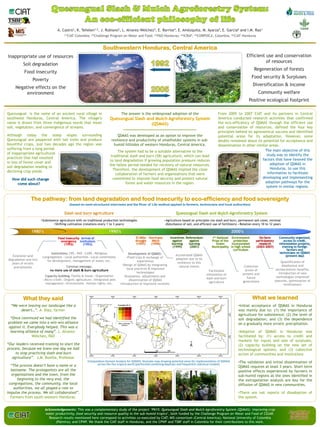
Inappropriate use of resources                                                                                                                                                                                Efficient use and conservation
                                                                                                                                                                                                                        of resources
                                     Soil degradation
                                                                                                                                                                                                                    Regeneration of forests
                                        Food insecurity
                                                                                                                                                                                                                  Food security & Surpluses
                                                  Poverty
                                                                                                                                                                                                                   Diversification & Income
         Negative effects on the
              environment                                                                                                                                                                                              Community welfare
                                                                                                                                                                                                                Positive ecological footprint

Quezungual is the name of an ancient rural village in                                                            The answer is the widespread adoption of the                            From 2005 to 2007 CIAT and its partners in Central
southwest Honduras, Central America. The village’s                                                                                                                                       America conducted research activities that confirmed
name is drawn from three indigenous words that mean                                                                                                                                      the eco-efficiency of QSMAS through the efficient use
soil, vegetation, and convergence of streams.                                                                                                                                            and conservation of resources, defined the four key
                                                                                                                                                                                         principles behind its agronomical success and identified
Although today the steep slopes surrounding                                                                  QSMAS was developed as an option to improve the                             potential areas for its adaptation. However, some
Quezungual are peppered with tall trees and produce                                                      resilience and productivity of smallholder systems in sub-                      doubts remained about its potential for acceptance and
bountiful crops, just two decades ago the region was                                                       humid hillsides of western Honduras, Central America.                         dissemination in other similar areas.
suffering from a long period                                                                                                                                                                                          The main objective of this
                                                                                                             The system had to be a suitable alternative to the
of inappropriate agricultural                                                                                                                                                                                          study was to identify the
                                                                                                         traditional slash and burn (SB) agriculture, which can lead
practices that had resulted                                                                                                                                                                                         factors that have favored the
                                                                                                        to land degradation if growing population pressure reduces
in loss of forest cover and                                                                                                                                                                                              adoption of QSMAS in
                                                                                                        the fallow period needed for recovery of natural resources.
soil degradation leading to                                                                                                                                                                                              Honduras, to use this
                                                                                                          Therefore, the development of QSMAS implied the close
declining crop yields.                                                                                                                                                                                                 information to facilitate
                                                                                                            collaboration of farmers and organizations that were
   How did such change                                                                                    committed to improve food security and protect natural                                                    developing and implementing
     come about?                                                                                                  forest and water resources in the region.                                                           adoption pathways for the
                                                                                                                                                                                                                      system in similar regions.


                                                                          (based on semi-structured interviews and the River of Life method applied to farmers, technicians and local authorities)

                                                                       Slash and burn agriculture                                                        Quesungual Slash and Mulch Agroforestry System
                                                      •Subsistence agriculture with no traditional production technologies                       • Agriculture
                                                                                                                                                             based on principles (no slash and burn, permanent soil cover, minimal
                                                               •Shifting cultivation (rotations every 1 to 3 years)                               disturbance of soil, and efficient use of fertilizers) • Rotation every 10 to 12 years

                                                  1980’s                                                1990’s                                                                                       2000’s
                                                                   Food insecurity Arrival of                              El Niño Hurricane          Incentives Referendum         1st National Environment           On-farm         Community organized,
                                                                     emergency institutions                                drought   Mitch              against    against          Prize of the   protection        participatory        access to credit,
                                                                       (1992)       (1992)                                 (1997)   (1998)              burning    burning             Green      incorporated         research        reforestation projects,
                                                                                                                                                        (1999)     (2001)           Municipality in high school      (2003-2007)         training to foreign
                                                                                                                                                                                                   curriculum                                farmers and
                                                             Institutions: CRS • FAO • CARE • Religious               Development of QSMAS:                                                                                            technicians on QSMAS
   Extensive land                                                                                                                                        Accelerated QSMAS                                                                  (present day)
                                                       congregations • Local authorities • Local committees          •Field trips & exchange of
degradation and two                                                                                                                                      adoption due to its
                                                          for development, management of water, etc.                         experiences                                                                                                  Quantification of
  years of erratic                                                                                                                                        resilience to this
                                                                                                                  •Design of QSMAS by integrating          natural events                                   Collective                     biophysical and
    precipitation                                                       Common message:
                                                                                                                     local practices & improved                                                                                      socioeconomic benefits,
                                                              no more use of slash & burn agriculture                                                                             Facilitated               action of
                                                                                                                             technologies                                                                  present and                  introduction of new
                                                         Capacity building: Family & house • Organization                                                                       elimination of
                                                                                                                   •Evaluation, adjustments and                                                               future                  technologies (improved
                                                       • Micro-credit • Organic agriculture • Integrated pest
                                                                                                                                                                                slash and burn
                                                                                                                       dissemination of QSMAS                                                              generations               pastures, optimization of
                                                         management • Environment • Human rights, etc.                                                                            agriculture
                                                                                                                •Introduction of improved varieties                                                                                         fertilization)


  “We were leaving our landscape like a                                                                                                                                                                 •Initial acceptance of QSMAS in Honduras
       desert…”. A. Díaz, farmer                                                                                                                                                                        was mainly due to: (1) the importance of
                                                                                                                                                                                                        agriculture for subsistence; (2) the level of
 “Once convinced we had identified the                                                                                                                                                                  soil degradation; and (3) the dependence
problem we came into a win-win alliance                                                                                                                                                                 on a gradually more erratic precipitation.
against it. Everybody helped. This was a
 learning alliance of many”. L. Alvarez-                                                                                                                                                                •Adoption of QSMAS in Honduras was
              Wélchez, FAO                                                                                                                                                                              facilitated by: (1) access to credit and
                                                                                                                                                                                                        markets for inputs and sale of surpluses;
“Our leaders received training to start the                                                                                                                                                             (2) capacity building on the new set of
process, because we knew one day we had                                                                                                                                                                 technological options; and (3) collective
     to stop practicing slash and burn                                                                                                                                                                  action of communities and institutions.
   agriculture”. J.M. Bonilla, Professor
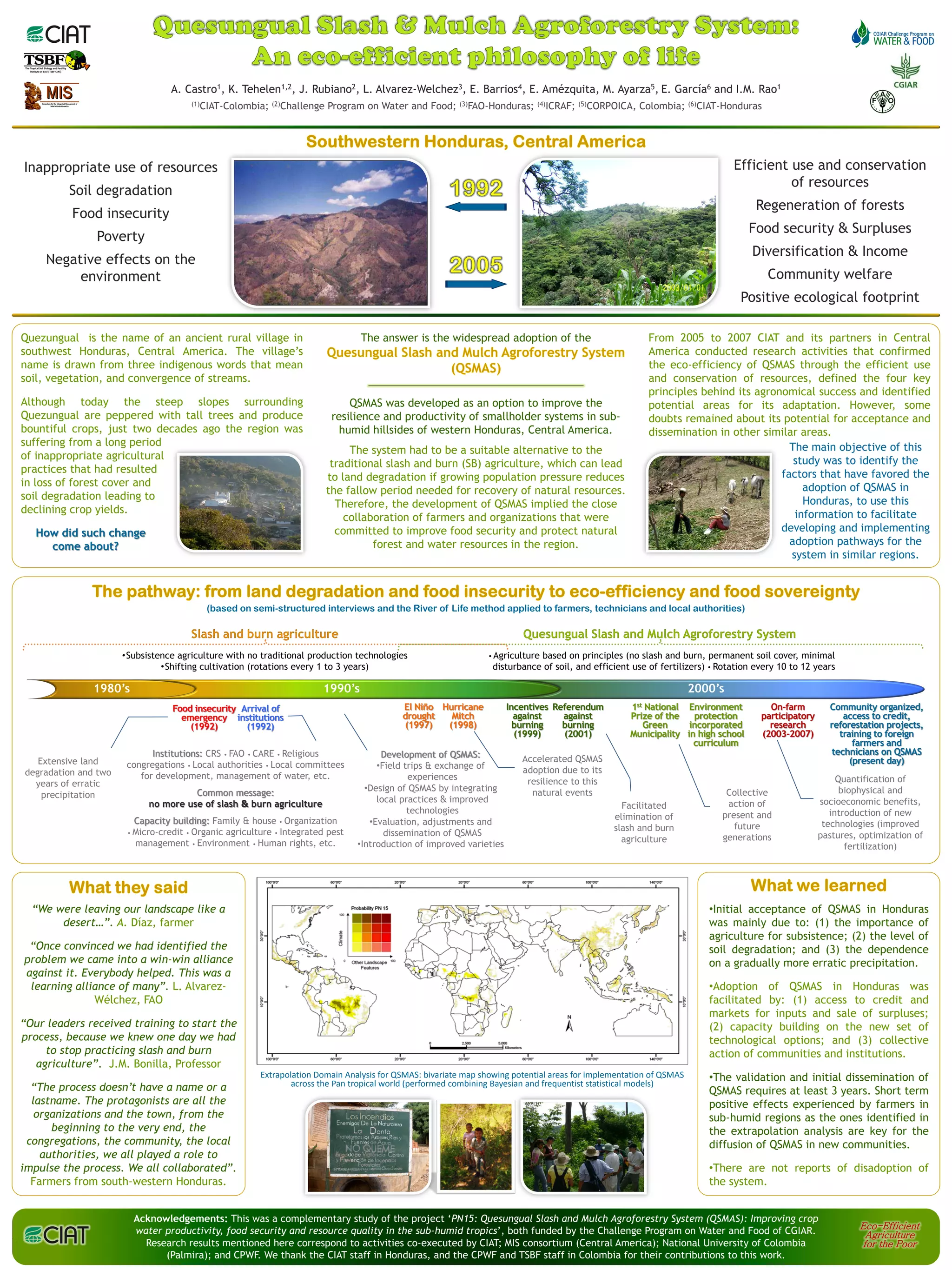
                                                                                        Extrapolation Domain Analysis for QSMAS: bivariate map showing potential areas for implementation of QSMAS      •The validation and initial dissemination of
  “The process doesn’t have a name or a                                                         across the Pan tropical world (performed combining Bayesian and frequentist statistical models)
                                                                                                                                                                                                        QSMAS requires at least 3 years. Short term
  lastname. The protagonists are all the                                                                                                                                                                positive effects experienced by farmers in
   organizations and the town, from the                                                                                                                                                                 sub-humid regions as the ones identified in
      beginning to the very end, the                                                                                                                                                                    the extrapolation analysis are key for the
 congregations, the community, the local                                                                                                                                                                diffusion of QSMAS in new communities.
    authorities, we all played a role to
impulse the process. We all collaborated”.                                                                                                                                                              •There are not reports of disadoption of
  Farmers from south-western Honduras.                                                                                                                                                                  the system.


                                                           Acknowledgements: This was a complementary study of the project ‘PN15: Quesungual Slash and Mulch Agroforestry System (QSMAS): Improving crop
                                                                                                                                                                                                                                              Eco-Efficient
                                                           water productivity, food security and resource quality in the sub-humid tropics’, both funded by the Challenge Program on Water and Food of CGIAR.                                  Agriculture
                                                             Research results mentioned here correspond to activities co-executed by CIAT; MIS consortium (Central America); National University of Colombia                                  for the Poor
                                                                 (Palmira); and CPWF. We thank the CIAT staff in Honduras, and the CPWF and TSBF staff in Colombia for their contributions to this work.

Poster22: Quesungual slash & mulch agroforestry systems and eco-efficient philosophy of life

  • 1.
    A. Castro1, K.Tehelen1,2, J. Rubiano2, L. Alvarez-Welchez3, E. Barrios4, E. Amézquita, M. Ayarza5, E. García6 and I.M. Rao1 Consortium for the Integrated Management of Soils in Central America (1)CIAT-Colombia; (2)Challenge Program on Water and Food; (3)FAO-Honduras; (4)ICRAF; (5)CORPOICA, Colombia; (6)CIAT-Honduras Inappropriate use of resources Efficient use and conservation of resources Soil degradation Regeneration of forests Food insecurity Food security & Surpluses Poverty Diversification & Income Negative effects on the environment Community welfare Positive ecological footprint Quezungual is the name of an ancient rural village in The answer is the widespread adoption of the From 2005 to 2007 CIAT and its partners in Central southwest Honduras, Central America. The village’s America conducted research activities that confirmed name is drawn from three indigenous words that mean the eco-efficiency of QSMAS through the efficient use soil, vegetation, and convergence of streams. and conservation of resources, defined the four key principles behind its agronomical success and identified Although today the steep slopes surrounding QSMAS was developed as an option to improve the potential areas for its adaptation. However, some Quezungual are peppered with tall trees and produce resilience and productivity of smallholder systems in sub- doubts remained about its potential for acceptance and bountiful crops, just two decades ago the region was humid hillsides of western Honduras, Central America. dissemination in other similar areas. suffering from a long period The main objective of this The system had to be a suitable alternative to the of inappropriate agricultural study was to identify the traditional slash and burn (SB) agriculture, which can lead practices that had resulted factors that have favored the to land degradation if growing population pressure reduces in loss of forest cover and adoption of QSMAS in the fallow period needed for recovery of natural resources. soil degradation leading to Honduras, to use this Therefore, the development of QSMAS implied the close declining crop yields. information to facilitate collaboration of farmers and organizations that were How did such change committed to improve food security and protect natural developing and implementing come about? forest and water resources in the region. adoption pathways for the system in similar regions. (based on semi-structured interviews and the River of Life method applied to farmers, technicians and local authorities) Slash and burn agriculture Quesungual Slash and Mulch Agroforestry System •Subsistence agriculture with no traditional production technologies • Agriculture based on principles (no slash and burn, permanent soil cover, minimal •Shifting cultivation (rotations every 1 to 3 years) disturbance of soil, and efficient use of fertilizers) • Rotation every 10 to 12 years 1980’s 1990’s 2000’s Food insecurity Arrival of El Niño Hurricane Incentives Referendum 1st National Environment On-farm Community organized, emergency institutions drought Mitch against against Prize of the protection participatory access to credit, (1992) (1992) (1997) (1998) burning burning Green incorporated research reforestation projects, (1999) (2001) Municipality in high school (2003-2007) training to foreign curriculum farmers and Institutions: CRS • FAO • CARE • Religious Development of QSMAS: technicians on QSMAS Extensive land Accelerated QSMAS (present day) congregations • Local authorities • Local committees •Field trips & exchange of degradation and two adoption due to its for development, management of water, etc. experiences Quantification of years of erratic resilience to this •Design of QSMAS by integrating natural events Collective biophysical and precipitation Common message: local practices & improved socioeconomic benefits, no more use of slash & burn agriculture Facilitated action of technologies present and introduction of new Capacity building: Family & house • Organization elimination of •Evaluation, adjustments and future technologies (improved • Micro-credit • Organic agriculture • Integrated pest slash and burn dissemination of QSMAS generations pastures, optimization of management • Environment • Human rights, etc. agriculture •Introduction of improved varieties fertilization) “We were leaving our landscape like a •Initial acceptance of QSMAS in Honduras desert…”. A. Díaz, farmer was mainly due to: (1) the importance of agriculture for subsistence; (2) the level of “Once convinced we had identified the soil degradation; and (3) the dependence problem we came into a win-win alliance on a gradually more erratic precipitation. against it. Everybody helped. This was a learning alliance of many”. L. Alvarez- •Adoption of QSMAS in Honduras was Wélchez, FAO facilitated by: (1) access to credit and markets for inputs and sale of surpluses; “Our leaders received training to start the (2) capacity building on the new set of process, because we knew one day we had technological options; and (3) collective to stop practicing slash and burn action of communities and institutions. agriculture”. J.M. Bonilla, Professor Extrapolation Domain Analysis for QSMAS: bivariate map showing potential areas for implementation of QSMAS •The validation and initial dissemination of “The process doesn’t have a name or a across the Pan tropical world (performed combining Bayesian and frequentist statistical models) QSMAS requires at least 3 years. Short term lastname. The protagonists are all the positive effects experienced by farmers in organizations and the town, from the sub-humid regions as the ones identified in beginning to the very end, the the extrapolation analysis are key for the congregations, the community, the local diffusion of QSMAS in new communities. authorities, we all played a role to impulse the process. We all collaborated”. •There are not reports of disadoption of Farmers from south-western Honduras. the system. Acknowledgements: This was a complementary study of the project ‘PN15: Quesungual Slash and Mulch Agroforestry System (QSMAS): Improving crop Eco-Efficient water productivity, food security and resource quality in the sub-humid tropics’, both funded by the Challenge Program on Water and Food of CGIAR. Agriculture Research results mentioned here correspond to activities co-executed by CIAT; MIS consortium (Central America); National University of Colombia for the Poor (Palmira); and CPWF. We thank the CIAT staff in Honduras, and the CPWF and TSBF staff in Colombia for their contributions to this work.