DEPARTMENT OF BOTANY
M.Sc. Horticulture and Landscape Management
Semester – IV
Core Paper 404: Recent Advances in Horticulture
Dr. GADDEYYA GANDIPILLI
M.Sc., M.Ed., Ph.D., PGDESD., PGCCC., APSET., UGC-NET.
Faculty, RAH, Department of Botany, A.U.
WATERSHED MANAGEMENT
Watershed management objectives,
Approaches,
Steps in watershed development.
ORGANIC FARMING
Importance and principles of organic farming in horticultural crops,
sources and importance of organic matter.
Organic mulches weed control in organic farming,
organic pest control.
Composting, principles of composting,
vermin-culture, vermin-composting &vermin wash,
coir pith manure.
PROTECTED CULTIVATION
Cultivation of high value crops in Protected Cultivation-poly house culture
of vegetable crops.
Cultivation of high value crops in Protected Cultivation- poly house culture
of flower crops.
FLOWER ARRANGEMENT
Flower arrangement – Ikabana & western trend,
Principles of flower arrangement,
tools & equipment,
dehydrated flowers, dehydration methods,
maintenance of flower shape,
procedure for embedding, pot –pourri.
BONSAI
Bonsai – Suitable plants for Bonsai;
Aesthetics with plant parks,
classification of Bonsai,
requirements of Bonsai pot,
Training and pruning, potting & repotting, general care.
APICULTURE,
Apiculture, bee-keeping flora in India,
bee-keeping technology, equipment, Honey extraction.
MUSHROOM PRODUCTION
Mushroom production nutritional aspects, recipes, home scale
industry prospects.
WATERSHED MANAGEMENT
Watershed is not simply the hydrological
unit but also socio-political-ecological
entity which plays crucial role in
determining food, social, and economical
security and provides life support services
to rural people
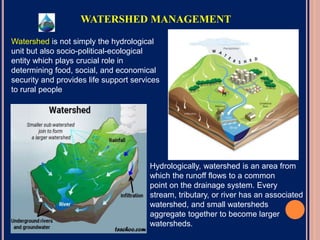
Hydrologically, watershed is an area from
which the runoff flows to a common
point on the drainage system. Every
stream, tributary, or river has an associated
watershed, and small watersheds
aggregate together to become larger
watersheds.
Management of natural resources at watershed scale
produces multiple benefits in terms of
increasing food production,
improving livelihoods,
protecting environment,
addressing gender and equity issues
biodiversity concerns
(Sharma, 2002; Wani et al. 2003a,b; Joshi et al. 2005; and
Rockstorm et al. 2007).
WATERSHED DEVELOPMENT PROJECTS
Watershed development projects in the country has been sponsored and
implemented by Government of India from early 1970s onwards.
oDrought Prone Area Program (DPAP),
oDesert Development Program (DDP),
oRiver Valley Project (RVP),
oNational Watershed Development Project for Rain-fed Areas (NWDPRA)
oIntegrated Wasteland Development Program (IWDP)
Entire watershed development program was primarily focused on structural-
driven compartmental approach of soil conservation
and rainwater harvesting
Utilizing the land based on its capability
Protecting the fertile top soil
Minimizing the silting up of the reservoirs and lower fertile lands
Protecting vegetative cover throughout the year
In situ conservation of rain water
Safe diversion of surface runoff to storage structures
construction of check dams for increasing ground water recharge
Increasing cropping intensity through inter and sequence cropping.
Alternate land use systems for efficient use of marginal lands
Water harvesting for supplemental irrigation
Ensuring sustainability of the ecosystem
Maximizing farm income through agricultural related activities such as
dairy poultry, sheep, and goat farming
Improving infrastructural facilities for storage transport and agricultural
marketing
Setting up of small scale agro industries and
Improving socio-economic status of farmers.
PRINCIPLES OF WATERSHED MANAGEMENT
The watershed aims, ultimately at improving standard of
living of common people in the basin by
increasing their earning capacity,
offering facilities such as electricity, drinking water,
 irrigation water, freedom from fears, floods etc.
adequate water supply for domestic , agricultural and
industrial needs.
abatement of organic, inorganic and soil pollution.
protect and enhance the water resource
increase infiltration of rainwater.
OBJECTIVES OF WATERSHED MANAGEMENT
WATERSHED MANAGEMENT APPROACHES
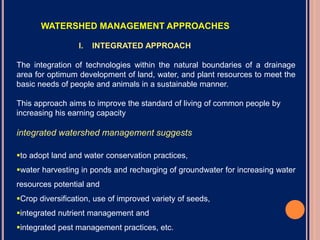
I. INTEGRATED APPROACH
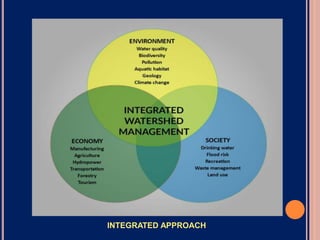
The integration of technologies within the natural boundaries of a drainage
area for optimum development of land, water, and plant resources to meet the
basic needs of people and animals in a sustainable manner.
This approach aims to improve the standard of living of common people by
increasing his earning capacity
integrated watershed management suggests
to adopt land and water conservation practices,
water harvesting in ponds and recharging of groundwater for increasing water
resources potential and
Crop diversification, use of improved variety of seeds,
integrated nutrient management and
integrated pest management practices, etc.
INTEGRATED APPROACH
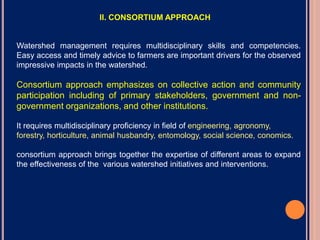
Watershed management requires multidisciplinary skills and competencies.
Easy access and timely advice to farmers are important drivers for the observed
impressive impacts in the watershed.
Consortium approach emphasizes on collective action and community
participation including of primary stakeholders, government and non-
government organizations, and other institutions.
It requires multidisciplinary proficiency in field of engineering, agronomy,
forestry, horticulture, animal husbandry, entomology, social science, conomics.
consortium approach brings together the expertise of different areas to expand
the effectiveness of the various watershed initiatives and interventions.
II. CONSORTIUM APPROACH
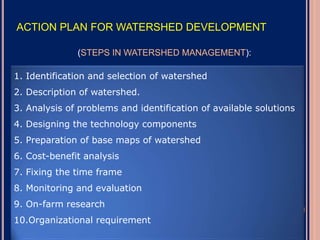
1. Identification and selection of watershed
2. Description of watershed.
3. Analysis of problems and identification of available solutions
4. Designing the technology components
5. Preparation of base maps of watershed
6. Cost-benefit analysis
7. Fixing the time frame
8. Monitoring and evaluation
9. On-farm research
10.Organizational requirement
ACTION PLAN FOR WATERSHED DEVELOPMENT
(STEPS IN WATERSHED MANAGEMENT):
COMPONENTS OF WATERSHED MANAGEMENT
The main components of watershed programme are:
1. SOIL AND WATER CONSERVATION
2. WATER HARVESTING
3. CROP MANAGEMENT AND
4. ALTERNATE LAND USE SYSTEMS
MINISTRY OF RURAL DEVELOPMENT
DEPARTMENT OF LAND RESOURCES
The Department of Land Resources, Ministry of Rural development,
Government of India is implementing centrally sponsored
programmes of Integrated Wasteland Development Programme
(IWDP), Drought Prone Areas Programme (DPAP) and Desert
Development Programme (DDP) for development of
waste/degraded lands through watershed approach.
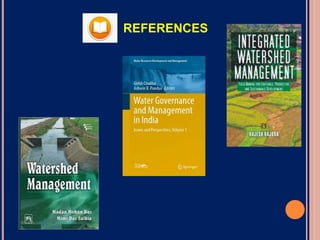
REFERENCES
Thank You…

watershed management-Dr.G.GADDEYYA

  • 1.
    DEPARTMENT OF BOTANY M.Sc.Horticulture and Landscape Management Semester – IV Core Paper 404: Recent Advances in Horticulture Dr. GADDEYYA GANDIPILLI M.Sc., M.Ed., Ph.D., PGDESD., PGCCC., APSET., UGC-NET. Faculty, RAH, Department of Botany, A.U.
  • 2.
    WATERSHED MANAGEMENT Watershed managementobjectives, Approaches, Steps in watershed development. ORGANIC FARMING Importance and principles of organic farming in horticultural crops, sources and importance of organic matter. Organic mulches weed control in organic farming, organic pest control. Composting, principles of composting, vermin-culture, vermin-composting &vermin wash, coir pith manure. PROTECTED CULTIVATION Cultivation of high value crops in Protected Cultivation-poly house culture of vegetable crops. Cultivation of high value crops in Protected Cultivation- poly house culture of flower crops.
  • 3.
    FLOWER ARRANGEMENT Flower arrangement– Ikabana & western trend, Principles of flower arrangement, tools & equipment, dehydrated flowers, dehydration methods, maintenance of flower shape, procedure for embedding, pot –pourri. BONSAI Bonsai – Suitable plants for Bonsai; Aesthetics with plant parks, classification of Bonsai, requirements of Bonsai pot, Training and pruning, potting & repotting, general care. APICULTURE, Apiculture, bee-keeping flora in India, bee-keeping technology, equipment, Honey extraction. MUSHROOM PRODUCTION Mushroom production nutritional aspects, recipes, home scale industry prospects.
  • 4.
    WATERSHED MANAGEMENT Watershed isnot simply the hydrological unit but also socio-political-ecological entity which plays crucial role in determining food, social, and economical security and provides life support services to rural people Hydrologically, watershed is an area from which the runoff flows to a common point on the drainage system. Every stream, tributary, or river has an associated watershed, and small watersheds aggregate together to become larger watersheds.
  • 5.
    Management of naturalresources at watershed scale produces multiple benefits in terms of increasing food production, improving livelihoods, protecting environment, addressing gender and equity issues biodiversity concerns (Sharma, 2002; Wani et al. 2003a,b; Joshi et al. 2005; and Rockstorm et al. 2007).
  • 6.
    WATERSHED DEVELOPMENT PROJECTS Watersheddevelopment projects in the country has been sponsored and implemented by Government of India from early 1970s onwards. oDrought Prone Area Program (DPAP), oDesert Development Program (DDP), oRiver Valley Project (RVP), oNational Watershed Development Project for Rain-fed Areas (NWDPRA) oIntegrated Wasteland Development Program (IWDP) Entire watershed development program was primarily focused on structural- driven compartmental approach of soil conservation and rainwater harvesting
  • 7.
    Utilizing the landbased on its capability Protecting the fertile top soil Minimizing the silting up of the reservoirs and lower fertile lands Protecting vegetative cover throughout the year In situ conservation of rain water Safe diversion of surface runoff to storage structures construction of check dams for increasing ground water recharge Increasing cropping intensity through inter and sequence cropping. Alternate land use systems for efficient use of marginal lands Water harvesting for supplemental irrigation Ensuring sustainability of the ecosystem Maximizing farm income through agricultural related activities such as dairy poultry, sheep, and goat farming Improving infrastructural facilities for storage transport and agricultural marketing Setting up of small scale agro industries and Improving socio-economic status of farmers. PRINCIPLES OF WATERSHED MANAGEMENT
  • 8.
    The watershed aims,ultimately at improving standard of living of common people in the basin by increasing their earning capacity, offering facilities such as electricity, drinking water,  irrigation water, freedom from fears, floods etc. adequate water supply for domestic , agricultural and industrial needs. abatement of organic, inorganic and soil pollution. protect and enhance the water resource increase infiltration of rainwater. OBJECTIVES OF WATERSHED MANAGEMENT
  • 9.
    WATERSHED MANAGEMENT APPROACHES I.INTEGRATED APPROACH The integration of technologies within the natural boundaries of a drainage area for optimum development of land, water, and plant resources to meet the basic needs of people and animals in a sustainable manner. This approach aims to improve the standard of living of common people by increasing his earning capacity integrated watershed management suggests to adopt land and water conservation practices, water harvesting in ponds and recharging of groundwater for increasing water resources potential and Crop diversification, use of improved variety of seeds, integrated nutrient management and integrated pest management practices, etc.
  • 10.
  • 11.
    Watershed management requiresmultidisciplinary skills and competencies. Easy access and timely advice to farmers are important drivers for the observed impressive impacts in the watershed. Consortium approach emphasizes on collective action and community participation including of primary stakeholders, government and non- government organizations, and other institutions. It requires multidisciplinary proficiency in field of engineering, agronomy, forestry, horticulture, animal husbandry, entomology, social science, conomics. consortium approach brings together the expertise of different areas to expand the effectiveness of the various watershed initiatives and interventions. II. CONSORTIUM APPROACH
  • 12.
    1. Identification andselection of watershed 2. Description of watershed. 3. Analysis of problems and identification of available solutions 4. Designing the technology components 5. Preparation of base maps of watershed 6. Cost-benefit analysis 7. Fixing the time frame 8. Monitoring and evaluation 9. On-farm research 10.Organizational requirement ACTION PLAN FOR WATERSHED DEVELOPMENT (STEPS IN WATERSHED MANAGEMENT):
  • 13.
    COMPONENTS OF WATERSHEDMANAGEMENT The main components of watershed programme are: 1. SOIL AND WATER CONSERVATION 2. WATER HARVESTING 3. CROP MANAGEMENT AND 4. ALTERNATE LAND USE SYSTEMS
  • 14.
    MINISTRY OF RURALDEVELOPMENT DEPARTMENT OF LAND RESOURCES The Department of Land Resources, Ministry of Rural development, Government of India is implementing centrally sponsored programmes of Integrated Wasteland Development Programme (IWDP), Drought Prone Areas Programme (DPAP) and Desert Development Programme (DDP) for development of waste/degraded lands through watershed approach.
  • 15.
  • 16.