GLOBAL SOIL PARTNERSHIP
  Sally Bunning and Ronald Rojas Vargas
   Land and Water Division, FAO Rome
                Prepared for the
   Town Hall Event European Geosciences Union
              24 April 2012 in Vienna
Outline

• Why are Soils so important?
• What are the Challenges: past, present and future?
• Global Soil Partnership
      •   Why?
      •   Vision and mission
      •   Pillars of action
      •   Governance
      •   Status of its establishment
• Regional Soil Partnerships
• How can EGU scientists/members contribute to the
  GSP?
1. Why are Soils so Important?
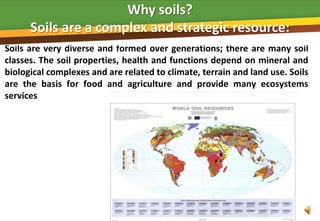
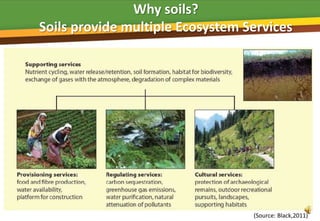
Why soils?
      Soils are a complex and strategic resource:
Soils are very diverse and formed over generations; there are many soil
classes. The soil properties, health and functions depend on mineral and
biological complexes and are related to climate, terrain and land use. Soils
are the basis for food and agriculture and provide many ecosystems
services
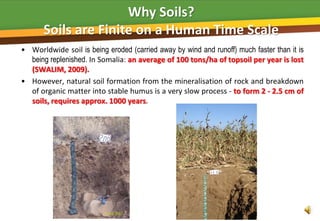
Why Soils?
       Soils are Finite on a Human Time Scale
• Worldwide soil is being eroded (carried away by wind and runoff) much faster than it is
  being replenished. In Somalia: an average of 100 tons/ha of topsoil per year is lost
  (SWALIM, 2009).
• However, natural soil formation from the mineralisation of rock and breakdown
  of organic matter into stable humus is a very slow process - to form 2 - 2.5 cm of
  soils, requires approx. 1000 years.
Why soils?
Soils provide multiple Ecosystem Services


                                  (Source: Black,2011)
What are the Challenges for Soils:
  Past, Present and Future?
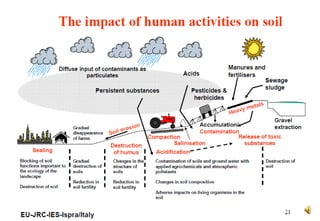
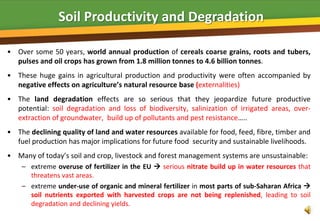
Soil Productivity and Degradation

• Over some 50 years, world annual production of cereals coarse grains, roots and tubers,
  pulses and oil crops has grown from 1.8 million tonnes to 4.6 billion tonnes.
• These huge gains in agricultural production and productivity were often accompanied by
  negative effects on agriculture’s natural resource base (externalities)
• The land degradation effects are so serious that they jeopardize future productive
  potential: soil degradation and loss of biodiversity, salinization of irrigated areas, over-
  extraction of groundwater, build up of pollutants and pest resistance…..
• The declining quality of land and water resources available for food, feed, fibre, timber and
  fuel production has major implications for future food security and sustainable livelihoods.
• Many of today’s soil and crop, livestock and forest management systems are unsustainable:
    – extreme overuse of fertilizer in the EU  serious nitrate build up in water resources that
      threatens vast areas.
    – extreme under-use of organic and mineral fertilizer in most parts of sub-Saharan Africa 
      soil nutrients exported with harvested crops are not being replenished, leading to soil
      degradation and declining yields.
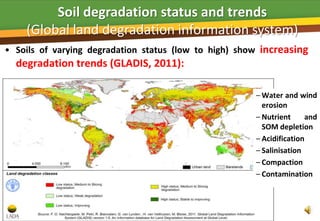
Soil degradation status and trends
    (Global land degradation information system)
• Soils of varying degradation status (low to high) show increasing
  degradation trends (GLADIS, 2011):

                                                       – Water and wind
                                                         erosion
                                                       – Nutrient     and
                                                         SOM depletion
                                                       – Acidification
                                                       – Salinisation
                                                       – Compaction
                                                       – Contamination
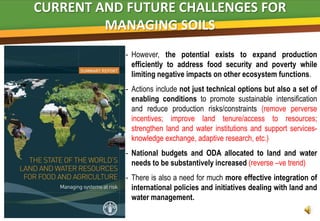
CURRENT AND FUTURE CHALLENGES FOR
         MANAGING SOILS
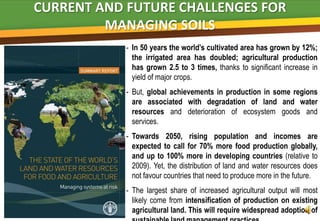
            - In 50 years the world’s cultivated area has grown by 12%;
              the irrigated area has doubled; agricultural production
              has grown 2.5 to 3 times, B  thanks to significant increase in
              yield of major crops.
            - But, global achievements in production in some regions
              are associated with degradation of land and water
              resources and deterioration of ecosystem goods and
              services.
            - Towards 2050, rising population and incomes are
              expected to call for 70% more food production globally,
              and up to 100% more in developing countries (relative to
              2009). Yet, the distribution of land and water resources does
              not favour countries that need to produce more in the future.
            - The largest share of increased agricultural output will most
              likely come from intensification of production on existing
              agricultural land. This will require widespread adoption of
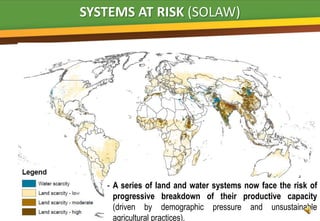
SYSTEMS AT RISK (SOLAW)


                                 B


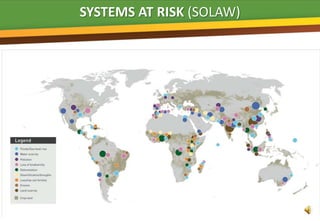
   - A series of land and water systems now face the risk of
     progressive breakdown of their productive capacity
     (driven by demographic pressure and unsustainable
     agricultural practices).
SYSTEMS AT RISK (SOLAW)


                   B
CURRENT AND FUTURE CHALLENGES FOR
         MANAGING SOILS
            - However, the potential exists to expand production
              efficiently to address food security and poverty while
                                         B
              limiting negative impacts on other ecosystem functions.
            - Actions include not just technical options but also a set of
              enabling conditions to promote sustainable intensification
              and reduce production risks/constraints (remove perverse
              incentives; improve land tenure/access to resources;
              strengthen land and water institutions and support services-
              knowledge exchange, adaptive research, etc.)
            - National budgets and ODA allocated to land and water
              needs to be substantively increased (reverse –ve trend)
            - There is also a need for much more effective integration of
              international policies and initiatives dealing with land and
              water management.
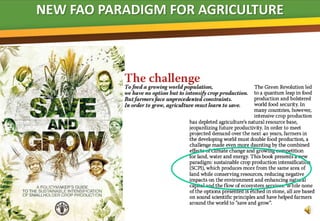
NEW FAO PARADIGM FOR AGRICULTURE


                       B
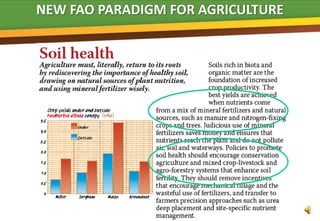
NEW FAO PARADIGM FOR AGRICULTURE


                       B
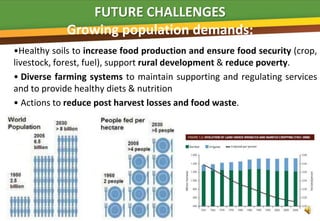
FUTURE CHALLENGES
            Growing population demands:
•Healthy soils to increase food production and ensure food security (crop,
livestock, forest, fuel), support rural development & reduce poverty.
                                                    B
• Diverse farming systems to maintain supporting and regulating services
and to provide healthy diets & nutrition
• Actions to reduce post harvest losses and food waste.
FUTURE CHALLENGES
                         Growing Water scarcity:
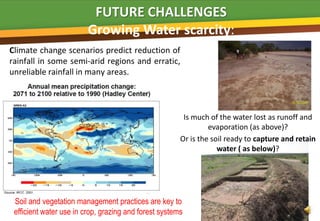
Climate change scenarios predict reduction of
rainfall in some semi-arid regions and erratic,
unreliable rainfall in many areas.


                                                        Is much of the water lost as runoff and
                                                                evaporation (as above)?
                                                       Or is the soil ready to capture and retain
                                                                   water ( as below)?


 Soil and vegetation management practices are key to
 efficient water use in crop, grazing and forest systems
FUTURE CHALLENGES
      Climate change adaptation and mitigation:
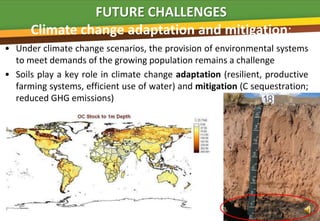
• Under climate change scenarios, the provision of environmental systems
  to meet demands of the growing population remains a challenge
• Soils play a key role in climate change adaptation (resilient, productive
  farming systems, efficient use of water) and mitigation (C sequestration;
  reduced GHG emissions)
FUTURE CHALLENGES
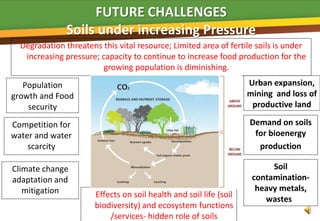
               Soils under increasing Pressure
  Degradation threatens this vital resource; Limited area of fertile soils is under
   increasing pressure; capacity to continue to increase food production for the
                         growing population is diminishing.
   Population                                                       Urban expansion,
growth and Food                                                     mining and loss of
    security                                                         productive land

Competition for                                                     Demand on soils
water and water                                                      for bioenergy
    scarcity                                                          production

Climate change                                                            Soil
adaptation and                                                       contamination-
   mitigation                                                         heavy metals,
                       Effects on soil health and soil life (soil
                                                                        wastes
                       biodiversity) and ecosystem functions
                           /services- hidden role of soils
2. Global Soil Partnership
Soils situation today: Major concern

•   Soil data - fragmented, partly outdated (fertility, SOC,…), heterogeneous-
    difficult to compare, not easy accessible, not responding to users demands.
•   Soil capacities - increasingly a scarce resource (loss of soil expertise & skills).
•   Soil knowledge & research - fragmented (fertility, CC, ecology), domain of soil
    scientists, not accessible for use by various disciplines/for decision making,
    not tailored to address problems/development agendas of today.
•   Awareness & investments in soil management - extremely low compared to
    the needs that soil is a precious resources & requires special care from its users.
•   Soil policy: Often perceived as a 2nd-tier priority; lack of international
    governance body to support coordinated global action on their management.
Need for compatible and coordinated soil policies – A unified and authoritative
voice is needed to better coordinate efforts and pool limited resources (for
agriculture, forestry, food security, UNCCD, CBD, UNFCCC, disaster & drought
management, land competition, rural & urban land use planning & development).
Why a Global Soil Partnership ?


A Global soil Partnership (complementing the Global water
partnership) can bring due recognition and concerted action
with stakeholders at international, national and local levels to
protect and sustain soil and water resources as the basis for
sustainable agriculture and food security.

It will provide a platform and intergovernmental mechanism
for updating and sharing knowledge on soils, for developing
capacities of users and technical institutions and providing
information and evidence for strengthened policies and
investment programmes.
Why a Global Soil Partnership?

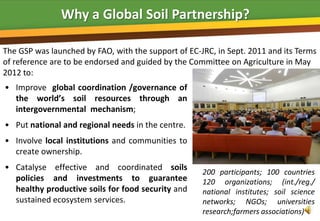
The GSP was launched by FAO, with the support of EC-JRC, in Sept. 2011 and its Terms
of reference are to be endorsed and guided by the Committee on Agriculture in May
2012 to:
• Improve global coordination /governance of
  the world’s soil resources through an
  intergovernmental mechanism;
• Put national and regional needs in the centre.
• Involve local institutions and communities to
  create ownership.
• Catalyse effective and coordinated soils
                                                     200 participants; 100 countries
  policies and investments to guarantee              120 organizations; (int./reg./
  healthy productive soils for food security and     national institutes; soil science
  sustained ecosystem services.                      networks; NGOs; universities
                                                     research;farmers associations)
GSP Vision and Mission

• The Vision of the GSP is the improvement of the global governance of
  the limited soil resources of the planet in order to guarantee healthy and
  productive soils for a food secure world, as well as sustain other
  ecosystem services on which our livelihoods and societies depend
  including water regulation and supply, climate regulation, biodiversity
  conservation and other cultural services.
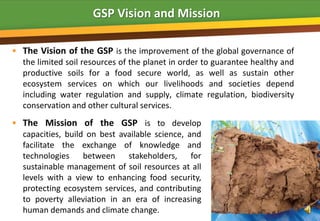
• The Mission of the GSP is to develop
  capacities, build on best available science, and
  facilitate the exchange of knowledge and
  technologies between stakeholders, for
  sustainable management of soil resources at all
  levels with a view to enhancing food security,
  protecting ecosystem services, and contributing
  to poverty alleviation in an era of increasing
  human demands and climate change.
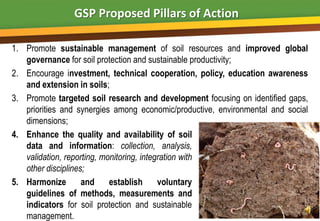
GSP Proposed Pillars of Action

1. Promote sustainable management of soil resources and improved global
   governance for soil protection and sustainable productivity;
2. Encourage investment, technical cooperation, policy, education awareness
   and extension in soils;
3. Promote targeted soil research and development focusing on identified gaps,
   priorities and synergies among economic/productive, environmental and social
   dimensions;
4. Enhance the quality and availability of soil
   data and information: collection, analysis,
   validation, reporting, monitoring, integration with
   other disciplines;
5. Harmonize        and     establish      voluntary
   guidelines of methods, measurements and
   indicators for soil protection and sustainable
   management.
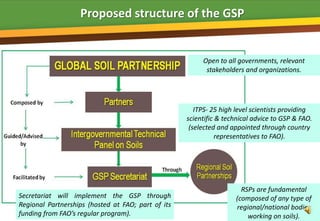
Proposed structure of the GSP


                                                         Open to all governments, relevant
                                                          stakeholders and organizations.


                                                       ITPS- 25 high level scientists providing
                                                    scientific & technical advice to GSP & FAO.
                                                     (selected and appointed through country
                                                               representatives to FAO).


                                                                      RSPs are fundamental
Secretariat will implement the GSP through                          (composed of any type of
Regional Partnerships (hosted at FAO; part of its                   regional/national bodies
funding from FAO’s regular program).                                    working on soils).
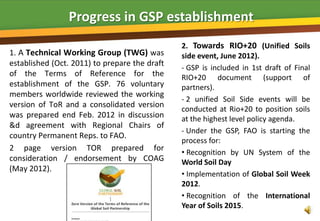
Progress in GSP establishment
                                               2. Towards RIO+20 (Unified Soils
1. A Technical Working Group (TWG) was         side event, June 2012).
established (Oct. 2011) to prepare the draft
                                               - GSP is included in 1st draft of Final
of the Terms of Reference for the              RIO+20 document (support of
establishment of the GSP. 76 voluntary         partners).
members worldwide reviewed the working
                                               - 2 unified Soil Side events will be
version of ToR and a consolidated version
                                               conducted at Rio+20 to position soils
was prepared end Feb. 2012 in discussion       at the highest level policy agenda.
&d agreement with Regional Chairs of
                                               - Under the GSP, FAO is starting the
country Permanent Reps. to FAO.
                                               process for:
2 page version TOR prepared for
                                               • Recognition by UN System of the
consideration / endorsement by COAG            World Soil Day
(May 2012).
                                               • Implementation of Global Soil Week
                                               2012.
                                               • Recognition of the International
                                               Year of Soils 2015.
Progress in GSP establishment

3. Networking and Actions to address soils issues in the field
FAO is funding LOAs with a leading institution in the regions to set up institutional
networks as basis of the Regional Soil Partnerships and start a process of
developing soil information systems in which capacity development is priority:
•Asia: coordinated by Soil Science institute, Chinese Academy of Sciences; 1st meeting -16
countries & many institutions  Nanjing Communiqué (11 Feb 2012)
• MENA: coordinated by the Ministry of Agriculture Jordan and ICARDA; 1st meeting early
April; in addition to an Amman communiqué agreed to develop an FAO TCP project
• Latin America: coordinated by EMBRAPA, Brazil, & Argentina; 1st meeting 16-20 April
2012;.
• Africa: to be developed in consultation with TSBF-CIAT, ICRAF , Afnet network and other
partners
  The RSPs will prioritise and implement the GSP plans of actions, while
  addressing local needs with local experts and fostering south-south
  cooperation and collaboration (e.g. Globalsoilmap.net, Global soil forum etc.)
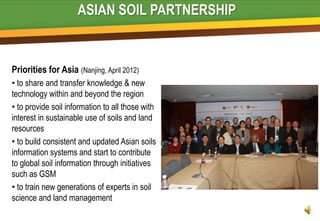
ASIAN SOIL PARTNERSHIP


Priorities for Asia (Nanjing, April 2012)
• to share and transfer knowledge & new
technology within and beyond the region
• to provide soil information to all those with
interest in sustainable use of soils and land
resources
• to build consistent and updated Asian soils
information systems and start to contribute
to global soil information through initiatives
such as GSM
• to train new generations of experts in soil
science and land management
Progress in GSP establishment

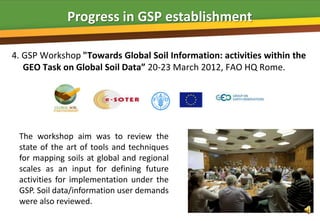
4. GSP Workshop "Towards Global Soil Information: activities within the
   GEO Task on Global Soil Data” 20-23 March 2012, FAO HQ Rome.


 The workshop aim was to review the
 state of the art of tools and techniques
 for mapping soils at global and regional
 scales as an input for defining future
 activities for implementation under the
 GSP. Soil data/information user demands
 were also reviewed.
Town Hall Event Discussion
           (Vienna 24 April 2012)
How can members of the European Geosciences
         Union contribute to the GSP?
How can EGU members contribute to GSP

We invite soil scientists/ institutes/members of EGU to suggest
How could you contribute to the GSP Pillars for soil protection, sustainable
management and food security in the region and globally?
What in your view are the main needs and priorities:
   1. to promote sustainable soil management (What practices? Where?)
   2. to improve soil information & its use (What gaps? How/Where to
        monitor/survey? How to integrate with other disciplines?)
   3. to enhance investment, technical cooperation, policy, education
        awareness and extension in soils (what support?)
   4. to promote targeted applied soil research (What gaps and priority
        issues in the region? How to address economic, environmental &
        social impacts?);
   5. to develop and promote harmonised guidelines, methods,
        measurements and indicators (What is needed for sustainable soil
        management and for soil protection?).