The Global Soil
Partnership
Ronald Vargas and Feras Ziadat
FAO Land and Water Division
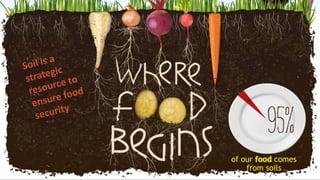
of our food comes
from soils
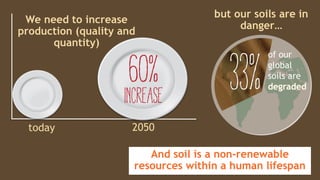
but our soils are in
danger…
today 2050
of our
global
soils are
degraded
We need to increase
production (quality and
quantity)
And soil is a non-renewable
resources within a human lifespan
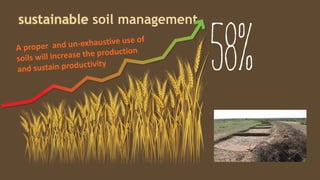
sustainable soil management
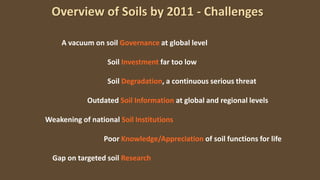
A vacuum on soil Governance at global level
Soil Investment far too low
Soil Degradation, a continuous serious threat
Outdated Soil Information at global and regional levels
Weakening of national Soil Institutions
Poor Knowledge/Appreciation of soil functions for life
Gap on targeted soil Research
Overview of Soils by 2011 - Challenges
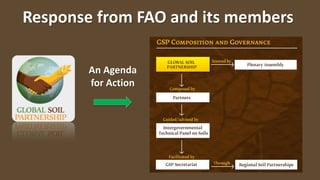
Response from FAO and its members
An Agenda
for Action
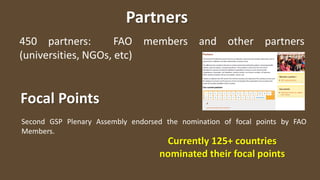
Partners
450 partners: FAO members and other partners
(universities, NGOs, etc)
Focal Points
Second GSP Plenary Assembly endorsed the nomination of focal points by FAO
Members.
Currently 125+ countries
nominated their focal points
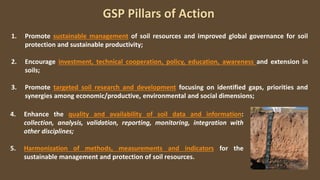
GSP Pillars of Action
1. Promote sustainable management of soil resources and improved global governance for soil
protection and sustainable productivity;
2. Encourage investment, technical cooperation, policy, education, awareness and extension in
soils;
3. Promote targeted soil research and development focusing on identified gaps, priorities and
synergies among economic/productive, environmental and social dimensions;
4. Enhance the quality and availability of soil data and information:
collection, analysis, validation, reporting, monitoring, integration with
other disciplines;
5. Harmonization of methods, measurements and indicators for the
sustainable management and protection of soil resources.
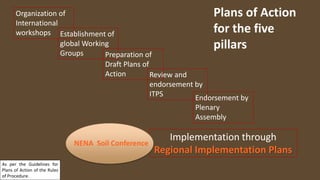
Plans of Action
for the five
pillars
As per the Guidelines for
Plans of Action of the Rules
of Procedure.
Organization of
International
workshops Establishment of
global Working
Groups Preparation of
Draft Plans of
Action Review and
endorsement by
ITPS Endorsement by
Plenary
Assembly
Implementation through
Regional Implementation Plans
NENA Soil Conference
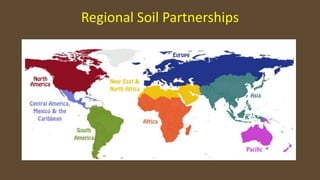
Regional Soil Partnerships
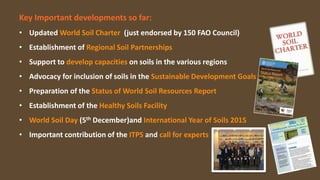
Key Important developments so far:
• Updated World Soil Charter (just endorsed by 150 FAO Council)
• Establishment of Regional Soil Partnerships
• Support to develop capacities on soils in the various regions
• Advocacy for inclusion of soils in the Sustainable Development Goals
• Preparation of the Status of World Soil Resources Report
• Establishment of the Healthy Soils Facility
• World Soil Day (5th December)and International Year of Soils 2015
• Important contribution of the ITPS and call for experts
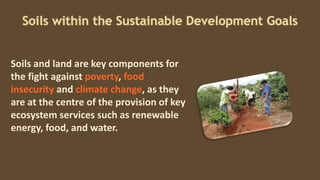
Soils within the Sustainable Development Goals
Soils and land are key components for
the fight against poverty, food
insecurity and climate change, as they
are at the centre of the provision of key
ecosystem services such as renewable
energy, food, and water.
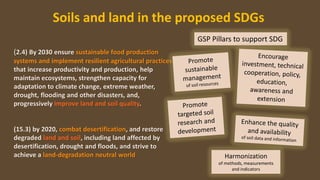
(2.4) By 2030 ensure sustainable food production
systems and implement resilient agricultural practices
that increase productivity and production, help
maintain ecosystems, strengthen capacity for
adaptation to climate change, extreme weather,
drought, flooding and other disasters, and,
progressively improve land and soil quality.
(15.3) by 2020, combat desertification, and restore
degraded land and soil, including land affected by
desertification, drought and floods, and strive to
achieve a land-degradation neutral world
Soils and land in the proposed SDGs
GSP Pillars to support SDG
Harmonization
of methods, measurements
and indicators
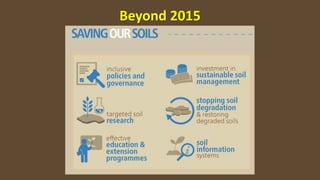
Beyond 2015
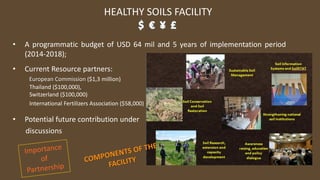
HEALTHY SOILS FACILITY
• A programmatic budget of USD 64 mil and 5 years of implementation period
(2014-2018);
• Current Resource partners:
European Commission ($1,3 million)
Thailand ($100,000),
Switzerland ($100,000)
International Fertilizers Association ($58,000)
• Potential future contribution under
discussions
This conference and the NENA Soil Partnership
• Increase awareness about the fundamental roles of soils for human life, food
security, climate change, essential ecosystem services, poverty alleviation and
sustainable development
• Consolidate the NENA Soil Partnership by establishing a steering committee and
thematic working groups as per the Regional Soil Partnerships guidelines
• Review and prioritize soil related challenges in the region and develop the NENA Soil
Partnership Implementation Plan
• Discuss the execution of the implementation and funding mechanisms, e.g. NENA
Regional GEF draft proposal on soil and climate change
THANK YOU

Global Soil Partnership

  • 1.
    The Global Soil Partnership RonaldVargas and Feras Ziadat FAO Land and Water Division
  • 2.
    of our foodcomes from soils
  • 4.
    but our soilsare in danger… today 2050 of our global soils are degraded We need to increase production (quality and quantity) And soil is a non-renewable resources within a human lifespan
  • 5.
  • 6.
    A vacuum onsoil Governance at global level Soil Investment far too low Soil Degradation, a continuous serious threat Outdated Soil Information at global and regional levels Weakening of national Soil Institutions Poor Knowledge/Appreciation of soil functions for life Gap on targeted soil Research Overview of Soils by 2011 - Challenges
  • 7.
    Response from FAOand its members An Agenda for Action
  • 8.
    Partners 450 partners: FAOmembers and other partners (universities, NGOs, etc) Focal Points Second GSP Plenary Assembly endorsed the nomination of focal points by FAO Members. Currently 125+ countries nominated their focal points
  • 9.
    GSP Pillars ofAction 1. Promote sustainable management of soil resources and improved global governance for soil protection and sustainable productivity; 2. Encourage investment, technical cooperation, policy, education, awareness and extension in soils; 3. Promote targeted soil research and development focusing on identified gaps, priorities and synergies among economic/productive, environmental and social dimensions; 4. Enhance the quality and availability of soil data and information: collection, analysis, validation, reporting, monitoring, integration with other disciplines; 5. Harmonization of methods, measurements and indicators for the sustainable management and protection of soil resources.
  • 10.
    Plans of Action forthe five pillars As per the Guidelines for Plans of Action of the Rules of Procedure. Organization of International workshops Establishment of global Working Groups Preparation of Draft Plans of Action Review and endorsement by ITPS Endorsement by Plenary Assembly Implementation through Regional Implementation Plans NENA Soil Conference
  • 11.
  • 12.
    Key Important developmentsso far: • Updated World Soil Charter (just endorsed by 150 FAO Council) • Establishment of Regional Soil Partnerships • Support to develop capacities on soils in the various regions • Advocacy for inclusion of soils in the Sustainable Development Goals • Preparation of the Status of World Soil Resources Report • Establishment of the Healthy Soils Facility • World Soil Day (5th December)and International Year of Soils 2015 • Important contribution of the ITPS and call for experts
  • 13.
    Soils within theSustainable Development Goals Soils and land are key components for the fight against poverty, food insecurity and climate change, as they are at the centre of the provision of key ecosystem services such as renewable energy, food, and water.
  • 14.
    (2.4) By 2030ensure sustainable food production systems and implement resilient agricultural practices that increase productivity and production, help maintain ecosystems, strengthen capacity for adaptation to climate change, extreme weather, drought, flooding and other disasters, and, progressively improve land and soil quality. (15.3) by 2020, combat desertification, and restore degraded land and soil, including land affected by desertification, drought and floods, and strive to achieve a land-degradation neutral world Soils and land in the proposed SDGs GSP Pillars to support SDG Harmonization of methods, measurements and indicators
  • 15.
  • 16.
    HEALTHY SOILS FACILITY •A programmatic budget of USD 64 mil and 5 years of implementation period (2014-2018); • Current Resource partners: European Commission ($1,3 million) Thailand ($100,000), Switzerland ($100,000) International Fertilizers Association ($58,000) • Potential future contribution under discussions
  • 17.
    This conference andthe NENA Soil Partnership • Increase awareness about the fundamental roles of soils for human life, food security, climate change, essential ecosystem services, poverty alleviation and sustainable development • Consolidate the NENA Soil Partnership by establishing a steering committee and thematic working groups as per the Regional Soil Partnerships guidelines • Review and prioritize soil related challenges in the region and develop the NENA Soil Partnership Implementation Plan • Discuss the execution of the implementation and funding mechanisms, e.g. NENA Regional GEF draft proposal on soil and climate change
  • 18.