ECOWAS/IT
"Information and
Communication Technologies
and Information Gateways"
Our Vision
… to become a Knowledge organization that
spurs the knowledge revolution in developing
countries and acts as a catalyst for creating,
sharing, and applying cutting edge knowledge
necessary for poverty reduction and economic
development
Why focus on Knowledge?
 The knowledge revolution offers a historic
opportunity to redraw the global economy by:
– enhancing competitiveness of developing countries
– offering new opportunities for economic growth
– leapfrogging technologies
– increasing returns on investments in education and
health
– empowerment of local communities and the poor
But there is also the risk of a
growing divide….
 both in access to knowledge
 and in access to the technologies that are
powering the knowledge revolution
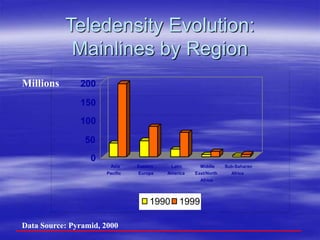
Teledensity Evolution:
Mainlines by Region
0
50
100
150
200
Asia
Pacific
Eastern
Europe
Latin
America
Middle
East/North
Africa
Sub-Saharan
Africa
1990 1999
Data Source: Pyramid, 2000
Millions
-
2,000
4,000
6,000
8,000
10,000
12,000
14,000
1995 1996 1997 1998 1999 March Now
Last 5 Years
Billion
US$
DJIA Mkt. Cap
NASDAQ Mkt. Cap
Total Mkt. Cap
More Wealth Created
The Situation in Terms of Aggregate
Connectivity Level Has Been
Improving,
Source: Pyramid Research, 2000
0
100
200
300
400
500
600
700
1990 1991 1992 1993 1994 1995 1996 1997 1998 1999
Fixed+Mobile -- OECD Fixed+Mobile -- Non-OECD
Internet Subs -- OECD Internet Subs -- Non-OECD
Million
Defining the
Digital Divide :
how serious an
issue is it ?
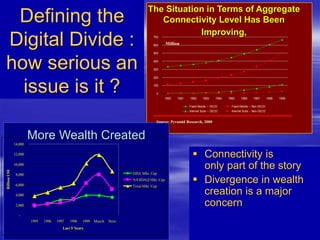
 Connectivity is
only part of the story
 Divergence in wealth
creation is a major
concern
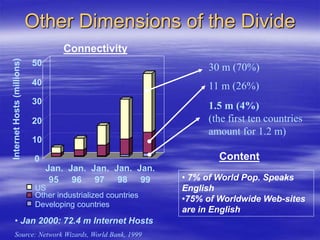
Other Dimensions of the Divide
0
10
20
30
40
50
Jan.
95
Jan.
96
Jan.
97
Jan.
98
Jan.
99
US
Other industrialized countries
Developing countries
Internet
Hosts
(millions)
30 m (70%)
11 m (26%)
1.5 m (4%)
(the first ten countries
amount for 1.2 m)
Source: Network Wizards, World Bank, 1999
• 7% of World Pop. Speaks
English
•75% of Worldwide Web-sites
are in English
Connectivity
Content
• Jan 2000: 72.4 m Internet Hosts
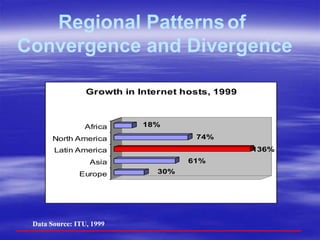
Data Source: ITU, 1999
Regional Patternsof
Convergence and Divergence
30%
61%
136%
74%
18%
Europe
Asia
Latin America
North America
Africa
Growth in Internet hosts, 1999
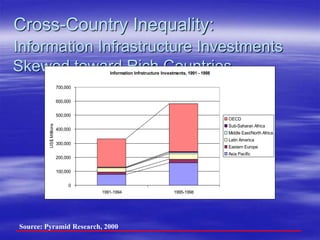
Cross-Country Inequality:
Information Infrastructure Investments
Skewed toward Rich Countries
Source: Pyramid Research, 2000
Information Infrstructure Investments, 1991 - 1998
0
100,000
200,000
300,000
400,000
500,000
600,000
700,000
1991-1994 1995-1998
US$
Millions
OECD
Sub-Saharan Africa
Middle East/North Africa
Latin America
Eastern Europe
Asia Pacific
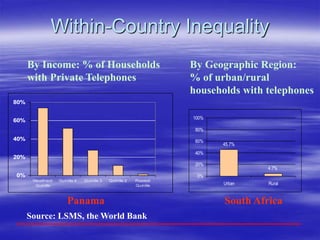
Within-Country Inequality
Source: LSMS, the World Bank
Panama South Africa
0%
20%
40%
60%
80%
Wealthiest
Quintile
Quintile 4 Quintile 3 Quintile 2 Poorest
Quintile
By Income: % of Households
with Private Telephones
By Geographic Region:
% of urban/rural
households with telephones
45.7%
4.7%
0%
20%
40%
60%
80%
100%
Urban Rural
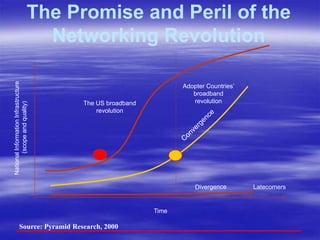
The Promise and Peril of the
Networking Revolution
The US broadband
revolution
Adopter Countries’
broadband
revolution
National
Information
Infrastructure
(scope
and
quality)
Time
Latecomers
Source: Pyramid Research, 2000
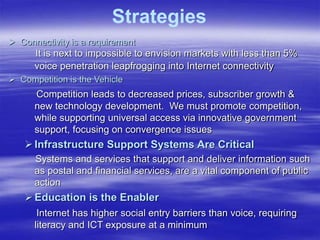
 Connectivity is a requirement
It is next to impossible to envision markets with less than 5%
voice penetration leapfrogging into Internet connectivity
 Competition is the Vehicle
Competition leads to decreased prices, subscriber growth &
new technology development. We must promote competition,
while supporting universal access via innovative government
support, focusing on convergence issues
Infrastructure Support Systems Are Critical
Systems and services that support and deliver information such
as postal and financial services, are a vital component of public
action
Education is the Enabler
Internet has higher social entry barriers than voice, requiring
literacy and ICT exposure at a minimum
Strategies
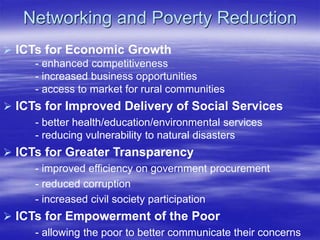
Networking and Poverty Reduction
 ICTs for Economic Growth
- enhanced competitiveness
- increased business opportunities
- access to market for rural communities
 ICTs for Improved Delivery of Social Services
- better health/education/environmental services
- reducing vulnerability to natural disasters
 ICTs for Greater Transparency
- improved efficiency on government procurement
- reduced corruption
- increased civil society participation
 ICTs for Empowerment of the Poor
- allowing the poor to better communicate their concerns
Our response is
focused on
 Supporting the enabling environment for
efficient creation, adaptation and
dissemination of knowledge
 Building Human Capacity for the Knowledge
Economy
 Expanding Access
 Supporting knowledge sharing through
research, networking and communities of
practice
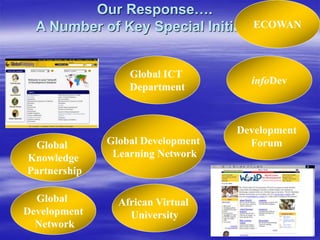
Our Response….
A Number of Key Special Initiatives
Global ICT
Department
infoDev
Global
Development
Network
Global
Knowledge
Partnership
African Virtual
University
Development
Forum
Global Development
Learning Network
ECOWAN
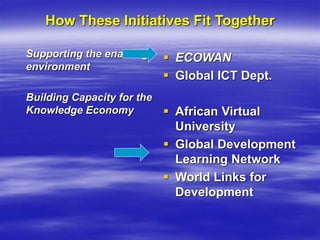
How These Initiatives Fit Together
Supporting the enabling
environment
Building Capacity for the
Knowledge Economy
 ECOWAN
 Global ICT Dept.
 African Virtual
University
 Global Development
Learning Network
 World Links for
Development
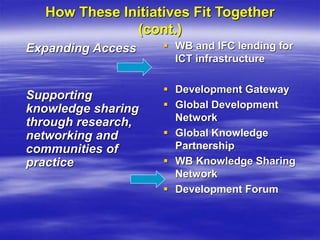
How These Initiatives Fit Together
(cont.)
Expanding Access
Supporting
knowledge sharing
through research,
networking and
communities of
practice
 WB and IFC lending for
ICT infrastructure
 Development Gateway
 Global Development
Network
 Global Knowledge
Partnership
 WB Knowledge Sharing
Network
 Development Forum
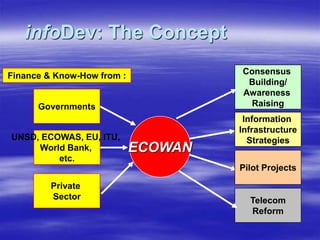
infoDev: The Concept
ECOWAN
Private
Sector
UNSD, ECOWAS, EU, ITU,
World Bank,
etc.
Governments
Telecom
Reform
Information
Infrastructure
Strategies
Consensus
Building/
Awareness
Raising
Pilot Projects
Finance & Know-How from :
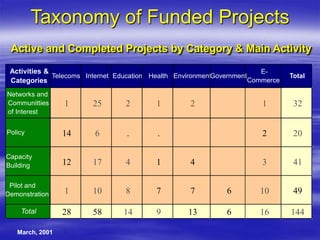
Active and Completed Projects by Category & Main Activity
March, 2001
Activities &
Categories
Telecoms Internet Education Health EnvironmentGovernment
E-
Commerce
Total
Networks and
Communitties
of Interest
1 25 2 1 2 1 32
Policy 14 6 . . 2 20
Capacity
Building 12 17 4 1 4 3 41
Pilot and
Demonstration 1 10 8 7 7 6 10 49
Total 28 58 14 9 13 6 16 144
Taxonomy of Funded Projects
 Planet University IS
 Y2K Health Sector Coord.
 RFP/Analysis
 ICT indicators
 15 iCSF Conferences
 PeopleLink
 Information Strategy Tool Kit/UNITAR
 INDEV
India’s Rural Health Care
 Knowledge Network for Grassroots
Sofia’s MIS
Georgia’s Demonstration projects
 Information infrastructure for
Uganda
National Graduate Registry
 E commerce Uganda
and Tanzania
Stories Exchange Net
African Connection-Rural Telecom
Metabase de Datos
Empowering people with disabilities
-Guatemala MicroNet
Asia Pacific Telecom.
Regulatory Forum
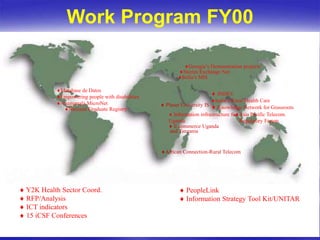
Work Program FY00
 Country Gateways
Global Knowledge for Development Online Forum
 iCSF Workshops
ACT 2000
ICANN (Yokohama & LA)
MT 2000
OECD Dubai
infoDev-Motorola Visiting Fellowship Program
Online ICT Resource Center for the Global
Development Community
 Creating a Global Information Network on
Distance Education
Regulatory Colloquium
OHADA.com
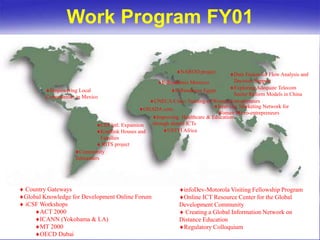
Work Program FY01
Community
Telecenters
Improving Healthcare & Education
through shared ICTs
Empowering Local
Communities in Mexico
NAROD project
Inter-city Marketing Network for
Women Micro-entrepreneurs
E-Readiness Egypt
E-Readiness Morocco
USTTI Africa
Exploring Adequate Telecom
Sector Reform Models in China
UNECA/Cisco Training of Women Entrepreneurs
CDI Intl. Expansion
Kindlink Houses and
Families
 RITS project
Data Fusion for Flow Analysis and
Decision Support
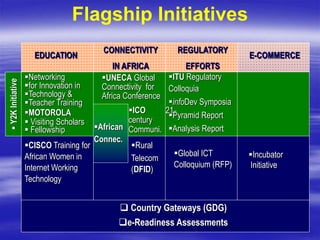
Flagship Initiatives
EDUCATION
CONNECTIVITY
IN AFRICA
REGULATORY
EFFORTS
E-COMMERCE
Networking
for Innovation in
Technology &
Teacher Training
MOTOROLA
 Visiting Scholars
 Fellowship
 Country Gateways (GDG)
e-Readiness Assessments
CISCO Training for
African Women in
Internet Working
Technology
ITU Regulatory
Colloquia
infoDev Symposia
Pyramid Report
Analysis Report
Incubator
Initiative
UNECA Global
Connectivity for
Africa Conference
Global ICT
Colloquium (RFP)
African
Connec.
Rural
Telecom
(DFID)
ICO 21st
century
Communi.
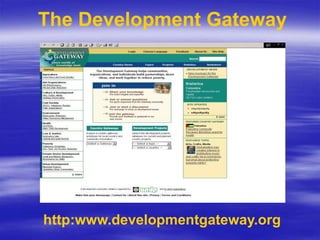
The Development Gateway
http:www.developmentgateway.org
 Solve development problems by sharing high-
quality information from local, national and global
sources, tailored to users’ needs by topic and
community, quickly and easily.
 A platform to facilitate the establishment of
common standards for the exchange of
information among the development community.
 Expanded opportunities for building and sharing
knowledge and experience in and among
developing countries.
Gateway Value Propositions
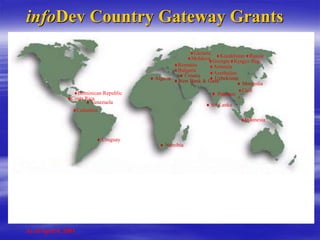
 Algeria
 Pakistan
Bulgaria
Georgia
Romania
Dominican Republic
Indonesia
infoDev Country Gateway Grants
Colombia
Russia
West Bank & Gaza
Armenia
Azerbaijan
Chin
a
Ukraine
Kyrgyz Rep.
Moldova
Costa Rica
 Venezuela
 Sri Lanka
Kazakhstan
As of April 4, 2001
 Croatia  Uzbekistan
 Uruguay
 Mongolia
 Namibia
For more information...
www.worldbank.org/ict
www.infodev.org
www.developmentgateway.org
www.ecowas.int
www.unites.org

Information and communication technologies and information gateway

  • 1.
  • 2.
    Our Vision … tobecome a Knowledge organization that spurs the knowledge revolution in developing countries and acts as a catalyst for creating, sharing, and applying cutting edge knowledge necessary for poverty reduction and economic development
  • 3.
    Why focus onKnowledge?  The knowledge revolution offers a historic opportunity to redraw the global economy by: – enhancing competitiveness of developing countries – offering new opportunities for economic growth – leapfrogging technologies – increasing returns on investments in education and health – empowerment of local communities and the poor
  • 4.
    But there isalso the risk of a growing divide….  both in access to knowledge  and in access to the technologies that are powering the knowledge revolution
  • 6.
    Teledensity Evolution: Mainlines byRegion 0 50 100 150 200 Asia Pacific Eastern Europe Latin America Middle East/North Africa Sub-Saharan Africa 1990 1999 Data Source: Pyramid, 2000 Millions
  • 7.
    - 2,000 4,000 6,000 8,000 10,000 12,000 14,000 1995 1996 19971998 1999 March Now Last 5 Years Billion US$ DJIA Mkt. Cap NASDAQ Mkt. Cap Total Mkt. Cap More Wealth Created The Situation in Terms of Aggregate Connectivity Level Has Been Improving, Source: Pyramid Research, 2000 0 100 200 300 400 500 600 700 1990 1991 1992 1993 1994 1995 1996 1997 1998 1999 Fixed+Mobile -- OECD Fixed+Mobile -- Non-OECD Internet Subs -- OECD Internet Subs -- Non-OECD Million Defining the Digital Divide : how serious an issue is it ?  Connectivity is only part of the story  Divergence in wealth creation is a major concern
  • 8.
    Other Dimensions ofthe Divide 0 10 20 30 40 50 Jan. 95 Jan. 96 Jan. 97 Jan. 98 Jan. 99 US Other industrialized countries Developing countries Internet Hosts (millions) 30 m (70%) 11 m (26%) 1.5 m (4%) (the first ten countries amount for 1.2 m) Source: Network Wizards, World Bank, 1999 • 7% of World Pop. Speaks English •75% of Worldwide Web-sites are in English Connectivity Content • Jan 2000: 72.4 m Internet Hosts
  • 9.
    Data Source: ITU,1999 Regional Patternsof Convergence and Divergence 30% 61% 136% 74% 18% Europe Asia Latin America North America Africa Growth in Internet hosts, 1999
  • 10.
    Cross-Country Inequality: Information InfrastructureInvestments Skewed toward Rich Countries Source: Pyramid Research, 2000 Information Infrstructure Investments, 1991 - 1998 0 100,000 200,000 300,000 400,000 500,000 600,000 700,000 1991-1994 1995-1998 US$ Millions OECD Sub-Saharan Africa Middle East/North Africa Latin America Eastern Europe Asia Pacific
  • 11.
    Within-Country Inequality Source: LSMS,the World Bank Panama South Africa 0% 20% 40% 60% 80% Wealthiest Quintile Quintile 4 Quintile 3 Quintile 2 Poorest Quintile By Income: % of Households with Private Telephones By Geographic Region: % of urban/rural households with telephones 45.7% 4.7% 0% 20% 40% 60% 80% 100% Urban Rural
  • 12.
    The Promise andPeril of the Networking Revolution The US broadband revolution Adopter Countries’ broadband revolution National Information Infrastructure (scope and quality) Time Latecomers Source: Pyramid Research, 2000
  • 14.
     Connectivity isa requirement It is next to impossible to envision markets with less than 5% voice penetration leapfrogging into Internet connectivity  Competition is the Vehicle Competition leads to decreased prices, subscriber growth & new technology development. We must promote competition, while supporting universal access via innovative government support, focusing on convergence issues Infrastructure Support Systems Are Critical Systems and services that support and deliver information such as postal and financial services, are a vital component of public action Education is the Enabler Internet has higher social entry barriers than voice, requiring literacy and ICT exposure at a minimum Strategies
  • 15.
    Networking and PovertyReduction  ICTs for Economic Growth - enhanced competitiveness - increased business opportunities - access to market for rural communities  ICTs for Improved Delivery of Social Services - better health/education/environmental services - reducing vulnerability to natural disasters  ICTs for Greater Transparency - improved efficiency on government procurement - reduced corruption - increased civil society participation  ICTs for Empowerment of the Poor - allowing the poor to better communicate their concerns
  • 17.
    Our response is focusedon  Supporting the enabling environment for efficient creation, adaptation and dissemination of knowledge  Building Human Capacity for the Knowledge Economy  Expanding Access  Supporting knowledge sharing through research, networking and communities of practice
  • 18.
    Our Response…. A Numberof Key Special Initiatives Global ICT Department infoDev Global Development Network Global Knowledge Partnership African Virtual University Development Forum Global Development Learning Network ECOWAN
  • 19.
    How These InitiativesFit Together Supporting the enabling environment Building Capacity for the Knowledge Economy  ECOWAN  Global ICT Dept.  African Virtual University  Global Development Learning Network  World Links for Development
  • 20.
    How These InitiativesFit Together (cont.) Expanding Access Supporting knowledge sharing through research, networking and communities of practice  WB and IFC lending for ICT infrastructure  Development Gateway  Global Development Network  Global Knowledge Partnership  WB Knowledge Sharing Network  Development Forum
  • 21.
    infoDev: The Concept ECOWAN Private Sector UNSD,ECOWAS, EU, ITU, World Bank, etc. Governments Telecom Reform Information Infrastructure Strategies Consensus Building/ Awareness Raising Pilot Projects Finance & Know-How from :
  • 22.
    Active and CompletedProjects by Category & Main Activity March, 2001 Activities & Categories Telecoms Internet Education Health EnvironmentGovernment E- Commerce Total Networks and Communitties of Interest 1 25 2 1 2 1 32 Policy 14 6 . . 2 20 Capacity Building 12 17 4 1 4 3 41 Pilot and Demonstration 1 10 8 7 7 6 10 49 Total 28 58 14 9 13 6 16 144 Taxonomy of Funded Projects
  • 23.
     Planet UniversityIS  Y2K Health Sector Coord.  RFP/Analysis  ICT indicators  15 iCSF Conferences  PeopleLink  Information Strategy Tool Kit/UNITAR  INDEV India’s Rural Health Care  Knowledge Network for Grassroots Sofia’s MIS Georgia’s Demonstration projects  Information infrastructure for Uganda National Graduate Registry  E commerce Uganda and Tanzania Stories Exchange Net African Connection-Rural Telecom Metabase de Datos Empowering people with disabilities -Guatemala MicroNet Asia Pacific Telecom. Regulatory Forum Work Program FY00
  • 24.
     Country Gateways GlobalKnowledge for Development Online Forum  iCSF Workshops ACT 2000 ICANN (Yokohama & LA) MT 2000 OECD Dubai infoDev-Motorola Visiting Fellowship Program Online ICT Resource Center for the Global Development Community  Creating a Global Information Network on Distance Education Regulatory Colloquium OHADA.com Work Program FY01 Community Telecenters Improving Healthcare & Education through shared ICTs Empowering Local Communities in Mexico NAROD project Inter-city Marketing Network for Women Micro-entrepreneurs E-Readiness Egypt E-Readiness Morocco USTTI Africa Exploring Adequate Telecom Sector Reform Models in China UNECA/Cisco Training of Women Entrepreneurs CDI Intl. Expansion Kindlink Houses and Families  RITS project Data Fusion for Flow Analysis and Decision Support
  • 25.
    Flagship Initiatives EDUCATION CONNECTIVITY IN AFRICA REGULATORY EFFORTS E-COMMERCE Networking forInnovation in Technology & Teacher Training MOTOROLA  Visiting Scholars  Fellowship  Country Gateways (GDG) e-Readiness Assessments CISCO Training for African Women in Internet Working Technology ITU Regulatory Colloquia infoDev Symposia Pyramid Report Analysis Report Incubator Initiative UNECA Global Connectivity for Africa Conference Global ICT Colloquium (RFP) African Connec. Rural Telecom (DFID) ICO 21st century Communi.
  • 26.
  • 27.
     Solve developmentproblems by sharing high- quality information from local, national and global sources, tailored to users’ needs by topic and community, quickly and easily.  A platform to facilitate the establishment of common standards for the exchange of information among the development community.  Expanded opportunities for building and sharing knowledge and experience in and among developing countries. Gateway Value Propositions
  • 28.
     Algeria  Pakistan Bulgaria Georgia Romania DominicanRepublic Indonesia infoDev Country Gateway Grants Colombia Russia West Bank & Gaza Armenia Azerbaijan Chin a Ukraine Kyrgyz Rep. Moldova Costa Rica  Venezuela  Sri Lanka Kazakhstan As of April 4, 2001  Croatia  Uzbekistan  Uruguay  Mongolia  Namibia
  • 29.