FOREX MARKET
SUBMITTED BY
ADARSH SHARMA
ANSHUL GARG
DAVID YADAV
GAURAV KUMAR
MRUDULA SWAMY
INTRODUCTION
• The term foreign exchange comprises of two important things
1 Foreign Currency
2 Exchange Rate
• Foreign Currency-The currency of any foreign country which is authorized
medium of circulation and the basis for record keeping in that country.
• Exchange Rate-Price for which the currency of a country can be exchanged for
another country's currency.
•
• The forex market is the market in which participants are able to buy,
sell, exchange and speculate on currencies.
• The forex markets is made up of banks, commercial companies,
central banks, investment firm’s, hedge funds, and retail forex
brokers and investors.
• The currency market is considered to be the largest financial market
in the world, processing trillions of dollars worth of transactions each
day.
• The main currency used for forex trading is the US dollar
CLASSIFICATION OF EXCHANGE RATES
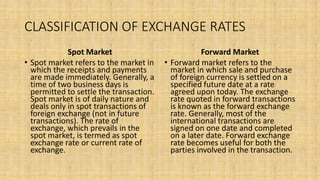
Spot Market
• Spot market refers to the market in
which the receipts and payments
are made immediately. Generally, a
time of two business days is
permitted to settle the transaction.
Spot market is of daily nature and
deals only in spot transactions of
foreign exchange (not in future
transactions). The rate of
exchange, which prevails in the
spot market, is termed as spot
exchange rate or current rate of
exchange.
Forward Market
• Forward market refers to the
market in which sale and purchase
of foreign currency is settled on a
specified future date at a rate
agreed upon today. The exchange
rate quoted in forward transactions
is known as the forward exchange
rate. Generally, most of the
international transactions are
signed on one date and completed
on a later date. Forward exchange
rate becomes useful for both the
parties involved in the transaction.
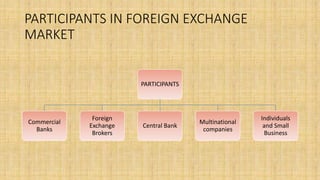
NATURE OF FOREIGN EXCHANGE
• Volatile affected by hedge, arbitrager, speculator.
• Affected by demand and supply.
• Affected by rate of interest.
• Affected by balance of payment surplus and deficit.
• Affected inflation rate.
• Spot and forward rates are different.
• Affected by the economic stability of the country.
• Affected by the fiscal policy of the government.
• Affected by the political condition of the country.
• It can be quoted directly or indirectly
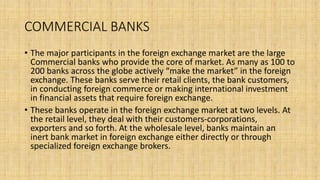
PARTICIPANTS IN FOREIGN EXCHANGE
MARKET
PARTICIPANTS
Commercial
Banks
Foreign
Exchange
Brokers
Central Bank
Multinational
companies
Individuals
and Small
Business
COMMERCIAL BANKS
• The major participants in the foreign exchange market are the large
Commercial banks who provide the core of market. As many as 100 to
200 banks across the globe actively “make the market” in the foreign
exchange. These banks serve their retail clients, the bank customers,
in conducting foreign commerce or making international investment
in financial assets that require foreign exchange.
• These banks operate in the foreign exchange market at two levels. At
the retail level, they deal with their customers-corporations,
exporters and so forth. At the wholesale level, banks maintain an
inert bank market in foreign exchange either directly or through
specialized foreign exchange brokers.
FOREIGN BANKERS
• Foreign exchange brokers also operate in the international currency
market. They act as agents who facilitate trading between dealers.
Unlike the banks, brokers serve merely as matchmakers and do not
put their own money at risk.
• They actively and constantly monitor exchange rates offered by the
major international banks through computerized systems such as
Reuters and are able to find quickly an opposite party for a client
without revealing the identity of either party until a transaction has
been agreed upon. This is why inter-bank traders use a broker
primarily to disseminate as quickly as possible a currency quote to
many other dealers.
CENTRAL BANK AND MNCs
• Another important player in the
foreign market is Central bank of
the various countries. Central
banks frequently intervene in the
market to maintain the exchange
rates of their currencies within a
desired range and to smooth
fluctuations within that range. The
level of the bank’s intervention will
depend upon the exchange rate
regime flowed by the given
country’s Central bank.
• MNCs are the major non-bank
participants in the forward market
as they exchange cash flows
associated with their multinational
operations. MNCs often contract to
either pay or receive fixed amounts
in foreign currencies at future
dates, so they are exposed to
foreign currency risk. This is why
they often hedge these future cash
flows through the inter-bank
forward exchange market.
INDIVIDULAS AND SMALL BUSINESS
• Individuals and small businesses also use foreign exchange market to
facilitate execution of commercial or investment transactions. The
foreign needs of these players are usually small and account for only a
fraction of all foreign exchange transactions. Even then they are very
important participants in the market. Some of these participants use
the market to hedge foreign exchange risk.
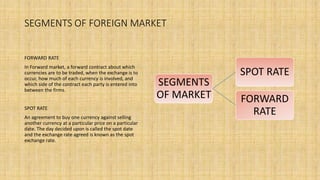
SEGMENTS OF FOREIGN MARKET
SEGMENTS
OF MARKET
SPOT RATE
FORWARD
RATE
FORWARD RATE
In Forward market, a forward contract about which
currencies are to be traded, when the exchange is to
occur, how much of each currency is involved, and
which side of the contract each party is entered into
between the firms.
SPOT RATE
An agreement to buy one currency against selling
another currency at a particular price on a particular
date. The day decided upon is called the spot date
and the exchange rate agreed is known as the spot
exchange rate.
FUNCTIONS OF FOREIGN EXCHANGE MARKET
• Foreign exchange market plays a very significant role in business
development of a country because of the fact that it performs several
useful functions
• Foreign exchange market transfers purchasing power across different
countries, which results in enhancing the feasibility of international trade
and overseas investment.
• It acts as a central focus whereby prices are set for different currencies.
• With the help of foreign exchange market investors can hedge or minimize
the risk of loss due to adverse exchange rate changes.
• Foreign exchange market allows traders to identify risk free opportunities
and arbitrage these away.
• It facilitates investment function of banks and corporate traders who are
willing to expose their firms to currency risks.
FOREX MARKET- A SOUND ,FINANCIALLY
STABLE AND PROFITABLE INVESTMENT AREA
LOWER TRADING COST
The lower trading costs in the forex market has made it
possible for even small, individual investors to make
decent profits from forex trading. With lower costs, the
possible losses are also much lower. forex trading usually
has no commission fees unlike in other investments. The
costs of forex trading are limited to the spread or the
difference between the selling and buying prices for a
particular currency pair.
With just a few hundred dollars (often $250 or less), you
can open a mini forex account and start trading
EXCELLENT TRANSPARENCY
Transparency means the free access to trading
information. Forex trading is a transparent process
because the trader has full access to market data and
information that are necessary to perform successful
transactions. The excellent transparency of the forex
market means that forex traders have more control over
their investments and can decide what to do based on the
information available.
SUPERIOUR LIQUIDITY
Traders are free to buy and sell currencies of their
own choosing. The superior liquidity of the forex
market enables traders to easily exchange currencies
without affecting the prices of the currencies being
traded. whether you trade a few thousand dollars or
several millions, you can be assured of the same
currency prices during the time an order was placed
and then executed. The forex market's superior
liquidity allows you to getLower trading cost the
profits you expect at the time you made the trade.
VERY STRONG MARKET TRENDS
Forex traders make money by getting accurate
market data and then analyzing the direction the
market takes. To do this, forex traders rely heavily on
trends and trending in an attempt to predict the
direction of the forex market. Most traders use
technical analysis to analyze past and present forex
market data and then search for trends

Forex Market

  • 1.
    FOREX MARKET SUBMITTED BY ADARSHSHARMA ANSHUL GARG DAVID YADAV GAURAV KUMAR MRUDULA SWAMY
  • 2.
    INTRODUCTION • The termforeign exchange comprises of two important things 1 Foreign Currency 2 Exchange Rate • Foreign Currency-The currency of any foreign country which is authorized medium of circulation and the basis for record keeping in that country. • Exchange Rate-Price for which the currency of a country can be exchanged for another country's currency. •
  • 3.
    • The forexmarket is the market in which participants are able to buy, sell, exchange and speculate on currencies. • The forex markets is made up of banks, commercial companies, central banks, investment firm’s, hedge funds, and retail forex brokers and investors. • The currency market is considered to be the largest financial market in the world, processing trillions of dollars worth of transactions each day. • The main currency used for forex trading is the US dollar
  • 4.
    CLASSIFICATION OF EXCHANGERATES Spot Market • Spot market refers to the market in which the receipts and payments are made immediately. Generally, a time of two business days is permitted to settle the transaction. Spot market is of daily nature and deals only in spot transactions of foreign exchange (not in future transactions). The rate of exchange, which prevails in the spot market, is termed as spot exchange rate or current rate of exchange. Forward Market • Forward market refers to the market in which sale and purchase of foreign currency is settled on a specified future date at a rate agreed upon today. The exchange rate quoted in forward transactions is known as the forward exchange rate. Generally, most of the international transactions are signed on one date and completed on a later date. Forward exchange rate becomes useful for both the parties involved in the transaction.
  • 5.
    NATURE OF FOREIGNEXCHANGE • Volatile affected by hedge, arbitrager, speculator. • Affected by demand and supply. • Affected by rate of interest. • Affected by balance of payment surplus and deficit. • Affected inflation rate. • Spot and forward rates are different. • Affected by the economic stability of the country. • Affected by the fiscal policy of the government. • Affected by the political condition of the country. • It can be quoted directly or indirectly
  • 6.
    PARTICIPANTS IN FOREIGNEXCHANGE MARKET PARTICIPANTS Commercial Banks Foreign Exchange Brokers Central Bank Multinational companies Individuals and Small Business
  • 7.
    COMMERCIAL BANKS • Themajor participants in the foreign exchange market are the large Commercial banks who provide the core of market. As many as 100 to 200 banks across the globe actively “make the market” in the foreign exchange. These banks serve their retail clients, the bank customers, in conducting foreign commerce or making international investment in financial assets that require foreign exchange. • These banks operate in the foreign exchange market at two levels. At the retail level, they deal with their customers-corporations, exporters and so forth. At the wholesale level, banks maintain an inert bank market in foreign exchange either directly or through specialized foreign exchange brokers.
  • 8.
    FOREIGN BANKERS • Foreignexchange brokers also operate in the international currency market. They act as agents who facilitate trading between dealers. Unlike the banks, brokers serve merely as matchmakers and do not put their own money at risk. • They actively and constantly monitor exchange rates offered by the major international banks through computerized systems such as Reuters and are able to find quickly an opposite party for a client without revealing the identity of either party until a transaction has been agreed upon. This is why inter-bank traders use a broker primarily to disseminate as quickly as possible a currency quote to many other dealers.
  • 9.
    CENTRAL BANK ANDMNCs • Another important player in the foreign market is Central bank of the various countries. Central banks frequently intervene in the market to maintain the exchange rates of their currencies within a desired range and to smooth fluctuations within that range. The level of the bank’s intervention will depend upon the exchange rate regime flowed by the given country’s Central bank. • MNCs are the major non-bank participants in the forward market as they exchange cash flows associated with their multinational operations. MNCs often contract to either pay or receive fixed amounts in foreign currencies at future dates, so they are exposed to foreign currency risk. This is why they often hedge these future cash flows through the inter-bank forward exchange market.
  • 10.
    INDIVIDULAS AND SMALLBUSINESS • Individuals and small businesses also use foreign exchange market to facilitate execution of commercial or investment transactions. The foreign needs of these players are usually small and account for only a fraction of all foreign exchange transactions. Even then they are very important participants in the market. Some of these participants use the market to hedge foreign exchange risk.
  • 11.
    SEGMENTS OF FOREIGNMARKET SEGMENTS OF MARKET SPOT RATE FORWARD RATE FORWARD RATE In Forward market, a forward contract about which currencies are to be traded, when the exchange is to occur, how much of each currency is involved, and which side of the contract each party is entered into between the firms. SPOT RATE An agreement to buy one currency against selling another currency at a particular price on a particular date. The day decided upon is called the spot date and the exchange rate agreed is known as the spot exchange rate.
  • 12.
    FUNCTIONS OF FOREIGNEXCHANGE MARKET • Foreign exchange market plays a very significant role in business development of a country because of the fact that it performs several useful functions • Foreign exchange market transfers purchasing power across different countries, which results in enhancing the feasibility of international trade and overseas investment. • It acts as a central focus whereby prices are set for different currencies. • With the help of foreign exchange market investors can hedge or minimize the risk of loss due to adverse exchange rate changes. • Foreign exchange market allows traders to identify risk free opportunities and arbitrage these away. • It facilitates investment function of banks and corporate traders who are willing to expose their firms to currency risks.
  • 13.
    FOREX MARKET- ASOUND ,FINANCIALLY STABLE AND PROFITABLE INVESTMENT AREA LOWER TRADING COST The lower trading costs in the forex market has made it possible for even small, individual investors to make decent profits from forex trading. With lower costs, the possible losses are also much lower. forex trading usually has no commission fees unlike in other investments. The costs of forex trading are limited to the spread or the difference between the selling and buying prices for a particular currency pair. With just a few hundred dollars (often $250 or less), you can open a mini forex account and start trading EXCELLENT TRANSPARENCY Transparency means the free access to trading information. Forex trading is a transparent process because the trader has full access to market data and information that are necessary to perform successful transactions. The excellent transparency of the forex market means that forex traders have more control over their investments and can decide what to do based on the information available. SUPERIOUR LIQUIDITY Traders are free to buy and sell currencies of their own choosing. The superior liquidity of the forex market enables traders to easily exchange currencies without affecting the prices of the currencies being traded. whether you trade a few thousand dollars or several millions, you can be assured of the same currency prices during the time an order was placed and then executed. The forex market's superior liquidity allows you to getLower trading cost the profits you expect at the time you made the trade. VERY STRONG MARKET TRENDS Forex traders make money by getting accurate market data and then analyzing the direction the market takes. To do this, forex traders rely heavily on trends and trending in an attempt to predict the direction of the forex market. Most traders use technical analysis to analyze past and present forex market data and then search for trends