Foreign exchange is a commodity that consists of
currencies issued by countries other than one‟s own.

Functions of foreign exchange :

 To facilitate this conversion of currencies, thereby
allowing firms to conduct trade more efficiently across
national boundaries.

 To facilitates international investment and capital
flows.
Figure 8.1 Demand for Yen         Figure 8.2 Supply of Yen


Demand for Japanese Yen is        Supply for Japanese Yen is
Derived from Foreigner‟s Demand   Derived from Japanese Demand
for Japanese Products             for Foreign Products
Figure 8.3 The Market for Yen
EXCHANGE RATE

o Direct exchange rate ( or direct quote) is the price of the
home currency.

~ U.S resident, the direct exchange rate between the U.S
Dollar and the yen (¥) on Wednesday, September 3, was
$.009241/ ¥1.

o Indirect exchange rate ( or indirect quote) is the price of
the home currency in terms of the foreign currency.

~U.S resident’s perspective, the indirect exchange rate on
Wednesday, September 3, was ¥108.21/$1.
THE STRUCTURE OF THE FOREIGN-EXCHANGE MARKET


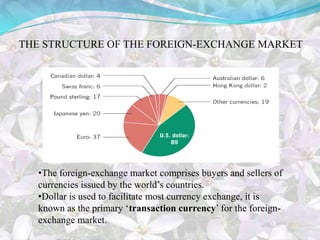
   •The foreign-exchange market comprises buyers and sellers of
   currencies issued by the world‟s countries.
   •Dollar is used to facilitate most currency exchange, it is
   known as the primary „transaction currency‟ for the foreign-
   exchange market.
Structure of the Foreign-
Exchange Market
The Role of Banks

 Buy or sell major traded currencies.

 Markets : Wholesale market

             Retail market

Example of large international banks are :-
 JPMorgan

 Chase

 Barclays

 Deutsche Bank
Continue…
The clients of the foreign-exchange departments of

banks :-

   Commercial customers

 Speculators

 Arbitrageurs
Continue…
2. Spot and Forward Markets
spot market – consist of foreign exchange transaction that are to be

consummated immediately.

Forward market - consist of foreign exchange transaction that are to occur

sometimes in the future.

Swap transaction – a transaction in which the same currency is bought

and sold simultaneously, but deliver is made at two different points in
  time.
Continue…
The two mechanism for future foreign exchange:

 Currency future

Publicly trade on many exchange worldwide, a currency future is a

contract that resembles a forward contract.

 Currency option

Allows, but does not require, a firm to buy or sell a specified amount of a

Foreign currency at a specified price at any time up to specified date.
Continue…
3. Arbitrage and the Currency Market
Arbitrage – riskless purchase of a product in one market for immediate

resale in a second market in order to profit from a price discrepancy.

There are two types of arbitrage activities :-
 Arbitrage of goods

 Arbitrage of money
Continue…
 Arbitrage of goods – purchasing power parity
if the price of a good differs between two markets, people will tend to buy

the good in the market offering the lower price, the “cheap” market, and

resell it in the market offering the higher price, the “expensive” market.

Represented by theory of purchasing power parity (PPP).
the theory states that the price of tradable goods, when expressed in

common currency, will tend to equalize across countries as a result of

Exchange rate changes.
Arbitrage of money
 This method requires money to make money
 The concept is “buy low, sells high”
 When the equilibrium is not in foreign-exchange
  market, professional traders can to arbitraging money to gain
  profit.

 From an economic view:
    the effect of arbitrage dealings is to correct the equilibrium in the prices
     of foreign exchange, or securities, or commodities.
    It is a force tending to equalize, establish parties among markets for the
     same item through competition of arbitrageurs.
Arbitrage of Money

                Two-point


  Three-point               Covered-interest


                                8-14
Two-point arbitrage
 Also known as geographic arbitrage
 Involves in profiting from price differences in two geographically
  distinct markets.
 For example, let the spot exchange rate be £1 = $1.80 in London and
  £1 = $2.00 in New York. We are quoting both exchange rate in
  sterling.
 Currency A/currency B will give the amount for currency B.
    In London: USD/GBP = £1 / $1.80
                           = 0.556
    In New York        : USD/GBP = £1 / $2.00
                           = 0.5
Three-point arbitrage          (TRIANGLE ARBITRAGE)
 is based on the concept of “Relative Arbitrage” and was designed to
  exploit price disparities amongst three currency pairs.
 Is the buying and selling of three different currencies to make
  riskless profit.
 Example:
    Suppose that £1 can buy $2 in New York, Tokyo, and London, $1
      can buy ¥120 in those three market, and £1 can buy ¥200 in all
      three. There is three-point arbitrage opportunity exist.
Figure 8.6 Three-Point Arbitrage


                                   8-17
Covered-interest arbitrage
 Is arbitrage that occurs when the difference between two countries‟
  interest rates is not equal to the forward discount on their countries.
 Occurs because international bankers etc are continually scanning
  money markets worldwide to obtain the best return on their short-
  term excess cash balances and the lowest rates on short-term loans.
 This is to protect or cover themselves from exchange rate risks.
 Example:
    Suppose the annual interest rate for three month deposits is
      12percent in London and 8 percent in New York. Investor in new
      York will be eager to earn higher return available in London.
The International Capital Market
1. Major International Banks
The international banking system is centered in large money market

banks headquartered in the world’s financial centers.

Establishment of overseas Banking Operations :
Subsidiary bank – separate incorporated from the parent.

Branch bank – not separated incorporated.

Affiliate bank – ownership with a local or foreign partner.
World’s 20 largest banks
Continue…
 Commercial Banking Services.
For exporters and tourist : Exchange home currency or traveler’s checks
for local currency.

   Investment Banking Services.
Furnished by large securities firms like Nomura, Smith Barney, Goldman
Sachs and Merrill Lynch.
To package and locate long-term debt and equity funding.
To arrange mergers and acquisitions of domestic and foreign firms.
Continue…
 2. The Eurocurrency market
 Originally called the Eurodollar market.
 Originated in the early 1950s.
 Eurodollars – U.S. dollars deposited in European bank accounts
    Euroyen
    Europounds
 Eurocurrency – currency on deposit outside in banks worldwide
 The Euroloans are often quoted on the basis of LIBOR
Continue…
3. International bond market
 Represent a major source of debt financing for
    World’s governments
    International organizations
    Larger firms
 Consisted of two types of bond:
       - Foreign Bond
       - Eurobond
 As global market evolve, global bond are used as one such
  innovative financial instrument.
International bond issues in 2007, by currencies (in
billions of U.S. dollars)
Continue…

4. GLOBAL EQUITY MARKET
• The growing importance of multinational
  operations and improvement in
  telecommunications technology have also
  made equity markets more global.

• Start-up companies no longer restricted to
  raise new equity solely from domestic
  sources.

• Country fund is the mutual fund that
  specializes in investing in a given country‟s
  firms.
Continue…
5. Offshore financial centers
 Focus on offering banking and others financial services o nonresident
  customers.
 MNCs often used to obtain low-cost Eurocurrency loans.
 Such benefits that they offers are:
     - Political stability
     - A regulatory climate that facilitates international capital transaction
     - Excellent communication links to other major financial centers.
 Location:
    Bahamas, Bahrain, the Cayman Islands, Bermuda, the Netherlands
     Antilles, Luxembourg, Singapore, Switzerland

foreign exchange

  • 2.
    Foreign exchange isa commodity that consists of currencies issued by countries other than one‟s own. Functions of foreign exchange :  To facilitate this conversion of currencies, thereby allowing firms to conduct trade more efficiently across national boundaries.  To facilitates international investment and capital flows.
  • 3.
    Figure 8.1 Demandfor Yen Figure 8.2 Supply of Yen Demand for Japanese Yen is Supply for Japanese Yen is Derived from Foreigner‟s Demand Derived from Japanese Demand for Japanese Products for Foreign Products
  • 4.
    Figure 8.3 TheMarket for Yen
  • 5.
    EXCHANGE RATE o Directexchange rate ( or direct quote) is the price of the home currency. ~ U.S resident, the direct exchange rate between the U.S Dollar and the yen (¥) on Wednesday, September 3, was $.009241/ ¥1. o Indirect exchange rate ( or indirect quote) is the price of the home currency in terms of the foreign currency. ~U.S resident’s perspective, the indirect exchange rate on Wednesday, September 3, was ¥108.21/$1.
  • 6.
    THE STRUCTURE OFTHE FOREIGN-EXCHANGE MARKET •The foreign-exchange market comprises buyers and sellers of currencies issued by the world‟s countries. •Dollar is used to facilitate most currency exchange, it is known as the primary „transaction currency‟ for the foreign- exchange market.
  • 7.
    Structure of theForeign- Exchange Market The Role of Banks  Buy or sell major traded currencies.  Markets : Wholesale market Retail market Example of large international banks are :-  JPMorgan  Chase  Barclays  Deutsche Bank
  • 8.
    Continue… The clients ofthe foreign-exchange departments of banks :-  Commercial customers  Speculators  Arbitrageurs
  • 9.
    Continue… 2. Spot andForward Markets spot market – consist of foreign exchange transaction that are to be consummated immediately. Forward market - consist of foreign exchange transaction that are to occur sometimes in the future. Swap transaction – a transaction in which the same currency is bought and sold simultaneously, but deliver is made at two different points in time.
  • 10.
    Continue… The two mechanismfor future foreign exchange:  Currency future Publicly trade on many exchange worldwide, a currency future is a contract that resembles a forward contract.  Currency option Allows, but does not require, a firm to buy or sell a specified amount of a Foreign currency at a specified price at any time up to specified date.
  • 11.
    Continue… 3. Arbitrage andthe Currency Market Arbitrage – riskless purchase of a product in one market for immediate resale in a second market in order to profit from a price discrepancy. There are two types of arbitrage activities :-  Arbitrage of goods  Arbitrage of money
  • 12.
    Continue…  Arbitrage ofgoods – purchasing power parity if the price of a good differs between two markets, people will tend to buy the good in the market offering the lower price, the “cheap” market, and resell it in the market offering the higher price, the “expensive” market. Represented by theory of purchasing power parity (PPP). the theory states that the price of tradable goods, when expressed in common currency, will tend to equalize across countries as a result of Exchange rate changes.
  • 13.
    Arbitrage of money This method requires money to make money  The concept is “buy low, sells high”  When the equilibrium is not in foreign-exchange market, professional traders can to arbitraging money to gain profit.  From an economic view:  the effect of arbitrage dealings is to correct the equilibrium in the prices of foreign exchange, or securities, or commodities.  It is a force tending to equalize, establish parties among markets for the same item through competition of arbitrageurs.
  • 14.
    Arbitrage of Money Two-point Three-point Covered-interest 8-14
  • 15.
    Two-point arbitrage  Alsoknown as geographic arbitrage  Involves in profiting from price differences in two geographically distinct markets.  For example, let the spot exchange rate be £1 = $1.80 in London and £1 = $2.00 in New York. We are quoting both exchange rate in sterling.  Currency A/currency B will give the amount for currency B.  In London: USD/GBP = £1 / $1.80 = 0.556  In New York : USD/GBP = £1 / $2.00 = 0.5
  • 16.
    Three-point arbitrage (TRIANGLE ARBITRAGE)  is based on the concept of “Relative Arbitrage” and was designed to exploit price disparities amongst three currency pairs.  Is the buying and selling of three different currencies to make riskless profit.  Example:  Suppose that £1 can buy $2 in New York, Tokyo, and London, $1 can buy ¥120 in those three market, and £1 can buy ¥200 in all three. There is three-point arbitrage opportunity exist.
  • 17.
    Figure 8.6 Three-PointArbitrage 8-17
  • 18.
    Covered-interest arbitrage  Isarbitrage that occurs when the difference between two countries‟ interest rates is not equal to the forward discount on their countries.  Occurs because international bankers etc are continually scanning money markets worldwide to obtain the best return on their short- term excess cash balances and the lowest rates on short-term loans.  This is to protect or cover themselves from exchange rate risks.  Example:  Suppose the annual interest rate for three month deposits is 12percent in London and 8 percent in New York. Investor in new York will be eager to earn higher return available in London.
  • 19.
    The International CapitalMarket 1. Major International Banks The international banking system is centered in large money market banks headquartered in the world’s financial centers. Establishment of overseas Banking Operations : Subsidiary bank – separate incorporated from the parent. Branch bank – not separated incorporated. Affiliate bank – ownership with a local or foreign partner.
  • 20.
  • 21.
    Continue…  Commercial BankingServices. For exporters and tourist : Exchange home currency or traveler’s checks for local currency.  Investment Banking Services. Furnished by large securities firms like Nomura, Smith Barney, Goldman Sachs and Merrill Lynch. To package and locate long-term debt and equity funding. To arrange mergers and acquisitions of domestic and foreign firms.
  • 22.
    Continue… 2. TheEurocurrency market  Originally called the Eurodollar market.  Originated in the early 1950s.  Eurodollars – U.S. dollars deposited in European bank accounts  Euroyen  Europounds  Eurocurrency – currency on deposit outside in banks worldwide  The Euroloans are often quoted on the basis of LIBOR
  • 23.
    Continue… 3. International bondmarket  Represent a major source of debt financing for  World’s governments  International organizations  Larger firms  Consisted of two types of bond: - Foreign Bond - Eurobond  As global market evolve, global bond are used as one such innovative financial instrument.
  • 24.
    International bond issuesin 2007, by currencies (in billions of U.S. dollars)
  • 25.
    Continue… 4. GLOBAL EQUITYMARKET • The growing importance of multinational operations and improvement in telecommunications technology have also made equity markets more global. • Start-up companies no longer restricted to raise new equity solely from domestic sources. • Country fund is the mutual fund that specializes in investing in a given country‟s firms.
  • 26.
    Continue… 5. Offshore financialcenters  Focus on offering banking and others financial services o nonresident customers.  MNCs often used to obtain low-cost Eurocurrency loans.  Such benefits that they offers are: - Political stability - A regulatory climate that facilitates international capital transaction - Excellent communication links to other major financial centers.  Location:  Bahamas, Bahrain, the Cayman Islands, Bermuda, the Netherlands Antilles, Luxembourg, Singapore, Switzerland